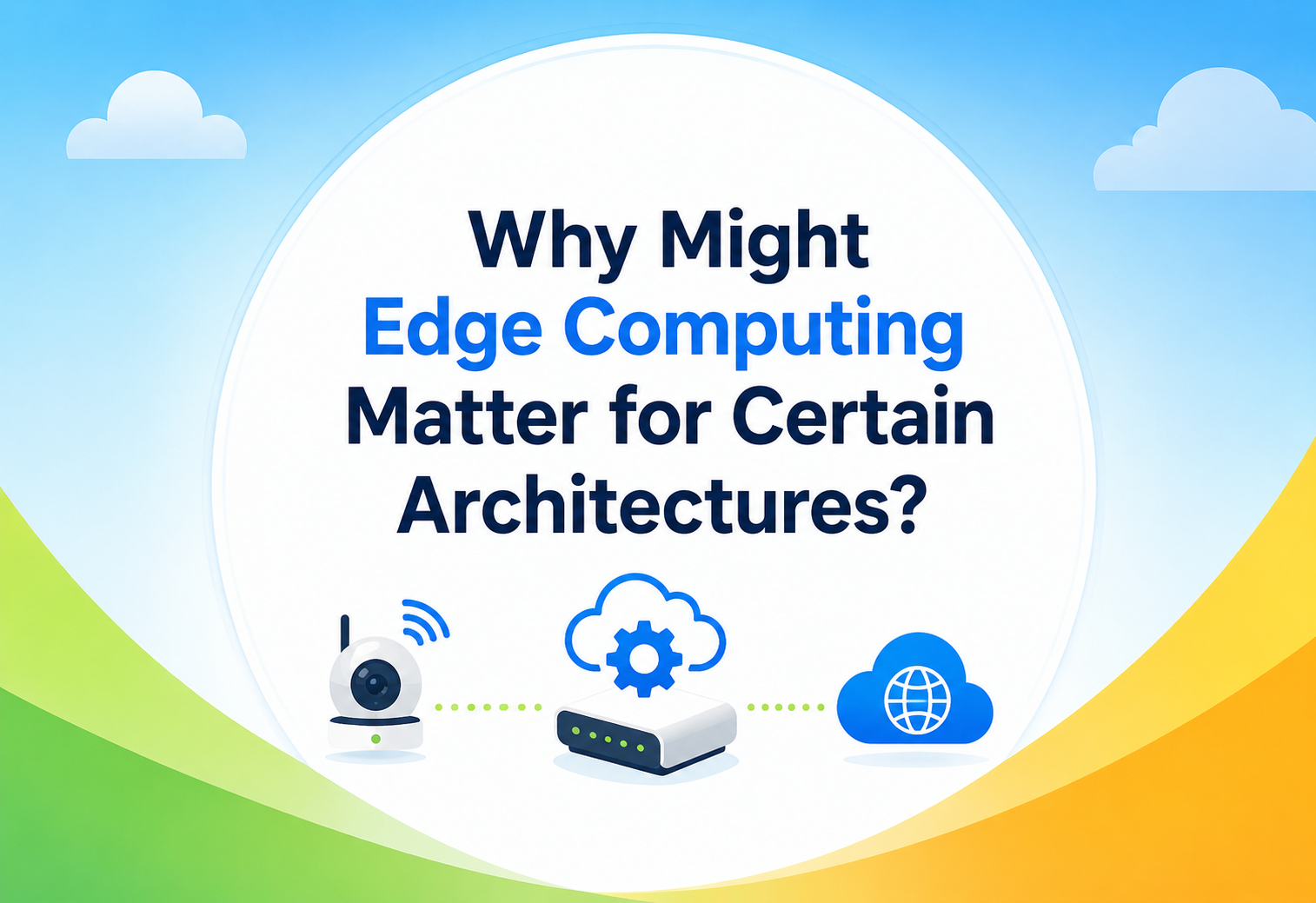
Why Might Edge Computing Matter for Certain Architectures?
A deep, beginner-friendly walkthrough of edge computing — what it is, why it exists, how it changes the shape of software systems, and when it’s the right tool for the job. Written for anyone who wants to actually understand the “why,” not just memorize the buzzword.
Introduction & History — What Is Edge Computing, and Where Did It Come From?
Edge computing means running computation — processing data, making decisions, storing state — physically close to where that data is generated, instead of sending everything to a distant, centralized data center (the “cloud”). Think of it as moving the brain of the system closer to the hands and eyes.
Imagine you have a lemonade stand. If every time a customer asked for a cup, you had to call your supplier in another city, wait for them to compute how much sugar to add, and then get instructions back before pouring — that would be painfully slow. It makes far more sense to keep the recipe and a mini “decision-making” process right there at the stand. That’s the essence of edge computing: keep the decision-making close to the action.
A short history
1. 1990s — Content Delivery Networks (CDNs)
Companies like Akamai began caching static web content (images, videos) on servers scattered around the world, so users didn’t have to fetch everything from one origin server. This was arguably the first mainstream “edge” pattern.
2. 2000s — Rise of centralized cloud computing
AWS (2006), and later Azure and Google Cloud, popularized the idea of renting massive, centralized compute power. This was revolutionary, but it also meant every request had to travel to a handful of giant data centers, sometimes thousands of miles away.
3. 2010s — Explosion of IoT devices
Sensors, cameras, industrial machines, and smartphones started generating enormous volumes of data. Sending all of it to the cloud became expensive, slow, and sometimes physically impossible (think of a ship in the middle of the ocean with limited satellite bandwidth).
4. 2015–2018 — Formalization of “edge computing”
The term “edge computing” became an industry standard. Standards bodies, telecom companies, and cloud providers began building dedicated edge platforms (AWS Greengrass, Azure IoT Edge, Google Distributed Cloud Edge).
5. 2019–2022 — 5G and Mobile Edge Computing (MEC)
The rollout of 5G networks made ultra-low-latency edge computing practical at massive scale, especially for autonomous vehicles, AR/VR, and smart factories.
6. Today — Edge as a first-class architectural layer
Edge computing is no longer a niche add-on. It’s a deliberate architectural decision made alongside “where should this service live: client, edge, or cloud?”
A centralized cloud is like a single giant library in the capital city where everyone in the country has to travel to borrow a book. Edge computing is like having small local libraries in every neighborhood — most people get what they need instantly, and only rare or special books need a trip to the capital.
Problem & Motivation — The Problem Edge Computing Solves
To understand why edge computing matters, you first need to understand what breaks when everything is centralized. Picture a purely cloud-centric architecture: every device — a sensor, a phone, a car — sends its data across the internet to one (or a few) data centers, which do all the thinking and send a response back.
This works fine for many applications. But it starts to strain under a few specific pressures:
1. The speed of light is a hard limit
Data cannot travel faster than the speed of light. A round trip from New York to a data center in California and back takes roughly 60–80 milliseconds, even under perfect network conditions. Add network congestion, routing hops, and processing queues, and you’re easily at 150–300 ms for a single request. For a video call, that’s tolerable. For a robot arm on a factory floor that must react to a human hand entering its space, 150 ms could mean an accident.
2. Bandwidth isn’t free or infinite
A single autonomous vehicle can generate 4 terabytes of sensor data per day. A modern factory with hundreds of cameras doing quality inspection could generate petabytes monthly. Shipping all of that raw data to the cloud is expensive, and in many real-world locations (rural areas, ships, mines, remote wind farms) the available bandwidth simply can’t handle it.
3. Connectivity isn’t guaranteed
Cloud-only architectures assume the network is always there. But offshore oil rigs, moving trains, airplanes, and disaster zones often have spotty or zero connectivity. If a critical system halts every time the internet blips, that’s an unacceptable failure mode for many industries.
4. Data sovereignty and privacy
Regulations like GDPR in Europe increasingly require that certain data (medical records, biometric data, financial details) stay within a specific geographic region — or never leave the premises where it was generated at all. Sending everything to a centralized cloud in another country can be a legal non-starter.
Edge computing exists precisely to attack these four pressures: latency, bandwidth, connectivity, and data locality. It doesn’t replace the cloud — it complements it by handling the time-sensitive, bandwidth-heavy, or locally-sensitive parts of the workload closer to where the data is born.
Core Concepts You Need to Know
The edge
“The edge” refers to any computing resource that sits between the data source (a device, sensor, or user) and the centralized cloud. It’s not one single location — it’s a spectrum.
Device Edge
Compute happening directly on the device itself — a smartphone, a smart camera, a sensor with a tiny onboard chip.
On-Premises Edge
A small server or cluster physically located at a factory, retail store, or hospital — owned and operated locally.
Network Edge (MEC)
Compute resources embedded inside telecom infrastructure, like a 5G tower, so processing happens one hop from the device.
Regional Edge / CDN PoPs
Points of presence spread across cities or regions — closer than the central cloud, but still shared infrastructure.
Centralized Cloud
The traditional large-scale data center — still used for heavy batch processing, long-term storage, and global coordination.
Latency vs. throughput
Latency is how long a single request takes to get a response — like how long it takes one customer to get their coffee. Throughput is how many requests can be handled per unit of time — like how many customers the coffee shop can serve per hour. Edge computing primarily targets latency, though it often improves throughput too by spreading load across many small nodes instead of funneling everything into one place.
Fog computing
You’ll sometimes hear “fog computing” used almost interchangeably with edge computing. The distinction: fog computing usually refers to an intermediate layer of networked compute nodes (think: a regional hub connecting many edge devices), while edge often refers to the outermost layer closest to the data source. In practice, many real systems blend both, and the terms are used loosely across the industry.
Edge–cloud continuum
Rather than thinking “edge OR cloud,” modern architects think of a continuum: a spectrum of compute locations from the device itself all the way to a centralized region, with decisions made per-workload about where each piece of logic should run.
If cloud computing asks “how do we centralize compute to get economies of scale?”, edge computing asks “how do we decentralize compute to get proximity, speed, and resilience?” Most real systems need a mix of both.
Architecture & Components of an Edge System
A typical edge computing architecture has several distinct layers, each with its own responsibilities. Let’s walk through them from the ground up.
1. Device layer
The devices themselves — sensors, cameras, actuators. Some devices are “dumb” (just collect and forward data), while increasingly many are “smart” (able to run small models or scripts locally, sometimes called tinyML).
2. Edge layer
A local gateway or small server, often physically located within the same building or site. It aggregates data from many devices, runs real-time logic, filters noise, and only forwards what’s necessary upstream. This is where most “edge computing” magic happens.
3. Fog / regional layer
An optional intermediate tier that aggregates data from multiple edge sites — for example, a regional hub collecting summarized data from 50 retail stores before sending it to the cloud.
4. Cloud layer
The centralized brain: long-term storage, heavy analytics, machine learning model training, and global coordination across all edge sites.
Key components inside an edge node
| Component | Responsibility |
|---|---|
| Local runtime / container engine | Runs application logic (often lightweight containers, e.g. via K3s or balenaOS) |
| Message broker | Handles local pub/sub communication between devices and services (e.g. MQTT broker) |
| Local data store | Small embedded database for buffering and short-term storage |
| Sync agent | Handles reliable, resumable synchronization with the cloud when connectivity is available |
| Device management agent | Handles remote updates, health checks, and configuration for the node itself |
Internal Working — How an Edge Node Actually Works, Step by Step
Let’s trace through what happens inside a real edge node — say, a smart camera system doing quality inspection on a factory conveyor belt.
1. Ingestion
The camera captures a frame and pushes it into a local buffer.
2. Pre-processing
The edge software resizes, normalizes, and filters the image — cheap operations done immediately.
3. Inference
A small, optimized machine learning model (already downloaded from the cloud ahead of time) runs on the local hardware (often a GPU or NPU chip) to detect defects.
4. Local decision
If a defect is detected, the edge node immediately triggers an actuator to remove the faulty item from the line — all within milliseconds, with no cloud round trip.
5. Selective forwarding
Only a summary (e.g., “1 defect detected, type: crack, confidence: 92%”) plus maybe a compressed thumbnail is sent to the cloud — not the full raw video stream.
6. Cloud aggregation
Over time, the cloud collects these summaries from thousands of edge nodes across many factories, uses them to retrain a better detection model, and pushes the improved model back down to the edge nodes.
Edge computing does not mean “no cloud at all.” In almost every real system, the edge handles the fast, local, time-critical work, while the cloud still handles training, long-term storage, and cross-site coordination. It’s a division of labor, not a replacement.
Minimal Java example: a simple edge-style local decision loop
Here’s a simplified Java example simulating an edge node that processes sensor readings locally and only escalates to a (simulated) cloud service when something truly needs central attention.
public class EdgeNode {

    private static final double TEMP_THRESHOLD = 80.0; // degrees Celsius
    private final CloudSyncClient cloudSync;
    private final LocalBuffer buffer = new LocalBuffer();

    public EdgeNode(CloudSyncClient cloudSync) {
        this.cloudSync = cloudSync;
    }

    // Called every time a new sensor reading arrives
    public void onSensorReading(SensorReading reading) {
        buffer.add(reading); // always buffer locally first

        if (reading.getTemperature() > TEMP_THRESHOLD) {
            // Time-critical: act immediately, locally, no network call
            triggerLocalShutdown(reading);
        }

        // Only send a summary upstream every 30 seconds, not every reading
        if (buffer.isFlushDue()) {
            SensorSummary summary = buffer.summarize();
            cloudSync.sendWhenAvailable(summary); // non-blocking, retries if offline
            buffer.clear();
        }
    }

    private void triggerLocalShutdown(SensorReading reading) {
        System.out.println("ALERT: Overheat detected locally at "
                + reading.getTimestamp() + " — shutting down actuator now.");
        // Direct hardware call would go here — no cloud round trip needed
    }
}
Notice the key idea: the temperature check and shutdown decision never wait on the network. Only the periodic summary is sent to the cloud, and even that is designed to tolerate being offline (sendWhenAvailable queues and retries).
Data Flow & Lifecycle in Edge Architectures
Understanding how data moves through an edge system — and what happens to it at each stage — is essential for designing one correctly.
The lifecycle of a piece of data
1. Generation
Created by a device or sensor.
2. Local buffering
Held briefly in memory or on local disk at the edge.
3. Local processing
Filtered, transformed, or used for an immediate decision.
4. Decision point
Does this data need to travel further, or is its useful life already over?
5. Selective transmission
Only meaningful, compressed, or aggregated data continues upstream.
6. Central aggregation
Combined with data from many other edge nodes in the cloud.
7. Feedback loop
Insights (like an updated ML model) flow back down to the edge.
A well-designed edge architecture treats bandwidth as a scarce resource. The goal isn’t to move data — it’s to extract value from data as close to its origin as possible, and only move the distilled result.
Advantages, Disadvantages & Trade-offs — Why Edge Computing Matters, and Where It Hurts
This is the heart of the question: why might edge computing matter for certain architectures? The honest answer is: it matters a lot for some systems, and barely at all for others. Let’s be precise about both sides.
Advantages
- Dramatically lower latency for time-critical decisions
- Reduced bandwidth costs and network load
- Continued operation during network outages
- Better data privacy — sensitive data can stay local
- Improved scalability — load is distributed, not centralized
- Regulatory compliance for data residency requirements
Disadvantages & Trade-offs
- Higher operational complexity — you’re now managing many small nodes, not one big cluster
- Harder to update software consistently across thousands of edge devices
- Limited hardware resources at the edge (CPU, memory, storage)
- Physical security risk — edge hardware can be stolen or tampered with
- Debugging distributed edge issues is harder than debugging one data center
- Initial hardware and deployment cost per site
When edge computing matters most
Edge computing earns its complexity in architectures where at least one of the following is true:
- A decision must be made in single-digit or low double-digit milliseconds (robotics, autonomous vehicles, industrial safety systems).
- The volume of raw data generated vastly exceeds what’s economical to transmit (video surveillance, high-frequency sensor arrays).
- The system must keep functioning when disconnected from the internet (ships, remote sites, disaster response).
- Data must legally or contractually remain within a specific physical boundary.
- User experience depends heavily on responsiveness (gaming, AR/VR, interactive kiosks).
When edge computing is overkill
Conversely, if your system is a typical web application — a to-do list app, an internal HR dashboard, a blog — the cloud’s centralized simplicity almost always wins. Adding edge infrastructure there just adds operational burden for no real benefit.
Performance & Scalability Considerations
Edge computing changes the scalability equation in an interesting way. In a centralized cloud model, scaling usually means adding more servers in the same few data centers — vertical or horizontal scaling within a controlled environment. In edge computing, scaling means adding more physical locations, each with its own constraints.
Horizontal scaling by geography
Instead of scaling one data center bigger, edge architectures scale by spreading many small nodes across geography. This naturally distributes load — no single node has to handle traffic from the entire world.
Resource constraints
Edge nodes typically have far less CPU, RAM, and storage than a cloud server. This forces architects to be deliberate: models must be compressed (quantization, pruning), and software must be lightweight (small container images, efficient runtimes).
| Dimension | Centralized Cloud | Edge Computing |
|---|---|---|
| Typical latency | 50–300 ms | 1–20 ms |
| Compute per node | Very high (elastic) | Limited, fixed hardware |
| Scaling strategy | Add more cloud instances | Add more physical sites/devices |
| Failure blast radius | Can be large if a region fails | Usually isolated to one site |
| Bandwidth cost | Pay for all data transferred | Pay only for filtered summaries |
A good rule of thumb: measure the “value density” of your data. High-frequency, low-value-per-byte data (like raw video) benefits enormously from edge pre-processing. Low-frequency, high-value data (like a daily sales report) usually doesn’t need edge treatment at all.
Designing for High Availability at the Edge
Reliability in edge architectures looks different from reliability in the cloud. In the cloud, you achieve high availability by replicating across multiple availability zones in the same region. At the edge, each node is often physically alone — there’s no neighboring rack to fail over to.
Key reliability strategies
- Local autonomy: Each edge node should be able to keep making its core decisions even if it completely loses contact with the cloud.
- Graceful degradation: If the ML model can’t be refreshed, keep running the last known-good version rather than failing entirely.
- Store-and-forward: Buffer data locally during outages, then reliably sync once connectivity returns — never silently drop critical data.
- Redundant hardware at critical sites: For mission-critical use cases (like a hospital), pair edge nodes so one can take over if another fails.
- Health heartbeats: Each edge node should regularly report “I’m alive and healthy” so the cloud can detect silent failures.
A common failure mode is designing edge nodes that “fail closed” — meaning if they lose cloud connectivity, they stop working entirely. For most edge use cases, this defeats the whole purpose. Design for “fail local,” not “fail cloud-dependent.”
Security in Edge Architectures
Security gets meaningfully harder at the edge, because you no longer have the luxury of a handful of tightly controlled data centers. Instead, you might have thousands of physically distributed devices, some sitting in publicly accessible locations.
Core threats
Physical Tampering
An attacker with physical access to a device could extract secrets, swap firmware, or damage hardware.
Insecure Communication
Edge-to-cloud traffic must be encrypted (TLS) — never assume a “local” network is safe.
Weak Device Identity
Every edge node needs a strong, unique cryptographic identity so the cloud can trust which node sent what data.
Outdated Firmware
Edge devices are often forgotten and left unpatched for years, becoming easy targets.
Supply Chain Risk
Hardware or pre-installed software from third parties may contain vulnerabilities or backdoors.
Data Exposure at Rest
Locally buffered data should be encrypted at rest, since the device itself could be physically stolen.
Mitigation practices
- Use hardware-backed secure elements (TPM chips) to store cryptographic keys.
- Enforce mutual TLS (mTLS) between edge nodes and cloud services.
- Sign and verify all firmware and model updates before applying them.
- Apply the principle of least privilege — an edge node should only be able to access exactly what it needs.
- Automate patching and maintain a fleet-wide inventory of device software versions.
Observability Across a Distributed Edge Fleet
Monitoring a thousand edge nodes is a fundamentally different problem than monitoring ten cloud servers. You can’t just SSH into each one when something goes wrong — most edge fleets require centralized, automated observability.
What to monitor
- Health metrics: CPU, memory, disk, temperature, uptime per node.
- Connectivity metrics: Is the node currently reachable? How long was its last outage?
- Application metrics: Inference latency, error rates, queue depth for buffered data.
- Sync metrics: How much data is waiting to sync? Is the backlog growing?
- Security events: Failed authentication attempts, unexpected firmware changes.
Common approach
Most production edge fleets use a lightweight local agent (e.g., built on Prometheus node exporters or a custom lightweight telemetry client) that batches metrics and logs, then ships them to a central observability platform (Grafana, Datadog, or similar) whenever connectivity allows — using the same store-and-forward principle as the application data itself.
Treat “silence” as a signal. If an edge node stops reporting metrics entirely, that’s often more dangerous than a node reporting errors — it could mean total failure, a network partition, or tampering. Alert on missing heartbeats, not just on explicit error codes.
Deployment Models & Cloud Integration
Getting software onto thousands of physically distributed devices — and keeping it updated — is one of the hardest operational challenges in edge computing.
Common deployment patterns
Containerized Edge Runtimes
Lightweight Kubernetes distributions like K3s or MicroK8s let teams deploy and manage containers at the edge using familiar cloud-native tooling.
Over-the-Air (OTA) Updates
Devices pull signed updates on a schedule or trigger, with rollback support if an update fails health checks.
Canary Rollouts
New software is deployed to a small percentage of edge nodes first, monitored, then gradually rolled out fleet-wide.
Cloud-Managed Edge Services
Offerings like AWS IoT Greengrass, Azure IoT Edge, and Google Distributed Cloud Edge let teams manage edge fleets from a central cloud console.
The edge–cloud relationship
In practice, the cloud usually plays these roles relative to the edge fleet: central configuration management, model/software distribution, long-term data warehousing, cross-site analytics, and disaster recovery coordination. The edge, in turn, reports summarized telemetry and occasionally requests updated logic.
Data Storage, Caching & Load Balancing at the Edge
Local databases
Edge nodes typically use lightweight, embedded databases rather than full server-grade systems — for example SQLite, or purpose-built edge databases that support offline-first operation and later synchronization with a central database (a pattern sometimes called “eventual consistency at the edge”).
Caching
Caching is arguably the original edge computing use case (think CDNs caching images and video). The same principle extends to application data: frequently accessed reference data (like a product catalog or a configuration file) can be cached locally at the edge, dramatically cutting latency for reads.
Load balancing
Instead of a traditional load balancer distributing traffic across servers in one data center, edge architectures often use geo-based routing — directing each user’s request to the nearest edge location using DNS-based or Anycast routing. This is both a performance optimization and a form of load distribution.
| Concern | Cloud Approach | Edge Approach |
|---|---|---|
| Consistency model | Strong consistency common | Often eventual consistency |
| Caching layer | Redis/Memcached in-region | Local embedded cache per node |
| Traffic routing | Load balancer within a region | Geo-routing to nearest edge site |
Offline-first edge databases generally sacrifice strong consistency for availability — per the CAP theorem, when a network partition happens (and at the edge, it will), you must choose between consistency and availability. Most edge systems choose availability, syncing and resolving conflicts later.
APIs & Microservices in Edge Architectures
Edge computing pairs naturally with microservices — small, focused services can be selectively deployed to the edge, while others stay centralized in the cloud.
Splitting services across the continuum
A well-designed edge-aware system doesn’t just duplicate the entire application at every edge node. Instead, architects decide, service by service, where each piece of logic should live:
- Edge-resident services: Real-time inference, local safety checks, immediate user interaction.
- Cloud-resident services: User account management, billing, long-term analytics, model training.
- Replicated services: Configuration or reference data services that run at the edge but sync from a central source of truth.
Java example: a minimal edge-aware REST endpoint
Below is a simplified example of an edge microservice exposing a local inference endpoint, falling back to a cloud call only if local confidence is too low.
@RestController
@RequestMapping("/api/inspect")
public class EdgeInspectionController {

    private final LocalInferenceService localInference;
    private final CloudInferenceClient cloudInference;

    public EdgeInspectionController(LocalInferenceService localInference,
                                     CloudInferenceClient cloudInference) {
        this.localInference = localInference;
        this.cloudInference = cloudInference;
    }

    @PostMapping
    public InspectionResult inspect(@RequestBody ImagePayload payload) {
        InspectionResult localResult = localInference.classify(payload);

        // Only escalate to the cloud if local confidence is too low
        // and connectivity is currently available — otherwise trust the edge result
        if (localResult.getConfidence() < 0.6 && cloudInference.isReachable()) {
            return cloudInference.classify(payload);
        }
        return localResult;
    }
}
API design considerations for edge
- APIs should be designed to work correctly even when the “upstream” service is temporarily unreachable.
- Favor asynchronous, event-driven communication (e.g., MQTT, gRPC streaming) over synchronous request/response where possible, since it tolerates intermittent connectivity better.
- Version your edge APIs carefully — you can’t always force an immediate upgrade on every device.
Design Patterns & Anti-patterns
Useful patterns
Store-and-Forward
Buffer data locally and forward it reliably once connectivity returns — never lose data due to a network gap.
Fail Local, Not Cloud-Dependent
Design core functionality to keep working even with zero cloud connectivity.
Model Cascading
Run a small, fast model at the edge; escalate to a larger cloud model only when confidence is low.
Data Gravity Awareness
Process data where it’s generated instead of moving large volumes to where the compute lives.
Progressive Sync
Sync summarized/aggregated data frequently; sync full raw data only occasionally or on demand.
Anti-patterns to avoid
The “Thin Edge” Trap
Deploying edge hardware but still routing every decision through the cloud defeats the entire purpose — you’ve added cost with none of the latency benefit.
Ignoring Update Fleet Management
Treating a fleet of 5,000 devices like a single server leads to inconsistent versions and unpatched vulnerabilities.
Over-Edging Everything
Pushing every service to the edge “just in case” adds massive operational overhead for workloads that never needed low latency.
No Conflict Resolution Strategy
Allowing offline edits at multiple edge nodes without a clear conflict-resolution plan leads to silently corrupted data once everything syncs.
Best Practices & Common Mistakes
Best practices
1. Start with the constraint, not the technology
Identify whether your real problem is latency, bandwidth, connectivity, or data locality before deciding to add edge infrastructure.
2. Keep edge logic small and well-tested
Edge code is harder to update quickly, so it should be simple, stable, and thoroughly tested before deployment.
3. Automate fleet management from day one
Manual device management does not scale past a handful of nodes.
4. Design for partial failure everywhere
Assume any given edge node, and the network to it, can disappear at any moment.
5. Monitor aggressively
You cannot fix what you cannot see, and edge nodes are inherently harder to observe than cloud servers.
6. Encrypt data both in transit and at rest
Edge devices are physically more exposed than a locked data center.
Common mistakes
- Treating the edge as “just a smaller cloud” instead of designing for its unique constraints (limited resources, intermittent connectivity, physical exposure).
- Underestimating the cost and complexity of physical deployment and maintenance across many sites.
- Failing to plan for hardware failure and end-of-life replacement cycles.
- Not testing for network partition scenarios before going to production.
- Forgetting that edge software updates are much riskier — a bad update to a fleet of unattended devices can be very costly to fix.
Only push logic to the edge if it genuinely needs to be there. Every piece of edge-resident code is a piece of code you now have to secure, update, and monitor across potentially thousands of physically distributed locations.
Real-World Examples — Who Actually Uses Edge Computing, and Why
Frequently Asked Questions
Is edge computing replacing cloud computing?
No. Edge computing complements the cloud. Most production systems use both — the edge for time-sensitive, local decisions, and the cloud for heavy analytics, storage, and coordination.
Do I need edge computing for a typical web or mobile app?
Usually not. If your app isn’t latency-critical, bandwidth-constrained, or required to work offline, a centralized cloud architecture is simpler and cheaper to run.
What’s the difference between edge computing and a CDN?
A CDN is a specific, narrow form of edge computing focused on caching and delivering static content. Modern edge computing extends that idea to running full application logic, not just serving cached files.
Is edge computing more secure than the cloud?
Not inherently — it trades one set of risks for another. Cloud data centers are physically well-guarded but centralized (a bigger target). Edge devices are distributed (smaller individual blast radius) but physically exposed and harder to monitor uniformly.
How do I decide what should run at the edge versus the cloud?
Ask: does this specific piece of logic need to react within milliseconds, does it process a huge volume of raw data, or must it keep working offline? If yes to any of those, it’s a strong candidate for the edge. Otherwise, keep it centralized for simplicity.
How does edge computing relate to 5G?
5G networks pair naturally with edge computing because operators deploy small compute nodes inside cellular base stations (a pattern called Multi-access Edge Computing, or MEC). This lets latency-sensitive workloads like AR/VR, cloud gaming, and connected vehicles react within a single-digit-millisecond hop from the user’s radio.
What’s the difference between edge computing and fog computing?
They’re closely related and often used interchangeably. In stricter usage, “fog” refers to an intermediate networked tier of compute nodes sitting between devices and the cloud, while “edge” specifically refers to the outermost tier closest to the data source. Most modern architectures simply speak of an edge–cloud continuum rather than treating them as separate concepts.
Summary — Bringing It All Together
Edge computing matters for certain architectures because some problems simply cannot be solved by a faster internet connection or a bigger cloud data center. When a robot arm must stop moving within milliseconds of detecting a human hand, when a fleet of vehicles generates more data per day than can reasonably be uploaded, or when a system must keep functioning with zero internet connectivity — that’s when moving computation physically closer to the data source stops being a nice-to-know optimization and becomes an architectural requirement.
At the same time, edge computing is not free. It introduces real operational complexity: fleets of physically distributed, resource-constrained, harder-to-secure nodes that must be monitored, updated, and maintained at scale. The best architects treat “where should this run: device, edge, fog, or cloud?” as a deliberate, per-workload decision — not a blanket architectural philosophy applied everywhere.
Key Takeaways
- Edge computing moves processing physically closer to where data is generated, directly attacking latency, bandwidth, connectivity, and data-locality constraints.
- It complements, rather than replaces, centralized cloud computing — most real systems use both together across a continuum.
- It matters most for time-critical, bandwidth-heavy, connectivity-fragile, or regulation-sensitive workloads: robotics, autonomous vehicles, industrial IoT, smart cameras, and telecom infrastructure.
- It matters least for typical, non-time-sensitive applications, where centralized simplicity usually wins.
- Successful edge architectures are built on “fail local, not cloud-dependent” thinking, store-and-forward data handling, automated fleet management, and strong security for physically exposed hardware.
- The right question isn’t “should we use edge computing?” — it’s “which specific pieces of our system actually need it?”