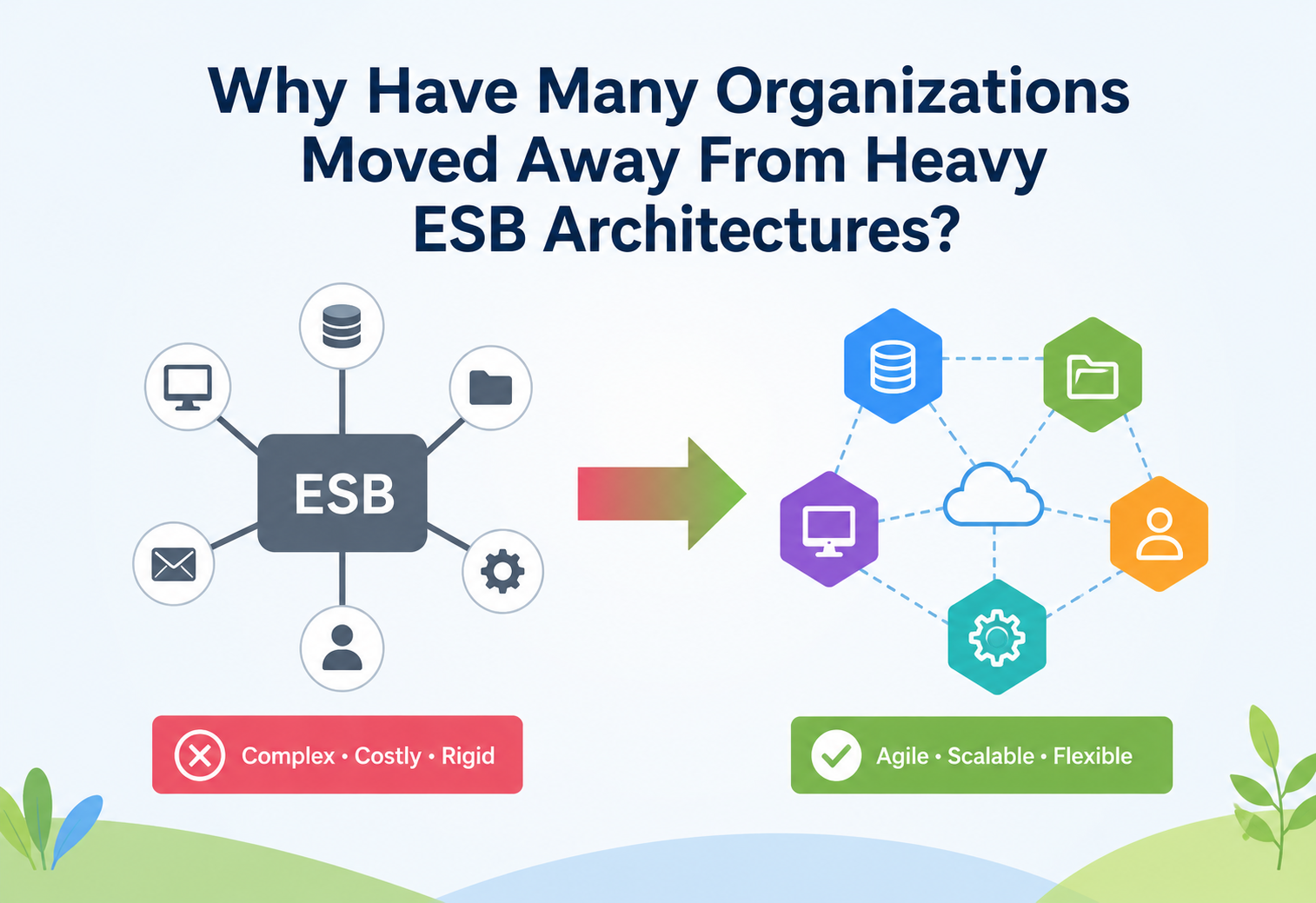
Why Have Many Organizations Moved Away From Heavy ESB Architectures?
A beginner‑to‑production guide that explains what an Enterprise Service Bus actually is, why it once dominated integration architecture, and why modern teams — from lean startups to Netflix and Amazon — have replaced heavy, centralised ESBs with lightweight, decentralised integration patterns.
Introduction & History
If you have worked in enterprise software for more than a few years, you have probably heard someone say — half proudly, half exhausted — “we ripped out the ESB.” It has become almost a rite of passage in enterprise architecture circles: a sentence that signals an organisation has moved from a centralised, heavyweight integration model toward something leaner. To understand why so many companies made that move, we first need to understand what an ESB actually is, why it was built, and why it made so much sense for the era it was born in.
An Enterprise Service Bus (ESB) is a centralised software architecture pattern used to enable different applications to communicate with each other by acting as a middle layer — a “bus” — that routes, transforms, and manages messages between systems. Instead of every application talking directly to every other application, each application talks to the ESB, and the ESB figures out how to get the message to the right place, in the right format.
1.1 Where ESBs came from
The ESB pattern rose to prominence in the early‑to‑mid 2000s, growing out of earlier Enterprise Application Integration (EAI) tools and message brokers. Before ESBs, large enterprises — banks, telecoms, insurance companies, airlines — had accumulated dozens or hundreds of applications over decades: mainframes from the 1980s, ERP systems from the 1990s, custom‑built line‑of‑business apps, and newly acquired systems from mergers. Each spoke a different “language” — different data formats, different protocols (SOAP, CORBA, proprietary file formats, flat files, EDI) and different assumptions about how data should look.
Connecting these systems point‑to‑point (each system directly wired to every other system it needed to talk to) created what architects call spaghetti integration — a tangled mesh of one‑off connections that became nearly impossible to understand, test, or change safely. Vendors like IBM (WebSphere ESB), Oracle (Oracle Service Bus), TIBCO (BusinessWorks), Software AG (webMethods), and MuleSoft (Mule ESB) built products specifically to solve this mess by centralising integration logic into one place.
Fig 1.1 · the classic hub‑and‑spoke ESB — one bus, every language, every route.
For roughly a decade this was considered best practice. The pitch was compelling: one team owns integration, business logic for routing and transformation lives in one governed place, and any two systems can be connected through configuration rather than custom code. Many Fortune 500 companies invested millions of dollars and years of effort building out ESB platforms as the backbone of their IT estate.
And yet, starting around the mid‑2010s, a clear trend emerged: organisations — especially those adopting microservices, cloud‑native architecture, and DevOps practices — began deliberately moving away from heavy, centralised ESBs. This guide explains exactly why, what problems ESBs solved, what new problems they created, and what architectures replaced them.
1.2 A brief timeline
It helps to see this as a genuine architectural pendulum rather than a single overnight decision, because the reasoning behind each swing still matters today.
- 1990sPoint‑to‑point integrations and early EAI hub‑and‑spoke tools attempt to tame growing enterprise application sprawl, with mixed success.
- Early–mid 2000sService‑Oriented Architecture (SOA) becomes the dominant enterprise paradigm, and the ESB emerges as SOA’s flagship implementation pattern, backed by major vendors and consulting practices.
- Mid‑2000s–early 2010sLarge enterprises invest heavily in ESB platforms, centralising dozens of teams’ integration logic into a small number of shared clusters, often under a dedicated “SOA Center of Excellence.”
- Early–mid 2010sAmazon, Netflix and other cloud‑native pioneers popularise microservices as an alternative philosophy, explicitly rejecting shared middleware in favour of independently‑owned services communicating over simple protocols.
- Mid‑2010s onwardKubernetes, Docker, and mature open‑source brokers (Kafka in particular) give mainstream enterprises practical, production‑ready tooling to replicate the decentralised model without Amazon‑scale engineering resources, accelerating the industry‑wide shift.
Understanding this timeline matters because it shows that the shift away from heavy ESBs was not driven by a single bad product or a single bad decision — it was driven by a broader realisation that centralising business logic and deployment gatekeeping, however well‑intentioned, does not scale with the number of independent teams an organisation needs to support.
The Problem & Motivation
To understand the shift away from ESBs, we need to understand two separate problems: the problem ESBs were built to solve, and the new problem that heavy ESBs themselves eventually became.
2.1 The original problem — point‑to‑point chaos
Imagine a mid‑sized retail company with 12 core systems: inventory, orders, payments, shipping, CRM, loyalty program, email marketing, warehouse management, returns, pricing, tax calculation, and analytics. If every system needs to talk to a handful of others directly, you can end up with 40, 60 or even 100+ individual point‑to‑point connections. Each connection has its own protocol, its own retry logic, its own authentication, and its own data mapping code, usually written by whichever team needed it at the time, with little consistency.
This was a completely legitimate and painful problem, and centralising the “who talks to whom, and how” logic into a single bus was a genuinely good idea in principle. It reduced N² point‑to‑point wiring into N connections into a hub.
2.2 The new problem — the ESB became a monolithic bottleneck
Here is the twist that many organisations discovered the hard way: centralising integration logic solved the wiring problem but created a new, arguably worse one. The ESB itself turned into a single, massive, tightly‑coupled piece of shared infrastructure that every team depended on and that only a small central team really understood.
Over years, ESB instances at large enterprises accumulated thousands of routing rules, transformation maps, and orchestration flows, all running inside one platform, deployed as one (or a small cluster of) monolithic runtime. What started as a traffic router slowly turned into a place where actual business logic lived — validation rules, orchestration sequences, even parts of business processes — because it was “easy” to add one more transformation step to the bus rather than change the source or destination application.
That is essentially what happened to ESBs inside large enterprises. The central integration team became a permanent bottleneck: every new feature that touched two systems required a change request to the ESB team, who had a backlog, their own release calendar, and limited bandwidth. A change that should have taken a two‑person team two days instead took six weeks because it needed to go through a shared, tightly‑governed, and often poorly‑documented central platform.
2.3 Motivation for change
Three broader industry shifts amplified the pain and provided both the motivation and the alternative:
- Microservices architecture — teams wanted independently deployable services owned end‑to‑end by small teams, which directly conflicts with a shared central integration layer that every team must coordinate through.
- Cloud‑native infrastructure and DevOps — the expectation of deploying many times a day was incompatible with a monolithic ESB release process.
- API‑first thinking — instead of hiding integration logic in a hidden middle layer, teams wanted well‑documented, directly callable APIs owned by the team that built the underlying service.
Core Concepts
Before going further, let’s define the vocabulary you need to fully understand this topic.
| Term | What it means | Why it matters |
|---|---|---|
| ESB (Enterprise Service Bus) | A central middleware layer that routes, transforms, and orchestrates messages between applications. | The subject of this guide — the pattern many teams are moving away from. |
| Point‑to‑point integration | Direct connections between two systems without an intermediary. | The original problem ESBs tried to solve; also what small microservice teams favour today at small scale with direct APIs. |
| Message broker | Middleware that accepts messages from producers and delivers them to consumers, often asynchronously (e.g., Kafka, RabbitMQ). | A lighter‑weight replacement for ESB‑style routing, used without heavy central orchestration logic. |
| Smart endpoints, dumb pipes | A microservices principle: intelligence (business logic) lives in the services (endpoints), not in the integration layer (pipes). | The direct philosophical opposite of the ESB’s “smart pipe” model. |
| Orchestration vs. Choreography | Orchestration = a central conductor tells each service what to do and when. Choreography = each service reacts to events independently, with no central conductor. | ESBs favour orchestration; modern event‑driven microservices favour choreography. |
| Coupling | The degree to which one component depends on the internal details or availability of another. | Heavy ESBs create hidden coupling through shared transformation and routing logic. |
| Single point of failure (SPOF) | A component whose failure brings down the whole system. | A large, centralised ESB cluster is a classic SPOF risk if not carefully isolated. |
| API Gateway | A lightweight edge component that handles routing, authentication, and rate‑limiting for API calls, without embedding business logic. | Commonly replaces the “traffic routing” part of what ESBs did, without the heavy orchestration. |
3.1 What “heavy” means in “heavy ESB”
It’s worth being precise here: the issue is not integration middleware itself — message brokers, event streams, and API gateways are all still integration middleware, and organisations still use plenty of it. The issue is specifically heavy, centralised, logic‑laden ESBs characterised by:
- A single shared runtime cluster serving the entire enterprise
- Business logic (validation, orchestration, transformation rules) embedded inside the bus rather than in owning services
- A dedicated central team that must review, approve, and deploy every integration change
- Complex proprietary tooling requiring specialised (and often scarce) skills
- Long release cycles measured in weeks, not minutes
Architecture & Components of a Traditional ESB
To appreciate what changed, you need to understand what a traditional heavy ESB was actually made of. Most commercial ESB products share a common set of building blocks.
Fig 4.1 · one platform, one deployment unit — routing, transformation, and orchestration all glued together.
4.1 Key components
Routing engine
Decides where an incoming message should go, based on content, headers, or business rules (content‑based routing).
Transformation engine
Converts message formats between systems (e.g., XML to JSON, EDI to XML), often using XSLT or proprietary mapping tools.
Orchestration engine
Coordinates multi‑step business processes across systems, often using standards like BPEL (Business Process Execution Language).
Protocol adapters
Connectors for various protocols: SOAP/HTTP, JMS, FTP, database polling, mainframe connectors, and more.
Service registry
A catalogue of available services and endpoints exposed through the bus.
Central monitoring console
A single dashboard where the central team watches message flow across the entire enterprise.
4.2 The modern alternative architecture, side by side
Fig 4.2 · the gateway and Kafka carry traffic only — every business rule lives inside the owning service.
Notice the difference: in the modern model, no single component “owns” all the business logic. The gateway handles only cross‑cutting routing and security concerns; the event stream (like Apache Kafka) handles only reliable message delivery. All actual business logic — validation, transformation, orchestration of a specific workflow — lives inside the services that own that domain.
Internal Working: How A Message Actually Moved Through An ESB
To make this concrete, let’s walk through what happened, step by step, when an order was placed in a typical ESB‑centric e‑commerce system, versus what happens in a modern decentralised system.
5.1 Traditional ESB flow
- 1
Order published
The order system publishes an “OrderCreated” message onto the ESB using its own proprietary XML schema.
- 2
Adapter receives
The ESB’s adapter layer receives the message and validates it against a registered schema.
- 3
Routing rule fires
The routing engine inspects message content (e.g., order value, customer type) and decides which downstream systems need to be notified — inventory, billing, shipping, loyalty.
- 4
Transformations run
The transformation engine converts the message into four different formats: the inventory system’s flat‑file format, the billing system’s SOAP schema, the shipping partner’s EDI format, and the loyalty program’s JSON API format.
- 5
Orchestration sequences
The orchestration engine sequences these calls — for example, inventory must be checked and reserved before billing is triggered, and billing must succeed before shipping is notified.
- 6
Compensating logic on failure
If any step fails, the orchestration engine executes compensating logic (e.g., release the inventory reservation) — logic that lives entirely inside the ESB, not inside any of the actual applications.
- 7
Central logging
The central monitoring console logs the full transaction for the operations team to review.
5.2 Modern decentralised flow (event‑driven microservices)
- 1
Order validates itself
The order service validates the order itself and persists it to its own database.
- 2
Event published
The order service publishes a well‑documented “OrderCreated” event to a Kafka topic, using a schema it owns and versions (often via a schema registry).
- 3
Consumers subscribe
The inventory service, billing service, shipping service, and loyalty service each independently subscribe to that topic and react according to their own internal logic.
- 4
Owned retry & compensation
Each service owns its own retry logic, error handling, and compensating actions (often implemented as a saga pattern) — no central orchestrator dictates their internal behaviour.
- 5
Independent evolution
If the billing service changes its internal schema, it only needs to keep its published event contract backward‑compatible; it does not need permission from a central team to deploy.
Here is a simplified Java / Spring Boot example showing how a service might publish a domain event directly, without going through a heavy ESB orchestration layer:
@Service
public class OrderService {

    private final OrderRepository orderRepository;
    private final KafkaTemplate<String, OrderCreatedEvent> kafkaTemplate;

    public OrderService(OrderRepository orderRepository,
                         KafkaTemplate<String, OrderCreatedEvent> kafkaTemplate) {
        this.orderRepository = orderRepository;
        this.kafkaTemplate = kafkaTemplate;
    }

    @Transactional
    public Order createOrder(OrderRequest request) {
        // 1. Business logic lives HERE, in the owning service - not in a bus
        Order order = Order.fromRequest(request);
        order.validate();
        orderRepository.save(order);

        // 2. Publish a lightweight, versioned domain event
        OrderCreatedEvent event = new OrderCreatedEvent(
                order.getId(), order.getCustomerId(), order.getTotalAmount());
        kafkaTemplate.send("order.created.v1", order.getId().toString(), event);

        return order;
    }
}
Downstream services subscribe independently:
@Component
public class InventoryEventListener {

    private final InventoryService inventoryService;

    public InventoryEventListener(InventoryService inventoryService) {
        this.inventoryService = inventoryService;
    }

    @KafkaListener(topics = "order.created.v1", groupId = "inventory-service")
    public void onOrderCreated(OrderCreatedEvent event) {
        // Inventory team owns this logic completely - no central ESB team involved
        inventoryService.reserveStockForOrder(event.orderId(), event.customerId());
    }
}Data Flow & Lifecycle Comparison
Let’s trace the full lifecycle of a single business event — a customer address change — through both models, to make the contrast very concrete.
Heavy ESB lifecycle
- CRM team requests an “address change” flow through the central ESB team’s ticketing system.
- ESB team schedules the work into their sprint (often 2–4 weeks out).
- ESB developer writes a new transformation map and routing rule inside the proprietary ESB tooling.
- Change is tested in a shared ESB test environment, alongside dozens of other pending changes.
- Change is bundled into the next scheduled ESB release (often bi‑weekly or monthly).
- If something breaks, it can affect unrelated flows sharing the same runtime.
Decentralised lifecycle
- CRM team adds a new field to its own “CustomerAddressChanged” event schema (backward‑compatible).
- CRM team deploys their own service independently, same day.
- Any service that cares about address changes (billing, shipping, tax) subscribes to the event and updates its own consumer logic on its own schedule.
- Testing happens within each team’s own CI/CD pipeline, isolated from unrelated services.
- Deployment happens through each team’s own pipeline — potentially several times a day.
Fig 6.1 · three consumers, one event, no conductor — each service applies its own logic in parallel.
The key lifecycle difference is blast radius and lead time. In the ESB model, a small change has to travel through a shared pipeline with everyone else’s changes, and a bug in one flow can affect the shared runtime hosting many unrelated flows. In the decentralised model, the blast radius of any single change is limited to the team that made it and the explicit contract (the event schema) it publishes.
Pros, Cons & Trade-offs
It would be a mistake to conclude that ESBs were simply “bad architecture.” They were a rational solution to a real problem, and they still make sense in certain contexts today. Let’s be fair and specific about the trade‑offs.
7.1 What heavy ESBs genuinely got right
- Centralised governance — for regulated industries (banking, insurance, healthcare), having one place to audit every cross‑system data flow was, and sometimes still is, a real compliance advantage.
- Protocol translation at scale — connecting genuinely ancient systems (mainframes, EDI‑based partner feeds) to modern systems still benefits from dedicated adapter tooling.
- Reduced point‑to‑point sprawl — for organisations that had genuinely uncontrolled point‑to‑point chaos, an ESB (even a heavy one) was a meaningful improvement.
- Reuse of transformation logic — a single canonical data model, if well maintained, can reduce duplicate mapping logic across teams.
7.2 What heavy ESBs got wrong at scale
- Single point of failure risk — if the ESB cluster degrades, potentially every integrated business process degrades simultaneously.
- Organisational bottleneck — a small central team becomes a mandatory gatekeeper for practically every cross‑team change in the company.
- Hidden business logic — validation and orchestration rules buried inside proprietary ESB configuration are hard to test, hard to version in normal source control, and often poorly understood outside the central team.
- Vendor lock‑in — proprietary tooling (XSLT dialects, vendor‑specific orchestration engines) makes it expensive to migrate away or hire skilled engineers.
- Slow release cadence — shared infrastructure typically means shared, conservative release schedules, which conflicts directly with modern continuous delivery practices.
- Difficult local testing — developers often cannot run a full ESB instance locally, making fast feedback loops difficult compared to a simple local microservice.
| Dimension | Heavy ESB | Decentralised (API + Events) |
|---|---|---|
| Ownership | Central integration team | Each service team owns its own logic |
| Deployment cadence | Weeks (shared release train) | Multiple times per day, per service |
| Failure blast radius | Potentially enterprise‑wide | Limited to the failing service / consumer |
| Business logic location | Inside the bus (hidden, proprietary) | Inside owning services (visible, testable) |
| Skill requirements | Specialised, often vendor‑specific | Common, widely available (REST, Kafka, gRPC) |
| Local developer testing | Difficult, needs shared environment | Easy, run one service locally |
| Good fit for | Heavy legacy / mainframe integration, tight regulatory audit needs | Cloud‑native microservices, fast‑moving product teams |
Performance & Scalability
Performance is one of the most concrete reasons organisations moved away from heavy ESBs. A centralised bus, by definition, sits in the critical path of a very large share of enterprise traffic.
8.1 The scaling bottleneck
When every message between every pair of systems flows through one platform, that platform’s capacity becomes a hard ceiling on the entire company’s integration throughput. Scaling a heavy ESB usually meant scaling the entire monolithic platform — often vertically (bigger servers) because the orchestration engine and shared state made horizontal scaling difficult, expensive, and sometimes unsupported by the vendor’s licensing model.
In a decentralised architecture, each service scales independently based on its own load profile. The inventory service, which might see huge spikes during flash sales, can scale out to 50 instances without any coordination with, or impact on, the billing service, which might run steadily on 3 instances.
# Each service scales independently based on its own load profile
apiVersion: autoscaling/v2
kind: HorizontalPodAutoscaler
metadata:
  name: inventory-service-hpa
spec:
  scaleTargetRef:
    apiVersion: apps/v1
    kind: Deployment
    name: inventory-service
  minReplicas: 3
  maxReplicas: 50
  metrics:
  - type: Resource
    resource:
      name: cpu
      target:
        type: Utilization
        averageUtilization: 65
8.2 Latency overhead
Every hop through a heavy orchestration engine adds latency: message parsing, schema validation, transformation, routing rule evaluation, and orchestration state management. For simple request‑response interactions (e.g., “get customer profile”), routing that call through a full ESB orchestration pipeline could add tens to hundreds of milliseconds of unnecessary overhead compared to a direct, lightweight API call.
High Availability & Reliability
Reliability engineering is where the “single point of failure” critique of heavy ESBs becomes most concrete and most dangerous.
9.1 Blast radius of failure
In a heavy ESB architecture, if the central bus cluster experiences an outage, a performance degradation, or even a bad deployment, the blast radius can span every business process that depends on cross‑system communication — order processing, billing, partner integrations, reporting — simultaneously. This is the textbook definition of a single point of failure, even when the ESB itself is deployed in a “highly available” cluster, because a logical bug or bad configuration change can still take down the whole shared platform regardless of how many redundant nodes it runs on.
Fig 9.1 · one shared runtime = one shared incident.
9.2 Failure isolation in decentralised systems
In a well‑designed decentralised architecture, failures are contained by design. If the loyalty service goes down, orders can still be placed, billed, and shipped — the loyalty points might just be applied a bit later once the service recovers and processes the backlog of events from the durable event log (like Kafka). This pattern, where a failing dependency degrades gracefully rather than blocking the entire flow, is often implemented using the circuit breaker pattern.
@Service
public class LoyaltyClient {

    private final CircuitBreaker circuitBreaker;
    private final RestTemplate restTemplate;

    public LoyaltyClient(CircuitBreakerRegistry registry, RestTemplate restTemplate) {
        this.circuitBreaker = registry.circuitBreaker("loyaltyService");
        this.restTemplate = restTemplate;
    }

    public Optional<LoyaltyPoints> awardPoints(String customerId, int amount) {
        Supplier<LoyaltyPoints> call = () ->
            restTemplate.postForObject("/loyalty/award",
                new LoyaltyRequest(customerId, amount), LoyaltyPoints.class);

        return Optional.ofNullable(
            circuitBreaker.executeSupplier(() -> call.get()));
    }
}9.3 Disaster recovery differences
Disaster recovery for a heavy ESB usually means failing over an entire complex platform — replicating orchestration state, in‑flight transactions, and configuration to a secondary data centre, which is operationally complex and often only tested a few times a year. Disaster recovery for decentralised services is typically simpler per‑service: each team manages recovery for its own, much smaller blast radius, and durable event logs like Kafka can replay missed events once a consumer recovers.
Security
Security considerations also shifted meaningfully between the two models.
10.1 Heavy ESB security model
In a centralised ESB, security was often enforced at the bus level: authentication, authorisation, and message‑level encryption were configured centrally, giving the security team one place to apply policy. This had real benefits — consistent policy enforcement — but also real drawbacks: a misconfiguration in one shared policy could expose or block traffic for many unrelated systems at once, and the ESB itself became an extremely high‑value target, since compromising it could expose data flowing between dozens of critical systems.
10.2 Decentralised security model
Modern architectures favour zero trust principles: every service authenticates and authorises every call independently, typically using short‑lived tokens (like OAuth2 / JWT), rather than relying on being “inside” a trusted central bus. Each service also has narrowly scoped access to only the data and downstream systems it actually needs.
@RestController
@RequestMapping("/api/orders")
public class OrderController {

    @PostMapping
    @PreAuthorize("hasAuthority('SCOPE_orders:write')")
    public ResponseEntity<Order> createOrder(
            @AuthenticationPrincipal Jwt jwt,
            @RequestBody OrderRequest request) {
        String customerId = jwt.getSubject();
        Order order = orderService.createOrder(customerId, request);
        return ResponseEntity.ok(order);
    }
}
This distributes the security surface but also distributes responsibility — each team must correctly implement authentication and authorisation for its own service, which is why API gateways and service meshes (like Istio) are commonly used to provide consistent security policy enforcement (mTLS, token validation) without recreating a heavy, logic‑laden ESB.
Monitoring, Logging & Metrics
Observability is another area where the shift away from heavy ESBs required — and enabled — real innovation.
11.1 The ESB monitoring model
Heavy ESBs typically shipped with a central monitoring console showing message flow, throughput, and errors across the whole platform. This gave a genuinely useful single‑pane‑of‑glass view — but only for traffic that passed through the bus, and usually with limited ability to correlate a single business transaction across multiple hops without custom correlation‑ID plumbing.
11.2 The distributed tracing model
In decentralised architectures, no single component sees the whole picture by default, so organisations adopted distributed tracing — propagating a correlation ID (trace ID) through every service call and event, and aggregating spans in tools like Jaeger, Zipkin, or Grafana Tempo, combined with OpenTelemetry instrumentation.
@Bean
public Tracer tracer(OpenTelemetry openTelemetry) {
    return openTelemetry.getTracer("order-service");
}

public Order createOrder(OrderRequest request) {
    Span span = tracer.spanBuilder("createOrder").startSpan();
    try (Scope scope = span.makeCurrent()) {
        span.setAttribute("customer.id", request.customerId());
        Order order = orderRepository.save(Order.fromRequest(request));
        eventPublisher.publish(new OrderCreatedEvent(order));
        return order;
    } finally {
        span.end();
    }
}Fig 11.1 · every service ships its own span; the aggregator reconstructs the flow.
Deployment & Cloud Considerations
Deployment models are perhaps the most visible, day‑to‑day reason engineering teams pushed back against heavy ESBs.
12.1 Heavy ESB deployment reality
Because a heavy ESB is a single shared runtime hosting logic for many teams, deployments had to be carefully coordinated, batched, and scheduled — often through a change advisory board (CAB) process, with releases happening weekly, bi‑weekly, or even monthly. A single team wanting to ship a small fix could be forced to wait for the next shared release window, or worse, get bundled with unrelated changes that increase risk.
12.2 Cloud‑native deployment model
Cloud‑native, containerised microservices flipped this completely: each service has its own independent CI/CD pipeline, its own container image, and its own deployment schedule, orchestrated through platforms like Kubernetes. This aligns naturally with DevOps practices like continuous delivery and the “you build it, you run it” ownership model.
name: deploy-inventory-service
on:
  push:
    branches: [main]
    paths: ['inventory-service/**']
jobs:
  build-and-deploy:
    runs-on: ubuntu-latest
    steps:
      - uses: actions/checkout@v4
      - name: Build and test
        run: ./gradlew :inventory-service:test :inventory-service:build
      - name: Build container image
        run: docker build -t registry/inventory-service:${{ github.sha }} .
      - name: Deploy to Kubernetes
        run: kubectl set image deployment/inventory-service
              inventory-service=registry/inventory-service:${{ github.sha }}
Notice that this pipeline only touches the inventory service. It does not require sign‑off from a central integration team, does not share a release window with billing or shipping, and can run dozens of times a day if needed.
Databases, Caching & Load Balancing
The database and data‑ownership model is one of the deepest architectural differences between ESB‑centric and decentralised systems.
13.1 Shared database anti‑pattern under ESBs
Many heavy‑ESB‑era enterprises also relied on shared, centralised databases that multiple applications read from and wrote to directly, with the ESB orchestrating the timing of those reads and writes. This created tight coupling at the data layer: a schema change to a shared table could silently break several unrelated applications.
13.2 Database‑per‑service model
Modern microservices architecture strongly favours a database‑per‑service pattern: each service owns its own database (or schema), and no other service is allowed to query it directly. All access goes through the owning service’s API or published events.
Fig 13.1 · the only door to another service’s data is its API.
13.3 Caching and load balancing
Heavy ESBs typically centralised caching (if any) at the bus level, which meant cache invalidation logic had to account for every consumer’s freshness requirements at once — a genuinely hard problem. Decentralised services instead cache at the point of need: an order service might cache product pricing locally with Redis, tuned specifically to its own read patterns and staleness tolerance, without needing to coordinate cache policy with every other team.
@Cacheable(value = "productPrices", key = "#productId")
public BigDecimal getProductPrice(String productId) {
    return pricingClient.fetchPrice(productId);
}
Load balancing similarly moved from a centralised bus‑level concern to a per‑service concern, typically handled by Kubernetes Services, client‑side load balancers (like Spring Cloud LoadBalancer), or a service‑mesh sidecar (like Envoy in Istio) — giving each service fine‑grained control over its own retry, timeout, and load‑balancing strategy.
APIs & Microservices
Microservices architecture is not just a coincidental trend that happened alongside the decline of ESBs — it is the direct architectural philosophy that replaced it.
14.1 APIs as first‑class contracts
Instead of a central bus deciding how systems talk to each other, each service publishes its own well‑documented API (typically REST or gRPC), often described with an OpenAPI specification, and versions that contract explicitly and independently.
openapi: 3.0.3
info:
  title: Inventory Service API
  version: 1.2.0
paths:
  /inventory/{productId}/reserve:
    post:
      summary: Reserve stock for an order
      parameters:
        - name: productId
          in: path
          required: true
          schema: { type: string }
      requestBody:
        content:
          application/json:
            schema:
              type: object
              properties:
                orderId: { type: string }
                quantity: { type: integer }
      responses:
        '200': { description: Reservation successful }
        '409': { description: Insufficient stock }
14.2 API gateways — the lightweight successor
Many capabilities people associate with ESBs — routing, rate limiting, authentication, request / response logging — did not disappear; they moved into a much thinner layer called an API gateway (e.g., Kong, Amazon API Gateway, Spring Cloud Gateway). The crucial difference is that an API gateway deliberately avoids embedding business logic or orchestration; it stays a “dumb pipe” focused purely on cross‑cutting, infrastructure‑level concerns.
ESB does
- Routing
- Transformation
- Business orchestration
- Business validation rules
- Compensating transaction logic
API gateway does
- Routing
- Authentication / rate limiting
- Basic request logging
- (no business logic — stays in services)
- (no orchestration — stays in services)
14.3 Event‑driven microservices
For asynchronous, decoupled communication, message brokers and event‑streaming platforms (Kafka, RabbitMQ, AWS SNS/SQS, Azure Service Bus in its lightweight queue form) replaced the orchestration engine’s role, but crucially without embedding business rules inside the broker itself — the broker just guarantees reliable delivery; the business logic that reacts to the event lives entirely within the consuming service.
Design Patterns & Anti-patterns
15.1 Patterns that replaced ESB capabilities
Saga pattern
Replaces ESB‑style orchestration for multi‑step business transactions, using either choreography (each service reacts to events and publishes its own compensating events on failure) or a lightweight orchestrator owned by a single business‑process team, not a shared enterprise‑wide bus.
Strangler fig
The most common migration strategy for moving off a heavy ESB: new functionality is built as independent services that gradually “strangle” and replace ESB‑routed flows, one flow at a time, rather than a risky big‑bang rewrite.
Backend‑for‑Frontend (BFF)
A thin, purpose‑built API layer for a specific client (web, mobile) that aggregates calls to several microservices, replacing some of the ESB’s orchestration role but scoped to one consumer, not the whole enterprise.
Circuit breaker & bulkhead
Replace the reliability the ESB’s centralised error handling used to (imperfectly) provide, but implemented per‑service so failures stay isolated.
Fig 15.1 · the strangler fig migration — one flow at a time until the bus is empty.
15.2 Anti‑patterns to avoid on both sides
15.3 Canonical Data Model — a pattern worth re‑examining
ESBs popularised the canonical data model — one shared “true” representation of a business entity (like “Customer”) that every system’s data gets transformed into and out of. In practice, maintaining a single canonical model across an entire large enterprise proved extremely difficult, since different domains legitimately need different views of the same concept. Domain‑Driven Design’s concept of a bounded context — where each service defines its own local model, translating only at the edges when necessary — has largely replaced the single canonical model as the more practical, less coupling‑prone pattern.
Best Practices & Common Mistakes
16.1 Best practices when moving away from a heavy ESB
- Migrate incrementally — use the strangler fig pattern rather than a risky big‑bang cutover; keep the ESB running for untouched flows while new flows go direct.
- Define clear service ownership — every piece of business logic that used to live in the bus needs an explicit new owning team before it is migrated.
- Version your event and API contracts — since there’s no longer a central team mediating every change, backward‑compatible versioning becomes each team’s own responsibility.
- Invest in observability early — distributed tracing and centralised log aggregation (e.g., the ELK stack or Grafana Loki) need to be in place before you decompose, not after, or you will lose the single‑pane‑of‑glass visibility the ESB used to provide.
- Keep the API gateway “dumb” — resist the temptation to add business logic to your gateway; it should stay a thin routing / security layer.
- Establish a lightweight platform team — rather than a heavy central integration team, many organisations create a small platform‑engineering team that provides shared tooling (CI/CD templates, service mesh, event‑schema registry) without owning business logic.
16.2 Common mistakes
16.3 A practical migration checklist
For teams actually planning a move away from a heavy ESB, it helps to break the effort into concrete, sequenced steps rather than treating it as one giant rewrite. The following order has worked well across many real‑world migrations:
- 1
Inventory existing flows
Before touching anything, catalogue every business process currently routed through the ESB, along with its owning business capability, its consumers, and how frequently it changes. You cannot safely decompose what you have not mapped.
- 2
Rank by change frequency & risk
Flows that change often and carry low regulatory risk are usually the best first candidates for migration, since they deliver visible agility wins quickly and build organisational confidence in the new approach.
- 3
Stand up shared platform capabilities first
Before migrating a single flow, ensure the event‑schema registry, distributed tracing, centralised log aggregation, and CI/CD templates are in place — these are the capabilities that let independent teams operate safely without a central bus watching over them.
- 4
Apply the strangler fig pattern flow by flow
Route new traffic for a given business process through the new decentralised path while the ESB continues to serve the remaining legacy flows, then decommission the ESB’s copy of that flow once the new path is proven stable in production.
- 5
Formally transfer ownership
Each migrated flow needs an explicit new owning team, documented in the same place your organisation tracks all service ownership, so there is never ambiguity about who is responsible when something breaks.
- 6
Decommission incrementally
Only retire the ESB cluster itself once every flow has been migrated and validated; keeping it running in a reduced capacity during the transition avoids a risky big‑bang cutover.
Real-World & Industry Examples
Netflix
Netflix has publicly discussed its multi‑year migration from a data‑centre‑based, more centralised architecture to a cloud‑native microservices architecture on AWS, driven partly by the need to independently scale wildly different workloads and to avoid the fragility of centralised dependencies during its rapid growth in streaming traffic.
Amazon
Amazon’s internal shift toward strict service‑oriented architecture in the early‑to‑mid 2000s — every team exposing functionality only through well‑defined APIs, with no shared central integration layer — is widely cited as a foundational decision that enabled the company’s later scale and eventually became the technical and cultural basis for Amazon Web Services.
Uber
As Uber scaled from a single application to thousands of microservices supporting millions of rides globally, it needed tracing and observability tooling (Jaeger) specifically because no single centralised platform could give visibility into a request’s full journey across so many independently owned services — a problem that simply didn’t exist in the same form under a centralised ESB, precisely because everything used to flow through one place.
Traditional banking & insurance
Heavy ESBs have not disappeared everywhere. Many banks, insurers, and government agencies with strict regulatory audit requirements and deep legacy mainframe estates still run substantial ESB platforms today, often modernised with lighter‑weight API layers on top. The shift has been strongest where engineering velocity and cloud‑native scale matter most; slower — and sometimes deliberately avoided — where centralised governance and audit trails are the primary architectural priority.
“The ESB solved integration for the age of the CAB. Microservices solved integration for the age of the deploy button.”
FAQ, Summary & Key Takeaways
Did organisations get rid of integration middleware entirely?
No. They replaced heavy, logic‑laden, centrally‑governed ESBs with lighter‑weight components — API gateways, message brokers, and event‑streaming platforms — that handle routing and delivery without embedding business logic or requiring central‑team approval for every change.
Is an ESB always the wrong choice today?
No. For organisations with heavy legacy / mainframe integration needs, strict regulatory audit requirements, or relatively infrequent, low‑velocity integration needs, a well‑scoped ESB (or a modern, lighter integration platform) can still be a reasonable choice. The key lesson is to avoid letting the bus accumulate hidden business logic and organisational bottleneck power over time.
What is the single biggest reason organisations moved away from heavy ESBs?
Organisational velocity. A shared, centrally‑governed integration layer fundamentally conflicts with the goal of many independent teams deploying frequently and owning their own logic end‑to‑end. This is more of an organisational / process problem than a purely technical one.
What replaced the ESB’s orchestration capabilities?
The saga pattern (choreography or scoped orchestration owned by a single business‑process team), combined with event‑driven architecture using message brokers like Kafka or RabbitMQ, and circuit breakers for resilience.
Isn’t a Kafka cluster also a kind of centralised single point of failure?
It can be, which is why it’s important to distinguish infrastructure centralisation from logic centralisation. A Kafka cluster centralises reliable message delivery (infrastructure) but does not centralise business logic, ownership, or deployment schedules — those stay fully distributed across teams. That distinction is the core of why event‑streaming platforms avoided the organisational bottleneck problem heavy ESBs created.
How do I know if my organisation still needs a heavy ESB?
A useful test is to ask how often your integration logic changes and how many independent teams need to change it in parallel. If a small, stable set of flows changes only a few times a year and a single central team can comfortably review every change, a well‑governed ESB (or a modern lightweight integration platform) may still be appropriate. If dozens of teams need to ship changes weekly or daily, a shared central bus will almost always become the bottleneck this guide describes, regardless of how well‑run that central team is.
Key takeaways
- 01 ESBs solved a real problem: uncontrolled point‑to‑point integration chaos in large enterprises with many disparate systems.
- 02 Over time, heavy ESBs accumulated business logic, orchestration, and organisational gatekeeping power, turning a technical solution into an organisational bottleneck.
- 03 Microservices, cloud‑native infrastructure, and DevOps practices required independent, frequent deployment — directly incompatible with a shared, centrally‑governed integration layer.
- 04 Modern architectures replace the ESB’s capabilities with lightweight, decentralised components: API gateways for routing / security, message brokers or event streams for reliable delivery, and business logic owned entirely within each service.
- 05 The core philosophical shift is “smart endpoints, dumb pipes” — intelligence lives in services, not in the integration layer.
- 06 Heavy ESBs are not universally wrong; they remain reasonable in specific contexts (legacy‑heavy, audit‑heavy, low‑velocity environments), but the trend has clearly moved toward decentralisation wherever engineering agility and independent scaling matter most.