What Is the Cache-Aside Pattern?
A complete, beginner-to-production walkthrough of the most widely used caching strategy in modern software — how it works, why it exists, when it breaks, and how companies like Facebook, Netflix, Amazon and Uber use it at massive scale.
Introduction & History
Imagine you are a librarian. Every time someone asks for a popular book — say, a bestselling novel — you walk all the way to a huge, dusty warehouse three miles away, find the book, and bring it back. This takes ten minutes every single time, even if a hundred people ask for the exact same book in the same afternoon.
Now imagine you get smart. You keep a small shelf right next to your desk. The first time someone asks for that bestseller, you fetch it from the warehouse — but before handing it over, you also place a copy on your desk shelf. The next person who asks for the same book? You just reach over and hand it to them in two seconds. No warehouse trip needed.
That small shelf next to your desk is a cache. And the strategy you just used — “check the shelf first, and only go to the warehouse if it’s not there, then put a copy on the shelf for next time” — is exactly what programmers call the cache-aside pattern (also known as lazy loading).
Cache-aside means your application code — not the cache itself — is responsible for checking the cache, loading data from the database on a miss, and writing the result back into the cache.
A Short History
Caching itself is almost as old as computing. CPUs have had hardware caches (L1, L2, L3) since the 1980s, sitting between the ultra-fast processor and the comparatively slow main memory. The same idea — “keep a fast copy of slow data close to where it’s needed” — was later borrowed by web and database engineers as applications grew and databases became the bottleneck.
The cache-aside pattern, specifically, became mainstream in the early-to-mid 2000s as web traffic exploded. Sites like Facebook, LinkedIn, and Amazon needed a way to serve millions of reads per second without melting their relational databases. The turning point was Facebook’s public description (around 2008–2013) of how they used Memcached as a cache-aside layer in front of MySQL, serving billions of requests a day. This design became the textbook example still taught today, and it directly inspired the Redis-based architectures used almost everywhere now.
System design interviews, backend engineering job descriptions, Redis / Memcached documentation, and almost every large-scale web architecture diagram you’ll ever see.
Why this pattern has stayed popular for over two decades
Technology trends come and go quickly, but cache-aside has remained the default caching strategy in most production systems for a simple reason: it is easy to reason about, easy to add incrementally to an existing system without a rewrite, and it fails safely. You don’t need to redesign your database or your application’s core logic to add a cache-aside layer — you can introduce it one endpoint at a time, measure the improvement, and expand from there. This incremental, low-risk nature is a big part of why it has outlived many more elaborate caching architectures that were harder to adopt safely.
Problem & Motivation
To understand why cache-aside exists, you first need to understand the problem it solves: databases are slow compared to memory, and they don’t scale infinitely.
Why databases become the bottleneck
A typical relational database (like PostgreSQL or MySQL) reads data from disk (or, in modern setups, from disk-backed buffer pools). Even with SSDs, a disk-based query involves:
- Parsing and planning the SQL query
- Locating the data (possibly across multiple index lookups)
- Reading blocks from disk or a buffer cache
- Applying any joins, filters, or sorting
- Serializing and sending the result back over the network
This whole process might take anywhere from 1 millisecond (for a simple, well-indexed lookup) to hundreds of milliseconds (for a complex query under load). Now imagine 50,000 users per second all asking for the same handful of “hot” items — a trending product, a celebrity’s profile, today’s news headline. Hitting the database that hard, for the same data over and over, is wasteful and dangerous.
A beginner example
Think of a school library with only one librarian and one copy of the class textbook. If 30 kids all need to check a fact from the textbook during the same 10 minutes, they’d have to line up, one at a time. But if the teacher photocopies the important page and pins it on the classroom notice board, every kid can just glance at the board — no line, no waiting, no bothering the librarian.
A software example
An e-commerce app shows a product page. Every page view needs: product name, price, stock count, description, and reviews summary. Without caching, every single page view triggers a database query (or several). If that product goes viral and 10,000 people view it in one minute, the database gets hit 10,000 times for data that hasn’t changed at all.
A production example
Netflix’s homepage recommendation rows are viewed by tens of millions of users. If every homepage load queried the recommendation database directly, the databases would need enormous (and expensive) capacity just to handle repeat reads of nearly identical data. Instead, Netflix (like most large-scale companies) caches heavily so the database only needs to handle the much smaller number of “cache miss” and “write” operations.
Reduce load on the database, reduce response latency for users, and let the system scale to far more read traffic than the database alone could ever handle.
Core Concepts
Before we go deeper, let’s define every term you’ll need, one at a time.
What is a cache?
A cache is a small, fast storage layer that keeps copies of data so future requests for that data can be served faster. Caches are usually kept in RAM (memory), which is dramatically faster than disk.
Analogy: Your kitchen counter is a cache for the pantry. You keep the spices you use every day on the counter (fast access) instead of walking to the pantry (slower) every time you cook.
What is “cache-aside”?
Cache-aside describes who is responsible for managing the cache. In this pattern, the application code sits “aside” (next to) the cache and database, and personally handles all the logic: check cache → if missing, get from database → store in cache → return to user. The cache itself is “dumb” — it doesn’t know anything about the database. It just stores whatever key-value pairs the application gives it.
This is different from patterns like read-through caching, where the cache system itself knows how to fetch from the database automatically. We’ll compare these later in the Patterns section.
Cache hit vs. cache miss
- Cache hit: The requested data is found in the cache. Fast! No database trip needed.
- Cache miss: The requested data is not in the cache (either it was never cached, or it expired). The application must go to the database.
Analogy: Asking your friend a question. If they know the answer immediately, that’s a “hit.” If they say “I don’t know, let me look it up,” that’s a “miss” — and after they look it up, they’ll probably remember it for next time.
TTL (Time To Live)
TTL is a timer attached to cached data that says “delete this automatically after X seconds/minutes.” It exists because cached data can become stale (outdated) if the underlying database changes. TTL is a safety net that guarantees data won’t stay wrong forever, even if something goes wrong with cache invalidation.
Analogy: Milk in your fridge has an expiry date. Even if you forget to check whether it has gone bad, the date on the carton warns you not to trust it forever.
Cache invalidation
This means actively removing or updating a cache entry when the underlying data changes, rather than waiting for TTL to expire it. It’s famously one of the hardest problems in computer science — there’s an old programmer joke: “There are only two hard things in Computer Science: cache invalidation and naming things.”
Key-value store
Most caches (like Redis and Memcached) are key-value stores: you save data using a unique “key” (like user:1024) and retrieve it using that same key, like looking up a word in a dictionary by its exact spelling.
Key
A unique identifier, e.g. product:552. Like a library call number.
Value
The actual data stored, e.g. JSON of the product details.
TTL
Expiry timer for that key, e.g. 300 seconds.
Eviction
Automatic removal of old / unused entries when the cache runs out of space.
The data structure behind an LRU cache
It’s worth understanding, at least at a high level, what happens inside a cache like Redis or an in-process cache like Caffeine when it needs to decide what to evict. The most common eviction algorithm — LRU (Least Recently Used) — is usually implemented using two data structures working together:
- A hash map (dictionary): maps each key directly to its value, giving O(1) — meaning “constant time,” or “instant regardless of size” — lookups.
- A doubly linked list: keeps track of the order in which entries were used, with the most-recently-used entry at the front and the least-recently-used entry at the back.
Every time an entry is read or written, it’s moved to the front of the linked list. When the cache is full and a new entry needs space, the entry at the back of the list — the one nobody has touched in the longest time — is removed. Combining the hash map (for speed) with the linked list (for ordering) is what allows both “get” and “put” operations to run in constant time, no matter how large the cache grows.
Picture a stack of shirts in a drawer. Every time you wear a shirt, you put it back on top of the pile instead of at the bottom. When the drawer gets full, you donate the shirt sitting at the very bottom — the one you clearly haven’t worn in the longest time.
A minimal Java sketch of LRU logic (conceptual)
class SimpleLRUCache<K, V> extends LinkedHashMap<K, V> {
    private final int capacity;

    public SimpleLRUCache(int capacity) {
        // accessOrder=true reorders entries on every get(), not just put()
        super(capacity, 0.75f, true);
        this.capacity = capacity;
    }

    @Override
    protected boolean removeEldestEntry(Map.Entry<K, V> eldest) {
        // Java's LinkedHashMap calls this automatically after every insert
        return size() > capacity;
    }
}
Java’s built-in LinkedHashMap already implements this hash-map-plus-linked-list idea internally, which is why it’s a popular, battle-tested building block for small in-process LRU caches.
Architecture & Components
A cache-aside setup typically has three main components sitting together:
- The Application (Service Layer): Your backend code — the “brain” that decides when to read from cache, when to hit the database, and when to update the cache.
- The Cache: A fast, in-memory key-value store such as Redis, Memcached, or even an in-process cache like Caffeine (Java) or Guava Cache.
- The Database (Source of Truth): The permanent, durable storage — PostgreSQL, MySQL, MongoDB, DynamoDB, etc. This is where the “real,” authoritative data lives.
Why the application controls everything
This is the defining feature of cache-aside. The cache is a passive, general-purpose tool — like a whiteboard. It doesn’t know what a “user” or “product” is; it just stores bytes under keys. All the intelligence — what to cache, for how long, and when to refresh it — lives in your application code.
A restaurant chef (application) keeps a small prep station (cache) next to the stove with ingredients that are used often. The chef decides what goes on the prep station and refills it from the walk-in fridge (database) when something runs out. The prep station itself has no idea what a “recipe” is.
Internal Working
The read path (cache-aside read algorithm)
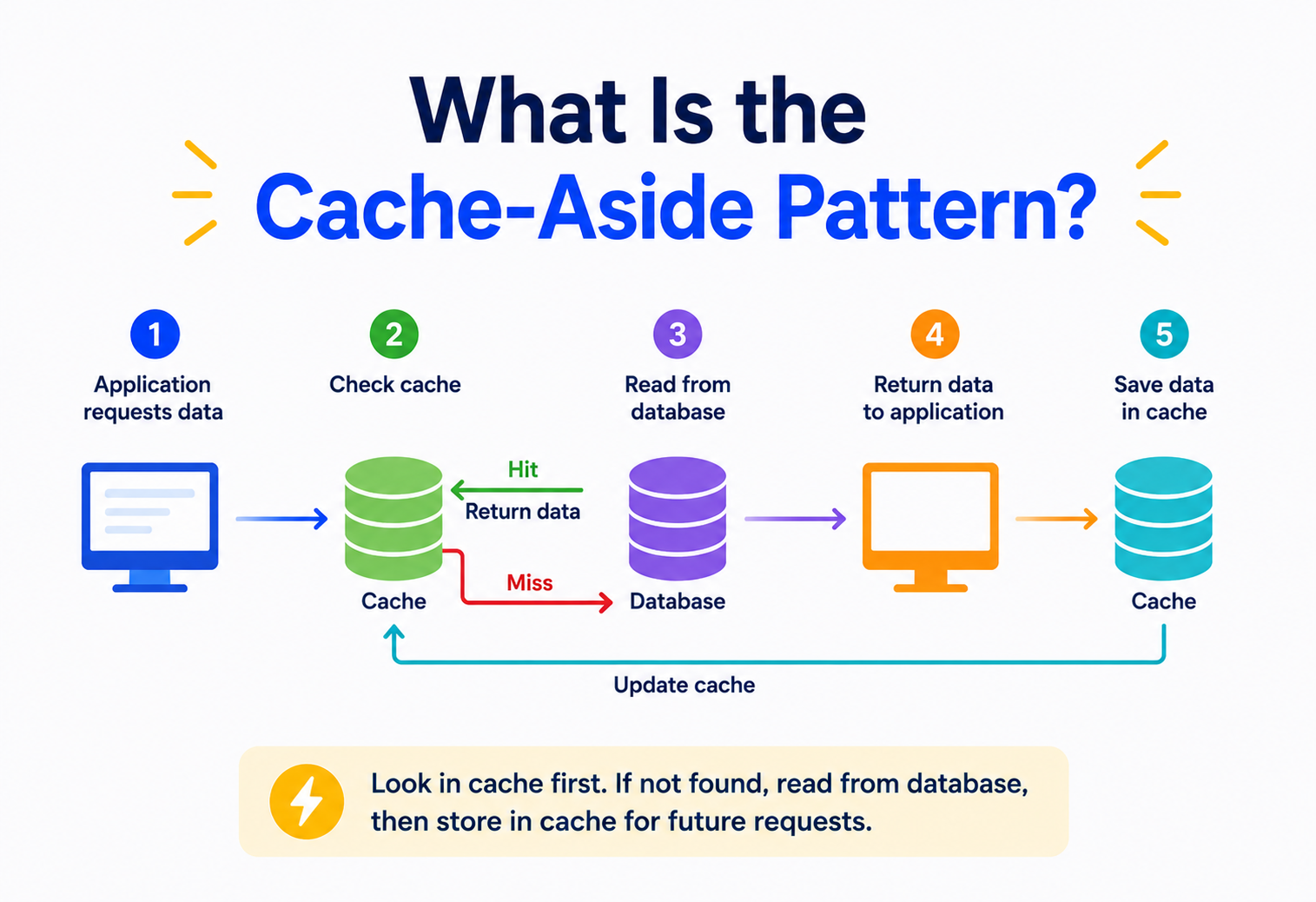
Here is exactly what happens, step by step, when your application needs to read a piece of data:
- The application receives a request for data (e.g., “get product #552”).
- It builds a cache key, e.g.
product:552. - It asks the cache: “Do you have a value for this key?”
- If yes (cache hit): return that value immediately. Done — the database was never touched.
- If no (cache miss): query the database for the data.
- Take the result from the database and write it into the cache under the same key, usually with a TTL.
- Return the result to the caller.
The write path (updates and cache invalidation)
Writes are trickier, because now you must keep the cache and database consistent. The standard cache-aside approach for writes is:
- Write the new data directly to the database (the source of truth).
- Invalidate (delete) the corresponding cache entry — don’t try to update it in place.
- The next read for that key will be a cache miss, which will re-populate the cache with fresh data from the database.
If two write operations happen close together, updating the cache directly can leave it holding an older value than the database (a race condition). Deleting is simpler and safer — it guarantees the next read fetches fresh data from the database instead of trusting a possibly-stale in-place update.
Java example: Read path
public Product getProduct(int productId) {
    String cacheKey = "product:" + productId;

    // Step 1: Try the cache first
    String cachedJson = cache.get(cacheKey);
    if (cachedJson != null) {
        return deserialize(cachedJson);   // Cache HIT
    }

    // Step 2: Cache MISS -> go to the database
    Product product = database.findProductById(productId);
    if (product == null) {
        return null; // not found anywhere
    }

    // Step 3: Populate the cache for next time (TTL = 300 seconds)
    cache.setWithTtl(cacheKey, serialize(product), 300);

    return product;
}
Java example: Write path with invalidation
public void updateProductPrice(int productId, BigDecimal newPrice) {
    // Step 1: Update the source of truth first
    database.updateProductPrice(productId, newPrice);

    // Step 2: Invalidate (delete), don't try to patch the cache
    String cacheKey = "product:" + productId;
    cache.delete(cacheKey);

    // Next read will naturally re-populate the cache with fresh data
}Data Flow & Lifecycle
Let’s trace the full lifecycle of a single cache entry from birth to death.
- 1Creation (Cache Miss → Populate)A user requests data that isn’t cached yet. The application fetches it from the database and stores it in the cache with a TTL. The entry is “born.”
- 2Reuse (Cache Hits)Every subsequent request for the same key is served instantly from the cache, without touching the database, until the entry expires or is deleted.
- 3Invalidation (On Write)If the underlying data changes, the application deletes the cache entry immediately after updating the database, so stale data isn’t served.
- 4Expiry (TTL Timeout)If nothing explicitly deletes the entry, its TTL eventually runs out and the cache automatically removes it — a safety net against forgotten invalidations.
- 5Eviction (Memory Pressure)If the cache runs low on memory before TTL expiry, it may evict (remove) less-used entries early, based on a policy like LRU (Least Recently Used).
- 6RebirthThe cycle restarts: the next request for that key becomes a cache miss again, and the entry is recreated fresh from the database.
Eviction policies you should know
| Policy | Meaning | Analogy |
|---|---|---|
| LRU (Least Recently Used) | Removes the entry that hasn’t been accessed for the longest time | Clearing out the fridge item nobody has touched in weeks |
| LFU (Least Frequently Used) | Removes the entry accessed the fewest number of times | Donating the toy your kid plays with the least |
| FIFO (First In, First Out) | Removes the oldest entry regardless of usage | A queue at a ticket counter — first came, first served (or removed) |
| TTL-based | Removes entries once their timer expires | Food past its expiry date is thrown out automatically |
Advantages, Disadvantages & Trade-offs
- Only requested data gets cached — no wasted memory on unused data
- Cache failures don’t break the app (it just falls back to the database)
- Simple mental model: check, miss, fetch, store
- Works with any database and almost any cache technology
- Resilient to cache restarts — data repopulates naturally on demand
- First request for any key is always slow (a “cold” cache miss)
- Risk of stale data between a database write and cache invalidation
- Extra code complexity — the app must manage cache logic itself
- Possible “thundering herd” problem under high concurrent misses
- Two systems (cache + DB) to keep consistent and monitor
The consistency trade-off
Cache-aside does not guarantee strong consistency — there’s always a small window where the cache might be out of date compared to the database (for example, right between a database update and the cache deletion). This is called eventual consistency: the cache will eventually reflect the truth, just not necessarily instantly.
For most read-heavy applications (product catalogs, user profiles, news feeds), a few hundred milliseconds or seconds of staleness is a perfectly acceptable trade-off for a massive performance gain. For data like bank balances, you’d typically avoid caching writes this loosely, or you’d use very short TTLs combined with careful invalidation.
Performance & Scalability
Cache hit ratio: the most important metric
Cache hit ratio = (cache hits) / (cache hits + cache misses). This single number tells you how effective your cache is. A hit ratio of 95% means only 5% of requests actually reach your database — a massive reduction in load.
If your database can handle 2,000 queries/second safely, and your cache hit ratio is 90%, your application can actually serve roughly 20,000 requests/second in total — because only 10% of them (2,000) reach the database.
The “thundering herd” (cache stampede) problem
Imagine a popular cache entry expires at the exact moment 10,000 requests arrive for it. All 10,000 requests see a cache miss simultaneously and all rush to the database at once — overwhelming it. This is called a thundering herd or cache stampede.
Analogy: Imagine a single door out of a stadium, and everyone tries to leave through it at the exact same second because the game just ended. Chaos.
Common mitigations
- Locking / mutex: Only one request is allowed to query the database and repopulate the cache; others wait briefly or receive slightly stale data.
- Request coalescing: Multiple simultaneous requests for the same missing key are merged into a single database call.
- Jittered TTLs: Instead of every key expiring at exactly 300 seconds, add a small random offset (e.g., 300±30 seconds) so keys don’t all expire at once.
- Stale-while-revalidate: Serve the slightly-old cached value immediately while refreshing it in the background.
Java example: Mitigating thundering herd with a lock
public Product getProductSafely(int productId) {
    String cacheKey = "product:" + productId;
    String cachedJson = cache.get(cacheKey);
    if (cachedJson != null) {
        return deserialize(cachedJson);
    }

    String lockKey = "lock:" + cacheKey;
    // Try to acquire a short-lived distributed lock (e.g. Redis SETNX)
    boolean gotLock = cache.setIfAbsent(lockKey, "1", 5); // 5-second lock

    if (gotLock) {
        try {
            Product product = database.findProductById(productId);
            cache.setWithTtl(cacheKey, serialize(product), 300);
            return product;
        } finally {
            cache.delete(lockKey);
        }
    } else {
        // Another thread is already refilling the cache; wait briefly and retry
        sleep(50);
        return getProductSafely(productId);
    }
}
Negative caching
What happens when a user asks for something that doesn’t exist — like a product ID that was deleted or never existed? Without care, every such request becomes a guaranteed cache miss, hitting the database over and over for data that will never be found. Negative caching solves this by caching the “not found” result itself (usually with a short TTL), so repeated lookups for missing data are also served quickly, protecting the database from being hammered by bots, broken links, or scanning scripts.
Use a much shorter TTL for negative caching than for normal data. If a legitimate item is created moments after being cached as “not found,” you don’t want users to be stuck seeing “not found” for too long.
Cache warming
Instead of always waiting for the first user to trigger a slow cache miss, some systems proactively “warm” the cache — loading known hot keys into it ahead of time, such as right after a deployment, a cache flush, or a scheduled batch job before a predictable traffic spike (like a flash sale). This trades a bit of upfront background work for a smoother experience for the very first real users, avoiding a wave of simultaneous cold misses.
Analogy: A coffee shop grinding beans and pre-brewing a pot before opening its doors, rather than making every single customer in the morning rush wait for the first pot to brew from scratch.
Choosing what to cache: cost vs. benefit
Not everything deserves to be cached. A useful mental checklist before caching any piece of data:
- Is it read far more often than it’s written? High read-to-write ratio is the strongest signal that caching will help.
- Is it expensive to compute or fetch? A complex join or aggregation benefits more from caching than a trivial single-row lookup.
- Can the application tolerate slightly stale data? If the answer is a hard “no,” caching may need very short TTLs or may not be appropriate at all for that specific field.
- Is the data reasonably small? Caching huge blobs eats memory quickly and can push out many smaller, more valuable entries.
Scalability with cache-aside
Because caches like Redis and Memcached can be scaled horizontally (adding more nodes, sharding keys across them), and because most of your read traffic never touches the database at all, cache-aside lets a system scale to serve millions of read requests per second while keeping the database size modest and affordable.
High Availability & Reliability
What happens if the cache goes down?
This is actually one of cache-aside’s biggest strengths. Because the application always knows how to fall back to the database, a cache outage doesn’t take your whole system down — it just makes things slower (every request becomes a “miss”). This graceful degradation is sometimes called failing open.
Always wrap cache calls in a try/catch (or equivalent) so that if the cache server is unreachable, the application silently falls back to the database instead of crashing the whole request.
public Product getProductResilient(int productId) {
    String cacheKey = "product:" + productId;
    try {
        String cachedJson = cache.get(cacheKey);
        if (cachedJson != null) {
            return deserialize(cachedJson);
        }
    } catch (CacheUnavailableException e) {
        log.warn("Cache unavailable, falling back to DB", e);
        // Don't crash — just proceed to the database below
    }

    Product product = database.findProductById(productId);

    try {
        cache.setWithTtl(cacheKey, serialize(product), 300);
    } catch (CacheUnavailableException e) {
        log.warn("Could not populate cache, continuing anyway", e);
    }

    return product;
}
Replication and sharding of the cache itself
To avoid the cache becoming a single point of failure at scale, production caches are usually deployed as clusters:
- Replication: Each cache node has one or more replicas. If the primary node fails, a replica can take over (this is how Redis Sentinel and Redis Cluster work).
- Sharding / Partitioning: Data is split across multiple cache nodes using a hashing strategy (like consistent hashing), so no single node has to store or serve everything.
Disaster recovery considerations
Because a cache is not the source of truth, most teams don’t back it up like a database. If the entire cache cluster is lost, the system simply experiences a temporary flood of cache misses (a “cold cache”) as it slowly refills from the database — painful for a few minutes, but not catastrophic. Some teams “pre-warm” the cache after a major outage by proactively loading known hot keys before opening traffic back up.
CAP theorem and where caching fits in
The CAP theorem is a foundational idea in distributed systems. It states that any distributed data store can only guarantee two out of these three properties at the same time, during a network failure:
- Consistency (C): Every read receives the most recent write or an error.
- Availability (A): Every request receives a (non-error) response, even if it isn’t the most recent data.
- Partition tolerance (P): The system keeps working even if network messages are lost or delayed between nodes.
Since real networks do experience partitions from time to time, partition tolerance is essentially mandatory — meaning in practice, systems must choose between prioritizing Consistency (CP) or Availability (AP) when a partition happens. Cache-aside architectures generally lean toward the AP side: if the cache and database briefly disagree, the system keeps serving responses (from cache or database, whichever is reachable) rather than blocking requests until perfect consistency is restored. This is exactly why cache-aside is described as offering “eventual consistency” rather than strong consistency.
Imagine two friends updating a shared shopping list on paper, but they’re in different rooms and can’t always hear each other. They’d rather each keep shopping with whatever list they have (Availability) than freeze and wait for perfect agreement (Consistency) every single time. Later, when they meet up, they reconcile the differences.
Concurrency and race conditions
Caches are shared by many application threads and many application server instances at once, so race conditions are a real concern. A classic example: Thread A reads stale data from the database (because of replication lag) right as Thread B writes fresh data and invalidates the cache. If Thread A then writes its stale value into the cache after Thread B’s invalidation, the cache ends up holding old data indefinitely, until the TTL eventually clears it.
Common concurrency-safety techniques include:
- Atomic operations: Using cache commands that are inherently atomic (like Redis’s
SETNX,INCR, or Lua scripting) so multiple steps happen as one uninterruptible unit. - Optimistic locking / versioning: Storing a version number alongside the cached value, and only accepting a cache write if the version being written is newer than what’s currently cached.
- Short TTLs on volatile data: Reducing the time window during which a race condition could cause visible harm.
- Distributed locks: As shown earlier in the thundering-herd example, a short-lived lock ensures only one process refills a given cache key at a time.
Replication in caching layers
Just like databases, production caches use replication for durability and failover. In Redis, for example, a primary node handles writes and asynchronously streams changes to one or more replica nodes. If the primary fails, a tool like Redis Sentinel can automatically detect the failure and promote a replica to become the new primary — a process called failover. This keeps the cache available even during hardware failures, though there is a small risk of losing the most recent, not-yet-replicated writes during the failover window (acceptable for a cache, since the database remains the durable source of truth).
Partitioning (sharding) at scale
A single cache server has a limited amount of memory and network throughput. To scale beyond one machine, caches are partitioned (also called sharded): the total key space is divided across many nodes. The most common technique is consistent hashing, which maps both cache nodes and keys onto a circular hash space. Consistent hashing is popular because when a node is added or removed, only a small fraction of keys need to move to a different node — unlike simple modulo-based hashing, where nearly every key would need to be relocated.
Think of consistent hashing like assigning students to lockers arranged in a circle. If one locker breaks, only the students assigned to that one locker (and maybe their immediate neighbor) need to move — everyone else stays exactly where they were.
Consensus and coordination
When a cache cluster needs to agree on things like “who is the current primary node” or “which shard owns this key range,” it relies on consensus algorithms — protocols that let a group of machines agree on a single value even if some of them fail or messages are delayed. Redis Sentinel uses a quorum-based voting approach (a lightweight form of consensus) to decide when to fail over to a new primary; more general-purpose consensus algorithms like Raft or Paxos are used in other distributed coordination systems (such as etcd or ZooKeeper) that some caching and service-discovery layers depend on behind the scenes. As a beginner, the key idea to remember is simple: consensus algorithms exist so that a group of independent machines can make one, shared, trustworthy decision instead of ending up in conflicting states.
Failure recovery in practice
Putting it all together, a well-designed cache-aside system survives failure through layered defenses:
- Node-level: Replication and automatic failover keep a single cache node’s death from taking down the whole cluster.
- Cluster-level: If the entire cache cluster becomes unreachable, the application’s fallback logic routes all reads and writes directly to the database.
- Application-level: Circuit breakers can temporarily stop even trying to reach a consistently failing cache, avoiding wasted time on doomed connection attempts, and periodically test whether the cache has recovered.
- Recovery: Once the cache is back, it starts empty (a “cold” cache) and gradually refills itself through normal cache-aside traffic, or is deliberately pre-warmed with the most important keys first.
Security
- Don’t cache sensitive data blindly: Passwords, tokens, and personal identification numbers generally should not sit in a shared cache unencrypted, since a cache breach could expose them.
- Access control: Cache servers (like Redis) should never be exposed directly to the public internet. Use network isolation (VPC, security groups) and require authentication (Redis AUTH / ACLs).
- Encryption in transit: Use TLS between your application and the cache, especially in cloud environments where traffic may cross networks.
- Cache key injection: Never build cache keys directly from unsanitized user input without validation — a malicious value could be used to guess or collide with other users’ cache keys.
- Data leakage across tenants: In multi-tenant systems, always namespace cache keys by tenant/user ID (e.g.,
tenant123:product:552) so one customer can never accidentally see another’s cached data.
Caching an entire API response that includes a user’s private data using a cache key that isn’t unique per-user — this can leak one person’s private information to another person entirely.
Defense in depth for caches
Because caches sit close to the application and often hold copies of sensitive data temporarily, treating them with the same security seriousness as a database is important, not optional. A layered (“defense in depth”) approach typically includes:
- Network layer: Cache servers live inside a private subnet with no public IP, reachable only from application servers via security group / firewall rules.
- Authentication layer: Strong, rotated passwords or token-based auth (Redis 6+ ACLs let you create fine-grained users with limited permissions, similar to database roles).
- Application layer: Careful key construction and input validation, as discussed above, plus code review focused specifically on what ends up being cached.
- Compliance layer: For regulated industries (finance, healthcare), teams often maintain an explicit inventory of what categories of data are permitted to be cached at all, and for how long, to stay aligned with regulations like GDPR or HIPAA.
The “right to be forgotten” problem
Regulations like GDPR give users the right to request deletion of their personal data. If your system caches that data, a deletion from the primary database isn’t enough — the cache must be explicitly invalidated too, or the “deleted” data could keep reappearing in cached responses until its TTL naturally expires. This is a good example of why cache invalidation logic deserves the same rigor as any other part of a data-deletion workflow.
Monitoring, Logging & Metrics
You cannot improve what you don’t measure. Key metrics to track for any cache-aside system:
Hit Ratio
Percentage of requests served from cache vs. total requests. The single most important number.
Latency (p50/p95/p99)
How long cache hits vs. misses take. Watch for tail latency spikes.
Eviction Rate
How often entries are removed due to memory pressure — a sign you may need a bigger cache.
Memory Usage
Tracks how close the cache is to running out of space.
Error / Timeout Rate
Connection failures or timeouts talking to the cache — early warning of instability.
Database QPS
Should stay low and stable if the cache is doing its job well.
Tools commonly used
Prometheus + Grafana dashboards, Redis’s built-in INFO command and slow log, CloudWatch (AWS ElastiCache), Datadog, and distributed tracing tools (like OpenTelemetry) to see exactly how much time a request spends waiting on the cache vs. the database.
Set an alert if hit ratio suddenly drops below a normal baseline (e.g., from 90% to 40%) — this often signals a bug in cache-key generation, an accidental mass invalidation, or a cache node failure.
Deployment & Cloud
In production, teams rarely run their own cache server by hand. Common managed options include:
| Cloud | Managed Cache Service |
|---|---|
| AWS | ElastiCache (Redis or Memcached) |
| Google Cloud | Memorystore (Redis or Memcached) |
| Azure | Azure Cache for Redis |
| Self-managed / Kubernetes | Redis or Memcached deployed via Helm charts, often with the Redis Operator |
Deployment considerations
- Co-location: Place the cache physically close (low network latency) to the application servers, ideally in the same availability zone.
- Sizing: Estimate memory needs based on (number of hot keys) × (average value size), plus overhead, plus room to grow.
- Blue / green or rolling deploys: Since the cache is separate from application instances, you can deploy new app versions without losing cached data — a major operational benefit.
- Cost optimization: Cache instances are billed by memory size; regularly review TTLs and what’s being cached to avoid over-provisioning.
Databases, Caching & Load Balancing
Cache-aside typically sits alongside — not instead of — other scaling techniques:
- Read replicas: Extra copies of the database used only for reads, reducing load on the primary. Cache-aside reduces load on both the primary and its replicas.
- Load balancers: Distribute incoming requests across many application servers, all of which typically share the same cache cluster.
- Database connection pooling: Even with caching, misses still need efficient database connections — pooling prevents connection exhaustion during traffic spikes.
- CDNs: A related but different concept — CDNs cache static assets (images, videos, JS files) geographically close to users, while application caches like Redis cache dynamic data.
APIs & Microservices
In a microservices architecture, each service often owns its own cache-aside logic for its own data, rather than sharing one giant cache across all services (which creates tight coupling). Common patterns:
- Per-service cache: A “product service” caches product data; an “inventory service” caches stock counts — each independently, using their own keys and TTLs.
- API Gateway caching: Some API gateways (e.g., Amazon API Gateway, Kong) can cache full HTTP responses for GET endpoints, effectively applying a coarse-grained cache-aside pattern at the network edge.
- GraphQL / REST field-level caching: Individual fields or resolvers may be cached separately to avoid re-fetching unrelated data on every request.
If Service A caches data that Service B owns and updates, Service B must have a reliable way (like publishing an event) to tell Service A’s cache to invalidate — otherwise cross-service staleness becomes a serious bug source.
Design Patterns & Anti-patterns
Cache-aside vs. other caching strategies
| Pattern | Who manages the cache? | When cache is filled | Best for |
|---|---|---|---|
| Cache-aside | Application code | On demand (lazy), after a miss | Read-heavy, irregular access patterns |
| Read-through | The cache / library itself | Automatically on miss (cache calls the DB) | Simplifying app code when using frameworks that support it |
| Write-through | The cache itself | On every write, immediately | Strong consistency between cache and DB |
| Write-behind (write-back) | The cache itself | Written to cache first, DB updated asynchronously later | Write-heavy workloads needing very low write latency |
Cache-aside is “lazy” (loads on demand) and puts logic in the app. Write-through / read-through push that logic into the caching layer itself, trading flexibility for simplicity.
A worked comparison: choosing the right pattern
Imagine you’re designing a system that stores user profile pictures’ metadata (URL, upload date, size). Reads massively outnumber writes — people view profiles constantly but rarely change their picture. Cache-aside fits naturally here: cache on read, invalidate on write, and accept a brief moment of staleness right after someone updates their photo.
Now imagine a different system: a stock-trading order book, where every single write must be reflected instantly and consistently for every reader, and losing even one write is unacceptable. Here, write-through (or no caching at all for the critical path) would be a safer choice than cache-aside, because write-through keeps the cache and database updated together as a single, controlled step, reducing the window where they might disagree.
This is a common interview-style trade-off question: “Would you use cache-aside for this system?” The strong answer is never just “yes” or “no” — it’s identifying the read/write ratio, the acceptable staleness window, and the cost of serving wrong data, then matching those constraints to the caching strategy that fits best.
Combining patterns in the real world
Production systems often blend strategies rather than picking just one. A common combination is cache-aside for most read paths (simple, resilient, flexible) plus write-through or explicit event-driven invalidation for a small number of critical, frequently-changing keys where staleness would be especially costly. There’s no single “correct” caching architecture — the right choice always depends on the specific data’s read/write patterns, consistency requirements, and how expensive it is to serve wrong or missing data.
Common anti-patterns to avoid
- Caching everything with no TTL: Leads to unbounded memory growth and stale data lasting forever.
- Updating the cache in place on writes instead of deleting it: Creates race-condition risk where an older write “wins” and overwrites a newer cached value.
- Using the cache as the only copy of data: A cache is not a database — it can lose data at any time (restart, eviction). Never treat it as your source of truth.
- No fallback on cache failure: Letting a cache outage crash your whole application defeats the purpose of a resilience-friendly pattern.
- Overly broad cache keys: E.g., caching an entire page instead of specific reusable pieces, causing unnecessary invalidation of unrelated data.
Best Practices & Common Mistakes
Always set a TTL
Even a generous one (hours) acts as a safety net against invalidation bugs.
Namespace your keys
Use prefixes like service:entity:id to avoid collisions across teams and services.
Handle cache failures gracefully
Never let a down cache take down the whole application.
Delete, don’t update, on writes
Simpler and safer than trying to keep an in-place update perfectly correct.
Add jitter to TTLs
Prevents synchronized mass expiry and stampedes.
Monitor hit ratio continuously
It’s the earliest warning sign of caching problems.
Common mistakes
- Forgetting to invalidate the cache after a database migration or bulk update
- Caching error responses (e.g., a temporary “user not found” due to replication lag) and serving that error for the full TTL
- Using inconsistent serialization formats between write and read paths, causing deserialization failures
- Not accounting for cache warm-up time after a deployment or scale-out event
Most of these mistakes share a common thread: they happen when the cache is treated as an afterthought rather than as a real component of the system that deserves its own design review, its own tests, and its own monitoring dashboard. Teams that get the most value out of cache-aside tend to treat cache-key naming conventions, TTL policies, and invalidation logic as first-class parts of their codebase — documented, reviewed, and revisited as the application grows — rather than a quick hack bolted on during a performance emergency.
Real-World & Industry Examples
Facebook / Meta
Popularized large-scale cache-aside using Memcached in front of MySQL, famously serving billions of cache lookups per second across thousands of Memcached servers.
Netflix
Uses EVCache (built on Memcached) heavily in a cache-aside style to serve personalized homepage and streaming metadata at very low latency across global regions.
Amazon
Product catalog and pricing pages rely on aggressive caching layers so the core order and inventory databases aren’t hammered by simple product-view traffic.
Uber
Caches frequently accessed data like driver locations and surge-pricing zones close to the edge, falling back to core services when data is missing or stale.
While the exact internal engineering details of these companies evolve constantly and aren’t all public, the underlying pattern taught here — check cache, fall back to database on miss, then populate the cache — is the same fundamental idea used across the industry, just tuned with company-specific optimizations (custom eviction algorithms, geo-distributed replicas, and consistent-hashing schemes).
What smaller teams can learn from these examples
You don’t need Netflix-scale traffic to benefit from cache-aside. Even a small startup with a single database server can run into trouble when one popular page (a viral blog post, a trending item, a shared link) suddenly gets far more traffic than usual. Adding a simple Redis cache-aside layer in front of just the handful of “hot” queries — without redesigning your entire architecture — is often the single highest-leverage performance improvement a small engineering team can make. It’s common for a team to see database CPU usage drop by 70–90% after introducing caching for their busiest read endpoints, simply because most of that traffic was repeatedly asking for the same handful of things.
Rather than trying to cache your entire database, start by identifying your top 10–20 slowest or most frequently-hit read queries (using your database’s slow query log or APM tool), and apply cache-aside just to those. This “80/20” approach delivers most of the benefit with a fraction of the engineering effort.
FAQ, Summary & Key Takeaways
Frequently Asked Questions
Is cache-aside the same as “lazy loading”?
Yes — “lazy loading” is another common name for the exact same pattern, emphasizing that data is only loaded into the cache when it’s actually requested, not ahead of time.
What cache technology should I use?
Redis and Memcached are the two most common choices. Redis supports richer data structures (lists, sets, sorted sets) and persistence options; Memcached is simpler and historically very fast for pure key-value caching. For a single-server or low-traffic app, an in-process cache library (like Caffeine in Java) may be enough.
How long should my TTL be?
It depends entirely on how often the underlying data changes and how tolerant your application is of staleness. Rapidly changing data (stock prices) might use seconds; rarely changing data (a country list) might use hours or days.
Can cache-aside guarantee no stale data?
No. It provides eventual consistency, not strong consistency. If you need guaranteed up-to-date reads at all times, you’d need stronger (and slower) techniques, or you’d avoid caching that specific data entirely.
Does cache-aside work with NoSQL databases?
Yes — the pattern is database-agnostic. It works the same way whether your source of truth is PostgreSQL, MongoDB, DynamoDB, or Cassandra.
What’s the difference between cache-aside and a CDN?
Both are forms of caching, but they operate at different layers. A CDN (Content Delivery Network) caches static or semi-static content (images, videos, HTML, JavaScript files) at edge locations physically close to users around the world. Cache-aside, as covered in this tutorial, typically caches dynamic application data (database query results) in a server-side cache like Redis, sitting between your application and your database. You can — and most large systems do — use both together.
Should I cache database query results or fully-rendered objects?
Most teams cache serialized objects (like a JSON representation of a “Product” or “User”) rather than raw SQL result sets, because objects are easier to reuse across different parts of an application and easier to version as your schema evolves.
How do I test cache-aside logic?
Write unit tests that mock the cache and database separately, covering at least three scenarios: (1) cache hit — database should never be called; (2) cache miss — database is called exactly once, and the cache is populated afterward; (3) cache failure — the application still returns correct data from the database without crashing.
Summary
The cache-aside pattern is a simple but powerful idea: let your application check a fast cache first, fall back to the slower database only when necessary, and keep the cache updated as data changes. It’s the most widely used caching strategy in the industry because it’s flexible, resilient to cache failures, and easy to reason about — even though it does require the application to carry a bit of extra logic and to accept eventual (not instant) consistency.
Key Takeaways
- Cache-aside means the application manages cache reads, writes, and invalidation — not the cache itself.
- Read path: check cache → miss → query database → populate cache → return data.
- Write path: update database → delete (invalidate) the cache entry, never update it in place.
- Use TTLs as a safety net against missed invalidations, and add jitter to avoid synchronized expiry.
- Always handle cache failures gracefully — the database should remain the reliable fallback.
- Watch your cache hit ratio as the primary health signal of your caching layer.
- Guard against the thundering herd problem using locks, request coalescing, or stale-while-revalidate.
- Cache-aside trades perfect consistency for major gains in speed and scalability — a trade-off that fits most read-heavy real-world systems.