What Is Zero Trust Security?
From “never trust, always verify” to real architectures at Google, Netflix, and beyond — everything you need to actually understand, design, and defend Zero Trust systems.
Introduction & History
Imagine an office building where, once you swipe your badge at the front door, you can walk into any room, open any filing cabinet, and sit down at any desk — no questions asked. That was how most corporate networks worked for decades. If a device was “inside” the network — plugged into the office LAN, or connected through the VPN — it was trusted. Anything inside the perimeter was assumed safe. Anything outside was the danger.
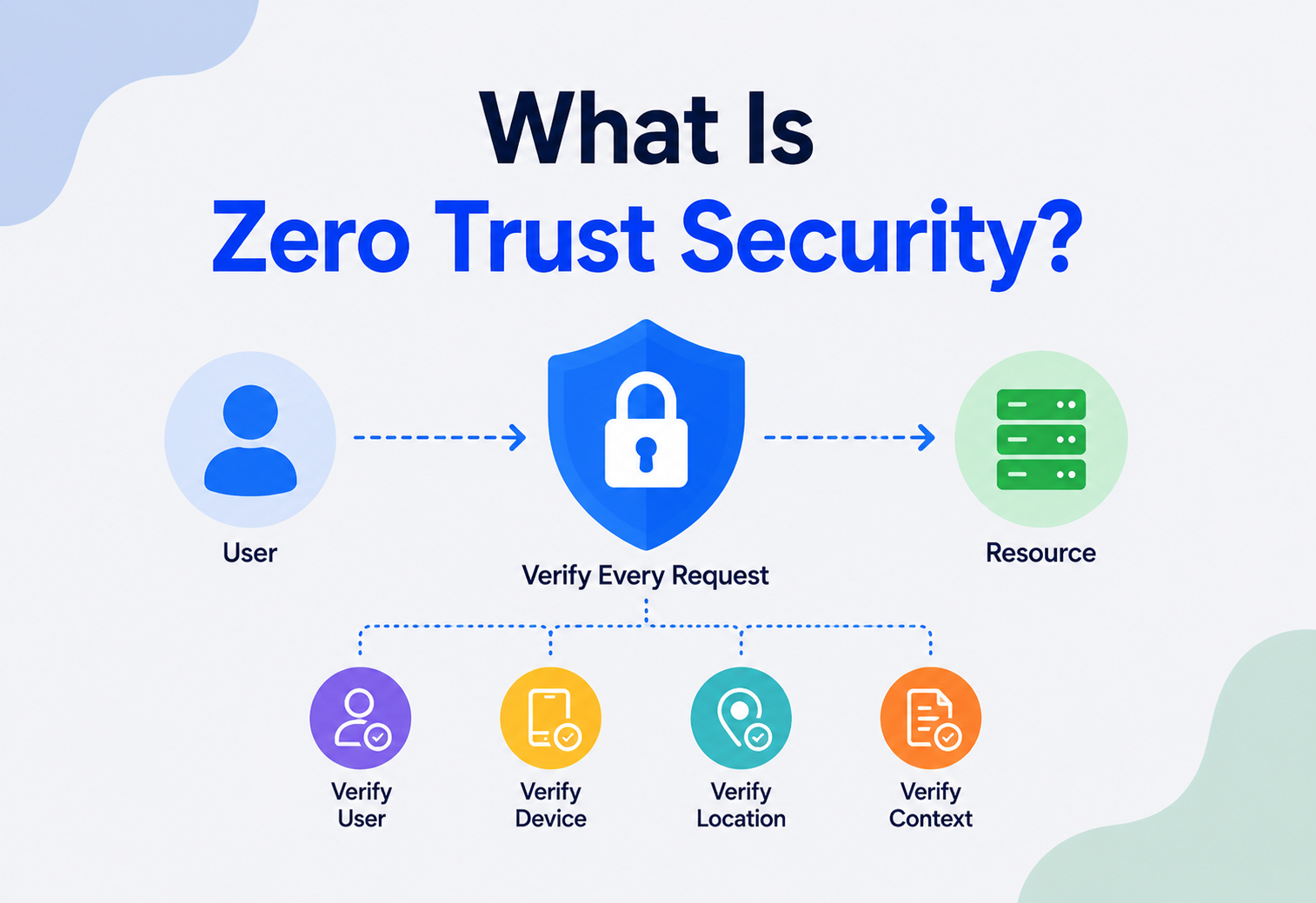
Zero Trust security throws that assumption away. It says: trust nobody and nothing by default — not a device, not a user, not a service — no matter whether they are inside or outside the network boundary. Every single request must prove who it is, prove it is allowed to do what it’s asking to do, and prove it is being made from a healthy, compliant device, every single time.
1.1 Where Did the Term Come From?
The phrase “Zero Trust” was popularised around 2010 by John Kindervag, an analyst at Forrester Research, who argued that the old “trust but verify” model of network security was fundamentally broken. His insight was simple but radical: stop trusting based on network location. A user sitting in the office is not inherently safer than a user connecting from a coffee shop — both must be verified with the same rigor.
The idea did not stay theoretical for long. Google began an internal initiative called BeyondCorp in 2011, triggered partly by a sophisticated nation-state attack (Operation Aurora) that showed how dangerous it was to assume anything inside the corporate network was safe. Google spent nearly a decade re-architecting how its own employees accessed internal applications — removing the traditional VPN entirely and requiring every request to be authenticated and authorised based on user identity and device state, regardless of network location.
By the late 2010s and early 2020s, Zero Trust moved from a niche idea to a mainstream mandate. In the United States, a 2021 presidential executive order on cybersecurity directed federal agencies to adopt Zero Trust architectures, and the National Institute of Standards and Technology (NIST) published SP 800-207, which remains the closest thing the industry has to an official reference architecture for Zero Trust today.
1.2 A Short Timeline
~2010 — Forrester Coins “Zero Trust”
John Kindervag argues that “trust but verify” is broken, and that network location can no longer stand in for trust.
2011 — Google Starts BeyondCorp
Reacting to Operation Aurora, Google spends nearly a decade removing the corporate VPN and replacing it with identity- and device-aware access.
2020 — NIST SP 800-207
NIST publishes the closest thing the industry has to a formal Zero Trust reference architecture, giving vendors and enterprises a common vocabulary.
2021 — US Executive Order 14028
Federal agencies are directed to adopt Zero Trust architectures, kicking off one of the largest coordinated ZT rollouts in the world.
Today
Service meshes, SASE, and cloud-native identity make Zero Trust the default direction for new architectures — not a niche security choice.
1.3 Why Now, and Why Does It Matter to You as an Engineer?
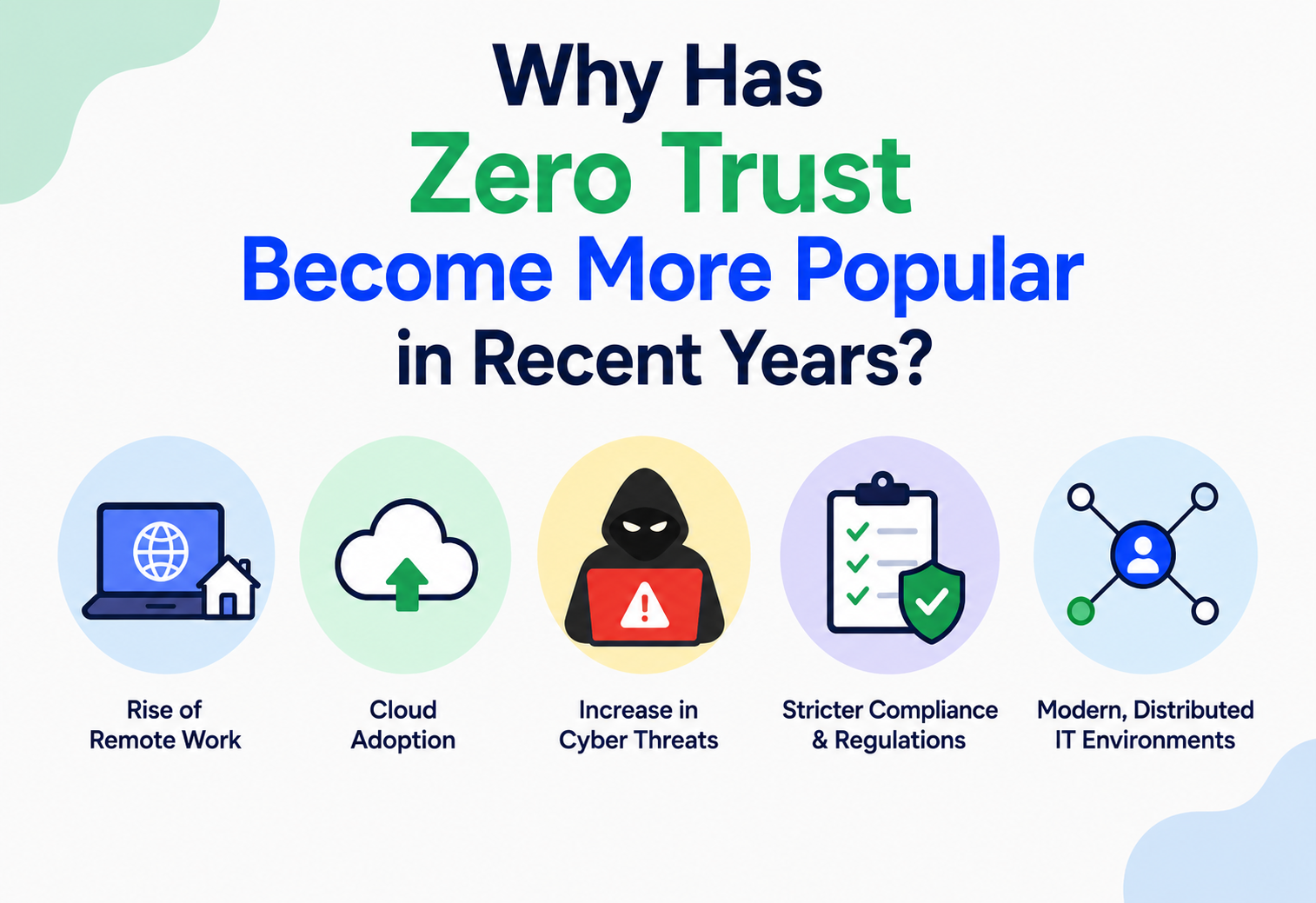
Three forces converged to make Zero Trust unavoidable. First, the perimeter itself dissolved: employees work from home, contractors connect from personal laptops, and workloads run across multiple public clouds — there is no longer a single network edge to defend. Second, attackers evolved: modern breaches rarely come from someone smashing through the firewall from outside; they come from phished credentials, stolen session tokens, or a compromised third-party vendor that already had “trusted” access. Third, microservices architectures multiplied the number of things that talk to each other inside a data centre, so the old idea of “trusted internal traffic” became a much bigger attack surface than it used to be.
As a software architect or engineer, you will increasingly be expected to design systems where authentication and authorisation are not an afterthought bolted onto the network edge, but a property enforced on every single call — between users and services, and between services and other services.
The Problem & Motivation
To understand why Zero Trust exists, you have to understand the model it replaced: the perimeter-based (“castle-and-moat”) security model.
2.1 The Castle-and-Moat Model
In this model, an organisation builds a strong outer wall — firewalls, VPN gateways, intrusion detection systems — around its network. Anyone who successfully gets past that wall (typically by authenticating once, at the VPN or the office Wi-Fi) is then treated as broadly trustworthy. Internal traffic between servers, internal APIs, and internal databases often had little or no additional authentication because “it’s all inside the moat anyway.”
A castle-and-moat model has one catastrophic weakness: once an attacker is inside the moat — through a phished employee credential, a compromised laptop, a vulnerable VPN appliance, or a supply-chain-compromised vendor tool — there is very little standing between them and everything else. This is called lateral movement, and it is the single most common pattern in large-scale breaches over the last fifteen years.
2.2 Concrete Failure Scenarios
Phished Credentials
An employee’s password is stolen via a fake login page. The attacker connects through the VPN using valid credentials and is now “inside,” with the same broad access as the real employee.
Compromised Vendor
A vendor with legitimate, trusted network access to a client’s systems gets breached, and that trusted connection becomes the attacker’s entry point — the pattern behind some of the most damaging retail and government-contractor breaches in history.
Unpatched Internal Service
Because internal traffic between microservices was implicitly trusted, a single vulnerable internal API — never meant to be exposed externally — becomes a pivot point once an attacker is anywhere on the internal network.
Remote Work Explosion
When most employees worked from an office, “inside the network” was a meaningful, physically-defensible boundary. Once most employees started connecting from home routers, coffee shops, and personal devices, that boundary effectively stopped existing — yet many organisations kept defending it as if it still did.
2.3 The Motivation, in One Sentence
Zero Trust exists because network location is not a valid proxy for trust. Being “inside” a network tells you almost nothing about whether a request is legitimate — so every request, from every source, must be independently verified, authorised, and continuously re-evaluated based on identity, device posture, and context, not on which cable or Wi-Fi network it came through.
Picture a college campus with one security guard at the main gate who checks student IDs. Once inside, students can walk into any lecture hall, any lab, any dorm — nobody checks again. Now imagine one stolen or fake student ID gets someone through that gate. They now have free run of the entire campus. Zero Trust is the campus deciding that every building, every lab, every dorm room needs its own ID check, tailored to what that specific room is meant to protect.
Core Concepts
Zero Trust is not a single product you buy — it’s a set of principles that reshape how you design access control. NIST SP 800-207 organises it around a small number of tenets. Let’s unpack the vocabulary you’ll need.
3.1 “Never Trust, Always Verify”
The foundational mantra. No user, device, or workload is trusted by default, regardless of whether it is inside or outside a defined network perimeter. Trust must be established explicitly, for every access request, using verifiable evidence.
3.2 Least-Privilege Access
Every identity — human or machine — is granted the minimum set of permissions needed to do its job, for the shortest useful time. If a service only needs to read from one database table, it should not have write access to the whole database, and it should not hold that access forever if it can be issued short-lived, just-in-time credentials instead.
3.3 Micro-Segmentation
Instead of one large trusted network zone, the network (and the application layer above it) is divided into many small segments, each with its own access boundary. Compromising one segment should not automatically grant access to the next.
3.4 Continuous Verification
Authentication is not a one-time event at login. Zero Trust systems continuously re-evaluate trust signals — has the device’s security posture changed? Is this login attempt coming from an impossible travel location? Has the session been active unusually long? — and can revoke or step up authentication mid-session.
3.5 Identity as the New Perimeter
Since network location can no longer be trusted, identity — of users, devices, and workloads — becomes the primary boundary that access decisions are built around. This is often summarised as “identity is the new perimeter.”
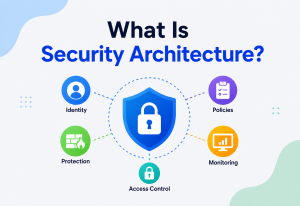
3.6 Policy Decision Point (PDP) and Policy Enforcement Point (PEP)
NIST’s reference architecture splits Zero Trust logic into two roles. The Policy Decision Point is the brain: given a request’s context (who, what device, what resource, what risk signals), it decides allow or deny. The Policy Enforcement Point is the muscle: it sits directly in the path of the request (as a gateway, proxy, or sidecar) and enforces whatever the PDP decided.
3.7 Device Posture / Device Trust
Beyond just “who is the user,” Zero Trust asks “what device are they using, and is it healthy?” A device posture check might verify that disk encryption is enabled, the OS is patched, an EDR (endpoint detection and response) agent is running, and the device is enrolled in corporate device management — before granting access, regardless of who the user is.
3.8 Behavioural and Contextual Signals
Beyond static device checks, mature Zero Trust systems watch for behavioural anomalies over time — is this user suddenly downloading far more data than their historical baseline? Are they authenticating from two geographically distant locations within an impossibly short window (“impossible travel”)? Are they attempting actions outside their normal working hours or outside the scope of their typical role? None of these signals alone is proof of compromise, but combined they feed into the overall trust / risk score a Policy Engine uses, allowing the system to react proportionally — perhaps requiring step-up authentication rather than an outright block, preserving usability while still raising the bar for anything unusual.
3.9 Key Vocabulary at a Glance
| Term | What it means | Everyday analogy |
|---|---|---|
| Subject | The user or workload requesting access | The person trying to enter a building |
| PDP | Decides whether to allow a request | The security control room watching every camera |
| PEP | Enforces the PDP’s decision at the point of access | The physical door lock / turnstile |
| Device posture | Health / compliance state of the requesting device | Checking someone isn’t carrying a weapon before entry |
| Micro-segmentation | Small, isolated network / access zones | Watertight compartments on a ship |
| mTLS | Mutual TLS — both sides of a connection prove identity via certificates | Both people show ID to each other, not just one |
Architecture & Components
A production Zero Trust architecture is made of several cooperating components. Let’s map them out, following the shape of NIST SP 800-207’s logical architecture.
4.1 Policy Enforcement Point (PEP)
This is the gatekeeper that actually sits between a subject and a resource. In practice it can take many shapes: an identity-aware proxy in front of a web app, an API gateway in front of microservices, a service mesh sidecar (like Envoy in Istio) between two internal services, or even a lightweight agent on the resource itself.
4.2 Policy Decision Point (PDP) — Split Into Policy Engine and Policy Administrator
The Policy Engine evaluates trust algorithms against policy rules (role, attributes, risk score) and produces a decision. The Policy Administrator is responsible for actually establishing or shutting down the communication path — issuing a short-lived credential / token, or instructing the PEP to terminate a session.
4.3 Identity Provider (IdP)
The system of record for who a user or workload is — think Okta, Azure AD / Entra ID, Google Workspace, or an internal OIDC provider. Issues tokens (typically OIDC / JWT or SAML) after authenticating a subject, ideally with multi-factor authentication (MFA).
4.4 Device Trust / Endpoint Management
A system (like an MDM — mobile device management — or an EDR platform) that reports the security posture of a device: patch level, disk encryption, whether it’s jailbroken / rooted, whether required agents are running.
4.5 Policy Engine / Attribute Sources
Feeds the PDP with contextual signals: user role, group membership, time of day, geolocation, IP reputation, resource sensitivity classification, and real-time threat intelligence.
4.6 Micro-Perimeters and the Service Mesh
In a microservices world, the PEP concept is frequently implemented via a service mesh — a dedicated infrastructure layer (Istio, Linkerd, Consul Connect) that transparently injects a sidecar proxy next to every service instance. Every service-to-service call is intercepted by these sidecars, which enforce mutual TLS and fine-grained authorisation policies without the application code needing to know anything about it.
Google’s BeyondCorp architecture puts an identity-aware proxy in front of every internal application. When an engineer tries to open an internal tool, the request first hits this proxy, which checks the user’s identity (via SSO + MFA) and the device’s certificate-backed trust level before ever letting the request reach the actual application server — regardless of whether the engineer is in a Google office or on a hotel Wi-Fi network on the other side of the world.
4.7 Trust Algorithm Types: Criteria-Based vs. Score-Based
NIST SP 800-207 describes two broad styles the Policy Engine can use to reach a decision. A criteria-based trust algorithm evaluates a fixed checklist of required attributes — the request either meets every required condition (correct group, compliant device, approved location) or it doesn’t; there is no partial credit. A score-based trust algorithm instead assigns a numeric confidence score to each signal (device health, behavioural normalcy, network reputation) and combines them into an overall trust score, which is then compared against a threshold that can vary by the sensitivity of the resource being requested. Score-based approaches are more flexible — a slightly out-of-date device patch level might still be enough to access a low-sensitivity internal wiki, but not enough to access payroll data — but they are also harder to reason about, test, and explain during an audit.
4.8 The Role of a Policy Information Point (PIP)
Many real deployments add a further component: the Policy Information Point, which acts as an aggregator that feeds the PDP with all the raw attribute data it needs — pulling from the HR system (is this person still employed?), the device management platform, threat intelligence feeds, and the resource catalog (how sensitive is this particular resource?). Keeping this data-gathering role separate from the actual decision logic keeps the Policy Engine simpler and makes it easier to add new signal sources over time without rewriting core policy logic.
Internal Working — How a Request Actually Gets Verified
Let’s trace, step by step, what happens when a user tries to access a protected internal application in a mature Zero Trust deployment.
- Initial authentication: The user opens the application and is redirected to the Identity Provider. They authenticate with a password plus a second factor (MFA) — a push notification, hardware key (like a YubiKey / FIDO2 token), or TOTP code.
- Token issuance: The IdP issues a short-lived token (commonly an OIDC ID token / access token, a JWT) that encodes the user’s identity and some claims (roles, groups).
- Device posture check: In parallel, the client presents a device certificate or the endpoint agent reports posture data (OS version, disk encryption, EDR status) to the Device Trust service.
- Request hits the PEP: The user’s request, carrying the token, arrives at the identity-aware proxy / API gateway in front of the target resource.
- PEP consults the PDP: The PEP forwards the relevant context — identity claims, device posture, requested resource, source IP, time — to the Policy Decision Point.
- Policy evaluation: The Policy Engine evaluates rules such as: “Is this user in the ‘billing-team’ group? Is the device compliant? Is the resource classified as ‘sensitive’, requiring a device posture score above 80? Is the request coming from an unusual location, requiring step-up MFA?”
- Decision returned: The PDP returns allow, deny, or “step-up required” (e.g. re-prompt for MFA) back to the PEP.
- Enforcement: If allowed, the PEP forwards the request onward — often minting a new short-lived, narrowly-scoped internal token for the downstream service, rather than passing the original user token everywhere.
- Continuous re-evaluation: The session is not trusted indefinitely. Access tokens expire quickly (often minutes), device posture is periodically re-checked, and anomalous behaviour mid-session (impossible travel, sudden privilege escalation attempts) can trigger re-authentication or termination.
- Everything is logged: Every decision — allow or deny — is written to an audit log, feeding into a SIEM (Security Information and Event Management) system for detection and forensics.
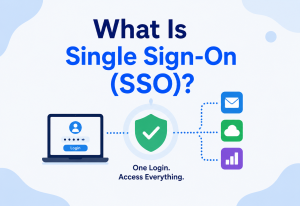
5.1 Service-to-Service Verification (mTLS)
The same “never trust, always verify” idea applies between backend services, not just between a human and an application. This is typically implemented with mutual TLS (mTLS): unlike normal TLS, where only the server proves its identity to the client, mTLS requires both sides to present certificates and verify each other before any data flows.
Here’s a simplified Spring Boot configuration where a microservice acts as an OAuth2 resource server, validating every incoming request’s JWT against the identity provider before allowing it to reach any controller — a basic building block of Zero Trust at the application layer.
// build.gradle dependency
// implementation 'org.springframework.boot:spring-boot-starter-oauth2-resource-server'

@Configuration
@EnableWebSecurity
public class ZeroTrustSecurityConfig {

    @Value("${oauth2.issuer-uri}")
    private String issuerUri;

    @Bean
    public SecurityFilterChain filterChain(HttpSecurity http) throws Exception {
        http
            // Never trust by default: every request must be authenticated
            .authorizeHttpRequests(auth -> auth
                .requestMatchers("/actuator/health").permitAll()
                .requestMatchers("/api/billing/**").hasAuthority("SCOPE_billing:read")
                .anyRequest().authenticated()
            )
            // Validate JWT on every single request - no session-based trust
            .oauth2ResourceServer(oauth2 -> oauth2
                .jwt(jwt -> jwt.decoder(jwtDecoder()))
            )
            // Stateless: no server-side session to "remember" a prior trust decision
            .sessionManagement(sm -> sm
                .sessionCreationPolicy(SessionCreationPolicy.STATELESS)
            );
        return http.build();
    }

    @Bean
    public JwtDecoder jwtDecoder() {
        // Validates signature, expiry, and issuer against the IdP on every call
        NimbusJwtDecoder decoder = JwtDecoder.withIssuerLocation(issuerUri).build();
        decoder.setJwtValidator(JwtValidators.createDefaultWithIssuer(issuerUri));
        return decoder;
    }
}
Notice the key Zero Trust properties baked into this configuration: sessions are stateless (no long-lived server-side trust), every request is authenticated against the IdP, and authorisation is scoped down to specific permissions (SCOPE_billing:read) rather than a blanket “logged in = trusted” model.
Data Flow & Lifecycle of Trust
It helps to think of Zero Trust not as a static wall but as a continuous lifecycle that a piece of trust — a token, a session, a certificate — moves through.
6.1 Token Minting and Expiry
Tokens are deliberately short-lived (often 5–15 minutes for access tokens) so that a stolen token has a small window of usefulness. Refresh tokens allow a legitimate client to get a new access token without re-prompting the user constantly, but refresh tokens themselves are tightly scoped and can be revoked centrally.
6.2 Continuous Risk Scoring
Modern Zero Trust platforms compute a dynamic risk score per session using signals like: has the IP address changed to an unusual country mid-session? Is the device suddenly missing its EDR heartbeat? Has the user attempted unusual actions? A rising risk score can silently downgrade a session’s privileges or force step-up authentication — without necessarily kicking the user out entirely.
6.3 Revocation Propagation
When an admin disables a user’s account or a device is reported stolen, that revocation needs to propagate quickly across every PEP and cached token. This is one of the harder distributed-systems problems in Zero Trust: how do you revoke a JWT that a service already has cached, without going back to a central store on every single request? Common approaches include very short token TTLs (so the token simply expires soon), token introspection endpoints (trade latency for freshness), or a distributed revocation list broadcast to PEPs.
There’s a real trade-off here similar to the CAP theorem’s consistency-versus-availability tension: do you want every PEP to check a central “is this token revoked?” service on every request (strong consistency, but adds latency and a single point of failure), or do you accept eventual consistency (a revoked token might still work for a few seconds until it naturally expires or a cache refreshes)? Most production systems choose short-lived tokens plus asynchronous revocation lists as a pragmatic middle ground.
Pros, Cons & Trade-offs
Zero Trust is not free — the benefits are enormous, but so is the engineering and organisational lift. Understanding both sides honestly is what separates a real adoption from a marketing badge.
Advantages
- Dramatically reduces blast radius of a breach via micro-segmentation and least privilege.
- Works naturally for remote / hybrid workforces — no reliance on “being on the corporate network.”
- Reduces reliance on a single perimeter defence (defence in depth).
- Fine-grained, auditable access decisions improve compliance posture.
- Limits lateral movement even after initial compromise.
Costs / Trade-offs
- Significant upfront engineering and organisational investment.
- Every request now carries authentication / authorisation latency overhead.
- Operational complexity: more moving parts (IdP, PDP, PEP, device trust) to keep highly available.
- Legacy applications that can’t be easily fronted by a PEP are hard to retrofit.
- Poorly tuned policies can create false positives that block legitimate work.
The core trade-off to internalise: Zero Trust trades simplicity and raw performance for reduced blast radius and better auditability. A castle-and-moat network is simpler to reason about and faster (one check, then free movement), but catastrophic when breached. Zero Trust is slower per-request and organisationally heavier to build, but contains damage far better.
Performance & Scalability
Because every request now involves at least one extra round trip (to validate a token, check policy, sometimes check device posture), performance engineering matters a lot in Zero Trust systems.
8.1 Where the Latency Comes From
- Token validation: Verifying a JWT signature is fast (microseconds, using cached public keys) — but if you instead call a remote token-introspection endpoint on every request, that network round trip can add tens of milliseconds.
- Policy evaluation: Complex attribute-based policies (checking group membership, device posture, resource sensitivity) may require the PDP to query multiple backend systems.
- mTLS handshake overhead: Establishing new mTLS connections for every service call is expensive; connection pooling and keep-alive are essential.
8.2 How Production Systems Scale This
- Prefer signature-based JWT verification over introspection wherever possible — verify locally using cached public keys (JWKS) rather than calling the IdP on every request.
- Cache policy decisions for a short TTL (seconds, not minutes) when the same subject repeatedly accesses the same resource, balancing freshness against load on the PDP.
- Push policy evaluation to the edge — service mesh sidecars evaluate policy locally using a synced policy bundle (this is exactly what Open Policy Agent / OPA does), avoiding a network hop to a central PDP for every call.
- Connection reuse for mTLS — service meshes maintain persistent, pooled mTLS connections between sidecars rather than paying the handshake cost per request.
Netflix’s internal service mesh terminates mTLS at the sidecar layer and reuses long-lived, pooled connections between services, so that the cryptographic handshake cost is amortised across thousands of requests rather than paid on every single call — critical at Netflix’s scale of billions of internal requests per day.
High Availability & Reliability
In a castle-and-moat model, if your firewall goes down, traffic often fails open in an uncontrolled way, or the whole network segment is unreachable. In Zero Trust, the PDP and IdP become critical-path dependencies for literally everything — if they go down, every request that needs a fresh decision could be blocked. This makes their availability design especially important.
9.1 Avoiding a Single Point of Failure
- Deploy the IdP and PDP across multiple availability zones / regions with active-active or active-passive replication.
- Design for graceful degradation, not fail-open: if the PDP is unreachable, the correct default is almost always deny, not allow — but combine this with cached, recently-valid decisions to avoid a total outage for already-authenticated sessions.
- Local policy caching at the PEP: systems like OPA sidecars keep a locally synced copy of policy so that even a temporary PDP outage doesn’t halt every request in the mesh — new policy updates just can’t propagate until connectivity is restored.
9.2 Failure Recovery Patterns
Circuit breakers are used around calls to the PDP / IdP: if the identity provider becomes slow or unresponsive, a circuit breaker can stop hammering it with retries (which would make the outage worse) and instead serve a controlled, safe-default response. Rate limiters on authentication endpoints also protect the IdP from being overwhelmed during a credential-stuffing attack or a retry storm from misbehaving clients.
Some early Zero Trust rollouts “fail open” when the policy engine times out, silently allowing requests through to avoid breaking production. This defeats the entire purpose of Zero Trust — a PDP outage becomes a free pass for attackers. The correct default is fail-closed, cushioned by short-lived cached decisions for continuity, not a blanket bypass.
9.3 Disaster Recovery for Identity Infrastructure
Disaster recovery planning for Zero Trust infrastructure deserves the same rigor as DR planning for a primary production database. This typically means: a documented, regularly-tested runbook for failing the IdP over to a secondary region; “break-glass” emergency access procedures that let a small set of highly-vetted administrators regain access if the primary identity system is completely unavailable (protected by its own extremely strict controls, since a break-glass account is an obvious high-value target); and regular game-day exercises where teams intentionally simulate an IdP or PDP outage to verify that dependent systems degrade safely rather than catastrophically.
9.4 A Simple Maturity Model
Organisations rarely arrive at full Zero Trust overnight. It helps to think in stages:
Foundational
MFA everywhere, centralised identity, basic device inventory.
Intermediate
Short-lived credentials replace static secrets, network micro-segmentation begins, policy decisions are centrally logged.
Advanced
Continuous, risk-based re-evaluation of sessions, automated certificate lifecycle management, policy-as-code with CI / CD-gated changes.
Optimal
Every request, human or machine, is dynamically evaluated in real time against rich contextual signals, with sub-second detection and automated response to anomalous access patterns.
Most organisations, even mature ones, have a mix of maturity levels across different systems — and that’s normal; the goal is steady progress on the highest-value assets first, not a single “done” state.
Securing Zero Trust Itself
Zero Trust is a security architecture, but the components that implement it — the IdP, the PDP, the certificate authority issuing mTLS certs — become extremely high-value targets themselves. Securing Zero Trust infrastructure deserves its own attention.
10.1 Protect the Identity Provider Above Everything Else
Since identity is the new perimeter, the IdP is the new crown jewel. It must be protected with hardware-backed MFA for administrators, strict change control, and continuous monitoring for anomalous admin activity — a compromised IdP undermines the entire Zero Trust model at once.
10.2 Certificate Lifecycle Management
mTLS depends on a working, well-secured internal certificate authority (CA) issuing short-lived certificates to every workload. Automating certificate issuance and rotation (e.g. via tools like SPIFFE / SPIRE, cert-manager on Kubernetes, or HashiCorp Vault’s PKI engine) is essential — manual certificate management does not scale and inevitably leads to expired-certificate outages or, worse, long-lived certificates that stay valid for years, undermining the “short-lived trust” principle.
10.3 Least Privilege for the Policy Engine Itself
The service account that lets the PDP query group memberships, device posture, and risk signals should itself have narrowly scoped, read-only access — a compromised PDP should not be able to modify identities or policies, only evaluate them.
10.4 Secure the Supply Chain of Policy
Policy-as-code (e.g. Rego policies for OPA) should go through the same code review, testing, and CI / CD pipeline as application code. An attacker who can quietly push a permissive policy change bypasses Zero Trust entirely without ever touching an application.
Think of it like giving your building’s master keycard system its own extra-secure vault. If someone steals the master keycard printer, they can mint themselves a key to every room in the building — so that printer needs more protection than any individual room does.
Monitoring, Logging & Metrics
Because Zero Trust relies on continuous verification rather than a one-time perimeter check, observability isn’t optional — it’s the mechanism that makes “continuous” actually mean something.
11.1 What to Log
- Every authentication attempt (success and failure), with device and location metadata.
- Every authorisation decision made by the PDP — allow, deny, and step-up — with the reasoning / policy that triggered it.
- Token issuance, refresh, and revocation events.
- mTLS handshake failures between services (often an early signal of misconfiguration or an attempted spoof).
- Device posture check results and posture state changes.
11.2 Key Metrics to Track
| Metric | Why it matters |
|---|---|
| PDP decision latency (p50 / p95 / p99) | Directly adds to every user-facing request’s latency. |
| Authorisation denial rate | Spikes can indicate an attack, or a misconfigured policy blocking real users. |
| Token validation error rate | Signals expired-cert issues, clock skew, or forged tokens. |
| Device posture compliance rate | Tracks how much of the fleet is meeting security baseline. |
| Step-up authentication trigger rate | Helps tune risk-scoring thresholds against user friction. |
| PDP / IdP availability (uptime) | Since these are now critical-path, their SLA gates every other SLA. |
11.3 Correlation IDs and Distributed Tracing
A single user action can fan out across dozens of microservices, each performing its own authorisation check. Attaching a correlation ID / trace ID to every request — and propagating it through every PEP and PDP call — is essential for reconstructing “what actually happened” during an incident, and for feeding a SIEM system that can detect multi-step attack patterns spanning several services.
Large financial institutions typically feed every PDP allow / deny decision, along with distributed trace context, into a SIEM pipeline in near real time, allowing security teams to detect patterns like “the same identity was denied access to 40 different sensitive resources within 2 minutes” — a strong signal of credential compromise or an insider threat, that would be invisible looking at any single denied request in isolation.
Deployment & Cloud
Zero Trust maps naturally onto modern cloud-native deployment patterns, because cloud environments never had a traditional network perimeter to begin with.
12.1 Zero Trust and Kubernetes
In Kubernetes, Zero Trust is typically implemented via a combination of: Network Policies (restricting which pods can talk to which — a form of micro-segmentation), a service mesh (Istio / Linkerd) providing automatic mTLS and fine-grained authorisation between pods, and identity federation so that workloads get scoped, short-lived cloud credentials (e.g. via IRSA on AWS EKS, or Workload Identity on GKE) instead of long-lived static secrets baked into container images.
12.2 Multi-Cloud and Hybrid Environments
Because Zero Trust doesn’t depend on a physical network boundary, it is one of the few security models that genuinely works the same way whether a workload runs on-premises, in AWS, in Azure, or in GCP — identity, device posture, and policy travel with the request instead of being tied to a specific network’s location.
12.3 SASE — Secure Access Service Edge
SASE is the networking industry’s productised version of Zero Trust principles at the edge: instead of backhauling all traffic through a central corporate data centre for inspection, security policy enforcement moves to distributed points of presence close to the user, combining Zero Trust Network Access (ZTNA), a cloud-delivered firewall, and secure web gateway functions.
12.4 CI / CD Pipeline Identity
Zero Trust extends to build pipelines too: rather than long-lived, static cloud credentials stored as CI secrets, modern pipelines use short-lived, workload-identity-federated tokens (e.g. GitHub Actions OIDC tokens exchanged for temporary AWS credentials) — applying the same “no standing, long-lived trust” principle to the software supply chain itself.
Databases, Caching & Load Balancing
The data tier is where a lax Zero Trust rollout usually shows up first — because if the database still takes a single shared password, everything above it is only as strong as that one secret.
13.1 Database Access Under Zero Trust
Databases are frequently the most sensitive resource in a system, so they get some of the strictest Zero Trust treatment: applications authenticate to the database using short-lived, dynamically generated credentials (e.g. HashiCorp Vault’s database secrets engine issues a unique username / password per application instance, valid for a limited time) instead of a single shared static password baked into a config file.
Network-level access to the database is also segmented — only the specific service (or PEP in front of it) that legitimately needs database access is allowed to open a connection at all, enforced via network policies or security groups, not by “it’s on the internal network so it’s fine.”
13.2 Caching Policy Decisions
Because PDP calls add latency, many architectures cache authorisation decisions briefly — but caching must be done carefully. A common pattern is to cache “allow” decisions for a very short TTL (a few seconds) keyed by (subject, resource, action), while never caching “deny” decisions for long, since a legitimately fixed permission issue should take effect quickly.
13.3 Load Balancing the PDP and IdP
Since the PDP and IdP sit on the critical path of nearly every request, they need to be treated with the same load-balancing rigor as your most important production service: multiple healthy replicas behind a load balancer, health checks that actually exercise the authentication / decision logic (not just a bare TCP check), and geographic distribution so a regional outage doesn’t take down authentication globally.
Think of a bank that gives each teller a temporary, single-use vault combination that changes every hour, rather than one master combination that never changes. Even if a combination leaks, it’s useless an hour later. That’s exactly what short-lived, dynamically generated database credentials achieve for application-to-database access.
APIs & Microservices
Microservices are where Zero Trust principles become most visible in day-to-day engineering work, because the number of internal API calls vastly outnumbers external ones.
14.1 API Gateway as PEP
An API gateway sitting in front of a set of microservices is a natural place to implement the Policy Enforcement Point role for external and cross-team traffic: validating tokens, enforcing rate limits per identity, and routing only authorised requests onward.
14.2 Service-to-Service Authorisation With Scoped Tokens
Rather than a single user token being blindly forwarded through five downstream services (each trusting it fully), a common Zero Trust pattern is token exchange: each service, before calling the next one, exchanges its current token for a new, narrower-scoped token appropriate to that specific downstream call — a form of least privilege applied to inter-service calls.
// Example: a Spring Boot service exchanging an incoming user token
// for a narrowly-scoped service token before calling downstream

@Service
public class OrderServiceClient {

    private final WebClient webClient;
    private final TokenExchangeService tokenExchangeService;

    public OrderDetails fetchOrder(String orderId, Jwt incomingToken) {
        // Never forward the original broad-scope user token downstream.
        // Exchange it for a token scoped only to "orders:read".
        String scopedToken = tokenExchangeService.exchange(
                incomingToken.getTokenValue(),
                "orders:read"
        );

        return webClient.get()
                .uri("/internal/orders/{id}", orderId)
                .headers(h -> h.setBearerAuth(scopedToken))
                .retrieve()
                .bodyToMono(OrderDetails.class)
                .block();
    }
}
14.3 mTLS Between Services via a Service Mesh
In a mesh-based setup, application code (like the example above) doesn’t even need to manage mTLS certificates itself — the sidecar proxy transparently intercepts outbound and inbound traffic, wrapping it in mTLS and enforcing authorisation policy, so developers get Zero Trust properties largely “for free” at the infrastructure layer.
14.4 API-Level Least Privilege
Fine-grained API scopes (orders:read, orders:write, billing:read) rather than one broad “authenticated” flag let each service request exactly the access it needs — an attacker who compromises one service’s credentials should not be able to use them against unrelated APIs.
14.5 Rate Limiting as a Zero Trust Control
Rate limiting is often thought of purely as a reliability mechanism, but under Zero Trust it also functions as a security control: limiting how many requests a given identity — human or workload — can make per minute bounds the damage a compromised credential can do even after it passes authentication and authorisation. A compromised service account that suddenly tries to read ten thousand records a second, far outside its normal baseline, should trip both a rate limiter and an anomaly-detection alert, even though every individual request was technically “authorised.”
14.6 Backward Compatibility and API Versioning Under Zero Trust
Rolling out stricter scopes on an existing API is a common source of production incidents if done carelessly: older API clients that were never issued the new, narrower scope suddenly start failing. Mature teams handle this the same way they’d handle any breaking API change — announce a deprecation window, run the new scope requirement in audit-only / log-only mode first, notify owners of client applications still using the old broad scope, and only flip to hard enforcement once telemetry shows every legitimate caller has migrated.
Design Patterns & Anti-Patterns
The patterns worth stealing directly — and the shapes worth watching out for when reviewing someone else’s architecture.
Patterns to Adopt
- Identity-aware proxy — a single, well-defended chokepoint that fronts every internal application with SSO + device trust.
- Sidecar-enforced mTLS — offload identity / encryption concerns to infrastructure (service mesh) rather than reimplementing them in every service’s application code.
- Token exchange — downgrade broad user tokens into narrowly-scoped service tokens as they cross service boundaries.
- Policy-as-code — express authorisation rules in a versioned, reviewable, testable format (e.g. Rego for OPA) rather than clicking through an admin console, enabling code review and CI testing of security policy changes.
- Just-in-time (JIT) access — instead of standing admin permissions, engineers request elevated access for a specific task, approved and automatically expiring after a short window, dramatically shrinking the time window an attacker can exploit a compromised admin account.
- Short-lived credentials — make every secret expire in minutes to hours, not months to years.
Anti-Patterns to Avoid
- “Zero Trust theatre” — deploying Zero Trust-branded products (an identity-aware proxy, say) at the edge of the network, while internal service-to-service traffic remains completely unauthenticated. This is castle-and-moat with a new coat of paint, not real Zero Trust.
- VPN + trust everything inside — the classic anti-pattern the entire model was built to replace.
- Long-lived static tokens baked into config files or environment variables, valid for months or years.
- Fail-open PDP — silently allowing requests through when the policy engine is unreachable, quietly disabling your entire security model exactly when it’s needed most.
- One giant shared IAM role — giving every microservice the same broad cloud IAM role “to keep things simple” defeats least privilege entirely; a compromise of any one service grants access equivalent to compromising all of them.
- Treating MFA as sufficient on its own — strong initial authentication without continuous device posture and behavioural checks still leaves session hijacking and token theft largely unaddressed.
Best Practices & Common Mistakes
A short, opinionated checklist for teams starting or maturing a Zero Trust programme. Nothing here is theoretical — every item is a place real rollouts either succeeded or quietly failed.
16.1 Best Practices
Start With Your Highest-Value Assets
Don’t try to Zero-Trust-ify your entire estate on day one — identify the most sensitive systems (customer data, financial systems, admin consoles) and apply strict identity, device, and micro-segmentation controls there first.
Inventory Before You Enforce
You cannot write good access policy for services and data flows you don’t know exist. Discovery and asset inventory is unglamorous but foundational.
Short-Lived by Default
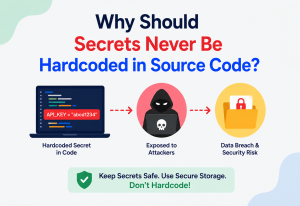
Every new service, pipeline, and integration should default to short-lived, automatically rotated credentials rather than static secrets.
Monitor Before You Block
Roll out new policies in “audit / log-only” mode first, review what would have been denied, and only then switch to active enforcement — this avoids breaking legitimate workflows nobody knew depended on broad access.
Automate Rotation
Automate certificate and secret rotation. Manual processes don’t survive contact with a large, fast-moving engineering organisation.
Treat IdP / PDP as Tier-0
Treat the IdP and PDP as tier-0 critical infrastructure — with the highest SLA, the most rigorous change control, and dedicated on-call ownership.
16.2 Common Mistakes
- Rolling out enforcement too fast, across too much, at once — breaking dozens of workflows simultaneously erodes organisational trust in the Zero Trust programme itself.
- Ignoring legacy systems that can’t easily support modern token-based auth, leaving a large unmodernised gap in an otherwise strong architecture.
- Over-relying on network-level controls alone (firewalls, network policies) without also solving application-level identity and authorisation — true Zero Trust needs both layers working together.
- Treating Zero Trust as a one-time project rather than an ongoing discipline — policies, device fleets, and threat landscapes all keep changing, so policy needs continuous tuning.
- Under-investing in developer experience — if getting a short-lived credential is painful and slow, engineers will route around it with static secrets and shared logins, quietly reintroducing exactly the risk Zero Trust was meant to remove.
Real-World / Industry Examples
Abstract advice gets much sharper once you see how the biggest platforms and governments actually put Zero Trust into practice.
Google BeyondCorp
Perhaps the most cited real-world Zero Trust implementation. Google removed the traditional corporate VPN entirely for internal application access, replacing it with identity-aware proxies in front of every internal app, device-certificate-based trust, and continuous, context-aware authorisation — allowing engineers to work securely from any network, including a public café Wi-Fi, with no VPN client required.
Netflix — Service Mesh + Internal PKI
Netflix operates at a scale of enormous internal service-to-service traffic and has invested heavily in automated, short-lived internal certificates and mTLS enforced transparently at the infrastructure layer, so that individual engineering teams don’t need to reimplement authentication logic themselves — Zero Trust becomes a platform capability rather than a per-team burden.
US Federal Government
Following a series of high-profile breaches, Executive Order 14028 and NIST SP 800-207 mandated federal civilian agencies to develop Zero Trust implementation plans, with SP 800-207 serving as the primary reference architecture — one of the largest coordinated, mandated Zero Trust rollouts in the world, spanning thousands of legacy and modern systems.
Finance & Healthcare
Highly regulated industries have been early, aggressive Zero Trust adopters, largely driven by compliance frameworks that increasingly expect fine-grained, auditable access control and least privilege as baseline requirements, not optional hardening.
Many large technology companies now issue employees a hardware security key (FIDO2 / WebAuthn) as their primary second factor, combine it with a managed, continuously-attested corporate device, and route all internal application access through an identity-aware proxy — collapsing “VPN access” and “internal network trust” into a single, continuously re-verified identity-and-device-based decision on every request.
FAQ, Summary & Key Takeaways
The questions that come up most often the first time an engineer or architect seriously investigates Zero Trust as a discipline — followed by the summary and the takeaways worth remembering.
No. Zero Trust is an architectural philosophy and a set of principles (NIST SP 800-207 being the closest thing to a formal spec). Vendors sell products — identity-aware proxies, service meshes, ZTNA / SASE platforms — that help you implement Zero Trust, but no single purchase makes a system “Zero Trust” on its own.
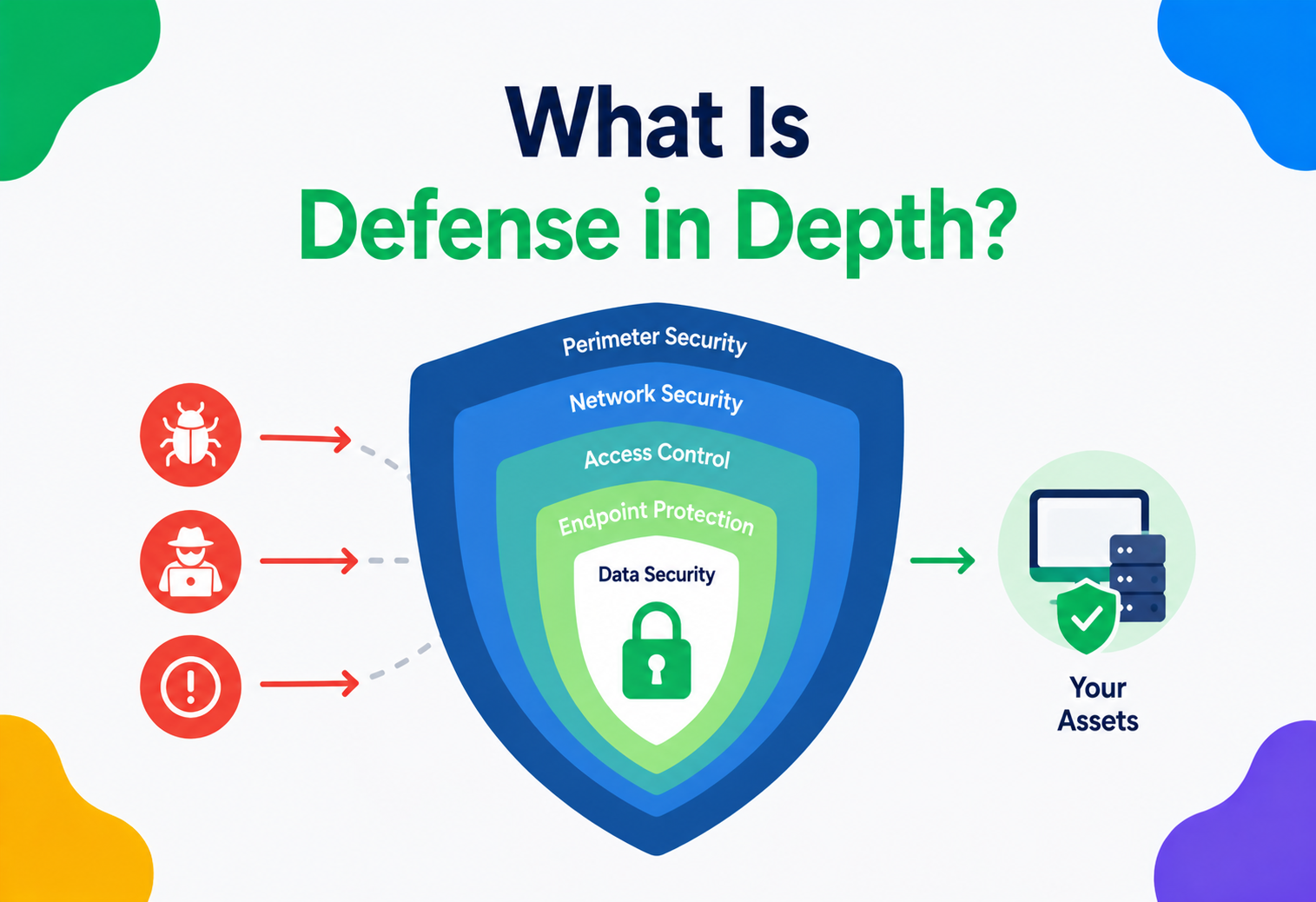
No — network-level controls (firewalls, network policies, micro-segmentation) remain part of a defence-in-depth strategy. Zero Trust adds identity- and context-aware controls on top of, not instead of, sound network hygiene.
A traditional VPN grants broad network-level access once you connect, effectively extending the “trusted inside” to wherever you’re sitting. Zero Trust Network Access (ZTNA) instead grants access to specific applications or resources, re-verified continuously, without extending broad network-level trust at all.
No — the core principles (short-lived credentials, least privilege, MFA everywhere, no implicit trust from network location) scale down well and are increasingly accessible to small teams through managed identity providers and cloud-native tooling, not just custom-built platform engineering at Google’s scale.
Turn on strong MFA everywhere, inventory your most sensitive resources, and eliminate long-lived static credentials in favour of short-lived, automatically rotated ones. These three moves alone eliminate a large share of the most common real-world breach patterns, well before a full architecture rollout.
It adds some latency per request compared to a system with no checks at all, but well-engineered implementations keep this overhead small — local JWT signature verification, sidecar-based mTLS, and cached short-TTL policy decisions typically add single-digit milliseconds, not hundreds. The bigger cost is usually organisational (design and rollout effort), not runtime performance.
Zero Trust systems are themselves distributed systems, so they inherit familiar distributed-systems tensions. Deciding how quickly a revoked token or a policy change must propagate to every PEP is, at its core, a consistency-versus-availability trade-off much like the one described by the CAP theorem — and just like a distributed database, most Zero Trust deployments choose eventual consistency (short-lived tokens, asynchronous policy sync) over a fully synchronous, always-consistent check on every single request, because the latter doesn’t scale.
Incrementally, and almost always should be. Most successful programmes start by fronting the highest-value applications with an identity-aware proxy, layering in device posture checks, then gradually extending mTLS and fine-grained policy to service-to-service traffic — legacy systems that can’t be touched right away can often be placed behind a PEP as a compatibility layer rather than requiring an immediate rewrite.
Not strictly — you can implement mTLS and token-based authorisation directly in application code or via API gateways, and many organisations start there. A service mesh simply makes these controls consistent and centrally manageable across every service without each team reimplementing the same logic, which is why larger organisations with dozens or hundreds of services tend to adopt one as they scale.
Summary
Zero Trust security replaces the old assumption that “inside the network” means “safe” with a simple, strict rule: verify every request, every time, based on identity, device health, and context — never on network location alone. It emerged from Forrester’s early 2010s critique of perimeter security and Google’s BeyondCorp initiative, was formalised by NIST SP 800-207, and has become the default direction for modern security architecture, from individual microservices talking to each other over mTLS, to entire federal governments re-architecting how millions of employees access systems.
Key Takeaways
- Trust is earned per-request, based on identity + device + context — never assumed from network location.
- Least privilege and micro-segmentation shrink the blast radius of any single compromise.
- The PEP / PDP split — enforcement at the edge, decision-making centralised — is the architectural backbone described in NIST SP 800-207.
- Short-lived credentials and automated rotation are non-negotiable; static, long-lived secrets are the single most common way Zero Trust programmes quietly fail in practice.
- The IdP and PDP become tier-0 critical infrastructure and must be engineered, monitored, and secured accordingly — their availability and security now gate everything else.
- Zero Trust is a continuous discipline, not a one-time migration project — policies must evolve as the organisation, threat landscape, and device fleet change.
You now understand Zero Trust from history to production architecture. The gap between knowing these principles and shipping them is almost entirely organisational patience — measured rollouts, honest inventories, and a habit of treating identity as the real perimeter, request by request.