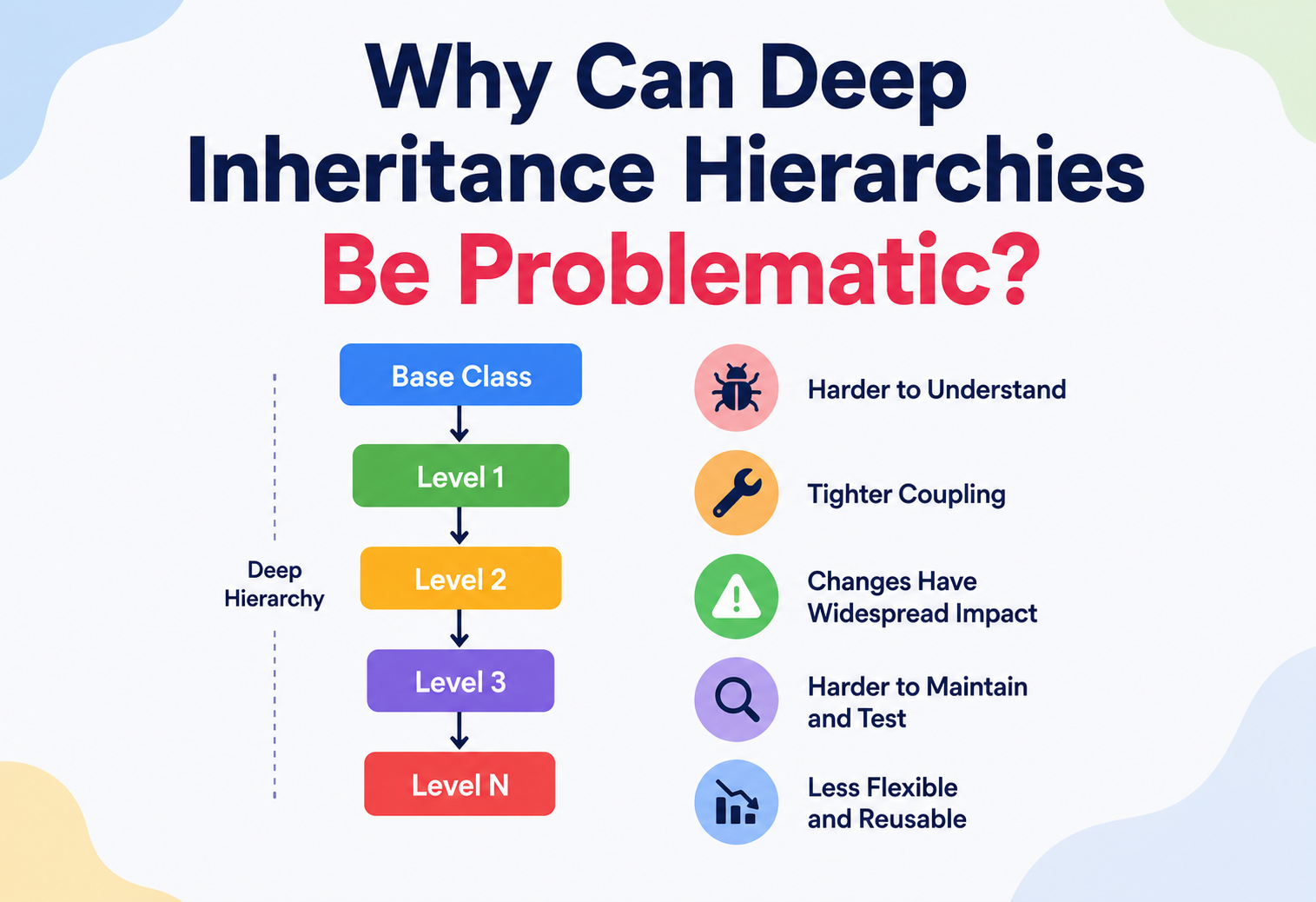
Why Can Deep Inheritance Hierarchies Be Problematic?
Ever played the whispering game, where a message gets passed quietly from person to person down a long line, and comes out the other end hilariously wrong? The longer the line, the worse the distortion. A deep inheritance hierarchy has the exact same weakness — except instead of a funny mistake, it’s a bug that takes a whole afternoon to track down.
The Big Idea, in One Breath
Picture a very tall, very old apartment building, built one floor at a time over many decades, where every new floor’s plumbing and wiring was simply connected into whatever the floor directly below it already had. On the tenth floor, a plumber tracing a single leaking pipe might have to climb down through eight other floors, each with its own quirks and past repairs, just to find out where the water is actually coming from. Nobody designed the building to be this confusing — it just grew that way, one reasonable addition at a time, until tracing anything back to its source became a genuine expedition.
A deep inheritance hierarchy is that apartment building. It’s a chain of classes — a parent, a child of that parent, a child of that child, and so on — stacked many levels high, where understanding any single piece of behavior often means climbing all the way up (or down) through several other levels first. A shallow hierarchy, two or three levels deep, rarely causes much trouble. But every additional level compounds the difficulty of tracing, testing, and safely changing anything built on top of it.
Imagine a rulebook written as a stack of separate memos, where each new memo says “follow all the previous memos, except for this one small change.” Memo 1 sets the baseline rules. Memo 2 tweaks one rule. Memo 3 tweaks another, referencing Memo 2. By Memo 12, understanding the actual, final rule for any given situation means reading all twelve memos in order, holding every exception in your head simultaneously, and hoping you didn’t misremember something from Memo 4 along the way. A deep inheritance hierarchy asks a programmer to do exactly this, every single time they want to understand how one class actually behaves.
This guide focuses specifically on why depth itself — not inheritance in general — becomes the real source of pain, and roughly how deep is too deep before that pain becomes genuinely costly for a team.
It’s worth being precise about the distinction from the very start, since the two ideas get conflated constantly. Inheritance itself, used with a shallow, well-considered structure, is a perfectly healthy, widely used tool — plenty of successful, long-lived codebases use a single level or two of inheritance without any trouble at all. The concern this guide focuses on is specifically what happens once that structure keeps growing taller, level after level, usually without anyone deliberately deciding “yes, we want a five-level hierarchy” — it simply accumulates that way, one individually reasonable addition at a time.
What Actually Counts as “Deep”
There’s no single, universally agreed-upon number that marks the exact line between “reasonable” and “deep,” but a rough, widely shared intuition exists among experienced engineers.
| Depth | General Feel |
|---|---|
| 1–2 levels | Very common, usually low-risk — a single parent with a handful of direct children. |
| 3–4 levels | Worth paying attention to — still often fine, but complexity is starting to accumulate. |
| 5+ levels | Frequently flagged as genuinely deep — tracing behavior reliably becomes noticeably harder here. |
What matters more than the raw number, though, is how much each level actually changes or depends on the ones above it. A five-level hierarchy where each level adds one small, self-contained detail can be perfectly manageable. A three-level hierarchy where each level overrides and reinterprets behavior from the one above it can already feel genuinely deep and confusing, despite technically having fewer levels. Depth is really a proxy for a more important underlying question: how much do you have to hold in your head at once to understand this one class correctly?
It’s also worth noting that different corners of the software world hold noticeably different comfort levels with depth. Some safety-critical or highly regulated coding standards explicitly cap inheritance depth at a small, fixed number, treating any hierarchy beyond that limit as an automatic red flag requiring justification. Other, more loosely structured application codebases tolerate considerably more depth in practice, especially in mature frameworks where the hierarchy has been carefully maintained by expert framework authors over many years. Knowing which context you’re actually working in — a small internal tool versus a safety-critical system — reasonably changes how strict a team should be about limiting depth.
Problem 1: The Fragile Base Class, Amplified
The fragile base class problem — where a change to a parent class can quietly break child classes built on top of it — already causes real pain with a single level of inheritance. Depth doesn’t just add this same risk again at each new level; it multiplies it, since a change at the very top of a deep hierarchy can ripple through every single level beneath it.
Worse, the person making a change to a shared ancestor class often has no realistic way of knowing every single descendant that currently depends on the exact behavior they’re about to modify, especially in a large, long-lived codebase maintained by many different engineers over the years. A seemingly small, careful fix at the top of a deep hierarchy can quietly break behavior three or four levels down, in a class the original engineer never even knew existed.
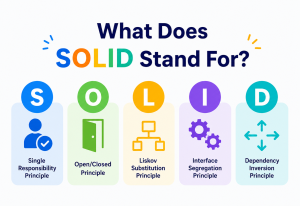
The deeper the hierarchy, the larger and less predictable the “blast radius” of any single change made near the top — and the harder it becomes for any one person to reason about that blast radius with real confidence.
Problem 2: The Yo-Yo Problem
There’s a specific, well-known name for the reading experience a deep hierarchy forces on programmers: the yo-yo problem. Understanding a single method’s actual behavior often means bouncing up the hierarchy to find where it was originally defined, then back down to see where it was overridden, then up again to check whether a grandparent’s version is still partially used — a dizzying, repetitive up-and-down motion, just like a yo-yo, before a clear picture finally emerges.
This isn’t just an inconvenience — it has a real, measurable cost. Studies and informal surveys of professional developers have repeatedly found that programmers spend a disproportionate share of their time simply reading and navigating existing code, rather than writing new code. A deep hierarchy directly taxes exactly that reading and navigating time, turning what should be a quick lookup into a genuine, multi-step investigation.
Modern development tools soften this problem somewhat — a code editor with reliable “jump to definition” and “find all overrides” features can mechanically shortcut some of the manual climbing the yo-yo problem originally described. But tooling only speeds up the navigation itself; it doesn’t reduce the amount of context a person still has to genuinely understand and hold in their head once they arrive at each level. Even with the best tooling available, a programmer still has to read, interpret, and reconcile behavior spread across five different files before they can act with real confidence — the yo-yo problem gets faster to execute, but it doesn’t disappear.
Problem 3: Locked In at Compile Time
Every level of a class hierarchy is decided the moment the code is written, not while the program is actually running. In a shallow hierarchy, this rigidity rarely matters much. In a deep one, it becomes a genuine structural liability, because an object’s entire, multi-level identity is frozen in place from the moment it’s created, with no way to reshape it later without rewriting the class definitions themselves.
This rigidity becomes especially painful when a genuinely new, slightly different variation needs to be introduced later. Adding a new kind of vehicle to a five-level vehicle hierarchy means carefully figuring out exactly where in that existing chain the new type belongs — and if it doesn’t cleanly fit any single existing branch, engineers are often forced into an uncomfortable choice: awkwardly force it into the nearest available branch anyway, or duplicate logic elsewhere to avoid disturbing the existing structure. Either option adds long-term cost that a more flexible, composition-based structure would have avoided from the start.
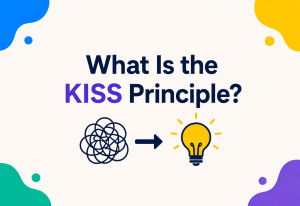
Decided once, hard to revisit
An object’s full inherited identity is fixed the moment its class is compiled, not while the program runs.
New variations rarely fit cleanly
A genuinely new kind of thing often doesn’t map neatly onto any single existing branch of a deep tree.
Problem 4: Leaky Encapsulation
Encapsulation — the idea that a class should hide its internal details and expose only a clean, intentional interface — tends to erode as a hierarchy grows deeper. Subclasses frequently need at least partial access to a parent’s internal state to work correctly, and the deeper the chain, the more internal detail ends up exposed, layer after layer, to classes many levels removed from where that detail actually originated.
This creates a particularly subtle kind of coupling: a change to an internal detail in a grandparent class, several levels up, can silently break a great-grandchild class that was never supposed to know that detail existed in the first place, let alone depend on it. The deeper the chain, the more of these silent, distant dependencies tend to accumulate, and the harder they become to fully audit or trust.
Encapsulation is like a closed door between rooms. Deep inheritance tends to prop that door open a little more at every level, until information meant to stay private in one room quietly ends up depended upon three rooms away.
Step by Step: Watching a Hierarchy Deepen
Let’s trace a vehicle class hierarchy slowly deepening over time, using simple pseudocode, to see exactly how reasonable each individual step feels.
Step 1 — A perfectly reasonable start
v1.tsclass Vehicle { move() { /* ... */ } }
class Car extends Vehicle {}
Step 2 — One more reasonable level
v2.tsclass MotorVehicle extends Vehicle { refuel() { /* ... */ } }
class Car extends MotorVehicle {}
Introducing MotorVehicle between Vehicle and Car felt like a reasonable clarification — after all, not every Vehicle has an engine to refuel.
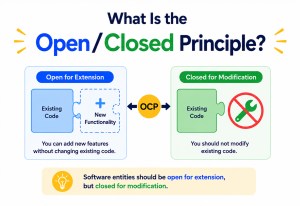
Step 3 — Electric cars arrive
v3.tsclass ElectricCar extends Car {
    refuel() { throw new Error("Electric cars don't refuel") }
    chargeBattery() { /* ... */ }
}
The hierarchy is now four levels deep, and it already contains an awkward workaround — ElectricCar inherits a refuel() method from two levels up that makes no sense for it at all, forcing an override that just throws an error.
Step 4 — The pain compounds further
v4.tsclass SelfDrivingElectricCar extends ElectricCar {
    engageAutopilot() { /* ... */ }
}
Five levels deep now, and a new engineer trying to understand SelfDrivingElectricCar‘s full behavior has to read through Vehicle, MotorVehicle, Car, and ElectricCar in order, encountering the awkward, thrown-error version of refuel() along the way, before finally arriving at the class they actually wanted to understand.
Every single step in this chain felt individually reasonable. The pain only becomes obvious once you try to actually use, test, or extend the class sitting at the bottom of the whole stack.
Real-World Examples
Older desktop UI frameworks
Some well-known older graphical toolkits developed famously deep component hierarchies, often cited as cautionary examples in software design discussions.
Long-lived business applications
Business software maintained over many years by rotating teams often accumulates hierarchies deeper than anyone originally intended.
Textbook Animal hierarchies
Classic teaching examples — Animal, Mammal, Dog, Poodle — are often used specifically to illustrate how quickly depth can introduce awkward edge cases.
Early character class systems
Some early game engines built deep character or entity hierarchies that later shifted toward component-based, composition-first designs for exactly these reasons.
A widely shared, memorable critique of inheritance-heavy design comes from programmer Joe Armstrong, who once quipped that object-oriented languages promising code reuse through inheritance are a bit like wanting a banana but getting a gorilla holding the banana — and the entire jungle behind it. Whether or not one fully agrees with the joke, it captures something genuinely true about deep hierarchies: reusing one small, specific piece of behavior can end up dragging along a great deal of unrelated, unwanted baggage from every level above it.
Automated testing frameworks themselves offer a particularly ironic real-world example. Some early testing libraries were built around deep hierarchies of test-case base classes, where a specific test class might inherit setup and teardown behavior from three or four ancestor classes. Teams using these frameworks often reported the very same yo-yo confusion this guide describes — debugging why a test unexpectedly passed or failed meant climbing back up through several layers of inherited setup logic, in tools whose entire purpose was supposed to make verifying code easier, not harder.
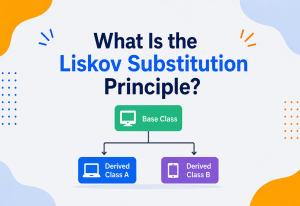
Is There Ever a Genuine Upside?
Where Some Depth Can Help
- A genuinely stable, well-understood domain can support a deeper hierarchy safely.
- Each level can meaningfully reduce duplicate code, if the shared behavior truly belongs there.
- Some languages and frameworks are specifically designed around deeper hierarchies working well.
Why the Risk Usually Wins
- Every additional level increases the yo-yo problem’s navigation cost.
- Fragile base class risk compounds rather than simply adding up.
- Encapsulation erodes further with each additional level.
- New variations become harder to fit cleanly as the tree grows.
Depth itself isn’t automatically evil — a hierarchy that’s deep because the underlying domain genuinely has that many stable, meaningful layers can work perfectly well. The real danger is depth that accumulated by accident, one convenient shortcut at a time.
How Deep Is Too Deep?
Beyond the rough numeric guide covered earlier, a few practical questions help a team judge whether their specific hierarchy has become genuinely risky.
- Can a new engineer explain any given class’s full behavior within a minute or two? If understanding one class routinely requires reading through four or five others first, that’s a strong signal.
- Have any subclasses had to override a method just to disable or ignore it? A thrown error or an empty override, like the electric car’s
refuel()from earlier, is a classic sign the hierarchy has outgrown its original, clean design. - Does adding a genuinely new variation feel awkward? Struggling to find where a new type “belongs” in the existing tree suggests the tree’s structure no longer matches reality cleanly.
- Do changes near the top of the hierarchy make the team nervous? Widespread hesitation to touch a shared ancestor class is a very human, very reliable warning sign.
None of these questions comes with a hard numeric threshold attached, and that’s intentional — depth-related risk depends heavily on how stable and well-understood the underlying real-world categories actually are, not just on a raw level count. A team that can honestly answer “yes, this still feels manageable” to all four questions likely has a healthy hierarchy, regardless of its exact depth.
It’s worth revisiting these four questions periodically, rather than asking them only once. A hierarchy that felt perfectly manageable a year ago can quietly cross into genuinely risky territory through a handful of small, individually reasonable additions, exactly the way the electric car example unfolded step by step earlier in this guide. Building a habit of periodically re-asking “does this still feel manageable?” — during a routine code review, or a quarterly architecture check-in — catches this kind of gradual drift long before it hardens into something expensive to unwind.
How to Flatten a Deep Hierarchy
- Identify which levels are genuinely “is-a,” and which are actually “has-a.” Levels introduced mainly to share a convenient method, rather than describe a genuine category, are strong candidates for conversion into composed behavior instead.
- Extract shared behavior into composed, injectable pieces. Move logic like
chargeBattery()orrefuel()into small, focused classes that get plugged in only where they genuinely apply. - Flatten awkward overrides. A method that only exists to throw an error or do nothing is a strong signal that the behavior never belonged in that shared ancestor to begin with.
- Introduce interfaces for shared capabilities. A
ChargeableorRefuelableinterface can describe an ability cleanly, without forcing every unrelated subclass to inherit it by default. - Refactor gradually, one level at a time. Flattening five levels down to two in a single, sweeping change is risky — verifying each extracted piece with tests along the way keeps the process safe.
When adding a new level to an existing hierarchy, pause and ask whether the new level describes a genuinely new category, or whether it’s really just a convenient place to stash one more method. That one habit prevents a surprising share of accidental depth before it starts.
Key Takeaways
Remember This
- A deep inheritance hierarchy is one stacked many levels high, where understanding any single class often requires tracing behavior through several other levels first.
- There’s no universal number that marks “too deep,” but five or more levels is commonly flagged, and how much each level changes matters as much as the raw count.
- Depth amplifies the fragile base class problem, causes the well-known “yo-yo problem” while reading code, locks structure in at compile time, and gradually erodes encapsulation.
- Awkward overrides that throw errors or do nothing are a classic, reliable sign a hierarchy has outgrown its original clean design.
- Depth itself isn’t automatically bad — a hierarchy that’s deep because the domain genuinely has that many stable layers can still work well.
- Flattening a deep hierarchy usually means extracting genuinely composed abilities into small, focused, injectable pieces, refactored gradually and verified with tests along the way.