What Is a Foreign Key?
From filing‑cabinet analogies to production microservice architectures — a deep, beginner‑friendly journey through the single database concept that keeps related data honest.
Introduction & History
Imagine a school office with two filing cabinets. One cabinet holds a card for every student. The other cabinet holds a card for every class. Now imagine every student’s card has a little note that says “I am enrolled in Class 7B.” That little note is doing something very important — it is connecting the student card to the class card.
A foreign key is exactly that little note, but inside a computer database instead of a filing cabinet. It is a piece of data in one table that points to a piece of data in another table, so the computer always knows how two pieces of information are related to each other.
This single idea — letting one table “point to” another table safely — is one of the biggest reasons why modern databases are reliable. Without it, data would slowly turn into a mess of orphaned, disconnected, and contradictory records.
A Short History
To understand why foreign keys exist, it helps to know a bit of history.
The Relational Model
A researcher named Edgar F. Codd, working at IBM, published a paper called “A Relational Model of Data for Large Shared Data Banks.” Before this, databases stored data in rigid, tree‑like or network‑like structures that were hard to change and hard to query. Codd proposed storing data in simple tables (rows and columns), and defining relationships between tables using shared values instead of physical pointers.
SQL is Born
IBM researchers Donald Chamberlin and Raymond Boyce created SQL (Structured Query Language) to let people talk to these relational databases using English‑like sentences.
Referential Integrity Formalized
As relational databases like Oracle, IBM DB2, and later Microsoft SQL Server grew popular, database theorists formalized the concept of referential integrity — the rule that a reference from one table to another must always point to something that actually exists. The foreign key constraint became the built‑in mechanism to enforce this rule automatically.
Mainstream Adoption
MySQL (with the InnoDB storage engine), PostgreSQL, and other open‑source databases added strong foreign key support, making this feature available to nearly every application built on Earth.
The NoSQL Detour and Return
When “NoSQL” databases (like MongoDB, Cassandra, DynamoDB) became popular for massive scale, many of them dropped foreign keys entirely to gain speed and flexibility. This forced developers to enforce relationships manually in application code. Today, many teams use a hybrid: relational databases with real foreign keys for critical data, and NoSQL stores for high‑volume, loosely‑structured data.
Think of the history like transportation. Before organized roads (relational model), people carried goods on scattered paths (early hierarchical databases). Then someone invented a road system with proper traffic rules (SQL and relational integrity) — foreign keys are like the road signs and traffic laws that stop cars from crashing into each other.
The Problem & Motivation
Let’s understand the exact problem a foreign key solves, using a very simple story.
The Story of a Broken Bookstore
Suppose you are building a database for a small online bookstore. You create two tables:
| Table | Purpose | Columns |
|---|---|---|
authors | Stores author information | author_id, name, country |
books | Stores book information | book_id, title, author_id, price |
Every book needs to know which author wrote it. So each row in books stores an author_id number, which is supposed to match an author_id in the authors table.
Now, without any rule enforcing this connection, several bad things can happen:
- Orphaned records: Someone deletes author #5 from the
authorstable, but 200 books still sayauthor_id = 5. Now those books point to an author who no longer exists — like a library card catalog entry pointing to a shelf that was torn down. - Typos and garbage data: Someone accidentally inserts a book with
author_id = 9999, but no author with that ID exists. The book is now floating in space, connected to nothing. - Silent data corruption: Reports that count “books per author” become wrong, because some books point to authors that don’t exist, and the numbers don’t add up.
- No safety net: Any bug in application code, any careless script, or any manual database edit can break these relationships instantly, and nothing stops it.
Without foreign keys, your database is like a phone book where some phone numbers belong to people who moved away years ago, and nobody removed the old entries. The data looks fine until you actually try to call someone.
The Solution
A foreign key constraint tells the database: “The author_id column in books must always match an existing author_id in authors. If it doesn’t, reject the operation.”
This turns the database itself into a guard that never sleeps. It checks every insert, update, and delete, and refuses to let bad, disconnected data get in.
authors table). If the author doesn’t exist, the row is turned away.Core Concepts
Before foreign keys make sense, we need to be clear on a small stack of database vocabulary.
Table, Row, and Column (quick refresher)
- Table: A grid, like a spreadsheet, that stores one type of thing (e.g.,
students,orders,products). - Row (Record): One single entry in the table (e.g., one specific student).
- Column (Field): One piece of information about every row (e.g.,
name,age).
What Is a Primary Key?
What it is: A primary key is a column (or combination of columns) that uniquely identifies each row in a table. No two rows can ever have the same primary key value, and it can never be empty (NULL).
Why it exists: Computers need a guaranteed unique way to refer to a specific row, the same way every citizen has a unique ID number even if two people share the same name.
A primary key is like your fingerprint or your student roll number. Even if two students are both named “Sam Smith,” their roll numbers (like 2024017 and 2024033) are always different. That roll number is the primary key of the “students” table of your school.
In a table students(student_id, name, grade), student_id is the primary key. Every student gets a unique number: 101, 102, 103…
What Is a Foreign Key? (The Main Event)
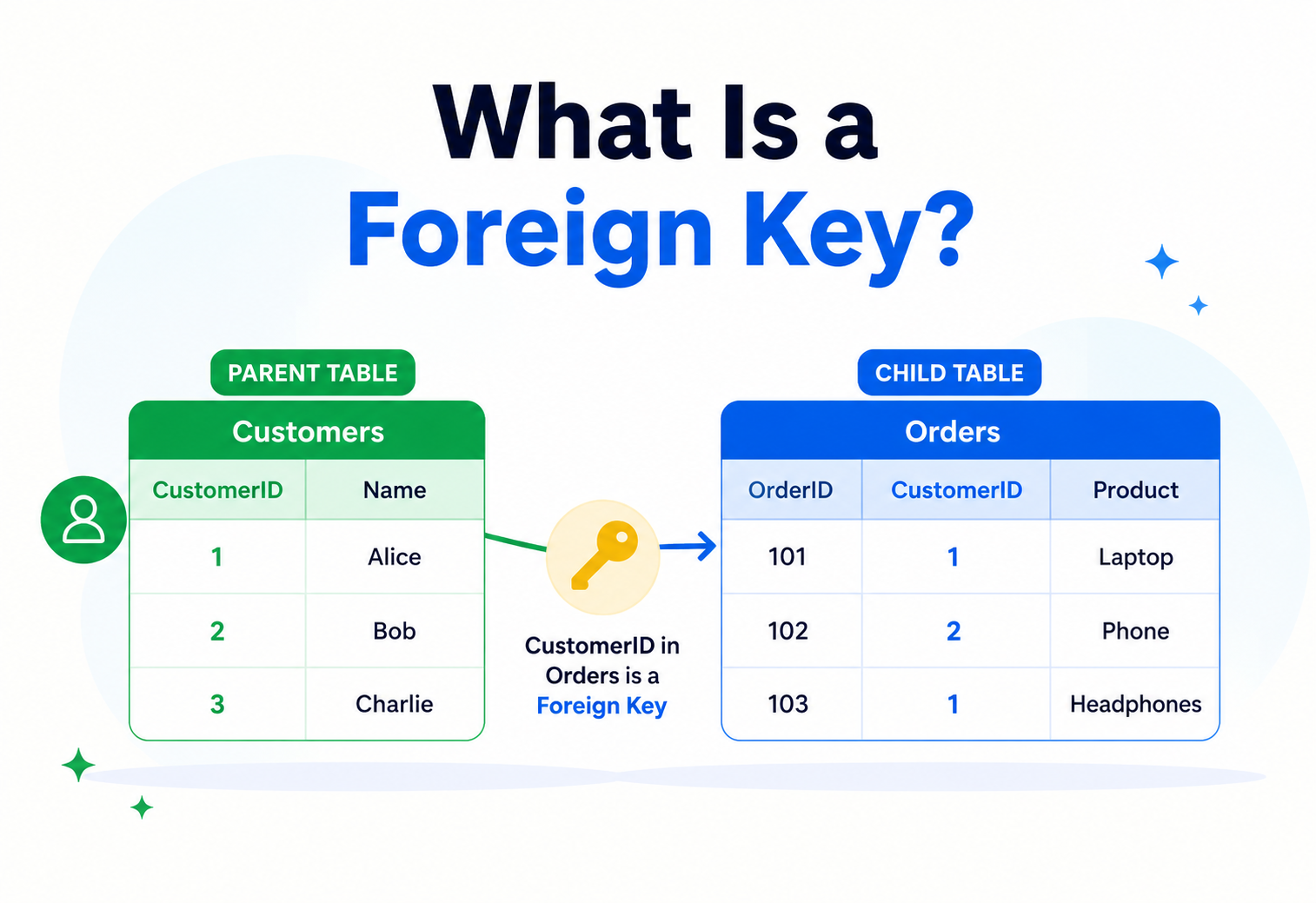
What it is: A foreign key is a column (or set of columns) in one table that refers to the primary key of another table (or, occasionally, the same table). It creates and enforces a link between two tables.
Why it exists: To make sure relationships between data stay correct and consistent — this rule is called referential integrity. It also documents, right inside the database schema, exactly how tables relate to each other, so anyone reading the schema understands the data model.
Where it’s used: Practically every relational database in the world — banking systems, e‑commerce platforms, hospital record systems, airline booking systems, social media platforms (for connecting users to posts, comments, likes), and enterprise software.
Think of a library. Every book has a barcode sticker (a “reference number”) pointing to a specific member’s library card when it’s checked out. The book’s checkout slip doesn’t repeat the member’s full name, address, and phone number — it just stores their unique member ID. That ID on the slip is a foreign key: it “points to” the member table without duplicating all their information.
In our bookstore example: books.author_id is a foreign key that references authors.author_id. The table holding the foreign key (books) is called the child table or referencing table. The table being pointed to (authors) is called the parent table or referenced table.
Referential Integrity
What it is: The guarantee that every foreign key value either matches an existing value in the parent table, or is NULL (empty, meaning “no reference yet”). No dangling, no broken links.
Why it exists: To prevent orphaned data, like a shipping label addressed to a house that was demolished.
The Simple Family Tree Diagram
PK means Primary Key, and FK means Foreign Key. The relationship reads as “one author can write zero or many books.” Each book belongs to exactly one author, but each author can have many books — this is a one‑to‑many relationship, the most common relationship in databases.Types of Relationships
| Relationship | Meaning | Real example |
|---|---|---|
| One‑to‑Many | One parent row connects to many child rows | One author writes many books |
| One‑to‑One | Each parent row connects to exactly one child row | One person has one passport |
| Many‑to‑Many | Many rows on both sides connect to many rows on the other, usually via a middle “junction” table | Many students enroll in many courses |
ENROLLMENTS) that holds two foreign keys — one pointing to students, one pointing to courses. This junction table is sometimes called a “bridge table” or “join table.”Composite Foreign Keys
What it is: Sometimes a foreign key is made of more than one column together, matching a composite primary key in the parent table.
Imagine an order_items table that references orders(order_id, store_id) because orders are uniquely identified by both an order number and which store branch it belongs to. The foreign key in order_items would then be the pair (order_id, store_id) together.
Self‑Referencing Foreign Keys
What it is: A foreign key can point back to the same table it lives in. This is useful for hierarchical data.
An employees table might have a manager_id column that is a foreign key referencing employees.employee_id — because a manager is also an employee! This lets you build an entire company org chart using one single table.
Architecture & Components
Let’s zoom out and see how foreign keys fit into the bigger architecture of a database system.
The Building Blocks
Schema
The overall blueprint of the database — all tables, columns, and constraints (including foreign keys) defined together.
Constraint
A rule the database enforces automatically. A foreign key is one type of constraint (others include PRIMARY KEY, UNIQUE, NOT NULL, and CHECK).
Constraint Catalog / Metadata
Databases store information about their own constraints in internal system tables (e.g., PostgreSQL’s pg_constraint, MySQL’s information_schema.KEY_COLUMN_USAGE). This is how tools like ER diagram generators “know” your relationships.
Storage Engine
The internal component that actually stores and retrieves data on disk. Not all storage engines support foreign keys — for example, MySQL’s older MyISAM engine ignores them, while InnoDB (the modern default) enforces them properly.
How It Fits Together
Declaring a Foreign Key (Java + SQL Example)
Here is how you declare this relationship using standard SQL (works with PostgreSQL, MySQL, SQL Server, Oracle with tiny syntax differences):
CREATE TABLE authors (
    author_id   INT PRIMARY KEY,
    name        VARCHAR(100) NOT NULL,
    country     VARCHAR(50)
);

CREATE TABLE books (
    book_id     INT PRIMARY KEY,
    title       VARCHAR(200) NOT NULL,
    author_id   INT,
    price       DECIMAL(10,2),
    CONSTRAINT fk_books_author
        FOREIGN KEY (author_id)
        REFERENCES authors(author_id)
        ON DELETE RESTRICT
        ON UPDATE CASCADE
);
Now let’s look at how a Java application (using JDBC) interacts with this schema. The Java code itself doesn’t need to know about the foreign key rule — the database enforces it, and Java just needs to handle the possible exception.
import java.sql.*;

public class BookRepository {

    private final Connection connection;

    public BookRepository(Connection connection) {
        this.connection = connection;
    }

    public void addBook(int bookId, String title, int authorId, double price) {
        String sql = "INSERT INTO books (book_id, title, author_id, price) VALUES (?, ?, ?, ?)";
        try (PreparedStatement stmt = connection.prepareStatement(sql)) {
            stmt.setInt(1, bookId);
            stmt.setString(2, title);
            stmt.setInt(3, authorId);
            stmt.setDouble(4, price);
            stmt.executeUpdate();
            System.out.println("Book added successfully.");
        } catch (SQLIntegrityConstraintViolationException e) {
            // This exception fires specifically when a foreign key rule is broken
            System.out.println("Error: author_id " + authorId + " does not exist. Cannot add book.");
        } catch (SQLException e) {
            System.out.println("Unexpected database error: " + e.getMessage());
        }
    }
}Notice something important: the Java code never manually checks “does this author exist?” before inserting. The database itself does that check and throws SQLIntegrityConstraintViolationException if it fails. This is the power of foreign keys — the rule lives in one place (the database) instead of being repeated in every application that touches the data.
Internal Working
Now let’s go under the hood and understand how a database actually enforces a foreign key at the engine level. This is the part that separates a casual user from someone who truly understands databases.
The Index Requirement
In almost all production‑grade relational databases, a foreign key column should be (and in some databases, must be) backed by an index — a fast lookup data structure, typically a B‑Tree — on both sides of the relationship:
- The parent table’s referenced column must already have a unique index (this comes automatically with a
PRIMARY KEYorUNIQUEconstraint). - The child table’s foreign key column should have an index too — not always mandatory, but strongly recommended, because every insert/update/delete needs to check for matching rows quickly.
Imagine trying to check if a name exists in a phone book with a million entries. If the phone book isn’t sorted alphabetically (no index), you’d have to check every single page (a “full table scan”) — painfully slow. If it’s sorted (an index/B‑Tree), you can jump straight to the right section in a few steps. A foreign key check without an index is like searching an unsorted phone book every single time someone joins a book to an author.
What Happens Internally on INSERT
- The application sends an
INSERTstatement. - The database engine parses the SQL and builds an execution plan.
- Before writing the new row, the constraint checker looks up the foreign key column’s value in the parent table’s index.
- If a matching row is found (or the FK value is
NULL, which is allowed by default), the insert proceeds. - If no match is found, the engine raises a constraint violation error and rolls back the operation.
- Internally, many databases also take a shared lock (a lightweight, non‑exclusive lock) on the matched parent row during the transaction, to prevent that parent row from being deleted at the exact same moment by another concurrent transaction. This is part of how databases maintain consistency under concurrency.
What Happens Internally on DELETE (Parent Row)
This is where things get more interesting. When you try to delete a row from the parent table (e.g., delete an author), the database must decide what to do with all the child rows (books) that reference it. This behavior is controlled by referential actions.
| Action | What it does | Analogy |
|---|---|---|
RESTRICT / NO ACTION | Blocks the delete if any child rows reference this parent row. | You can’t demolish a house if people are still registered as living there — move them out first. |
CASCADE | Automatically deletes (or updates) all matching child rows too. | Firing a manager and automatically reassigning/removing their whole team along with them. |
SET NULL | Sets the foreign key column in child rows to NULL instead of deleting them. | An author retires; their books stay on the shelf, just marked “author unknown” for now. |
SET DEFAULT | Sets the foreign key column to a predefined default value. | Reassigning orphaned tickets to a “general support” default queue. |
RESTRICT, CASCADE, or SET NULL) determines the final outcome.Constraint Checking: Immediate vs Deferred
Most databases check foreign key constraints immediately, meaning right after each statement. Some advanced databases (like PostgreSQL and Oracle) support deferred constraints, which check the rule only at the end of a transaction (at COMMIT) instead of after every single statement. This is useful when you need to insert two related rows in an order that would temporarily “break” the rule, such as inserting two rows that reference each other.
-- PostgreSQL example of a deferred constraint
ALTER TABLE books
    ADD CONSTRAINT fk_books_author
    FOREIGN KEY (author_id) REFERENCES authors(author_id)
    DEFERRABLE INITIALLY DEFERRED;
Locking and Concurrency Considerations
Because foreign key checks require reading the parent table, they can introduce extra locking overhead in highly concurrent systems. For example, in MySQL’s InnoDB engine, inserting a child row typically takes a shared lock on the referenced parent row to prevent it from being deleted mid‑transaction. In write‑heavy systems with millions of concurrent transactions, this can occasionally become a source of lock contention — something senior engineers must watch for when foreign keys touch “hot” parent rows (like a single popular “category” row referenced by millions of products).
Data Flow & Lifecycle
Let’s trace the complete lifecycle of data as it flows through a system that uses foreign keys — from the moment a user clicks a button in an app, to the final state stored in the database.
End‑to‑End Flow Example: Placing an Order
The Role of Transactions
What it is: A transaction is a group of database operations that are treated as a single “all‑or‑nothing” unit. Foreign keys work hand‑in‑hand with transactions to guarantee data correctness.
Why it exists: Without transactions, if step 5 of a 10‑step process fails, you could be left with half‑finished, inconsistent data. Transactions ensure either everything succeeds together, or everything is undone together.
A transaction is like a bank transfer: money leaves your account AND arrives in your friend’s account as one indivisible action. If the system crashes halfway, you don’t want to end up with the money vanished from your account but never arriving anywhere. Foreign keys are the rulebook; transactions are the safety net that applies that rulebook atomically.
Java Example: Full Transaction with Foreign Key Awareness
public void placeOrder(int customerId, List<Integer> productIds) throws SQLException {
    Connection conn = null;
    try {
        conn = dataSource.getConnection();
        conn.setAutoCommit(false); // start transaction

        // Step 1: Insert order (foreign key checks customer_id automatically)
        String orderSql = "INSERT INTO orders (customer_id, order_date) VALUES (?, NOW())";
        int orderId;
        try (PreparedStatement stmt = conn.prepareStatement(orderSql, Statement.RETURN_GENERATED_KEYS)) {
            stmt.setInt(1, customerId);
            stmt.executeUpdate();
            ResultSet keys = stmt.getGeneratedKeys();
            keys.next();
            orderId = keys.getInt(1);
        }

        // Step 2: Insert each order item (foreign key checks product_id automatically)
        String itemSql = "INSERT INTO order_items (order_id, product_id) VALUES (?, ?)";
        try (PreparedStatement stmt = conn.prepareStatement(itemSql)) {
            for (int productId : productIds) {
                stmt.setInt(1, orderId);
                stmt.setInt(2, productId);
                stmt.addBatch();
            }
            stmt.executeBatch();
        }

        conn.commit(); // all foreign key checks passed - make it permanent
        System.out.println("Order placed successfully.");

    } catch (SQLException e) {
        if (conn != null) conn.rollback(); // undo everything if any FK check failed
        System.out.println("Order failed and was rolled back: " + e.getMessage());
        throw e;
    } finally {
        if (conn != null) conn.setAutoCommit(true);
    }
}
Lifecycle Summary Table
| Stage | What happens to Foreign Keys |
|---|---|
| Schema Design | Foreign key relationships are planned and declared as part of the table structure. |
| Data Insertion | Every new child row is checked against the parent table before being accepted. |
| Data Update | Changing a foreign key value re‑triggers the same existence check. |
| Data Deletion | Deleting a parent row triggers the configured referential action (RESTRICT, CASCADE, SET NULL, etc). |
| Query Time | Foreign keys are commonly used in JOIN operations to combine related data from multiple tables. |
| Schema Evolution | Foreign keys must be considered carefully when altering table structures, archiving data, or migrating schemas. |
Advantages, Disadvantages & Trade‑offs
Foreign keys buy you guarantees you can bet a bank on — but every guarantee has a cost. Here are both sides, honestly.
Advantages
- Data Integrity — guarantees that relationships between tables are always valid; no orphaned or “dangling” references.
- Self‑Documenting Schema — anyone looking at the database structure can immediately see how tables relate, without reading application code.
- Automatic Enforcement — the rule is enforced by the database itself, so it can’t be bypassed by a buggy script or a careless developer using a different application.
- Cascading Operations — CASCADE rules let you clean up related data automatically instead of writing manual cleanup code everywhere.
- Query Optimizer Assistance — some databases use known foreign key relationships to make smarter query execution plans.
Disadvantages
- Performance Overhead — every write operation on the child table requires an extra lookup in the parent table, adding latency.
- Locking / Contention — foreign key checks can add lock contention in extremely high‑throughput systems.
- Rigid Schema Changes — some schema changes (dropping a table, bulk‑loading data out of order) become more complicated — you often must disable, load, then re‑enable constraints.
- Harder Horizontal Sharding — when data is split (sharded) across multiple database servers, enforcing a foreign key across two different physical databases becomes very difficult or impossible with native constraints.
- Bulk Import Slowdowns — loading millions of rows with active FK checks is much slower than loading with constraints temporarily disabled.
The Big Trade‑off: Consistency vs Scale
This is one of the most important trade‑offs in real‑world system design. Foreign keys give you strong consistency guarantees, but that consistency has a performance and scalability cost. This is why massive internet‑scale systems (like social media feeds or IoT sensor data pipelines) often move away from strict foreign keys and instead enforce relationships in application code or via asynchronous consistency checks — trading some safety for raw speed and scale.
Companies like Netflix and Amazon often use relational databases with real foreign keys for critical financial and account data (billing, subscriptions), but use eventually‑consistent, foreign‑key‑free NoSQL stores for massive, less critical data like viewing history or recommendation logs.
Performance & Scalability
The Cost of a Foreign Key Check
Every INSERT or UPDATE on a table with a foreign key requires the database to perform an additional lookup — usually an indexed lookup on the parent table’s primary key. On a properly indexed system, this cost is small (often just a few extra microseconds), but at millions of writes per second, small costs multiply.
Bulk Loading Strategy
When loading huge amounts of data (for example, migrating a million historical orders into a new system), engineers commonly:
- Temporarily disable foreign key checks.
- Bulk‑insert all the data quickly.
- Re‑enable foreign key checks.
- Run a validation query to check for any orphaned rows introduced during the load, and fix them before finalizing.
-- MySQL example: disabling and re-enabling FK checks for a bulk load
SET FOREIGN_KEY_CHECKS = 0;

-- ... bulk INSERT statements here ...

SET FOREIGN_KEY_CHECKS = 1;Disabling foreign key checks is powerful but dangerous. If your bulk data actually contains broken references, you won’t find out until you re‑enable checks (or worse, never find out at all if you forget to validate). Always run an integrity validation query afterward.
Indexing Strategy for Foreign Keys
Always index your foreign key columns on the child table (many databases like PostgreSQL do not create this index automatically — only MySQL/InnoDB does by default). Without this index, every parent‑row delete or update must perform a full table scan on the child table to check for dependents, which is extremely slow on large tables.
CREATE INDEX idx_books_author_id ON books(author_id);Scaling Strategies When Foreign Keys Become a Bottleneck
| Strategy | How it helps |
|---|---|
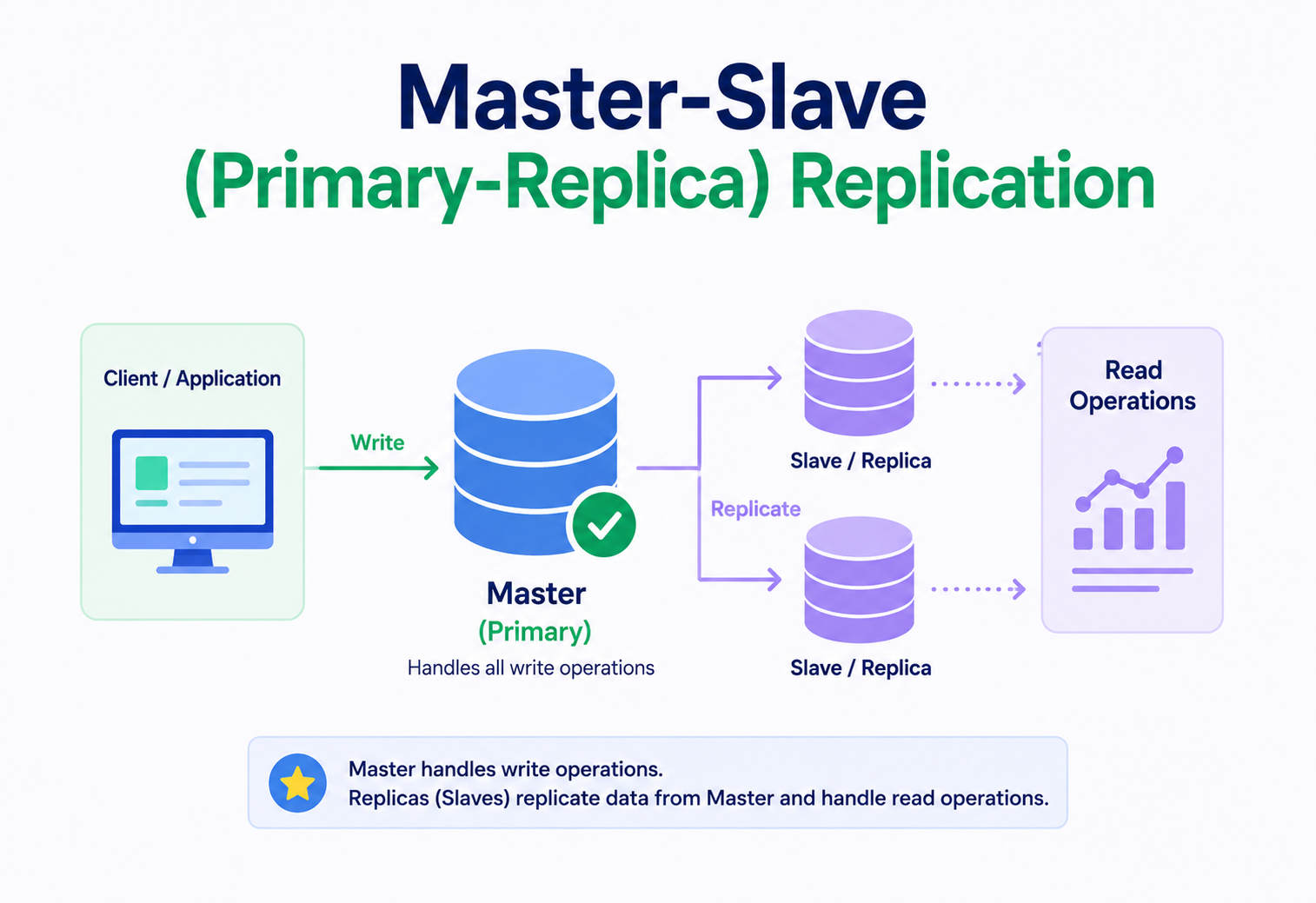
| Read Replicas | Offload read‑heavy queries (like JOINs across foreign keys) to replica servers, keeping the primary server focused on writes and FK checks. |
| Caching | Cache frequently‑joined parent data (like product categories) in memory (e.g., Redis) to reduce repeated database lookups. |
| Denormalization | In extreme high‑scale cases, some systems intentionally duplicate small pieces of parent data into the child table (like storing author_name directly in books) to avoid a join entirely — sacrificing some normalization for speed. |
| Application‑Level Enforcement | In sharded/distributed systems, some teams move referential integrity checks into application code or background reconciliation jobs, since native cross‑shard foreign keys aren’t supported. |
High Availability & Reliability
Foreign Keys and Replication
What it is: Replication means copying your database’s data to one or more additional servers, so if the main server fails, a replica can take over, and so read traffic can be spread out.
Foreign key constraints are typically enforced on the primary (writer) node. Replicas usually receive already‑validated data through the replication stream (e.g., MySQL’s binary log, PostgreSQL’s write‑ahead log), so they don’t need to re‑check foreign keys — they just apply changes that already passed validation on the primary.
The CAP Theorem Connection
What it is: The CAP theorem states that a distributed system can only guarantee two out of three properties at the same time: Consistency (everyone sees the same data), Availability (the system always responds), and Partition Tolerance (the system keeps working even if network links between servers break).
Foreign keys are fundamentally a consistency tool. In a single, non‑distributed relational database, you get strong consistency easily. But once you split (shard/partition) your data across multiple independent database nodes, enforcing a foreign key that spans two different nodes becomes a distributed systems problem — and per CAP theorem, you’d have to sacrifice either strict consistency or availability during network partitions to maintain it. This is exactly why most sharded systems drop cross‑shard foreign keys and instead rely on eventual consistency, background jobs, or application‑level checks.
Imagine two separate offices in different cities, each keeping their own paper filing cabinet. If office A needs to instantly verify a fact stored only in office B’s cabinet before filing a paper, and the phone line between cities goes down, office A must choose: wait indefinitely (lose availability) or file anyway and hope it matches later (lose strict consistency). That’s the CAP trade‑off in action.
Failure Recovery
If a database crashes mid‑transaction, its write‑ahead log (WAL) or transaction log is used to recover to the last consistent state upon restart. Because foreign key checks happen as part of the transaction, a crash never leaves the database with a permanently broken relationship — either the whole transaction is rolled back, or it’s fully applied. This is part of the ACID guarantee (Atomicity, Consistency, Isolation, Durability) that relational databases provide.
Backup and Restore Considerations
When restoring a backup, foreign key constraints can complicate the order in which tables must be restored (parent tables often need to be restored before child tables, unless constraints are temporarily disabled during restore). Most backup tools handle this automatically, but it’s an important detail when writing custom restore scripts.
Security
Foreign Keys as a Security Boundary Helper
Foreign keys are not a security feature by themselves, but they support security indirectly:
- Preventing data injection into invalid relationships: An attacker (or buggy code) cannot insert a row that links to a fake or non‑existent parent record, closing off a class of data manipulation bugs.
- Supporting Row‑Level Security policies: Modern databases like PostgreSQL allow row‑level security rules that often rely on foreign key relationships (e.g., “a user can only see orders where
orders.customer_idmatches their own logged‑in customer ID”).
Common Security Pitfalls Related to Foreign Keys
Just because a foreign key ensures a customer_id exists doesn’t mean the currently logged‑in user is allowed to see that customer’s data. A foreign key enforces “this ID is real,” not “this user has permission to access it.” Application‑level authorization checks are still absolutely required.
If an attacker gains write access to a parent table with an ON DELETE CASCADE rule, deleting a single parent row could silently wipe out huge amounts of related data. Sensitive cascade rules should be reviewed carefully and often protected with extra application‑level confirmation steps.
SQL Injection Awareness
Foreign keys don’t protect against SQL injection. Regardless of your schema’s relationships, always use parameterized queries (like the PreparedStatement shown earlier in Java) instead of concatenating raw user input into SQL strings.
Monitoring, Logging & Metrics
What to Monitor
| Metric | Why it matters |
|---|---|
| Constraint violation error rate | A sudden spike often signals a bug in application logic, a bad data migration, or an attempted attack. |
| Lock wait time on FK‑related tables | Helps detect contention caused by foreign key checks on “hot” parent rows. |
| Slow query logs involving JOINs | Reveals missing indexes on foreign key columns. |
| Replication lag | Since FK checks only happen on the primary, monitoring lag ensures replicas are up to date with validated data. |
| Orphaned row audits | Periodic scheduled jobs that scan for any inconsistency (useful especially in systems where FK checks were disabled temporarily, e.g., during bulk loads). |
Logging Best Practices
- Log every constraint violation with enough context (which table, which foreign key, which values) to debug quickly — but never log full sensitive customer data in plaintext.
- Use structured logging (JSON logs) so integrity errors can be easily searched and aggregated in tools like the ELK Stack (Elasticsearch, Logstash, Kibana) or Splunk.
Example: Catching and Logging FK Violations in Java
try {
    orderRepository.placeOrder(customerId, productIds);
} catch (SQLIntegrityConstraintViolationException e) {
    logger.warn("FK violation while placing order. customerId={}, reason={}",
                 customerId, e.getMessage());
    // Return a friendly error to the user instead of a raw stack trace
    throw new InvalidOrderException("One or more items in your order are no longer available.");
}Deployment & Cloud
Foreign Keys in Managed Cloud Databases
Modern cloud database services fully support foreign keys, though behavior can differ slightly:
Amazon RDS / Aurora
(MySQL, PostgreSQL compatible) Full foreign key support, same as standalone MySQL/PostgreSQL.
Google Cloud SQL / Spanner
Cloud SQL supports traditional foreign keys. Cloud Spanner (a globally distributed database) supports a special form called interleaved tables and enforced foreign keys, but with extra care needed around cross‑region latency.
Azure SQL Database
Full foreign key support, similar to on‑premises SQL Server.
Serverless / NewSQL
Databases like CockroachDB and YugabyteDB aim to give foreign key guarantees even across distributed, sharded nodes, using distributed consensus protocols (like Raft) — a modern evolution that tries to solve the “foreign keys don’t scale across shards” problem directly.
Schema Migrations in CI/CD Pipelines
When deploying schema changes (adding new foreign keys, changing cascade rules) through automated pipelines, teams typically use migration tools such as Flyway or Liquibase (common in Java ecosystems). These tools apply schema changes safely, in order, and can validate that no existing data violates a new foreign key constraint before applying it.
-- Example Flyway migration file: V5__add_fk_books_author.sql
ALTER TABLE books
    ADD CONSTRAINT fk_books_author
    FOREIGN KEY (author_id) REFERENCES authors(author_id)
ON DELETE RESTRICT;Adding a foreign key to a table that already has bad data (orphaned references) will cause the migration to fail. Production teams always run a pre‑migration validation query to find and fix orphaned rows before the deployment pipeline tries to apply the new constraint.
Databases, Caching & Load Balancing
Foreign Keys Across Different Database Types
| Database | Foreign Key Support | Notes |
|---|---|---|
| MySQL (InnoDB) | Full support | Requires InnoDB storage engine; MyISAM ignores FK constraints entirely. |
| PostgreSQL | Full support, very robust | Supports deferred constraints, composite keys, and rich referential actions. |
| SQL Server | Full support | Enterprise‑grade tooling for visualizing and managing FK relationships. |
| Oracle Database | Full support | Long‑standing, mature implementation, used heavily in banking/finance. |
| SQLite | Supported, but off by default | Must run PRAGMA foreign_keys = ON; for each connection. |
| MongoDB (NoSQL) | Not natively enforced | Relationships (via $lookup / manual reference fields) must be validated in application code. |
| Cassandra (NoSQL) | Not supported | Designed for massive write scale; denormalization is the norm instead of relational joins. |
Caching Layer Interaction
When a caching layer (like Redis or Memcached) sits in front of a database, it’s important to remember that the cache does not know about foreign key constraints. If a parent row is deleted and cascades to remove child rows, any cached copies of that child data become stale and must be invalidated separately. Common strategies include:
- Cache invalidation on write: Whenever the application deletes/updates a row, it also actively removes the related cache entries.
- Time‑to‑live (TTL) expiration: Cached data automatically expires after a set time, limiting how long stale data can exist.
- Change Data Capture (CDC): Tools like Debezium listen to the database’s transaction log and automatically publish change events, which downstream systems (including caches) can consume to stay in sync.
Load Balancing and Foreign Keys
Load balancers distribute traffic across multiple application servers, but the foreign key logic itself always lives in the database layer, not the load balancer. What matters for load‑balanced systems is ensuring that writes are routed to the correct primary database node (where FK checks happen) while reads can be safely distributed across replicas.
APIs & Microservices
Foreign Keys Inside a Single Service
Within one microservice that owns its own database, foreign keys work exactly as described throughout this tutorial — enforcing relationships between the tables that service controls (e.g., an “Orders Service” enforcing that order_items.product_id references its own local products table).
The Cross‑Service Problem
In a microservices architecture, different services often own different databases (this is called database‑per‑service). A “Users Service” might own the users table, while an “Orders Service” owns the orders table. You cannot create a real database‑level foreign key from orders.user_id to a table living in a completely different database owned by a different service — the databases don’t even know about each other.
How Microservices Handle This
- Synchronous validation: Before creating an order, the Orders Service calls the Users Service’s API to confirm the user exists. Adds latency and a dependency, but is simple to reason about.
- Event‑driven consistency: The Users Service publishes events (e.g., “UserDeleted”) to a message broker like Kafka. The Orders Service listens and reacts (e.g., marking related orders appropriately), achieving eventual consistency without a direct database‑level link.
- Data duplication (denormalization): The Orders Service might store a lightweight, cached copy of relevant user info (like
user_idanddisplay_name) locally, updated via events, to avoid needing a live cross‑service call for every read.
Uber’s microservices handling trip data and driver data are separate services. When a trip references a driver, that reference is validated and kept consistent through internal APIs and event streams — not a single shared database foreign key — because each service scales and deploys independently.
Design Patterns & Anti‑patterns
Good Design Patterns
Normalize, then Selectively Denormalize
Start with a clean, normalized schema using foreign keys correctly, then only denormalize specific hot paths after measuring real performance needs.
Junction Table for Many‑to‑Many
Always use a dedicated junction table with two foreign keys instead of trying to force many‑to‑many relationships into a single column.
Soft Deletes with Careful Cascades
Instead of hard‑deleting parent rows (which can trigger dangerous cascades), mark them as is_deleted = true and handle cleanup deliberately.
Explicit Referential Actions
Always explicitly declare ON DELETE/ON UPDATE behavior instead of relying on database defaults, so behavior is clear and intentional.
Anti‑patterns to Avoid
Some schemas try to make one column reference “different tables depending on a type flag” (e.g., a comments table with commentable_id and commentable_type that could point to either a post or a photo). Real foreign key constraints cannot enforce this pattern because a single column can only reference one specific table. This weakens referential integrity and should generally be avoided in favor of separate, explicit join tables.
Blindly setting every foreign key to ON DELETE CASCADE can lead to catastrophic, unintended mass deletions from a single innocent‑looking delete statement. Always think through the real‑world business meaning before choosing CASCADE.
Some teams skip foreign keys entirely from day one to “keep things simple/fast,” relying only on application code to maintain relationships. This often leads to silent data corruption over time. Only truly high‑scale systems, after careful measurement, should make this trade‑off deliberately — not as a shortcut.
Best Practices & Common Mistakes
Best Practices Checklist
- Always index foreign key columns on the child table.
- Explicitly choose
ON DELETE/ON UPDATEbehavior — never leave it to guesswork. - Use consistent, predictable naming for constraints (e.g.,
fk_<child_table>_<parent_table>) to make debugging easier. - Validate data before adding a new foreign key to an existing table with live data.
- Use database migration tools (Flyway, Liquibase) to version‑control schema changes involving foreign keys.
- Write automated tests that intentionally try to violate foreign key rules, to confirm your application handles the resulting errors gracefully.
- Monitor constraint violation rates in production as a health signal.
Common Mistakes
- Forgetting to index the FK column — causes full table scans on deletes/updates to the parent table. Fix: always add an index explicitly, especially on PostgreSQL.
- Relying on application code alone for integrity — any bug, script, or manual database change can silently corrupt data. Fix: use real database‑level foreign keys wherever the data lives in one database.
- Not handling constraint violation exceptions — users see ugly raw database errors. Fix: catch and translate exceptions into clear application‑level errors.
- Using CASCADE without understanding blast radius — can unexpectedly wipe out large amounts of related data. Fix: review and test cascade behavior carefully before deploying.
- Mixing storage engines within one database — a MyISAM table silently ignores FK constraints. Fix: standardize on a storage engine that supports FK enforcement (like InnoDB).
Real‑world & Industry Examples
Five industries where foreign keys quietly hold the whole system together — and where they’re strategically loosened.
Banking Systems
Banking systems rely heavily on strict foreign keys. A transactions table referencing an accounts table ensures money can never be recorded as moving to or from an account that doesn’t exist. This strong consistency is critical — banks prioritize correctness far above raw write speed for core ledger data, which is exactly what foreign keys and full ACID transactions are built for.
E‑commerce Platforms (Amazon‑style)
An e‑commerce platform’s core order‑processing database typically uses foreign keys extensively: orders → customers, order_items → products, payments → orders. However, massive product catalogs, browsing history, and recommendation data are usually handled by separate, more scalable, foreign‑key‑free systems designed for speed and flexibility.
Airline Reservation Systems
A bookings table referencing a flights table (via foreign key) ensures a booking can never point to a flight number that doesn’t exist in the schedule. Cascading rules here are handled very carefully — canceling a flight typically triggers a controlled, monitored process (rebooking passengers, refunds) rather than a blind ON DELETE CASCADE that instantly deletes all bookings.
Social Media Platforms
A comments table referencing a posts table via foreign key ensures comments can’t exist on a post that was never created. At the scale of platforms like Instagram or Twitter/X, some of this integrity work shifts to background reconciliation jobs and sharded databases where strict, real‑time cross‑shard foreign keys aren’t practical, but the underlying goal — preventing orphaned data — remains the same.
Healthcare Systems
Electronic health record (EHR) systems use foreign keys to connect prescriptions to patients and doctors, and lab_results to patients. Given the legal and safety stakes, these systems favor very strict referential integrity, often refusing any operation that would create ambiguity about which patient a medical record belongs to.
FAQ, Summary & Key Takeaways
Frequently Asked Questions
Can a foreign key column contain NULL?
Yes, by default. A NULL means “this row is not yet linked to anything,” and NULLs are exempt from the foreign key check (since there’s nothing to match). If your business rule requires that every row must always have a link, combine the foreign key with a NOT NULL constraint.
Can a table have more than one foreign key?
Yes, absolutely. A table can have many foreign keys, each pointing to a different parent table (or even the same table multiple times, using different columns).
Is a foreign key the same as an index?
No. A foreign key is a data integrity rule; an index is a performance structure. They are related — a foreign key needs an index on the parent side to work, and should have one on the child side too — but they solve different problems.
Does every database support foreign keys?
Most traditional relational databases (MySQL/InnoDB, PostgreSQL, SQL Server, Oracle, SQLite) support them fully. Many NoSQL databases (MongoDB, Cassandra, DynamoDB) do not enforce them natively, leaving referential integrity to the application layer.
What is the difference between a foreign key and a primary key?
A primary key uniquely identifies rows within its own table. A foreign key lives in one table but points to (and must match) a primary key value in another table (or the same table, for self‑references).
Why would a company choose NOT to use foreign keys?
Usually for extreme write‑scale scenarios where the performance overhead of constant constraint checking is unacceptable, or in sharded/distributed architectures where cross‑node foreign keys aren’t technically supportable. This trade‑off should always be a deliberate, measured engineering decision — not a default habit.
Summary
A foreign key is a simple but powerful idea: a column in one table that must match a real value in another table’s primary key. It is the mechanism that keeps related data connected and correct across an entire database, enforced automatically by the database engine itself rather than relying on every piece of application code to behave perfectly.
We traced its origins back to Edgar Codd’s relational model, saw exactly what problem it solves (orphaned and disconnected data), explored how it works internally (index lookups, referential actions like CASCADE and RESTRICT, locking behavior), and followed it through the full lifecycle of real applications — from a single INSERT statement to distributed microservice architectures where the concept still matters, even without a literal database‑level constraint.
Key Takeaways
- A foreign key connects a child table to a parent table and enforces that the connection is always valid.
- Referential integrity is the overall guarantee that foreign keys provide — no dangling references.
- Always index foreign key columns for performance.
- Choose
ON DELETE/ON UPDATEbehavior (RESTRICT, CASCADE, SET NULL) deliberately, based on real business rules. - Foreign keys have real performance and scalability costs — understand the trade‑off, especially at high write volumes or in distributed/sharded systems.
- In microservices, “foreign key” relationships often become logical concepts enforced through APIs and events rather than a single database constraint.
- Foreign keys are a data‑correctness tool, not a security/authorization tool — application‑level permission checks are still required.