What is Database Normalization?
A complete, no-jargon walkthrough of why tables get messy, how the normal forms fix them step by step, and when breaking the rules on purpose is the right engineering call — illustrated with real schemas, working Java, and production trade-offs.
Introduction & History
The messy-notebook analogy — and how normalization grew out of a 1970 IBM research paper.
Imagine your school kept every student’s information written by hand in one giant notebook. Every page had the student’s name, their class, their teacher’s name, their teacher’s phone number, every subject they take, and every grade they got. Now imagine that same teacher teaches 40 students. Her phone number would be written 40 separate times, once per student. If she changes her phone number, someone has to find all 40 pages and fix every single one. Miss even one, and now the notebook has two different phone numbers for the same teacher — nobody knows which one is correct anymore.
That messy notebook is exactly what an “unnormalized” database looks like. Database normalization is the discipline of reorganizing that notebook into several smaller, connected notebooks — one for students, one for teachers, one for subjects — so that every piece of information is written down in exactly one place. This tutorial is a complete, ground-up explanation of that discipline: why it exists, how it works, and how professional engineers use (and sometimes deliberately break) it in real production systems.
1.1 · A short history
Normalization was invented by Dr. Edgar F. Codd, a British computer scientist working at IBM. In 1970, Codd published a paper called “A Relational Model of Data for Large Shared Data Banks.” Before this paper, databases were built as tangled webs of pointers — a style called the “hierarchical” or “network” model — where finding data meant physically following chains of links, similar to following a treasure map with many twists. Codd proposed something radically simpler: store data in flat, two-dimensional tables (rows and columns), and let a mathematical query language do the navigating instead of the programmer.
This became the relational model, and it is the foundation of almost every SQL database in use today: MySQL, PostgreSQL, Oracle, SQL Server, and many others. But Codd noticed a problem: just putting data into tables did not automatically make those tables well-designed. You could still build a table that mixed unrelated facts together and caused the same “one notebook, forty phone numbers” problem. So between 1970 and 1974, Codd and other researchers (including Raymond Boyce) defined a series of increasingly strict rules a table could follow to be considered “clean.” These rules are called normal forms, and the process of applying them is called normalization.
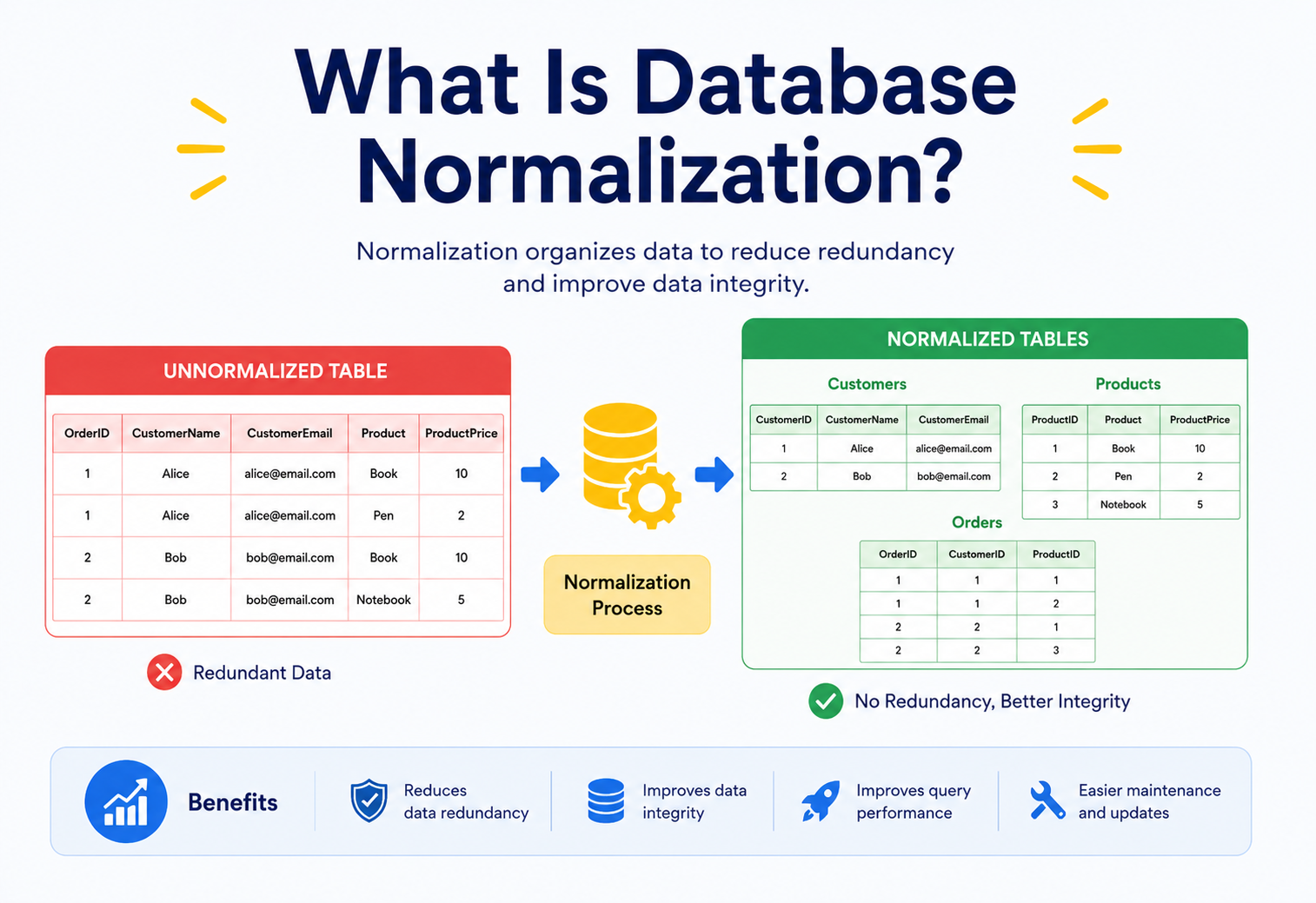
Database normalization is a step-by-step method for organizing data in a relational database so that each fact is stored only once, related facts are grouped together sensibly, and the database itself refuses to let contradictory or duplicate information sneak in.
More than fifty years later, this idea has not gone out of style. Whether you’re building a to-do list app, a hospital records system, or the backend that powers a ride-sharing app used by millions of people, the same core question from 1970 still applies: “If I store this piece of information in two places, what happens when they disagree?” Normalization is the answer to that question.
The Problem: Why We Need Normalization
Building a messy table on purpose — and watching it break in real time.
Let’s build the messy notebook ourselves, as a single database table, and watch it break in real time. Suppose we are building the backend for an online bookstore, and we decide — because it feels “simple” — to put everything into one giant table called orders.
| order_id | customer_name | customer_email | customer_city | book_title | book_author | book_price | quantity |
|---|---|---|---|---|---|---|---|
| 1001 | Asha Verma | asha@mail.com | Pune | Clean Code | Robert Martin | 499 | 1 |
| 1002 | Asha Verma | asha@mail.com | Pune | Pragmatic Programmer | Andrew Hunt | 599 | 2 |
| 1003 | Rahul Nair | rahul@mail.com | Kochi | Clean Code | Robert Martin | 499 | 1 |
At first glance this looks harmless. But look closely: “Asha Verma” and her email and city are written twice, once per order. “Clean Code” and its author and price are also written twice, once for Asha and once for Rahul. This repetition — called data redundancy — is the root of almost every problem normalization exists to solve.
The drawer label
It’s like writing your home address on every single letter you keep in a drawer, instead of writing it once on the drawer label. If you move house, you’d have to correct every letter individually.
Company address in users
A users table where every row repeats the company’s full address, instead of linking to a separate companies table via a company_id.
Why does this matter so much that a whole field of computer science was built around fixing it? Because redundancy doesn’t just waste disk space — it actively creates opportunities for the data to become self-contradictory. That leads us to the three classic anomalies.
Update, Insert & Delete Anomalies
The three weird side effects of bad table design — and their one shared root cause.
An anomaly is simply an unwanted, weird side effect caused by bad table design. There are three classic types. Using our messy orders table above, let’s trigger each one.
-
Update Anomaly
What it is: When the same fact is stored in multiple rows, updating it means you must remember to change every copy. Miss one, and your database now contains two different “truths” at the same time.
Example: Asha Verma changes her email address. If we only update row 1001 and forget row 1002, the database now believes Asha has two different email addresses. Which one is correct? Nobody can say — the data itself has become a lie.
Production example: Imagine Amazon storing a seller’s business address inside every single product listing row instead of a separate
sellerstable. If the seller relocates, thousands of product rows would need updating, and any missed row would show stale address information to customers. -
Insert Anomaly
What it is: When you are forced to add unrelated data just to record one new fact, or you literally cannot record a fact because a required column doesn’t apply yet.
Example: Suppose the bookstore wants to add a brand-new book, “Designing Data-Intensive Applications,” to its catalog before anyone has ordered it. Our
orderstable has no room for a book that isn’t attached to an order — every row requires acustomer_name. We are stuck; we cannot insert a book without inventing a fake order.Beginner analogy: It’s like a school attendance register that only has a column for “which class trip a student is going on.” You cannot add a brand-new student to the school records until you also pick a class trip for them — even if they haven’t chosen one yet.
-
Delete Anomaly
What it is: When deleting one fact accidentally wipes out another, unrelated fact, because they were both crammed into the same row.
Example: Rahul Nair cancels his one and only order (order 1003, for “Clean Code”). If we delete that row, we don’t just lose the order — we lose the only record that Rahul Nair exists as a customer at all, and depending on the data, we might even lose the fact that “Clean Code” costs 499, if his was the last order referencing that book.
Production example: On a ride-sharing platform, if a driver’s profile information were only stored inside individual trip records, deleting the driver’s very first (and possibly only) completed trip could erase their entire profile from the system.
When someone asks “why do we normalize a database?”, the expected answer isn’t “because the textbook says so” — it’s “to eliminate insert, update, and delete anomalies caused by redundant data.” Keep this phrase in your toolkit.
Core Concepts & Vocabulary
Learning the names of the tools before we pick them up in the workshop.
Before we can normalize anything, we need a shared vocabulary. Think of this section as learning the names of tools before using them in a workshop.
4.1 · Relation (table)
What it is: a table made of rows (records) and columns (fields), where every row describes one “thing” of the same type. Why it exists: humans and computers both understand grids extremely well — it’s the same reason spreadsheets are so popular. Analogy: a table is like a class attendance sheet: one row per student, one column per piece of information (name, roll number, grade).
4.2 · Attribute (column)
What it is: a single named property stored for every row, e.g. email, price, city. Analogy: columns are like labeled boxes on a form — “Name:”, “Age:”, “City:” — each box always means the same thing no matter whose form you’re looking at.
4.3 · Tuple (row / record)
What it is: one complete entry in the table — one specific student, one specific order, one specific book. Whether the SQL world calls it a “row” or the theory world calls it a “tuple,” it’s the same idea.
4.4 · Domain
What it is: the set of legal values a column is allowed to hold. The quantity column’s domain might be “positive whole numbers”; the email column’s domain is “text shaped like an email address.” Why it exists: domains stop nonsense from entering the database — like preventing someone from typing “banana” into an age field. In SQL this is usually enforced with column types, CHECK constraints, and enumerations.
Keys: Primary, Foreign, Candidate, Composite
Every single normal form is defined in terms of keys, so understanding them is non-negotiable.
Keys are how tables identify individual rows and how separate tables point at each other. Understanding keys is not optional — every single normal form is defined in terms of keys.
5.1 · Primary key
A primary key is one column (or a small set of columns) whose value is unique for every row and is never empty. It’s the row’s official ID card. In our bookstore example, order_id is a natural primary key for the orders table — no two orders share the same ID.
Your national ID number
Your Aadhaar number, Social Security number, or student roll number — a value that belongs to exactly one person and never changes.
Declared in SQL
CREATE TABLE customers (customer_id INT PRIMARY KEY, ...)
5.2 · Candidate key
Sometimes more than one column (or column combination) could each independently serve as the primary key. Each of these options is called a candidate key. For example, a customers table might have both customer_id and email as candidate keys, because both are guaranteed unique. We pick one to be the actual primary key; the others are sometimes enforced with a UNIQUE constraint instead.
5.3 · Composite key
A composite key is a primary key made from two or more columns combined, used when no single column is unique on its own. Example: in a table recording which students are enrolled in which courses, neither student_id alone nor course_id alone is unique (a student takes many courses, a course has many students) — but the pair (student_id, course_id) together is unique.
5.4 · Foreign key
A foreign key is a column in one table that stores the primary key value of a row in another table, creating a link between them. This is the mechanism that lets us split one messy table into several clean, connected tables without losing the relationships between the data.
Why it exists: it lets us store “Asha Verma” exactly once, in a customers table, and have the orders table simply refer back to her by ID instead of copying her details every time. Analogy: it’s like writing “see page 12” instead of re-copying an entire paragraph onto every page that mentions it. Practical example: orders.customer_id REFERENCES customers.customer_id — the database will now refuse to let an order reference a customer that doesn’t exist, protecting data integrity automatically.
Functional Dependency
The single most important idea behind every normal form — so we slow down here.
This is the single most important idea behind every normal form, so let’s slow down here.
Column B is functionally dependent on column A if, whenever you know the value of A, you can always determine exactly one value of B. We write this as A → B, read as “A determines B.”
Take our orders example: book_title → book_author. If you know the book’s title, “Clean Code,” you can determine its author, “Robert Martin,” with certainty — there’s exactly one correct answer. book_title is called the determinant.
Fingerprint → person
If you know a person’s fingerprint (A), you can always determine exactly which person it belongs to (B). One fingerprint never matches two people.
student_id → student_name
student_id → student_name — a student’s ID always points to exactly one name.
Functional dependency is important because normalization is really just this rule, repeated over and over: “every non-key column must depend on the key, the whole key, and nothing but the key.” That sentence — sometimes taught as a memorable rhyme — is the entire idea behind 1NF through BCNF. We’ll unpack exactly what “the whole key” and “nothing but the key” mean in the next sections.
“A column is functionally dependent on a key if that key’s value always tells you exactly what that column’s value is.”
6.1 · Trivial vs. non-trivial dependencies
A functional dependency A → B is called trivial when B is already part of A — for example, {student_id, course_id} → student_id is trivially true and tells us nothing new. Normal form definitions only care about non-trivial dependencies, ones that reveal a genuine rule about the data, because trivial dependencies can never cause redundancy on their own.
6.2 · Partial vs. transitive dependency, side by side
Students often mix up these two terms, so it helps to place them next to each other. A partial dependency happens when a column depends on only part of a composite key (this is what 2NF removes). A transitive dependency happens when a column depends on another non-key column, which itself depends on the key (this is what 3NF removes). Partial dependency is a problem of an incomplete key; transitive dependency is a problem of an indirect chain. Keeping these two mental pictures separate makes normal-form questions far easier to answer quickly and correctly, whether in an exam, a design review, or a coding interview.
First Normal Form (1NF)
Every cell holds exactly one value — no lists, no repeating groups.
Rule: Every column must hold a single, indivisible (atomic) value — no lists, no repeating groups, no comma-separated values packed into one cell. Each row must also be uniquely identifiable. Why it exists: If a cell holds multiple values, you cannot search, sort, count, or join on it reliably. The database engine sees “Fiction, Thriller, Mystery” as one long piece of text, not three separate facts.
Here’s a table that violates 1NF — notice the genres column packing multiple values into a single cell:
| book_id | title | genres |
|---|---|---|
| B1 | Dune | Sci-Fi, Adventure, Politics |
| B2 | Gone Girl | Thriller, Mystery |
The fix: pull the repeating group into its own table, connected by a foreign key. Now each row states exactly one fact.
| book_id | title |
|---|---|
| B1 | Dune |
| B2 | Gone Girl |
| book_id | genre |
|---|---|
| B1 | Sci-Fi |
| B1 | Adventure |
| B1 | Politics |
| B2 | Thriller |
| B2 | Mystery |
One letter per slot
A single mailbox slot should hold one letter at a time, not five letters crammed together that you then have to tear apart to read individually.
Netflix genres
Netflix doesn’t store “Action, Comedy, Drama” as one string on a title row — genres are a separate linked list of tags, which is exactly why you can filter by a single genre on the homepage.
Second Normal Form (2NF)
Every non-key column must depend on the whole key — not just a piece of it.
Rule: The table must already be in 1NF, and every non-key column must depend on the entire primary key — not just part of it. This rule only matters when you have a composite (multi-column) primary key. Why it exists: If a column only depends on half the key, that fact is being repeated once for every value of the other half of the key — bringing back redundancy.
Suppose we track which students enroll in which courses, along with the course fee:
| student_id | course_id | student_name | course_name | course_fee |
|---|---|---|---|---|
| S1 | C10 | Asha | Databases | 5000 |
| S1 | C11 | Asha | Networks | 4500 |
| S2 | C10 | Ravi | Databases | 5000 |
The primary key here is the composite pair (student_id, course_id). But look at student_name — it only depends on student_id, not on course_id at all. Similarly, course_name and course_fee only depend on course_id. These are called partial dependencies, and they are exactly what 2NF forbids. Notice “Databases” costing 5000 is repeated on two rows — if the fee changes, we risk another update anomaly.
The fix: split into three tables — one for the fact that only depends on student_id, one for the fact that only depends on course_id, and one junction table for the many-to-many relationship itself.
| student_id | student_name |
|---|---|
| S1 | Asha |
| S2 | Ravi |
| course_id | course_name | course_fee |
|---|---|---|
| C10 | Databases | 5000 |
| C11 | Networks | 4500 |
| student_id | course_id | enrolled_on |
|---|---|---|
| S1 | C10 | 2026-01-10 |
| S1 | C11 | 2026-01-12 |
| S2 | C10 | 2026-01-10 |
Beginner analogy
If a school register lists “class teacher’s phone number” next to every subject a student takes, that phone number is only related to the class, not the subject — so it doesn’t belong in that row at all.
Third Normal Form (3NF)
Every non-key column must depend on the key — and nothing but the key.
Rule: The table must already be in 2NF, and no non-key column may depend on another non-key column. Every non-key column must depend directly on the primary key — nothing but the key. Why it exists: These “chains” of dependency — called transitive dependencies — quietly reintroduce redundancy through the back door.
Look at this table of employees:
| emp_id | emp_name | dept_id | dept_name | dept_location |
|---|---|---|---|---|
| E1 | Nisha | D01 | Engineering | Bangalore |
| E2 | Karan | D01 | Engineering | Bangalore |
| E3 | Meera | D02 | Sales | Mumbai |
Here, dept_name and dept_location do depend on the primary key emp_id — but only indirectly, through dept_id. The real chain is emp_id → dept_id → dept_name, dept_location. dept_name is transitively dependent on emp_id. This is why “Engineering, Bangalore” is repeated for every engineer — the classic update-anomaly setup.
The fix: move department facts into their own table.
| emp_id | emp_name | dept_id |
|---|---|---|
| E1 | Nisha | D01 |
| E2 | Karan | D01 |
| E3 | Meera | D02 |
| dept_id | dept_name | dept_location |
|---|---|---|
| D01 | Engineering | Bangalore |
| D02 | Sales | Mumbai |
“The key, the whole key, and nothing but the key, so help me Codd.” 1NF fixes atomicity, 2NF fixes “the whole key,” 3NF fixes “nothing but the key.”
Boyce-Codd Normal Form (BCNF)
A stricter version of 3NF that catches an edge case involving overlapping composite keys.
BCNF is a stricter version of 3NF, designed to catch a rare edge case that 3NF misses: situations where a table has overlapping composite candidate keys.
For every functional dependency A → B in the table, A must be a candidate key (or a superset of one). In other words, every determinant must be a key.
Example: a tuition table where each professor teaches only one subject, but a subject can be taught by multiple professors, and a student can take a subject from any professor:
| student_id | subject | professor |
|---|---|---|
| S1 | Math | Dr. Rao |
| S2 | Math | Dr. Iyer |
| S1 | Physics | Dr. Shah |
Here professor → subject holds (each professor teaches exactly one subject), but professor is not a candidate key of this table — (student_id, subject) is. This determinant-that-isn’t-a-key situation is exactly what BCNF forbids. The fix is to split out a professor_subject table recording which professor teaches which subject, separate from which student studies with which professor.
BCNF decompositions can occasionally make it impossible to enforce certain functional dependencies without adding extra constraints, and in rare cases the decomposition isn’t “dependency-preserving.” This is precisely why most production teams stop at 3NF unless they hit this specific overlapping-key scenario.
4NF, 5NF & Beyond
The rare higher forms — useful in exams and a small number of genuinely tricky schemas.
11.1 · Fourth normal form (4NF)
4NF deals with multi-valued dependencies — situations where a table stores two or more independent, unrelated multi-valued facts about the same entity in one place. Classic example: a table listing an employee’s skills and, separately, the languages they speak, in one combined table:
| emp_id | skill | language |
|---|---|---|
| E1 | Java | English |
| E1 | Java | Hindi |
| E1 | Python | English |
| E1 | Python | Hindi |
Skills and languages have nothing to do with each other, yet the table is forced to list every combination — this is redundant “combinatorial explosion.” The fix: split into emp_skills and emp_languages, each linked to emp_id independently.
11.2 · Fifth normal form (5NF)
5NF (also called Project-Join Normal Form) handles even rarer cases where a table can be losslessly split into three or more smaller tables, but not into just two, without losing information when they’re joined back together. This mostly appears in specialized modeling scenarios — for example, a table connecting suppliers, parts, and projects where the valid combinations can’t be derived from any pairwise relationship alone.
4NF and 5NF matter for exams and for a small number of genuinely tricky real schemas, but the vast majority of working engineers will spend their entire careers designing at 3NF/BCNF and never need to consciously reach for 5NF.
Data Flow: Designing a Schema Step by Step
How a software architect actually approaches schema design on day one of a project.
Let’s walk through designing a normalized schema for a food-delivery app from scratch — the way a software architect actually approaches it on day one of a project.
Gather the facts as one flat sheet
Start the way a beginner naturally would — list every piece of information the app needs to remember: customer name, customer phone, restaurant name, restaurant address, dish name, dish price, order quantity, delivery agent name, delivery agent vehicle number, order status, order time.
Identify the “nouns” (entities)
Group facts that clearly describe the same real-world “thing”: Customer, Restaurant, Dish, DeliveryAgent, Order. Each noun becomes a candidate table.
Assign a primary key to each entity
customer_id,restaurant_id,dish_id,agent_id,order_id— usually auto-incrementing integers or UUIDs, since names and phone numbers can change or repeat.Draw the relationships
A restaurant has many dishes (one-to-many). A customer places many orders (one-to-many). An order can include many dishes, and a dish can appear in many orders (many-to-many, needing a junction table
order_items).Apply 1NF → 2NF → 3NF checks to every table
Check each table: are all values atomic? Does every column depend on the whole key? Does every column depend directly on the key and nothing else? Fix violations by splitting further.
Connect tables with foreign keys and constraints
Add
FOREIGN KEYconstraints so the database itself enforces that an order can never point to a customer who doesn’t exist.
Here is the resulting SQL for the core tables:
CREATE TABLE customers (
    customer_id   BIGINT PRIMARY KEY AUTO_INCREMENT,
    full_name     VARCHAR(120) NOT NULL,
    phone         VARCHAR(15)  NOT NULL UNIQUE
);

CREATE TABLE restaurants (
    restaurant_id BIGINT PRIMARY KEY AUTO_INCREMENT,
    name          VARCHAR(120) NOT NULL,
    address       VARCHAR(250) NOT NULL
);

CREATE TABLE dishes (
    dish_id       BIGINT PRIMARY KEY AUTO_INCREMENT,
    restaurant_id BIGINT NOT NULL,
    name          VARCHAR(120) NOT NULL,
    price         DECIMAL(8,2) NOT NULL,
    FOREIGN KEY (restaurant_id) REFERENCES restaurants(restaurant_id)
);

CREATE TABLE delivery_agents (
    agent_id      BIGINT PRIMARY KEY AUTO_INCREMENT,
    full_name     VARCHAR(120) NOT NULL,
    vehicle_no    VARCHAR(20)
);

CREATE TABLE orders (
    order_id      BIGINT PRIMARY KEY AUTO_INCREMENT,
    customer_id   BIGINT NOT NULL,
    restaurant_id BIGINT NOT NULL,
    agent_id      BIGINT,
    status        VARCHAR(20) NOT NULL,
    placed_at     TIMESTAMP NOT NULL DEFAULT CURRENT_TIMESTAMP,
    FOREIGN KEY (customer_id)   REFERENCES customers(customer_id),
    FOREIGN KEY (restaurant_id) REFERENCES restaurants(restaurant_id),
    FOREIGN KEY (agent_id)      REFERENCES delivery_agents(agent_id)
);

CREATE TABLE order_items (
    order_id      BIGINT NOT NULL,
    dish_id       BIGINT NOT NULL,
    quantity      INT NOT NULL CHECK (quantity > 0),
    PRIMARY KEY (order_id, dish_id),
    FOREIGN KEY (order_id) REFERENCES orders(order_id),
    FOREIGN KEY (dish_id)  REFERENCES dishes(dish_id)
);
Notice: nowhere does a restaurant’s name get repeated per dish, nowhere does a dish’s price get copied into every order — each fact lives in exactly one place, and every table’s non-key columns depend on nothing but that table’s own key.
Architecture: The Final Entity Relationship Diagram
The map of how our normalized tables connect — boxes are tables, lines are foreign keys.
An Entity Relationship Diagram (ERD) is the map of how our normalized tables connect. Reading one is a core skill — the boxes are tables, the lines are foreign key relationships, and the symbols at each end describe “how many.”
CUSTOMERS → ORDERS reads as “one customer places zero or many orders.” ORDERS → ORDER_ITEMS and DISHES → ORDER_ITEMS together show how ORDER_ITEMS is a junction table resolving the many-to-many relationship between orders and dishes — exactly the pattern we used to fix 2NF violations earlier.Compare this to what a single unnormalized table would have looked like — one flat sheet with every fact mixed together and no clear boundaries:
Java Example: Mapping a Normalized Schema
Each normalized table becomes one JPA @Entity; each foreign key becomes an object reference.
In real Java backends (Spring Boot + JPA/Hibernate is the most common combination), each normalized table typically becomes one @Entity class, and foreign keys become object references. Here is how the Restaurant → Dish one-to-many relationship from our ERD looks in code.
@Entity
@Table(name = "restaurants")
public class Restaurant {

    @Id
    @GeneratedValue(strategy = GenerationType.IDENTITY)
    private Long restaurantId;

    private String name;
    private String address;

    @OneToMany(mappedBy = "restaurant", cascade = CascadeType.ALL)
    private List<Dish> dishes = new ArrayList<>();
}

@Entity
@Table(name = "dishes")
public class Dish {

    @Id
    @GeneratedValue(strategy = GenerationType.IDENTITY)
    private Long dishId;

    private String name;
    private BigDecimal price;

    // This is the foreign key: dish "belongs to" one restaurant.
    // JPA turns this into a restaurant_id column automatically.
    @ManyToOne
    @JoinColumn(name = "restaurant_id", nullable = false)
    private Restaurant restaurant;
}
Notice how the Java code mirrors the database design directly: Dish holds a reference to exactly one Restaurant (the foreign key), never a copy of the restaurant’s name or address. If the restaurant renames itself, exactly one row in the database changes, and every dish automatically “sees” the new name the next time it’s queried — because there was never a second copy to forget about.
@Entity
@Table(name = "order_items")
@IdClass(OrderItemId.class)
public class OrderItem {

    @Id
    @ManyToOne
    @JoinColumn(name = "order_id")
    private Order order;

    @Id
    @ManyToOne
    @JoinColumn(name = "dish_id")
    private Dish dish;

    private Integer quantity;
}
The composite primary key (order_id, dish_id) from our 2NF discussion shows up here as an @IdClass — a small Java object representing both parts of the key together, exactly matching the database table it maps to.
Advantages, Disadvantages & Trade-offs
The honest two sides of designing to 3NF by default.
- Eliminates redundancy — each fact is stored exactly once, so storage is used efficiently and there’s only ever one “source of truth.”
- Prevents anomalies — insert, update, and delete anomalies become structurally impossible rather than something developers must remember to avoid.
- Improves data integrity — foreign key constraints let the database itself reject invalid relationships (e.g., an order for a customer that doesn’t exist).
- Makes the schema easier to extend — adding a new attribute to “restaurant” means touching one table, not rewriting logic scattered across the codebase.
- Smaller tables are faster to write to — writes touch less data, and locking (in concurrent systems) affects a smaller footprint.
- More tables means more joins — reading data that spans several entities (e.g., “show me the restaurant name for every order”) requires SQL
JOINoperations, which cost CPU and I/O. - Complexity for beginners — a heavily normalized schema with 20+ tables can be harder to mentally map out than a handful of wide tables.
- Can hurt read-heavy analytical workloads — dashboards that aggregate millions of rows across many joined tables are often slower than reading from a single pre-joined table.
| Concern | Normalized design | Denormalized design |
|---|---|---|
| Data consistency | Strong — one source of truth | Weaker — risk of contradicting copies |
| Write performance | Fast, small writes | Slower, must update all copies |
| Read performance (simple lookups) | Requires joins | Fast, no joins needed |
| Read performance (large-scale analytics) | Can be slow due to many joins | Often faster |
| Storage space | Efficient | Higher, due to duplication |
| Schema flexibility | Easy to extend cleanly | Harder — duplicated columns multiply changes |
Denormalization: Breaking Rules on Purpose
A conscious engineering trade-off, made after the schema is already correctly normalized.
Denormalization is the deliberate, controlled re-introduction of some redundancy into a normalized schema, in exchange for faster reads. This is not a mistake or a step backward — it’s a conscious engineering trade-off made after the schema is already correctly normalized, usually driven by real performance measurements, not guesses.
16.1 · When denormalization makes sense
- Read-heavy reporting/analytics systems (data warehouses) — where the same large joins run millions of times a day. Storing a pre-joined, pre-aggregated table avoids repeating that work every single query.
- Caching computed values — e.g., storing a
total_pricecolumn on theorderstable instead of recalculating it fromorder_itemson every read, refreshed whenever items change. - High-traffic read paths — a product page on an e-commerce site might store a denormalized snapshot of “seller name” directly on the product row to avoid a join on every single page view, accepting that the seller’s name updates with a slight delay.
Amazon product pages
Amazon’s product listing pages are widely understood to be backed by denormalized, cache-friendly read models — while the “source of truth” inventory and pricing systems behind the scenes remain normalized.
Star-schema warehouses
Data warehouses (used for Netflix or Uber-scale analytics) commonly use a “star schema” — a deliberately denormalized design with one central fact table and several surrounding dimension tables, optimized purely for fast aggregation.
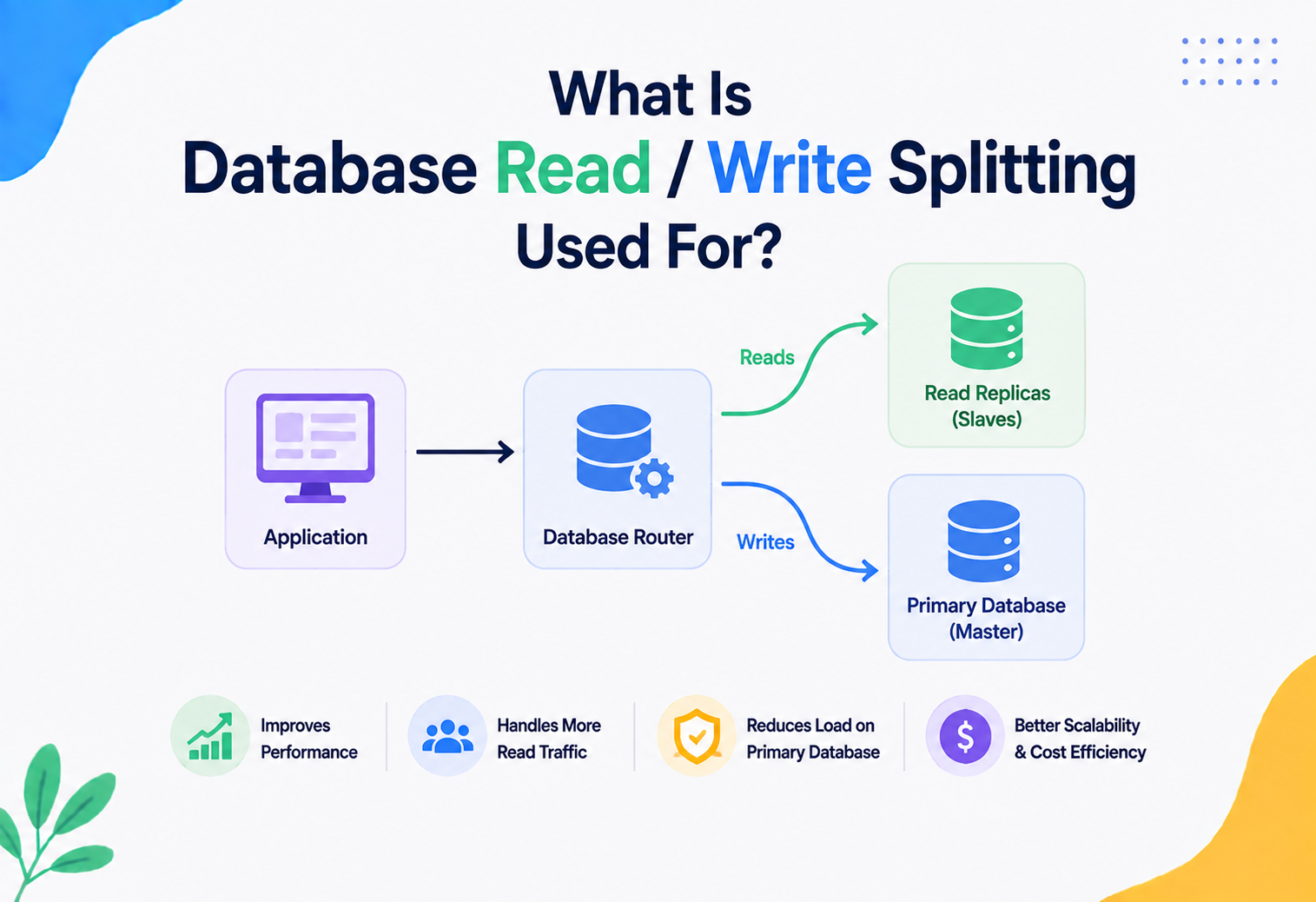
Modern systems often use a hybrid approach: keep the primary transactional database (the one handling orders, payments, sign-ups) normalized for correctness, and periodically copy/transform data into a separate, denormalized read replica or data warehouse for reporting. This pattern is sometimes called CQRS (Command Query Responsibility Segregation) — writes go through the normalized model, reads come from an optimized denormalized model.
Performance, Indexing & Scalability
Understanding the mechanics so you can make good decisions instead of following rules blindly.
Normalization affects performance in both directions, and understanding the mechanics helps you make good decisions instead of following rules blindly.
17.1 · Joins and indexes
Every foreign key relationship should almost always have a corresponding index on the foreign key column. An index is a separate, sorted data structure (commonly a B-tree) the database maintains alongside a table, letting it find matching rows in roughly logarithmic time instead of scanning every row.
CREATE INDEX idx_orders_customer_id ON orders(customer_id);
CREATE INDEX idx_dishes_restaurant_id ON dishes(restaurant_id);
CREATE INDEX idx_order_items_dish_id ON order_items(dish_id);
Without these indexes, a join between orders and customers would force the database to scan the entire orders table for every customer — turning what should be a fast lookup into an expensive full scan, especially as tables grow past millions of rows.
17.2 · Query planning
Modern relational database engines (PostgreSQL, MySQL/InnoDB, SQL Server) use a query planner/optimizer that decides the cheapest way to execute a join — whether to use a nested loop join, a hash join, or a merge join — based on table sizes and available indexes. A well-normalized schema with correct indexes typically lets the optimizer produce very efficient plans, often faster than scanning one giant denormalized table for the same answer.
17.3 · Scalability considerations
- Vertical scaling — for most normalized OLTP (transactional) workloads, a properly indexed schema on a single well-resourced database server handles very large traffic before joins become the bottleneck.
- Read replicas — normalized data can be replicated to read-only copies to spread out read traffic (used extensively at companies like Uber and Airbnb for their transactional stores).
- Caching layers — tools like Redis or Memcached sit in front of the normalized database to serve frequently-read, pre-joined data without hitting the database at all, combining the correctness of normalization with the speed of denormalized reads.
- Sharding — splitting a normalized table’s rows across multiple database servers by a key (e.g.,
customer_id), used at extreme scale (Instagram famously shards its Postgres-based user data this way).
Normalization in Distributed Systems (CAP, Sharding)
How CAP, sharding, and replication push large-scale systems toward hybrid designs.
Normalization was originally designed for single-machine relational databases. In large distributed systems, extra forces come into play.
18.1 · The CAP theorem
The CAP theorem states that a distributed data system can only fully guarantee two of these three properties at once: Consistency (every read sees the latest write), Availability (every request gets a response), and Partition tolerance (the system keeps working even if network links between servers fail). Since network partitions are unavoidable in real distributed systems, engineers really choose between prioritizing consistency (CP) or availability (AP) when a partition occurs.
Normalization directly amplifies the cost of consistency in distributed setups: a normalized schema often spreads related facts across tables that might live on different nodes, and enforcing foreign-key-style referential integrity across nodes is expensive or sometimes impossible. This is a major reason many large-scale distributed NoSQL databases (like Cassandra or DynamoDB) intentionally encourage a denormalized, “one query = one table” design instead of relational-style normalization.
18.2 · Joins across shards
When a normalized schema is sharded (split across many database servers by a key like customer_id), a join between two tables that live on different shards becomes a distributed join — much slower and more complex than a local join. Engineers commonly work around this by:
- Co-locating related data — sharding both
ordersandorder_itemsby the samecustomer_id, so a customer’s related rows always live on the same physical shard. - Selective denormalization — duplicating small, slow-changing reference data (like a restaurant’s name) onto the order row, avoiding a cross-shard join entirely for that one field.
- Application-side joins — fetching data from two shards separately and combining it in application code instead of in the database.
18.3 · Replication and consistency models
To survive server failures, normalized primary databases are usually replicated — copied continuously to standby servers. Synchronous replication waits for a copy to confirm the write before responding (safer, slower); asynchronous replication responds immediately and copies in the background (faster, small risk of losing the very latest writes on failure). Most production systems (including those behind Netflix and Uber) use asynchronous replication for read replicas and reserve strong, synchronous guarantees for the smallest set of truly critical writes, like payments.
Security & Data Integrity
Normalization is primarily a data-quality technique, but it has real security implications too.
Normalization is primarily a data-quality technique, but it has real security and integrity implications worth understanding.
- Constraint enforcement: foreign keys,
NOT NULL,UNIQUE, andCHECKconstraints — all natural companions of a normalized design — stop malformed or malicious data from ever being committed, which is a first line of defense against corrupted application state. - Principle of least duplication: sensitive data (like a password hash or a payment token) that lives in exactly one well-guarded table is far easier to secure, audit, and encrypt than the same data scattered redundantly across a dozen denormalized tables.
- Access control granularity: normalized tables let you grant database-level permissions precisely — e.g., a reporting service can be given read-only access to
orderswithout ever touching thecustomerstable that holds personal contact information. - SQL injection surface: this is unrelated to normalization itself, but it’s worth stating plainly — always use parameterized queries or an ORM (like JPA/Hibernate shown earlier) rather than concatenating raw strings into SQL, regardless of how the schema is normalized.
- Auditing: because a normalized schema keeps each fact in one place, “who changed this value and when” (via audit/history tables or database triggers) is far simpler to track accurately than in a denormalized table where the same field exists redundantly in many rows.
Denormalizing personally identifiable information (PII), like copying a customer’s email into many unrelated tables “for convenience.” This multiplies the number of places that must be secured, encrypted, and scrubbed under privacy regulations like GDPR — turning a simple compliance request (“delete this user’s data”) into a much bigger, error-prone hunt across the schema.
Monitoring, Migrations & Production Ops
Everything that keeps a normalized schema healthy after it’s in production.
20.1 · Monitoring what matters
- Slow query logs — most databases can log queries above a time threshold; a sudden rise often points to a missing index on a foreign key introduced during normalization.
- Query execution plans — tools like PostgreSQL’s
EXPLAIN ANALYZEreveal whether a join is using an index efficiently or falling back to a full table scan. - Lock contention metrics — heavily normalized, highly-referenced parent tables (like
customers) can become hotspots for lock waits under high concurrent write load. - Replication lag — for systems using read replicas, monitoring how far behind a replica is from the primary matters, since normalized joins split across a lagging replica can return stale results.
20.2 · Schema migrations
Because normalized schemas are made of many small, focused tables, schema changes are usually small and low-risk — adding a column to restaurants doesn’t touch orders at all. Tools like Flyway or Liquibase (common in Java/Spring Boot projects) apply these changes as version-controlled, repeatable migration scripts, letting a team track exactly how the schema evolved over time, the same way source code is tracked with Git.
-- V12__add_loyalty_points_to_customers.sql
ALTER TABLE customers
    ADD COLUMN loyalty_points INT NOT NULL DEFAULT 0;
20.3 · Backup and disaster recovery
Normalized schemas with well-defined foreign key relationships make point-in-time recovery more trustworthy — restoring a backup naturally restores a consistent, non-contradictory snapshot, because the constraints guarantee referential integrity was maintained at every committed moment. Denormalized copies (like a data warehouse) are typically treated as disposable and rebuildable from the normalized source, rather than backed up with the same rigor.
Real-World & Industry Examples
The repeated pattern at scale — normalize the source of truth, denormalize the systems built for speed around it.
Normalized catalog, denormalized viewing history
Netflix’s core catalog metadata (titles, cast, genres, seasons, episodes) is modeled in a normalized relational style so that updating one actor’s name or one genre tag propagates instantly everywhere it’s referenced — while separately, viewing-history and recommendation pipelines lean on highly denormalized, distributed stores (built on Cassandra) optimized purely for massive write throughput.
Normalized inventory, cached product pages
Order and inventory systems behind the scenes are normalized to guarantee that stock counts and prices never silently disagree between systems, while customer-facing product pages are served from denormalized, cached read models for speed.
Normalized trips, specialized geo indexes
Trip, driver, and rider data is normalized in core services to maintain strict referential integrity (a trip cannot exist without a valid driver and rider), while geospatial and real-time matching systems use specialized, denormalized data structures optimized for low-latency lookups.
Strict 3NF ledgers
Core banking ledgers are almost universally kept in strict normalized form (often 3NF or higher), because financial regulations demand that account balances, transactions, and customer identity never have two “possible truths” at once.
The pattern across all of these: normalize the system of record, and denormalize the systems built for speed around it. This is one of the most consistently repeated architectural decisions in large-scale software engineering.
Design Patterns & Anti-Patterns
The habits that scale — and the ones that quietly kill a schema.
22.1 · Good patterns
Junction (associative) tables
Use a small intermediate table for every many-to-many relationship, as we did with order_items above.
Lookup / reference tables
Use dedicated tables for fixed sets of values (e.g., a statuses table for order status codes) instead of hardcoding strings everywhere.
Surrogate keys
Prefer auto-incrementing IDs or UUIDs as primary keys instead of “natural” keys like email or phone number, which can change over a person’s lifetime.
Audit / history tables
Record changes to a normalized table over time in a paired history table, without duplicating current-state data anywhere.
22.2 · Anti-patterns to avoid
The “God table”
One giant table trying to represent multiple unrelated entities (our very first orders example). A tell-tale sign is dozens of nullable columns that only make sense for some rows.
Comma-separated columns
Storing “tag1,tag2,tag3” in one text column instead of a proper related table, violating 1NF and making search/filtering unreliable.
EAV overuse
Entity-Attribute-Value: a generic (entity_id, attribute_name, value) table used to avoid ever changing the schema. It sidesteps normalization theory entirely but sacrifices type safety, indexing, and query performance; it’s occasionally justified for truly dynamic user-defined fields, but is often reached for prematurely.
Premature denormalization
Flattening tables for “performance” before ever measuring whether joins were actually a bottleneck, trading away correctness for a speed gain that was never proven necessary.
Missing foreign keys
Splitting tables correctly on paper but skipping the actual FOREIGN KEY declaration in SQL “to keep inserts fast,” which quietly reopens the door to orphaned, inconsistent rows.
Best Practices & Common Mistakes
The practical rules working engineers actually follow — and the beginner traps to sidestep.
23.1 · Best practices
Design for 3NF by default
It removes essentially all practical anomalies while remaining easy to query and reason about.
Always index foreign key columns
A missing index on a join column is the single most common cause of “why is this simple query suddenly slow.”
Use surrogate primary keys
Prefer them for entities whose natural identifiers might change (names, emails, phone numbers).
Add database-level constraints
Use
NOT NULL,UNIQUE,CHECK, foreign keys — rather than relying solely on application code to enforce rules. Application bugs happen, but a well-constrained database won’t accept bad data regardless.Denormalize deliberately and document why
If you duplicate a column for performance, leave a comment explaining which query pattern justified the trade-off and how the copy stays in sync.
Version-control your schema
Use migration tools (Flyway, Liquibase, Alembic) instead of manual, undocumented
ALTER TABLEstatements.Model relationships explicitly
Draw the ERD before writing
CREATE TABLEstatements — most design flaws are caught faster on a whiteboard than in code.
23.2 · Common mistakes beginners make
- Treating normalization as an all-or-nothing checklist to “complete,” instead of a design tool used with judgment.
- Forgetting that a composite primary key’s order in a query can affect which indexes are usable.
- Normalizing so aggressively that simple, common queries require six or seven joins for basic information — a sign the entity boundaries may need rethinking, not just blind rule-following.
- Confusing “normalized” with “correct data types” — normalization is about structure and dependency, not about picking
VARCHARvsTEXT. - Not planning for how denormalized caches or read replicas will be kept in sync with the normalized source of truth, leading to silently stale data in production.
23.3 · Normalization and ACID transactions
Normalization and ACID (Atomicity, Consistency, Isolation, Durability) transactions solve related but distinct problems, and understanding how they cooperate is a common gap even among working engineers. Normalization is a design-time decision — it decides where each fact should permanently live so redundancy never has a chance to appear. ACID transactions are a run-time guarantee — they decide what happens while your application is actively reading and writing that already-normalized data.
Consider transferring money between two normalized accounts rows: debiting one account and crediting another must happen together, or not at all. Normalization ensures each account’s balance lives in exactly one row so there’s only one number to update; the transaction’s atomicity guarantee ensures that both updates commit together, or both roll back together, even if the server crashes mid-operation. Neither idea replaces the other — a normalized schema without transactions can still end up briefly inconsistent under concurrent access, and transactions on a badly denormalized schema still have to update every redundant copy of a fact correctly within that same transaction, which is strictly more work and more room for bugs.
@Transactional
public void transferFunds(Long fromAccountId, Long toAccountId, BigDecimal amount) {
    Account from = accountRepository.findById(fromAccountId).orElseThrow();
    Account to   = accountRepository.findById(toAccountId).orElseThrow();

    if (from.getBalance().compareTo(amount) < 0) {
        throw new InsufficientFundsException(fromAccountId);
    }
    from.setBalance(from.getBalance().subtract(amount));
    to.setBalance(to.getBalance().add(amount));
    // Both saves commit together, or neither does, because of @Transactional.
    accountRepository.save(from);
    accountRepository.save(to);
}
Because balance exists as a single normalized column per account rather than being duplicated in some summary table elsewhere, this transaction only has one number to protect per account — exactly the kind of simplicity normalization is meant to provide to the rest of the system built on top of it.
Frequently Asked Questions
Fast answers to the questions that come up in every design review, every interview, and every code review.
Is normalization only for SQL/relational databases?
The formal theory (1NF through 5NF) was defined specifically for the relational model. NoSQL databases (document stores like MongoDB, wide-column stores like Cassandra, key-value stores like DynamoDB) generally favor denormalized, query-optimized data modeling from the start, though the underlying idea — think carefully about where duplication is worth its cost — still applies everywhere data is modeled.
Do I always need to reach 3NF?
Not always, but it’s a strong, well-tested default. Some teams deliberately stop at 2NF or even 1NF for very simple, small, low-write tables where the extra joins from full normalization aren’t worth the design overhead. As a rule, though, 3NF should be the assumption unless you have a specific reason to deviate.
What’s the difference between a candidate key and a primary key?
A candidate key is any column (or column combination) that could uniquely identify a row. A table can have several candidate keys. The primary key is the one candidate key the designer officially chooses to be the table’s main identifier; the others are usually still protected with a UNIQUE constraint.
Can a table be in 3NF but not in BCNF?
Yes — this happens specifically when a table has multiple overlapping composite candidate keys and a non-key attribute determines part of a key, as shown in the professor/subject example earlier. It’s a genuinely rare situation in typical business schemas.
Does normalization slow down my application?
It can slow down specific read patterns that need to combine many tables, but it usually speeds up writes and, most importantly, prevents your data from becoming wrong. The right response to a proven read-performance problem is targeted denormalization or caching — not abandoning normalization altogether.
How is normalization different from just “good database design”?
Normalization is one specific, formally defined technique inside the broader practice of good database design. Good design also includes choosing sensible data types, naming conventions, indexing strategy, and access patterns — normalization addresses the redundancy and dependency structure of the tables specifically.
Summary & Key Takeaways
Fifty-plus years later, the same question still applies: if I store this in two places, what happens when they disagree?
- Database normalization is a step-by-step method, invented by Edgar Codd starting in 1970, for organizing relational data so that every fact is stored exactly once.
- Without it, tables suffer from update, insert, and delete anomalies — all caused by the same root problem: redundant, duplicated data.
- 1NF demands atomic values in every cell. 2NF removes partial dependencies on part of a composite key. 3NF removes transitive dependencies through other non-key columns. BCNF tightens this further so every determinant is a candidate key. 4NF/5NF handle rarer multi-valued and join-dependency edge cases.
- Keys — primary, candidate, composite, and foreign — are the mechanism that lets split tables stay connected without losing information.
- In production, most teams design to 3NF/BCNF by default, then apply deliberate, measured denormalization for specific proven performance needs — through caching, read replicas, or dedicated analytics warehouses.
- In distributed systems, normalization interacts with the CAP theorem, sharding, and replication — pushing many large-scale systems toward normalized systems of record with denormalized systems of speed built around them.
- The recurring, real-world pattern at companies like Netflix, Amazon, and Uber is consistent: keep the source of truth normalized; denormalize the copies built for speed.