The Fan-Out Problem in Microservices
A single button tap can quietly trigger dozens of network calls behind the scenes. This is a complete field manual for why fan-out happens, why it becomes dangerous at scale, and exactly how production systems at companies like Netflix, Amazon, Uber, and Google keep it under control — with parallelism, timeouts, circuit breakers, bulkheads, hedged requests, and distributed tracing.
01 · Introduction & History
Imagine you ask one friend a question, and instead of answering it themselves, that friend runs off and asks five other friends, and each of those friends asks two more friends, and so on. Pretty soon, one simple question has turned into fifty conversations happening at once. If even one of those fifty friends is slow to reply, your original question takes forever to get answered.
This is, in a nutshell, the fan-out problem. It is one of the most common — and most underestimated — challenges in modern software systems built as microservices. It does not show up in a textbook diagram. It shows up at 2 AM, in a production incident, when one slow service somewhere deep in a chain of calls brings down a page that looked perfectly simple to the user.
Where does the term come from?
“Fan-out” is a much older term than microservices. It was originally used in electronics and digital circuit design, decades before web applications existed. In a circuit, the “fan-out” of a logic gate is the number of other gate inputs that a single gate’s output can drive. Picture a single wire spreading out into many wires, like an electric fan’s blades spreading out from the center. That visual — one thing branching into many — is exactly why the term stuck.
When distributed systems and networking grew popular in the 1990s and 2000s, engineers borrowed the word. In networking, “fan-out” describes one node sending a message to many other nodes. Message queue systems, pub/sub systems, and load balancers have used “fan-out” to describe this same one-to-many spreading pattern for a long time.
Then came the shift from monolithic applications (one big application doing everything) to microservices (many small, independent services, each responsible for one job) in the 2010s. Companies like Netflix, Amazon, and Uber pioneered this shift because it let large engineering teams work independently and deploy fast. But this shift had a side effect nobody fully appreciated at first: a single user request, which used to be one function call inside one process, now had to travel across a network to reach dozens of independent services. The old electronics term “fan-out” was the perfect fit for this new problem, and it has stuck in distributed systems vocabulary ever since.
Today, “the fan-out problem” specifically refers to what happens when a single incoming request to a distributed system triggers many downstream requests to other services, and the health, latency, and reliability of the whole system starts to depend on the weakest link in that widening chain.
02 · Problem & Motivation
To understand why fan-out is a “problem” and not just a normal fact of life in distributed systems, we need to look at what breaks when fan-out is left unmanaged.
Why does fan-out happen at all?
Microservices exist because breaking a big application into small, independently deployable services gives teams speed, ownership, and the ability to scale each part separately. But a real product feature — like “show me my Amazon order status” or “load my Netflix homepage” — almost never lives inside a single service. It needs data scattered across many services: user profile, inventory, pricing, recommendations, reviews, shipping status, payment status, and more.
So the moment you split a monolith into microservices, you are forced to make a choice: either combine data from many services somewhere (which causes fan-out), or duplicate all that data into every service that might need it (which causes its own massive headaches around consistency). Most real systems end up doing some of both, but fan-out is unavoidable for any feature that touches more than one bounded context.
What actually goes wrong
Here is the core motivation for treating fan-out as a first-class architectural concern, not an afterthought:
- Latency multiplies, it doesn’t just add. If service A calls B, C, and D one after another (sequentially), your total response time is roughly the sum of all three. Even if you call them in parallel, your response time is at least as slow as the slowest of the three.
- Failure probability multiplies. If each downstream service has 99.9% uptime, and a request depends on 10 of them succeeding, the maths gets ugly fast. We will calculate this precisely in the next section.
- Small slowdowns become outages. A downstream service that gets 5% slower under load can cause the calling service to pile up waiting threads or connections, which can cascade into a full outage — even though the downstream service technically never “went down.”
- Resource exhaustion. Every fan-out call typically needs a thread, a socket, a connection-pool slot, and memory to hold the pending request. Wide fan-out under high traffic can exhaust these resources even when every downstream service is individually healthy.
- Retry storms. When a request fails and is retried, and that retry itself fans out again, you can accidentally multiply load on an already struggling downstream service — making the outage worse instead of better.
The business cost, not just the technical cost
It’s worth pausing on why engineering leaders take fan-out risk so seriously — it isn’t just an academic concern for people who enjoy drawing diagrams. Every extra hundred milliseconds of load time on a checkout page has been shown, in study after study from large e-commerce companies, to measurably reduce the fraction of visitors who complete a purchase. A page that fails outright, rather than loading slowly, is even more costly: the visitor doesn’t just wait longer, they often leave and don’t come back. So when a fan-out chain quietly adds latency or introduces new failure modes with every new downstream call a team bolts on, that is a direct, measurable hit to revenue, not merely an internal metric on an engineering dashboard.
There is also a hidden cost in engineering time itself. When an incident happens in a monolith, there is one codebase to look through. When an incident happens in a system with deep, wide fan-out, the on-call engineer often has to first figure out which of a dozen or more services is actually responsible, before they can even begin fixing the real problem. Without the observability tooling described later in this tutorial, that triage step alone can eat up the majority of an incident’s total resolution time. Teams that invest early in resilience patterns and tracing infrastructure consistently report shorter incidents and fewer repeat outages, because the “detective work” portion of an incident shrinks dramatically.
A weather app’s homepage needs today’s temperature, a 5-day forecast, an air-quality reading, and a news headline about the weather. If each piece of data comes from a different backend service, loading that one screen fans out into four API calls — and it renders only as fast as the slowest of the four.
An e-commerce “product page” service that fans out to inventory, pricing, reviews, recommendations, shipping estimator, and seller-info services has an amplification factor of 6x for every single page view. At 500 page views/second, that is 3,000 downstream calls/second — from one endpoint.
Netflix once had a slow “bookmarks” microservice cause thread pools in several unrelated calling services to fill up, because those callers had generous timeouts and no circuit breakers. Their public engineering posts about Hystrix were written specifically to prevent this class of cascading failure.
The core motivation, restated simply
Every time a system designer draws an arrow from Service A to Service B, C, and D, they are making a promise: “I trust that all of these will respond correctly and quickly enough.” Fan-out design is really about being honest with yourself about how much you can actually trust that promise, and building safety nets for the moments that promise is broken — because in a system with enough services, something is always failing somewhere.
03 · Core Concepts
3.1 What is fan-out?
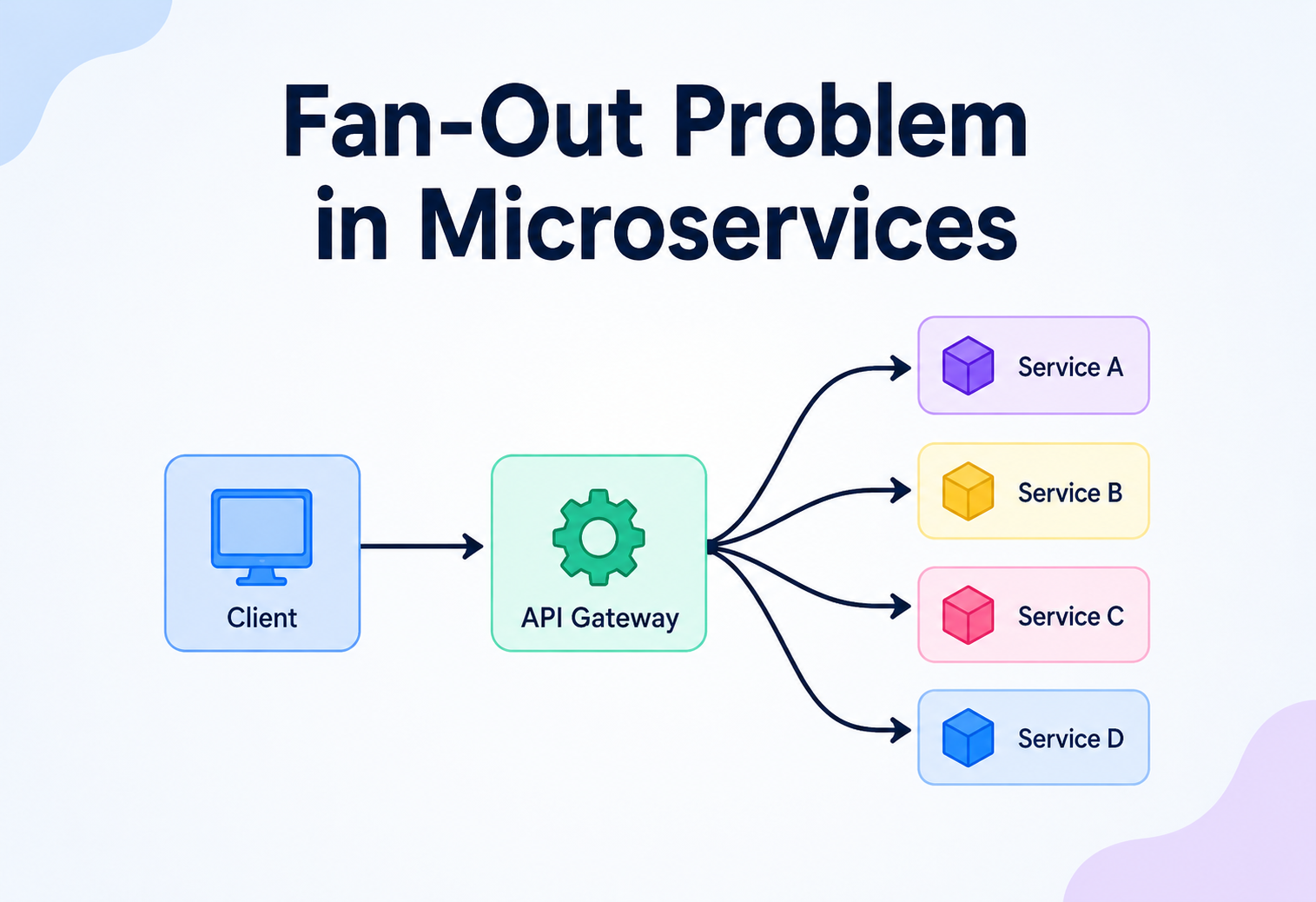
What it is: Fan-out is when one service, upon receiving a single request, issues multiple outgoing requests to other services (or the same service, multiple times) to gather the information it needs to respond.
Why it exists: Because in a microservices architecture, no single service owns all the data or logic needed to answer a complex question. The system has to “ask around.”
Where it’s used: API gateways, backend-for-frontend (BFF) layers, aggregator services, search systems, recommendation engines, and any “dashboard” style screen that pulls together many types of data.
3.2 Fan-in
What it is: The mirror image of fan-out. After a request has spread out to many services, the responses need to come back together — “fan in” — before the original caller can respond to the end user.
Why it exists: Gathering data is only half the job. Someone has to wait for, combine, and reconcile the answers, especially when some answers arrive late, out of order, or not at all.
Where it’s used: Aggregator services, the “scatter-gather” pattern (covered later), map-reduce style batch jobs, and any UI that renders a single page from multiple API responses.
3.3 Request amplification
What it is: A measurement of how many downstream requests a single upstream request produces. If one incoming request causes 12 outgoing requests, the amplification factor is 12x.
Why it exists as a concept: Engineers need a number to reason about capacity planning. If your service receives 1,000 requests per second and has an amplification factor of 12x, your downstream services collectively need to handle 12,000 requests per second just from this one source.
3.4 Synchronous vs. asynchronous fan-out
Synchronous fan-out means the calling service sends out requests and actively waits (blocks) until it gets responses back before it can reply to its own caller. This is the more common and more dangerous form, because the caller’s response time is directly tied to the slowest downstream response.
Asynchronous fan-out means the calling service publishes a message or event, and downstream services pick it up and process it independently, often without the original caller waiting for a response at all. This is safer for latency but introduces its own complexity around eventual consistency (data being correct “eventually,” not instantly).
| Aspect | Synchronous fan-out | Asynchronous fan-out |
|---|---|---|
| Caller waits? | Yes, blocks for response | No, fire-and-continue |
| Typical transport | REST, gRPC, GraphQL | Kafka, RabbitMQ, SQS/SNS |
| Failure impact | Immediate, visible to user | Delayed, often invisible to user |
| Best for | Read-heavy, user-facing pages | Write-heavy, background processing |
3.5 Cascading failure
What it is: A chain reaction where the failure (or slowness) of one service causes its callers to fail or slow down, which in turn causes their callers to fail or slow down, spreading outward through the fan-out tree.
Why it exists as a risk: Because services share limited resources (threads, connections, memory) with their callers. If those resources get tied up waiting on a slow downstream service, the calling service itself becomes slow or unresponsive — even though its own code has no bugs at all.
3.6 Backpressure
What it is: A mechanism where a system signals “I’m overloaded, slow down” to whoever is sending it requests, instead of silently accepting more work than it can handle and collapsing.
Why it exists: Without backpressure, a struggling service just keeps queuing up more and more requests until it runs out of memory or crashes — taking down everyone waiting on it. Backpressure lets a service protect itself by rejecting or delaying excess work early and cheaply, rather than failing late and expensively.
Amplification factor
The number of downstream requests generated per incoming request. A service with amplification 12x turns 1,000 rps at its front door into 12,000 rps against its dependencies — the single most important number for capacity planning in a fan-out system.
04 · Architecture & Components
Let’s look at the typical shape of a system where fan-out occurs, and name the components involved.
4.1 The components involved
API Gateway
The single entry point for external traffic. It handles authentication, rate limiting, and routing, and often kicks off the first level of fan-out by forwarding the request to one or more backend services.
Aggregator / BFF
“Backend-for-Frontend” — a service whose entire job is to fan out to several other services, wait for their responses, and stitch them into one clean response for the UI.
Leaf services
The services at the “end” of a fan-out branch that own a single piece of data or logic and don’t call anyone else — inventory, pricing, user profile, etc.
Service mesh / sidecar
Infrastructure (like Istio or Linkerd) that sits alongside every service and enforces timeouts, retries, and circuit breaking consistently, without every team reimplementing this logic.
Message broker
For asynchronous fan-out, a broker like Kafka or RabbitMQ receives one event and delivers it to many independent subscriber services.
Circuit breaker
A safety component (often a library, like Resilience4j) that “trips” and stops sending requests to a downstream service once it detects that service is failing, to protect both sides.
4.2 Fan-out depth vs. fan-out width
It helps to separate two dimensions of fan-out:
- Width — how many services are called at any one level (e.g., the aggregator calling 5 services directly).
- Depth — how many “hops” a request travels through before finally reaching a leaf service (e.g., Gateway → Aggregator → Recommendation Service → ML Model Service is 4 levels deep).
Both width and depth increase risk, but in different ways. Wide fan-out increases the odds that at least one call is slow (since you’re rolling more dice). Deep fan-out increases total latency, because each hop typically adds network round-trip time on top of the previous ones, and it also increases the number of places a single point of failure can hide.
05 · Internal Working
Let’s trace exactly what happens, step by step, inside a service that performs fan-out, and look at a Java example of the two most common approaches: sequential fan-out (the naive, slow way) and parallel fan-out (the standard, faster way).
5.1 Sequential fan-out (the naive approach)
The simplest way to write an aggregator is to call each downstream service one after another, waiting for each to finish before starting the next. This is easy to write, but its total latency is the sum of every call’s latency.
// Sequential fan-out: total time = sum of all calls (SLOW)
public OrderSummary getOrderSummary(String orderId) {
    UserProfile profile = userClient.getProfile(orderId);      // 80ms
    InventoryStatus stock = inventoryClient.getStatus(orderId); // 60ms
    PriceInfo price = pricingClient.getPrice(orderId);          // 90ms
    List<Review> reviews = reviewClient.getReviews(orderId);   // 120ms
    // Total: ~350ms, even though nothing here truly depends on
    // anything else — this is wasted, blocking wait time.
    return new OrderSummary(profile, stock, price, reviews);
}
5.2 Parallel fan-out (the standard approach)
By issuing all independent calls at once and waiting for all of them together, total latency becomes roughly the slowest single call, not the sum.
// Parallel fan-out using CompletableFuture: total time ≈ slowest call
public OrderSummary getOrderSummary(String orderId) {
    CompletableFuture<UserProfile> profileF =
        CompletableFuture.supplyAsync(() -> userClient.getProfile(orderId), executor);
    CompletableFuture<InventoryStatus> stockF =
        CompletableFuture.supplyAsync(() -> inventoryClient.getStatus(orderId), executor);
    CompletableFuture<PriceInfo> priceF =
        CompletableFuture.supplyAsync(() -> pricingClient.getPrice(orderId), executor);
    CompletableFuture<List<Review>> reviewsF =
        CompletableFuture.supplyAsync(() -> reviewClient.getReviews(orderId), executor);

    // Wait for all four, but only as long as the slowest one takes
    CompletableFuture.allOf(profileF, stockF, priceF, reviewsF).join();

    return new OrderSummary(profileF.join(), stockF.join(),
                             priceF.join(), reviewsF.join());
}
This version drops the ~350ms sequential example down to roughly 120ms — the time of the slowest call (reviews). This single change is often the biggest and cheapest performance win available in an aggregator service.
5.3 Adding a timeout and a fallback
Parallel calls alone aren’t enough. What if the reviews service hangs forever? We need a hard timeout, and ideally a graceful fallback (like returning an empty review list) rather than failing the entire request.
CompletableFuture<List<Review>> reviewsF = CompletableFuture
    .supplyAsync(() -> reviewClient.getReviews(orderId), executor)
    .orTimeout(200, TimeUnit.MILLISECONDS)
.exceptionally(ex -> Collections.emptyList()); // graceful fallback06 · Data Flow & Lifecycle
Let’s walk through the full life of one request as it fans out and fans back in, using a realistic online shopping example: loading a product detail page.
Stage-by-stage breakdown
- Entry: The user’s device sends one HTTP request to the API Gateway.
- Routing: The Gateway authenticates the request and forwards it to the Aggregator service responsible for product pages.
- Fan-out: The Aggregator identifies four pieces of data it needs and issues four calls in parallel.
- Independent execution: Each downstream service processes its own request independently, unaware of the other three calls happening at the same time.
- Partial fan-in with timeout enforcement: The Aggregator waits, but only up to a maximum timeout. Fast responses (Inventory, Pricing) return normally. A slow one (Recommendations) barely makes it. A too-slow one (Reviews) is cut off and replaced with a fallback value.
- Response assembly: The Aggregator builds one combined JSON object from whatever data it has, marking which parts are “best effort” if needed.
- Return trip: The combined response travels back through the Gateway to the user’s device, which renders the page.
Notice something important: the user got a usable page even though one of the four services technically failed to respond in time. This is graceful degradation — the natural goal of well-designed fan-out.
07 · Advantages, Disadvantages & Trade-offs
Advantages of allowing fan-out (why we don’t just avoid it)
- Separation of concerns: Each service can own exactly one piece of the business, developed and deployed independently by a focused team.
- Independent scaling: The Pricing service can scale differently from the Reviews service, based on its own load pattern.
- Reuse: A well-designed leaf service (like Inventory) can be reused by many different aggregators — mobile app, web app, partner API — without duplicating logic.
- Parallelism gains: When done right (parallel, not sequential), fan-out can actually be faster than a monolith doing the same work in a single-threaded sequence.
Disadvantages and risks
- Latency tax: Every hop adds network round-trip time, serialization/deserialization cost, and the risk of queuing delay.
- Compounding failure probability: More dependencies mean more chances for something to break (detailed math below).
- Operational complexity: Debugging “why was this request slow?” across 12 services is far harder than debugging one process.
- Resource amplification: Threads, connections, and memory get consumed at every level of the fan-out tree.
- Cost: More network calls generally means more compute, more inter-service bandwidth, and higher cloud bills.
The reliability math
If a request depends on N independent downstream services, each with individual availability p (say, 99.9% = 0.999), and all of them must succeed for the request to succeed, the overall availability is approximately p^N.
| Dependencies (N) | Per-service availability | Combined availability | Downtime per year |
|---|---|---|---|
| 1 | 99.9% | 99.9% | ~8.8 hours |
| 5 | 99.9% | ~99.5% | ~43 hours |
| 10 | 99.9% | ~99.0% | ~87 hours |
| 20 | 99.9% | ~98.0% | ~175 hours |
This is also why designs that make failures independent-of-each-other-optional (i.e., “nice to have” data that can be skipped) instead of all-mandatory perform so much better in the real world. If Reviews being unavailable just means the page shows no review stars instead of failing entirely, your effective availability for the page load stays close to that of your mandatory dependencies only.
08 · Performance & Scalability
8.1 Tail latency amplification
This is one of the most counter-intuitive and important ideas in fan-out systems. Suppose each of 20 downstream calls has a 99th-percentile latency of 100ms — meaning only 1% of individual calls are slower than that. You might assume your aggregator is “safe” 99% of the time. You’d be wrong.
If your request needs all 20 calls to succeed quickly, the probability that at least one of them lands in that unlucky “slow 1%” is roughly 1 - (0.99)^20 ≈ 18%. In other words, nearly one in five requests will experience the “rare” slow case, simply because you rolled the dice 20 times. This phenomenon is called tail latency amplification, and it’s why wide fan-out systems often “feel slow” even though every individual component looks fast on its own dashboards.
8.2 Hedged requests
A well-known technique (popularized by Google’s research on “The Tail at Scale”) is to send a duplicate (“hedged”) request to a second replica of a slow service if the first one hasn’t responded within, say, the 95th-percentile expected latency, and just use whichever response comes back first. This trades a bit of extra load for a big reduction in tail latency.
8.3 Connection pooling and thread budgets
Each fan-out call typically needs a connection from a pool. If your aggregator has a pool of 50 connections per downstream service and receives 200 concurrent requests, each needing 4 downstream calls, you can hit pool exhaustion fast. Scalability planning for fan-out systems must account for the multiplied connection and thread demand, not just the raw request count.
// Example: sizing a thread pool for fan-out work
// Rule of thumb (I/O-bound calls):
//   threads ≈ target_throughput * average_call_latency_seconds
// e.g. 500 requests/sec * 4 calls each * 0.1s avg latency = 200 threads
ExecutorService executor = new ThreadPoolExecutor(
    50, 200, 60, TimeUnit.SECONDS,
    new LinkedBlockingQueue<>(1000),
    new ThreadPoolExecutor.CallerRunsPolicy() // backpressure: caller absorbs load
);
8.4 Caching to reduce fan-out width
The cheapest way to speed up a fan-out call is to not make it at all. Caching results from leaf services (with a sensible time-to-live) at the aggregator level can eliminate a huge fraction of downstream traffic for data that doesn’t change every second — like product descriptions or category listings.
8.5 Capacity planning across a fan-out tree
Capacity planning for a single service is relatively straightforward: measure its own traffic, decide on a safety margin, and provision accordingly. Capacity planning for a fan-out tree is harder, because traffic to a deeply-nested leaf service can come from many different upstream aggregators at once, each with its own independent growth pattern. A recommendations service might be called directly by a mobile BFF, a web BFF, an email personalization job, and a search results service — four unrelated teams whose combined traffic the recommendations team needs to anticipate.
A practical approach many teams use is to maintain a simple dependency map (often auto-generated from tracing data rather than hand-maintained, since hand-maintained diagrams go stale almost immediately) showing which services call which, and at what typical multiplier. This map becomes the basis for load testing: rather than only load testing each service alone, teams simulate a traffic spike at the very top of the tree and watch how that load multiplies as it spreads outward, checking whether every leaf service’s provisioned capacity can absorb the combined amplified load, not just its own historical average.
09 · High Availability & Reliability
This is the heart of taming the fan-out problem. Here are the standard defenses, in the order most engineers reach for them.
9.1 Timeouts
Every outgoing call must have an explicit, tight timeout based on real measured latency data (usually p99 plus a small buffer) — never an unbounded “wait forever” default.
9.2 Retries — with caution
Retrying a failed call can help with transient blips, but naive retries can make an overloaded service worse by adding even more load exactly when it can least afford it. The fix is exponential backoff with jitter: wait a randomized, growing amount of time between retries so that many clients don’t all retry at the exact same moment.
// Exponential backoff with jitter (simplified)
int attempt = 0;
long baseDelayMs = 100;
while (attempt < maxRetries) {
    try {
        return downstreamClient.call(request);
    } catch (TransientException e) {
        long expDelay = baseDelayMs * (1L << attempt);
        long jitter = ThreadLocalRandom.current().nextLong(expDelay);
        Thread.sleep(jitter);
        attempt++;
    }
}
throw new DownstreamUnavailableException();
9.3 Circuit breakers
A circuit breaker watches the error rate of calls to a downstream service. If errors cross a threshold, the breaker “opens” and immediately fails fast (without even attempting the call) for a cooldown period, giving the struggling downstream service room to recover instead of being hammered by retries.
// Resilience4j circuit breaker example
CircuitBreakerConfig config = CircuitBreakerConfig.custom()
    .failureRateThreshold(50)                 // open at 50% error rate
    .waitDurationInOpenState(Duration.ofSeconds(10))
    .slidingWindowSize(20)
    .build();

CircuitBreaker breaker = CircuitBreaker.of("reviewsService", config);

Supplier<List<Review>> decorated = CircuitBreaker
    .decorateSupplier(breaker, () -> reviewClient.getReviews(orderId));

List<Review> reviews = Try.ofSupplier(decorated)
    .recover(throwable -> Collections.emptyList())
    .get();
9.4 Bulkheads
What it is: Isolating resources (like thread pools or connection pools) per downstream dependency, so that one slow dependency can’t consume all the resources needed to talk to the others.
9.5 Fallbacks and graceful degradation
Whenever possible, define a sensible default: an empty list, a cached last-known value, or a simplified response. A page that loads without personalized recommendations is far better than a page that shows an error.
9.6 Load shedding
When a service is overwhelmed, it can deliberately reject a portion of incoming requests (usually the least important ones, or the newest ones) to protect its ability to serve the requests it can handle, rather than degrading uniformly for everyone.
10 · Security
Fan-out introduces security considerations that a monolith never has to think about, because a request’s “trust boundary” now crosses many network hops.
- Service-to-service authentication: Every internal call in a fan-out tree should be authenticated (commonly with mutual TLS or short-lived service tokens), not just trusted because it’s “internal traffic.” Internal networks get breached too.
- Authorization propagation: The original user’s identity and permissions need to be securely passed down through every level of the fan-out tree, so a leaf service can enforce “can this user actually see this data?” — not just “did this request come from a legitimate service?”
- Amplification attacks: A malicious or buggy client could exploit a service with high fan-out amplification to cause disproportionate load on internal systems — essentially a denial-of-service vector hidden inside legitimate-looking traffic. Rate limiting at the edge is essential.
- Data over-exposure: Aggregators that fan out to many services and combine the results must be careful not to accidentally leak more data than the original caller was authorized to see, especially when combining data from services with different sensitivity levels.
- Sensitive data in traces: Distributed tracing (next section) captures request/response payloads across every hop for debugging — teams must scrub personally identifiable information from these traces to avoid creating a sprawling, hard-to-audit copy of sensitive data.
11 · Monitoring, Logging & Metrics
You cannot manage what you cannot see. In a fan-out system, a single slow user-facing request might be caused by any one of dozens of internal calls, so visibility tooling is not optional — it is core infrastructure.
11.1 Distributed tracing
What it is: A system that tags every request with a unique trace ID at the entry point, and passes that ID down through every downstream call, so all the pieces of one logical request can be reassembled into a single visual timeline afterward.
Where it’s used: Tools like Jaeger, Zipkin, and the OpenTelemetry standard are the modern default choice for this in 2026-era microservice stacks.
11.2 The key metrics to track (“the four golden signals”)
| Signal | What it measures | Why it matters for fan-out |
|---|---|---|
| Latency | How long calls take, especially p50/p95/p99 | Reveals tail latency amplification |
| Traffic | Requests per second, per service | Reveals amplification factor under load |
| Errors | Failed call rate per downstream dependency | Feeds circuit breaker decisions |
| Saturation | Thread pool / connection pool usage | Early warning before cascading failure |
11.3 Dependency dashboards and alerting
Teams typically build a per-service “dependency health” dashboard showing the error rate and latency of every downstream call, along with circuit breaker states (closed/open/half-open). Alerting thresholds are usually tied to sustained changes (e.g., error rate above 5% for 2 minutes) rather than single spikes, to avoid alert fatigue from normal network noise.
12 · Deployment & Cloud
Modern cloud platforms provide managed building blocks that make it easier to control fan-out risk without writing everything from scratch.
- Service mesh (Istio, Linkerd, AWS App Mesh): Enforces timeouts, retries, circuit breaking, and mTLS at the infrastructure layer via sidecar proxies, so every service gets consistent protection without each team reimplementing it in application code.
- Managed API gateways (AWS API Gateway, Kong, Apigee): Handle rate limiting and request throttling at the very first entry point, capping how much fan-out any single external client can trigger.
- Autoscaling: Since fan-out multiplies load onto leaf services, those leaf services need autoscaling policies tuned to handle burst amplification, not just their own direct traffic patterns.
- Canary and staged rollouts: Because a change to one widely-depended-upon leaf service can affect dozens of calling services at once, cloud deployment pipelines typically roll out changes to a small percentage of traffic first, watching dependency health dashboards before a full rollout.
- Multi-region deployment: For disaster recovery, fan-out trees are often duplicated per region, with careful design to avoid cross-region calls (which add significant latency) except when absolutely necessary for failover.
# Istio DestinationRule — per-dependency timeout, retry, and outlier detection
apiVersion: networking.istio.io/v1beta1
kind: DestinationRule
metadata:
  name: reviews-service
spec:
  host: reviews.default.svc.cluster.local
  trafficPolicy:
    connectionPool:
      tcp: { maxConnections: 100 }
      http: { http1MaxPendingRequests: 50, maxRequestsPerConnection: 10 }
    outlierDetection:
      consecutive5xxErrors: 5
      interval: 10s
      baseEjectionTime: 30s
      maxEjectionPercent: 50
13 · Databases, Caching & Load Balancing
13.1 Caching strategies to reduce fan-out
| Strategy | How it works | Best for |
|---|---|---|
| Client-side (aggregator) cache | Aggregator stores recent responses in memory or Redis | Slow-changing data (product descriptions) |
| CDN edge caching | Entire responses cached geographically close to users | Public, non-personalized data |
| Request coalescing | Multiple simultaneous identical requests share one in-flight call | Popular items during traffic spikes |
| Write-through cache | Cache updated at write time, not just read time | Data needing strong-ish freshness |
13.2 Load balancing across fan-out targets
When a downstream service has multiple replicas, the calling service needs a load balancing strategy: round-robin (simple, even spread), least-connections (send to the replica with fewest active requests), or latency-aware balancing (prefer replicas that have recently responded fastest). In wide fan-out systems, latency-aware balancing meaningfully reduces tail latency because it naturally routes away from a replica that’s having a bad moment.
13.3 Database-level fan-out
Fan-out isn’t limited to service calls — it also happens at the database layer. A single query that needs to check data across multiple shards (partitions) of a database is doing database fan-out, and suffers the exact same tail-latency amplification problem: the query isn’t done until the slowest shard responds.
// Aggregator-level cache with request coalescing (Caffeine)
LoadingCache<String, ProductDetails> cache = Caffeine.newBuilder()
    .maximumSize(10_000)
    .expireAfterWrite(Duration.ofSeconds(30))
    .refreshAfterWrite(Duration.ofSeconds(10))
    .build(key -> productClient.fetch(key));  // one in-flight call per key

ProductDetails details = cache.get(productId);
// Coalescing: 1000 concurrent requests for productId=42 → 1 downstream call
14 · APIs & Microservices — Composition Patterns
14.1 API composition (the aggregator pattern)
The most direct answer to fan-out: build a dedicated service whose entire job is to call multiple leaf services and compose one unified response. This is what we’ve been describing throughout this tutorial.
14.2 Backend-for-Frontend (BFF)
A specialized aggregator built for one specific client type — a mobile BFF might fan out to fewer services and return a lighter payload than a web BFF, which might request more detail. This avoids a “one-size-fits-all” aggregator that over-fetches for every client.
14.3 GraphQL and federation
GraphQL lets a client specify exactly which fields it needs in a single query. Under the hood, a GraphQL server (or a federated gateway like Apollo Federation) still fans out to multiple underlying services or “subgraphs” to resolve each field — but it does so more precisely, often avoiding over-fetching data the client didn’t actually ask for. This does not eliminate the fan-out problem; it just makes fan-out more field-precise and puts resolution logic in a well-understood framework instead of hand-rolled aggregator code.
{ product { name price(currency: "USD") reviews(limit: 3) } } still triggers three separate resolver calls behind the scenes — to Catalog, Pricing, and Reviews services — but the client only had to write one clean query and only receives exactly the fields it asked for.14.4 Event-driven choreography (avoiding synchronous fan-out entirely)
Instead of one service synchronously calling many others, services can publish events to a broker, and interested services subscribe and react independently. This removes the caller’s dependency on immediate responses, at the cost of eventual (not immediate) consistency and more complex debugging.
15 · Design Patterns & Anti-patterns
15.1 Scatter-Gather pattern
What it is: The formal name for “send parallel requests to multiple services, then gather and combine their responses” — exactly what our aggregator example does. It’s the standard, well-understood pattern for handling fan-out deliberately.
15.2 Circuit Breaker pattern
Covered in section 9 — prevents a struggling dependency from being hammered, and prevents its callers from wasting resources waiting on doomed calls.
15.3 Bulkhead pattern
Covered in section 9 — isolates resource pools per dependency so failures don’t spread sideways.
15.4 Saga pattern (for fan-out writes)
When a single business transaction needs to write to multiple services (not just read from them), a distributed transaction becomes very hard to do safely. The Saga pattern breaks the transaction into a sequence of local transactions, each with a defined “compensating action” to undo it if a later step fails — avoiding the need for a fragile, blocking two-phase commit across services.
16 · Best Practices & Common Mistakes
Best practices checklist
- Set explicit, data-driven timeouts on every downstream call — never rely on defaults.
- Run independent calls in parallel, not sequentially, wherever there’s no real dependency between them.
- Add circuit breakers around every external dependency, with sensible thresholds tuned from real traffic data.
- Classify each dependency as “mandatory” or “optional,” and build fallbacks for every optional one.
- Use bulkheads to isolate thread/connection pools per downstream dependency.
- Add distributed tracing with a propagated trace ID from day one, not as an afterthought during an incident.
- Cache aggressively for slow-changing data to reduce fan-out width under load.
- Load test the full fan-out tree, not just individual services in isolation — many failures only appear under combined load.
- Use exponential backoff with jitter for any retries, and cap the maximum number of retry attempts.
- Review the fan-out tree periodically and actively look for ways to flatten or reduce it.
Common mistakes to avoid
- Treating every downstream dependency as equally critical, forcing the whole request to fail if any one of them fails.
- Load testing individual services but never testing the combined fan-out path under realistic concurrent load.
- Copy-pasting client code for each new downstream dependency instead of using a shared, well-tested resilient HTTP client wrapper.
- Ignoring tail latency (p99) in favor of average latency, which hides the exact problem fan-out systems are prone to.
- Adding more fan-out (calling more services) to add a feature, without ever revisiting whether older calls are still needed.
17 · Real-World & Industry Examples
Netflix
Netflix’s homepage is a textbook fan-out case: a single app launch fans out to dozens of microservices for personalized rows, artwork selection, viewing history, and more. Netflix open-sourced Hystrix specifically to give every team a standard circuit breaker and bulkhead implementation, and later moved toward similar resilience patterns built into their service mesh, after repeated cascading-failure incidents made the need for systemic protection clear.
Amazon
A single Amazon product page is famously composed from dozens of independent backend calls — pricing, inventory, reviews, recommendations, delivery estimates, and more. Amazon’s internal engineering culture popularized designing every service to degrade gracefully, since at their scale, some dependency is essentially always having a bad moment somewhere in the fleet.
Uber
Matching a rider with a driver and calculating a fare fans out across trip, pricing, mapping, and driver-location services in real time. Uber’s engineering teams have written about using bulkheads and adaptive concurrency limits to keep a spike in one region’s traffic from starving other regions of shared resources.
Google (Search & “The Tail at Scale”)
Google’s influential research on tail latency described how a single search results page fans out to thousands of backend index shards, and popularized techniques like hedged requests specifically to fight the tail-latency-amplification problem described in section 8 of this tutorial.
The consistent lesson from these four is that at large enough scale, “fan-out engineering” stops being a niche resilience topic and becomes the day job of the platform team — because with enough services in the tree, something is always failing, and the whole business runs on how gracefully the rest of the system handles that fact.
18 · FAQ, Summary & Key Takeaways
Frequently asked questions
Is fan-out always a bad thing?
No. Fan-out is a natural, often necessary consequence of splitting a system into microservices. It only becomes “a problem” when it’s left unmanaged — no timeouts, no circuit breakers, no fallback strategy — rather than deliberately designed for.
What’s the difference between fan-out and N+1 queries?
They’re related but not identical. The N+1 problem is usually a database-specific case where one query triggers N additional queries (often by accident, due to lazy-loading). Fan-out is the broader, service-level pattern of one request triggering many downstream requests, which can happen over HTTP, gRPC, or message queues, not just databases.
Does using async/event-driven architecture eliminate the fan-out problem?
It changes the shape of the problem rather than eliminating it. You trade synchronous latency risk for eventual-consistency complexity, and you still need to think about how many consumers a single event fans out to and how they handle failures independently.
How many downstream calls is “too many” for one request?
There’s no universal number — it depends on each dependency’s reliability and latency. But as a rule of thumb from the math in section 7, once a single request depends on more than 8–10 mandatory synchronous calls, teams typically start seeing noticeable reliability and tail-latency degradation, and should look hard at reducing, caching, or making some of those dependencies optional.
Is GraphQL a solution to the fan-out problem?
GraphQL makes fan-out more precise (fetching only requested fields) but does not remove the underlying need to call multiple services. All the same resilience techniques — timeouts, circuit breakers, fallbacks — are still needed inside GraphQL resolvers.
Should every microservice have its own circuit breaker configuration?
Yes, ideally tuned to that specific dependency’s real-world latency and error behavior rather than copying one generic configuration everywhere. A payments service and a “related products” service have very different tolerance for failure, and their circuit breaker thresholds should reflect that difference — a stricter, faster-tripping breaker for a critical path, and a more lenient one for a purely optional data source.
Can fan-out problems happen inside a single service too, not just between services?
Yes. Any time one piece of code loops over a list and makes a separate call for each item — a database query per item, a cache lookup per item — you have the same fan-out shape at a smaller scale, sometimes called the “N+1” pattern when it involves a database. The same fixes apply: batch the calls together where possible, run independent ones in parallel, and set limits on how large that list is allowed to grow.
Summary
The fan-out problem describes what happens when a single incoming request in a microservices system spreads out into many downstream calls, and the overall speed and reliability of the response becomes hostage to the slowest or least reliable of those calls. It’s an unavoidable side effect of splitting systems into small, focused services, but it is entirely manageable with the right patterns: parallel execution instead of sequential chains, strict timeouts, circuit breakers, bulkheads, sensible fallbacks for non-critical data, and strong observability through distributed tracing. Companies operating at the largest scale — Netflix, Amazon, Uber, Google — have all independently arrived at very similar toolkits for taming fan-out, which tells us these aren’t just “nice ideas” but battle-tested necessities for any system with meaningful dependency depth.
Key takeaways
- Fan-out is one request spreading into many downstream calls; fan-in is gathering the responses back together.
- Parallel execution turns “sum of latencies” into “latency of the slowest call” — always prefer it over sequential calls when calls are independent.
- Reliability multiplies downward: more mandatory dependencies means lower combined availability, even if each one is individually solid.
- Tail latency amplification means wide fan-out systems “feel slow” more often than any single dependency’s own metrics would suggest.
- Timeouts, circuit breakers, bulkheads, and fallbacks are the standard toolkit for making fan-out safe in production.
- Distributed tracing is not optional at scale — it’s the only practical way to see where time and failures are actually happening across a fan-out tree.
- Not every dependency needs to be mandatory — classify each one and design graceful degradation for the optional ones.