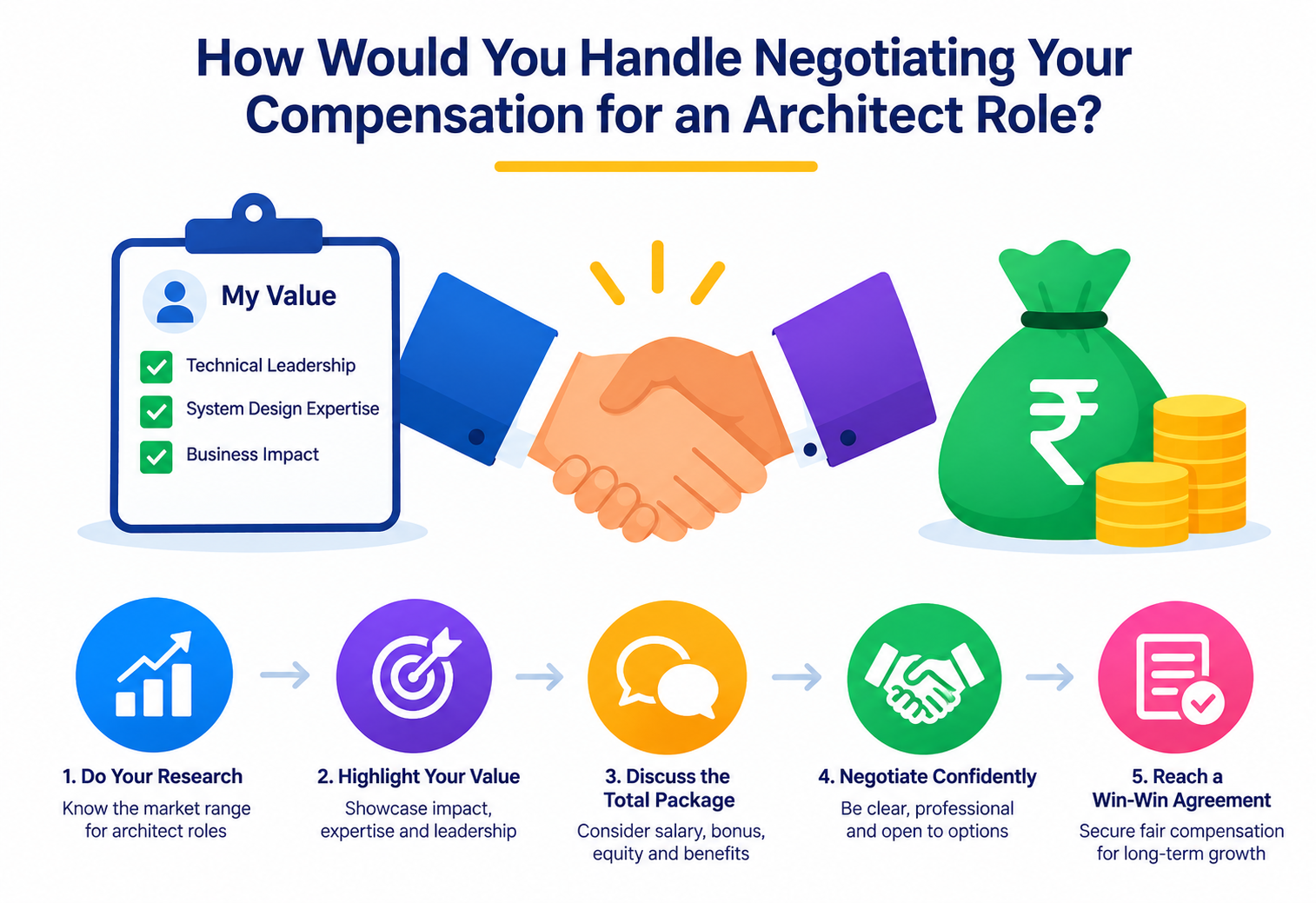
How Would You Handle Negotiating Your Compensation for an Architect Role?
A calm, honest walk through one of the most quietly stressful conversations in a senior career — and how to have it without losing yourself in the process. Concrete preparation, sample language, and a steady mindset for a conversation most senior engineers have too rarely to feel practiced at.
Why This Conversation Feels Heavier at the Architect Level
There is a version of this conversation that plays out in most people’s heads long before it happens in real life — a tense, high-stakes exchange where one wrong word costs you thousands of dollars, or worse, makes you look greedy and difficult in front of people you were hoping would soon be your colleagues. That imagined version is almost always harsher than the real one. Compensation conversations for architect roles are rarely adversarial when handled well; they are simply two sides trying to reach a number that feels fair, informed by facts neither side had at the start of the conversation. This piece is meant to make that real version feel a little more familiar before you actually walk into it.
Compensation negotiation carries some discomfort at every career stage, but there is something particular about the architect level that tends to make it feel heavier. Part of it is simply the numbers involved — the gap between a reasonable offer and a generous one can be substantial at this level, large enough that getting it wrong feels like it genuinely matters in a way it might not have earlier in your career. But the bigger part, if we are honest, is what this conversation seems to say about you as a professional.
By the time you are interviewing for architect roles, you have usually spent well over a decade building technical judgment, and a good part of your identity is wrapped up in being someone whose judgment is sound. Negotiating compensation can feel like it is testing that same judgment in a completely different arena — one where the “right answer” is not a technical trade-off you can reason through with confidence, but a social and financial one, full of unknowns about what the other side is actually willing to pay, what is normal, and what might come across as reasonable versus overreaching.
It is worth naming this directly: the anxiety you might feel here is not a sign you are bad at negotiating. It is a sign you are a thoughtful person taking a real financial and professional decision seriously, in an area where you simply have less practiced experience than you do with system design. That is completely normal, and it tends to fade with a little structure and a little honest preparation — which is really what the rest of this piece is for.
This is not a performance where you have to appear confident about numbers you are unsure of. It is an information exchange, conducted with more care than most conversations, where being honest about what you need is not the same thing as being difficult.
What to Understand About Your Own Number Before You Talk to Anyone
Almost every negotiation that goes badly starts the same way: with someone entering the conversation not quite sure what they actually want, and discovering their own priorities in real time, under pressure, while someone on the other end is watching and waiting for an answer. The single most protective thing you can do before any conversation about money is spend time, privately and without pressure, figuring out what you actually need and want — separately from what you think you are allowed to ask for.
Start with research, but hold it loosely. Publicly available salary data, whether from surveys, aggregator sites, or conversations with peers in similar roles, gives you a range, not a precise answer — company size, location, industry, and the specific scope of the architect role all shift that range meaningfully. Rather than chasing one perfect number, aim for a realistic band: a lower point you would still feel genuinely good about accepting, and an upper point that reflects the strongest, most well-supported version of your value.
Then go a layer deeper than market data, into your own life. What does this number need to cover, realistically, for the next few years? Are there specific goals — a home purchase, a child’s education, supporting family, simply building savings you have been putting off — that make a certain number meaningfully more important to you right now than it might be in the abstract? This is not information you need to share with an employer, but knowing it yourself changes how steady you will feel in the conversation, because you are negotiating from a place of clarity about your own life, not just reacting to whatever number appears on a screen.
2.1 A Small but Important Distinction
There is a difference between your walk-away number — the point below which this role genuinely does not make sense for you — and your target number — the outcome you are actually aiming for. Conflating the two is one of the most common reasons people either accept offers they later resent, or hold too rigid a line on an offer that was actually reasonable. Write both down, privately, before any conversation begins. It also helps to write a third, quieter number: a stretch point above your target that you would happily accept if the company offered it, so that a genuinely strong offer does not catch you unprepared to say yes.
The Anatomy of an Architect Compensation Package
One reason these negotiations feel more complex at the architect level is that the package itself usually has more moving parts than earlier-career offers. Focusing only on base salary, while natural, means missing a lot of what is actually being negotiated. It helps to understand each piece on its own terms before a conversation starts, so you are not encountering any of them for the first time under pressure.
- Base salary — the steady, predictable part, and usually the easiest to compare across companies, though it tells only part of the story.
- Annual or performance bonus — worth understanding not just as a percentage, but as a realistic range: what does a typical year actually pay out, versus the best-case number quoted during recruiting?
- Equity or stock — often the most complex and least understood part of the package, especially at private companies, where the actual value depends heavily on assumptions about future growth that are impossible to verify from outside.
- Sign-on bonus — sometimes used by companies as a flexible lever when base salary bands are rigid; worth asking about directly if the base number feels capped.
- Benefits and allowances — health coverage, retirement contributions, learning budgets, relocation support — individually smaller, but collectively meaningful, and sometimes easier to negotiate than the headline number.
- Review and promotion timeline — not compensation in the moment, but a real factor in your compensation trajectory over the next few years, and worth understanding clearly.
The single headline base salary
The one number that’s easiest to compare across offers is the one people focus on almost exclusively — often at the cost of missing everything else that will shape their actual take-home compensation over the next several years.
Equity, bonus realism, growth curve
Equity assumptions, bonus realism, and how quickly compensation actually grows after year one usually get less attention than they deserve — and they are frequently the pieces that decide whether an offer looks great in year three or merely acceptable.
It is worth asking, directly and without embarrassment, for a full breakdown of how each of these pieces works — how bonus is calculated and historically paid out, how equity vests and what it has actually been worth for people who have been there a while, what the promotion and review cadence typically looks like for architect-level roles. These are completely ordinary, expected questions. Asking them clearly signals that you are thinking about this as a real financial decision, not just reacting to a single number on an offer letter.
It also helps to understand that these pieces interact with each other in ways that are not always obvious from the offer letter alone. A slightly lower base salary paired with a strong, well-vested equity grant at a company genuinely on a healthy growth trajectory might outperform a higher base at a company with a weaker outlook, over a three or four year horizon. None of this means chasing the flashiest possible equity story — plenty of confident-sounding growth narratives do not materialise — but it does mean resisting the urge to reduce the whole package down to a single comparable number too quickly. Take the time to actually model out, even roughly on paper, what each offer might look like across a realistic multi-year horizon, not just in the first twelve months.

Getting Your Own Mindset Steady Before the Call
Beyond research and numbers, there is a quieter kind of preparation that matters just as much, and it has nothing to do with spreadsheets. It is the internal work of arriving at the conversation feeling settled rather than anxious, because the tone you carry into a negotiation often shapes the outcome as much as the actual words you use.
One useful practice is to say your numbers out loud to yourself, or to a trusted friend, before the actual conversation happens. There is something about hearing your own voice state a figure plainly — without a nervous laugh afterward, without immediately softening it — that makes it easier to do the same thing later, when it actually counts. If the number still feels uncomfortable to say out loud after a few tries, that discomfort is worth exploring gently: is it because the number feels genuinely too high, or simply because asking for anything at all still feels unfamiliar? Those are two very different problems, and only one of them means you should actually lower your number.
It also helps to remember, honestly, that the person on the other side of this conversation is very often not the final decision-maker on your compensation. Recruiters and hiring managers are frequently relaying numbers back and forth between you and an internal compensation committee or a budget set well above their own authority. This is not meant to make the conversation feel less personal — it is meant to lighten the emotional weight of it. You are rarely negotiating against one person’s personal judgment of your worth; you are usually working within a structured process that both sides are navigating together, imperfectly, toward a fair outcome.
Say the number, out loud, in a calm voice, five times. Notice what your body does — where it tightens, where it tries to soften the sentence with a laugh or an apology. The goal is not to feel no discomfort at all; it is to have already met that discomfort in private, so it does not ambush you in the actual conversation.
When to Actually Talk About Money
Timing causes more quiet anxiety than almost any other part of this process. Bring it up too early, and it can feel like you are reducing the conversation to a transaction before either side has established real mutual interest. Wait too long, and you risk investing significant time and emotional energy into a process that turns out to be financially misaligned from the start.
A gentle, generally reliable approach: let the company raise compensation first if they are willing to, since many recruiters open with a range early precisely to avoid wasting anyone’s time. If they do not, it is entirely reasonable to ask about the expected range yourself once you have a real sense the role is a serious mutual fit — typically after an initial screening conversation, before investing in a lengthy interview loop. There is nothing impolite about asking early; in fact, it usually reads as thoughtful and efficient, both for you and for them.
The more delicate timing question is usually about your own specific number — not the range, but your actual expectation. As a general pattern, it is wise to let the company share their range or number first whenever possible, since whoever states a specific figure first tends to anchor the rest of the conversation around it. This is not a manipulative game; it is simply sound practice, because you genuinely do not yet know what they are able or willing to offer, and naming your number too early can quietly cap you below what they might have offered on their own.
Handling “What Are Your Expectations?”
This question tends to arrive earlier than people expect, sometimes even in a first screening call, and it can feel like being caught without a script. The good news is that a calm, honest answer here is almost always better received than an evasive one — recruiters ask this question constantly, and they can usually tell the difference between someone being thoughtfully strategic and someone being cagey out of anxiety.
One gentle, well-tested approach is to share a well-researched range rather than a single number, and to frame it around your understanding of the market rather than a personal demand. This keeps the conversation collaborative rather than confrontational, and it leaves room for the company to respond with their own thinking rather than feeling boxed in by a single figure.
“Based on what I have seen for similar architect roles at companies around this size, I would expect somewhere in the range of [X to Y], though I am genuinely open to understanding more about how you structure the full package before narrowing that down.”
If pressed for a single number, it is completely fine to give the upper portion of your researched range, stated calmly rather than apologetically. There is a common instinct to soften a number by immediately following it with a justification or an apology-shaped explanation — resist that where you can. A number stated plainly, without nervous over-explanation, tends to be taken more seriously than the same number wrapped in hedges.

Using Leverage Honestly, Without Games
Leverage is one of the more uncomfortable words in this whole topic, because it can sound manipulative — like something you are supposed to fabricate or exaggerate to gain an edge. In reality, the most durable and least stressful form of leverage is simply true information, shared honestly, about your actual situation.
If you have another offer in hand, or another process moving in parallel, it is entirely reasonable and normal to mention it, especially if a company is asking you to make a decision on a timeline that does not give you room to let other conversations play out. There is no need to dramatise it or use it as a threat — a simple, factual mention is usually enough: “I wanted to be transparent that I am currently further along in another process, and I would love to understand your timeline so I can plan accordingly.” This is honest, respectful, and gives the company real information they can act on if they want to.
What tends to backfire is manufactured leverage — implying interest or competing offers that do not actually exist. Beyond the ethical issue, it is genuinely risky in a way that is easy to underestimate: engineering circles, especially at the architect level, are smaller than they feel, and a fabricated story has a real chance of unravelling in an uncomfortable way, sometimes years later, in a context you did not anticipate.
The strongest leverage in any negotiation is simply being able to walk away with your integrity intact — not a bluff, just a genuine willingness to say no if the fit is not right. Everything else is technique layered on top of that one steady fact.
Negotiating Beyond the Base Number
When a base salary number feels genuinely fixed — and sometimes it is, especially at larger companies with rigid internal pay bands — that does not mean the conversation is over. Several other parts of an offer are often more flexible than the headline number, precisely because they do not require reopening a formal salary band.
- Sign-on bonus — often the most flexible lever available, since it is typically a one-time cost rather than a change to an ongoing pay structure.
- Start date and initial review timing — asking for an earlier first performance review, tied to a compensation adjustment, can meaningfully shorten the path to a higher number without changing today’s offer.
- Title and scope — occasionally more negotiable than people assume, and worth a conversation if the responsibilities described genuinely go beyond the level being offered.
- Remote flexibility or relocation support — can carry real financial value even when it does not show up as a number on the offer letter itself.
- Professional development budget — smaller in absolute terms, but sometimes easy to secure, and genuinely useful over time.
It is worth approaching this part of the conversation with genuine curiosity rather than a rehearsed list of demands. Asking, plainly, “is there flexibility anywhere else in the package if the base number is fixed?” is a completely normal question, and most experienced recruiters will answer it honestly, because they would usually rather find a creative path to yes than lose a candidate over a single rigid number.
A Small Story About Two Very Different Conversations
Sometimes the clearest way to see what “good” and “not-so-good” look like in a negotiation is to sit with two ordinary, believable examples side by side — not caricatures, but the kind of decisions any thoughtful person could plausibly make on either side.
Picture two architects, both receiving offers from companies of a similar size, in a similar market, for similar roles. The first, uneasy about the whole process, accepts the initial number quickly, partly out of relief that the interview process is finally over, and partly out of a quiet fear that pushing back might make the company reconsider the offer altogether. Only months later, comparing notes with a peer at a similar company, does it become clear the offer was meaningfully below what the company would likely have offered if asked.
The second architect, in a similar position, takes two days before responding — not to be strategic, but genuinely to think it over, the way most reasonable people would want to for a decision this size. When they respond, they thank the company warmly for the offer, express real enthusiasm about the role, and then simply share that based on their research and the scope of the position, they were hoping for a number closer to the top of the range discussed earlier, along with a modest signing bonus to help offset the transition cost from their current role. The recruiter, unsurprised — this is an entirely normal request — comes back within a few days with an improved offer, not the full ask, but meaningfully closer to it.
What is worth noticing in this story is not a dramatic negotiation tactic. It is the simple decision to ask, calmly and respectfully, rather than to assume asking was not allowed. The second architect was not more aggressive or more skilled at negotiating in some innate sense — they simply gave themselves permission to have the conversation at all, and treated it as a normal, expected part of accepting a senior role rather than an imposition on the company’s goodwill.
The Fears Underneath the Fear
It is worth being honest about what actually makes this conversation hard, because it is rarely the mechanics of negotiation itself — most people can learn the mechanics fairly quickly. What makes it hard is usually a set of quiet fears sitting underneath, worth naming directly so they lose some of their grip.
10.1 The Fear of Seeming Greedy
Many people, especially those raised with strong messages about humility or gratitude, feel a genuine discomfort asking for more than what is initially offered, as though doing so reveals something unflattering about their character. It is worth remembering that companies build negotiation room into offers as a matter of routine practice — asking for more is not taking advantage of anyone; it is simply participating in a process both sides already expect.
10.2 The Fear That Asking Will Cost You the Offer
This fear is understandable but, in the overwhelming majority of cases at the architect level, not realistic. Companies that have gone through the time and expense of a full architect interview loop rarely rescind an offer over a reasonable, respectfully delivered counter. If a company would genuinely walk away over a fair, well-researched ask, that itself is useful information about what working there might be like.
10.3 The Fear of Not Knowing Your Own Worth
This one runs deeper, and it is worth sitting with rather than rushing past. Many senior engineers, even highly accomplished ones, carry a quiet uncertainty about whether they are “actually” as valuable as the market suggests, especially if their path here involved some luck or timing alongside genuine skill. This feeling is extremely common, and it has very little to do with your actual market value, which is determined by supply, demand, and demonstrated impact — not by how confident you happen to feel on a given Tuesday.

The confidence to negotiate well does not have to come before you feel ready. Most people build that confidence by doing it once, imperfectly, and noticing the world did not end. It is a skill built through practice, not a personality trait you either have or do not.
10.4 The Fear of Comparing Yourself to Everyone Else’s Numbers
In an era where compensation figures circulate fairly freely online and among peers, it is easy to fall into a comparison trap — feeling like your own negotiation is a failure if it does not match the highest number you have seen someone else quote. It is worth remembering that publicly shared numbers are rarely a complete picture; they often leave out company stage, location cost of living, total years of relevant experience, and simple variance in how negotiations happened to unfold on a given day. Your own number needs to make sense for your own situation, not win an invisible competition against numbers you only ever see out of context.
A Few Gentle Scripts, If It Helps to Have Language Ready
Having a few phrases ready in advance can take a surprising amount of pressure off the moment itself, simply because you are not trying to compose careful language on the spot, under stress. These are not meant to be memorised word for word — more like a starting shape you can adjust into your own voice.
“Thank you so much for this — I am genuinely excited about the role. This is a significant decision, so I would like a couple of days to think it through properly. Would that be alright?”
“I really appreciate the offer, and I am looking forward to the possibility of joining. Based on my research into similar architect roles and the scope we discussed, I was hoping we could land closer to [number]. Is there room to explore that?”
“I wanted to be upfront that I am also further along in another process. I would genuinely prefer to join here if we can find a number that works for both of us — could you help me understand your timeline?”
“I understand the base salary band might be fixed on your end. Is there flexibility elsewhere — a sign-on bonus, an earlier review, or additional equity — that might help bridge the gap?”
“Thank you for working through this with me — I am happy to accept at [number]. I am genuinely looking forward to getting started.”
What to Do If the Answer Is No
Sometimes, even after a thoughtful, well-researched, respectfully delivered ask, the answer really is no — the budget genuinely is not there, or the internal pay band genuinely cannot move. This is not a failure on your part, and it does not mean you asked incorrectly. It simply means you have learned something true about the constraints on the other side, which is valuable information either way.
At that point, the decision comes back to the two numbers you wrote down for yourself earlier — your walk-away point and your target. If the offer, even without further movement, sits comfortably above your walk-away number and the role genuinely excites you for reasons beyond compensation, it can still be a good decision to accept, with a clear, honest understanding of the trade-off you are making, rather than a lingering resentment about it.
If the offer sits below what you need, it is entirely acceptable to decline gracefully, without guilt or over-explanation. A short, warm message — thanking them for their time, expressing genuine appreciation for the process, and explaining honestly that the compensation does not currently align with what you need — leaves the relationship intact. Many people who decline offers this way end up crossing paths again with the same company, sometimes years later, under different circumstances where the numbers do align.
A Few Honest Questions People Ask
A handful of the questions that come up most often when senior engineers actually start thinking about a real compensation conversation — answered plainly, without pretending the answers are simpler than they really are.
“What if I genuinely do not know what a fair number is for this role?”
This is more common than people admit, especially for architect roles, which vary enormously in scope from one company to the next. It is completely reasonable to say so directly to a recruiter — “I want to make sure I am thinking about this accurately; could you help me understand how this role is typically levelled and compensated?” Most recruiters, especially in-house ones, are willing to have this conversation honestly, because a well-informed candidate makes the whole process smoother for them too.

“Is it okay to negotiate if this is a promotion into an architect role internally, rather than an external offer?”
Yes, and the same underlying principles apply, though the conversation often feels more personal because you are negotiating with people you already work with. It can help to separate the two conversations mentally — one about whether you are ready for the scope of the role, which is a performance conversation, and one about what fair compensation for that scope looks like, which is a market conversation. Keeping them distinct tends to make both easier to have clearly.
“What if the recruiter seems annoyed or pushes back hard on my counter?”
A little pushback is a normal, expected part of the process, not a sign you have done something wrong — recruiters are often working within real constraints and advocating for the company’s position, the same way you are advocating for your own. If the pushback feels respectful, even if firm, it is worth continuing the conversation calmly. If it ever feels genuinely hostile or dismissive over a reasonable ask, that is worth noticing as information about the company itself, separate from the specific number involved.
“How many rounds of back-and-forth is normal before this starts to feel excessive?”
Most compensation negotiations settle within one or two rounds of back-and-forth. A single thoughtful counter, followed by the company’s response, followed by either acceptance or one more small adjustment, covers the overwhelming majority of real conversations. If you find yourself in round four or five over a relatively small gap, it is often a sign to simply ask directly, “what would help us close this gap?” rather than continuing to negotiate indirectly.
A Closing Thought
If there is one thing worth carrying out of all of this, it is that negotiating compensation for a role you have worked years to become qualified for is not an act of greed, and it is not a test of your character that you either pass or fail based on how comfortable you feel doing it.
It is simply an ordinary, expected part of accepting senior responsibility — a conversation companies plan for, budget for, and genuinely do not hold against you when it is handled with honesty and respect.
The version of this conversation that plays out in your head beforehand is almost always more adversarial than the one that actually happens. Most recruiters have had this exact conversation hundreds of times, and most of those conversations end reasonably, with both sides landing somewhere fair. You do not need to become a different, more aggressive version of yourself to participate in it well. You simply need a little preparation, a little clarity about what you actually need, and enough self-respect to ask for it plainly, without over-explaining or apologising for wanting to be paid fairly for the years of work that brought you here.
Whatever number this conversation lands on, the practice of having it — calmly, honestly, without losing yourself in either false confidence or quiet self-doubt — is a skill that will serve you in every senior conversation that comes after this one, not just this single offer. That, in the end, may be worth even more than the number itself.
What to Carry Out of This Piece
- Decide your walk-away, target and stretch numbers privately, in writing, before any conversation begins.
- Understand every part of the package — base, bonus, equity, sign-on, benefits, review cadence — not just the headline number.
- Say your numbers out loud before the call so they feel normal in your own mouth.
- Let the company share their range or number first whenever possible; when asked, share a well-researched range framed by the market, not a demand.
- Use only honest leverage — real competing processes, real timeline needs — never manufactured pressure.
- If the base is fixed, ask about sign-on, review timing, title, remote flexibility, and development budget.
- Name the fears underneath the fear — seeming greedy, losing the offer, not knowing your worth, comparison — so they lose their grip.
- Have a few gentle scripts ready so you are not composing careful language under stress.
- If the answer is no, come back to your walk-away and target numbers, then either accept without resentment or decline warmly.
- Remember: this is an ordinary, expected part of accepting senior responsibility, not a test of your character.
The practice of having this conversation calmly — without losing yourself in either false confidence or quiet self-doubt — is a skill that will serve you in every senior conversation that comes after this one, not just this single offer.