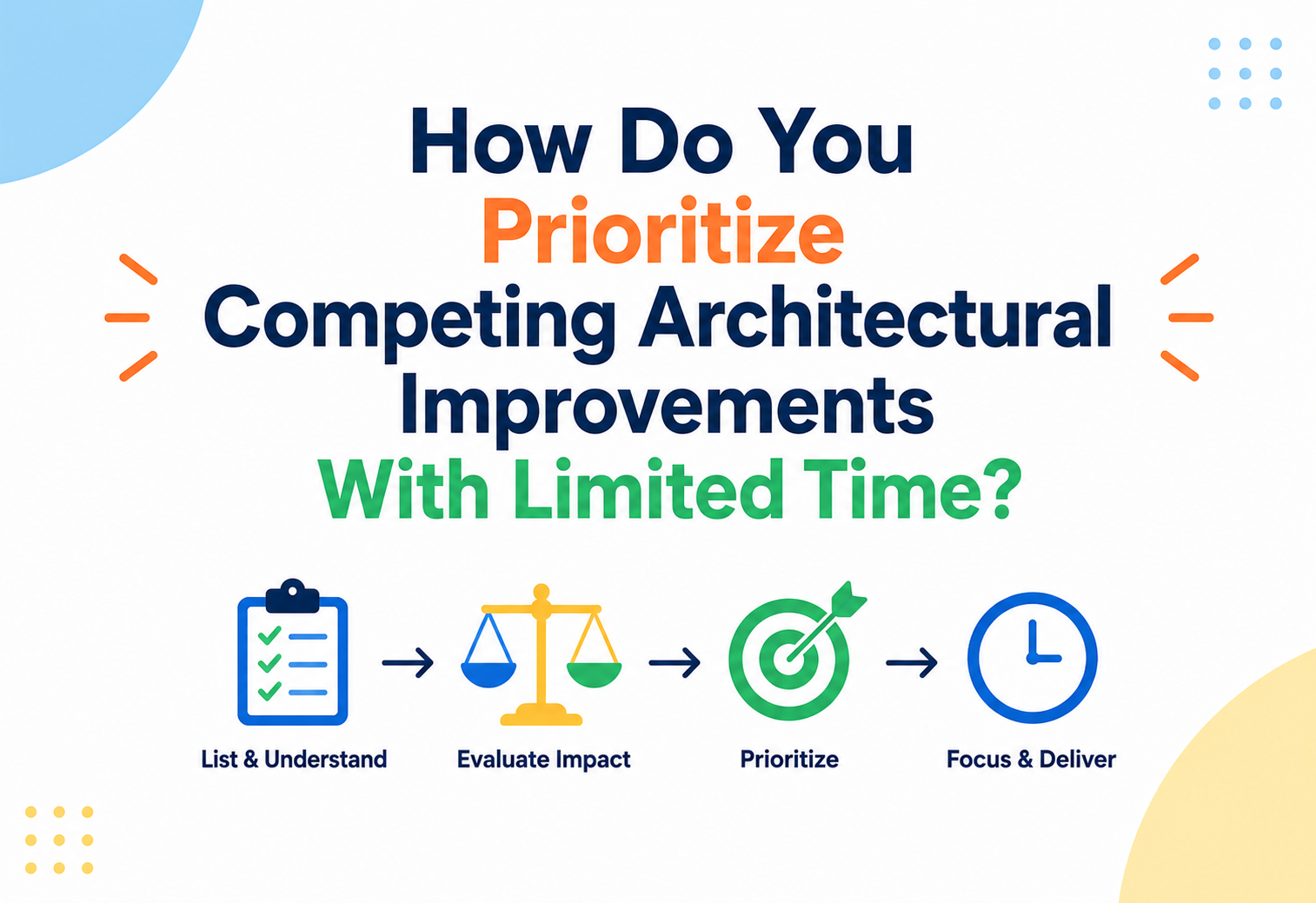
How do you prioritize competing architectural improvements when time won’t stretch any further?
Every backlog has more good ideas than good hours. This is not a framework you’ll memorize in five minutes — it’s a way of thinking that gets easier the more you practice it, one honest trade-off at a time.
The Quiet Overwhelm Nobody Warns You About
If you lead architecture on any real system, you already know this feeling: a list that keeps growing while your calendar keeps shrinking. Database migrations that “should” happen. A monolith that quietly begs to be split. A caching layer nobody trusts anymore. New feature work leaning on you for a decision by Friday. And somewhere underneath all of it, a nagging sense that whichever thing you pick to do first, you’re also choosing three things to leave undone. This piece is about making peace with that tension — and making better choices inside it.
Nobody tells you, when you become the person responsible for a system’s architecture, that the hardest part of the job won’t be technical. You’ll figure out the sharding strategy. You’ll land on the right pattern for that saga. The technical puzzles, as thorny as they get, are the kind of thorny you signed up for.
What catches most architects off guard is something softer and much more constant: the sheer number of things that deserve your attention at the same time, and the very small number of hours you actually have to give them. A slow query here. A service that’s becoming a single point of failure there. A team asking for a shared library so they stop copy-pasting the same retry logic five different ways. Each one, on its own, is reasonable. Together, they form a pile that never seems to get smaller, no matter how many items you clear off the top.
This isn’t a sign that you’re behind, or that your planning is broken. It’s simply what happens in any living system that people depend on. Growth creates friction, friction creates ideas for improvement, and improvement ideas outnumber the hours available to build them. The goal was never to make the list disappear. The goal is to get calm and clear-eyed about which parts of the list matter most, right now, for the system and the people who rely on it.
There’s a particular kind of tiredness that comes from carrying a long list in your head instead of putting it somewhere outside yourself. So before anything clever — before frameworks, before scoring models — the very first move is much simpler, and much more human.

Start by Naming Everything, Out Loud
Before you can compare two improvements, both of them need to exist somewhere real — not as a vague weight sitting in your chest, but as a written line you can actually look at. This sounds almost too simple to mention, and yet it’s the step most of us skip, because half-formed worries feel more urgent when they’re still swirling around unnamed.
Take twenty minutes, on your own or with your team, and write down every architectural improvement that’s currently on your mind. Don’t filter yet. Don’t rank yet. Just get it all onto one page — the database index you’ve been meaning to add, the circuit breaker that’s missing on that flaky downstream call, the observability gap that made last month’s incident take three extra hours to diagnose, the service boundary that keeps causing merge conflicts between two teams. Everything. Even the ones that feel small. Even the ones you’re a little embarrassed still aren’t done.
Grab a blank page — physical or digital, it doesn’t matter — and write one line per improvement idea. Resist the urge to judge, group, or rank as you go. You’re not planning yet. You’re just letting the pile step out of your head and into the light, where it’s easier to think about.
Something quietly useful happens when you do this. The list on paper is almost always shorter, and less scary, than the list in your head. Worry has a way of multiplying things; a written list can only hold what’s actually there. You’ll also start to notice natural clusters — three items that are really one underlying problem wearing different clothes, or two “urgent” items that, once written side by side, clearly aren’t as urgent as they felt in isolation.
This first act of naming is not busywork. It’s the foundation everything else in this piece stands on. You cannot prioritize what you haven’t looked squarely at.
If you lead a team, it’s worth doing this exercise together rather than alone, even if it takes a little longer. Every engineer carries a slightly different view of where the system hurts, shaped by whichever part of it they touch most often. The person who owns the deployment pipeline sees a different set of pains than the person who’s been fielding customer support escalations about a flaky search feature. A shared list, built from several honest perspectives, is almost always a truer picture of the system than any single person’s list could be — including yours.
Why Your Gut Needs a Little Help, Not a Replacement
Experienced architects develop good instincts, and those instincts deserve real respect. If fifteen years of shipping and firefighting has taught you that a certain kind of coupling always turns into an outage eventually, that intuition is worth something. It’s built from real scar tissue, and it shouldn’t be thrown out in favor of a spreadsheet.
But instinct has a well-known blind spot: it responds most strongly to whatever is loudest, most recent, or most personally annoying — not necessarily to what matters most for the business or the system as a whole. The service that paged you at 2 a.m. last week will feel urgent even if, calmly assessed, it’s a minor and rare failure mode. Meanwhile a slow-burning risk, like a database approaching its connection limits six months from now, won’t feel urgent at all, right up until the week it becomes a crisis.
This is why a light structure helps — not to override your judgment, but to catch the places where recency and noise are quietly distorting it. Think of a framework less like a rulebook and more like a second, calmer voice in the room, asking questions your tired brain might skip on a Friday afternoon: Who is actually affected by this? What happens if we wait? How much does it really cost to fix?

Instead of asking “which of these feels most important,” try asking “which of these, left undone, will I regret the most in six months — and why.” The second question pulls you out of today’s noise and into a slightly longer view, which is usually where good architectural judgment actually lives.
Four Lenses That Hold Real Weight
Once your list exists on paper, you need a small number of questions to look at each item through — not twenty criteria, not a fifty-column spreadsheet nobody will maintain past week two. In practice, four lenses cover almost everything that actually matters when you’re choosing between architectural improvements.
Impact — who feels this, and how much?
Impact isn’t about how technically interesting a change is. It’s about the size and shape of the difference it makes once it’s live. Does this improvement touch every request that hits your system, or one edge case that happens twice a month? Does it protect revenue, protect customer trust, protect the team’s ability to sleep through the night? Try to describe impact in terms a non-engineer on your team could nod along to — “checkout gets 40% faster” lands very differently than “we reduce p99 latency on the payment service.”
Risk — what happens if we do nothing?
This is the lens most teams underuse, because risk is quiet until it isn’t. A single point of failure that hasn’t failed yet still carries real risk; it just hasn’t sent you the bill. Ask honestly: if this stays exactly as it is for another two quarters, what’s the worst plausible outcome, and how likely is it? An improvement that prevents a rare but catastrophic failure can rightly outrank one that offers a nicer, but non-critical, improvement.
Effort — what will it actually cost us?
Effort is more than raw engineering hours. It includes the coordination tax of touching a service three other teams depend on, the testing burden of a change near your most fragile code, and the emotional cost of asking a tired team to take on one more migration. Be honest here, even when honesty is inconvenient. Underestimating effort is one of the most common ways good prioritization plans quietly fall apart.
Reversibility — how expensive is it to change our mind later?
Some architectural decisions are easy to undo if they turn out wrong — a feature flag, a config change, a small refactor scoped to one service. Others are one-way doors: a database choice baked into years of queries, a public API contract other companies now depend on. Improvements that are cheap to reverse can be tried sooner and with more confidence, even with imperfect information. One-way doors deserve slower, more deliberate thought, even if that means they wait a little longer for a clearer head and a fuller picture.
You don’t need precise numbers for any of these. A simple high/medium/low rating, applied honestly and consistently, will outperform a falsely precise score built on guesses dressed up as data. Here’s what that can look like once you lay a handful of items side by side.
| Improvement | Impact | Risk of Waiting | Effort | Reversible? | A quiet gut check |
|---|---|---|---|---|---|
| Add read replica for reporting queries | High | Medium | Medium | Yes | Buys real breathing room, low regret if delayed slightly |
| Split monolith’s billing module into a service | High | Low | High | No | Right long-term move, but not this quarter’s fire |
| Add circuit breaker on flaky partner API | Medium | High | Low | Yes | Cheap, fast, prevents a repeat of last month’s incident |
| Standardize logging format across services | Medium | Low | Low | Yes | Good “small win,” worth batching with other quick fixes |
| Migrate to new message queue platform | Medium | Low | High | No | Tempting, but the current one still works fine — resist the shiny pull |
Notice what the table does for you: it doesn’t decide anything on its own, but it stops the loudest item, or the most technically exciting one, from automatically winning. The circuit breaker, unglamorous as it sounds, rises to the top not because someone shouted about it, but because the numbers, honestly filled in, say it should.
The Cost of Waiting, Made Visible
There’s a concept borrowed from lean product thinking that architects rarely apply to their own backlog, and it’s worth stealing: cost of delay. The idea is disarmingly simple — instead of only asking “how good is this improvement,” ask “what does every week we don’t do this actually cost us?”
Some costs are obvious once you frame them this way. A slow database query that runs on every checkout might be quietly costing conversions every single day it stays unfixed — a cost that compounds, week after week, whether or not anyone notices it happening. Compare that to a nice-to-have internal tooling improvement, where the cost of waiting another month is close to zero, because nobody outside your team is affected by the delay at all.
You don’t need a finance degree to use this well. A short sentence is often enough: “Every week we don’t fix this, we lose roughly X.” Sometimes X is measurable — dollars, error rate, hours of manual work. Sometimes it’s softer — team morale, on-call fatigue, a slowly eroding trust between two teams who keep stepping on each other’s toes. Write the sentence anyway. Naming the cost of delay, even approximately, turns a vague sense of “we should really get to this” into something you can actually compare and act on.

Urgent is not the same as important, and cost of delay helps tell them apart. Something can feel urgent because it’s loud today, while costing very little if it waits a week. Something else can feel entirely quiet, while costing you more every single day it’s ignored. Cost of delay pulls the quiet, expensive items into the light where they belong.
Talking About Trade-offs, Gently but Honestly
Architecture doesn’t happen in a vacuum, and neither does prioritization. Every choice you make about where to spend engineering time is also a conversation — with your manager, with product partners, with the teams who’ll feel the effects of whatever you decide. How you have that conversation matters almost as much as the decision itself.
The instinct many architects have, especially early in their careers, is to lead with the technical reasoning: the coupling, the query plans, the failure modes. That reasoning is important, but leading with it can lose the room fast, because most stakeholders don’t share your technical vocabulary and, understandably, don’t want to. What they do want to know is simpler: what does this mean for the things I care about — speed, reliability, cost, our roadmap?
Translate before you present. “We need to refactor the payment service’s data layer” becomes “checkout has been getting slower under load, and if we don’t address the underlying cause soon, a busy sale day could cause real problems for customers.” Same substance, but now the person across the table can actually weigh it against their own priorities, instead of nodding politely at something they don’t fully follow.
Bring the trade-off, not just the ask
“If we do A this quarter, B waits — here’s what that means for each” respects the other person’s ability to help decide, rather than asking them to rubber-stamp a decision you’ve already made alone.
Use their language for impact, yours for the plan
Impact in terms of user experience, revenue, or team capacity; plan in as much or as little technical depth as they want to hear.
Show your work briefly
A simple version of the four-lens table above, shared honestly, builds more trust than a confident opinion with no visible reasoning behind it.
These conversations, done with care, do something quietly important beyond just getting a decision approved: they build the kind of trust that makes the next hard conversation easier, and they make it clear that prioritization isn’t something being done to the team, but something being worked through with them.
The Art of Saying “Not Yet” With Kindness
Somewhere in every prioritization exercise, you have to tell someone — a teammate, a stakeholder, sometimes yourself — that a genuinely good idea isn’t happening right now. This is, for a lot of architects, the emotionally hardest part of the whole process, harder than any technical decision. Nobody enjoys being the person who says no to good work, especially when the person asking clearly cares about it.
It helps to separate two things that often get tangled together: the quality of an idea, and its timing. Saying “not yet” is not the same as saying “this doesn’t matter” or “you were wrong to suggest it.” Most of the time, it means exactly what it says — this is good, and something else is simply better right now, given everything else competing for the same hours.
A few small habits make this conversation land softly instead of landing like rejection:
Name what you’re saying yes to, and why
This makes clear the decision was a comparison, not a judgment of the idea that lost.
Give it a rough return date, even a loose one
“Let’s revisit this next quarter” feels very different from silence, even when the actual timeline is uncertain.
Write it down somewhere visible
A shared “later” list, reviewed on a regular cadence, tells people their idea didn’t vanish into a void — it’s parked, not forgotten.
Thank the person for raising it
Genuinely. The team that stops surfacing improvement ideas because they feel unheard is a much bigger problem than any single delayed migration.
Over time, a team that trusts how you say “not yet” will keep bringing you their best thinking. A team that feels dismissed will quietly stop bothering — and that silence is far more expensive than any backlog item you deferred.
Balancing Big Bets With Small Wins
A prioritization plan made entirely of ambitious, high-impact projects sounds impressive on paper, and tends to fall apart in reality. Big architectural bets — a service split, a data platform migration, a re-architecture of your event system — take months, involve many people, and produce very little visible progress in the early weeks. If your entire plan is made of these, morale quietly erodes long before the payoff arrives, because nobody gets to feel the satisfaction of finishing anything.
Small wins matter more than their size suggests. A cleaned-up alerting rule, a removed dead code path, a fixed flaky test that’s been ignored for months — these take a day, sometimes an hour, and they give a team something real to close out and feel good about while the bigger, slower work grinds forward in the background. They also, quietly, reduce the everyday friction that makes big work harder to do well.
A healthy mix, in practice, often looks something like this: one or two significant structural improvements running steadily in the background, a handful of medium efforts moving each sprint, and a standing lane for quick, high-leverage fixes that any engineer can pick up without waiting on a full planning cycle. None of these ratios are a fixed law — your system and your team’s context will shape the right balance — but the underlying principle holds broadly: variety in the size of your wins keeps momentum alive, and momentum is worth more to a long project than most people give it credit for.
One big structural bet
The service split, the platform migration, the long re-architecture — running steadily in the background for months.
Three or four medium improvements
Meaningful, sprint-sized efforts that move each cycle — enough to show real progress on the roadmap without swallowing the whole team.
An open lane for small fixes
Quick, high-leverage wins any engineer can pick up without waiting on a full planning cycle — alerting cleanups, dead code removal, tiny cleanups.
When you plan a quarter of architectural work, try listing it in three honest buckets: one big structural bet, three or four medium improvements, and an open lane for small fixes that surface along the way. If any bucket is empty, that’s usually worth noticing before the quarter starts, not after.
It’s also worth paying attention to how this mix feels to the people actually doing the work, not just how it looks on a roadmap slide. A team deep into month three of a difficult migration, with nothing else to point to, tends to lose energy in ways that are hard to see coming and hard to reverse quickly once they show up. Interleaving a few small, closeable wins alongside the long project isn’t a distraction from the “real” work — it’s part of what keeps the real work sustainable over the months it actually takes to finish properly.
A Story From the Field
A few years back, a mid-sized platform team I know well was staring at a familiar wall of competing priorities. Three things sat at the top: a long-planned migration off an aging message broker, a request from a partner team for a new internal API, and a nagging pattern of intermittent timeouts on their checkout flow that nobody had fully explained.
The instinct in the room, understandably, leaned toward the message broker migration. It was overdue, technically satisfying, and had been on the roadmap for two quarters already — the kind of project that carries its own quiet momentum just from having existed on a slide for so long. The new API felt urgent too, since a partner team was waiting and visibly frustrated by the delay.
But when the team sat down and actually applied the four lenses honestly, a different picture emerged. The checkout timeouts, while intermittent and hard to pin down, were touching real revenue every time they happened — a cost of delay that was small on any single day, but added up meaningfully across weeks of quiet, unexplained failures nobody had bothered to fully investigate. The message broker, meanwhile, was working fine; it was old, but it wasn’t currently costing anyone anything measurable. The risk of waiting on it a little longer was genuinely low.
They made the harder call: pause the broker migration for one quarter, and put their best two engineers on tracking down the checkout issue. It turned out to be a connection pool misconfiguration that had been quietly causing cascading timeouts under moderate load — a fix that took about a week once properly diagnosed, but that had been sitting undiagnosed for months because it never felt urgent enough to fully chase down.

The lesson the team took away wasn’t “always chase intermittent bugs first.” It was simpler and more durable than that: the loudest, most planned-for item in the room isn’t automatically the most valuable one to do next. A short, honest look through a few clear lenses surfaced something their gut, on its own, had quietly been walking past for months.
A Few Traps Worth Watching For
Five recurring pulls that quietly distort otherwise-sound prioritization — each easy to spot once you’ve seen it named, and much harder to fall into once you’re looking for it.
The sunk cost pull
If you’ve already spent weeks on something, it’s tempting to keep spending time on it simply because you’ve spent time on it already. Sunk cost is, by definition, already gone — it shouldn’t weigh on today’s decision about where the next hour goes. Ask fresh each time: knowing what I know now, would I start this today?
The shiny technology pull
New tools and patterns are genuinely fun to learn, and that’s not a bad thing about you — it’s part of what makes good engineers good. But “we should migrate to this” deserves the same honest four-lens look as anything else on the list, not a pass because it’s interesting. If a system genuinely works, “boring but stable” is a perfectly good state for it to stay in for a while longer.
The loudest voice in the room
Whoever escalates most persistently often gets attended to first, whether or not their item is actually the most valuable one. A written, shared prioritization process protects against this — not by ignoring urgency, but by making sure urgency is judged by its actual cost of delay, not by how many Slack messages were sent about it.
Precision theater
A scoring spreadsheet with decimal points and weighted formulas can feel more rigorous than it is. If the underlying inputs are still rough estimates, dressing them up in false precision doesn’t make the decision better — it just makes disagreement harder to voice, because numbers carry an authority they haven’t earned. Simple, honest, and roughly right beats complicated and falsely exact almost every time.
Perpetual deferral
Some improvements are genuinely important but never quite urgent enough to win this particular week — and if you’re not careful, that pattern repeats indefinitely. It’s worth occasionally asking of your “later” list: has anything sat here for three cycles in a row without ever surfacing? If so, it may deserve a deliberate slot, not another polite postponement.
Revisiting Priorities, on Purpose
A prioritized list is a snapshot, not a contract. The moment you finish ranking your improvements, the world quietly starts making that ranking a little less accurate — new information arrives, a risk you rated “low” turns out to be climbing, a partner team’s plans shift and change what’s urgent for you too. Treating a priority list as permanent is its own kind of trap.
What works better, in practice, is a light, predictable rhythm of revisiting. Many teams find a short check-in every two to four weeks is enough — not a full re-planning exercise each time, just an honest ten-minute question: has anything changed enough to reorder this list? Most weeks, the answer is no, and that’s fine; the reassurance itself is valuable. Some weeks, the answer changes everything, and you’ll be glad you looked before committing another sprint to yesterday’s picture of the world.
This regular rhythm also does something subtler: it takes the pressure off getting the ranking perfectly right the first time. You don’t need to agonize over every close call, because you know you’ll look again soon, with fresh eyes and fresher information. Good prioritization isn’t a single decision — it’s a habit of re-deciding, calmly and on schedule.
A Few Questions People Often Ask, and Closing Thoughts
Six of the questions that come up most often once teams start using this approach in practice — and a short closing on why the whole exercise is worth building the habit around.
What if leadership just tells me what to prioritize, and it doesn’t match my own read of the situation?
This happens often, and it isn’t always a sign something’s wrong — leadership may hold context you don’t, like a partnership deadline or a budget constraint. The useful move is to share your reasoning clearly and briefly, once, so it’s on record and understood, and then support the decision fully once it’s made. If the mismatch keeps happening on important calls, that’s worth a direct, calm conversation about how priorities get set, separate from any single instance.
How do I prioritize when I genuinely don’t have enough information to score something confidently?
Treat “we don’t know enough yet” as its own finding, not a blocker. A small time-boxed investigation — a day or two to gather the missing data — can often be the highest-value next step, ahead of committing real effort to either direction. Rough estimates, clearly labeled as rough, are still far better than guessing in silence.
Should security and compliance work ever be treated as “just another item” on the list?
Most teams are better served treating clear security and compliance obligations as a separate, protected lane rather than competing directly against feature and performance work on the same list. That said, the four lenses still apply within that lane — not every security-adjacent idea is equally urgent, and honest prioritization still helps you sequence even protected work sensibly.
What’s a reasonable way to prioritize when the team is very small and every hour is precious?
Smaller teams generally benefit from leaning even harder into the effort and reversibility lenses, since a single miscalculated large effort can consume a disproportionate share of total capacity. Favor smaller, reversible steps more often, and save the rare big, irreversible bet for the moments the evidence is genuinely overwhelming.
How do I keep this whole process from becoming its own time sink?
Keep the ceremony light on purpose. A shared list, four honest ratings per item, and a short recurring check-in cost far less time than most teams fear, especially once the habit settles in. If the process itself starts feeling heavy, that’s a signal to simplify it, not a signal to abandon prioritization altogether.
How do I know if the priorities I set actually worked out?
Give yourself a simple, honest check a few weeks or a quarter after any decision: did the improvement you chose actually deliver the impact you expected, and did the risk you deferred stay as quiet as you hoped it would? You won’t get this right every time, and that’s fine — the point isn’t a perfect track record. It’s building a feedback loop that quietly sharpens your instincts, so the four lenses get easier and faster to apply honestly the next time you sit down with a long list and not enough hours.
Closing thoughts
- There is no formula that removes the discomfort of choosing between good things with limited time — and it’s worth being honest with yourself that some discomfort here is simply part of the role, not a problem to be engineered away. What a light framework and a steady rhythm can offer instead is something quieter and more sustainable: a way to make these choices calmly, explain them clearly, and trust them enough to move forward without endless second-guessing.
- Name what’s competing for your time — get the list out of your head and onto paper where it can be looked at squarely.
- Look at it through a few honest lenses instead of whichever one is loudest today — impact, risk, effort, reversibility.
- Talk about the trade-offs openly with the people they affect, in their language for impact and yours for the plan.
- Say “not yet” with real kindness, and mean it — name what you’re saying yes to, give it a rough return date, and park it visibly.
- Mix your big bets with small, satisfying wins — variety in the size of your wins keeps momentum alive over long projects.
- Come back to the list often enough that it never has the chance to grow stale or feel permanent.