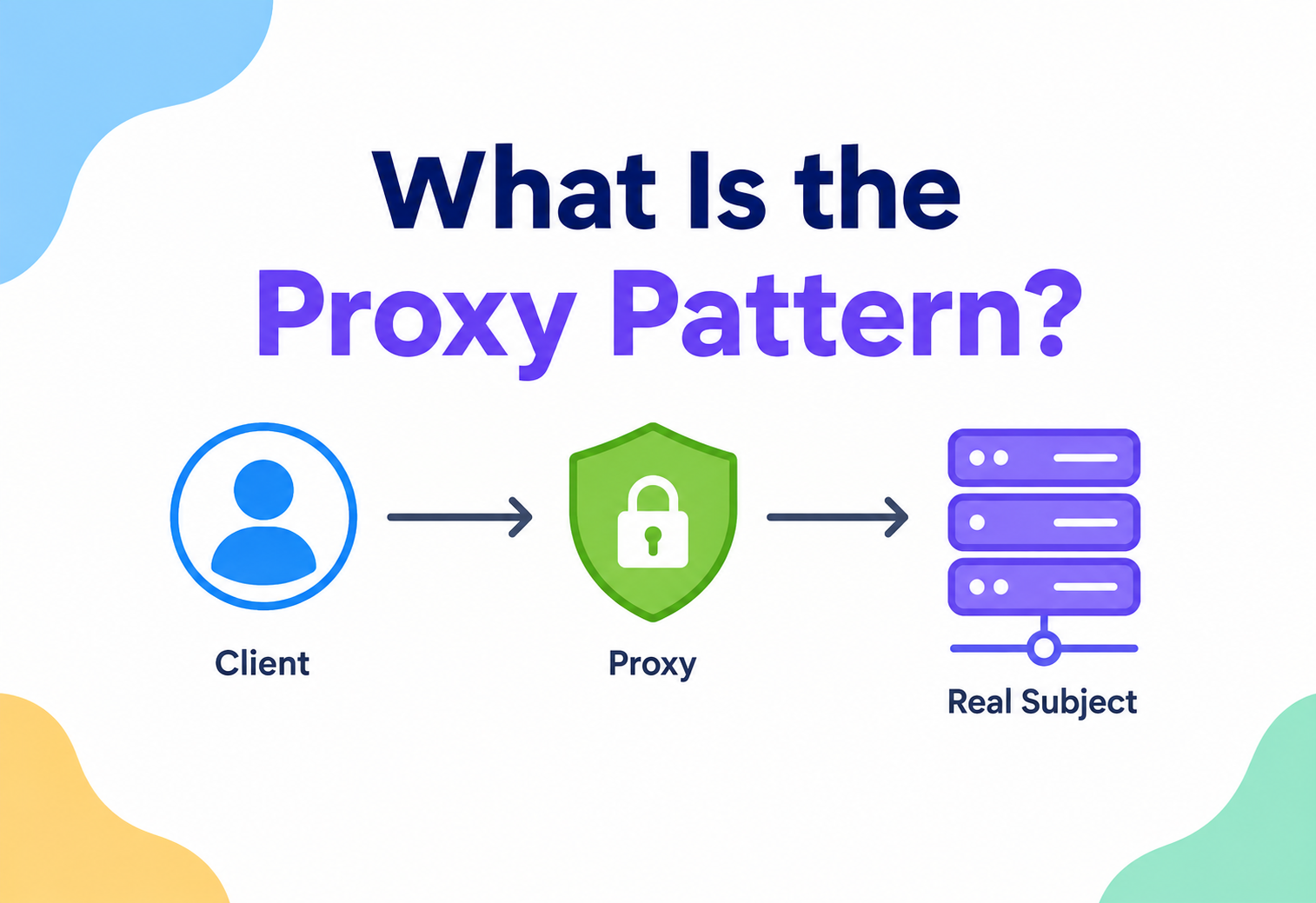
What Is the Proxy Pattern?
A credit card isn’t money. It’s a small plastic stand-in that lets you spend money without carrying cash around, while quietly adding its own extra checks along the way — fraud protection, spending limits, reward points. Software has its own version of this exact trick, and it’s called the Proxy pattern.
The Big Idea, in One Breath
Picture handing over a credit card to pay for lunch. The cashier doesn’t need to see your actual bank account, count your savings, or verify your salary. They just need this one small plastic card, which stands in for your money, represents it faithfully, and quietly handles a bunch of extra work behind the scenes — checking for fraud, tracking your spending, adding reward points — all without you or the cashier ever needing to think about it directly.
The card isn’t the money. It’s a stand-in, a representative, acting on the money’s behalf. You could, in theory, walk around with your actual life savings in cash, but that would be slow, risky, and inconvenient. The card gives you nearly all the same power, wrapped in something safer, more convenient, and quietly smarter.
That exact idea — a small, trustworthy stand-in that represents something else, adds a bit of its own extra behavior, and lets you interact with it as if it were the real thing — is precisely what the Proxy pattern brings to software. It’s a way of placing a lightweight substitute object in front of a real object, so that anyone using the substitute gets the same basic experience as using the real thing, while the substitute quietly manages extra concerns like security, performance, or access along the way.
Think about a receptionist at a busy office. Visitors don’t walk straight into the manager’s office uninvited — they speak to the receptionist first. The receptionist looks and behaves, from the visitor’s point of view, like the natural first point of contact. Behind the scenes, though, the receptionist is quietly checking who’s allowed in, keeping a log of visitors, and deciding when it’s actually appropriate to let someone through to the real manager.
Keep both of these small pictures — the credit card and the receptionist — close at hand as you read on. Nearly every technical idea in the rest of this guide is simply a more precise, code-shaped version of the exact same trick: let a trustworthy stand-in represent something valuable, and quietly do a little extra work on its behalf.
This guide walks through exactly what the Proxy pattern is, the different flavors it comes in, and where real, professional software architecture leans on this exact “stand-in with extra powers” idea constantly — from a simple image gallery all the way up to the security systems protecting some of the largest platforms in the world.
It’s worth pausing on why this particular idea — a trustworthy stand-in doing extra work on someone’s behalf — turns out to matter so much in software specifically. Real systems constantly deal with objects that are expensive to create, dangerous to expose directly, or physically distant. Loading a huge image file, opening a sensitive financial record, or reaching across the internet to a server on another continent are all situations where handing someone the “real thing” directly, with no safeguards in between, would be slow, risky, or simply impractical. A well-placed stand-in solves all of these problems using the exact same basic shape, adjusted only slightly for each specific situation.
You don’t need a technical background to follow the ideas ahead. Every code example in this guide comes paired with a plain-language explanation and a familiar, everyday comparison, so the underlying logic stays clear even where the syntax feels unfamiliar. By the end, “Proxy pattern” should feel less like an intimidating phrase from a design-patterns textbook, and more like a simple, sensible habit you’ve already been practicing every time you’ve handed over a card instead of cash.
What the Pattern Really Is
Formally, the Proxy pattern provides an object that stands in for another object, sharing the exact same interface, so that anyone using the proxy can’t tell the difference from using the real thing directly — at least not from the outside. Underneath that shared interface, though, the proxy is free to add its own extra behavior: checking permissions, delaying expensive work, logging activity, or forwarding requests somewhere else entirely.
This is one of the classic “structural” design patterns — a family concerned with how objects and classes are composed together to form larger, well-organized structures. Where creational patterns worry about how objects get built, and behavioral patterns worry about how objects communicate, structural patterns worry about how pieces fit together cleanly, without unnecessary tangling. The Proxy pattern specifically tackles situations where directly using an object would be risky, slow, inconvenient, or simply undesirable, and a controlled stand-in solves the problem elegantly.
A proxy looks exactly like the real object from the outside, but it’s quietly free to say “not so fast” before letting a request through, or to do a little extra work of its own along the way.
It’s worth being precise about what “encapsulating access” really means here, since it’s easy to gloss over. The proxy doesn’t necessarily hide the real object’s existence entirely — often it holds a direct reference to it, and could, in theory, be inspected closely enough to reveal that reference. What the proxy actually controls is the pathway: every request from the outside world is required to pass through the proxy first, giving it a genuine, enforced opportunity to act before the real object is ever touched.
The key design requirement that makes this pattern work cleanly is that the proxy and the real object both agree to honor the exact same shared interface or contract. Because of this, any code that was written to work with the real object continues working perfectly well with the proxy instead, without needing a single line changed — the proxy simply slots in seamlessly, wherever the real object used to sit.
The word “proxy” itself is borrowed directly from everyday English, where it already means exactly this — someone or something authorized to act on another’s behalf. A “proxy vote,” cast by one person on behalf of another who can’t attend in person, carries the same essential idea: a trusted stand-in, acting with real authority, representing someone or something that isn’t directly present. Software engineering didn’t invent this concept; it simply borrowed a very old, very human idea and gave it a precise, reusable shape.
Like several of its structural cousins, the Proxy pattern was formally catalogued in the influential 1994 book on object-oriented design written by the four authors often nicknamed the “Gang of Four,” alongside twenty-two other well-known patterns. More than three decades later, it remains one of the most widely used patterns in professional software, precisely because the underlying problem it solves — controlling access to something valuable, expensive, or distant — never really goes away, no matter how technology itself continues to change.
The Key Roles
Every Proxy pattern design is built from a small handful of cooperating pieces, and recognizing each one is the real key to understanding how the pattern holds together. Compared to some other patterns, the Proxy pattern is refreshingly compact — most of its power comes from just a few pieces working together consistently, rather than a large number of moving parts.
Subject
The subject is the shared interface, or contract, that both the real object and the proxy agree to implement. It’s what makes the substitution possible in the first place — as long as both sides honor the same subject, calling code never has to know which one it’s actually talking to. Think of it as the job description both the receptionist and the manager are willing to sign off on: “anyone fulfilling this role must be able to greet a visitor and respond to their request.”
Real Subject
The real subject is the object doing the genuine, meaningful work — the bank account behind the credit card, the manager behind the receptionist. It has no idea a proxy even exists in front of it; it simply does its job correctly whenever it’s actually called upon, remaining entirely unaware of, and unaffected by, however many layers of proxies might be standing between it and the outside world.
Proxy
The proxy is the stand-in object sitting between the client and the real subject. It implements the same shared interface, and internally holds a reference to the real subject, deciding when — and whether — to actually forward a request through to it. This is where all of the pattern’s real personality lives: the exact same basic shape can behave like a cautious gatekeeper, a patient delayer, a helpful rememberer, or a faithful long-distance messenger, depending entirely on what the proxy chooses to do before forwarding a request onward.
Client
The client is whatever code is actually making requests, believing it’s simply talking to “the subject” — blissfully unaware, and rightly so, of whether it’s actually talking to the real object or a proxy standing in front of it. This blissful unawareness is a genuine design feature, not an oversight; it’s precisely what keeps the client’s own code simple, focused, and free of any special handling for “proxy” versus “real object” cases.
If you can point to “the interface everyone agrees on,” “the object doing the real work,” and “the stand-in quietly deciding what happens before that real work runs,” you’ve correctly identified the subject, the real subject, and the proxy.
It’s worth noticing how narrow each role’s knowledge stays. The client only ever needs to know about the shared subject interface — it genuinely doesn’t matter to the client whether a proxy or the real object sits behind it. The real subject, meanwhile, has no awareness whatsoever that a proxy might exist in front of it; it simply performs its job correctly whenever it’s actually called. Only the proxy itself needs to know about both sides at once, holding a reference to the real subject while presenting the same face to the outside world. This careful narrowing of who-knows-what is exactly what allows a proxy to be added to, or removed from, a system with minimal disruption to everything else.
Seeing the Anatomy
Here’s a diagram showing how these pieces connect, using the receptionist analogy translated into a simple, shared structure. Following the arrows from left to right traces exactly the same journey a real request takes through a proxy-based system, whether that system is a small program or a sprawling enterprise platform.
Notice the dashed line between the receptionist and the manager, labeled “if allowed.” That dashed line is the entire point of the pattern: the proxy doesn’t automatically forward every request. It’s free to inspect, delay, log, deny, or otherwise handle a request differently, and only pass it along to the real object when it genuinely makes sense to do so.
It’s worth imagining what would happen without that receptionist standing in the middle. Every single visitor would walk directly to the manager’s office, with no filtering, no logging, and no way to politely redirect someone who doesn’t actually need to be there. The manager would spend enormous amounts of time handling requests that never needed their personal attention in the first place. The receptionist doesn’t just add convenience — they fundamentally change how much of the manager’s valuable time and attention gets protected and preserved for the moments that genuinely require it.
A Worked Example: A Lazy-Loading Image Gallery
Let’s turn this into real, working code with one of the most classic examples of the Proxy pattern: an image viewer that avoids loading a large, expensive image file until someone actually asks to see it.
Imagine an application displaying a scrollable gallery of a thousand photo thumbnails. Loading every single full-resolution photo the instant the gallery opens would be wasteful in the extreme — most of those photos may never even be scrolled into view, let alone opened. A far more sensible approach is to represent each photo with a lightweight stand-in at first, only paying the real cost of loading a specific photo the moment someone actually clicks to view it.
Proxy Pattern — loading an image only when it's genuinely needed// The Subject — shared interface
interface Image {
    void display();
}

// The Real Subject — expensive to create
class RealImage implements Image {
    private String filename;

    RealImage(String filename) {
        this.filename = filename;
        loadFromDisk(); // slow, expensive operation
    }
    private void loadFromDisk() {
        System.out.println("Loading " + filename + " from disk...");
    }
    public void display() {
        System.out.println("Displaying " + filename);
    }
}

// The Proxy — stands in until the image is truly needed
class ImageProxy implements Image {
    private String filename;
    private RealImage realImage;

    ImageProxy(String filename) {
        this.filename = filename;
        // notice: no loading happens here yet
    }
    public void display() {
        if (realImage == null) {
            realImage = new RealImage(filename); // load only now
        }
        realImage.display();
    }
}

// Usage:
Image photo = new ImageProxy("vacation.jpg");
System.out.println("Gallery loaded instantly — no image work done yet.");

photo.display(); // only now does the real loading happen
photo.display(); // already loaded, so this is instant
Notice that creating an ImageProxy is instant, since it doesn’t touch the disk at all. Only the first call to display() actually triggers the slow, expensive work of loading the real image — and every call after that reuses the already-loaded image, since the proxy remembers it’s already been created.
A photo gallery with a hundred thumbnails can display instantly using a hundred lightweight proxies, only paying the real cost of loading a full-resolution image the moment a user actually opens one.
There’s a quieter benefit hiding here too. Because ImageProxy and RealImage both implement the exact same Image interface, any part of the application working with images never has to write special-case logic for “images that haven’t loaded yet” versus “images that have.” It simply calls display() on whatever it’s holding, and trusts the object — whichever one it actually turns out to be — to handle things correctly. This uniformity is what allows the rest of a large application to stay refreshingly simple, even while a great deal of careful, deliberate laziness happens quietly underneath it.
The Four Main Types of Proxies
While every proxy shares the same basic shape — a stand-in honoring the same interface as the real object — proxies tend to fall into a handful of well-recognized flavors, each solving a different, specific problem. Learning these four names gives you a genuinely useful shared vocabulary for describing exactly what kind of proxy a design calls for, rather than just saying “some kind of wrapper” and leaving the real intent vague.
Virtual Proxy: Delay Expensive Work
A virtual proxy postpones the creation or loading of an expensive object until it’s genuinely needed, exactly like the image gallery example above. This is sometimes called lazy loading, and it’s one of the most common, practical uses of the entire pattern.
Protection Proxy: Guard Access
A protection proxy checks whether a specific request should even be allowed before forwarding it through — verifying permissions, roles, or credentials. Only requests that pass this check ever reach the real object underneath.
Remote Proxy: Represent Something Far Away
A remote proxy stands in locally for an object that actually lives somewhere else entirely — on a different server, a different machine, sometimes a different continent. Calling code interacts with the local proxy as if the real object were right there, while the proxy quietly handles all the messy networking details underneath.

Caching Proxy: Remember Recent Answers
A caching proxy keeps a short-term memory of recent results, returning that stored answer instantly for a repeated request rather than redoing the same expensive work all over again.
Smart Proxy: A Little of Everything Extra
Sometimes described as a fifth, catch-all category, a smart proxy adds general housekeeping behavior around the real object — counting how many times it’s been used, automatically cleaning up resources when they’re no longer needed, or logging every single call for later review. It doesn’t fit neatly into the other four boxes, but it follows exactly the same underlying shape: a stand-in, quietly doing extra work before forwarding a request through. A shared document that automatically tracks how many people currently have it open, and only releases certain resources once the last viewer closes it, is a familiar everyday example of exactly this kind of smart, bookkeeping-oriented proxy at work.
Virtual proxies say “not yet.” Protection proxies say “not so fast, let me check.” Remote proxies say “let me handle the distance for you.” Caching proxies say “I already know the answer to that.” Smart proxies say “let me also keep track of a few extra things while I’m here.”
Real systems very often blend more than one of these flavors into a single proxy — a well-built remote proxy, for instance, might also cache recent results to avoid repeating slow network calls, and might additionally check permissions before forwarding a request at all. The four (or five) categories are useful mental labels, not strict, mutually exclusive boxes.
It’s worth taking a moment to notice why each of these flavors solves a genuinely different problem, rather than simply being minor variations on a theme. A virtual proxy is fundamentally about timing — when should expensive work actually happen? A protection proxy is fundamentally about permission — should this particular request even be allowed? A remote proxy is fundamentally about distance — how do I make something far away feel local? A caching proxy is fundamentally about memory — have I already done this exact work recently? Recognizing which of these four underlying questions a given design problem is really asking is often the fastest way to identify which flavor of proxy actually fits.
A Worked Case Study: A Protection Proxy for Files
Let’s design something closer to real, professional software: a document management system where only certain users are allowed to open certain sensitive files.
Before writing any code, it helps to picture the two very different worlds that need to stay cleanly separated: the world of “who is allowed to see what,” and the world of “how do I actually read a file from disk.” Mixing these two concerns together inside a single class tends to produce tangled, hard-to-maintain code, where a simple permissions change risks accidentally breaking file-reading logic that had nothing to do with it. A protection proxy exists precisely to keep these two worlds cleanly apart.
Identify the real subject
A
FileReaderclass knows how to open and read the actual contents of a file on disk.Define the shared interface
A
Readableinterface with a singleread()method, honored by both the real reader and its proxy.Build the protection proxy
A
SecureFileReaderchecks the current user’s permission level before ever touching the realFileReader.Let the rest of the app stay unaware
Every other part of the system simply calls
read()on aReadable, with no idea whether it’s talking to a proxy or the real thing.
A Protection Proxy — checking permissions before forwarding a requestinterface Readable {
    String read();
}

class FileReader implements Readable {
    private String filename;
    FileReader(String filename) { this.filename = filename; }
    public String read() {
        return "Contents of " + filename;
    }
}

class SecureFileReader implements Readable {
    private FileReader realReader;
    private String filename;
    private String userRole;

    SecureFileReader(String filename, String userRole) {
        this.filename = filename;
        this.userRole = userRole;
    }

    public String read() {
        if (!userRole.equals("ADMIN")) {
            throw new SecurityException("Access denied: insufficient permissions");
        }
        if (realReader == null) {
            realReader = new FileReader(filename);
        }
        return realReader.read();
    }
}

// Usage:
Readable doc = new SecureFileReader("payroll.csv", "ADMIN");
System.out.println(doc.read());   // allowed, reads successfully

Readable blocked = new SecureFileReader("payroll.csv", "GUEST");
blocked.read();   // throws SecurityException, never touches the real file
Notice how this single class quietly combines two proxy flavors at once — it’s a protection proxy, checking permissions, and also a virtual proxy, only creating the real FileReader once access has actually been confirmed. If access is denied, the expensive real object is never even created, saving both security risk and unnecessary work in one clean stroke.
This ordering — checking permissions before doing any expensive work at all — deserves a moment of attention, since it’s a genuinely important design decision, not an accident of how the code happens to be written. Reversing the order, loading the file first and only afterward checking whether the user was ever allowed to see it, would waste effort on every denied request and, in more sensitive systems, could even create a subtle security risk if the loading step itself has any observable side effects. Checking access first, and only doing real work once that check clearly passes, is a small habit worth carrying into every protection proxy you ever build.
The rest of the document management system never has to sprinkle permission checks throughout its own code. It simply calls read() and trusts the proxy to handle the gatekeeping correctly, every single time.
This design also makes testing considerably easier. A test verifying that unauthorized users are correctly blocked never needs a real file sitting on disk at all — it only needs to confirm that SecureFileReader throws the expected error for the wrong role, without the test ever touching real file-reading logic. Similarly, a test verifying the file-reading logic itself works correctly can use the plain FileReader directly, without needing to think about permissions at all. Each piece can be tested cleanly and independently, precisely because the pattern kept their responsibilities so clearly separated from the start.
Across Different Languages
The Proxy pattern shows up across virtually every language with objects and interfaces, and some languages even offer special built-in tools that generate proxies automatically, saving engineers from hand-writing the same wrapping logic over and over again.
Python — a Simple Caching Proxyclass ExpensiveService:
    def get_data(self, key):
        print(f"Computing for {key}...")
        return key.upper()

class CachingProxy:
    def __init__(self, service):
        self.service = service
        self.cache = {}

    def get_data(self, key):
        if key not in self.cache:
            self.cache[key] = self.service.get_data(key)
        else:
            print(f"Returning cached result for {key}")
        return self.cache[key]
JavaScript — a Native Proxy Objectconst bankAccount = {
  balance: 1000,
};

const protectedAccount = new Proxy(bankAccount, {
  get(target, prop) {
    console.log(`Reading ${prop}`);
    return target[prop];
  },
  set(target, prop, value) {
    if (prop === "balance" && value < 0) {
      throw new Error("Balance cannot go negative");
    }
    target[prop] = value;
    return true;
  }
});

protectedAccount.balance = 500; // allowed
protectedAccount.balance = -50; // throws an error
JavaScript is worth calling out specifically, since it includes a genuine, built-in Proxy object as a core language feature — no manually written wrapper class required. Reading or writing any property on the wrapped object can be intercepted automatically, which makes JavaScript an unusually convenient language for experimenting with this pattern directly. Java, similarly, offers a built-in mechanism for generating simple proxies automatically at runtime for interfaces, commonly used inside larger frameworks to add cross-cutting behavior like logging or transaction management without hand-writing a proxy class for every single interface.
This general idea — automatically generating a proxy around an object at runtime, rather than hand-writing one for every single class — is sometimes called dynamic proxying, and it’s an especially powerful tool for framework authors. Instead of manually wrapping a hundred different service classes to add the exact same logging or security behavior around each one, a framework can generate all hundred proxies automatically, following one shared recipe, at the moment the application starts up. This is precisely how many popular enterprise frameworks quietly add transaction management, security checks, or performance monitoring around ordinary application code, without that application code ever needing to mention proxies itself.
Where Real Architecture Actually Uses It
The Proxy pattern is one of the quiet workhorses sitting underneath enormous amounts of professional infrastructure, often invisible to the very engineers relying on it every day. Once you know to look for it, it’s genuinely difficult to find a large, modern software system that doesn’t lean on some form of this idea somewhere in its architecture.
Load related data only when touched
Database frameworks often return lightweight proxy objects for related records, only fetching the real data from the database the moment a field is actually accessed.
One front door for many services
A gateway sits in front of a collection of backend services, forwarding, authenticating, and rate-limiting requests before they ever reach the real service.
A local stand-in for a distant server
A CDN server acts as a caching proxy, serving a website’s files from a nearby location instead of routing every single request back to the original, distant server.
Inspect before allowing through
Network proxies inspect and filter traffic, blocking harmful or unauthorized requests before they ever reach the systems behind them.
Local stubs for distant services
Calling a method on a “remote service” often actually calls a local proxy stub, which quietly handles the network communication and returns the real result.
Add behavior without editing the class
Many frameworks generate automatic proxies around application objects to transparently add logging, transactions, or security checks around existing methods.
Automatic cleanup, hidden inside
Certain memory-management tools act as proxies around raw resources, automatically tracking usage and cleaning up once nobody needs the resource anymore.
A stand-in for something real
Automated tests frequently substitute a lightweight proxy-like object for a real, expensive, or unpredictable dependency, keeping tests fast and reliable.
Web browsers themselves rely on proxies constantly, sometimes visibly and sometimes not. A corporate network might route every outgoing web request through a proxy server that checks it against a list of allowed destinations, logs it for later review, and only then forwards it out to the wider internet — precisely the protection-proxy pattern, just running at network scale rather than inside a single program’s memory.
Database-related tools deserve particular attention here, since lazy-loading proxies are genuinely everywhere inside them. When an application asks for a specific customer record, a well-designed data layer often doesn’t immediately fetch every single piece of related information — their entire order history, every support ticket they’ve ever filed — all at once. Instead, it commonly returns a lightweight proxy standing in for that related data, only reaching out to the actual database the moment the application code genuinely tries to use it. This single design decision can be the difference between a page loading instantly and a page silently fetching thousands of unnecessary database rows nobody actually asked to see.
API gateways deserve one further mention, since they represent perhaps the most visible, widely deployed use of protection and caching proxies working together at internet scale. A single gateway sitting in front of dozens of backend services can confirm a caller’s identity once, apply consistent rate limits across every service at once, and cache frequently requested, rarely changing responses — all without a single one of those backend services needing to implement any of that logic itself. This centralization is a huge part of why modern, large-scale platforms can add or change security policies in one place, rather than updating dozens of individual services separately every time a rule changes.

Everyday Analogies
This pattern shows up constantly outside of software too, anywhere a trustworthy stand-in represents something more valuable, more distant, or more sensitive.
A Restaurant Menu
You read the menu, not the actual dish, deciding what you want before the kitchen goes to the trouble of actually preparing anything.
A Security Guard
Checks your ID before letting you into a building, standing between you and whatever — or whoever — is actually inside.
A Diplomatic Ambassador
Represents an entire country in a foreign land, handling communication on that country’s behalf without every citizen needing to travel there personally.
A Well-Stocked Pantry
Keeps recently bought groceries close at hand, saving a fresh trip to the store every single time something is needed.
A Bouncer at a Club
Decides who’s allowed past the rope, checking age or membership before anyone actually reaches the real venue inside.
A Travel Agent
Books a hotel on the other side of the world on your behalf, handling the distant details so you don’t have to negotiate directly yourself.
A Product Preview Thumbnail
Shows a small, quick preview of a product online, only loading the full-resolution photos and details once you actually click through.
A Doctor’s Office Front Desk
Confirms your appointment and identity before you’re allowed back to see the doctor directly, protecting both privacy and the doctor’s time.
What ties every one of these together is the same quiet promise: a nearby, trustworthy stand-in takes on the hassle, the risk, or the distance involved in dealing with something valuable directly, letting everyone else interact with that stand-in almost exactly as if they were dealing with the real thing. That same quiet promise is what makes this pattern feel so intuitive the moment it’s explained, even to someone who has never written a line of code in their life.
It’s worth noticing, too, how naturally people already trust this exact arrangement in daily life, often without a second thought. Nobody feels uneasy handing a credit card to a cashier instead of cash, or speaking to a receptionist instead of demanding to see the manager directly. That comfort exists because these stand-ins have earned trust by consistently, reliably representing the real thing correctly. Software proxies earn that same kind of trust the same way — by faithfully honoring the shared interface, and by handling their extra responsibilities correctly, every single time, without surprising the objects and people depending on them.
Proxy vs. Decorator vs. Adapter vs. Facade
The Proxy pattern is frequently confused with three close structural cousins — Decorator, Adapter, and Facade — since all four involve one object standing in front of another. The difference lies in exactly why each one exists.
All four patterns share a family resemblance because they’re all, in some sense, about wrapping. But the reason for wrapping is what genuinely separates them, and that reason shapes everything else about how each pattern is designed and used in practice.
| Pattern | Core Purpose | Interface Relationship |
|---|---|---|
| Proxy | Control access to an object — delay, guard, cache, or relay | Same interface as the real object |
| Decorator | Add new responsibilities or behavior to an object | Same interface, but designed to be layered repeatedly |
| Adapter | Make two incompatible interfaces work together | Deliberately different interface, translated into another |
| Facade | Simplify a complex group of subsystems into one easy interface | An entirely new, simplified interface over many objects |
A helpful way to keep these apart: a Proxy controls access to one specific thing while pretending to be it. A Decorator openly adds new abilities to one specific thing while still admitting it’s wrapping something. An Adapter translates between two things that were never designed to speak the same language. A Facade doesn’t wrap just one object at all — it simplifies an entire tangled group of them behind one clean front door.
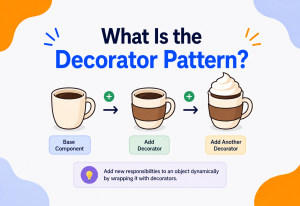
One more subtle distinction worth noting: a Decorator is specifically designed to be stacked, layer upon layer, each one adding its own small piece of new behavior — think of wrapping a simple coffee order in successive layers of “add milk,” “add sugar,” “add whipped cream.” A Proxy, by contrast, is typically designed as a single controlling layer sitting directly in front of the real object, focused on access rather than on being infinitely stackable. Both patterns can technically be chained, but the underlying intent — enhancing versus controlling — remains genuinely different even when the code looks superficially similar.
If your goal is genuinely to add brand-new capabilities to an object — not control or guard access to it — that’s usually a job for the Decorator pattern, even though the code can look remarkably similar to a proxy on the surface.
A useful memory trick for keeping all four apart: a Proxy protects, a Decorator enhances, an Adapter translates, and a Facade simplifies. None of these four ideas are mutually exclusive in a large, real system — a single API gateway, for instance, might genuinely act as a Proxy controlling access, a Facade simplifying many backend services into one clean interface, and occasionally an Adapter translating between an older service’s interface and a newer one, all within the very same piece of infrastructure.
Strengths and Trade-offs
Like every design pattern, the Proxy pattern is a genuine trade-off, not a universal win. Weighing both sides honestly helps decide when it truly earns its place.
It helps to think about this the way an office thinks about hiring a receptionist. A receptionist adds real, ongoing overhead — a salary, a desk, training — but in exchange, protects the manager’s time, screens out unnecessary interruptions, and keeps a helpful record of who visited and when. For a tiny two-person office, that overhead might genuinely not be worth it. For a busy company handling constant visitors, it quickly becomes indispensable.
What the pattern buys you
Controls access to a sensitive or expensive object without modifying that object’s own code. Enables lazy loading, meaningfully improving performance for expensive-to-create objects. Adds security, logging, or caching transparently, invisible to the rest of the application. Keeps the real object’s code focused purely on its core responsibility.
What the pattern quietly costs
Adds an extra layer of indirection, which can make debugging slightly less direct. A poorly designed proxy can become a hidden bottleneck if it does too much work on every single request. Keeping the proxy’s interface perfectly in sync with the real object requires ongoing discipline. Overusing proxies for trivial objects can add unnecessary complexity to a simple codebase. Layering many proxies on top of each other can make the true call path harder to trace during troubleshooting.
In practice, this pattern earns its keep the moment a genuine need shows up for controlled, delayed, cached, or guarded access to an object — particularly when that object is expensive to create, lives somewhere distant, or handles anything security-sensitive. For simple, cheap, purely local objects with no special access concerns, a direct reference is usually simpler and entirely sufficient.
A fair, honest question to ask before introducing a proxy: “Would anyone genuinely notice, or benefit, if this object’s access were delayed, checked, cached, or relayed?” If the answer is clearly yes, the small extra layer of indirection tends to pay for itself quickly. If the honest answer is “probably not,” a direct reference remains the simpler, entirely reasonable choice, at least until real evidence of the need shows up.
Common Mix-Ups Worth Avoiding
Even once the core idea feels familiar, a handful of habits can quietly undercut the benefits this pattern is supposed to bring. Here are the ones worth watching for most closely.
Letting the Proxy’s Interface Drift From the Real Subject
If the proxy and the real object stop honoring exactly the same shared interface, calling code can no longer safely swap between them, and the entire “invisible substitution” benefit of the pattern quietly breaks down. This can happen gradually and almost innocently — a small convenience method added to the proxy alone, for instance, that the real subject never bothered to implement — but even a small drift like this can quietly reintroduce the exact coupling the pattern was meant to remove.
Putting Too Much Logic Inside the Proxy
A proxy that starts making real business decisions, rather than simply controlling access, delaying work, or caching results, risks blurring into something closer to the real subject itself — muddying responsibilities that were meant to stay cleanly separated. A protection proxy deciding who’s allowed in is reasonable; a protection proxy that also starts calculating prices or applying business rules has quietly wandered outside its proper job description.
Forgetting to Handle the “Access Denied” Case Gracefully
A protection proxy that crashes ungracefully, or fails silently, when access is denied can create confusing bugs elsewhere in a system. Denied access should be handled deliberately and predictably, with a clear, well-defined outcome the rest of the application can depend on — a specific error type, a clear return value, or a well-documented exception, rather than an unexpected crash that leaves calling code guessing what actually happened.
Overusing Proxies Where a Direct Reference Would Do
Not every object needs a proxy standing in front of it. If there’s no genuine need for delay, protection, caching, or remote access, wrapping an object in a proxy purely out of habit adds unnecessary indirection for no real benefit.
A caching proxy that never expires or refreshes its cached results can quietly serve stale, outdated data forever. Caching proxies need a clear, deliberate policy for when cached results should be discarded and refreshed.
Most of these mix-ups share the same underlying cause: losing sight of the proxy’s one clear job — controlling access — and letting it slowly absorb responsibilities that genuinely belong somewhere else. A healthy habit is to periodically ask, of any proxy in a codebase, “if I removed this proxy entirely and replaced it with a direct reference, what specifically would break?” A clear, confident answer is a good sign the proxy is doing exactly the focused job it was meant to do.
Why This Small Pattern Matters at a Bigger Scale
It’s tempting to file the Proxy pattern away as a small trick for lazy-loading a few images. In practice, this exact idea quietly shapes decisions in some of the largest, most security-critical systems in modern computing, often forming the very first line of defense a request encounters before it ever touches anything genuinely valuable.
Consider a large bank’s online platform. When a customer requests their account balance, the request very rarely reaches the actual core banking database directly. Instead, it typically passes through several layers of proxies: an authentication proxy confirming the customer’s identity, a rate-limiting proxy preventing abuse from automated scripts, and a caching proxy serving recently requested, unchanged data instantly rather than repeatedly hammering the core database. The customer experiences all of this as one smooth, instant balance check — completely unaware of the careful, layered defense quietly standing between them and the sensitive systems underneath.
This same reasoning scales up to the architecture of the modern internet itself. Enormous platforms serving billions of requests a day survive largely because of proxy-shaped infrastructure absorbing and filtering the vast majority of traffic before it ever reaches the core systems doing the real, expensive work. Without this layered protection, a single unexpected spike in demand — a viral moment, a coordinated attack — could overwhelm a system’s true, valuable resources directly, rather than being absorbed and smoothed out by a resilient front line of proxies built specifically to take that hit.
The receptionist and the bank’s layered security are really telling the same story, just at two very different sizes and stakes. Once the underlying idea clicks at the small scale, it transfers almost perfectly to the big, high-stakes systems professional architects build every day.
This same reasoning shapes how architects think about scaling a growing product, not just protecting an already-large one. A startup’s first version of a product might talk directly to its database with no proxy layer in between at all — perfectly reasonable when traffic is light and the team is small. As the product grows, a thoughtful architect gradually introduces exactly the proxy-shaped layers this guide has covered: caching for frequently requested data, protection for increasingly sensitive information, and remote proxies as functionality gets split across separate services. The underlying application code often barely changes; it’s the layers of proxies quietly added around it that let the same system gracefully absorb ten, a hundred, or a thousand times more load than it started with.
Frequently Asked Questions
A few more questions that tend to come up once the core idea starts to feel familiar, gathered here for quick reference alongside everything covered earlier in this guide.
Can a single object have more than one proxy in front of it?
Yes — proxies can even be layered, one in front of another, each adding its own specific concern. A request might pass through a logging proxy, then a caching proxy, then a protection proxy, before finally reaching the real object, much like a letter passing through several checkpoints before final delivery.
Does the client always know it’s talking to a proxy?
Often it doesn’t, and that’s usually intentional — a well-designed proxy is meant to be transparent, indistinguishable from the real object through the shared interface. In some designs, particularly protection proxies, this transparency is a deliberate security feature, since a client that can’t tell it’s being checked can’t easily work around that check.
Is a proxy server the same thing as the Proxy design pattern?
They’re extremely close relatives, applying the exact same underlying idea at different scales. A proxy server is a network-level implementation of the same basic concept the Proxy pattern describes at the level of individual objects inside a single program. Both share the same fundamental job: standing between a requester and the real destination, deciding what to forward, log, cache, or block along the way.
How is a virtual proxy different from simply checking “if null, create it” everywhere?
The logic looks similar, but the location matters enormously. Scattering “if null, create it” checks throughout a codebase means every single piece of calling code has to remember to do it correctly. A virtual proxy centralizes that exact same logic in one place, so calling code never has to think about it at all — it just uses the object normally.
Can proxies be generated automatically instead of hand-written?
Yes, and many frameworks do exactly this. Rather than manually writing a new proxy class for every single interface that needs one, some languages and frameworks can automatically generate a matching proxy at runtime, given just the shared interface and the extra behavior that should be added around it.
Does using a proxy always make a system slower, since there’s an extra step?
Not necessarily — quite often the opposite is true. A caching proxy, for instance, can make a system dramatically faster overall by avoiding repeated expensive work, even though each individual call technically passes through one extra small step first.
Is it worth adding a proxy “just in case” a need for one shows up later?
Generally not — it’s usually better to introduce a proxy once a genuine, observed need for delay, protection, caching, or remote access actually appears, rather than speculatively wrapping every object up front. Because the proxy shares the real object’s interface, it can typically be introduced later without disturbing existing calling code, which removes much of the pressure to add one prematurely.
How do I decide which of the four proxy types my situation calls for?
Ask what’s actually slowing you down or worrying you. If creating the object is expensive, you likely want a virtual proxy. If who’s allowed to use it matters, you likely want a protection proxy. If it lives somewhere far away, you likely want a remote proxy. If the same request keeps repeating with the same answer, you likely want a caching proxy. Many real designs end up needing more than one of these at once.
Glossary
A quick-reference collection of every important term used throughout this guide, gathered in one place so you can look any of them up again later without scrolling back through the whole article.
| Term | Definition |
|---|---|
| Proxy | A stand-in object that shares a real object’s interface while controlling, delaying, or extending access to it. |
| Subject | The shared interface both the real object and its proxy agree to honor, enabling seamless substitution. |
| Real Subject | The actual object performing the genuine work a proxy ultimately stands in front of. |
| Virtual Proxy | A proxy that delays creating or loading an expensive object until it’s genuinely needed. |
| Protection Proxy | A proxy that checks permissions or credentials before allowing a request through to the real object. |
| Remote Proxy | A local stand-in representing an object that actually exists on a different machine or server. |
| Caching Proxy | A proxy that stores recent results and returns them instantly for repeated requests. |
| Smart Proxy | A proxy that adds general housekeeping behavior — logging, counting, cleanup — around the real object. |
| Lazy Loading | The practice of delaying expensive work or data-fetching until it’s actually required. |
| Structural Design Pattern | A category of design patterns concerned with how objects and classes are composed into larger, well-organized structures. |
| Interceptor | A mechanism, often implemented as a proxy, that adds behavior around an existing method call without modifying its original code. |
| Dynamic Proxying | A technique where a proxy is automatically generated at runtime for a given interface, rather than being hand-written. |
Key Takeaways
We’ve covered a lot — credit cards, receptionists, image galleries, bank security layers, and API gateways. If just a few ideas stay with you, let it be these.
Remember This
- The Proxy pattern places a stand-in object in front of a real object, sharing the exact same interface.
- Because the interface matches, calling code can’t tell the difference between the proxy and the real thing.
- Four common flavors solve different problems: virtual (delay), protection (guard), remote (represent something distant), and caching (remember).
- A proxy is free to inspect, delay, deny, or log a request before deciding whether to forward it to the real object at all.
- Real architecture leans on this constantly — lazy-loading ORMs, API gateways, CDNs, security proxies, and RPC stubs all use this exact shape.
- The core payoff is controlled access: security, performance, and convenience added transparently, without ever touching the real object’s own code.
The next time you notice a piece of code that would benefit from being a little more cautious, a little lazier, or a little better protected before doing its real work, pause and ask whether a small, trustworthy stand-in — a proxy — could take on that responsibility cleanly, without disturbing the real object underneath at all. More often than not, it can, and the resulting design will feel a little more like a well-run reception desk than an unguarded open door.
And the next time you hand over a credit card instead of cash, pass through a security checkpoint, or notice a website loading instantly thanks to a nearby cached copy of its files, take a small moment to notice it: that’s the exact same shape the Proxy pattern gives to software, quietly standing guard in the background of daily life long before anyone gave it a formal name.