The Architecture Failure Interview Question
A structured field guide to answering one of the most revealing questions in a senior engineer or architect loop — how to pick the right story, structure it honestly, and turn a real failure into the strongest single moment in the interview.
The Question That Quietly Turns the Interview
Somewhere in the middle of a senior engineer or architect interview — after the whiteboard round and the coding round — the interviewer leans back and asks a deceptively simple question: “Tell me about a time your architecture decision failed.” For many candidates, this is the moment the interview quietly turns.
The question is not a trick. It turns the interview because most candidates have never rehearsed an honest, structured answer to it. They have spent nearly all of their preparation time on success stories, on system design drills, and on algorithmic problems — and this question specifically asks for the opposite. It asks you to publicly reflect on a moment you did not get right, under time pressure, in front of a stranger who is grading you.
This question belongs to a well-known family of interview techniques called behavioral interviewing, built on the premise that past behavior is the best predictor of future behavior. The approach traces back to industrial psychology research in the 1970s, and it became mainstream in tech hiring through structured formats like the STAR method (Situation, Task, Action, Result), popularized broadly across corporate hiring in the 1990s and 2000s and now a near-universal expectation in senior technical interviews at companies of every size — from five-person startups to the largest cloud providers.
What makes the architecture failure variant special is that it is specifically designed to probe judgment under uncertainty — the exact skill a system design whiteboard round cannot fully test. Whiteboard exercises reward you for reasoning cleanly about a well-specified, static problem in thirty minutes. Real architecture decisions, by contrast, are made with incomplete information, evolving requirements, and business pressure, and some of them turn out to be wrong months or years later. Interviewers ask this question because they want to know how you behave when reality contradicts the decision you made — do you learn, adapt, and own it, or do you deflect, blame, and repeat the mistake?
Think about how flight schools train pilots. A huge part of pilot training is not about flying perfectly — it is about simulating engine failures, bad weather, and instrument malfunctions, then evaluating how the trainee responds. Airlines do not want pilots who have never made a mistake; they want pilots who know exactly what to do the moment something goes wrong, because eventually, something always does. Interviewers ask about architecture failures for the same reason: they are not looking for someone who has never been wrong. They are looking for someone who handles being wrong well.
This guide treats the question the way it would treat any architecture topic — with a structured framework, real components you can assemble, worked examples, and an honest look at what goes right and wrong. Except here, the system being designed is your answer, and the architecture is the story structure that makes it land well in an interview room.
It is also worth understanding where this question typically sits within a broader interview loop, because that context shapes how you should prepare. At most companies hiring for senior engineer, staff engineer, or architect-level roles, the interview process includes at least one dedicated behavioral round, often conducted by a hiring manager, a skip-level manager, or a senior peer outside your immediate reporting line. This question is one of a small set of “greatest hits” that show up across nearly every such round, alongside questions like “tell me about a time you disagreed with a technical decision,” “describe a conflict with a teammate,” and “tell me about a project you’re most proud of.” Unlike the pure system-design whiteboard round, which is scored primarily on technical correctness and communication, the behavioral round is scored primarily on judgment, self-awareness, and communication under a very different kind of pressure — the pressure of being asked to publicly reflect on a moment you did not get right.
There is a reason experienced interviewers keep returning to this particular question rather than simply asking “are you a good architect?” directly. Self-reported confidence is nearly worthless as a hiring signal — almost everyone will say yes. But the specific, textured way someone describes a real failure — what they noticed, what they missed, how they explain the gap between their intent and the outcome — is remarkably hard to fake convincingly on the spot. That is precisely why preparation matters so much here: not because you are trying to manufacture a false impression, but because a true story, told clearly and with the right structure, communicates far more signal than the same true story told haltingly and without preparation.

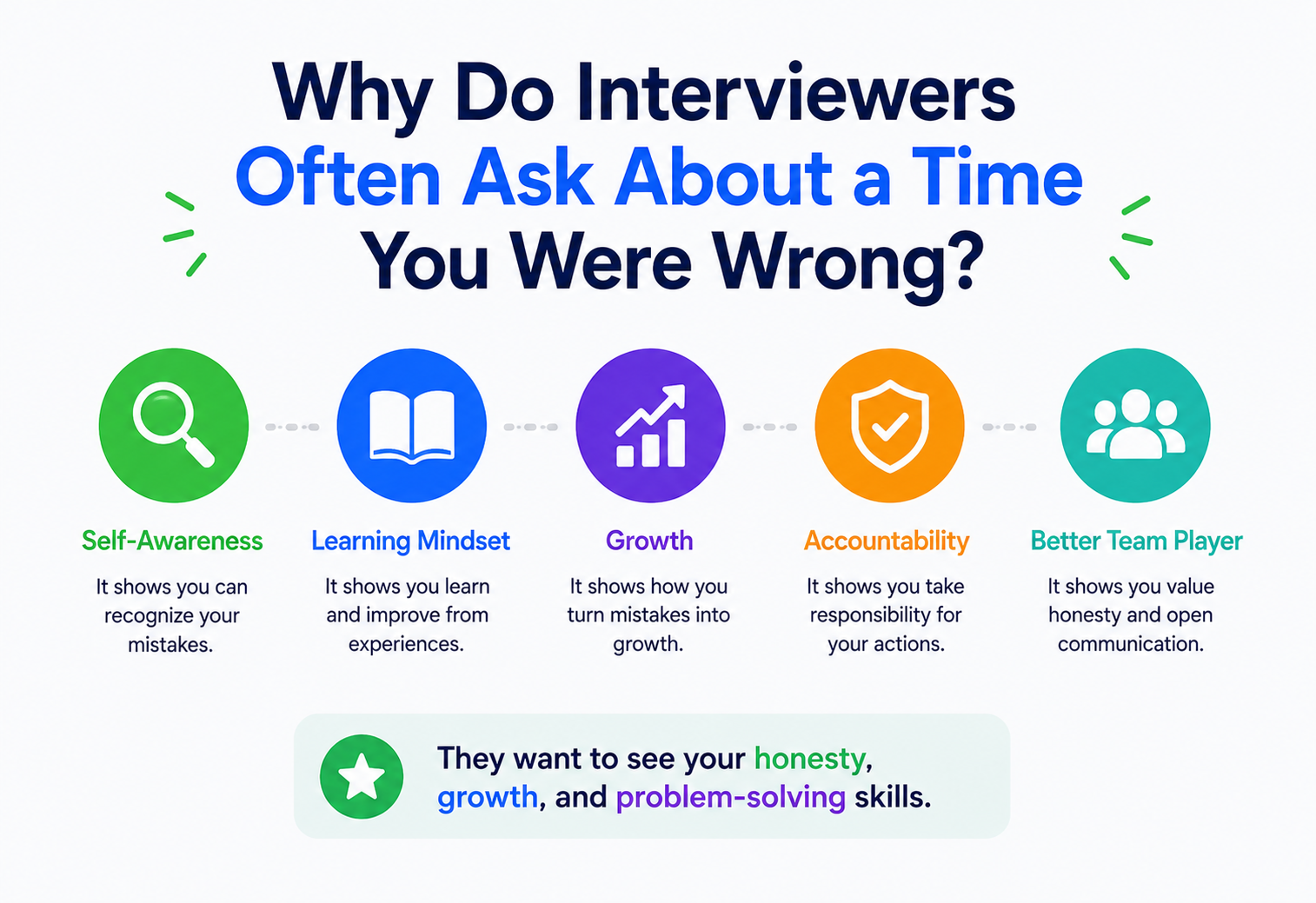
Why This Question Trips Up Strong Candidates
Before building an answer framework, it is worth being honest about why this specific question trips up so many otherwise strong candidates — including people with genuinely deep, impressive engineering experience.
Where Candidates Get Stuck
- They have never picked a story in advance. Under interview pressure, trying to recall and structure a failure story from scratch, live, produces a rambling, unfocused answer.
- They pick a story that is not actually theirs. Blaming a previous manager, a difficult stakeholder, or “the business” for a decision the candidate actually made signals a lack of ownership, which is the opposite of what the question is testing for.
- They pick a story that is too small. A minor, low-stakes mistake (“I once used the wrong logging library”) does not demonstrate real architectural judgment, and interviewers can tell when a candidate is avoiding a meaningful example.
- They pick a story that is too catastrophic without a redemption arc. Describing a genuine disaster without a clear “here is what I learned and changed afterward” ending leaves the interviewer with doubts rather than confidence.
- They over-focus on technical detail and under-focus on judgment. A long technical explanation of exactly what went wrong, without any reflection on the reasoning process or what would be done differently, misses the actual point of the question.
This question maps directly onto a real, valuable workplace skill: the ability to make a decision, watch it fail, and respond productively rather than defensively. Teams that cannot have honest post-mortems repeat the same mistakes indefinitely. Engineers who cannot own past decisions tend to make riskier, less accountable ones going forward, because there is no personal cost to being wrong. Interviewers who ask this question well are trying to hire for exactly that quality — and preparing a genuine, well-structured answer is not “gaming” the interview, it is practicing the same reflective habit that makes engineers better at the actual job.
What a Strong Answer Signals
Takes Responsibility
Owns the decision that was made, without deflecting to a manager, a stakeholder, or a team.
Shows the Reasoning
Reveals the thought process at the time of the decision, not just hindsight after the outcome.
Demonstrates Change
Points to a concrete change in behavior or process that came out of the failure.
The motivation for this guide, then, is to give you a repeatable, honest framework — not a script to memorize word-for-word, but a structure flexible enough to fit your real experience, that consistently produces answers demonstrating all three qualities above.
The Cost of Getting This Question Wrong
It is worth being concrete about what is actually on the line. In a tightly contested hiring process, especially for senior and staff-level roles where technical skill among finalist candidates is often roughly comparable, behavioral rounds frequently become the deciding factor. A candidate who nails the system design round but delivers a defensive, evasive, or unconvincing answer to this specific question can lose an offer to a candidate with marginally weaker technical chops but a clearly stronger demonstration of judgment and ownership. Hiring committees at many companies explicitly weigh “would I trust this person with an irreversible, high-stakes architecture decision” — and this question, more than almost any other single question in the loop, is designed to generate direct evidence for that judgment.
There is a flip side worth naming too: over-preparing in the wrong direction can backfire just as badly. A candidate who has clearly rehearsed a slick, overly polished failure story that conveniently makes them look great can come across as insincere — interviewers who conduct dozens of these interviews a year develop a strong intuition for stories that feel performed rather than lived. The goal of preparation, covered throughout this guide, is not to sand away every rough edge until the story sounds too clean, but to give a true, textured story enough structure that it can be delivered clearly under pressure without losing its honesty.
The Vocabulary Behind a Great Answer
Before assembling a full answer, let us define the building blocks you will be working with. Every strong response leans on some subset of these ideas, whether the candidate names them explicitly or not.
The STAR Method
What it is: a four-part structure for behavioral answers — Situation (the context), Task (your specific responsibility), Action (what you actually did), Result (what happened, including what you learned). It originated in structured employment interviewing research and remains the most widely taught framework for behavioral interview questions.

The STARL Variant
What it is: an extension adding a fifth element, Learning, making the reflective piece explicit rather than folding it into the Result. For architecture-failure questions specifically, making the learning explicit is often what separates a good answer from a great one, because it forces you to name a durable change — not just describe what happened.
Blameless Post-Mortem
What it is: a practice, popularized by companies like Google and Etsy, of analyzing an incident or failure by focusing on systemic and process causes rather than individual blame. Borrowing this mindset for your interview answer — describing what the system and process were missing, not just “I made a mistake” — produces a much more mature, senior-sounding answer.
Reversible vs. Irreversible Decisions
What it is: a framework popularized by Amazon’s Jeff Bezos, distinguishing “one-way door” decisions (hard or costly to reverse) from “two-way door” decisions (easy to undo). A strong failure story often demonstrates awareness of which type of decision you were making at the time — and whether that awareness (or lack of it) shaped what happened.
Think of a one-way door as walking into a tattoo parlor, and a two-way door as trying on a shirt in a fitting room. If your architecture decision was reversible and you moved fast, tested it, and course-corrected quickly — that is usually a sign of good judgment, not poor judgment, even if the initial choice needed changing. If it was irreversible (like a database technology choice baked into years of application code) and you moved just as fast without extra scrutiny, that is a more interesting and more honest thing to reflect on in your story.
Second-Order Effects
What it is: the downstream consequences of a decision that are not obvious at the time it is made. Many architecture failures are not caused by an obviously bad first-order choice, but by a reasonable first-order choice that had unanticipated second-order effects — this distinction matters a great deal in how you frame the “why it failed” part of your story.
Sunk Cost Fallacy
What it is: the tendency to keep investing in a failing decision because of what has already been invested, rather than what makes sense going forward. Stories that include recognizing and escaping a sunk cost trap — “we had already built half of it, but I pushed to stop and change direction anyway” — tend to land very well, because they demonstrate exactly the kind of clear-eyed judgment interviewers are probing for.
Hindsight Bias
What it is: the tendency, once an outcome is known, to overestimate how predictable that outcome actually was beforehand. This concept matters enormously for how you frame your Action section — a strong answer resists the temptation to describe the original decision as though the failure should have been obvious, since doing so can unintentionally make you sound careless rather than unlucky given a genuine unknown. The most credible failure stories acknowledge this tension directly: “with the information I had at the time, this was a reasonable call — the piece I could not have easily predicted was X.”
Choosing the Right Story Is Half the Work
Just as assessing an inherited system is the first real work before touching it, the first real work here is choosing — and pressure-testing — the right failure story before you ever walk into the interview room. This is arguably the highest-leverage step in the entire process.
The Four Pillars of a Good Story Candidate
It Was Genuinely Your Call
You made or strongly influenced the actual decision — not a story where you were simply following someone else’s architecture and it happened to go wrong.
It Had Real Stakes
The failure had a measurable, non-trivial impact — a production incident, a costly rework, a missed deadline with real consequences — not something inconsequential.
The Reasoning Was Sound at the Time
Given what you knew when you made the call, the decision was reasonable — the failure came from something that was genuinely hard to foresee, not obvious negligence.
It Has a Real Resolution
You can point to a concrete recovery, a specific lesson, and — ideally — a change in process or practice that came out of it.
Practical Techniques for Finding Your Story
- Scan your incident and post-mortem history. If you have worked on production systems, you likely have a paper trail of real incidents — this is often the richest source of genuine material.
- Ask “what decision do I still think about?” Decisions that still occasionally cross your mind months or years later are usually the ones with real lessons attached, which makes for a more authentic-sounding answer.
- Avoid your single worst story if it is still raw. If a failure genuinely damaged your confidence or you have not fully processed it, it may come across as defensive or emotionally unresolved in an interview setting — pick a story you can discuss with some distance.
- Prepare two stories, not just one. Interviewers sometimes follow up with “tell me about another one,” or the first story you prepared may not fit the specific phrasing of the question asked.
A senior engineer preparing for interviews might keep a private running document — sometimes called a “brag document” in its success-story form — but extended to also include a short “lessons learned” log updated after every significant decision or incident throughout their career. By interview time, they are not scrambling to remember a story; they are selecting from a pre-existing, well-understood list.
The STARL Structure, Applied
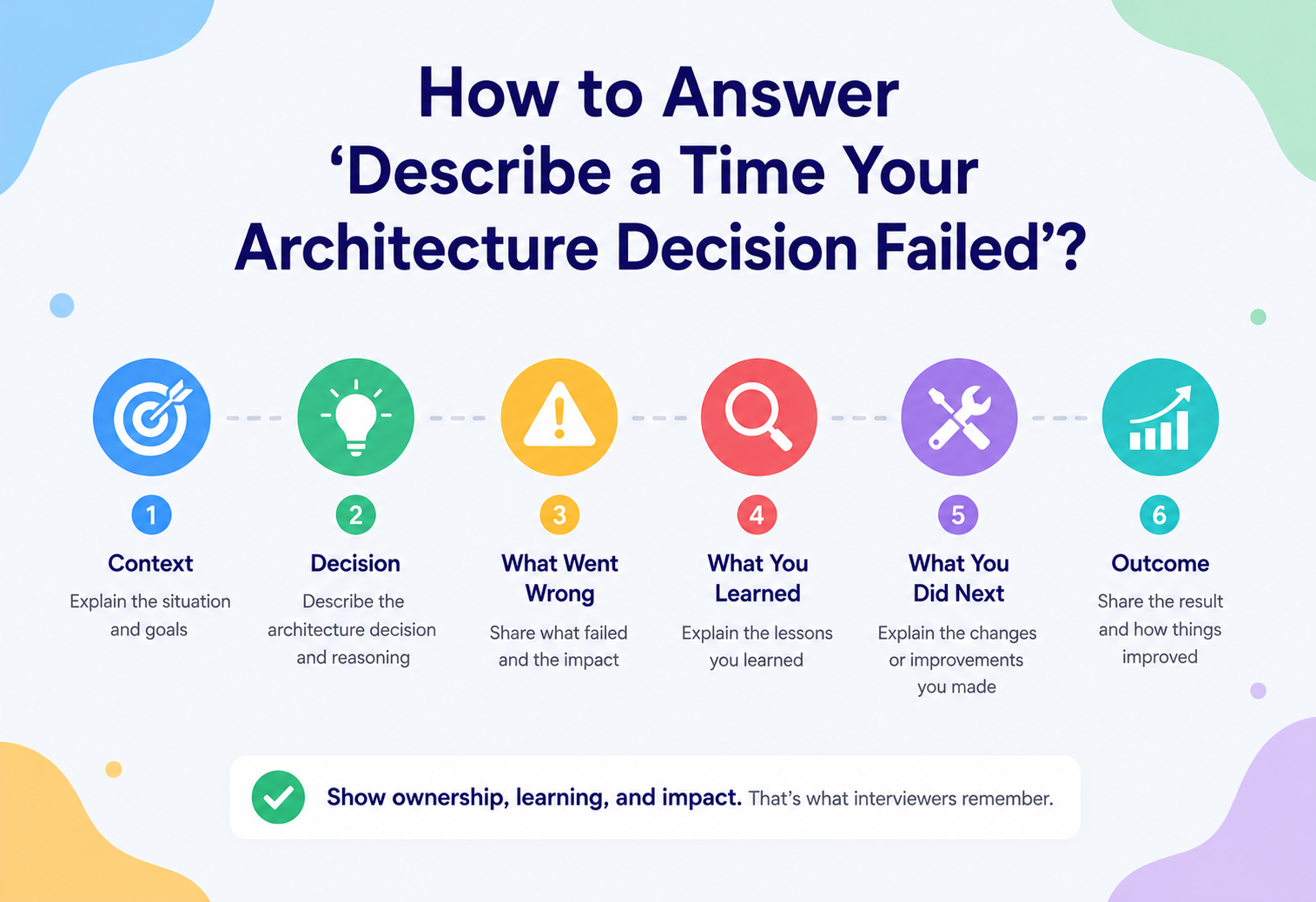
Once you have selected a story, the next step is structuring it. Here is the STARL framework applied specifically to an architecture-failure story, with the internal mechanics of each part.
S — Situation (10–15% of your answer)
Set the scene quickly: the company or product context, the scale of the system, and the business pressure or constraint you were operating under. Keep this brief — interviewers do not need a five-minute company history, just enough context to understand why the decision mattered.

T — Task (5–10% of your answer)
State your specific role and responsibility clearly. This is where you establish that the decision was genuinely yours — “I was the tech lead responsible for choosing our message queue technology” is far stronger than a vague “the team decided.”
A — Action (35–40% of your answer, the largest section)
Describe the actual decision, and — critically — the reasoning behind it at the time. This is the part candidates most often rush past, but it is the part that demonstrates judgment. Explain what alternatives you considered, what trade-offs you weighed, and why the choice seemed right given what you knew then.
R — Result (20–25% of your answer)
Describe what actually happened, honestly and specifically. Use concrete details where you can — an outage duration, a performance regression, a missed deadline — without becoming a purely technical post-mortem. Then describe how you responded once the failure became clear: how you diagnosed it, communicated it, and what the resolution looked like.
L — Learning (15–20% of your answer)
This is the section that most separates strong answers from mediocre ones. State clearly and specifically what you learned, and — ideally — a concrete change in how you approach similar decisions now. Vague lessons (“I learned to be more careful”) land poorly; specific ones (“I now always run a load test against production-scale data before committing to a caching strategy, because that is exactly what I skipped”) land well.
Time yourself out loud, not just in your head. A well-structured STARL answer to this question should run about two to three minutes spoken aloud. Shorter, and you are likely skipping the reasoning (Action) or the reflection (Learning) that the interviewer actually wants. Longer, and you risk losing the interviewer in unnecessary technical detail.
A Worked Mini-Example
To make this concrete, here is a condensed illustration of how the five parts connect, using the “premature microservices split” archetype from Chapter 17. Notice how each part is short but specific, and how directly the Learning section connects back to the Action section rather than floating free as a generic statement.
| Part | Example (condensed) |
|---|---|
| Situation | “At a mid-stage startup, our checkout monolith was becoming a bottleneck for the team’s release velocity.” |
| Task | “As the tech lead for the payments area, I proposed and drove the decision to split checkout into three separate services.” |
| Action | “I split along what looked like natural boundaries — cart, pricing, and payment — based on the code structure at the time, without first mapping the actual data dependencies between them.” |
| Result | “Within two months, the three services were making so many synchronous calls to each other that a single checkout request touched all three, and a slowdown in one degraded all of them together — we had built a distributed monolith with extra network hops.” |
| Learning | “I now insist on mapping data and communication dependencies explicitly, using domain-driven design’s bounded context exercise, before drawing any service boundary — and I helped introduce that as a standard step for any future service split on the team.” |
Notice that this example does not require the candidate to have been careless or inexperienced — splitting along code structure is a common, reasonable-sounding first instinct, and the failure comes from a specific, nameable gap (not mapping dependencies first) rather than vague bad judgment. That specificity is what makes both the failure and the lesson credible.
From “No Idea” to “Confident Delivery”
Just as a system has a lifecycle from design to deployment, your answer has a preparation lifecycle. Here is a realistic timeline for getting from “I have no idea what story to tell” to “I can deliver this confidently under interview pressure.”
Brainstorm candidate stories
List three to five real architecture decisions that did not go as planned, without filtering yet — just get them written down.
Filter using the four pillars
Apply the framework from Chapter 4 to narrow down to your strongest one or two candidates.
Draft the STARL structure
Write out each section in bullet form first — full sentences can come later. Focus especially on making the Action and Learning sections concrete.
Trim for time
Read it aloud, time it, and cut anything that does not serve the core narrative. Most first drafts run too long.
Practice out loud, not just in your head
Silent rehearsal feels fluent but produces halting, unstructured delivery under real pressure. Say it out loud, ideally to another person, multiple times.
Update as you gain new experience
Your best story a year from now may be different from your best story today — revisit and refresh this preparation periodically, not just before a single interview cycle.
Many candidates prepare the Situation and Result in detail but leave the Action and Learning sections vague, assuming they will “just talk through it naturally” in the room. Under interview adrenaline, this is exactly where answers fall apart into rambling or freeze into overly short, unconvincing responses. Prepare the middle and the end at least as thoroughly as the beginning.
How Honest and How Technical to Be
There is no single correct calibration for every interview — the right level of technical depth and the right level of vulnerability depend on the interviewer, the role, and the company. Here is an honest breakdown of the trade-offs involved.
Highly Technical Detail — upsides
- Demonstrates real depth and hands-on credibility
- Strong for staff/principal-level architecture roles
- Hard to fake, which builds trust with a skeptical interviewer
Highly Technical Detail — risks
- Can bury the judgment and reflection the question is actually testing for
- Risks losing a non-technical or cross-functional interviewer in the room
- Easy to run over time if not tightly edited
High Vulnerability / Full Ownership — upsides
- Builds significant trust and credibility with the interviewer
- Demonstrates emotional maturity and self-awareness
- Differentiates you from candidates who default to deflection
High Vulnerability — risks
- Without a strong Learning section, can read as simply “I made a bad call” with no redemption
- Requires genuine emotional distance from the story to deliver confidently, not defensively
A Calibration Framework
| Interview Context | Recommended Calibration |
|---|---|
| Staff/Principal architecture round with senior engineers | Lean more technical; go deep on the reasoning and trade-offs |
| Cross-functional or hiring-manager behavioral round | Lean more on the judgment, communication, and leadership angle; keep technical detail light |
| Panel with mixed technical/non-technical interviewers | Lead with the business impact and decision reasoning; offer technical depth only if asked to go deeper |
| You are not sure who is in the room | Default to the STARL time allocation in Chapter 5 — it naturally balances both dimensions |
A Note on Seniority Signaling
One trade-off worth naming explicitly: the level of the role you are interviewing for should shape which part of the story you emphasize most. For a mid-level engineer, interviewers are often most interested in whether you can honestly recognize and articulate a mistake at all — plenty of candidates at this level still instinctively deflect or minimize, so simply demonstrating clear ownership is itself a meaningful signal. For a senior or staff engineer, the bar rises: interviewers expect not just ownership but evidence that you influenced the broader system or team as a result — a changed process, a new safeguard, a shift in how the team makes similar decisions going forward. For a principal or architect-level role, interviewers often listen specifically for organizational or cross-team impact — did the lesson change how decisions get made beyond just your own individual practice? Calibrating your Learning section’s scope to the seniority of the role you are targeting is a subtle but real way to make the same true story land appropriately for each context.

Making the Answer Work Across Different Rounds
Just as a well-designed system needs to perform under varying load, a well-prepared answer needs to “perform” across different interview formats — a 30-minute behavioral round, a 5-minute portion of a longer system design interview, or a rapid-fire panel format.
Common Failure Modes Under Interview “Load”
- Running long when time is short. If you are asked this as one of several questions in a tightly timed round, your full 2–3 minute version needs a 60–90 second “compressed” version ready, hitting only the Action and Learning at full strength and trimming Situation and Task to a sentence each.
- Getting derailed by follow-up questions. Interviewers will often probe deeper into the Action section (“why didn’t you consider X instead?”). Anticipate the two or three most likely follow-ups and have honest, specific answers ready rather than being caught off guard.
- Losing the thread under nerves. Without a clear mental structure, adrenaline can cause candidates to skip straight from Situation to Result, missing the reasoning that makes the story valuable. Practicing the STARL skeleton until it is automatic prevents this.
// Self-check before using a story in a real interview:
boolean isStoryReady(Story story) {
    return story.wasGenuinelyMyDecision()
        && story.hadRealMeasurableStakes()
        && story.reasoningWasDefensibleAtTheTime()
        && story.hasConcreteResolution()
        && story.hasSpecificActionableLesson()
        && story.spokenLengthSeconds() <= 180;
}
Practice your compressed 60-second version just as much as your full version. It is the one you will actually need most often, since this question frequently arrives as just one of six or seven questions in a tightly timed behavioral round.
Consistency Across Rounds Builds Compounding Trust
Just as a reliable system behaves predictably under repeated use, a reliable interview answer should hold up consistently — across multiple interview rounds at the same company, across different interviewers, and under scrutiny and follow-up questions.
Where Inconsistency Creeps In
- Exaggerating stakes differently each time. If you tell the story to two different interviewers at the same company and the “impact” changes noticeably, it erodes trust if they compare notes.
- Shifting the blame ratio. If one version of the story is fully self-owned and another quietly shifts responsibility elsewhere, it signals the story is not fully honest to begin with.
- Inconsistent technical details. Minor details can shift naturally in casual retelling, but core facts — what the decision was, what broke, how it was fixed — should stay stable every time.
It is worth writing your STARL answer down word-for-word once — not to memorize verbatim, but so you have a single, stable source of truth for the facts of the story. This prevents the natural drift that happens when a story is only ever told from memory, differently each time. Revisit that written version every few months, and update it deliberately rather than letting it drift unconsciously through repeated informal retellings.
Being Honest Without Disclosing Too Much
A subtle but important consideration: your story likely involves a real former employer, real systems, and possibly real colleagues. Being honest and specific does not mean disclosing confidential or sensitive information, and handling this well is itself a small signal of professional judgment.
What to Anonymize or Generalize
- Company-confidential metrics — instead of exact revenue or user numbers, use relative terms (“a significant portion of our checkout traffic”) or ranges you are comfortable sharing.
- Proprietary architecture details — describe the shape of the problem and decision without disclosing details that would be considered trade secrets or confidential system design specifics.
- Individual colleagues — avoid naming specific people, especially in the context of what went wrong; keep the focus on the decision and the process, not on individuals.
- Ongoing or unresolved issues — if the failure or its consequences are still actively unfolding at your current employer, exercise extra discretion, or choose a different, fully resolved story instead.
Instead of “at [Company], we lost $400,000 in revenue over the six-hour outage, and my manager, [Name], was furious,” a well-calibrated version might be: “the decision led to a multi-hour outage affecting a significant share of our checkout flow, which had a meaningful, well-quantified business impact that leadership took seriously.” This preserves the honesty and the stakes without disclosing information you may not be authorized to share.
If you are ever unsure whether a detail is appropriate to share, err on the side of generalizing it. Interviewers are testing your judgment and ownership, not your willingness to disclose your former employer’s confidential numbers — and demonstrating that same judgment inside the interview itself is a quiet but real point in your favor.
Reading the Room and Iterating
Just as a live system needs observability to know whether it is healthy, your interview answer benefits enormously from “instrumentation” — feedback loops that tell you whether it is actually landing the way you intend.
The Three Pillars of Answer Observability
Mock Interview Feedback
Practice with a peer, mentor, or coach and ask specifically: did the reasoning in the Action section feel clear? Did the Learning feel genuine and specific?
Recorded Self-Review
Record yourself delivering the answer and watch it back. Most people are surprised by filler words, pacing issues, or an underdeveloped section they thought was strong.
Real Interview Signal-Reading
In the actual interview, watch for follow-up questions as a signal — being asked to go deeper on the reasoning is usually a good sign; being asked “so what did you actually learn from that?” may mean your Learning section was not specific enough the first time.
A simple, high-leverage practice: after every mock interview or real interview where you use this story, jot down one line about how it landed and what you would adjust. Over a few iterations, this feedback loop sharpens the story noticeably — the same way production monitoring sharpens a system over its first few months live.
Adapting to Company Culture
Different companies and interview cultures expect slightly different “deployment environments” for this answer. Being aware of these differences helps you calibrate before you walk in.
Adapting to Different Company Contexts
- Startups often value speed and pragmatism — a story about a fast decision that failed due to genuinely unknowable early-stage uncertainty, followed by a quick pivot, tends to resonate strongly.
- Large, established companies often value process and systemic thinking — framing your Learning section around a process change (better review gates, a new decision-record practice) rather than a purely individual lesson tends to land well.
- Companies with strong blameless post-mortem cultures (common at many large tech companies) will respond especially well to a story framed around systemic and process causes, per Chapter 3’s blameless post-mortem concept — this signals cultural fit as much as technical judgment.
- Regulated industries (finance, healthcare, government) may respond best to a story emphasizing risk assessment and compliance awareness in the original decision-making process, even if the failure itself was more operational than regulatory.
Adapting framing to company culture is not the same as changing the facts of your story — the goal is emphasis, not fabrication. A dishonest answer that happens to match company culture is far riskier than an honest one that does not perfectly match it, especially once follow-up questions arrive.
Choosing the Right Level of Detail
The technical “data layer” of your answer — the actual architecture details — needs careful handling. Too little, and the story feels vague and unconvincing. Too much, and you bury the judgment the question is really testing.
What Technical Detail to Include
- Name the actual technology or pattern involved. “We chose to shard the database by customer ID” is concrete and credible; “we made a database decision” is vague and forgettable.
- State the specific failure mode. “The sharding key created a hot shard that could not be rebalanced without downtime” is specific and demonstrates real understanding; “the database had problems” is not.
- Include one clear metric or signal of the failure — a specific latency figure, error rate, or outage duration, generalized per Chapter 10’s guidance if needed — that grounds the story in reality.
A Structured Technical Framing
| Element | What to Include |
|---|---|
| The decision | Specific technology, pattern, or architectural choice — named clearly |
| The alternative considered | At least one alternative you weighed, and why you did not choose it at the time |
| The failure mode | The specific, technical way the decision broke down under real conditions |
| The fix | What was actually changed — a different pattern, a migration, a process — not just “we fixed it” |
A useful gut check: could a technical interviewer ask you three specific follow-up questions about the architecture itself and get confident, detailed answers? If not, the story may need more preparation on the technical substance before you use it in a real interview.
Ownership Without Erasing the Team
Architecture decisions rarely happen in isolation, and a strong answer usually reflects that — showing how you worked with others, rather than presenting the decision as a solo act, without diluting your own ownership of the outcome.
Balancing Individual Ownership with Team Context
- Be clear about your specific role without erasing the team around you — “I proposed and championed the decision, and the team ultimately signed off on it” is honest and still centers your ownership.
- Describe how you communicated the failure once it became clear — to your team, to stakeholders, to leadership. This is often as revealing to interviewers as the original technical decision itself.
- Show what changed collaboratively afterward — a new review process, a new decision-record template, a changed team norm — demonstrates that the lesson became durable, not just personal.
// Many strong “Learning” sections describe adopting a lightweight
// Architecture Decision Record (ADR) practice after a failure like this.
public class ArchitectureDecisionRecord {
    private final String title;
    private final String context;         // why this decision was needed
    private final List<String> alternativesConsidered;
    private final String decision;
    private final String consequences;      // including known risks, stated up front
    private final String reversibility;    // “one-way door” or “two-way door” — see Chapter 3
}
Mentioning a concrete artifact like this in your Learning section — “after that incident, I started writing a short ADR for every significant architecture decision, explicitly noting whether it was reversible and what would trigger us to revisit it” — gives the interviewer something specific and durable to remember, rather than a vague statement of having “learned to be more careful.”
Handling the Interpersonal Aftermath Honestly
A dimension candidates often skip entirely is the human side of the failure — how you communicated it upward and sideways once it became clear, and how you managed the relationships involved. Did you have to deliver difficult news to a stakeholder who had pushed back on your original decision and turned out to be right? Did you have to rebuild trust with a team that had followed your technical direction into a painful rework? These moments are often just as revealing as the technical reasoning, and including a brief, honest beat about them — without turning the story into a therapy session — rounds out the answer considerably. A single well-chosen sentence, such as “the hardest part was not the technical fix, it was going back to the team and admitting the direction I had pushed for needed to change,” does a lot of work in a short amount of time, because it shows self-awareness about the social dimension of technical leadership, not just the architecture itself.
The Shapes of Strong and Weak Answers
Certain answer shapes come up over and over. Recognizing them by name — both the good and the bad — is a fast way to pressure-test a draft before you take it into a real room.
Patterns That Make a Strong Answer
Own It Fully
Clearly state the decision was yours, without hedging language like “we sort of decided” or “it wasn’t really my call.”
Show the Reasoning
Explain why the decision made sense at the time, demonstrating judgment rather than just narrating an outcome.
Be Specific in Failure Mode
Name the actual technical way things broke down, grounding the story in real credibility.
End on a Durable Lesson
A specific practice or process change you carry forward, not a vague platitude.
Match Tone to Culture
Emphasize systemic or individual framing depending on what you know about the company (see Chapter 12).
Keep It Time-Boxed
A tight two-to-three-minute story respects the interviewer’s time and signals strong communication skills on its own.
Anti-patterns to Avoid
The Humble-Brag Failure
- A “failure” story that is actually a thinly veiled success story (“my only flaw is I work too hard”)
- Interviewers see through this immediately and it damages trust
The Blame Shift
- Framing the story so the real fault clearly lies with a manager, a stakeholder, or “the business”
- Signals low ownership — exactly what this question is designed to detect
The Unresolved Wound
- A story where the emotional weight is still raw, coming across as defensive or unprocessed
- Better to choose a story you have real distance and perspective on
The Technical Ramble
- Getting lost in architecture minutiae without ever surfacing the judgment or the lesson
- Leaves the interviewer unsure what you actually learned
Habits That Separate Prepared Candidates from Panicked Ones
The gap between candidates who deliver this answer cleanly and those who fumble it is rarely raw talent. It is a small set of habits, practiced consistently.
Best Practices
- Prepare before you are asked, not during. This question is common enough that going in without a ready story is a preventable, unforced error.
- Choose a story with real stakes and real ownership. Small, low-consequence stories waste the opportunity this question actually gives you.
- Weight the Action and Learning sections most heavily. These are what interviewers are actually listening for, per the STARL breakdown in Chapter 5.
- Practice out loud, more than once, ideally with another person. Silent rehearsal does not expose the same gaps that speaking aloud does.
- Keep a stable, single version of the facts. Consistency across retellings builds trust, especially across multiple interview rounds at the same company.
- Anonymize sensitive details thoughtfully, without sacrificing the honesty and specificity that make the story credible.
- Rehearse likely follow-up questions specifically, rather than only the main narrative — interviewers often learn more from how you handle a probing follow-up than from the polished main story itself.
Common Mistakes
A “failure” with no real consequences does not demonstrate the judgment-under-pressure quality interviewers are looking for. If you are choosing between two stories, the one with the higher real stakes is usually the stronger choice, even if it feels riskier to tell.
Stories that end right at the moment things went wrong, without describing the resolution and the lesson, leave the interviewer with an unfinished, uneasy impression. Always carry the story through to what changed afterward.
The best-prepared candidates do not just write one story for one interview cycle — they maintain an evolving log of decisions and lessons throughout their career, the same discipline described in Chapter 4, which makes every future interview (and every future architecture decision) a little easier.
Four Failure Stories You Will Hear Again and Again
Certain failure archetypes come up so often in real interview loops that recognizing them — either in your own experience or in a candidate’s answer — is genuinely useful. Each has a strong and weak version.
The Premature Microservices Split
A team splits a monolith into microservices too early, before the domain boundaries were well understood, leading to a “distributed monolith” with all the operational overhead of microservices and none of the independence. A strong version of this story focuses on how the boundaries were chosen, what signal was missing, and what domain-driven design practice was adopted afterward.
The Under-Provisioned Database Choice
Choosing a database technology optimized for the wrong access pattern — for example, a document store for data that turned out to need complex relational joins at scale — and having to migrate under production pressure months later. Strong versions of this story focus on what load-testing or access-pattern analysis was skipped originally, and what became standard practice afterward.
The Over-Engineered Solution
Building a highly flexible, configurable system for anticipated future requirements that never materialized, adding complexity and slowing the team down for years for no realized benefit. This story pairs well with a Learning section about adopting “you aren’t gonna need it” (YAGNI) discipline and preferring simpler, evolvable designs over speculative generality.
The Synchronous Coupling Mistake
Building a critical user-facing flow with a synchronous dependency on a slower, less reliable downstream service, causing cascading failures whenever that dependency degraded. Strong versions describe adopting asynchronous patterns, circuit breakers, or graceful degradation afterward as a direct, durable lesson.
Across nearly every strong example, the pattern is the same: a defensible decision made with the information available at the time, a clear and specific failure mode once reality diverged from the assumption, and a concrete, durable change in practice afterward. Notice that none of these examples require negligence or incompetence — the most compelling stories almost never do.
The Questions Candidates Ask Most
A quick pass through the questions that come up most often when preparing for this specific interview question — both from candidates preparing for it and from people asked to coach others through it.
What if I genuinely can’t think of an architecture decision that failed?
This is rare for anyone with meaningful production experience, but if it applies to you, broaden your definition of “failed” — it does not need to be a catastrophic outage. A decision that had to be substantially reworked, that caused avoidable pain for the team, or that you would clearly do differently today all qualify.
Is it okay to use a story where the failure was not fully my fault?
Yes, as long as you were genuinely part of the decision and you own your portion of it honestly, without shifting blame elsewhere. Framing it through the blameless post-mortem lens from Chapter 3 — focusing on systemic gaps rather than individual fault — often produces the most mature-sounding version of these stories.
How technical should I get if the interviewer is not an engineer?
Lead with the business context and the decision-making process; offer technical depth only if they ask for it or seem engaged with it. See the calibration framework in Chapter 7 for more detail.
Should I mention the specific company by name?
Generally, use your judgment based on whether the company is public knowledge on your resume and whether anything you are sharing could be considered confidential — when in doubt, keep company specifics light and focus on the decision itself, per Chapter 10.
What if the interviewer asks a follow-up I did not prepare for?
Answer honestly in the moment rather than reciting a scripted line that does not fit — interviewers can usually tell the difference. If you genuinely do not know or cannot recall a detail, it is fine to say so briefly and move the conversation back to what you do remember clearly.
Can I use the same story across every interview I do?
Generally yes, with adjustments for company culture and time constraints as described in Chapter 12 — but keep a second story ready in case the first does not fit a specific follow-up or you are asked for a different example in a later round.
What if my failure story involves a decision made by consensus, not just me?
Be specific about your particular contribution to the decision and be honest that others were involved — interviewers generally respect accurate attribution far more than a story that implausibly centers you as the sole decision-maker on something that was clearly a group call. Focus your ownership language on the part you genuinely drove.
Is it better to pick a story where I caught the failure myself, or one where someone else caught it?
Either can work well. A story where you caught it yourself demonstrates strong self-monitoring; a story where someone else caught it can demonstrate humility and how well you responded to being told you were wrong — which is its own valuable signal, especially if you describe that moment honestly rather than glossing over it.
How do I avoid sounding rehearsed if I have practiced this story many times?
Practice the structure and the key facts until they are automatic, but avoid memorizing exact phrasing word-for-word — internalizing the shape of the story rather than a fixed script naturally preserves a more conversational, authentic delivery, even after dozens of repetitions.

What to Carry Into the Room
“Describe a time your architecture decision failed” is not a trap — it is an invitation to demonstrate exactly the kind of judgment, honesty, and growth that makes someone genuinely trustworthy in an architecture role.
The candidates who answer it well are not the ones who never made mistakes; they are the ones who have done the quiet, deliberate work of choosing the right story and structuring it honestly, well before they ever walk into the room.
Key Takeaways
- Pick the right story deliberately — genuinely yours, real stakes, defensible original reasoning, and a clear resolution (Chapter 4).
- Use the STARL structure, weighting the Action and Learning sections most heavily — that is what interviewers are actually listening for (Chapter 5).
- Prepare both a full version and a compressed version, since this question often arrives with limited time available (Chapter 8).
- Stay consistent across retellings — the same core facts and ownership every time you tell it (Chapter 9).
- Be honest and specific without disclosing confidential details — generalize sensitive numbers and names thoughtfully (Chapter 10).
- Adapt framing, not facts, to company culture — emphasize systemic or individual lessons depending on context (Chapter 12).
- End on a concrete, durable change — a specific practice, not a vague platitude (Chapters 5 and 16).
- Treat this as an ongoing habit, not a one-time interview prep task — the same reflective discipline that makes a great answer also makes a better engineer.
Every architect worth hiring has a failure story — the ones who get hired are distinguished not by having avoided failure, but by what they did with it afterward, and by how clearly and honestly they can tell you about it now.
Prepare that story with the same care you would bring to designing the system itself, and this question stops being something to dread and becomes one of the strongest moments in your interview.
One last piece of perspective worth carrying forward: the discipline built while preparing this answer rarely stays confined to interview prep. Engineers who take the time to genuinely reconstruct a past decision — the context, the alternatives considered, the specific way reality diverged from the plan, and the concrete change that followed — tend to find that the exercise sharpens their actual judgment, not just their interview performance. The next time you face a genuinely uncertain, high-stakes architecture decision, the habit of thinking in terms of reversibility, second-order effects, and explicit trade-offs — the same vocabulary this guide has walked through — tends to show up naturally in how you approach the decision itself, long before anyone asks you to describe it in an interview room.