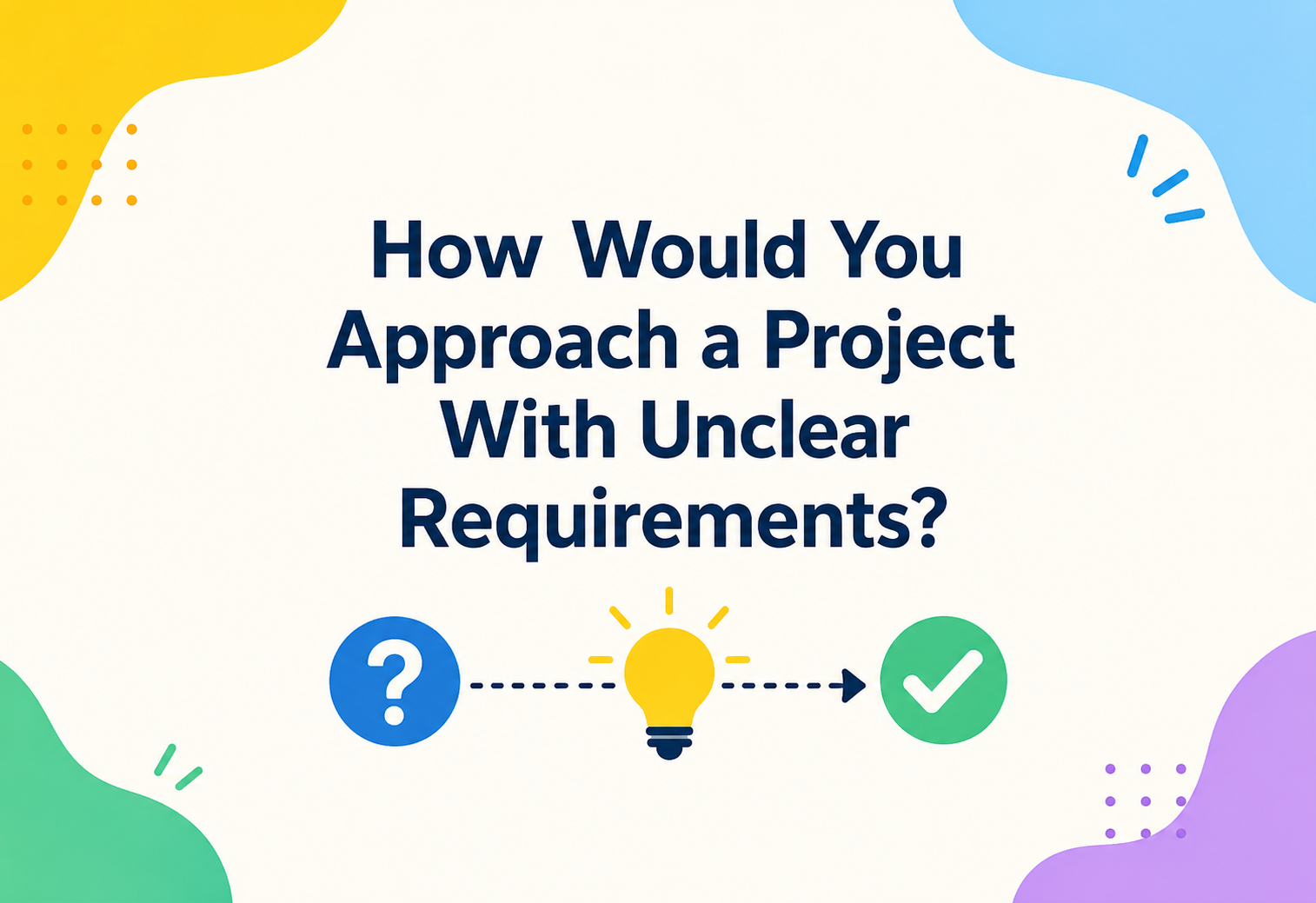
How would you approach a project with unclear requirements?
A quiet, honest look at what to do when the brief is thin, the client isn’t sure either, and the only way forward is to start walking before the fog lifts.
The discomfort you’re feeling is completely normal
You’ve just been handed a project, and the requirements are… vague. Maybe the client said “something modern and easy to use.” Maybe your manager said “figure out the best approach” without saying what problem you’re actually solving. Maybe there’s a document, but half of it contradicts the other half, and nobody seems to have noticed.
If your stomach tightened a little reading that, you’re not alone, and there is nothing wrong with you. Most people are trained, from school onward, to expect a clear assignment before they start working. A prompt. A rubric. A list of what “done” looks like. So when that structure isn’t there, it can feel like the ground has shifted under your feet, even though nothing has actually gone wrong yet. You simply haven’t been told the shape of the thing you’re meant to build.
Here’s the part that’s worth sitting with for a moment: unclear requirements are not a sign that the project is broken, and they are not a test you’ve already failed. In almost every field, real work begins this way. The client doesn’t fully know what they want yet, because if they did, they probably wouldn’t need you. The manager hasn’t scoped it fully, because scoping requires understanding that will only come from digging in. Ambiguity, uncomfortable as it feels, is often just the raw material you’re being handed to shape.
So before any strategy, any framework, any clever technique, the first move is simply this: let yourself feel steady even though you don’t yet have the full picture. You are not supposed to know everything on day one. Nobody does. What you’re being asked to do is find out, carefully and patiently, and that is a completely different skill from “already knowing.” It’s a skill you can build, and this piece is about how.
Why requirements show up unclear in the first place
It helps to understand where the fuzziness comes from, because different causes call for slightly different responses. Vague requirements are rarely random; they usually trace back to one of a handful of very human reasons.
The requester doesn’t fully know yet
They have a feeling, a frustration, or a vision, but they haven’t translated it into specifics. They know something is slow, or ugly, or missing, but not exactly what “fixed” would look like.
Too many people, too many opinions
A brief written by committee often ends up vague on purpose, because specifics would force a disagreement nobody wants to have yet. Ambiguity becomes a way of postponing conflict.
The problem itself is still moving
Markets shift, users change their habits, competitors release something new. Sometimes a brief is vague because the target it’s aiming at hasn’t stopped moving long enough to describe clearly.
Nobody has done this exact thing before
When a project is genuinely new, there’s no template to copy from. The requirements can only be discovered, not simply written down, because they don’t exist anywhere yet.
Time pressure cut the planning short
Sometimes people know they should define things more precisely, but a deadline loomed and “let’s just start and figure it out” won the argument.
Communication broke down somewhere
A requirement might have been clear once, three meetings ago, and gotten fuzzier with every retelling, like a message passed down a long chain of people.
Noticing which of these is happening on your project isn’t just an academic exercise. If the client genuinely doesn’t know yet, your job leans toward gentle discovery and prototyping. If it’s a committee avoiding conflict, your job may involve surfacing that disagreement kindly, so it can be resolved instead of buried. If the ground is still moving, you may need to build in a way that stays flexible rather than rushing toward a fixed target. The fog has a shape, even when it doesn’t have details, and reading that shape is often the real first step.
A different way to hold the problem
Before any tactics, there’s a mindset shift that makes everything after it easier. It’s the difference between waiting for clarity and going out to meet it.
Many people, understandably, treat unclear requirements as an obstacle blocking the “real work.” They wait for someone to hand them a finished spec, and in the meantime they feel stuck, frustrated, or resentful that nobody has done their job of defining things properly. That posture is understandable, but it tends to leave you passive at exactly the moment you need to be curious.
Treat ambiguity as the actual assignment
Instead of thinking, “I can’t start until I know what’s needed,” try shifting to, “finding out what’s needed is the work, at least for now.” This isn’t a trick of positive thinking; it changes what you actually do with your time. Rather than sitting idle waiting for a document, you start scheduling conversations, sketching possibilities, and testing small assumptions. The uncertainty becomes something you’re actively working with, rather than something blocking you.
Hold your first guesses loosely
Early on, you will form a mental picture of what’s needed, often within the first conversation. That instinct is valuable, but it can also quietly harden into an assumption you stop questioning. Try to notice your own first guesses and treat them as hypotheses, not conclusions. Write them down somewhere, even informally, so you can look back later and see whether they held up or needed to change. This small habit keeps you honest with yourself.
Accept that you’ll build some of the wrong thing
This is the part people resist the most, but it’s freeing once accepted. When requirements are unclear, some of your early work will turn out to be a detour. That’s not a failure of planning; it’s the cost of learning by doing, and it’s almost always cheaper than the alternative, which is waiting for perfect information that may never arrive. The goal isn’t to avoid every wrong turn. It’s to take small enough steps that a wrong turn costs you a day, not a month.
Separate the discomfort from the actual risk
It’s worth noticing that the feeling of not knowing and the actual danger of not knowing are two different things, even though they arrive together and feel identical in the moment. Most unclear projects are not, in reality, high-stakes emergencies where a wrong early guess causes lasting damage. They simply feel that way because uncertainty is uncomfortable, and discomfort borrows the emotional weight of danger even when little is actually at risk. Naming this gap out loud, even just to yourself, tends to loosen the grip of that discomfort considerably. Ask plainly: if my current guess turns out wrong, what does it actually cost to correct it? Usually, especially early on, the honest answer is: not very much — a day, a conversation, a redrawn sketch. That answer alone is often enough to let you move again.
Start by listening, longer than feels comfortable
The instinct, especially for people who like to solve problems, is to jump straight to building something, anything, just to feel productive. Resist that instinct for a little while longer than feels natural. The highest-leverage hour on an unclear project is almost always spent listening.
When you sit down with whoever requested the work — whether that’s a client, a manager, or a product owner — your goal isn’t to extract a list of specifications. It’s to understand the world they’re standing in: what problem is bothering them, who else is affected, what they’ve already tried, and what “better” would actually feel like day to day. People are often much better at describing a frustration than a solution, and that frustration, if you listen closely, usually contains everything you need.
Questions that open things up, rather than close them down
Closed questions (“Do you want feature A or feature B?”) tend to get you a shallow answer, because you’ve already narrowed the possibilities before the person has finished thinking. Open questions invite them to describe the actual texture of the problem.
“Walk me through the last time this was a problem for you — what exactly happened?”
“If this worked perfectly, what would change about your day?”
“Who else notices when this goes wrong, and how do they notice?”
“What have you already tried, and what happened when you did?”
“Is there anything you’re assuming I already understand, that I might not?”
Notice that none of these ask “what do you want built.” That question, asked too early, invites a guess dressed up as a requirement. The questions above invite a story instead, and stories are much harder to misinterpret than feature lists, because they carry context along with them.
It’s also worth listening for what’s not said. If three different people describe the same problem slightly differently, that gap is real information, not an inconsistency to smooth over. It usually means the project touches more than one need, and part of your job will be figuring out how those needs relate, or whether they conflict.
Give people room to think out loud, even when it feels slow. It can be tempting to fill every silence in a conversation, especially when you’re the one asking questions and feeling responsible for keeping things moving. But some of the most useful answers arrive a few seconds after the obvious one, once someone has stopped reciting the version they’d prepared and started actually reflecting. A short pause, held gently, often does more work than another clever question.
It also helps to write things down in the person’s own words during these conversations, rather than immediately translating what they say into your own professional vocabulary. If a client says “it feels clunky,” resist the urge to silently convert that into “the interface needs a redesign” before you’ve asked what clunky actually means to them. Sometimes clunky means slow. Sometimes it means confusing. Sometimes it means it simply looks old. Each of those points toward a different piece of work, and the word itself, kept intact, is a clue you don’t want to lose in translation.

Turn the fog into small, solid steps
Once you’ve listened enough to have a rough sense of the terrain, the next skill is breaking an unclear whole into small pieces that are clear enough to act on, even if the whole still isn’t. This is where a genuine sequence of steps helps, because it really is a process you move through in order.
Write down what you think you know, in plain language
Not a formal spec, just a short, honest note: here’s the problem as I currently understand it, here’s who it affects, here’s what success might look like. Share it back with whoever briefed you and ask them to correct it. This single step catches an enormous number of misunderstandings early, while they’re still cheap to fix.
Separate what’s fixed from what’s still open
Some things are genuinely non-negotiable: a deadline, a budget, a legal constraint, a platform the client already uses. Others just feel fixed because nobody has questioned them yet. Sorting these two apart gives you a much smaller, more honest space to actually explore.
Pick the smallest useful thing you can build or show
This might be a rough sketch, a single working screen, a short outline, or a five-minute prototype. The point isn’t polish, it’s speed. You want something concrete enough that people can react to it, because reactions to a real thing are almost always sharper and more honest than answers to a hypothetical question.
Show it early, and watch more than you talk
Bring that small thing back to the people who care about the outcome, before it feels “ready.” Watch their face, not just their words, when they look at it. Genuine confusion, hesitation, or a sudden question you hadn’t considered are gold; they’re telling you exactly where the fog is thickest.
Update your understanding, and repeat
Take what you learned, adjust your plain-language note from step one, and go again. Each loop through this cycle should be a little faster and a little more confident than the last, because you’re carrying real information forward instead of starting from a blank page every time.
This loop, repeated a handful of times, does something that no amount of upfront planning can: it replaces guesses with evidence, gradually, at low cost. By the third or fourth round, you’ll often find the requirements have become far clearer, not because someone finally wrote a proper document, but because you built the clarity yourself, one small step at a time.
Two projects, two very different starts
It might help to picture two versions of the same situation, because the difference between them is smaller than it looks, and entirely within your control.
In the first version, someone receives a brief that reads: “Build us a better way for customers to track their orders.” Nothing else. Feeling the pressure to look capable, they nod, go quiet for two weeks, and build a full tracking dashboard, complete with maps, notifications, and a delivery timeline, because that’s what “better tracking” sounded like to them. When they finally show it, the client looks puzzled. Most customers already know roughly when their order will arrive; what’s actually frustrating them is that support tickets about missing packages take four days to get answered. The dashboard is polished, technically impressive, and almost entirely beside the point. Two weeks are gone, trust has taken a small dent, and the real problem hasn’t moved an inch.
In the second version, someone receives the exact same one-line brief. Instead of disappearing to build, they ask for twenty minutes with two people: someone from support, and one recently frustrated customer. In that short conversation, the actual shape of the problem appears almost immediately: it isn’t visibility that’s missing, it’s response time when something goes wrong. They sketch a rough idea — a lightweight page showing order status plus a single, prominent “something’s wrong” button that routes straight to a support queue with the order details attached, no dashboard, no maps. They show a rough paper sketch the very next day. The client’s face changes almost instantly, because for the first time, someone is solving the problem they actually have, not the one implied by a vague sentence.
Nothing separates these two outcomes except the order of operations. Neither person had a clearer brief than the other; the brief was identical, one short sentence, no more. The difference was entirely in what happened in the first few days: building immediately versus asking first, guessing at the whole thing versus testing a small piece of it. Unclear requirements rarely punish people for not knowing. They punish people for not pausing long enough to find out.
A few common traps, and gentler ways through them
Certain patterns show up again and again on ambiguous projects. None of them are character flaws — they’re just easy grooves to fall into, especially under time pressure. Naming them in advance makes them much easier to notice, and to step around, when they show up in your own work.
Mistaking activity for progress
When you’re anxious about not knowing enough, it’s tempting to fill the uncertainty with visible motion: writing code, drafting documents, filling slides, anything that looks like progress to an outside observer. But motion in the wrong direction isn’t progress, it’s just a more expensive kind of waiting. Before doing something that will take more than a day, it’s worth asking plainly: does this bring me closer to understanding the real problem, or is it just something to point to in a status update?
Treating the first answer as the final one
The first explanation someone gives you is real, but it’s rarely complete. People often lead with the most socially acceptable version of a problem, or the version that’s easiest to explain quickly, and the fuller picture comes out gradually, once trust builds and more time has passed. Resist locking in your plan around the very first sentence someone says to you, even if it sounds clear and confident.

Solving for the loudest voice in the room
On projects with several stakeholders, it’s easy to quietly orient everything around whoever is most vocal, simply because their feedback is easiest to hear. That person’s opinion matters, but it may not represent the people who will actually use whatever you build. It’s worth deliberately seeking out quieter voices, especially end users who rarely get asked directly, because their perspective often reveals gaps the loudest voice never mentioned.
Waiting for permission to ask a “basic” question
There’s a quiet fear that asking something simple will make you look inexperienced, so people sit on confusion for days, hoping it resolves itself. It almost never does. A short, humbly worded question, sent early, costs you a moment of mild discomfort. The same confusion left unspoken tends to cost days of rework later, once it’s finally discovered the hard way.
Talking with stakeholders without losing the thread
Unclear requirements are rarely just a technical or logistical problem. They’re a relationship problem, too, because behind every vague brief is a person, or several people, with their own worries, pressures, and blind spots. How you talk with them matters as much as what you build.
Say what you understand, out loud, often
One of the simplest and most underused habits is narrating your own understanding back to people, regularly, in plain words: “So, if I’ve got this right, the main problem is X, and the thing that matters most to you is Y — did I miss anything?” This does two things at once. It gives the other person an easy, low-pressure way to correct you before you’ve gone too far, and it quietly builds their trust, because they can see you’re genuinely trying to understand rather than just nodding along.
Separate “I don’t know yet” from “nobody knows”
When you’re missing information, it helps to be precise about why. Sometimes you don’t know because you haven’t asked. Sometimes you don’t know because the other person hasn’t decided. Sometimes nobody in the organization has decided, and it genuinely needs a conversation between people who aren’t you. Naming which of these is true, kindly and without blame, helps everyone understand what actually needs to happen next, instead of the ambiguity just sitting there, unaddressed, making everyone quietly anxious.
Keep the conversation going, don’t just report at the end
It’s tempting, especially under pressure, to disappear for a while and come back with a finished answer, hoping it will be exactly right. On an unclear project, this is risky, because you might spend a long stretch of time moving in a direction that a five-minute conversation could have corrected. Short, frequent check-ins, even informal ones, keep small misunderstandings from growing into large, expensive ones.
Write down what you learn, as you go
When requirements are unclear, understanding doesn’t arrive all at once, it accumulates slowly, in small pieces, often in casual conversations that are easy to forget by next week. If you don’t capture that understanding somewhere, you end up re-learning the same things repeatedly, and worse, different people on the project end up holding slightly different, unspoken versions of “what we’re building.”
You don’t need an elaborate system for this. A single, living document works well: a short, honestly-worded page that says what you currently believe the project is for, what’s been decided, what’s still open, and what assumptions you’re making in the meantime. Update it after every meaningful conversation. Date your entries. Let old assumptions stay visible — crossed out rather than deleted — so anyone joining later can see how the understanding evolved, and why.
This habit does something subtle but important: it turns your evolving understanding into something shareable. Instead of clarity living only in your head, where it can quietly drift, it becomes something the whole team can check, question, and correct. It also protects you. If a decision changes later, you have an honest record of what was agreed at the time, rather than relying on memory, which tends to reshape itself in hindsight.

What we believe today: a short paragraph, rewritten as understanding grows.
What’s confirmed: decisions that have actually been agreed, with who agreed and when.
What’s still open: honest questions nobody has answered yet.
What we’re assuming for now: reasonable guesses you’re proceeding on, clearly labeled as guesses.
Knowing when, and how, to push back gently
There’s a version of “going with the flow” that tips over into simply absorbing every ambiguity yourself, quietly, at your own expense. That’s not sustainable, and it isn’t actually more helpful to the project. Part of approaching unclear requirements well is knowing when to say, kindly but clearly, that something needs to be decided before you can move further.
The key word there is kindly. Pushing back doesn’t need to sound like a complaint or an accusation. It can sound like an invitation to think together: “I want to make sure I build the right thing, and right now I see two very different directions this could go — could we spend fifteen minutes deciding which one matters more?” Framed this way, you’re not creating friction, you’re offering to remove some, by surfacing a decision that was going to have to happen eventually anyway.
A useful test for when to push back is to ask yourself: is this ambiguity something I can resolve through my own judgment, small experiments, or a quick conversation, or is it something that genuinely requires someone else’s authority, values, or priorities? Plenty of small ambiguities are yours to resolve; that’s part of what makes the work interesting. But some choices, particularly ones about budget, risk, or which audience matters most, aren’t really yours to guess at. Naming those clearly, instead of quietly picking a direction and hoping it’s right, protects both you and the project.
It also helps to bring options rather than open-ended questions when you do push back. Instead of “I don’t know what to do here,” try “here are two reasonable paths I can see, with a rough sense of the trade-offs — which matters more to you?” This keeps the conversation moving forward, and it shows that your uncertainty comes from genuine complexity, not from a lack of effort on your part.
Raising a genuine ambiguity in week one, while there’s still room to adjust course, feels like careful diligence. Raising the same ambiguity in the final week, right before a deadline, feels like a last-minute problem, even if you only just noticed it yourself. Where possible, flag open questions the moment you spot them, even if the answer isn’t needed for another few weeks. It gives everyone more room to think, and it means the eventual decision, whenever it comes, doesn’t have to be rushed.
Getting comfortable with not knowing, over time
If you do this kind of work for long enough, something quietly shifts. The discomfort of an unclear brief doesn’t disappear entirely, but it stops feeling like an emergency. You start to trust the process of listening, sketching, showing, and adjusting, because you’ve watched it work before, even when it felt shaky in the moment.
This is worth naming, because early on it can feel like everyone else has some secret clarity you’re missing. They don’t. Experienced people are usually not more certain than beginners; they’re simply less afraid of the uncertainty, because they’ve built a personal track record of finding their way through it. That track record is exactly what you’re building right now, on this project, whether it feels like it or not.
One gentle practice that helps: after each unclear project, take ten quiet minutes to reflect honestly. What did you assume early on that turned out to be wrong? What question, if you’d asked it sooner, would have saved you time? What did a stakeholder say, almost in passing, that turned out to matter more than anything in the official brief? These small reflections compound quietly. They won’t make the next unclear project painless, but they will make it a little more familiar, and familiarity is most of what confidence actually is.

A few things worth saying plainly
Away from frameworks and steps for a moment, a handful of things that are simply true, and worth carrying with you.
It’s alright to feel a small wave of anxiety when a project starts foggy. That feeling isn’t a signal that you’re unprepared, it’s just what uncertainty feels like in the body, and it usually fades within the first few real conversations, once you have something to hold onto.
It’s alright to be wrong early. Being wrong about a small prototype in week one is not the same as being wrong about a finished product in month six, and treating them the same is one of the most common, avoidable sources of stress in this kind of work.
It’s alright to ask questions that feel obvious. The question that feels too simple to ask out loud is very often the one that reveals a real gap in shared understanding, and asking it kindly, without apologizing for asking, tends to earn respect rather than lose it.
And it’s alright to move slowly at the very start, even when everyone around you seems to want speed. A little patience in the first week, spent listening and sketching rather than building at full pace, almost always saves far more time later than it costs upfront. Slow, deliberate beginnings tend to produce fast, steady middles. Rushed beginnings tend to produce slow, painful middles, full of rework.
A gentle checklist for your next foggy project
Not a rigid process, just a handful of reminders worth glancing back at when things feel unclear again.
Seven quiet reminders
- Listen before you build. Spend real time understanding the problem behind the request, not just the words used to describe it.
- Write your understanding down in plain language, and share it back for correction, early and often.
- Separate fixed constraints from assumptions that simply haven’t been questioned yet.
- Build the smallest useful thing you can show, and let real reactions guide the next step.
- Check in often, in small doses, rather than disappearing and reporting back once at the end.
- Push back kindly when a decision genuinely isn’t yours to guess at, and bring options, not just problems.
- Be patient with yourself. Discomfort at the start is normal, and clarity is something you build, not something you wait for.