
How Would You Convince a Team to Adopt a New Technology?
A complete, beginner-to-production guide to the craft of technical persuasion — how architects evaluate, pitch, pilot, and roll out new technologies without relying on hype, authority, or luck.
The Chef, the Induction Cooktop, and the Real Problem
Picture a chef who has cooked with a gas stove for fifteen years. One day, someone hands them an induction cooktop and says, “this is faster and more precise, switch to it today.” Even if every claim is true, the chef doesn’t just switch. They worry about their instincts being wrong on the new surface, about ruining a dish mid-service, about relearning muscle memory built over a decade. Convincing them isn’t a matter of reciting specifications — it’s a matter of trust, evidence, and a safe way to try it without risking the whole dinner service.
This is exactly the situation an architect faces every time they want a team to adopt a new technology — a new database, a new language, a new framework, a new cloud service. The technology itself is rarely the hard part. The hard part is people.
Why this is a named, studied skill
The pattern of how new ideas spread through a group of people was formally studied long before software existed. In 1962, sociologist Everett Rogers published Diffusion of Innovations, describing how any new idea — a farming technique, a medicine, a technology — spreads through a population in a predictable curve: a small group of innovators try it first, then early adopters, then the early majority, then the late majority, and finally laggards who resist until they have no choice. Software architects, whether they know Rogers’s name or not, are constantly working within this exact curve — trying to move a technology from “two curious engineers tried it in a side project” to “this is now how our whole team builds things.”
Think of technology adoption like introducing a new vegetable to a picky eight-year-old. Announcing “this is good for you, eat it” almost never works. What works is a small taste, prepared well, with no pressure to finish the plate — and then, if they liked it, a bit more next time. Forcing a team to swallow a completely new technology stack in one big rollout produces exactly the same reaction as forcing broccoli on that eight-year-old: resistance, not adoption.
Why architects specifically own this responsibility
A developer can fall in love with a new tool in their spare time. An architect has to ask a harder question: will fifteen other engineers, most of whom have never touched this tool, be able to build, debug, and operate it safely at 2 a.m. during an incident, two years from now, after the person who introduced it may have moved to a different team? That question — sustainability at scale, across people who didn’t choose the tool — is what separates enthusiasm from architecture. This guide walks through exactly how experienced architects build the case for a new technology, using real practices from companies that have done this successfully at scale.

A short history of technology adoption in software
The pattern of over-eager technology adoption is nearly as old as the software industry itself. The “silver bullet” fallacy — the hope that a single new tool or methodology will dramatically and permanently solve an organization’s engineering problems — was named and criticized by Fred Brooks in his famous 1986 essay No Silver Bullet, decades before microservices, NoSQL, or containers existed. Brooks argued that most of software’s real difficulty comes from the inherent complexity of the problems being solved, not from the tools used to solve them — meaning no single technology adoption, however exciting, was ever going to be a complete fix on its own. That lesson has proven true again and again: object orientation, Agile, microservices, and now AI tooling have each, in turn, been oversold as a silver bullet by enthusiastic early adopters, and each has, in turn, settled into being one useful tool among many rather than a magic fix. Architects who remember this history bring a healthy, credibility-building skepticism to their own pitches — they promise what the technology can actually deliver, not what the hype cycle claims.
Whether you are a senior engineer proposing your first framework upgrade or a principal architect steering a company-wide platform migration, the ability to persuade a room full of skeptical, experienced engineers is one of the highest-leverage skills you can develop. Careers stall when good ideas fail to land; they accelerate when architects consistently turn well-evidenced proposals into successful, sticky adoptions.
Why Rational People Resist Change for Rational Reasons
Why does this deserve a whole discipline of its own, rather than just “explain why the new tool is better”? Because most attempts to introduce new technology fail — not because the technology was bad, but because the adoption process was.
The core problem · skepticism is usually earned, not irrational
It’s tempting to assume resistance to new technology comes from laziness or stubbornness. In practice, experienced engineers resist new technology because they have been burned before — by a tool that was abandoned a year after adoption, by a “better” framework that turned out to have worse documentation and a smaller community, by a migration that took three times longer than promised. Their skepticism is usually earned, not irrational, and treating it as irrational is one of the fastest ways for an architect to lose credibility.
Why “it’s technically better” is never enough
A new technology decision is rarely evaluated on technical merit alone, even though that’s how it’s usually pitched. It’s evaluated on a mix of technical merit, perceived risk, team skill fit, migration cost, and plain old trust in whoever is proposing it. An architect who only prepares a technical argument — benchmarks, feature comparisons — walks into the room with half the ammunition they need.
Every experienced engineer in the room is silently asking a version of the same question: “if I bet my next six months on this, and it goes wrong, who absorbs that cost?” Until an architect answers that question directly, no amount of benchmark data will move the room.
The three forces that create resistance
- Sunk cost — the team has already invested years of skill-building in the current stack; switching feels like discarding that investment.
- Risk aversion — unknown failure modes of a new technology feel scarier than the known, already-mitigated failure modes of the old one, even when the new technology is objectively more reliable.
- Change fatigue — a team that has been through several forced migrations recently has less patience for “just one more” transition, regardless of how good the pitch is.
None of these forces are about the technology being wrong. They’re about the change being expensive and risky in ways a spec sheet doesn’t capture. An architect’s job is to reduce that perceived cost and risk to the point where trying the new technology becomes the obviously safer choice — not just the theoretically better one.
The trust deficit problem
There’s a subtler force at work too: every proposal is evaluated partly on the credibility of the person proposing it, not just the content of the proposal itself. An architect who has previously championed a technology that was later abandoned, or who has a habit of overselling benefits and underselling risks, faces a much steeper climb the next time — regardless of how good the new pitch actually is. This is why experienced architects are unusually careful about the claims they make; each accurate, honest prediction is a small deposit into a trust account that gets spent, gradually, on every future proposal. Overpromising even once can wipe out years of accumulated credibility in a single bad rollout.
Think of a friend who has recommended three restaurants in a row that turned out disappointing. Even if their fourth recommendation is genuinely the best one yet, you’ll approach it with lower enthusiasm and a backup plan in mind. Team trust in an architect’s technology recommendations works exactly the same way — it compounds, in both directions.
Psychological safety as a precondition for honest resistance
A subtler point, often missed: a team that feels safe voicing skepticism openly will surface real objections early, when they’re cheap to address. A team that doesn’t feel safe voicing skepticism will simply nod along in the meeting and then quietly under-invest in the migration afterward — a much more expensive form of resistance to detect and fix, because it hides as passive non-adoption rather than an open disagreement an architect can actually respond to. Building genuine psychological safety around raising concerns is, somewhat counterintuitively, one of the most effective tools an architect has for getting an honest, fast, and ultimately more successful adoption decision.
The Adoption Quadrant & the Diffusion Curve
The Adoption Quadrant
Borrowing the same style of thinking architects use for technical debt, adoption proposals can be sorted along two axes: how proven is the technology, and how well does it fit this specific team and problem?
Proven & Good Fit
Widely adopted elsewhere, clearly solves a real pain this team has. The easiest, safest pitch to make.
Proven & Poor Fit
Battle-tested at other companies, but doesn’t match this team’s actual problem. A classic resume-driven-development trap.
Unproven & Good Fit
Genuinely solves this team’s problem well, but lacks a long track record. Needs a careful pilot before a wide rollout.
Unproven & Poor Fit
Neither proven nor a good match. Usually driven by hype rather than a real problem — the pitch an architect should decline to make.
The strongest pitches live in the “Proven & Good Fit” quadrant. The most seductive but dangerous pitches often live in “Unproven & Poor Fit” — a shiny new technology, seen at a conference, with no clear connection to an actual problem the team has today.

The Diffusion of Innovations curve
An architect’s strategy should change depending on which part of this curve they’re targeting. Pitching to innovators requires almost no persuasion — they want to try new things. Pitching to the early majority, who make up the bulk of most teams, requires concrete proof from people they already trust, not abstract enthusiasm. Skipping straight from “innovators tried it” to “let’s mandate it for everyone” is one of the most common and costly mistakes an architect can make.
Cost of adoption versus cost of inaction
Every technology decision has two costs, and only one of them is usually discussed. The cost of adoption is obvious: training time, migration effort, temporary productivity dip. The cost of inaction is quieter but often larger: continuing to pay the “interest” on an outdated tool — slower delivery, harder hiring, growing technical debt — for another year, and another, and another.
Imagine a team still manually testing every release because they never adopted automated testing tools. The cost of adopting a testing framework is a few weeks of setup and learning. The cost of inaction is every single release, forever, taking longer and carrying more risk than it needs to. Architects must make this second, invisible cost just as visible as the first.
Crossing the chasm · why the early majority is the hardest audience
Marketing researcher Geoffrey Moore extended Rogers’s diffusion curve with an important observation: there’s a dangerous gap — a “chasm” — between early adopters and the early majority. Early adopters are comfortable with rough edges and enjoy being first; the early majority wants proof that the technology works reliably for people just like them, doing the exact kind of work they do. A pitch that worked perfectly on the innovators and early adopters often stalls completely at this chasm, because the early majority isn’t persuaded by “it’s exciting” — they’re persuaded by “three teams just like ours already use this successfully in production.” Recognizing which side of the chasm your current audience sits on changes what kind of evidence will actually move them.
Presenting a proof of concept built by one enthusiastic engineer to a room of pragmatic engineers is a chasm-crossing failure. What actually persuades the early majority is evidence generated by people with a similar risk tolerance and workload to their own — which is exactly why a properly run, team-representative pilot matters so much more than a solo spike.
The Six Components of a Credible Proposal
Just like managing technical debt needs concrete artifacts, building a case for new technology needs concrete components — not just a confident conversation in a hallway.
1 · The problem statement
Before naming the technology at all, a strong proposal starts with the specific, felt pain it solves: “our deployments take 45 minutes and fail 1 in 5 times” is a problem statement. “We should use Kubernetes” is not — it’s a conclusion without a premise, and premises are what get teams to agree.
2 · A working proof of concept
Nothing replaces a real, working example built against the team’s actual code and actual data — even a small slice of it. A proof of concept converts an abstract argument into something engineers can poke at, break, and question directly.
3 · A comparison matrix
A simple, honest table comparing the current approach and the proposed one across the dimensions the team actually cares about — not just the dimensions that favor the new technology.
4 · A migration and rollback plan
Every credible proposal answers, in writing, “how do we get out of this if it doesn’t work?” A migration plan without an exit plan is a one-way door, and one-way doors are exactly what make risk-averse, experienced engineers dig in their heels.
5 · An internal champion network
An architect rarely convinces an entire team alone. A small group of respected engineers — ideally including at least one natural skeptic who becomes convinced through the pilot — repeating the case in their own words in code reviews and standups carries far more weight than the architect repeating it a fourth time in a meeting.
6 · A training and documentation plan
Even a technically perfect pilot fails to scale if only the original champions know how to use the new technology well. A credible proposal includes a concrete plan for closing that knowledge gap: internal workshops, curated getting-started docs tailored to the team’s own stack, and pairing sessions with engineers who haven’t used the technology before.
The honest comparison matrix, illustrated
| Dimension | Current stack | Proposed technology |
|---|---|---|
| Learning curve for the team | None (already known) | Estimated 2–3 weeks to competency |
| Community & hiring pool | Large, well-established | Growing, smaller but active |
| Operational maturity | Well understood failure modes | Fewer known failure modes in-house |
| Solves the stated problem? | Partially, with workarounds | Directly |
Notice that a good comparison matrix does not simply flatter the new technology — it explicitly names the areas where the incumbent is still stronger. This apparent generosity to the current stack is one of the strongest trust-building moves an architect can make; it signals that the pitch is an honest evaluation, not marketing.
How the components combine into a single proposal
The Six Steps From Pain to Bounded Pilot
Step 1 · Start from pain, not from excitement
The most durable adoption pitches begin with a complaint the team is already making out loud — “our build takes forever,” “we keep hitting this same bug category,” “onboarding a new hire takes six weeks.” An architect who listens for these recurring complaints, rather than starting from a technology they personally find exciting, has already done half the persuasion work before saying a single word about the solution.
Step 2 · Run a small, low-risk spike
Before pitching anyone, architects typically spend a short, time-boxed period — often one to two weeks — building a small, real proof of concept, deliberately scoped to be low-risk: a non-critical internal tool, a single read-only service, a batch job that runs overnight. This spike answers the architect’s own doubts before it needs to answer anyone else’s.
A team considering a message queue migration might first route just one low-traffic, non-critical event type — like internal audit logs — through the new system for two weeks, rather than attempting to migrate the primary order-processing pipeline on day one. If it fails, the blast radius is a delayed audit log, not a broken checkout flow.
Step 3 · Quantify, don’t just describe
“This framework feels nicer to work with” doesn’t get budget approved. “Our proof of concept processed the same workload in 40% less time and required 60% less boilerplate code” gets budget approved. Just as with technical debt, architects translate enthusiasm into numbers stakeholders can act on.
Step 4 · Address the room’s real objections, out loud, first
Skilled architects don’t wait for skeptics to raise concerns defensively in a meeting — they raise the strongest objections themselves, before anyone else does, and answer them directly: “you’re probably wondering what happens to our on-call runbooks — here’s the updated one, already tested during the spike.” This single habit does more to build trust than any slide of benchmark numbers, because it signals the architect has already thought as hard about the risks as the skeptics have.
Step 5 · Propose a bounded pilot, not a company-wide mandate
The ask should always be smaller than the eventual goal: “let’s use this for one new service for one quarter and review the results together” is a request most teams can say yes to. “Let’s rewrite everything in this” is a request almost no experienced team says yes to, no matter how good the technology is.
A concrete Java example · a runnable benchmark harness
A concrete, credible way to quantify a proposal is a small, repeatable benchmark that any skeptical engineer can run themselves and verify.
// A minimal, honest benchmark harness comparing current vs proposed
// serialization approach.
public class SerializationBenchmark {

    private static final int ITERATIONS = 100_000;

    public static void main(String[] args) {
        Order sample = Order.sampleOrder();

        BenchmarkResult jacksonResult = runBenchmark("Current: Jackson JSON",
            () -> currentSerializer.serialize(sample));

        BenchmarkResult protobufResult = runBenchmark("Proposed: Protocol Buffers",
            () -> proposedSerializer.serialize(sample));

        System.out.println(jacksonResult);
        System.out.println(protobufResult);
        System.out.printf("Payload size reduction: %.1f%%%n",
            100.0 * (1 - (double) protobufResult.avgBytes / jacksonResult.avgBytes));
    }

    private static BenchmarkResult runBenchmark(String label, Supplier<byte[]> op) {
        long start = System.nanoTime();
        long totalBytes = 0;
        for (int i = 0; i < ITERATIONS; i++) {
            totalBytes += op.get().length;
        }
        long elapsedMs = (System.nanoTime() - start) / 1_000_000;
        return new BenchmarkResult(label, elapsedMs, totalBytes / ITERATIONS);
    }
}
Publishing this kind of small, runnable benchmark alongside the proposal — rather than just quoting numbers from a blog post — lets skeptical engineers verify the claim themselves, which is often the single most convincing thing an architect can offer.
Step 6 · Present in the language of the audience in the room
A pitch to engineers should lean on the comparison matrix, the benchmark, and the migration plan. A pitch to engineering leadership needs a different emphasis entirely: cost, timeline, risk to delivery commitments, and impact on hiring and retention. Presenting the same slide deck to both audiences is a common, avoidable mistake — architects who tailor the framing to what each audience is actually accountable for get significantly further, significantly faster, than those who repeat one generic pitch everywhere.
Explaining a new car’s value to a mechanic and to someone paying the monthly loan are different conversations, even though it’s the same car. The mechanic cares about build quality and repairability; the buyer cares about monthly cost and reliability. A good salesperson — and a good architect — leads with what each audience actually weighs most heavily.
From Recurring Pain to Institutionalized Adoption
Just like a technical debt item has a lifecycle, an adoption decision moves through well-defined stages that an architect actively manages.
Stage-by-stage breakdown
Discovery
A recurring pain point is identified, either by the architect or surfaced repeatedly by the team.
Exploration
A small, private spike is built to test feasibility before anyone else is asked to invest time.
Socialization
Early results are shared informally with a few trusted engineers, gathering objections while the stakes are still low.
Formal proposal
A written case is presented, including the problem statement, comparison matrix, and rollback plan.
Bounded pilot
The technology is used for a real, but limited, piece of production work with a defined review date.
Measurement
The same metrics promised in the proposal are actually measured and reported, whether or not they’re flattering.
Decision
Leadership and the team jointly decide: expand, adjust, or roll back, based on the pilot’s real evidence.
Institutionalization
If adopted, documentation, training, and support paths are built so the technology doesn’t depend on one champion’s tribal knowledge.
Skipping straight from step 4 (formal proposal) to step 8 (institutionalization), without ever running a genuine, measured pilot. Without step 6, the eventual rollout is based on hope rather than evidence — and the first time it disappoints someone, the whole decision loses credibility.
Why the review date matters more than it seems
The single detail that separates a healthy pilot from an accidental permanent decision is a calendar date, agreed by everyone in advance, when the pilot’s results will actually be discussed. Without that date, pilots have a strong tendency to simply continue by default — not because anyone decided they succeeded, but because nobody ever explicitly decided anything at all. A technology that “sort of” got adopted through inertia, rather than through a clear decision, is much harder to either fully commit to or safely roll back later, because no one agreed on what evidence would justify either outcome.
Advantages, Disadvantages & Honest Costs
Why architects don’t chase every new technology
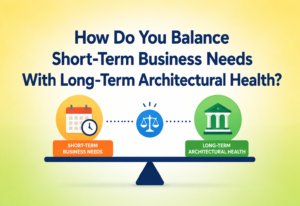
Just as with technical debt, the goal isn’t zero change or maximum change — it’s managed change. Adopting everything new burns a team out chasing trends; adopting nothing new eventually leaves a team unable to hire, unable to scale, and stuck maintaining tools the rest of the industry has moved past.
It helps to think of every engineering team as having a finite amount of change capacity in any given quarter — not unlike a household budget. Spend it all on one large, high-risk bet, and there’s little room left to absorb an unrelated surprise, like an urgent security patch or an unplanned scaling emergency. Spend none of it, and the team slowly drifts out of step with the rest of the industry, making the eventual, unavoidable catch-up migration far more painful than it would have been if handled gradually. Architects who explicitly track and discuss this change capacity — rather than treating each new proposal as an isolated decision — make noticeably better sequencing choices about which technology to pitch now, and which to deliberately delay until the team has more room to absorb it.
Advantages of adopting early
- Solves a real, currently-felt pain point directly.
- Improves hiring — engineers want to work with modern tools.
- Can be a genuine competitive advantage in speed or reliability.
- Prevents the team from falling behind the wider ecosystem.
Disadvantages if adopted carelessly
- Team pays a temporary productivity tax while learning.
- Smaller community means fewer answers when something breaks.
- Immature tooling can hide operational surprises until production.
- Risk of a second, half-finished migration if the first attempt is abandoned.
The trade-off triangle, applied to adoption
Every adoption decision balances capability (what the new technology unlocks), risk (how well-proven it is), and cost (time and effort to migrate and retrain). A proposal that maximizes capability while ignoring risk and cost is a pitch, not a plan — and experienced teams can tell the difference immediately.
A team evaluating a new frontend framework might genuinely love its developer experience, but if the current application has 200,000 lines of code in the existing framework and only three engineers know the new one well, the honest trade-off analysis may conclude: adopt it for new, isolated projects first, and revisit a full migration only after the team has built real production experience with it.
A simple decision framework · the three-question test
When deciding whether a technology is even worth pitching, experienced architects run it through three quick questions before investing further time. First: does this solve a problem the team already feels, or one only I feel? Second: can I prove the benefit with a small, low-risk pilot rather than asking for faith up front? Third: if the pilot fails, is there a clear, cheap way back to where we started? A technology that fails any one of these three questions is usually not ready to be pitched yet — not because it’s a bad technology, but because the case for it isn’t yet strong enough to survive contact with a skeptical room.
Scrutinising the Vendor’s Benchmark Numbers
New technologies are almost always marketed with impressive benchmark numbers. Part of an architect’s job is scrutinizing those claims against the team’s actual workload, not the vendor’s ideal-case demo.

- Reproduce, don’t just cite — run the vendor’s benchmark yourself against representative data before repeating its numbers to anyone else.
- Test at realistic scale — a tool that performs beautifully with a thousand records may behave very differently at the team’s actual data volume.
- Check tail latency, not just averages — a new technology with a lower average latency but a much worse p99 can be a net negative for user experience, even though the headline number looks better.
- Understand the scaling ceiling — every technology has a point where it stops scaling linearly; know where that point is before committing to it as a long-term foundation.
A benchmark run on a vendor’s dedicated hardware, with tuned configuration and a favorable dataset shape, tells you what’s possible, not what your team will actually get on day one in your own environment. Architects who skip independent verification often discover the gap the hard way, in production, after the team has already committed.
Testing under realistic failure conditions, not just happy-path load
Raw throughput numbers describe the best case. A more revealing test asks how the technology behaves under stress: what happens when a dependency times out, when memory pressure builds, when the system receives ten times its expected load during a traffic spike? Many technologies that look excellent in a clean, controlled benchmark reveal awkward behavior under exactly these conditions — connection pools that don’t recover gracefully, queues that grow unbounded, retries that amplify rather than absorb a downstream slowdown. Architects who deliberately inject this kind of stress during the pilot, rather than only measuring calm-weather performance, uncover the issues that would otherwise surface for the first time in a real production incident.
What honest benchmark reporting looks like
| Metric | Vendor’s benchmark | Your reproduction on team’s data |
|---|---|---|
| Throughput (req/sec) | 50,000 | 18,400 (real payload sizes, real network) |
| p50 latency | 2 ms | 4.5 ms |
| p99 latency | 8 ms | 62 ms under simulated back-end slowdown |
| Memory footprint at load | “low” | 2.1 GB steady, 3.4 GB during traffic burst |
Numbers like these, presented honestly, are far more persuasive than the vendor’s headline figures — because they represent what the team will actually experience, not a marketing artefact.
How Well Understood Are the Failure Modes?
A new technology’s reliability isn’t just about whether it crashes — it’s about how well understood its failure modes are, and how much operational experience exists both inside and outside the company.
- Time in production elsewhere — how many companies, and for how long, has this technology run real production workloads, not just prototypes?
- Failure mode documentation — does the project have a clear, honest account of how it fails, or only marketing material about how well it performs?
- Community incident history — public post-mortems from other companies using the technology are one of the richest, most honest sources of reliability insight available.
- Team’s own operational experience — has anyone on the team actually operated this technology under real failure conditions, or only followed a tutorial?
Choosing a brand-new database with elegant syntax but only eight months of public production use is like choosing a bridge design that has never been stress-tested in a real earthquake. It might be perfectly fine — but an architect’s job is to know that it hasn’t yet been proven, and to plan the rollout accordingly, rather than assuming maturity that doesn’t yet exist.
The maturity spectrum · bleeding, leading, and trailing edge
It helps to place any candidate technology on a rough maturity spectrum rather than treating “mature” as a yes-or-no label.
Bleeding edge
Exciting but genuinely risky — few production deployments exist, and the team would be among the first to discover its failure modes. Reserve these bets for narrow, low-stakes parts of the system where the team can absorb occasional stumbles without wider impact.
Leading edge
Real production track record at other companies, active maintenance, and a growing community, but hasn’t yet become an industry default. Mature enough to trust, new enough to still offer a real advantage — the sweet spot for most successful adoption decisions.
Trailing edge
Thoroughly proven, boring, and well-documented, but may be approaching the end of its useful life as newer alternatives emerge. Choosing this deliberately is sometimes right; drifting into it accidentally rarely is.
Most successful adoption decisions target the leading edge deliberately, while bleeding-edge bets are reserved for genuinely exceptional, well-understood upside in a well-bounded blast radius.
Making Security a First-Class Evaluation Axis
Security deserves separate, explicit evaluation in any adoption proposal, because a technology that is fast and reliable but insecure can create risk that outweighs every other benefit combined.
- Vulnerability disclosure history — how quickly has the project historically patched reported security issues?
- Default configuration safety — does the technology default to secure settings, or does it require careful, easy-to-miss hardening?
- Dependency footprint — how many third-party packages does adopting this technology pull in, and how well are those maintained?
- Compliance fit — does the technology support the audit, encryption, and access-control requirements the organization is already obligated to meet?
Treating a security review as a final rubber stamp after the technology decision has already effectively been made. Security evaluation belongs in the comparison matrix from day one, not as an afterthought that can only say “no” once everyone is already emotionally committed.
Involving security early, not asking for forgiveness later
Some of the most painful adoption failures happen when a team runs a technically excellent pilot, builds real enthusiasm, and only then discovers — during a pre-launch security review — that the new technology can’t meet a compliance requirement the team wasn’t tracking. Involving a security reviewer as an early stakeholder, even briefly, during the proposal stage rather than the launch stage, is one of the cheapest risk-reduction steps an architect can take. It costs a short conversation up front; skipping it can cost the entire pilot’s momentum months later.
Threat modelling the change itself, not just the technology
A subtler point is that the migration introduces its own transitional security exposure that architects should model deliberately: dual-running systems may briefly expose data through two different paths, feature flags may leak state to unauthorized callers, and rollback procedures may need to reason about credentials and secrets that lived only in the new system. Explicitly walking a security reviewer through these transition-time risks — not just steady-state operation of the new technology — is what separates a professionally handled migration from one where a security incident emerges from the cutover itself.
Success Metrics Agreed Before, Not After
A pilot without pre-agreed success metrics is just an opinion with extra steps. Before the pilot begins, the architect and the team should agree, in writing, on what “it worked” and “it didn’t work” actually look like.
| Metric category | What it tells you |
|---|---|
| Delivery speed | Did the team ship comparable work faster, slower, or the same during the pilot? |
| Defect rate | Did the new technology introduce more or fewer bugs than the equivalent work in the old stack? |
| Operational load | Did on-call burden or incident count change for the piloted service? |
| Developer sentiment | A short, honest survey of the pilot team — did they want to keep using it? |
| Cost | Infrastructure, licensing, and training cost, compared against the original estimate. |
Agreeing on success metrics before the pilot starts prevents the most common failure of technology politics: quietly redefining success after the fact to match whatever the data happened to show. A pre-agreed bar, met or missed in the open, is what earns lasting trust for the next proposal too.
Reporting negative results honestly
Not every pilot succeeds, and that’s a healthy, expected outcome of a well-run process — not a failure of the architect who proposed it. Reporting a pilot that missed its metrics clearly and honestly, rather than quietly shelving it or spinning the numbers, is one of the most credibility-building things an architect can do. It demonstrates that the entire evaluation process is trustworthy, which makes the next pilot’s positive results far more believable to a skeptical team.
The Costs You Won’t See Until Production
A technology that’s elegant to write code in but painful to deploy, monitor, and operate will quietly erode team goodwill no matter how good the pilot’s development-time metrics look.
- Does it fit existing CI/CD pipelines, or does it require an entirely new, parallel deployment toolchain?
- Does it integrate with existing observability tooling (logging, tracing, metrics dashboards), or does it need its own separate monitoring stack?
- What’s the on-call learning curve — can an engineer unfamiliar with the technology still debug a 3 a.m. incident using the runbook, or does it require the one person who introduced it?
- What’s the actual infrastructure cost at the team’s real scale, not the free-tier demo scale?
A team piloting a new stream-processing framework found that development was genuinely faster, but the framework required a separate, unfamiliar monitoring dashboard that didn’t integrate with the team’s existing Grafana setup. That operational gap — not the framework’s core functionality — became the deciding factor in delaying full adoption until proper integration work was funded.
The hidden cost of a second toolchain
Every additional technology a team adopts adds not just its own operational surface area, but a multiplicative cost: one more thing to patch, one more thing to back up, one more thing new hires need to learn, one more dashboard to check during an incident. This hidden cost rarely shows up in a technology’s own feature comparison, because it’s not really about the technology in isolation — it’s about the total operational complexity of the team’s entire stack. A proposal that’s honest about this multiplicative cost, and actively looks for ways to retire an old tool when adding a new one, earns far more trust than one that only ever adds without ever subtracting. Architects who make a habit of proposing a retirement alongside every addition tend to keep their team’s overall operational footprint roughly stable over time, rather than watching it grow, quietly and permanently, with every well-intentioned new tool.
Some engineering organizations adopt an explicit “one-in-one-out” discipline: no new tool is approved for wider rollout without a paired plan for what will be retired to make room for it. This forces honest discussion about whether the new technology is actually replacing something, or just accumulating alongside it.
Does It Play Well With Everything Else We Run?
A new technology rarely lives in isolation — it has to talk to everything the team already runs. Evaluating integration fit early prevents an unpleasant surprise late in the pilot.
- First-class client libraries — does it have well-maintained clients for the languages the team already uses in production?
- Coexistence during migration — can it live alongside the current system, or does it require an all-or-nothing cutover?
- Blurred service boundaries — a new tool that only works well if every microservice adopts it simultaneously is a much bigger commitment than one that can be introduced service by service.
A Java example · an adapter that lets old and new coexist
// A simple adapter interface lets the team run the old and new
// notification systems side by side during the pilot, with a
// feature flag deciding which implementation handles each request.
public interface NotificationSender {
    void send(Notification notification);
}

public class LegacyEmailSender implements NotificationSender {
    public void send(Notification notification) {
        legacyMailClient.dispatch(notification.toEmailPayload());
    }
}

public class NewEventDrivenSender implements NotificationSender {
    public void send(Notification notification) {
        eventPublisher.publish("notifications.send", notification.toEvent());
    }
}

// @Service
public class NotificationRouter {

    private final FeatureFlagClient flags;
    private final LegacyEmailSender legacySender;
    private final NewEventDrivenSender newSender;

    public void notify(Notification notification) {
        NotificationSender sender = flags.isEnabled("new-notification-pilot")
            ? newSender
            : legacySender;
        sender.send(notification);
    }
}
This pattern — an interface, two implementations, and a feature flag deciding which one runs — is one of the most reliable ways to pilot a new technology against real production traffic while keeping a one-flag rollback always available.
Preferring technologies that allow service-by-service adoption
When evaluating two otherwise similar technologies, the one that can be introduced one service at a time is almost always the safer organizational bet, even if the other has a marginally better feature set. A technology that requires every service to switch simultaneously turns a technical decision into a large-scale coordination problem across every team that owns an affected service — and coordination problems are consistently where ambitious migrations stall out, run over budget, or get abandoned partway through.
Martin Fowler’s “Strangler Fig” pattern is the classic name for this incremental strategy: new functionality grows around the old system like a strangler fig around a tree, replacing it piece by piece until eventually the old system can be removed — without ever requiring a scary big-bang cutover.
Adoption Patterns & Anti-patterns
Patterns that make adoption succeed
| Pattern | How it helps |
|---|---|
| Canary pilot | Route a small slice of real traffic to the new technology before a full rollout. |
| Feature-flagged dual running | Run old and new implementations side by side, switchable instantly if something goes wrong. |
| Internal tech talks | Let the pilot team present real results directly to peers, in their own words. |
| Documented runbooks | Ensure any engineer, not just the champion, can operate the new technology during an incident. |
| Time-boxed trial periods | Set a clear review date up front, so the decision doesn’t drift indefinitely. |
Anti-patterns that sink adoption efforts
Resume-driven development
- Choosing a technology because it looks good on a résumé, not because it solves the team’s actual problem.
The mandate from above
- Leadership announcing a switch with no pilot, no champion buy-in, and no rollback plan, relying purely on authority to force compliance.
The silent champion
- One engineer quietly building deep expertise in the new tool without documenting or teaching it, creating a single point of knowledge failure even as adoption grows.
The never-ending pilot
- A trial with no review date, which drifts on for a year without ever being formally evaluated or decided on, quietly becoming permanent, undocumented architecture.
The Canary Pilot and Feature-Flagged Dual Running patterns exist specifically as the answer to the Mandate From Above anti-pattern — they let a team experience the new technology’s benefits directly, on real work, rather than being told to trust it on faith.
The “boring technology” counter-pattern
Not every good architectural decision is about adopting something new. Engineer Dan McKinley’s widely cited essay on “choosing boring technology” argues that every team has a limited budget of innovation tokens to spend, and spending them all at once — a new database, a new language, and a new deployment platform in the same quarter — multiplies risk far more than it multiplies benefit. A mature adoption strategy sometimes means actively arguing against a new technology, not because it’s bad, but because the team’s innovation budget is better spent elsewhere this quarter. Knowing when to say “not yet, and here’s why” is as much a part of this skill as building a persuasive case for “yes.”
The Checklist & the Common Mistakes
Best practices checklist
- Start from a real, felt pain point — never from “this looks interesting.”
- Build a working proof of concept before pitching anyone, using the team’s real code and data where possible.
- Name the risks yourself, before skeptics do, and bring answers, not just awareness.
- Propose a bounded pilot with a defined scope, timeline, and review date — never an open-ended or all-or-nothing rollout.
- Agree on success metrics in advance, in writing, before the pilot begins.
- Recruit a genuine skeptic into the pilot team; a skeptic who becomes convinced is far more persuasive than any number of already-enthusiastic supporters.
- Document everything — runbooks, onboarding guides, and decision records — so adoption doesn’t depend on one person’s memory.
Common mistakes to avoid
- Leading with enthusiasm instead of evidence — excitement reads as bias to a skeptical audience, however genuine it is.
- Comparing the new technology’s best case to the old technology’s worst case — an unconsciously unfair comparison that experienced engineers spot immediately.
- Skipping the rollback plan — a proposal with no visible exit door will always feel riskier than it needs to, even when the risk is genuinely low.
- Declaring victory before measuring — announcing success based on gut feeling rather than the metrics agreed on at the start of the pilot.
- Forcing a full-team rollout immediately after a successful small pilot — success at small scale doesn’t automatically prove success at full scale; expand gradually and keep measuring.
A lightweight technology radar
Many organizations formalize this entire process into a recurring, lightweight practice often called a “technology radar” — a periodically updated, shared document that categorizes technologies the organization is watching, trialing, adopting, or deliberately retiring. This gives every proposal a natural home: a new idea starts in “assess,” moves to “trial” once a bounded pilot is approved, and only reaches “adopt” after measured evidence supports it. Keeping this radar visible to the whole engineering organization turns technology adoption from a series of one-off political battles into a shared, predictable, and far less exhausting process.
| Ring | Meaning | Typical action |
|---|---|---|
| Assess | Interesting; worth understanding, no commitment yet. | Read, watch talks, follow the community. |
| Trial | Actively being piloted in a bounded, low-risk part of the system. | Run the bounded pilot; measure honestly. |
| Adopt | Proven internally; recommended for new work in appropriate use cases. | Document, train, standardize. |
| Hold | Discouraged; don’t start new work here, plan retirement. | Freeze new use; migrate existing usage over time. |
How Big Companies Actually Rolled Things Out
Netflix and Cassandra · a slow, evidence-driven migration
Netflix’s move from relational databases to Apache Cassandra for many services wasn’t an overnight mandate. Engineers ran extensive internal benchmarking and reliability testing, migrating service by service over an extended period, with each migration building the evidence and internal expertise needed for the next — a textbook example of the bounded-pilot, measure-then-expand approach.
Airbnb and React · bottom-up, champion-driven adoption
Airbnb’s adoption of React in its early years grew from engineers experimenting on smaller, lower-risk parts of the product before it became the standard for new frontend work. The technology earned its adoption through visible, in-house success stories rather than a leadership mandate handed down before anyone had proven it out internally.
Uber and Go · solving a specific, felt performance problem
Uber’s adoption of the Go programming language for parts of its backend grew out of a specific need — high-throughput, low-latency services under massive geographic scale — rather than general enthusiasm for a new language. Teams that had a concrete performance problem Go was well-suited to solve adopted it first, and its use spread from those proven, high-visibility wins.
LinkedIn and Kafka · built internally, proven internally, then open-sourced
Kafka is one of the most striking examples of technology adoption done right: it was built at LinkedIn specifically to solve LinkedIn’s own real-time data pipeline problems, proven extensively in LinkedIn’s own production environment over years, and only after that internal validation did it spread — first across LinkedIn’s other teams, and eventually across the entire industry as an open-source project.
Shopify and Ruby on Rails · proving boring choices still scale
Shopify’s long-running commitment to Ruby on Rails, even as the company grew to handle massive global commerce traffic, is a useful counterexample to the assumption that scale always demands a technology rewrite. Rather than abandoning their existing stack for a trendier alternative, Shopify’s engineers invested heavily in scaling the architecture around Rails — sharding, caching, and modularizing a large codebase — demonstrating convincingly, with production evidence, that the existing technology could still meet the team’s needs. This is itself a form of successful “adoption” pitch: convincing a large organization to invest in evolving what it already has, backed by the same kind of rigorous evidence this guide has described throughout.
Every one of these examples shares the same pattern: the technology solved a real, specific, already-felt problem; it was proven on a small, bounded slice of real work first; and its reputation spread through visible internal success stories rather than a directive from above.
Wrap-Up & What to Remember
Frequently Asked Questions
What if leadership just wants to mandate the new technology immediately?
Push, respectfully, for at least a small bounded pilot with agreed success metrics before a full mandate. A mandate with no evidence behind it tends to produce compliance without genuine buy-in, which quietly resurfaces as resistance, workarounds, or attrition later.
How long should a pilot run before deciding?
Long enough to see the technology under real, varied conditions — commonly 4 to 12 weeks depending on the technology’s complexity — but with a firm review date set in advance so the pilot doesn’t drift indefinitely without a decision.
What if the pilot results are mixed, not clearly good or bad?
Mixed results are common and valuable — they often point to a narrower, better-fit use case than the original broad proposal. Consider adopting the technology for the specific scenario where it clearly won, rather than forcing an all-or-nothing decision on ambiguous data.
How do you handle a team member who refuses to engage with the pilot at all?
Understand what specifically they’re worried about — it’s often a legitimate concern rather than pure stubbornness. Involving them in defining the success metrics, rather than just the results, often turns resistance into genuine (if cautious) participation.
Is it ever right to adopt a technology without a pilot?
Occasionally — for very low-risk, easily reversible tools (a new linter, a new local development utility) a full pilot process is overkill. The rigor described in this guide should scale with the blast radius of the decision, not be applied uniformly to every tool choice.
What if a competitor is already using the new technology successfully?
External evidence is useful context, but it’s rarely sufficient on its own — a competitor’s team, workload, and constraints are never identical to yours. Treat competitor adoption as a signal worth investigating, not as proof, and still run your own bounded pilot before committing.
Summary
Convincing a team to adopt new technology is, at its core, a practice of earning trust through evidence rather than demanding it through authority. It starts by listening for pain the team already feels, proceeds through a small, low-risk spike that answers the architect’s own doubts first, and culminates in a bounded pilot with metrics agreed in advance and a rollback plan visible from day one. Along the way, the architect explicitly considers performance (verified against the team’s own workload, not the vendor’s demo), reliability (measured by where on the maturity spectrum the technology sits), security (invited to the table early, not asked to rubber-stamp at the end), operational overhead (including the multiplicative cost of every additional tool), and integration fit (favouring technologies that allow service-by-service adoption over all-or-nothing cutovers). The most successful adoption stories in industry — Netflix and Cassandra, Airbnb and React, Uber and Go, LinkedIn and Kafka, Shopify and Rails — all share the same shape: a specific, felt problem; a small, proven slice of real work; and reputation spreading through visible internal success rather than a directive from above.
Key Takeaways
- Technical persuasion is a distinct skill from technical evaluation — the best technology doesn’t automatically win; the best-evidenced, best-communicated proposal does.
- Start from a real, already-felt pain point, not from personal enthusiasm for a new tool.
- Build a working proof of concept and reproduce vendor benchmarks independently before pitching anyone.
- Name the room’s real objections yourself, and answer them with a concrete migration and rollback plan.
- Propose a small, bounded, time-boxed pilot with metrics agreed in advance — never an all-or-nothing mandate.
- Recruit genuine skeptics into the pilot; their conversion is far more persuasive than pre-existing enthusiasm.
- Tailor the pitch to the audience: engineers want evidence and mechanics; leadership wants cost, risk, and timeline.
- Companies like Netflix, Airbnb, Uber, LinkedIn, and Shopify all grew technology adoption from small, proven, internal wins — never from a mandate handed down before the evidence existed.
- Trust is compounding — each honest, measured pilot deposits credibility that pays dividends on every future proposal.