RELIABILITY · INCIDENT REVIEW · CULTURE
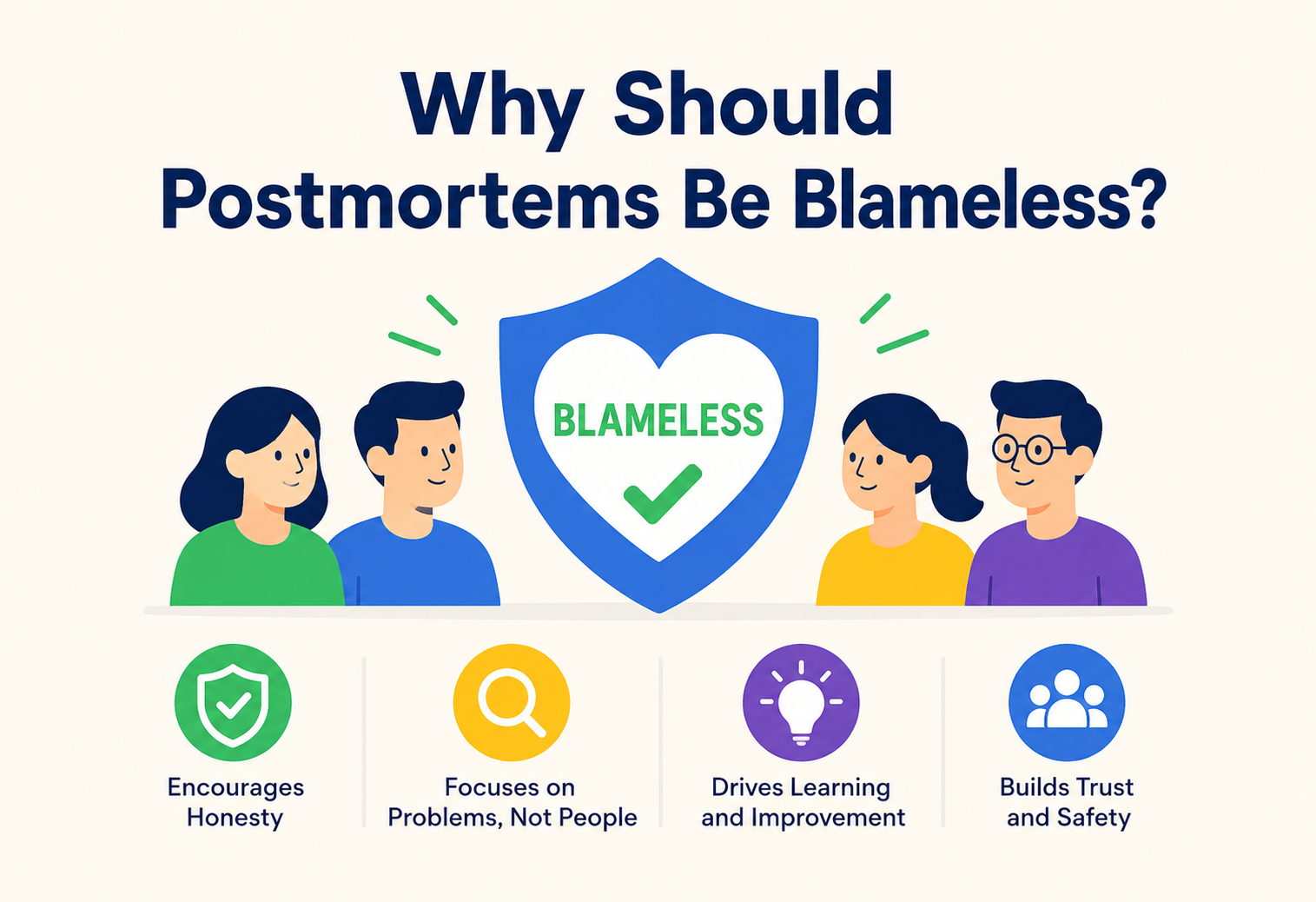
Why Should Postmortems Be Blameless?
A ground-up walkthrough of blameless postmortems — what they are, why blame quietly destroys reliability, and how to run a process that turns every failure into a system upgrade instead of a performance review.
01 · INTRODUCTION & HISTORY
From Cockpit Voice Recorders To Site Reliability Reviews
Imagine something breaks at work. Maybe a website goes down. Maybe a payment fails for thousands of customers. The first question almost every human being asks — instinctively, within seconds — is: “Who did this?” It is one of the oldest reflexes we have. It is also, as you will learn in this guide, one of the most expensive habits an engineering organisation can keep.
This guide is about a different question that mature engineering teams learn to ask instead: “What, in our system, made it possible for one person’s honest action to cause this much damage?” That single shift in questioning is the entire idea behind a blameless postmortem, and it is one of the highest-leverage cultural practices in modern software engineering.
What is a postmortem, in plain words?
A postmortem (sometimes called an “incident review,” “retrospective,” or at Amazon a “Correction of Error” document) is a written record and a team conversation that happens after something goes wrong — an outage, a data-loss event, a security breach, a bad deployment, a missed deadline. Its job is simple: figure out what happened, why it happened, and what the team will change so it is less likely to happen again.
The word itself is borrowed from medicine. A post-mortem examination is what a coroner performs on a body after death, to determine the cause. Engineers borrowed the metaphor because a postmortem examines a “dead” system state — a service that crashed, a pipeline that failed — to determine the cause of death, except instead of a body, we are examining logs, timelines, and decisions.

Think of a plane crash. Aviation investigators do not walk up to the pilot and say “you’re fired, this was your fault.” They pull the black box, reconstruct the last minutes of the flight second by second, and ask: what did the pilot see on their instruments? What did air traffic control tell them? Was the warning light broken? Was the manual confusing? The goal is never to punish the pilot (who, in almost every case, is already dead or traumatised) — the goal is to make sure the next pilot, in the same situation, does not crash. Aviation safety improved more in seventy years than almost any other industry precisely because of this blameless investigative culture, formalised long before software engineering ever existed.
A short history
The blameless postmortem did not start in Silicon Valley — it was borrowed from decades of research in high-risk industries where the cost of failure is measured in lives, not dollars:
Aviation safety
After WWII, aviation built “black box” flight recorders and no-blame incident reporting systems (like the modern NASA Aviation Safety Reporting System), because pilots would hide near-misses if reporting meant punishment. Removing blame increased reporting, and more reporting caught problems before they became crashes.
Three Mile Island
Investigators found operators had made reasonable decisions given confusing instrument readouts — the panel design itself, not operator stupidity, was a root cause. This planted an idea: bad outcomes are often produced by good people operating inside bad systems.
Healthcare patient safety
Hospitals adopted “Root Cause Analysis” and “Morbidity and Mortality” conferences, moving away from blaming individual doctors toward examining systemic gaps — understaffing, unclear protocols, poor handoffs.
Sidney Dekker & Just Culture
A human-factors researcher who studied airline and hospital accidents formalised the theory behind blameless reviews: humans do not wake up wanting to cause failure; failure is almost always the visible tip of deeper systemic issues.
Software & SRE adoption
Google’s SRE team, and later Etsy, Netflix, and Amazon, explicitly imported this thinking into software operations. Etsy’s John Allspaw is widely credited with popularising the term “blameless postmortem” in tech around 2012. Google later dedicated an entire chapter of its influential Site Reliability Engineering book (2016) to postmortem culture.
So when you hear “blameless postmortem” in a software team today, you are hearing the latest chapter of a much older story: an idea proven across aviation, nuclear power, and medicine, now applied to the servers, databases, and deployments that run modern digital life.
02 · THE PROBLEM & MOTIVATION
What Blame Actually Costs An Engineering Team
To understand why blameless postmortems matter, you first have to understand what happens without them. Picture a normal engineering team that has never adopted this practice.
The blame spiral
Something breaks. A director asks “whose change caused this?” An engineer named Priya is identified as the person who pushed the change that triggered the outage. In a blame-oriented culture, here is what typically happens next:
- Priya is publicly (or semi-publicly) named as the cause.
- Priya becomes defensive. Her instinct shifts from “help fix this” to “protect myself.”
- Other engineers who saw warning signs earlier, but did not speak up, stay quiet — speaking up now would mean admitting they also share some responsibility.
- The postmortem document is written carefully to avoid naming names, which means it is vague about what actually happened.
- Action items focus on “retrain the engineer” or “be more careful next time” instead of fixing the system.
- Six months later, a different engineer makes a similar mistake, because the underlying system flaw was never fixed — only papered over with a warning to “be careful.”
Blame does not prevent the next incident. It only makes people better at hiding the next incident until it is too big to hide.
Why humans hide information under blame
This is not a moral failing of engineers — it is basic human psychology, and it has been measured repeatedly in workplace research. When people believe that honesty about a mistake will be punished (with firing, public shaming, a bad performance review, or even just visible embarrassment in front of peers), they rationally protect themselves by:
- Omitting details that might make them look bad.
- Waiting to see if anyone notices before reporting an issue.
- Rounding the truth in whichever direction reduces personal exposure.
- Avoiding risky-but-necessary work altogether (nobody wants to be the one who touches the scary legacy system).
This creates a silent tax on the entire organisation: the people with the most detailed knowledge of what actually went wrong — the engineers who were paged, who typed the commands, who saw the graphs spike — become the least willing to share that knowledge in full. The organisation ends up trying to fix systems using an incomplete, defensively-edited version of the truth.
The motivation for blameless postmortems
Blameless postmortems exist to solve exactly this problem. The motivation is not about being “nice” to engineers for its own sake — it is a hard-nosed engineering strategy: you cannot fix what people are afraid to fully describe. By removing personal risk from honest disclosure, you unlock the complete picture of what happened, which is the only raw material from which a real fix can be built.
What blamelessness unlocks
- Engineers describe what actually happened, not the sanitised version.
- Near-misses get reported early, before they become disasters.
- Root causes are debated openly, not tiptoed around.
- Institutional knowledge accumulates across incidents.
What blame quietly costs
- Truth gets rounded off in the direction of self-protection.
- Near-misses are hidden until they escalate.
- Fixes target people, not the system — guaranteeing recurrence.
- Best engineers quietly leave teams that publicly blame.
Imagine two kids break a vase playing in the living room. In House A, the parent yells “WHO DID THIS?” and whoever admits it gets punished. Next time something breaks, both kids will hide it, blame the dog, or blame each other — the parent will never learn the coffee table is wobbly and keeps knocking things over. In House B, the parent says “accidents happen, let’s figure out what happened so we can prevent it” — and the kids explain that they were chasing each other because the rug keeps sliding on the tile floor. Now the parent can put down a rug grip pad, and the real cause (a slippery rug, not “bad kids”) gets fixed permanently.
03 · CORE CONCEPTS
The Vocabulary You Will See In Every Review
Before going further, let us define every important term you will need, in plain English. Each of these will come up again later in the guide.
Blameless
What: An approach to reviewing failures that separates “what happened and why” from “who should be punished.” Why: Because punishment suppresses honest information, and honest information is what prevents recurrence. Where it is used: Incident reviews, postmortems, retrospectives, safety investigations. Analogy: A doctor asking “what symptoms led to this diagnosis” rather than “whose fault is this illness.”
Root cause vs. proximate cause
The proximate cause is the immediate, visible trigger — “the engineer ran a command that deleted the production table.” The root cause is the deeper systemic condition that made that trigger possible or damaging — “there was no confirmation prompt before destructive commands, and there was no automated backup restore tested in the last year.” Blameless postmortems insist on digging past the proximate cause (a person’s action) to the root cause (a system gap).
Symptom: site is down. Proximate: bad config pushed to prod. Deeper: no staging validation step existed. Root: the deploy pipeline allows unreviewed config changes to reach production. Only the last one is worth fixing — everything above it is a downstream consequence.
Human error vs. systems thinking
Human-error framing treats a mistake as the final explanation: “the engineer typed the wrong command.” Systems thinking treats human error as the starting point of investigation, not the ending point, asking: why did the system allow that command to be typed without safeguards? Why did nothing catch it before it reached production? Modern reliability engineering strongly favours systems thinking, because humans are a fixed variable (they will always occasionally slip, misread a screen, or be tired) while systems are a variable you can actually redesign.
Psychological safety
What: A shared belief within a team that no one will be punished or humiliated for speaking up with ideas, questions, concerns, or mistakes. Why it matters here: Amy Edmondson’s landmark Harvard research found that the highest-performing hospital teams reported more errors, not fewer — not because they made more mistakes, but because they felt safe admitting them, which is a prerequisite for fixing them. Google’s own internal “Project Aristotle” study of what makes teams effective found psychological safety was the single strongest predictor of team performance, ahead of skill or experience.
Just Culture
What: A middle position between “blame everyone” and “blame no one, ever.” Just Culture (a term from Sidney Dekker’s research) distinguishes between honest mistakes (which should never be punished) and genuinely reckless or malicious behaviour (which still needs accountability). This is an important nuance covered in depth in Chapter 12.
Corrective Action Items (a.k.a. CAPs)
What: Concrete, assigned, trackable engineering or process changes that come out of a postmortem, meant to reduce the chance or blast radius of recurrence. Example: “Add a confirmation step to the delete-table script, owner: Priya, due: next sprint” — note this fixes the tool, not the person.
Blast radius
What: How much damage an incident actually caused — how many users affected, how much data lost, how much revenue impacted, how long the outage lasted. Postmortems study blast radius to understand both the raw severity of an incident and to evaluate whether safeguards (like rate limiting or canary deployments) successfully contained a problem that could have been much worse.
Timeline reconstruction
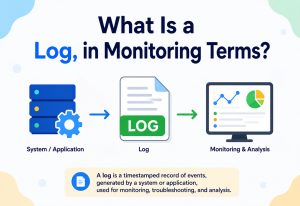
What: A minute-by-minute (sometimes second-by-second) factual account of what happened, built from logs, alerts, chat transcripts, and deploy records — before anyone adds interpretation or analysis. This is the “black box recording” step of a postmortem.
Five Whys
What: A simple technique (originating from Toyota’s manufacturing system) where you ask “why” repeatedly — typically five times — to walk from a surface symptom down to a systemic root cause. Covered in full with an example in Chapter 5.
Blameless
Separates cause from culprit; the review targets systems, not people, in its language and its follow-up.
Root cause
The systemic condition that made the incident possible — not the visible trigger someone happened to pull.
Psychological safety
The team-level belief that admitting a mistake is safer than hiding one — without it, blameless is impossible.
Just Culture
Distinguishes honest error from at-risk behaviour from recklessness — each treated differently, but always investigated systemically.
Timeline
Factual, timestamped account built first — before analysis contaminates the facts.
Five Whys
Repeated “why” questioning that structurally walks the discussion away from a person and toward a system.
Blast radius
How much damage actually occurred — measured, not felt.
Action items
Concrete, owned, dated fixes to a tool or process — never “be more careful.”
04 · ARCHITECTURE & COMPONENTS
A Postmortem Process Is A Small System In Its Own Right
A mature blameless postmortem process is not just “a meeting.” It is a small system with well-defined components, each with a specific job, much like a piece of software has services, data stores, and interfaces. Let us walk through the pieces.
The components
| Component | Role | Software analogy |
|---|---|---|
| Incident Commander (IC) | Owns the live incident response; coordinates people, not necessarily the person fixing the bug | Orchestrator / scheduler process |
| Postmortem Facilitator | Runs the review meeting neutrally; enforces blameless norms; is often not someone directly involved in the incident | Load balancer — routes conversation fairly, does not take sides |
| Postmortem Document / Template | Structured written record: summary, timeline, impact, root cause, action items | A standardised data schema / API contract |
| Timeline | Objective, timestamped sequence of events, alerts, and human actions | An event log / audit trail |
| Severity Rating (SEV1–SEV4) | Classifies how serious the incident was, driving how deep the review needs to go | Log level (ERROR vs WARN vs INFO) |
| Action Item Tracker | System (often a ticketing tool like Jira) that stores, assigns, and follows up on fixes | A task queue with retry/expiry logic |
| Postmortem Review Board / Ops Review | A recurring cross-team meeting where postmortems are read out, patterns across incidents are spotted | An aggregator / dashboard service pulling from many event logs |
| Knowledge Base | Searchable archive of past postmortems so future engineers can learn from history | A long-term data warehouse |
The postmortem document, section by section
Almost every mature engineering org (Google, Etsy, Atlassian, PagerDuty, Amazon) converges on a broadly similar document shape:
- Summary: Two or three sentences — what broke, for how long, who was affected.
- Impact: Quantified damage — users affected, revenue lost, SLA breached, data integrity impact.
- Timeline: Chronological, timestamped, factual — no blame language, no adjectives like “carelessly.”
- Root cause analysis: Often using Five Whys or a fishbone (cause-and-effect) diagram.
- What went well: Yes — genuinely. What monitoring caught this fast? What runbook helped?
- What went poorly: Honest, systemic framing — not “Priya’s mistake” but “our rollback process took 40 minutes because it required manual SSH access.”
- Where we got lucky: An underrated section — near-misses that could have been much worse, an early warning of latent risk.
- Action items: Specific, owned, dated, and trackable to closure.
Google’s SRE book publishes an actual internal postmortem template that includes a field literally titled “Where we got lucky” — because a near-miss that almost caused a much bigger disaster is treated as equally valuable data as the disaster itself. This reflects a deep architectural principle: the document is designed to extract maximum learning value, not to assign a verdict.
Modelling the components in code
Below is a simplified Java model of a postmortem system’s core data structures. This is not meant to be a production framework — it is a teaching example showing how the concepts above map to real data structures a team might build into an internal tool.
// A single incident, tracked from detection through resolution.
public class Incident {
    private final String id;
    private final String title;
    private Severity severity;
    private Instant detectedAt;
    private Instant resolvedAt;
    private final List<TimelineEvent> timeline = new ArrayList<>();
    private String incidentCommander;

    public Incident(String id, String title, Severity severity) {
        this.id = id;
        this.title = title;
        this.severity = severity;
    }

    public void recordEvent(String actor, String description, Instant when) {
        // Notice: we store WHAT happened and WHEN,
        // never a judgment like "actor made an error".
        timeline.add(new TimelineEvent(actor, description, when));
    }

    public Duration timeToResolve() {
        if (resolvedAt == null) return null;
        return Duration.between(detectedAt, resolvedAt);
    }
}

// A factual, timestamped entry — the raw material of the timeline.
public class TimelineEvent {
    private final String actor;       // "PagerDuty", "Priya", "deploy-bot"
    private final String description; // factual, no adjectives
    private final Instant when;

    public TimelineEvent(String actor, String description, Instant when) {
        this.actor = actor;
        this.description = description;
        this.when = when;
    }
}

public enum Severity { SEV1, SEV2, SEV3, SEV4 }// The postmortem document itself — deliberately separates
// factual sections from analysis sections from action items.
public class Postmortem {
private final Incident incident;
private String summary;
private String impactDescription;
private List<String> whatWentWell = new ArrayList<>();
private List<String> whatWentPoorly = new ArrayList<>();
private List<String> rootCauses = new ArrayList<>();
private List<ActionItem> actionItems = new ArrayList<>();
public Postmortem(Incident incident) {
this.incident = incident;
}
public void addActionItem(ActionItem item) {
// Every action item MUST target a system, process,
// or tool -- never a person's behavior alone.
if (item.getDescription().toLowerCase().contains("be more careful")) {
throw new IllegalArgumentException(
"Action item is not systemic enough. Redesign the fix.");
}
actionItems.add(item);
}
}
public class ActionItem {
private final String description;
private final String owner;
private final LocalDate dueDate;
private ActionItemStatus status = ActionItemStatus.OPEN;
public ActionItem(String description, String owner, LocalDate dueDate) {
this.description = description;
this.owner = owner;
this.dueDate = dueDate;
}
public String getDescription() { return description; }
}
public enum ActionItemStatus { OPEN, IN_PROGRESS, DONE, WONT_FIX }In Postmortem.addActionItem(), the code actively rejects action items phrased as “be more careful,” because that phrasing pushes the fix back onto human willpower — which does not scale and does not survive someone leaving the team. A real fix changes a tool, a default, a permission, or a process.
05 · INTERNAL WORKING — RUNNING THE MEETING
What A Well-Facilitated Review Actually Looks Like
Let us go inside an actual blameless postmortem meeting and see, step by step, how a well-run one differs from a poorly-run one.
Step 1 — Facilitator sets norms explicitly, out loud
A good facilitator opens with something like: “This meeting isn’t about who to blame. Assume everyone involved made reasonable decisions given what they knew at the time. Our job today is to understand the full picture and fix the system.” This sounds small, but saying it out loud, every time, resets the psychological frame for the room.
Step 2 — Walk the timeline together, facts only
The group reconstructs, minute by minute: when did the first alert fire? Who got paged? What did they see on their dashboard? What command did they run, and why did it seem like the right call at that moment? The facilitator actively blocks blame-coded language (“well, obviously someone should have checked…”) and redirects it to neutral, factual phrasing.
Step 3 — Ask “why” repeatedly (Five Whys)
The group does not stop at the first explanation. They dig with repeated “why” questions until they hit something they can actually change.
Q0. Why did the site go down?
A0. A bad config was deployed to production.

Q1. Why did the bad config reach production?
A1. The config passed CI because CI doesn't validate config files.

Q2. Why doesn't CI validate config files?
A2. Config validation was scoped out of the CI project two years ago.

Q3. Why was it scoped out?
A3. The team was under deadline pressure and treated configs as low-risk.

Q4. Why were configs treated as low-risk despite controlling production behaviour?
A4. --> ROOT CAUSE: No risk-classification process exists for config changes.
Notice the destination: the root cause is a missing process (risk classification for config changes), not “the engineer who wrote the config.” That is the entire point of the technique — it structurally walks you away from a person and toward a system.
Step 4 — Separate “what went poorly” from “who did poorly”
A skilled facilitator constantly translates blame-flavoured statements into system-flavoured ones in real time. For example:
| Blame-flavoured (redirect this) | System-flavoured (aim for this) |
|---|---|
| “Priya should have double-checked before running that command.” | “The command had no dry-run mode and no confirmation prompt for destructive operations.” |
| “The on-call engineer was too slow to respond.” | “Our alert routing took 12 minutes to escalate from the first responder to someone with the right access.” |
| “Whoever wrote this code didn’t think about edge cases.” | “Our code review checklist doesn’t currently prompt reviewers to consider null / empty inputs.” |
Step 5 — Generate action items, assign owners, set dates
Every “what went poorly” line should map to at least one concrete action item. Vague action items (“improve monitoring”) get pushed back on immediately by a good facilitator, in favour of specific ones (“add a P99 latency alert on the checkout service, threshold 800ms, owner: Marco, due: Aug 5”).
Step 6 — Close with “what went well” and “where we got lucky”
This is not a courtesy — it is data. Understanding what monitoring, runbook, or team behaviour worked well is just as important for reinforcing good patterns as finding what did not.
“Assume everyone involved made reasonable decisions given what they knew at that moment. Our job now is to understand the moment, not judge it.”
06 · DATA FLOW & LIFECYCLE OF AN INCIDENT
One Incident, Eight Stages, Two Feedback Loops
A blameless postmortem does not exist in isolation — it is one stage in a larger lifecycle that starts the moment something goes wrong and ends (ideally) with a permanently improved system.
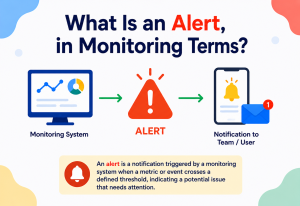
Detection
An alert fires, a monitor tips over, or a user reports a problem. This is the moment the clock starts.
Triage & Severity
Responders confirm the incident is real and classify it (SEV1–SEV4). Severity will drive how deep the review needs to go.
Incident Response
An Incident Commander coordinates people, communication, and the fix — separating “keep the room calm and organised” from “actually type the commands.”
Mitigation / Resolution
Service is restored, whether by rollback, failover, restart, or emergency patch. Users stop being affected.
Postmortem Drafting
Timeline + impact are written up while memories are fresh — typically within a few days of resolution.
Blameless Review Meeting
The team walks the timeline together, digs for root causes, and generates specific action items with owners and due dates.
Action Item Tracking
Fixes are treated like any other engineering ticket — implemented, reviewed, and verified in production.
Knowledge Base Archive
The finished postmortem is filed in a searchable archive so future engineers — and pattern-detection across many incidents — can learn from it.
Notice the two feedback loops shown in Fig 1 above. This is the whole point: a blameless postmortem is not a dead-end report that gets filed and forgotten. It is designed to loop back and change future behaviour — both by fixing the specific system gap (preventing a repeat of this exact incident) and by improving the triage / detection process itself as the organisation accumulates pattern knowledge across many incidents.
Why blamelessness has to be present at every stage, not just the meeting
A common mistake is treating “blameless” as a rule that only applies during the review meeting. In reality, if engineers believe that anything said during live incident response (step 3) or in the initial Slack thread (step 1) could later be used against them in a performance review, they will hedge their language even in the moment they need to be most direct and honest. Blamelessness has to be a standing organisational guarantee, not a meeting-room mood.
Severity classification drives depth
Not every incident needs the same depth of review. Most orgs scale the process to the severity:
| Severity | Typical impact | Review depth |
|---|---|---|
| SEV1 | Full outage, data loss, major revenue / safety impact | Full written postmortem + cross-team review meeting + exec visibility |
| SEV2 | Partial outage, degraded performance for many users | Written postmortem + team-level review meeting |
| SEV3 | Minor, contained impact, quick fix | Lightweight postmortem, async written summary |
| SEV4 | Near-miss, no user impact, caught internally | Optional short note, still logged for pattern tracking |
07 · ADVANTAGES, DISADVANTAGES & TRADE-OFFS
What The Practice Buys You — And What It Costs
Advantages
- More complete, honest information: Engineers describe what actually happened, including the near-misses and judgment calls, instead of the sanitised version.
- Fixes address root causes, not symptoms: Because the process forces you past “human error” to systemic causes, the fixes are durable.
- Faster incident response over time: Engineers report problems and near-misses earlier, before they escalate, because reporting is not dangerous.
- Better retention and morale: Engineers do not quietly leave a team after being publicly blamed for a systemic failure.
- Institutional memory: A searchable archive of well-written blameless postmortems becomes an onboarding and training resource — new engineers learn the org’s real failure modes.
- Cross-team pattern detection: When postmortems are honest and detailed, leadership can spot recurring systemic weaknesses (e.g., “our deploy pipeline is the root cause in 40% of SEV1s this year”) that a single team would not see.
Disadvantages & trade-offs
- Can be misread as “no accountability”: Without careful framing, some managers and executives worry blameless means nobody is ever responsible for anything. (Chapter 12 addresses this directly with the Just Culture model.)
- Takes real time and discipline: Writing a good postmortem, running a well-facilitated meeting, and tracking action items to completion is genuine, ongoing work — it is not free.
- Requires senior buy-in to work at all: If a VP publicly blames an engineer by name after a blameless review promised safety, trust in the entire process collapses instantly, org-wide, and is very hard to rebuild.
- Risk of “blameless theatre”: Some orgs adopt the language of blameless postmortems without changing incentives — action items still get deprioritised, and informal blame still happens in private 1:1s or performance reviews. This is worse than no process at all, because it teaches people the promise of safety is false.
- Does not excuse genuine recklessness or malice: A blameless culture that never distinguishes an honest mistake from repeated negligence or intentional harm loses credibility and can even become a shield for bad actors (see Just Culture in Chapter 12).
The upside, in one line each
- Honest information → real fixes
- Near-misses reported early
- Higher retention of senior engineers
- A learning archive across incidents
The trade-offs to plan for
- Needs visible leadership commitment
- Meetings, writing, and tracking cost real time
- One broken promise destroys years of trust
- Must still handle real recklessness
“Blameless postmortems trade the short-term emotional satisfaction of ‘someone must pay for this’ for the long-term engineering payoff of ‘the same thing will genuinely stop happening.'”
08 · PERFORMANCE & SCALABILITY OF THE PROCESS
Scaling From Ten Engineers To Ten Thousand
Just like a software system, a postmortem process has to scale as an organisation grows from 10 engineers to 10,000. What works for one team in one room breaks down at company scale without deliberate design.
Scaling problems and solutions
| Scaling problem | Approach that works |
|---|---|
| Too many incidents for leadership to review individually | Tiered review: only SEV1 / SEV2 get executive visibility; lower severities are reviewed at team level and rolled up into periodic trend reports |
| Postmortems written but never read again | Centralised, searchable knowledge base with tagging (by service, by root-cause category, by team) so patterns surface across hundreds of documents |
| Action items created but never completed | Automated tracking integrated into the ticketing system, with a standing “postmortem action item aging” dashboard reviewed monthly by leadership |
| Facilitator quality varies wildly across teams | Train a rotating pool of certified cross-team facilitators; facilitators should not run reviews for their own team’s incidents, to preserve neutrality |
| Postmortem fatigue (too many small incidents get “full treatment”) | Severity-scaled templates (Chapter 6) — a SEV4 near-miss gets a three-line note, not a two-hour meeting |
Metrics used to measure the process itself at scale
- Postmortem completion rate: percentage of qualifying incidents that actually got a written postmortem.
- Action item closure rate: percentage of action items completed within their due date.
- Time-to-postmortem: how quickly after resolution the document is drafted (fresher memory = more accurate timeline).
- Repeat incident rate: how often the same root-cause category recurs — the single most important measure of whether the whole process is actually working.
Companies operating at Google or Amazon’s scale run thousands of incidents a year. Amazon’s internal “Correction of Error” (COE) process requires a standardised five-whys-style root cause section for anything customer-impacting, and COEs are reviewed in operational meetings that explicitly look across teams for repeating causes — treating the postmortem corpus itself as a dataset to mine, not just individual documents to file away.
09 · RELIABILITY & THE FEEDBACK LOOP
Where Blamelessness Actually Buys You Uptime
This is arguably the most important chapter in this entire guide, because it answers the “so what” question directly: how does blamelessness actually make systems more reliable, measurably, over time?
The reliability feedback loop
The blameless practice creates a virtuous cycle — a positive feedback loop, in the systems-engineering sense:
- Engineers feel safe reporting honestly.
- Postmortems capture true root causes.
- Action items fix real systemic gaps.
- The system becomes more resilient.
- Fewer and less severe incidents occur.
- Which reinforces the safety to report honestly, back to step 1.
Compare it to the opposite, blame-driven loop, which is equally self-reinforcing in the wrong direction:
- Engineers fear reporting honestly.
- Postmortems hide or soften true causes.
- Action items are shallow — “be more careful.”
- The underlying system gap remains untouched.
- The same class of incident recurs.
- Which deepens the fear of being blamed, back to step 1.
Why this matters for high availability specifically
High-availability engineering is fundamentally about eliminating single points of failure and designing systems that degrade gracefully instead of catastrophically. Blameless postmortems are the mechanism by which an organisation discovers those single points of failure in the first place — because the honest, detailed story of “what actually happened during the outage” is exactly the map of where the system’s weak points are. A team that suppresses honest incident detail is, in effect, flying blind on its own reliability roadmap.
Compounding effect over time
Individually, one blameless postmortem might fix one bug. But the compounding effect across dozens of postmortems is what actually builds a resilient organisation: teams start noticing patterns (“half our SEV1s this year trace back to manual production access”), which justifies bigger structural investments (like building automated, reviewed deployment pipelines) that a single incident alone would never have justified funding.
Reliability improvement = honest information × systemic fixes × compounded over time. Blame breaks the first term, which breaks the whole equation, no matter how good the engineering is downstream.
10 · SECURITY POSTMORTEMS
Where Blamelessness Matters Even More
Security incidents deserve special attention because blame culture is even more dangerous here than in ordinary operational outages.
Why blame is especially costly in security incidents
If an engineer clicks a phishing link, or accidentally commits a credential to a public repository, or misconfigures a cloud storage bucket to be public, the instinct to blame that individual is extremely strong — it feels like an obvious personal mistake. But consider the alternative outcome of a blame culture here: the next engineer who almost falls for a phishing email, or notices they might have exposed a credential, will hesitate to report it immediately, for fear of the same punishment. In security, minutes matter enormously — a credential that is rotated within 10 minutes of exposure is a non-event; the same credential left active for three days because someone was afraid to report it can mean a full breach.
The fastest possible self-reporting time is the single biggest lever for reducing security incident damage — and self-reporting speed is almost entirely a function of whether people trust they will not be punished for speaking up immediately.
Blameless security review components
Fast, safe disclosure channel
A clearly advertised way to report “I think I might have done something risky” with an explicit promise: reporting quickly is always treated better than being found out later.
Detection gap vs. human trigger
A phishing click is the trigger; the root cause is usually “we lack email attachment sandboxing” or “we don’t enforce hardware security keys for high-privilege accounts.”
Just Culture applied to security
An honest mistake (clicking a well-crafted phishing email) is treated completely differently from a deliberate policy violation (intentionally disabling a security control to save time, repeatedly, despite warnings).
Minutes matter
Self-reporting speed is the single biggest damage-reduction lever — and trust is what makes that speed possible.
Where accountability still exists
Blameless does not mean security incidents have zero consequences ever. If an investigation reveals someone deliberately bypassed a security control they knew about, disabled logging to cover their tracks, or repeated a known-dangerous behaviour after being explicitly retrained, that is no longer “honest human error” — it moves into the Just Culture category of accountability, discussed fully in Chapter 12.
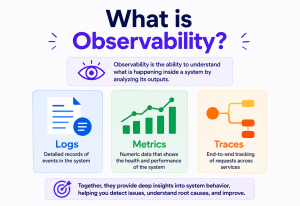
11 · MONITORING, LOGGING & METRICS
The Data That Fuels Honest Timelines — And The Trap That Ruins It
Monitoring and logging play a dual role in blameless postmortems: they are both the raw evidence used to reconstruct the timeline, and — if misused — a tool that can accidentally re-introduce blame culture through the back door.
Logs and metrics as blameless evidence
Good observability data (structured logs, distributed traces, deployment records, alert histories) lets a postmortem reconstruct an objective timeline instead of relying purely on people’s memory, which is unreliable and can be unconsciously self-protective. This is why teams with mature observability tend to run better postmortems — not because their engineers are more honest, but because the system itself remembers what happened independent of anyone’s account.
Production System   Monitoring       On-call Engineer     Postmortem Doc
       |                |                    |                    |
       |-- error rate ->|                    |                    |
       |    spikes      |-- page (t+2min) -->|                    |
       |                |                    |-- investigate,     |
       |                |                    |   rollback deploy  |
       |                |                    |   (t+14min)        |
       |<-- rate normal-|                    |                    |
       |    (t+16min)   |                    |                    |
       |                |-- alert + metric history export -----> |
       |                |                    |-- first-person   -->
       |                |                    |   account of      |
       |                |                    |   decisions       |
       |                |                    |   made            |
       |                |                    |                    |
       |            Timeline = objective data + human account     |
Key metrics that feed the postmortem
| Metric | What it tells the postmortem |
|---|---|
| MTTD (Mean Time to Detect) | How long between the actual problem starting and someone / something noticing |
| MTTA (Mean Time to Acknowledge) | How long between alert firing and a human confirming they are responding |
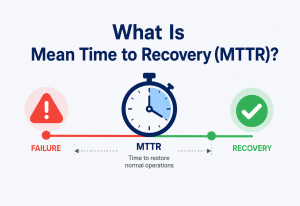
| MTTR (Mean Time to Resolve) | Total time from detection to full resolution — the headline reliability number |
| Error budget burn rate | How fast this incident consumed the team’s allowed unreliability for the period (an SRE concept) |
| Action item aging | How long action items from past postmortems have sat open — a leading indicator of whether the process has teeth |
The trap: using monitoring data to assign blame
Here is a subtle but important warning. A team can have perfect observability and still poison its blameless culture if it uses that data the wrong way — for example, building a dashboard that shows “number of production incidents per engineer” and quietly factoring that into performance reviews. The moment logging and metrics become a surveillance tool for judging individuals rather than a shared resource for understanding systems, engineers rationally start avoiding actions that would generate a paper trail, and the entire value of good observability data for postmortems collapses.
Metrics should describe the health of the system and the effectiveness of the process (MTTR trending down, action items closing on time) — never a scoreboard ranking individual engineers by how many incidents they were “involved in.”
12 · DESIGN PATTERNS & ANTI-PATTERNS
Patterns That Age Well — And Ones That Rot The Culture
Patterns (what works)
Five Whys
Covered in Chapter 5 — repeated “why” questioning to walk from symptom to system-level root cause.
Fishbone / Ishikawa diagram
A visual technique that branches out contributing factors into categories (People, Process, Tools, Environment) to avoid fixating on a single narrow cause.
Contributing factors, not “the” root
Mature teams avoid saying “the root cause was X,” preferring “contributing factors were A, B, and C” — almost every real incident is a combination of several small weaknesses lining up (the “Swiss cheese model”).
Just Culture decision tree
A structured way to distinguish honest error from at-risk behaviour from reckless / malicious behaviour, so “blameless” does not collapse into “consequence-free.”
Anti-patterns (what to avoid)
| Anti-pattern | Why it fails |
|---|---|
| Blameless in name only (“blameless theatre”) | The meeting avoids naming names, but the same person quietly gets a worse performance review afterward. Destroys trust permanently once discovered. |
| Stopping at the first “why” | “The engineer ran the wrong command” is treated as a complete root cause. No systemic fix results, guaranteeing recurrence. |
| Action items with no owner or date | “We should improve testing” with no owner and no deadline is a wish, not an action item — it will never get done. |
| Skipping postmortems for “small” incidents | Near-misses often contain the earliest, cheapest signal of a systemic risk. Skipping them means only learning from the expensive version of the lesson. |
| Punishing based on severity of outcome rather than quality of decision | Two engineers make the identical reasonable judgment call; one causes a minor blip, the other causes a major outage purely due to bad luck / timing. Judging them differently teaches people to fear bad luck, not bad decisions. |
| Facilitator is the incident’s own manager | Creates a built-in power imbalance and incentive to protect their own team’s reputation, undermining neutrality. |
13 · BEST PRACTICES & COMMON MISTAKES
A Portable Checklist For Every Review
Best practices
- Write the timeline before assigning any meaning — separate “what happened” from “why” from “what we’ll do” as sequential steps.
- Use neutral, system-focused language deliberately (“the deploy script did not validate the config”, not “Priya’s deploy script”).
- Publish widely (internally): the more people who can read a postmortem, the more the org learns per incident.
- Track action items like production bugs — same rigor, ownership, and follow-up cadence.
- Review the review process itself periodically using the repeat-incident-rate metric.
- Model it from the top — leaders visibly participate in postmortems for incidents involving their own decisions.
Common mistakes
- Confusing “blameless” with “consequence-free” (see the Just Culture tree in Chapter 12).
- Doing postmortems only for the biggest incidents — the cheapest lessons live in near-misses.
- Letting the postmortem become a status update instead of an investigation.
- Treating the document as the deliverable instead of the change — a beautiful write-up whose action items never close has produced zero reliability improvement.
- Publishing “blameless” but privately factoring incidents into performance reviews.
Longer notes on each best practice
- Write the timeline before assigning any meaning: Separate “what happened” from “why it happened” from “what we’ll do about it” as distinct, sequential steps — do not let analysis contaminate the facts.
- Use neutral language deliberately: Write “the deploy script did not validate the config” instead of “Priya’s deploy script.” Passive, system-focused phrasing is a discipline, not an accident.
- Publish widely (internally): The more people who can read a postmortem, the more the org learns per incident. Some companies (Etsy, later many others) publish sanitised postmortems even externally, as a trust-building signal to customers.
- Track action items like production bugs: Give them the same rigor, ownership, and follow-up cadence as any other engineering ticket — do not let them become “someday” items.
- Review the review process itself periodically: Ask “are our postmortems actually preventing repeat incidents?” using the repeat-incident-rate metric from Chapter 8.
- Model it from the top: Leaders should visibly participate in postmortems for incidents involving their own decisions, and never publicly override a blameless finding with a private punishment.
Longer notes on each common mistake
- Confusing “blameless” with “consequence-free”: As covered in Chapter 12’s Just Culture tree, genuine recklessness still needs accountability — pretending otherwise erodes trust in the fairness of the whole system.
- Doing postmortems only for the biggest incidents: Small incidents and near-misses are cheap, frequent lessons — skipping them wastes the cheapest form of learning available.
- Letting the postmortem become a status update instead of an investigation: If the meeting is just “here is what we fixed,” without genuinely open questions about why the system allowed it, it is theatre, not learning.
- Treating the document as the deliverable instead of the change: A beautifully written postmortem whose action items never get implemented has produced zero actual reliability improvement.
14 · REAL-WORLD INDUSTRY EXAMPLES
How The Biggest Operators — And The Oldest Industries — Do It
Google · Site Reliability Engineering
Google’s SRE discipline treats postmortems as a first-class engineering artefact. Their internal guidance explicitly states a postmortem’s value is measured by how much it prevents future incidents, not by how well it explains the past one. Their public SRE book devotes significant space to the psychology of blameless review, including a widely-cited anecdote about an engineer who accidentally took down a service and was thanked, publicly, for how much the incident revealed about a fragile piece of infrastructure.
Etsy · origin of the modern software “blameless postmortem”
Etsy, under engineer John Allspaw, is widely credited with formalising and publishing “blameless postmortem” guidelines for a software engineering audience around 2012. Etsy’s approach explicitly borrowed from aviation and human-factors research (including Sidney Dekker’s work) and emphasised that engineers make locally rational decisions given the information available to them at the time — the postmortem’s job is to reconstruct that information environment, not judge the decision in hindsight.
Amazon · Correction of Error (COE)
Amazon’s internal COE documents require a structured root-cause section (often using a five-whys-style format) for any customer-impacting event, and these documents are reviewed in operational forums that look for patterns across many incidents, not just single-incident fixes.
Netflix · Chaos Engineering as a preventive complement
Netflix’s Chaos Engineering practice (originating with “Chaos Monkey“) is philosophically connected to blameless postmortems: instead of waiting for a real incident to reveal a system weakness, Netflix deliberately injects controlled failures to find weaknesses proactively — treating every discovered weakness the same way a postmortem would, as a system gap to close, with zero blame attached to whichever engineer’s service “failed” the chaos test.
Aviation · NASA ASRS
Pilots, air traffic controllers, and mechanics can voluntarily and confidentially report safety incidents — including their own errors — to a third party (not their employer or the regulator directly), explicitly protected from certain enforcement actions. This system has been running since the 1970s and is often cited by software SRE teams as direct inspiration, because it proves at large scale, over decades, that removing personal risk from reporting produces dramatically more usable safety data.
Healthcare · Root Cause Analysis programmes
Modern hospital systems widely use structured Root Cause Analysis for adverse events, explicitly moving away from an older culture of individual physician blame toward examining staffing levels, handoff protocols, and equipment design — mirroring, almost exactly, the “system over person” logic covered throughout this guide.
A common thread across all of these: as an organisation grows in scale and consequence, it shifts from “find the person” toward “understand the system,” and it gets measurably safer and more reliable as a direct result.
15 · FAQ
The Questions That Come Up Every Time
Does “blameless” mean no one is ever held accountable?
No. Blameless refers specifically to how the postmortem process treats honest mistakes — it removes personal punishment as a consequence of honestly disclosing what happened. It does not remove accountability for genuinely reckless, negligent, or intentional misconduct; that is handled through separate management processes, informed by the Just Culture distinction covered in Chapter 12.
Isn’t it unfair that an engineer who causes a huge outage faces the same postmortem treatment as one who causes a tiny blip?
The size of the outcome is often influenced heavily by luck and timing, not by how “bad” the decision was. Two engineers can make the identical, reasonable judgment call; one happens to trigger it during low traffic (minor impact), the other during a big product launch (major impact). Judging the decision by its outcome rather than its reasonableness teaches people to fear randomness, not to make better decisions.
Won’t a blameless culture make engineers careless, since there’s “no consequence”?
In practice, the opposite tends to happen. Engineers in blameless cultures report higher engagement with reliability work, because they are not spending energy on self-protection and blame-avoidance. The “consequence” for mistakes is a real, effective system fix — which most engineers find more satisfying than punishment, because it means their mistake actually improved something permanently.
How do you start a blameless postmortem culture on a team that currently blames people?
Start small and be consistent: run one postmortem with strict blameless facilitation, publish it internally, and make sure no punishment follows from what was disclosed — even if that is uncomfortable in the short term. Trust is built by observing the promise held, incident after incident; it is destroyed instantly and durably by a single visible violation.
What’s the single most common reason blameless postmortem programmes fail?
Leadership says the words “blameless” but still privately factors incident involvement into performance reviews or promotion decisions. Once engineers discover this — and they always eventually do — the entire program’s credibility collapses, often permanently.
Do small startups need this, or is it only for big companies like Google and Amazon?
The core principle scales down easily — even a two-person postmortem conversation after a small outage benefits from separating “what happened” from “who’s at fault.” The formal document and cross-team review board can be added later as the org grows; the mindset should start on day one.
Post-incident stress and fear of blame are recognised workplace wellbeing concerns. If someone on your team is losing sleep or dreading on-call because of how incidents are handled, that is worth raising with a manager or HR — it is a legitimate operational and human issue, not just a cultural preference.
16 · SUMMARY & KEY TAKEAWAYS
What To Carry Into The Next Incident
A postmortem is a structured review of what happened after something breaks — its origins trace back through aviation safety, nuclear power, and healthcare, long before software engineering existed. The blameless version of the practice is not a courtesy or a mood; it is an engineering strategy for extracting maximum learning value from every failure, based on decades of evidence from industries where failure kills people.
Key takeaways
- Blame suppresses the honest information needed to fix systems — it does not prevent mistakes, it just hides them until they become bigger.
- The core discipline is systems thinking: treating human error as the starting point of an investigation, not the ending point, and digging (often via Five Whys) to a systemic root cause.
- A mature process has real architecture: an Incident Commander, a neutral facilitator, a structured document, timestamped timelines, tracked action items, and a searchable knowledge base.
- Blamelessness must hold at every stage of the incident lifecycle — detection, response, documentation, and review — not just inside the meeting itself.
- Blameless does not mean consequence-free: the Just Culture model distinguishes honest mistakes (no blame) from reckless or malicious behaviour (accountability still applies).
- Good observability data supports honest timelines — but must never be repurposed into a surveillance tool for judging individuals, or it silently poisons the whole culture.
- At scale, the process itself needs metrics (postmortem completion rate, action item closure rate, repeat-incident rate) to know if it is actually working.
- Companies like Google, Etsy, Amazon, and Netflix, and industries like aviation and healthcare, all converge on the same conclusion: removing personal risk from honest disclosure is the single highest-leverage way to build genuinely more reliable systems.
“The next time something breaks on your team, the most valuable question you can ask isn’t ‘who did this’ — it’s ‘what in our system made this possible, and what will we change so it can’t happen the same way again.'”