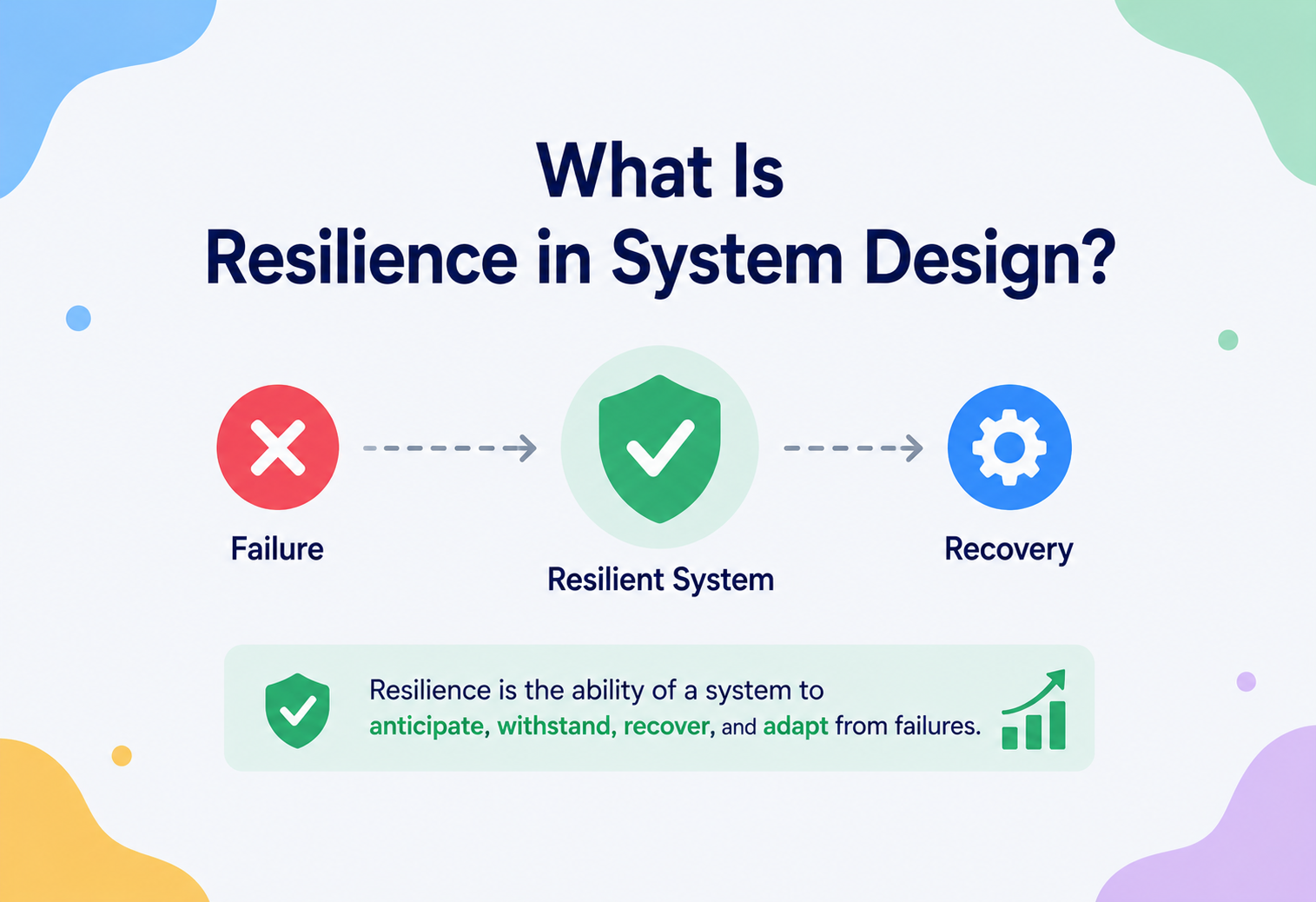
What Is Resilience in System Design?
A complete, beginner-to-production walkthrough of building systems that bend without breaking — the concepts, the patterns, the math, and the real production practices behind resilient architecture.
Where the Idea of Resilience Comes From
Resilience is not about avoiding every failure — it is the discipline of building systems that bend under stress and spring back. That mindset shift is where every technique in this guide begins.
Imagine a bridge designed to sway two feet in a strong wind instead of standing perfectly rigid. That sway is not a design flaw — it is the exact feature that keeps the bridge from snapping. Engineers call this property resilience: the ability of a structure to absorb stress, bend under pressure, and return to a stable shape instead of shattering. Software systems face an equivalent kind of wind every single day — hardware failures, network hiccups, sudden traffic spikes, buggy deployments, and even entire data-centre outages. Resilience in system design is the discipline of building software that survives that wind: a system that keeps serving users, or at least fails gracefully and recovers quickly, even when parts of it break.
The word “resilience” comes from the Latin resilire, meaning “to leap back.” Materials scientists and civil engineers have used it for centuries to describe how steel, rubber, or concrete return to shape after being stressed. Computer science borrowed the idea in the 1970s and 1980s, when early distributed-computing pioneers at institutions like Xerox PARC and Bell Labs began wrestling with the reality that networks are unreliable and machines crash. The famous Fallacies of Distributed Computing, first written down by L. Peter Deutsch and colleagues at Sun Microsystems in the 1990s, crystallised this thinking. The very first fallacy is: “The network is reliable.” Every resilience technique discussed in this article ultimately exists because that assumption is false.
Resilience engineering matured further through the work of aviation and nuclear-safety researchers like Erik Hollnagel and David Woods, who studied how complex human-operated systems (power plants, cockpits) survive unexpected shocks. Their key insight — that resilience is not about preventing every failure but about a system’s capacity to adapt — heavily influenced how modern software teams think about outages. Netflix’s Chaos Monkey, introduced in 2011, is a direct descendant of this philosophy: instead of hoping failures never happen, Netflix engineers began deliberately causing failures in production to prove their systems could absorb them.
The human immune system is resilient, not invincible. You get exposed to germs constantly, and you don’t stay perfectly healthy every single day — but your body detects the intrusion, isolates the damage, fights back, and returns to health. It rarely needs to be “perfect”; it needs to recover reliably. That is exactly the mindset behind resilient system design.
Today, resilience is a first-class concern in system-design interviews, cloud architecture reviews, and SRE (Site Reliability Engineering) practice. It sits alongside — and often overlaps with — related ideas like high availability, fault tolerance, and disaster recovery, but as we’ll see in the next section, resilience is a distinct and broader idea than any of these individually.
Why Correctness Alone Isn’t Enough
Correct code that runs on a single machine tells you nothing about how the system will behave when the network drops, the database blinks, or the traffic doubles. That gap is exactly what resilience fills.
Why does resilience deserve its own chapter in a system-design curriculum instead of being folded into “just write correct code”? Because in a distributed system, correctness alone is not enough. A perfectly correct piece of business logic will still fail the user if:
- The server it’s running on loses power.
- The database it depends on becomes unreachable for 200 milliseconds during a network blip.
- A downstream payment gateway suddenly takes 30 seconds to respond instead of 300 milliseconds.
- A traffic spike from a marketing campaign sends 50× the normal request volume.
- A bad deployment silently corrupts 2 percent of writes before anyone notices.
None of these are bugs in the traditional sense. They are the ordinary cost of doing business at scale, across networks, on commodity hardware, in a world where things fail. Werner Vogels, Amazon’s CTO, famously summarised this reality with the phrase “everything fails, all the time.” The question resilient design asks is not “how do we prevent failure?” — that is impossible at scale — but “how do we make failure cheap, contained, and recoverable?”
One server, one database
Picture a to-do list app with a single server and a single database on your laptop. If the database process crashes, the whole app goes down and every user sees an error page until you manually restart it. There is zero resilience: one failure equals total outage.
Same app, resilient
Now picture the same app the way a company like Trello would run it: multiple app-server replicas behind a load balancer, a primary database with automatic failover to a replica, a circuit breaker around every third-party integration, and retries with backoff on transient errors. If one app server crashes, the load balancer simply routes around it. If the primary database fails, a replica is promoted within seconds. Users might notice a brief slowdown, but the app stays up.
The business motivation is direct: outages cost money, trust, and sometimes safety. Studies of large e-commerce and SaaS companies routinely estimate the cost of downtime at tens of thousands to millions of dollars per hour depending on scale. But the deeper motivation is psychological and organisational — teams that build resilient systems can move faster, because they aren’t terrified that every deployment might bring the whole platform down. Resilience is what allows continuous delivery, rapid iteration, and confident scaling.
Resilience vs. Related Terms
It is worth untangling resilience from three terms it is commonly confused with, because interviewers and architecture reviews will expect you to draw these distinctions precisely.
| Term | What It Means | Key Question It Answers |
|---|---|---|
| Reliability | The system performs its intended function correctly over time | “Does it work correctly, consistently?” |
| Availability | The system is up and reachable when needed (often measured in “nines”) | “Is it up right now?” |
| Fault Tolerance | The system continues operating correctly despite the failure of a component | “Can one part fail without the whole thing failing?” |
| Resilience | The system absorbs stress, degrades gracefully, and recovers — even from failures nobody anticipated | “How does it behave under the unexpected, and how fast does it bounce back?” |
Fault tolerance is largely about known failure modes you have explicitly engineered around (like a disk failing in a RAID array). Resilience is broader — it includes the ability to cope with unknown or unanticipated stress, and it explicitly includes the recovery journey, not just the moment of failure.
The Vocabulary of Resilience
Before diving into architecture, let’s build a shared vocabulary. Every one of these terms will reappear throughout the rest of the guide.
Failure, Fault, and Error
These three words are often used interchangeably in casual conversation, but system design treats them as a causal chain:
- Fault — an underlying defect or abnormal condition (a bad disk sector, a bug, a misconfigured timeout).
- Error — the incorrect internal state produced by a fault (a null pointer, a corrupted variable).
- Failure — the externally visible consequence: the system stops delivering its expected service to the user.
Resilience engineering aims to stop a fault from ever escalating into a full-blown failure. Think of it as a series of dams: a fault occurs, and if your system is well-designed, the fault is caught and contained before it becomes an error, and even if it becomes an error, it’s caught before it becomes a user-visible failure.
Blast Radius
The “blast radius” of a failure is how much of the system it affects. A resilient architecture actively shrinks blast radius through isolation — bulkheads, cell-based architecture, and bounded contexts (a concept you may already know from Domain-Driven Design) all exist to keep one failure from taking down everything else.
A submarine is divided into watertight compartments. If one compartment floods, the crew seals the bulkhead doors and the submarine stays afloat — damaged, but afloat. Without those compartments, a single hull breach would sink the entire vessel. Microservice boundaries and bulkhead patterns do exactly the same job for software.
Graceful Degradation
Graceful degradation means a system under stress sheds non-essential functionality first, in order to preserve its core function. Amazon’s product pages, for example, will hide the “customers who bought this also bought” recommendation widget under extreme load rather than fail the entire page — because showing the product and letting someone buy it is the core function; recommendations are a nice-to-have.
Redundancy
Redundancy means having more than one of something so a single failure doesn’t remove your only copy. This applies to servers (multiple replicas), data (replication), network paths (multiple availability zones), and even entire regions (multi-region deployment).
Recovery: RTO and RPO
Two metrics dominate any serious resilience or disaster-recovery conversation:
| Metric | Full Name | Question It Answers |
|---|---|---|
| RTO | Recovery Time Objective | “How long can we be down before it’s unacceptable?” |
| RPO | Recovery Point Objective | “How much data can we afford to lose, measured in time?” |
An RPO of 5 minutes means that, in the worst case, the last 5 minutes of writes might be lost during a disaster — so your backup or replication strategy must capture data at least that frequently.
The CAP Theorem, Briefly
Resilience conversations inevitably brush against the CAP theorem, formalised by Eric Brewer in 2000. It states that a distributed data store can guarantee only two of the following three properties simultaneously during a network partition:
- Consistency (C) — every read receives the most recent write.
- Availability (A) — every request receives a (non-error) response.
- Partition Tolerance (P) — the system keeps working despite dropped or delayed messages between nodes.
Because network partitions are a fact of life in any real distributed system, P is non-negotiable, which really means every resilient distributed system must choose between CP (consistent but may reject requests during a partition) and AP (available but may serve slightly stale data during a partition). This choice directly shapes resilience strategy — an AP system like DynamoDB will keep answering reads even when replicas disagree; a CP system like a strongly-consistent SQL cluster may refuse writes rather than risk inconsistency. Neither is “more resilient” in the abstract; each is resilient in the way its use case demands.
Replication, Partitioning, and Consensus
Replication keeps multiple copies of data on different nodes so that losing one node doesn’t lose the data. Partitioning (sharding) splits data across nodes so no single node needs to hold — or serve — the entire dataset, limiting blast radius and improving scalability. Consensus algorithms like Raft and Paxos let a cluster of unreliable nodes agree on a single truth (such as “who is the current leader?”) even when some nodes are slow, crashed, or lying. Consensus is what makes automatic failover safe: without it, two nodes might both believe they’re the primary — a dangerous condition called split-brain.
Raft, the more approachable of the two well-known consensus algorithms, works by electing a single leader among a cluster of nodes. Every write goes through the leader, which replicates it to a majority of followers before considering it committed. If the leader stops sending heartbeats — because it crashed, lost network connectivity, or is simply overloaded — followers time out and trigger a new election. Because a new leader can only be elected with votes from a majority of nodes, and a write is only committed after reaching a majority, it becomes mathematically impossible for two separate leaders to both believe they’re valid at the same time. This is precisely what prevents split-brain in systems like etcd, Consul, and CockroachDB, all of which use Raft or a close variant under the hood.
Requiring a majority — not just any two nodes — to agree is what makes consensus resilient to partition. In a five-node cluster, any majority (three nodes) overlaps with any other possible majority by at least one node, so two different groups of nodes can never simultaneously elect two different leaders. This single mathematical property underpins almost every “automatic failover” feature in modern distributed databases.
Concurrency Under Failure
Resilient systems must also handle concurrent access correctly when things go wrong mid-operation. Two broad strategies exist: pessimistic locking, where a resource is locked before it’s touched (safe, but can create contention and can even deadlock the whole system if a lock-holder crashes while still holding the lock), and optimistic locking, where operations proceed without locks and instead detect conflicts at commit time via a version number or timestamp. Optimistic locking tends to be friendlier to distributed, partially-failing environments, because there is no lock left dangling when a node disappears mid-transaction — the worst case is simply that one of two conflicting writers has to retry.
The Building Blocks of Resilient Systems
Resilience is not a single component you install — it is a set of architectural building blocks that work together at every layer of the stack.
Let’s walk through the main ones.
Load Balancers
A load balancer distributes incoming traffic across multiple healthy server instances. Beyond spreading load, it is a resilience tool: it performs health checks and automatically stops sending traffic to instances that are unhealthy, effectively self-healing the traffic path around a failure.
Redundant Compute (Replica Sets)
Instead of one application server, resilient systems run a pool of identical replicas, often spread across multiple availability zones (physically separate data centres within a region) or multiple regions entirely. Losing one replica — or one entire zone — still leaves capacity to serve traffic.
Circuit Breakers
A circuit breaker sits between your service and a downstream dependency. If the dependency starts failing repeatedly, the breaker “trips” and stops sending requests to it for a while, failing fast instead of letting every request hang and pile up. This is directly modelled on electrical circuit breakers that cut power before wires overheat.
Bulkheads
Bulkheads partition resources (thread pools, connection pools, or entire services) so that exhaustion in one area cannot starve another. If your recommendation service’s thread pool fills up because a downstream call is slow, a bulkhead ensures your checkout service’s thread pool is unaffected.
Rate Limiters and Throttles
Rate limiters cap how many requests a client — or the system as a whole — can make in a given time window, protecting the system from being overwhelmed by legitimate traffic spikes or abusive clients.
Message Queues and Buffers
Queues like Kafka, RabbitMQ, or SQS decouple producers from consumers in time. If a downstream consumer slows down or crashes, messages simply wait in the queue instead of being lost or overwhelming the consumer when it recovers.
Health Checks and Watchdogs
Automated health checks (liveness and readiness probes in Kubernetes, for example) continuously verify that a component is actually working, not just “running.” A crashed-but-still-listening process is worse than a properly-terminated one because it silently swallows requests.
A simple health endpoint
A single Spring Boot app with a /health endpoint that a script pings every 10 seconds and restarts the app if it stops responding.
Kubernetes probes at scale
Kubernetes liveness and readiness probes automatically restart crashed pods and pull unready pods out of the load-balancer pool — used at massive scale by companies like Spotify and Airbnb.
High-Level Resilient Architecture
Notice how failure is anticipated at every layer: the load balancer routes around dead app servers; the circuit breaker prevents cascading failures into downstream calls; the queue absorbs bursts; and the standby database can be promoted if the primary dies. No single box in this diagram is a single point of failure.
How Resilience Patterns Actually Work
Let’s zoom into how a few of these components actually work under the hood, with Java examples you could realistically use in a Spring Boot service.
Retries with Exponential Backoff and Jitter
A naive retry (“just try again immediately”) can make things worse — if a service is struggling under load, a flood of instant retries from every client is like everyone re-dialling a busy phone line at once, which keeps the line busy forever. Exponential backoff increases the wait time between attempts, and jitter (randomness) spreads those retries out so clients don’t all hammer the service at the same instant.
public class RetryWithBackoff {

    public static <T> T executeWithRetry(Callable<T> operation, int maxAttempts) throws Exception {
        int attempt = 0;
        long baseDelayMs = 200;
        while (true) {
            try {
                return operation.call();
            } catch (Exception ex) {
                attempt++;
                if (attempt >= maxAttempts) {
                    throw ex; // give up after max attempts, let caller handle it
                }
                long exponential = (long) (baseDelayMs * Math.pow(2, attempt - 1));
                long jitter = ThreadLocalRandom.current().nextLong(0, baseDelayMs);
                long delay = exponential + jitter;
                Thread.sleep(delay);
            }
        }
    }
}
Only retry idempotent operations (an operation that produces the same result no matter how many times it is applied — such as GET or a PUT with a fixed final state). Retrying a non-idempotent “charge credit card” call can double-charge a customer unless you attach an idempotency key.
Circuit Breaker State Machine
A circuit breaker moves between three states: Closed (requests flow normally, failures are counted), Open (requests are rejected immediately without calling the dependency), and Half-Open (a trial request is allowed through to test if the dependency has recovered).
public class SimpleCircuitBreaker {
    enum State { CLOSED, OPEN, HALF_OPEN }

    private State state = State.CLOSED;
    private int failureCount = 0;
    private final int failureThreshold = 5;
    private long lastFailureTime = 0;
    private final long openTimeoutMs = 10_000;

    public synchronized boolean allowRequest() {
        if (state == State.OPEN) {
            if (System.currentTimeMillis() - lastFailureTime > openTimeoutMs) {
                state = State.HALF_OPEN;
                return true; // allow a single trial request
            }
            return false; // fail fast
        }
        return true; // CLOSED or HALF_OPEN trial in progress
    }

    public synchronized void recordSuccess() {
        failureCount = 0;
        state = State.CLOSED;
    }

    public synchronized void recordFailure() {
        failureCount++;
        lastFailureTime = System.currentTimeMillis();
        if (state == State.HALF_OPEN || failureCount >= failureThreshold) {
            state = State.OPEN;
        }
    }
}
In production Spring Boot systems, you would typically reach for Resilience4j instead of hand-rolling this, but understanding the state machine underneath makes you far more effective at configuring it correctly.
Timeouts and Bulkheads Together
@Bean
public CircuitBreakerConfig paymentServiceConfig() {
    return CircuitBreakerConfig.custom()
        .failureRateThreshold(50)                 // trip if 50% of calls fail
        .slowCallRateThreshold(80)                // also trip on slow calls
        .slowCallDurationThreshold(Duration.ofMillis(2000))
        .waitDurationInOpenState(Duration.ofSeconds(15))
        .permittedNumberOfCallsInHalfOpenState(3)
        .slidingWindowSize(20)
        .build();
}

@Bean
public ThreadPoolBulkhead paymentServiceBulkhead() {
    return ThreadPoolBulkhead.of("paymentService",
        ThreadPoolBulkheadConfig.custom()
            .maxThreadPoolSize(10)   // isolate this dependency's threads
            .coreThreadPoolSize(5)
            .queueCapacity(20)
            .build());
}
Notice the bulkhead caps the payment service’s thread pool at 10 threads. Even if payment calls hang forever, at most 10 threads are stuck — the other hundreds of threads serving unrelated requests are untouched.
A Request Under Failure, Step by Step
The theory is easier to feel when you watch a single request travel through a real resilient architecture — especially when something goes wrong halfway through.
Let’s trace a single checkout request through a resilient e-commerce system, and watch what happens when the inventory service becomes slow.
Request Arrives
The load balancer checks its health-check table and forwards the request only to a healthy app-server replica.
App Server Calls Inventory
The app server begins calling the inventory service to reserve stock, wrapped in a circuit breaker with a 2-second timeout.
Inventory Is Slow
The inventory service is under load (perhaps its own database is struggling). The call doesn’t return within 2 seconds.
Timeout Fires
The app server does not wait indefinitely; it treats this as a failure and records it against the circuit breaker.
Fallback Logic Runs
Rather than showing the user a raw error, the app degrades gracefully: it shows “Reserving your item, we’ll confirm shortly” and queues the reservation as an asynchronous message instead of a synchronous call.
Message Lands in Queue
The reservation goes into a queue (Kafka / SQS) which buffers it durably. The checkout flow completes from the user’s point of view.
Inventory Recovers
Its consumers drain the queue, processing the buffered reservation a few seconds later.
Circuit Breaker Closes
The breaker sees successes during its half-open trial period and closes again, resuming normal synchronous calls.
Monitoring Sees Everything
Throughout the sequence, monitoring recorded elevated latency and the circuit-breaker trip, notifying the on-call engineer — but no customer-facing outage occurred.
Every step in that lifecycle involved a decision point where an unresilient system would have simply failed the request outright. Resilient design is really a series of “what do we do instead of just erroring out?” decisions, made deliberately ahead of time rather than improvised during an incident.
Pros, Cons, and What Resilience Costs
Resilience is not free. Every technique buys you something valuable and charges something else in return — complexity, infrastructure, cognitive load. Knowing that ledger is what separates thoughtful architecture from reflex.
| Benefit | Cost / Trade-off |
|---|---|
| Fewer full outages; failures stay contained | Significantly more architectural complexity |
| Faster recovery (seconds/minutes instead of hours) | More infrastructure to run and pay for (replicas, queues, standby DBs) |
| Engineers can deploy more confidently and often | Harder to reason about system behaviour end-to-end |
| Better user trust and retention over time | Testing resilience (chaos engineering) requires real investment |
| Enables aggressive scaling without proportional risk | Some patterns (retries, queues) can mask underlying problems if misused |
Resilience is not free, and over-engineering it for a low-traffic internal tool is its own mistake — a three-node Kafka cluster to buffer 50 requests a day is wasted effort. The right amount of resilience investment scales with the blast radius of failure: a payments system deserves far more resilience engineering than an internal dashboard.
A useful mental model is to ask, for each component, “what does an hour of this being down actually cost — in money, in trust, in safety?” A marketing landing page that goes dark for an hour is embarrassing but rarely dangerous. A hospital’s patient-monitoring dashboard going dark for even a minute is a different category of problem entirely. Resilience engineering effort should be allocated in rough proportion to that cost, not applied uniformly across every system a team owns. This is also why resilience decisions are ultimately business decisions as much as technical ones — the right architecture review includes not just engineers, but whoever can speak to the real-world cost of downtime for that particular system.
It is also worth noting that resilience investment has diminishing returns. The jump from 99 percent to 99.9 percent availability is usually achievable with straightforward redundancy and retries. The jump from 99.9 percent to 99.99 percent often requires multi-region active-active architecture, extensive chaos testing, and a dedicated on-call rotation — an order of magnitude more effort for one additional “nine.” Teams that understand this curve make far better decisions about where to stop investing in resilience and start investing in new features instead.
Finally, resilience trades off against simplicity in a way that’s easy to underestimate until you’re the engineer debugging a production incident at 2 a.m. A system with five layers of retries, fallbacks, and circuit breakers can behave in genuinely surprising ways under compound failure — for instance, a fallback that itself depends on a component that is also degraded. Documenting these interactions, and periodically simplifying wherever a resilience mechanism has stopped earning its complexity, is itself a resilience practice.
Staying Fast While Staying Alive
A resilient-but-slow system has simply traded one kind of failure for another. These are the techniques that keep both bars — performance and resilience — high at the same time.
Resilience and performance are deeply intertwined — a system that’s resilient but slow under normal conditions has simply traded one kind of failure for another. Key techniques:
Horizontal Scaling
Adding more stateless replicas rather than making one server bigger (vertical scaling) is both a scalability and a resilience technique — more replicas mean more redundancy against any single node’s failure.
Caching
Caching reduces load on downstream systems, which indirectly improves resilience: a database under less average load has more headroom to absorb a traffic spike before it starts timing out.
Load Shedding
When incoming demand exceeds capacity, a resilient system deliberately rejects a portion of requests (often the lowest-priority ones) rather than trying to serve all of them poorly and risking total collapse. This is the same principle as a restaurant putting a waiting list outside instead of overcrowding the kitchen until every order comes out wrong.
@RestController
public class OrderController {

    private final Semaphore concurrencyLimiter = new Semaphore(200); // load shedding

    @PostMapping("/orders")
    public ResponseEntity<?> createOrder(@RequestBody OrderRequest request) {
        if (!concurrencyLimiter.tryAcquire()) {
            return ResponseEntity.status(503)
                .header("Retry-After", "2")
                .body("Service busy, please retry shortly");
        }
        try {
            return ResponseEntity.ok(orderService.create(request));
        } finally {
            concurrencyLimiter.release();
        }
    }
}
Autoscaling
Autoscaling adjusts the number of running replicas based on real-time load, so capacity grows before saturation causes cascading timeouts. It works best combined with load shedding as a safety net for the gap between demand spiking and new replicas becoming ready — new instances take time to boot, warm up caches, and pass health checks, and a resilient system needs to survive that warm-up window too.
Load Testing and Capacity Planning
Performance and resilience limits are rarely known until they have actually been measured. Load-testing tools like Gatling, k6, and JMeter let teams simulate realistic (and unrealistic) traffic patterns against a staging or shadow environment to answer questions such as: at what request rate does P99 latency start climbing? At what point does the circuit breaker for a downstream dependency begin tripping? How does the system behave once the connection pool is fully saturated? Capacity planning then uses these findings to size autoscaling thresholds, connection-pool limits, and bulkhead boundaries with real numbers instead of guesses.
100 users on a local box
Running a simple load test with 100 concurrent virtual users against a local Spring Boot app to see how response times change as you increase the load — a great first step before ever touching production capacity planning.
Rehearsing Black Friday
Large e-commerce platforms run full-scale load tests months ahead of predictable traffic surges (like a major sale event) specifically to validate that autoscaling policies, database connection limits, and circuit-breaker thresholds can absorb multiples of normal peak traffic without cascading failure.
Nines, Failover, and Disaster Recovery
The industry measures availability in “nines” because each additional nine costs disproportionately more. Choosing the right number of nines is arguably the most important resilience decision a team makes.
Availability is usually expressed in “nines”:
| Availability | Downtime / Year | Downtime / Month |
|---|---|---|
| 99% (two nines) | ~3.65 days | ~7.3 hours |
| 99.9% (three nines) | ~8.76 hours | ~43.8 minutes |
| 99.99% (four nines) | ~52.6 minutes | ~4.4 minutes |
| 99.999% (five nines) | ~5.26 minutes | ~26 seconds |
Each additional nine typically costs disproportionately more engineering effort, so mature teams define an SLA (Service Level Agreement, the external promise), backed by an internal SLO (Service Level Objective, the target) and measured via SLIs (Service Level Indicators, the actual metrics). A resilient system is designed and budgeted around a concrete SLO rather than an abstract goal of “always up.”
Failover
Failover is the automatic (or manual) process of switching to a standby component when the primary fails. Database failover typically involves promoting a replica to primary, updating DNS or connection routing, and redirecting traffic — all coordinated through a consensus mechanism to avoid split-brain.
Disaster Recovery Strategies
| Strategy | RTO | Cost | Description |
|---|---|---|---|
| Backup & Restore | Hours | Lowest | Periodic backups, restored manually on disaster |
| Pilot Light | Tens of minutes | Low | Minimal standby infrastructure kept warm, scaled up on failover |
| Warm Standby | Minutes | Medium | Scaled-down but running replica environment, ready to take full traffic |
| Active-Active (Multi-Region) | Seconds | Highest | Full duplicate environments actively serving traffic in multiple regions |
Concurrency and Consistency Under Failure
When a failover happens mid-write, or when two nodes briefly disagree, you must reason about concurrency carefully. Optimistic locking (using a version number to detect conflicting writes) is a common resilient pattern for handling concurrent updates without heavyweight locks:
@Entity
public class Account {
    @Id
    private Long id;
    private BigDecimal balance;

    @Version
    private Long version; // JPA optimistic locking

    // If two threads read the same version and both try to update,
    // the second write throws OptimisticLockException instead of
    // silently overwriting the first thread's change.
}
Where Security and Resilience Meet
Many attacks are, functionally, deliberate resilience tests — and many resilience techniques double as security controls. This overlap is bigger than it looks.
Security and resilience overlap heavily because many attacks are, functionally, deliberate resilience tests. A resilient system should treat malicious traffic the same way it treats an organic traffic spike.
- DDoS protection — rate limiting, WAFs (Web Application Firewalls), and CDN-layer traffic scrubbing absorb volumetric attacks before they ever reach application servers.
- Graceful auth failure — if your authentication provider (e.g. an OAuth identity provider) goes down, decide in advance whether existing sessions should keep working (available but momentarily less secure) or be forcibly logged out (secure but less available) — this is a resilience/security trade-off made consciously, not by accident.
- Secrets and credential rotation — resilient systems can rotate compromised credentials without downtime, using short-lived tokens and automated rotation rather than hardcoded long-lived secrets.
- Isolation as defence-in-depth — the same bulkheads that contain a technical failure also contain the blast radius of a security breach; a compromised service with its own scoped database credentials cannot pivot to read every other service’s data.
Cloudflare’s edge network absorbs massive DDoS attacks by distributing traffic across thousands of points of presence and dropping malicious requests before they ever reach an origin server — the same “shed load at the edge” principle used for legitimate traffic spikes.
Observability Is the Nervous System of Resilience
You cannot recover quickly from a failure you don’t know is happening. Everything in this section exists to shrink the gap between something going wrong and someone knowing about it.
You cannot recover quickly from a failure you don’t know is happening. Observability is the nervous system of resilience.
The Three Pillars
- Metrics — numeric time-series data (request rate, error rate, latency percentiles, circuit-breaker state) typically visualised in dashboards (Prometheus + Grafana is a common stack).
- Logs — structured, timestamped records of discrete events, useful for post-incident forensic analysis.
- Traces — end-to-end records of a single request’s journey across every service it touched, essential for pinpointing where in a microservices chain a failure originated.
Correlation IDs
A correlation ID (or trace ID) is generated when a request enters the system and passed along to every downstream service call, so all logs and traces related to that one request can be stitched back together — critical when a single user action fans out across a dozen microservices.
@Component
public class CorrelationIdFilter extends OncePerRequestFilter {
    @Override
    protected void doFilterInternal(HttpServletRequest req, HttpServletResponse res,
                                     FilterChain chain) throws ServletException, IOException {
        String correlationId = req.getHeader("X-Correlation-Id");
        if (correlationId == null) {
            correlationId = UUID.randomUUID().toString();
        }
        MDC.put("correlationId", correlationId);
        res.setHeader("X-Correlation-Id", correlationId);
        try {
            chain.doFilter(req, res);
        } finally {
            MDC.remove("correlationId"); // avoid leaking into next request on same thread
        }
    }
}
Key Resilience Metrics to Alert On
| Metric | Why It Matters |
|---|---|
| Error rate (% of 5xx responses) | Direct signal of user-facing failure |
| P99 latency | Tail latency reveals slow-degrading dependencies before they fully fail |
| Circuit-breaker state changes | Early warning that a dependency is unhealthy |
| Queue depth / consumer lag | Signals a downstream consumer is falling behind |
| Saturation (CPU, memory, connection-pool usage) | Predicts failure before it happens |
Shipping Changes Without Breaking Things
Bad deployments are one of the leading causes of outages. How you deploy is itself a resilience decision.
How you deploy changes is itself a resilience decision, since bad deployments are one of the leading causes of outages.
Progressive Delivery
- Blue-Green Deployment — run two identical production environments; switch traffic entirely from “blue” to “green” once the new version is verified, with instant rollback by switching back.
- Canary Releases — route a small percentage of real traffic (say 5 percent) to the new version, watch key metrics, and gradually increase the percentage — or roll back automatically if error rates spike.
- Feature Flags — decouple deployment from release, letting you disable a problematic feature instantly without a full rollback/redeploy cycle.
Cloud-Native Resilience Building Blocks
Modern cloud platforms bake resilience primitives directly into their infrastructure:
- Kubernetes — self-healing via liveness/readiness probes, pod restarts, and node auto-replacement; PodDisruptionBudgets prevent too many replicas from being taken down at once during maintenance.
- Multi-AZ deployment (AWS, GCP, Azure) — spreading replicas across physically isolated data centres within a region so a single facility’s power or network failure doesn’t take everything down.
- Managed databases with automatic failover (e.g. Amazon RDS Multi-AZ, Cloud SQL HA) — abstract away much of the failover complexity discussed above.
- Infrastructure as Code — Terraform / CloudFormation templates make disaster recovery a matter of re-running a known-good script rather than manual, error-prone rebuilding.
Chaos Engineering
Chaos engineering is the practice of deliberately injecting failures into a system — killing instances, adding artificial latency, blocking network calls — to verify resilience assumptions actually hold, rather than trusting they will. Netflix’s Chaos Monkey randomly terminates production instances during business hours; the “Simian Army” extended this to entire availability zones and regions. The core principle: you don’t really know your system is resilient until you have watched it survive a real failure, and it is far better to cause that failure on your own terms, during business hours, with engineers watching, than to discover a gap at 3 a.m. during a real outage.
Data-Tier Resilience in Depth
The data tier is usually where resilience gets hardest, because state doesn’t move as easily as compute. These are the techniques that shape RPO, RTO, and blast radius.
Database Replication Strategies
| Strategy | Consistency | Resilience Characteristic |
|---|---|---|
| Synchronous replication | Strong | Zero data loss on failover, but higher write latency and can block writes if a replica is slow / unreachable |
| Asynchronous replication | Eventual | Fast writes, but a small window of possible data loss (non-zero RPO) if the primary fails before replicating |
| Semi-synchronous replication | Near-strong | Waits for at least one replica to acknowledge, balancing safety and speed |
Caching for Resilience, Not Just Speed
A well-designed cache can serve stale-but-available data when the origin database is down, rather than failing the request entirely — a graceful-degradation pattern sometimes called “serve stale on error.”
public String getProductDescription(String productId) {
    String cacheKey = "product:" + productId;
    try {
        String fresh = database.query(productId); // primary path
        cache.set(cacheKey, fresh, Duration.ofMinutes(10));
        return fresh;
    } catch (DatabaseUnavailableException ex) {
        String stale = cache.getEvenIfExpired(cacheKey); // fallback path
        if (stale != null) {
            log.warn("Serving stale cache for {} due to DB outage", productId);
            return stale;
        }
        throw ex; // no cache available either, must fail
    }
}
Load-Balancing Algorithms and Resilience
| Algorithm | Behaviour |
|---|---|
| Round Robin | Simple rotation; doesn’t account for server health beyond basic checks |
| Least Connections | Routes to the server with the fewest active connections, naturally avoiding overloaded nodes |
| Weighted / Latency-Aware | Sends less traffic to slower or smaller-capacity nodes — useful during partial degradation |
| Consistent Hashing | Minimises redistribution of keys / traffic when a node joins or leaves — critical for resilient caching and sharded systems |
Sharding and Blast Radius
Sharding a database by, say, customer region means a problem affecting one shard (a hot key, a runaway query, a disk failure) only affects the customers on that shard — not your entire user base. This is the database-layer equivalent of the bulkhead pattern discussed earlier.
Common sharding strategies come with their own resilience trade-offs. Range-based sharding (splitting data by ID ranges or date ranges) is simple to reason about but risks “hot shards” — for example, a date-based shard holding the current month will absorb far more write traffic than a shard holding data from two years ago. Hash-based sharding spreads data more evenly by hashing a key, reducing hot-shard risk, but makes range queries and rebalancing harder. Directory-based sharding keeps an explicit lookup table mapping keys to shards, which adds flexibility (and a new potential single point of failure in the lookup service itself, so that lookup layer needs its own redundancy). Whichever strategy is chosen, resharding — moving data between shards as the system grows — is one of the highest-risk operations in a database’s life cycle, and resilient teams treat it with the same rigour as a full failover drill: staged rollouts, dual-write verification, and an easy abort path.
Resilience Across Service Boundaries
In a microservice architecture, a single user request fans out into many internal calls. Partial failure is normal, and resilience patterns move from “nice-to-have” to non-negotiable.
Resilience concerns become especially acute in microservice architectures, where a single user request can fan out into dozens of internal calls, and where partial failure is the normal condition rather than the exception.
Timeouts on Every Network Call
Every inter-service call must have an explicit timeout — a call with no timeout is a call that can hang forever, silently consuming a thread and eventually starving the entire service.
@Bean
public WebClient inventoryClient() {
    HttpClient httpClient = HttpClient.create()
        .responseTimeout(Duration.ofMillis(1500))
        .option(ChannelOption.CONNECT_TIMEOUT_MILLIS, 500);

    return WebClient.builder()
        .baseUrl("http://inventory-service")
        .clientConnector(new ReactorClientHttpConnector(httpClient))
        .build();
}
Idempotency Keys for Safe Retries
@PostMapping("/payments")
public ResponseEntity<PaymentResult> charge(
        @RequestHeader("Idempotency-Key") String idempotencyKey,
        @RequestBody ChargeRequest request) {

    Optional<PaymentResult> existing = paymentStore.findByIdempotencyKey(idempotencyKey);
    if (existing.isPresent()) {
        return ResponseEntity.ok(existing.get()); // safe to "retry": same result returned
    }

    PaymentResult result = paymentGateway.charge(request);
    paymentStore.save(idempotencyKey, result);
    return ResponseEntity.ok(result);
}
Saga Pattern for Distributed Transactions
When a business transaction spans multiple services (e.g. reserve inventory, charge payment, schedule shipping), you cannot use a traditional database transaction across service boundaries. The Saga pattern breaks the transaction into a sequence of local steps, each with a defined compensating action to undo it if a later step fails — trading strict atomicity for resilience and service independence.
API Gateway as a Resilience Chokepoint
An API gateway centralises cross-cutting resilience concerns — rate limiting, authentication, circuit breaking, and request routing — so individual services don’t each need to reinvent them, and so a misbehaving client can be throttled in one place before it reaches any backend service.
Eventual Consistency
Many resilient microservice designs deliberately accept eventual consistency — the guarantee that all replicas / services will converge to the same state eventually, but not necessarily instantly — in exchange for higher availability during partial failures. A shopping-cart service that shows a slightly stale inventory count for a few seconds after a purchase is trading strict consistency for resilience and responsiveness — usually the right trade-off for that use case, though clearly wrong for, say, a bank ledger.
Design Moves That Work — and Ones That Don’t
Every resilience toolkit boils down to a shortlist of patterns worth reaching for by default, and an equally important shortlist of shapes to avoid.
Resilience Design Patterns
| Pattern | Purpose |
|---|---|
| Retry with backoff & jitter | Recover from transient failures without overwhelming the dependency |
| Circuit breaker | Fail fast and stop hammering an unhealthy dependency |
| Bulkhead | Isolate resource pools so one failure cannot starve everything |
| Timeout | Bound how long you’ll wait, preventing indefinite resource lock-up |
| Fallback | Provide a degraded-but-functional response when the primary path fails |
| Rate limiting / throttling | Protect the system from being overwhelmed by demand |
| Load shedding | Deliberately drop lowest-priority work under extreme load to protect the core |
| Dead letter queue | Capture messages that repeatedly fail processing for later inspection instead of blocking the queue |
| Health check / self-healing | Automatically detect and replace unhealthy instances |
| Cell-based architecture | Partition the entire system into independent “cells” so one cell’s failure doesn’t affect others |
Common Anti-patterns
Retrying aggressively without backoff, especially across many clients simultaneously, can turn a brief blip into a sustained outage by overwhelming a recovering service right as it comes back up. Always use backoff, jitter, and a retry budget or cap.
A call with no timeout means one slow dependency can silently exhaust your entire thread pool, turning a partial slowdown into a total outage of an unrelated feature.
Any component with no redundancy — one database, one load balancer, one message broker — caps your entire system’s resilience at that component’s own reliability, no matter how resilient everything else is.
A standby database or backup region that has never actually been failed over to in a drill often fails silently when it is finally needed for real — configuration drift, stale credentials, and missed edge cases accumulate invisibly over time.
Over-alerting on every minor blip trains on-call engineers to ignore alerts, so that when a real cascading failure begins, the early warning signs are lost in the noise.
Best Practices & Common Mistakes
Do these things by default, and steer clear of these traps, and you avoid most of the pain teams typically discover the hard way.
Best Practices
- Set an explicit timeout on every network call, with no exceptions.
- Make retried operations idempotent, using idempotency keys where necessary.
- Define SLOs before building the system, and design resilience investment around them — don’t chase five nines for a system that only needs three.
- Practice failovers and disaster recovery regularly via game days and chaos engineering, not just on paper.
- Instrument everything with correlation IDs, metrics, and alerting tied to user-facing symptoms, not just internal server health.
- Design for graceful degradation explicitly — decide in advance what functionality is “core” versus “nice to have” under stress.
- Isolate blast radius with bulkheads, cell-based architecture, or sharding wherever a single failure could otherwise cascade.
- Document runbooks for known failure modes so incident response doesn’t depend on institutional memory during a 3 a.m. page.
Common Mistakes
- Treating resilience as a one-time project rather than an ongoing practice — systems and their failure modes evolve as traffic and architecture change.
- Adding a circuit breaker or retry logic without ever testing what happens when it actually trips.
- Assuming cloud-provider redundancy (multi-AZ, managed databases) automatically makes your application resilient — infrastructure resilience and application resilience are related but separate concerns.
- Over-indexing on preventing failure and under-investing in fast detection and recovery — resilience is as much about mean time to recovery (MTTR) as mean time between failures (MTBF).
- Ignoring the “thundering herd” problem when caches expire simultaneously or services recover simultaneously, causing a synchronised spike that itself becomes a new failure.
How the Industry Actually Practices Resilience
A short tour of how well-known engineering organisations turn the ideas in this guide into daily practice.
Chaos in production
Pioneered chaos engineering with Chaos Monkey and the broader Simian Army, deliberately terminating production instances and even entire regions to continuously validate that its microservices architecture degrades gracefully rather than catastrophically.
Feature-by-feature degradation
Amazon.com’s product pages are famously built to degrade feature-by-feature (recommendations, reviews) rather than fail entirely, and AWS itself is architected around isolated regions and availability zones specifically so a failure in one does not cascade globally.
SRE and error budgets
Google’s SRE practice formalised the SLA/SLO/SLI framework and popularised “error budgets” — a data-driven way of deciding how much resilience investment versus feature velocity a team should pursue at any given time.
Geographic cells
Uber’s ride-matching and payments systems rely heavily on cell-based architecture and bulkheads by geography, so an incident affecting one city’s infrastructure cell doesn’t propagate to unrelated markets.
Beyond routine chaos experiments, Netflix has publicly described exercises where it deliberately evacuates an entire AWS region’s worth of traffic and reroutes it to the remaining regions within minutes — a real-world validation of the active-active multi-region pattern discussed earlier. The exercise exists precisely because a disaster-recovery plan that has never been rehearsed is, in practice, an untested hypothesis rather than a working safety net.
That mindset shift — from “prevent all failure” to “assume failure and contain, detect, and recover from it fast” — is the single most important idea in this entire article. None of these organisations achieved it overnight; resilience is consistently described as an ongoing practice woven into everyday operations, code review, and on-call culture, not a checkbox completed once and forgotten.
Frequently Asked Questions
The questions engineers, product leads, and interviewers ask most often once they start seriously reasoning about resilience.
A Quick Resilience Checklist
Before calling a service “production-ready,” a resilient-systems team typically walks through a checklist like this one:
- Does every outbound network call have an explicit, sensible timeout?
- Are retries idempotent, bounded, and backed off with jitter?
- Is there a circuit breaker (or equivalent) around every non-critical downstream dependency?
- Is there more than one instance of every stateful and stateless component, spread across failure domains (zones / regions)?
- Does the system know how to degrade gracefully — and has that degraded mode actually been tested?
- Are RTO and RPO defined and validated for every critical data store, not just assumed?
- Is there alerting on user-facing symptoms (error rate, latency) as well as internal health (saturation, queue depth)?
- Has failover — of the database, of a whole availability zone — actually been exercised in the last few months, not just documented?
- Is there a clear, current runbook for the most likely failure scenarios, reachable by whoever is on call?
Summary
Resilience in system design is the deliberate practice of assuming failure will happen — hardware will die, networks will drop packets, traffic will spike unpredictably, and deployments will occasionally go wrong — and architecting systems that absorb that stress instead of collapsing under it. It spans every layer of the stack: load balancers and redundant compute at the infrastructure layer; circuit breakers, bulkheads, retries, and timeouts at the application layer; replication, sharding, and careful consistency trade-offs at the data layer; and observability, chaos engineering, and disaster-recovery practices at the operational layer. Concepts like the CAP theorem, RTO / RPO, and eventual consistency give you the vocabulary to reason precisely about the trade-offs involved, while patterns like the saga pattern, cell-based architecture, and graceful degradation give you concrete tools to apply.
Key Takeaways
- Resilience is about surviving and recovering from failure, not preventing it entirely — “everything fails, all the time” is the starting assumption, not the exception.
- Fault → error → failure is a chain; resilient design intercepts it as early as possible.
- Redundancy, isolation, graceful degradation, and fast recovery (low RTO / RPO) are the four pillars that show up in almost every resilience pattern.
- The CAP theorem forces every distributed system into an explicit consistency-versus-availability trade-off during partitions — resilient design means making that trade-off deliberately, not by accident.
- Timeouts, retries with backoff, circuit breakers, and bulkheads are the essential application-layer toolkit — and each has a well-known anti-pattern to avoid.
- You cannot claim resilience you haven’t tested — chaos engineering and regular failover drills turn assumptions into verified facts.
- Observability is what makes fast detection and recovery possible; resilience without visibility is just hope.