What Is SQL Injection?
A beginner-friendly, production-grade tour of the most persistent vulnerability class on the internet — how a single unescaped quote turns a login form into a full database takeover, why prepared statements fix the problem at its root, and the layered defenses (WAF, validation, least privilege, monitoring) that real engineering teams stack around every database call.
SQL injection is the vulnerability that has been sitting on the OWASP Top 10 for more than two decades — not because the fix is unknown, but because legacy code, rushed features, and inconsistent enforcement keep reintroducing the same mistake. This guide walks the topic end to end: concepts, taxonomy, how an injection actually executes inside a database engine, the ten layers of defense used in production, monitoring signals, cloud deployment, microservice specifics, real-world breach patterns, and the concrete Java / Spring Boot code every backend engineer should recognise on sight.
Introduction & History
From the first widely circulated write-up in 1998, through two decades of high-profile breaches, to modern ORM-based systems that still get hit through overlooked native-query escape hatches.
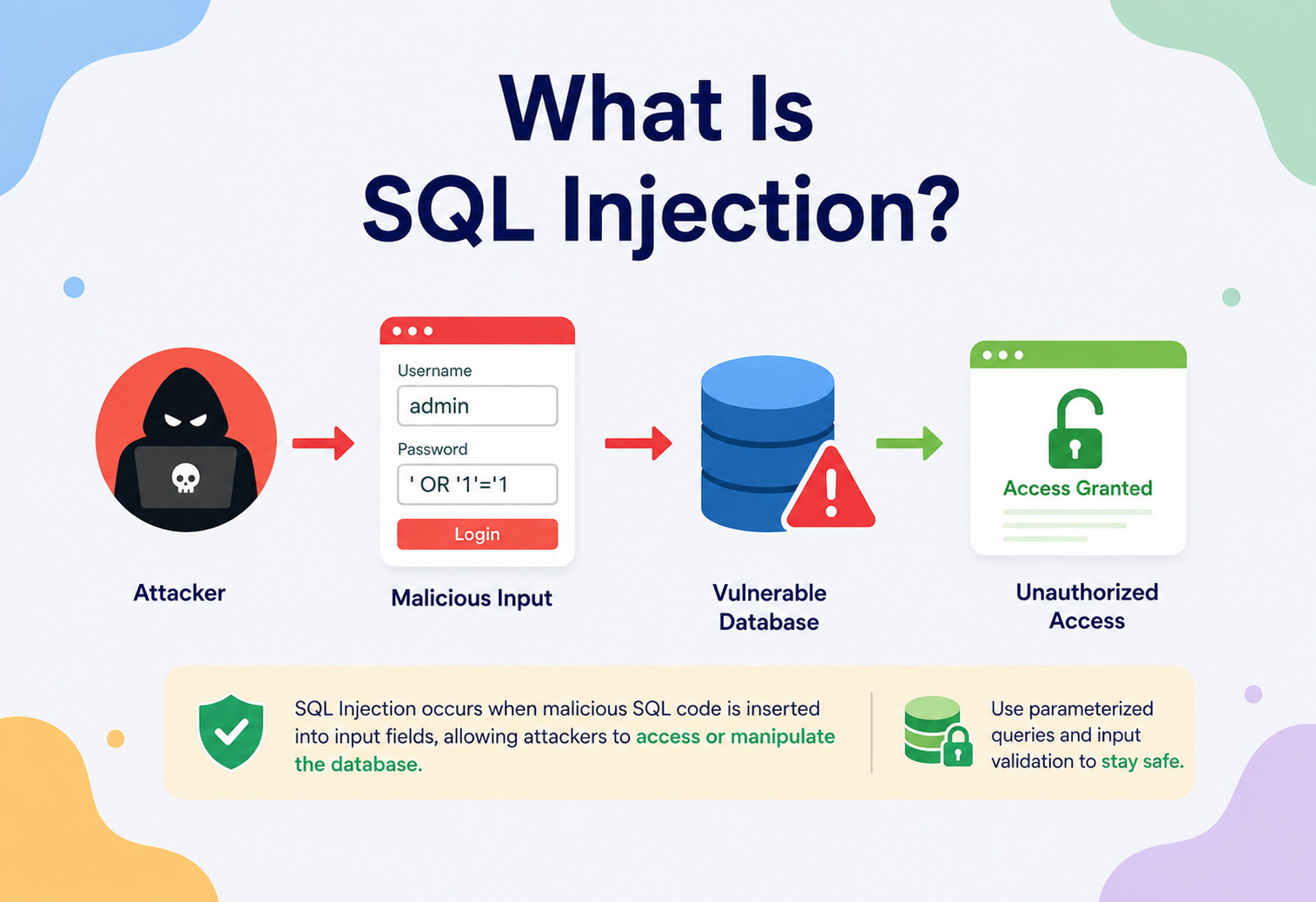
SQL Injection (often abbreviated SQLi) is a code injection technique that attackers use to interfere with the queries an application makes to its database. If an application builds SQL queries by directly stitching together user input and SQL keywords, an attacker can craft input that changes the meaning of the query itself — turning a simple login check into a full database takeover.
Real-life analogy — the too-trusting librarian
Imagine a librarian who accepts a note that says “Please fetch me the book titled: [whatever you write here].” If you write a normal title, you get a normal book. But if you write “Moby Dick; also, hand over every library card and its PIN,” and the librarian blindly follows every instruction written on the note without questioning where the title ends and new commands begin, you have just tricked them into leaking secrets. SQL injection works exactly like that: the “note” is your input, and the “librarian” is the database, unable to tell where your data ends and new commands begin.
1.1 · A SHORT HISTORY
SQL injection is almost as old as the web itself. The technique was first publicly documented around 1998, in a widely circulated article that demonstrated how improperly sanitized input in web forms could be used to manipulate backend SQL queries. Through the early 2000s, as dynamic, database-backed websites exploded in popularity, SQL injection became one of the most exploited vulnerability classes on the internet, responsible for a long list of high-profile data breaches.
Despite being a well-understood problem for over two decades, with well-known and simple fixes, SQL injection has consistently appeared in the OWASP Top 10 list of critical web application security risks, usually folded into the broader “Injection” category. The persistence of SQLi in modern breach reports is not because the fix is unknown — it is because legacy code, rushed development, and a lack of security-by-default habits keep reintroducing the same mistake.
SQL stands for Structured Query Language — the language used to talk to relational databases like MySQL, PostgreSQL, Oracle, and SQL Server. “Injection” means an attacker is slipping their own malicious code into a place where only trusted data was supposed to go.
The Problem & Motivation
Every meaningful web application reads and writes user-owned data through SQL — and every string-concatenated query is a potential foothold for the entire dataset a company has ever collected.
Almost every meaningful web application needs to store and retrieve data — user accounts, orders, messages, inventory. The most common way to do that is a relational database queried with SQL. The problem arises from a very natural, very common programming pattern: building a SQL query as a string by concatenating fixed SQL text with values that come from the user.
2.1 · THE CORE PROBLEM IN ONE SENTENCE
When user-supplied data and SQL code share the same channel (a single string), the database engine has no way of knowing which parts are “data” and which parts are “instructions” — so if the data happens to look like SQL syntax, it gets executed as SQL syntax.
// VULNERABLE: string concatenation builds the SQL query
String username = request.getParameter("username");
String password = request.getParameter("password");

String sql = "SELECT * FROM users WHERE username = '" + username +
             "' AND password = '" + password + "'";

Statement stmt = connection.createStatement();
ResultSet rs = stmt.executeQuery(sql);
If a user types a normal username like gaurav, this works fine. But if an attacker types the following into the username field:
' OR '1'='1' --the resulting query becomes:
SELECT * FROM users WHERE username = '' OR '1'='1' --' AND password = '...'The -- comments out the rest of the query, and '1'='1' is always true, so the query returns every row in the users table — the attacker is logged in as the first user, often the admin, without knowing any password at all.
This is not a theoretical edge case. This exact pattern — string-concatenated SQL in a login form — has been the entry point for some of the largest data breaches in history, exposing millions of credit card numbers, passwords, and personal records.
2.2 · WHY DEVELOPERS KEEP MAKING THIS MISTAKE
- It “just works” in testing. Concatenation is intuitive and passes every happy-path test case.
- Legacy code and copy-paste. Old tutorials and Stack Overflow answers still show vulnerable patterns.
- Dynamic query building for filters and sorting. Search pages with many optional filters tempt developers into string-building shortcuts.
- Trusting “internal” input. Developers sometimes assume admin panels or internal tools do not need the same rigor — but internal tools get breached too.
- ORMs used unsafely. Even modern ORMs allow raw, concatenated queries if a developer isn't careful.
2.3 · THE ECONOMIC MOTIVATION BEHIND THE ATTACK
Understanding why SQL injection remains attractive to attackers, beyond the technical mechanics, helps explain why defenses need to be taken seriously rather than treated as a checkbox. A single successful injection against a database holding customer records can yield thousands to millions of rows of personally identifiable information, payment data, or credentials in one automated pass — a return on effort that few other attack techniques can match, since the entire dataset a company has spent years accumulating can potentially be extracted through one overlooked input field. This asymmetry — a tiny amount of attacker effort against a potentially enormous payoff — is precisely why automated scanning tools that probe the entire internet for common injection patterns are run continuously by both malicious actors and, defensively, by security researchers and bug bounty hunters.
Core Concepts
Trust boundaries, query shape versus query data, and the attacker's mental model — the vocabulary that makes every later section click into place.
3.1 · WHAT EXACTLY IS BEING “INJECTED”?
The attacker injects SQL syntax fragments — quotes, operators like OR, comment markers like -- or /* */, subqueries, or entire additional statements — into a field the application intended to hold plain data, such as a username, a search box, a product ID in a URL, or even an HTTP header or cookie.
3.2 · THE TRUST BOUNDARY
Every application has a trust boundary: the line between “things we control” and “things a user controls.” SQL injection is fundamentally a trust boundary violation — user-controlled data crosses into the “code” territory of a SQL query without being neutralized first.
3.3 · KEY TERMS EXPLAINED FOR BEGINNERS
| Term | What it means | Simple example |
|---|---|---|
| Parameterized query / Prepared Statement | A query where placeholders (?) stand in for values; the database treats those values strictly as data, never as code | SELECT * FROM users WHERE id = ? |
| Sanitization | Cleaning or escaping input so special characters lose their SQL meaning | Turning a single quote ' into '' |
| Input validation | Rejecting input that doesn't match an expected format before it's even used | Only allowing digits for a numeric ID field |
| Least privilege | Giving a database account only the permissions it strictly needs | A reporting service account that can only SELECT, never DROP |
| WAF (Web Application Firewall) | A network-layer filter that blocks requests matching known attack patterns | Blocking any request containing UNION SELECT |
3.4 · EVERY QUERY HAS A “SHAPE” — AND THAT'S WHAT MUST STAY FIXED
Think of a SQL query as having two separate ingredients: a shape (the keywords, table names, column names, and structure — things the developer decides at design time) and values (the actual data a user provides at runtime, like a search term or an ID). A secure application locks the shape at design time and only ever lets user input flow into the value slots. SQL injection is what happens when that boundary is blurred — when a value slot is actually just a spot in a plain string, so anything typed there can bleed into the shape.
Beginner example — the fill-in-the-blank template
Picture a fill-in-the-blank sentence template: “Please give me the record where ID = ____.” If the blank can only ever hold a number, no amount of clever typing can turn it into a new sentence. But if the blank is actually just “whatever text you paste into this larger sentence I'm building,” then typing something like “5; also delete everything” can rewrite the whole sentence's meaning.
3.5 · THE ATTACKER'S MENTAL MODEL
Experienced penetration testers approach every input field with a simple question: “What happens if I put a single quote here?” If the application throws a database error, or behaves differently than expected, that is often the very first signal that the input is being interpreted as part of a SQL query rather than being treated purely as data. This is why even a single unescaped quote character causing a visible error is treated as a serious finding during a security audit — it reveals that the trust boundary between data and code has already been crossed.
3.5.1 · COMMON CHARACTERS AND KEYWORDS ATTACKERS PROBE WITH
| Payload fragment | Purpose |
|---|---|
' (single quote) | Attempts to break out of a quoted string literal |
-- or # | Comments out the remainder of the original query |
OR 1=1 | Forces a WHERE clause condition to always evaluate true |
UNION SELECT | Appends results from an attacker-chosen query to the original result set |
; (semicolon) | Attempts to terminate the current statement and start a new one (stacked queries) |
SLEEP() / WAITFOR DELAY | Introduces a measurable time delay to confirm blind injection conditions |
3.6 · BEGINNER EXAMPLE VS. PRODUCTION EXAMPLE
A student to-do list app
A student building a to-do list app writes "SELECT * FROM todos WHERE id=" + id. Anyone typing 1 OR 1=1 into the ID field sees everyone's to-do items, not just their own.
A production microservice
At the scale of a platform like Netflix, a single unsanitized query parameter in a recommendation or billing microservice could expose or corrupt millions of customer records, which is why large engineering organizations enforce parameterized queries via linting rules, code review gates, and automated static analysis in CI/CD pipelines — not just developer discipline.
Architecture: Types of SQL Injection
In-band, blind, out-of-band, and second-order — six broad variants of the same underlying flaw, differing only in how the attacker gets the answer back.
SQL injection is not a single technique — it is a family of related attacks, categorized by how the attacker extracts information from the database.
4.1 · IN-BAND SQL INJECTION (CLASSIC)
The attacker uses the same communication channel to launch the attack and gather results — typically, the results show up directly in the web page's response.
4.1.1 · UNION-BASED SQLi
Uses the SQL UNION operator to combine the results of the original query with results from an attacker-controlled query, extracting data from other tables entirely.
' UNION SELECT username, password, NULL FROM admin_users --4.1.2 · ERROR-BASED SQLi
The attacker deliberately triggers database error messages that leak information (table names, column names, data values) directly in the application's error output.
4.2 · BLIND SQL INJECTION
The application doesn't return data or error details directly, but the attacker can still infer information indirectly.
4.2.1 · BOOLEAN-BASED BLIND SQLi
The attacker asks the database true/false questions and observes subtle differences in the application's response (e.g., “Welcome back” vs. a generic page).
' AND SUBSTRING(password,1,1)='a' --4.2.2 · TIME-BASED BLIND SQLi
The attacker forces the database to pause for a measurable amount of time only if a condition is true, then infers the answer from response latency.
'; IF (1=1) WAITFOR DELAY '0:0:5' --4.3 · OUT-OF-BAND SQLi
Used when in-band and blind techniques aren't feasible. The attacker triggers the database to make an outbound network request (DNS or HTTP) to a server they control, exfiltrating data through that channel instead of the application's response.
4.4 · SECOND-ORDER SQLi
Malicious input is stored safely at first (e.g., in a user's profile name) but later reused, unsanitized, in a different query elsewhere in the system — the injection “detonates” later, in a different code path than where it was submitted.
| Type | Attacker sees results? | Difficulty | Typical detection |
|---|---|---|---|
| Union-based | Yes, directly | Low | Easy — obvious in logs |
| Error-based | Yes, via error text | Low | Easy — stack traces in responses |
| Boolean-blind | Indirect (page differences) | Medium | Moderate — needs pattern analysis |
| Time-based blind | Indirect (timing) | Medium | Harder — needs latency monitoring |
| Out-of-band | Via external channel | High | Hard — requires DNS/HTTP egress monitoring |
| Second-order | Delayed | High | Hard — requires full data-flow tracing |
Internal Working — How an Injection Actually Executes
Parse-then-bind versus concatenate-then-parse — a single sentence of database internals that explains why prepared statements fix injection categorically rather than statistically.
To understand why prepared statements fix the problem, it helps to understand what happens inside the database engine when it receives a query.
5.1 · QUERY PARSING AND EXECUTION STAGES
Parsing
The database engine reads the raw SQL text and breaks it into tokens (keywords, identifiers, operators, literals).
Parse tree / execution plan
The engine decides how to execute the query — which indexes to use, which tables to scan.
Execution
The plan runs against the actual data, and results are returned.
When you concatenate user input into the query string before parsing happens, the malicious input is tokenized as if it were part of the original developer-written SQL — the database engine has no way to distinguish “the developer wrote this” from “the user snuck this in,” because by the time parsing happens, it is all just one string.
5.2 · WHY PREPARED STATEMENTS FIX THIS AT THE ROOT
A prepared statement flips the order of operations. The SQL structure (with placeholders) is sent to the database and parsed first, producing a fixed execution plan. Only afterward are the actual values sent, in a separate channel, and bound directly into the plan as pure data — they are never re-parsed as SQL syntax.
// SAFE: parameterized query with PreparedStatement
String sql = "SELECT * FROM users WHERE username = ? AND password = ?";

PreparedStatement stmt = connection.prepareStatement(sql);
stmt.setString(1, username);
stmt.setString(2, password);

ResultSet rs = stmt.executeQuery();
Even if username equals ' OR '1'='1' --, it is bound as a single literal string value being compared against the username column — it can never break out of that role and become new SQL syntax.
It helps to be precise about why this holds even for extremely creative payloads. Once the database has compiled the query plan around a placeholder, that placeholder is permanently associated with a specific column and data type. Sending the string ' OR '1'='1' -- as the bound value doesn't cause the engine to re-read it as SQL text at all — it is handled the same way a raw byte sequence would be handled, compared character-for-character against the username column's stored values. This is a fundamentally different code path from string concatenation, where the entire final string is handed to the parser as one blob of “this is all SQL” before any distinction between developer-written code and user-supplied data has been made.
5.3 · SPRING BOOT / JPA EQUIVALENT
// SAFE: Spring Data JPA repository method (auto-parameterized)
public interface UserRepository extends JpaRepository<User, Long> {
    Optional<User> findByUsernameAndPassword(String username, String password);
}

// SAFE: JPQL with named parameters
@Query("SELECT u FROM User u WHERE u.username = :username AND u.password = :password")
Optional<User> authenticate(@Param("username") String username,
@Param("password") String password);Spring Data JPA and Hibernate are safe by default — until a developer uses EntityManager.createNativeQuery() or string-builds a JPQL query with concatenation instead of :namedParam bindings. ORMs reduce risk; they do not eliminate it automatically.
Data Flow & Attack Lifecycle
The request path from browser to database, every checkpoint where a defense can live, and why the query-construction step is the one that matters most.
Understanding the full lifecycle of a request helps identify every point where a defense can be placed.
6.1 · STAGE-BY-STAGE BREAKDOWN
Request submission
The attacker submits a crafted payload through a form field, URL parameter, HTTP header, cookie, or even a file upload's metadata.
Edge filtering (optional)
A WAF or CDN may pattern-match and block obviously malicious payloads before they reach the app.
Application processing
The request hits a controller or handler. If input validation is weak or absent, the raw string proceeds unchanged.
Query construction
This is the critical fork — if the query is built via concatenation, the attack succeeds structurally; if built via parameters, the attack is neutralized here regardless of content.
Database execution
The query (malicious or not) runs against real data with the privileges of the application's database account.
Response construction
Results (or error messages) flow back to the application and, potentially, directly to the attacker's screen — this is where in-band attacks become visible.
The attack payload travels through the entire normal request path — there is no special “hacker channel.” This is exactly why defense-in-depth (WAF + validation + parameterization + least privilege) matters: any single layer might miss something, but the query construction stage is the one layer that, if done correctly, makes the attack structurally impossible regardless of what earlier layers missed.
Defense Approaches: Pros, Cons & Trade-offs
Prepared statements, ORMs, allowlists, escaping, WAFs, least privilege, and stored procedures — not “pick one,” but layers with different strengths and weaknesses.
| Defense | Pros | Cons |
|---|---|---|
| Prepared statements / parameterized queries | Eliminates the root cause; near-zero performance cost; works across all major databases | Must be used consistently everywhere — one raw query anywhere reopens the risk |
| ORM (Hibernate / JPA) | Safe by default for standard CRUD; reduces boilerplate | Native/raw query escape hatches can reintroduce risk; can hide inefficient queries |
| Input validation / allowlisting | Stops malformed input early; improves data quality generally | Not sufficient alone — legitimate-looking input can still be malicious (e.g., valid-format strings with SQL meaning) |
| Escaping special characters | Better than nothing for legacy code that cannot be refactored quickly | Error-prone; different databases escape differently; considered a weak, last-resort defense |
| WAF | Catches known attack signatures without code changes; useful as a stopgap | Signature-based, so novel payloads can bypass it; can produce false positives blocking legitimate traffic; not a substitute for fixing the code |
| Least-privilege DB accounts | Limits blast radius even if injection succeeds | Doesn't prevent the injection itself; requires careful permission management |
| Stored procedures | Can encapsulate logic safely if written with parameters internally | Not automatically safe — a stored procedure that concatenates strings internally is just as vulnerable |
In production systems, these are not “pick one” — they are layered together. Parameterized queries are the non-negotiable foundation; everything else (WAF, validation, least privilege, monitoring) is defense-in-depth around that foundation.
Performance & Scalability of Defenses
Safe query patterns are almost always faster, not slower — and the systems that hold up best under active scanning campaigns are the ones designed to shed hostile traffic without hurting legitimate users.
A common (and incorrect) hesitation developers have is worrying that “safe” query patterns are slower. In reality, the opposite is usually true.
8.1 · PREPARED STATEMENTS OFTEN IMPROVE PERFORMANCE
Because the query structure is parsed and compiled once, many database engines can cache the execution plan and reuse it across repeated calls with different parameter values — avoiding the cost of re-parsing and re-planning identical query shapes on every call. Under high load, this caching effect can noticeably reduce CPU overhead on the database server compared to sending a slightly different literal string every time (which busts query plan caches).
8.2 · CONNECTION POOLING AND STATEMENT CACHING
Production systems combine prepared statements with connection pools (like HikariCP in Spring Boot) that maintain a pool of live database connections, and many JDBC drivers additionally cache compiled PreparedStatement objects per connection, avoiding repeated compilation overhead entirely for frequently-run queries.
# application.yml -- HikariCP tuning example
spring:
  datasource:
    hikari:
      maximum-pool-size: 20
      minimum-idle: 5
      connection-timeout: 30000
      # Enable server-side prepared statement caching (PostgreSQL example)
      data-source-properties:
        prepareThreshold: 3
        preparedStatementCacheQueries: 256
8.3 · WAF PERFORMANCE CONSIDERATIONS
WAFs add a small amount of latency per request since every payload must be pattern-matched against a rule set. At scale, this is usually negligible (single-digit milliseconds) when the WAF runs at the edge or CDN layer, but overly broad or poorly tuned rule sets can meaningfully increase latency and false-positive rates under very high request volumes.
8.4 · SCALABILITY UNDER ATTACK TRAFFIC
A well-defended system should scale gracefully even while actively under an injection scanning campaign. Rate limiting at the API gateway or load balancer layer, combined with a WAF that can auto-block IPs generating a high volume of malformed or flagged requests, prevents automated scanning tools from consuming a disproportionate share of application and database capacity that legitimate users depend on. This is an important distinction from purely functional scalability: the system is not just scaling to serve more legitimate traffic, it is scaling its ability to absorb and shed hostile traffic without that hostile traffic degrading service for everyone else.
High Availability & Reliability Considerations
Injection is not just a confidentiality risk — destructive queries, resource exhaustion, and cascading pool starvation put availability directly in the crosshairs.
SQL injection is not just a confidentiality risk (stealing data) — successful injections can also threaten availability and reliability.
9.1 · AVAILABILITY RISKS FROM SQLi
- Destructive queries: a successful injection with sufficient privileges can execute
DROP TABLEorDELETEstatements, destroying production data. - Resource exhaustion: time-based blind injection techniques deliberately run expensive queries (like
WAITFOR DELAYor heavy subqueries) that can tie up database connections and degrade service for legitimate users. - Cascading failures: in a microservices architecture, a database under injection-induced load can exhaust its connection pool, which can cascade into timeouts and failures across every downstream service that depends on it.
9.2 · RELIABILITY PRACTICES THAT ALSO REDUCE INJECTION BLAST RADIUS
- Read replicas with restricted write access: reporting and analytics queries run against a replica whose database account has no write permissions, so even a successful injection there cannot alter production data.
- Automated backups and point-in-time recovery: ensures that even a destructive injection can be recovered from without permanent data loss.
- Circuit breakers on the database client: prevent a single overloaded query (malicious or not) from exhausting the whole connection pool and taking down the entire application.
- Query timeouts: capping how long any single query is allowed to run limits the effectiveness of time-based blind injection and protects overall throughput.
// Setting a query timeout in Spring Data JPA
@QueryHints(@QueryHint(name = "javax.persistence.query.timeout", value = "3000"))
@Query("SELECT p FROM Product p WHERE p.category = :category")
List<Product> findByCategory(@Param("category") String category);Security Deep Dive — Preventing SQL Injection
Ten concrete layers, from parameterized queries and input validation to code review, SAST, and secure error handling — how real production systems stack defenses around every database call.
This is the heart of the guide. Below are the concrete, layered techniques used in real production systems.
10.1 · LAYER 1 — PARAMETERIZED QUERIES EVERYWHERE (NON-NEGOTIABLE)
Every single place a query touches user-controlled data must use a parameterized query, prepared statement, or a safe ORM API. No exceptions, no “just this once” raw concatenation for a quick internal tool.
10.1.1 · HANDLING DYNAMIC SORTING / FILTERING SAFELY
A common gray area: what about a page where the user picks the sort column, e.g. ?sortBy=price? You cannot parameterize a column or table name (placeholders only work for values, not identifiers) — so the correct fix is allowlisting:
// SAFE: allowlist approach for dynamic sort column
private static final Set<String> ALLOWED_SORT_COLUMNS =
    Set.of("price", "name", "created_at");

public List<Product> search(String sortBy) {
    String column = ALLOWED_SORT_COLUMNS.contains(sortBy) ? sortBy : "name";
    // column is now guaranteed to be one of our known-safe literals
    String sql = "SELECT * FROM products ORDER BY " + column;
    return jdbcTemplate.query(sql, productRowMapper);
}
10.2 · LAYER 2 — INPUT VALIDATION
Validate the shape of input as early as possible: numeric fields should be parsed as numbers (not strings), emails should match an email pattern, IDs should match a UUID or integer pattern. This will not stop all injection on its own, but it shrinks the attack surface and catches malformed input before it reaches business logic.
// Bean Validation example in a Spring Boot DTO
public class SearchRequest {
    @Pattern(regexp = "^[a-zA-Z0-9 ]{1,100}$", message = "Invalid search term")
    private String query;

    @Min(1)
    @Max(1000)
    private Integer productId;
}
10.3 · LAYER 3 — LEAST PRIVILEGE DATABASE ACCOUNTS
The application's database user should never be a superuser. A typical production setup separates accounts by responsibility:
| Account | Permissions | Used by |
|---|---|---|
| app_read_write | SELECT, INSERT, UPDATE, DELETE on application tables only | Main application service |
| app_read_only | SELECT only, on a read replica | Reporting / analytics service |
| migration_admin | DDL permissions (CREATE, ALTER, DROP) | CI/CD migration pipeline only, never the running app |
Even in a worst-case successful injection, an attacker limited to app_read_write permissions cannot drop tables, alter schemas, or read tables outside the application's own schema.
10.4 · LAYER 4 — WAF (DEFENSE-IN-DEPTH, NOT A SUBSTITUTE)
A WAF (such as AWS WAF, Cloudflare, or ModSecurity) inspects incoming requests for known SQL injection signatures — suspicious keywords like UNION SELECT, stacked semicolons, or common comment sequences — and blocks them before they reach the application. This buys time to patch vulnerable code and catches automated scanning tools, but should never be the only line of defense, since novel or obfuscated payloads can slip past signature matching.
10.5 · LAYER 5 — STORED PROCEDURES DONE CORRECTLY
Stored procedures can be safe if, internally, they also use bind parameters rather than concatenating strings. A stored procedure that builds dynamic SQL with string concatenation internally is just as vulnerable as application code doing the same thing.
10.6 · LAYER 6 — ORM-SPECIFIC SAFE PATTERNS
// SAFE: JPA Criteria API (fully parameterized, type-safe)
CriteriaBuilder cb = entityManager.getCriteriaBuilder();
CriteriaQuery<User> query = cb.createQuery(User.class);
Root<User> root = query.from(User.class);
query.select(root).where(cb.equal(root.get("username"), username));
List<User> results = entityManager.createQuery(query).getResultList();

// UNSAFE: native query built via string concatenation -- avoid this
String unsafeSql = "SELECT * FROM users WHERE username = '" + username + "'";
entityManager.createNativeQuery(unsafeSql, User.class); // DO NOT DO THIS
10.7 · LAYER 7 — SECURE ERROR HANDLING
Never expose raw database error messages, stack traces, or SQL text to end users — this is exactly what fuels error-based SQLi. Production systems should catch database exceptions and return generic error messages to the client while logging full details securely on the server side.
@ControllerAdvice
public class GlobalExceptionHandler {
    @ExceptionHandler(DataAccessException.class)
    public ResponseEntity<ErrorResponse> handleDbError(DataAccessException ex) {
        log.error("Database error", ex); // full detail logged internally
        return ResponseEntity.status(500)
            .body(new ErrorResponse("An unexpected error occurred")); // generic to client
    }
}
10.8 · LAYER 8 — CONTENT SECURITY BEYOND THE QUERY ITSELF
Secure query construction is necessary but not sufficient on its own; a production-grade security posture also considers what happens after data is retrieved. Data pulled from the database that originated from another user's input (e.g., a product review, a display name) should be treated as untrusted when rendered back into HTML, to avoid a related-but-distinct vulnerability class, cross-site scripting (XSS). While XSS and SQL injection are different vulnerabilities, they share the same root lesson: never trust data simply because it came from “your own” database, since it may have entered that database as someone else's unsanitized input.
10.9 · LAYER 9 — PEER CODE REVIEW FOCUSED ON DATA ACCESS
Many engineering organizations maintain a lightweight checklist reviewers apply specifically to any pull request touching a repository, DAO, or data-access class: does every method use parameter binding; are any native or raw queries introduced, and if so, why; are any new dynamic identifiers (table/column names) introduced, and if so, are they allowlisted. Treating data-access code changes as a distinct review category — rather than reviewing them the same way as, say, a CSS change — meaningfully reduces the rate at which unsafe patterns slip through.
10.10 · LAYER 10 — AUTOMATED SECURITY TESTING
- Static Application Security Testing (SAST): tools that scan source code for patterns like raw string concatenation feeding into SQL execution calls, catching issues before code merges.
- Dynamic Application Security Testing (DAST): automated scanners that send injection payloads against a running staging environment to catch issues that static analysis might miss.
- Dependency scanning: outdated JDBC drivers or ORM versions can carry their own vulnerabilities.
Monitoring, Logging & Metrics
Database error spikes, latency outliers, WAF block trends, failed-auth clusters — the signals that reveal an attacker actively probing your system right now.
Prevention reduces risk but detection is what catches the attacks that slip through — or reveals that an attacker is actively probing your system right now.
11.1 · WHAT TO LOG
- All database errors, with enough context (query template, not raw values) to investigate without exposing sensitive data in logs.
- Authentication failures and unusual login patterns (many failed logins from one IP in a short window).
- WAF block events — every blocked request is a signal, and spikes indicate active scanning.
- Slow query logs — unusually slow queries can indicate time-based blind injection attempts.
11.2 · METRICS WORTH TRACKING
| Metric | Why it matters |
|---|---|
| Database error rate per endpoint | A sudden spike on one endpoint often indicates active probing |
| P99 query latency | Time-based blind injection attempts show up as latency outliers |
| WAF block rate | Trend over time reveals scanning campaigns |
| Failed auth attempts per IP/user | Correlates with credential-stuffing and injection-based login bypass attempts |
| Query plan cache hit rate | Unexpected drops can indicate an influx of unusual, dynamically-built queries |
11.3 · CORRELATION IDs AND TRACING
In a microservices architecture, attach a correlation ID to every incoming request and propagate it through every downstream service call and database query log. When investigating a suspicious database error, this lets security teams trace the exact chain of services and the original request payload that triggered it — critical for distinguishing an application bug from an active attack.
// Adding a correlation ID via a Spring interceptor
public class CorrelationIdFilter extends OncePerRequestFilter {
    @Override
    protected void doFilterInternal(HttpServletRequest req, HttpServletResponse res,
                                     FilterChain chain) throws ServletException, IOException {
        String correlationId = req.getHeader("X-Correlation-ID");
        if (correlationId == null) correlationId = UUID.randomUUID().toString();
        MDC.put("correlationId", correlationId);
        try {
            chain.doFilter(req, res);
        } finally {
            MDC.clear();
        }
    }
}Never log raw parameter values that might contain sensitive data (passwords, tokens, PII) alongside injection attempt logs — you do not want your security logs to themselves become a data breach liability. Log the query template and a redacted or hashed version of suspicious inputs instead.
Deployment & Cloud Considerations
Managed WAFs, secrets managers, CI/CD security gates, private subnets, Kubernetes network policies, and infrastructure-as-code — the operational scaffolding that keeps injection risk low across environments.
12.1 · CLOUD-MANAGED WAF OPTIONS
Major cloud providers offer managed WAF services (AWS WAF, Azure Front Door WAF, Google Cloud Armor) with pre-built SQL injection rule sets that are continuously updated by the vendor, removing the operational burden of maintaining custom signature rules.
12.2 · SECRETS AND CONNECTION STRINGS
Database credentials should never be hardcoded or committed to source control. Production deployments typically pull credentials from a secrets manager (AWS Secrets Manager, HashiCorp Vault, Azure Key Vault) at startup or runtime, and rotate them periodically — limiting the damage window if credentials ever leak.
# Spring Boot pulling DB credentials from environment (populated by secrets manager)
spring:
  datasource:
    url: jdbc:postgresql://${DB_HOST}:5432/${DB_NAME}
    username: ${DB_USERNAME}
    password: ${DB_PASSWORD}
12.3 · CI/CD SECURITY GATES
Production-grade pipelines block a deployment if SAST tooling flags a new raw SQL concatenation pattern, treating SQL injection risk the same way a build-breaking test failure is treated — as a hard gate, not just a warning.
12.4 · NETWORK SEGMENTATION
Databases should sit in a private subnet with no direct public internet access, reachable only from application servers within the same VPC — meaning even if application-layer defenses somehow failed, the database itself is not a direct internet-facing target.
12.5 · CONTAINER AND ORCHESTRATION CONSIDERATIONS
When applications run in containers orchestrated by Kubernetes, database credentials are typically injected as Kubernetes Secrets mounted as environment variables or files, rather than baked into container images. Network policies at the cluster level can further restrict which pods are even allowed to establish a connection to the database service, adding another segmentation layer beyond the cloud provider's VPC boundary. This matters for injection specifically because it limits what an attacker can reach even if they achieve some level of code execution within a compromised container — the blast radius stays contained to whatever that specific pod's network policy allows.
12.6 · INFRASTRUCTURE-AS-CODE AND DRIFT PREVENTION
Defining database security groups, IAM roles, and WAF rules as infrastructure-as-code (using tools like Terraform) rather than through manual console changes ensures that security configurations are version-controlled, peer-reviewed, and consistently reproducible across environments — preventing the common real-world failure mode where a staging environment's looser security settings accidentally get promoted to production, or where a manually-applied production hotfix quietly weakens a security group rule and is never reverted.
Databases, Caching & Load Balancing Angle
The core flaw looks the same across MySQL, PostgreSQL, Oracle, and SQL Server — only the exact attack syntax differs, and only parameterization neutralizes all of them uniformly.
13.1 · DOES INJECTION RISK DIFFER ACROSS DATABASE ENGINES?
The core vulnerability pattern (unsafe query construction) is identical across MySQL, PostgreSQL, Oracle, SQL Server, and others — but the exact attack syntax (comment styles, time-delay functions, stacked query support) varies slightly per engine. Parameterized queries neutralize the risk consistently across all of them, which is one more reason to standardize on that approach rather than engine-specific escaping tricks.
13.2 · CACHING LAYERS AND INJECTION
Caches (like Redis) sitting in front of a database do not prevent injection, but they change the blast radius: a successful injection against the database can poison cached results that get served to many users afterward. Cache keys derived from unsanitized user input can also become their own injection-adjacent vector if not validated (e.g., cache poisoning).
13.3 · LOAD BALANCERS AND WAF PLACEMENT
In a typical production topology, the WAF sits at or near the load balancer or CDN edge, inspecting traffic before it is distributed to application instances — this centralizes injection-pattern detection in one place rather than duplicating it across every service.
13.4 · READ REPLICAS AND THE ILLUSION OF SAFETY
Teams sometimes assume that because analytics or reporting dashboards query a read replica rather than the primary database, injection risk there is somehow less important. While a read-only replica does limit an attacker to data theft rather than data destruction (since write commands will simply fail against a read-only connection), the confidentiality impact of a successful injection against a replica holding a full copy of production data is just as severe as one against the primary — the same parameterization and least-privilege rules apply equally to both.
13.5 · DATABASE CONNECTION POOLING AND INJECTION-DRIVEN EXHAUSTION
Connection pools like HikariCP maintain a fixed maximum number of concurrent database connections. A blind time-based injection attempt that deliberately holds a connection open for several seconds per request, if launched at scale or repeated rapidly, can exhaust the entire pool, causing every other legitimate request in the application to queue and eventually time out. This is why query timeouts (Section 9.2) and connection pool monitoring are as much a part of the SQL injection defense story as the query construction itself — they bound the damage a single slow, malicious query can inflict on overall system health.
APIs & Microservices
REST JSON, GraphQL, gRPC, headers, cookies, message queues — injection travels every channel that ends in a database call, and internal-service trust does not neutralize it.
14.1 · INJECTION RISK IS NOT LIMITED TO WEB FORMS
Any input channel can carry an injection payload: REST API JSON bodies, GraphQL query variables, gRPC message fields, HTTP headers, cookies, and even file names in multipart uploads. Every microservice that touches a database independently needs its own parameterized-query discipline — there is no single “one fix covers everything” boundary in a distributed system.
14.2 · API GATEWAY-LEVEL PROTECTION
API gateways can apply schema validation (e.g., OpenAPI or JSON Schema) to reject malformed request bodies before they reach any backend service, adding a validation layer that works across every microservice behind the gateway uniformly.
# OpenAPI schema constraining a field to prevent obviously malformed input
properties:
  productId:
    type: integer
    minimum: 1
    maximum: 999999
14.3 · SERVICE-TO-SERVICE TRUST IS NOT A FREE PASS
In microservices architectures, it is tempting to treat data coming from an internal service as “already trusted.” But if Service A passes through unsanitized user input to Service B without revalidating it, Service B's database call is just as exposed — internal network boundaries do not neutralize injection risk, since the malicious string is still present in the payload.
14.4 · GRAPHQL-SPECIFIC CONSIDERATIONS
GraphQL resolvers ultimately still translate a query into some form of database call, and the same rules apply: resolver implementations must use parameterized queries or safe ORM calls when they take a GraphQL argument and use it to fetch data. A common mistake in GraphQL APIs is a resolver that accepts a free-form “filter” argument and builds a raw SQL WHERE clause from it directly, which is functionally identical to a vulnerable REST endpoint — the injection surface simply moved to a different protocol.
14.5 · MESSAGE QUEUES AND ASYNCHRONOUS PROCESSING
Data does not only reach a database through synchronous HTTP request handling. In event-driven architectures, a message consumed from a queue (like Kafka or RabbitMQ) may eventually be used to build a database query in a downstream consumer service. Because that data may have originated, several hops earlier, from an end user's original request, the same parameterization discipline applies to queue consumers as it does to HTTP controllers — asynchronous processing does not imply the data has become any more trustworthy along the way.
Design Patterns & Anti-patterns
Repository / DTO / allowlist / defense-in-depth versus the six recurring anti-patterns every audit keeps finding.
15.1 · GOOD PATTERNS
Repository Pattern
Centralizes all database access behind repository interfaces (like Spring Data JPA repositories), making it easy to enforce parameterized-query usage consistently and audit database access in one place.
DTO / Data Transfer Object
Separates raw request input from domain or database objects, giving a natural place to apply validation before data ever reaches a query.
Allowlist Pattern
For anything that cannot be parameterized directly (column names, table names, sort direction), match user input against a fixed, known-safe set of values.
Defense in Depth
Layering validation, parameterization, least privilege, WAF, and monitoring so that no single failure point results in a full breach.
15.2 · ANTI-PATTERNS TO AVOID
- Dynamic SQL via string concatenation — the root cause of nearly all SQL injection.
- Blacklist-based sanitization — trying to filter out “bad” characters or keywords is a losing game, since attackers constantly find encoding tricks and syntax variations that bypass blacklists.
- “We'll fix it later” raw queries in admin tools — internal tools get compromised too, often via a compromised employee account or an SSRF chain.
- Trusting client-side validation alone — client-side checks are a UX nicety, not a security control, since attackers can bypass the browser entirely and call the API directly.
- Overly permissive database accounts — using a single superuser account for the whole application removes the safety net of least privilege.
- Verbose error messages in production — leaking stack traces and SQL text directly hands attackers a roadmap.
Best Practices & Common Mistakes
Eleven checklist items, four mental questions to ask every new endpoint, and the six mistakes audits actually keep finding — ranked by frequency.
16.1 · BEST PRACTICES CHECKLIST
- Use parameterized queries or prepared statements for every query touching user input, with no exceptions.
- Prefer ORM-managed queries (JPQL, Criteria API, Spring Data derived queries) over native or raw SQL wherever practical.
- Validate and constrain input shape (type, length, format, range) as early as possible.
- Allowlist dynamic identifiers (column and table names) that cannot be parameterized.
- Apply least-privilege database accounts, separated by service responsibility.
- Never expose raw database errors or stack traces to end users.
- Deploy a WAF as an additional layer, not a replacement for secure code.
- Run SAST and DAST scans in CI/CD and treat findings as build-blocking issues.
- Log and monitor database errors, slow queries, and WAF blocks with alerting thresholds.
- Rotate database credentials and store them in a secrets manager, never in source control.
- Conduct periodic penetration testing and code review focused specifically on data-access layers.
16.2 · A SHORT MENTAL CHECKLIST FOR EVERY NEW ENDPOINT
Before merging any code that reads a value from a request and eventually uses it in a database call, it is worth walking through four quick questions: Where does this query touch user input, and is that input bound as a parameter rather than concatenated into the SQL string? If a table or column name is dynamic, is it checked against a fixed allowlist rather than accepted as free text? If this query fails, what exact message reaches the end user — and does it leak anything about the query's structure or the database schema? And finally, does the database account executing this query have any permission beyond what this specific operation actually needs? Making this a five-second habit, rather than a periodic audit exercise, is what actually keeps injection risk low over the long life of a codebase, since most vulnerabilities are introduced gradually, one rushed feature at a time, rather than all at once.
16.3 · COMMON MISTAKES, RANKED BY AUDIT FREQUENCY
| Mistake | Risk level | Fix |
|---|---|---|
| String-concatenated queries in “quick” admin or reporting tools | High | Apply the same parameterization standard everywhere, no exceptions for internal tools |
| Raw native queries inside an otherwise-safe JPA codebase | High | Code review checklist item + SAST rule specifically for createNativeQuery with concatenation |
| Dynamic ORDER BY / column names built via concatenation | Medium | Allowlist approach shown in Section 10.1 |
| Overly detailed error messages returned to clients | Medium | Global exception handler returning generic messages, full detail logged server-side only |
| Single shared superuser DB account across all services | High | Split into least-privilege accounts per service or responsibility |
| No automated scanning in CI/CD | Medium | Add SAST / DAST gates before merge or deploy |
Real-World / Industry Examples
Why large organizations still get hit, the recognizable arc of a public post-mortem, and the industry response playbook that has quietly converged over the last decade.
SQL injection has been the root cause or a contributing factor in numerous major security incidents over the past two decades, spanning retail, finance, government, and telecom sectors. While exact technical post-mortems vary by incident and are best verified against primary breach-disclosure reports, the pattern across the industry is consistent: attackers found a single unparameterized query — often in a search feature, a login form, or a legacy admin panel — and used it as the initial foothold to move laterally through internal systems, exfiltrate customer databases, or in some cases install additional malware for long-term persistence.
17.1 · WHY LARGE ORGANIZATIONS STILL GET HIT
- Sprawling legacy systems: large enterprises often run hundreds of internal applications, some decades old, where consistent secure coding standards were never enforced.
- Third-party and vendor software: injection vulnerabilities in purchased or vendor-integrated software are outside the direct control of the affected company's engineering team.
- Shadow IT and unofficial tools: internal tools built quickly by non-security-focused teams often skip the same rigor applied to customer-facing applications.
17.2 · THE TYPICAL ANATOMY OF A BREACH THAT STARTS WITH SQLi
Publicly disclosed post-mortems across the industry tend to follow a recognizable arc: reconnaissance (attackers scan large numbers of websites for common vulnerable patterns, often using automated tools rather than manually targeting one company), initial foothold (a single vulnerable parameter is found, frequently in a lesser-used feature like a legacy search page or an old admin subdomain that security teams were not actively monitoring), privilege escalation (once inside the database, attackers look for stored credentials, API keys, or session tokens that let them move to other systems), and exfiltration (data is copied out slowly, sometimes over weeks, specifically to avoid triggering volume-based alerting thresholds). Understanding this arc is why monitoring (Section 11) matters as much as prevention — the goal is not just to stop the initial injection but to detect and contain an attacker who does get through.
17.3 · INDUSTRY RESPONSE PATTERNS
In response to repeated incidents, mature engineering organizations (in patterns publicly described by companies like Netflix, Amazon, and large financial institutions in their engineering blogs and conference talks) have converged on a common playbook: mandatory parameterized queries enforced via static analysis, centralized data-access layers or repositories that make unsafe patterns harder to accidentally introduce, regular penetration testing, bug bounty programs incentivizing external researchers to find and responsibly disclose injection flaws, and security champions embedded within individual engineering teams rather than security being a purely centralized function.
Card-data breaches
Retail POS and e-commerce backends have been repeatedly compromised through single vulnerable query parameters in search or checkout flows, exposing millions of payment-card records in one automated pass.
Legacy admin subdomains
Financial-services incidents disclosed publicly often trace back to a decade-old internal admin panel that never received the parameterization retrofit applied to the flagship customer app.
Voter and citizen registries
Government portals holding sensitive citizen data have been breached via unsanitized URL parameters in search or lookup features, spilling millions of PII rows attacker-side.
Customer-service portals
Telecom operators have suffered breaches where injection in an internal customer-service search UI let attackers extract subscriber records at scale.
Multi-tenant data leakage
In shared-database SaaS platforms, an injection in one tenant's search or filter endpoint can, without row-level security and least-privilege accounts, leak data from every other tenant on the same database.
The technical fix for SQL injection has been well understood since prepared statements became widely available in the early 2000s. What separates organizations that get breached from those that do not is almost always process — code review discipline, automated tooling, and organizational culture — not a lack of awareness of the vulnerability itself.
FAQ, Summary & Key Takeaways
Nine questions every real interviewer and every real security review asks, the one-paragraph summary, and the six lessons worth memorising.
Is SQL injection still relevant in 2026 with modern ORMs?
Yes. ORMs dramatically reduce risk for standard CRUD operations, but native or raw query escape hatches, dynamic identifiers (like sort columns), and legacy code paths remain common sources of injection even in modern, ORM-based codebases.
Can input validation alone prevent SQL injection?
No. Validation reduces the attack surface and catches malformed input, but well-formed strings can still carry SQL meaning. Parameterized queries are the only defense that removes the vulnerability at its structural root.
Does using a NoSQL database eliminate this risk?
It changes the syntax but not the underlying pattern. NoSQL databases have their own analogous injection risks (commonly called NoSQL injection) when queries are built by concatenating or unsafely interpolating user input into query objects or JavaScript expressions.
Is a WAF enough on its own?
No. A WAF is a valuable additional layer that catches known attack signatures, but it should never be the sole defense — it can be bypassed by novel or obfuscated payloads and does not fix the underlying vulnerable code.
What is the single highest-leverage fix a team can make today?
Audit every database call in the codebase for string-concatenated SQL and convert it to parameterized queries or safe ORM calls, then add a static analysis rule in CI/CD to prevent regressions.
Do I need to worry about SQL injection if I only use an ORM and never write raw SQL?
Your risk is dramatically lower, but not zero. Watch specifically for dynamic sorting or filtering built from user-selected column names, any use of native or raw query escape hatches, and any place a query is built by concatenating strings before being passed to the ORM, even if the ORM itself is “safe” in isolation.
How do penetration testers find SQL injection during an audit?
Typically through a mix of manual testing (trying special characters like quotes in every input field and observing error behavior or timing changes) and automated scanning tools that systematically send a large library of known injection payloads against every discovered input point, then flag responses that indicate the payload had an effect.
Is it safe to only sanitize input on the frontend (JavaScript) before sending it to the server?
No. Frontend validation only improves the experience for well-behaved users; an attacker can bypass the browser entirely and send crafted requests directly to the API using tools like curl or a proxy, so all real security enforcement must happen on the server side, at the point the query is constructed.
Can SQL injection lead to remote code execution on the server itself, not just the database?
In some configurations, yes. Certain database engines support functionality that can execute operating-system commands or write files to disk when invoked with sufficiently high privileges, which is one more reason least-privilege database accounts (Section 10.3) are a critical layer, not an optional extra.
18.1 · SUMMARY
SQL injection remains one of the most consequential and persistent vulnerabilities in software engineering because it exploits a simple, fundamental gap: mixing untrusted data and executable code in the same string. The fix — parameterized queries — has existed for decades and carries essentially no performance downside, yet the vulnerability continues to appear because of legacy code, inconsistent enforcement, and the many different input channels (forms, APIs, headers, internal tools) that all need the same discipline applied uniformly.
18.2 · KEY TAKEAWAYS
- SQL injection happens when user input is allowed to alter the structure of a SQL query, not just its data values.
- Parameterized queries and prepared statements fix the problem at its root by separating query structure from query data at the database engine level.
- Input validation, least privilege, WAFs, and monitoring are essential complementary layers — but none of them alone replaces parameterized queries.
- Injection risk exists across every input channel — forms, REST or GraphQL APIs, headers, cookies, and internal tools — not just public-facing search boxes.
- Detection (logging, metrics, correlation IDs) matters because prevention is never 100% guaranteed across a large, evolving codebase.
- Organizational process — code review, CI/CD security gates, and a security-first culture — is ultimately what prevents SQL injection at scale, more than any single tool.