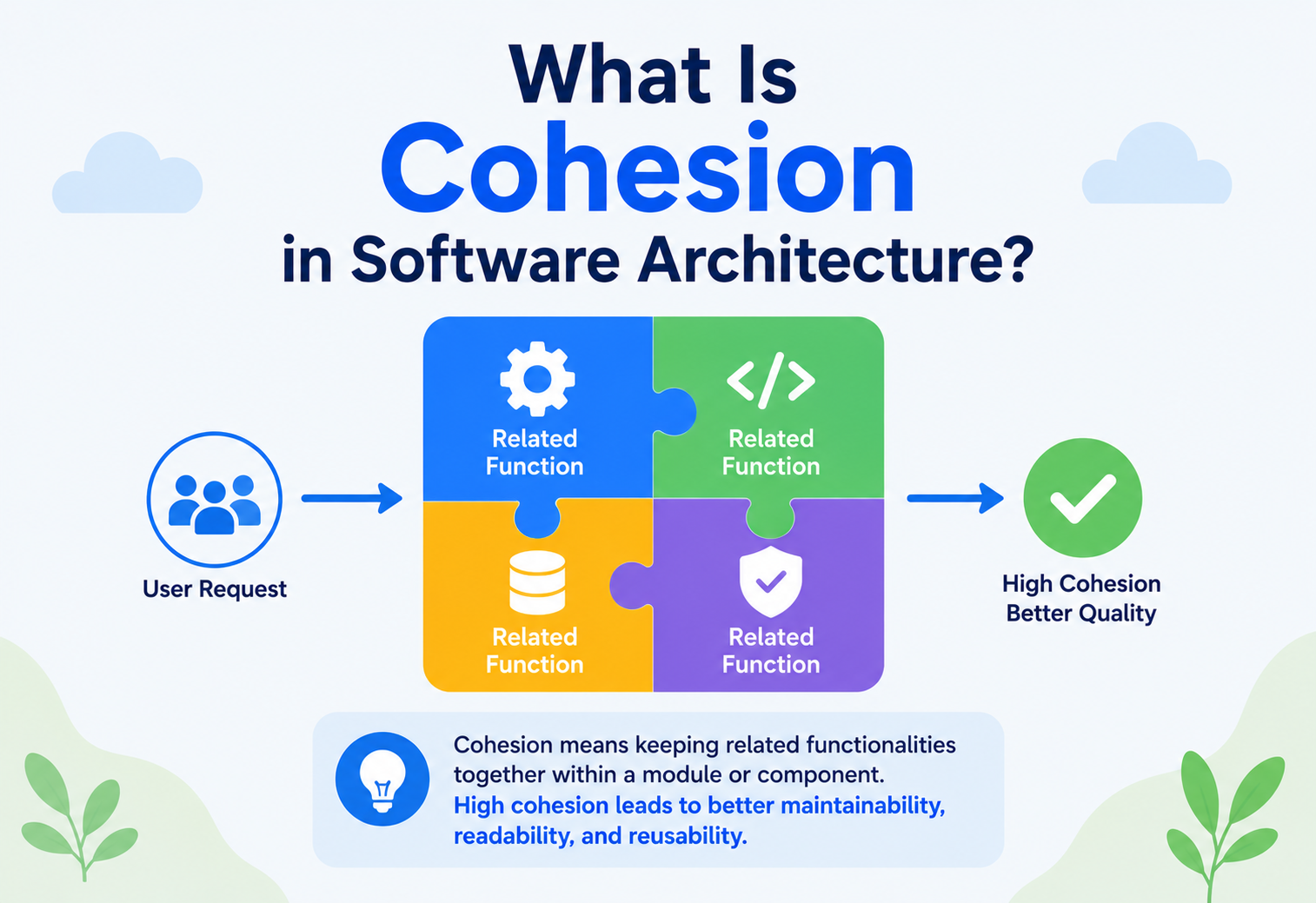
What Is Cohesion in Software Architecture?
A drawer full of nothing but forks feels obvious the moment you open it. A drawer full of forks, batteries, rubber bands, and an old birthday candle does not. This guide unpacks cohesion — the quiet quality that decides whether a piece of software behaves like the first drawer or the second.
The Big Idea, in One Breath
Open a kitchen drawer full of nothing but forks and you already know what it is for. Open a junk drawer full of anything at all and you don’t. That gap — between the two drawers — is what cohesion is really about.
Pull open a kitchen drawer that contains nothing but forks, and you instantly know what it is for. You don’t need to think, search, or guess — every single object inside belongs there, and nothing that doesn’t belong is taking up space. Now pull open a “junk drawer” instead: a tangle of forks, rubber bands, old batteries, and a lone mystery key that fits no lock anyone remembers owning. Finding anything useful in that drawer takes noticeably longer, and it is never quite clear what new item is or isn’t allowed to join the pile.
Software has drawers of exactly this kind, and how neatly the things inside each one belong together is called cohesion. A highly cohesive piece of code — a function, a class, a module — is the fork drawer: everything inside works toward one clear purpose. A poorly cohesive piece of code is the junk drawer: a grab-bag of loosely related, sometimes entirely unrelated responsibilities, all crammed into the same place simply because it was convenient at the time.
Picture a well-organised toolbox next to a chaotic one. In the well-organised box, the screwdriver compartment holds only screwdrivers — nothing else sneaks in. In the chaotic box, screwdrivers, nails, a phone charger, and a half-eaten snack all share the same space. Both boxes technically hold “stuff,” but only one of them lets you grab exactly what you need without first digging through everything else. That is the entire idea of cohesion, borrowed from a toolbox and applied to code.
What makes cohesion worth understanding deeply is that it is often the very first clue a system quietly gives away about its own health. Long before a bug shows up or a deadline slips, a low-cohesion class announces itself through an awkward name, a strange list of unrelated methods, or a class that somehow needs editing for almost every new feature request, no matter how unrelated that feature seems. Learning to spot that early warning sign is one of the most valuable habits an engineer can develop.
What Cohesion Really Is
A precise definition, plus a one-sentence test you can apply to any function, class, module, or service in less than ten seconds.
Formally, cohesion measures how closely and purposefully the responsibilities inside a single unit of code — a function, a class, a module, even a whole service — belong together. A highly cohesive unit does one clear job, and everything inside it directly supports that one job. A poorly cohesive unit does several loosely related, sometimes entirely unrelated jobs at once, bundled together more by accident or convenience than by genuine purpose.
It helps to think of cohesion as the answer to one simple question: “if I described what this piece of code is responsible for, could I do it in one clear sentence, without leaning on the word and more than once?” A shopping cart class that “adds items, removes items, and calculates the total” passes that test comfortably — every piece genuinely belongs to the idea of “managing a cart.” A class that “manages the cart, sends marketing emails, and logs website traffic” clearly does not.
If someone asks “what is cohesion?”, the honest answer is: it is how well the things living inside one piece of code actually belong together, and how clearly that piece can explain what it exists to do.
It is worth noting that cohesion was originally described by researchers studying what made older programs easy or difficult to maintain, well before it became a common word in day-to-day engineering conversation. Their finding was refreshingly simple: programs built from focused, single-purpose pieces were consistently easier to fix and extend than programs built from sprawling, multi-purpose ones — a finding that has aged remarkably well across every new programming language and architectural style that has come along since.
Why This Idea Matters So Much
Cohesion shows up everywhere you look: naming, testing, reuse, onboarding, safety of change. Four cards below capture the most direct benefits.
Highly cohesive code is dramatically easier to understand, because a reader only has to hold one clear purpose in their head, rather than juggle several unrelated ones at once. It is also easier to name well — a class that does one thing earns a clear, honest name like OrderCalculator, while a class doing five unrelated things often ends up with a vague, apologetic name like Helper or Manager, because no single honest name could possibly describe everything crammed inside it.
Cohesion also quietly shapes how safely a system can be changed. A highly cohesive piece of code tends to have very few reasons to ever need changing, and when it does need to change, the change is focused and predictable. A poorly cohesive piece of code has many unrelated reasons to change, which means it gets touched constantly, by many different people, for many different purposes — a reliable recipe for accidental bugs and conflicting edits.
There is a particularly human cost to low cohesion that is easy to overlook: onboarding. A new engineer joining a team can usually understand a highly cohesive class within minutes, because its name and its contents tell a single, honest story. A sprawling, low-cohesion class often takes far longer to make sense of, because a newcomer has to mentally untangle several unrelated stories that happen to be living under the same roof, with no obvious signal about which parts matter for the task they are actually trying to accomplish.
Easy to name, easy to explain
A highly cohesive piece of code can almost always be described honestly in a single, simple sentence.
Fewer reasons to change
Focused code has fewer unrelated reasons to be touched, which means fewer chances for accidental damage.
Easier to use elsewhere
A tightly focused piece of code is far easier to pick up and reuse in another context than a tangled, do-everything piece.
Simpler to verify
Testing something with one clear job is far simpler than testing something juggling five unrelated responsibilities at once.
The Cohesion Spectrum
Cohesion is not a strict yes-or-no label. It runs along a spectrum, from weak accidental grouping at one end to strong purposeful grouping at the other.
Just like coupling, cohesion isn’t a strict yes-or-no label — it is a spectrum, running from weak, accidental grouping at one end to strong, purposeful grouping at the other.
Very few pieces of code sit at the absolute extremes. Even a reasonably well-designed class often carries a small amount of loosely related convenience logic, and even a genuinely messy class usually has at least one thing in common tying its pieces together. Understanding cohesion isn’t about hunting for perfection — it is about noticing which direction a piece of code is leaning, and nudging it toward the focused end whenever a sensible opportunity arises.
It is also worth noticing that a piece of code’s position on this spectrum isn’t fixed for all time. A class that starts out cleanly functional can drift leftward over months or years, as small, convenient additions accumulate one at a time, each one seeming harmless on its own. Nobody sets out to build a low-cohesion class deliberately; it almost always happens gradually, through a long series of individually reasonable decisions, which is exactly why regular, deliberate attention matters more than a single one-time design effort.

The Seven Classic Types of Cohesion
Software engineers have long named seven recognisable levels of cohesion, ranked from the weakest and most accidental to the strongest and most purposeful. Reading through all seven at least once pays back many times over.
Software engineers have long described seven recognisable levels of cohesion, ranked here from the weakest and most accidental to the strongest and most purposeful. It is worth reading through all seven at least once, since recognising the middle levels — the ones that look “reasonably organised” but aren’t quite genuinely cohesive — is often more useful in daily practice than simply knowing the two extremes.
1. Coincidental Cohesion
The weakest form. Pieces are grouped together for no real reason at all, purely by coincidence — like a utility class that happens to hold a date formatter, a password checker, and a shopping cart total, simply because a developer needed somewhere to put them quickly.
2. Logical Cohesion
Pieces are grouped because they are logically similar in category, even though they do not actually work together — like a single class handling “all kinds of input,” whether that input is a keyboard press, a file upload, or a network message, purely because they are all broadly “input-related.”
3. Temporal Cohesion
Pieces are grouped simply because they happen to run at the same time — like a “startup” function that initialises the database connection, loads user settings, and starts a background timer. Three unrelated jobs, bundled together only because they all need to happen when the program begins.
4. Procedural Cohesion
Pieces are grouped because they follow one after another in a defined sequence of steps, even if those steps aren’t deeply related in purpose — like a function that validates a form, then logs the attempt, then updates a counter, purely because that is the order things happen to occur in.

5. Communicational Cohesion
Pieces are grouped because they all operate on the very same piece of data, even if the operations themselves are somewhat different — like a class that reads, validates, and formats a single customer record, all because each operation touches that same record.
6. Sequential Cohesion
Pieces are grouped because the output of one step becomes the direct input of the next, forming a genuine, meaningful pipeline — like a function that reads raw data, cleans it, then calculates a summary from the cleaned result, each step deliberately feeding the next.
7. Functional Cohesion
The strongest and most desirable form. Every single piece inside the unit exists purely to contribute to one single, well-defined task, and nothing more. A function that calculates a shipping cost and does absolutely nothing else is functionally cohesive.
It is worth noticing how the seven levels tell a gradual story rather than describe seven completely separate categories. Coincidental cohesion has no real reason behind its grouping at all; logical cohesion has a reason, but a shallow one based on surface category; temporal and procedural cohesion introduce a genuine connection through timing or sequence; communicational and sequential cohesion tighten that connection around shared data or a real pipeline; and functional cohesion, at the very top, finally achieves grouping around one single, undeniable purpose. Seeing them as a gradual climb, rather than seven unrelated boxes, makes the whole idea far easier to apply in practice.
How Cohesion Relates to Coupling
Cohesion and coupling are close siblings, and they look in opposite directions. Understanding one without the other only gets you halfway to a healthy system.
Cohesion and coupling are close siblings, but they look in opposite directions. Cohesion looks inward, asking how well the things inside one piece of code belong together. Coupling looks outward, asking how tightly connected two separate pieces of code are to each other. The two ideas support each other beautifully: a codebase built with high cohesion naturally tends to end up with low coupling as well, because well-focused pieces rarely need to reach deeply into each other’s business.
The reverse is also true, and worth remembering: poor cohesion tends to breed tight coupling. A class doing five unrelated jobs usually ends up being depended on by five completely unrelated parts of the system, each one caring about a different slice of what that class does — and now, a change meant for just one of those five jobs risks disturbing all the others that happen to share the same crowded home.
This is why experienced architects rarely discuss one of these two ideas without the other close behind. Improving cohesion inside a messy class is frequently the fastest, most direct path to reducing coupling around it, since splitting one overloaded class into several focused ones naturally gives each of its former dependents a smaller, cleaner, more specific thing to depend on instead of one large, tangled one.
| Question | Angle | What it asks |
|---|---|---|
| Cohesion | Looks inward | Do the things inside this one piece of code genuinely belong together? |
| Coupling | Looks outward | How tightly are two separate pieces of code entangled with each other? |
| The healthy goal | Both together | High cohesion inside every part, low coupling between the parts. |
Why High Cohesion Wins in the Long Run
A side-by-side comparison of what high cohesion gets right and what low cohesion quietly costs a team over months and years.
What High Cohesion Gets Right
- Easy to name honestly, because the purpose is genuinely singular
- Easy to test, since there is only one clear behaviour to verify
- Easy to reuse elsewhere, because it doesn’t drag in unrelated baggage
- Rarely needs to change for reasons unrelated to its actual purpose
- Naturally leads to lower coupling with the rest of the system
What Low Cohesion Costs
- Hard to name honestly, often ending up with vague names like “Manager” or “Utils”
- Testing requires juggling several unrelated behaviours at once
- Difficult to reuse, since unrelated logic comes along for the ride
- Gets changed constantly, for many unrelated reasons, increasing risk
- Tends to create unnecessary, tangled coupling elsewhere in the system
A specialist doctor who only treats one particular condition becomes remarkably good at that one thing, and patients know exactly why they are visiting. A doctor who tries to be a heart surgeon, a dentist, and an optometrist all at once, on the same day, in the same room, would struggle to be excellent at any of them — and patients would never quite know what to expect when they walked in. High cohesion is choosing to be the specialist, not the everything-doctor.
Every strength on this list ultimately traces back to a single, simple cause: focus reduces uncertainty. A reader, a tester, or a future maintainer approaching a highly cohesive piece of code knows almost immediately what to expect from it, what it is safe to change, and what it definitely will not affect. That certainty, multiplied across every class and function in a large system, is a large part of what separates a codebase that feels calm and trustworthy from one that feels like walking through a minefield.
The Trade-offs — Yes, There Are Some
Chasing cohesion too aggressively can quietly cause its own problems. Three honest trade-offs, plus a clear warning about the most common overshoot.
Splitting Too Aggressively
Chasing perfect cohesion can occasionally tempt a team to split a class into so many tiny, hyper-specific pieces that understanding one simple feature now means jumping between a dozen small files. The goal was never “as many small pieces as possible” — it was “pieces that are meaningfully, honestly focused.”
Some Grouping Genuinely Needs Judgment
Not every grouping decision has one obviously correct answer. Reasonable, experienced engineers can genuinely disagree about whether two closely related operations belong in the same class or in two separate ones — the right call often depends on how the two operations are likely to change in the future, which isn’t always fully knowable in advance.
Refactoring Toward Higher Cohesion Takes Real Effort
Untangling an old, low-cohesion class that has been growing for years isn’t free — it takes careful, deliberate work to safely pull it apart without breaking anything that quietly depends on its current shape. This effort is almost always worth it eventually, but it is fair to acknowledge it as a genuine, non-trivial cost rather than a free lunch.
Treating “high cohesion” as a competition to create the smallest possible classes. A single, slightly larger class with one genuinely coherent purpose usually beats ten tiny classes with no real story tying them together.
How to Actually Design for High Cohesion
Three quick, everyday tests that catch almost every real cohesion problem long before it lands in production.
A genuinely practical test, closely related to the Single Responsibility Principle, is to picture all the different people or events that might ever ask for a change to this piece of code. If a marketing request, a database change, and a screen redesign could all independently force changes to the very same class, that is a strong signal it is actually doing several unrelated jobs that deserve to live apart.
It also helps to group code around a shared reason to change, rather than a shared technical category. Two functions that both happen to use dates aren’t necessarily related — but two functions that both exist specifically to answer “is this order eligible for a refund?” almost certainly are, even if their internal logic looks quite different. Grouping around genuine purpose, rather than surface similarity, is what separates real cohesion from merely tidy-looking code.
Finally, it helps to accept that cohesion is rarely achieved perfectly on the very first attempt. Most genuinely cohesive code arrives there gradually, through a few rounds of thoughtful revision after the first working version already exists — which is a perfectly normal, healthy part of the process, not a sign that something was designed badly the first time around.
Common Mistakes Teams Make
Low cohesion rarely appears because someone deliberately designed a messy class. It almost always creeps in gradually, through a long series of individually reasonable, well-intentioned shortcuts.
Low cohesion rarely appears because someone deliberately designed a messy class — it almost always creeps in gradually, through a long series of individually reasonable, well-intentioned shortcuts.
The “Utils” or “Helper” Trap
It is tempting to create a catch-all class for anything that doesn’t obviously belong elsewhere. Over time, this class quietly grows into a dumping ground of unrelated logic, becoming exactly the kind of low-cohesion “junk drawer” this whole principle warns against.
Grouping by Convenience, Not Purpose
Placing two pieces of logic together simply because they happen to run at the same moment, or because it was quick to add a new method to an existing class, tends to create temporal or coincidental cohesion — technically grouped, but not genuinely related.
Confusing “Related Topic” With “Related Purpose”
Two pieces of logic can both be broadly “about users” without genuinely belonging together — sending a welcome email and calculating a user’s loyalty discount are both “user-related,” but they serve very different purposes and are likely to change for very different reasons.
Never Revisiting Old Groupings
A class that was genuinely cohesive when it was first written can slowly drift as new, loosely related features get bolted onto it over the years. Healthy teams periodically ask whether an old grouping still tells one honest, focused story, and split it further when it no longer does.
Adding “Just One More Method” Without Asking Why
The path to a low-cohesion class is almost never one big decision — it is dozens of small ones, each justified in the moment as “it is easier to add this here than to create a whole new class for it.” Pausing, even briefly, to ask whether a new method genuinely belongs with its neighbours is often the single cheapest habit available for keeping cohesion healthy over time.
Best Practices for Keeping Cohesion High
Five habits that quietly protect cohesion over months and years, without needing a single grand refactor.
Let the name do the test
If you cannot name a piece of code clearly and specifically, that is often a sign its purpose isn’t focused enough yet.
One reason to change
Keep asking whether a class has more than one genuine reason it might need to change, and split it when it does.
Not by category, but by cause
Keep things together because they change for the same reason, not merely because they sound similar.
Revisit old groupings occasionally
A class that was cohesive a year ago may have quietly drifted; regular review catches this before it becomes a real problem.
Combine the sentence test with SRP
Use the one-sentence description alongside “does this have more than one reason to change?” — together they catch almost every real cohesion problem.
It also helps to treat low cohesion the way a gardener treats weeds — something to notice early and address gradually, rather than something to fix all at once in one enormous, risky rewrite. Splitting one clearly overloaded class into two well-named, focused pieces the next time you are already working nearby is usually far easier, and far safer, than scheduling one big “cohesion cleanup” project down the line. Small, steady attention beats a large, occasional effort almost every single time.
Quick Questions, Straight Answers
Short, honest answers to the questions engineers ask most often once cohesion has clicked into place.
Is coincidental cohesion always wrong?
It is the weakest form and generally worth avoiding where possible, but it isn’t automatically forbidden. A small, genuinely miscellaneous utility function or two, clearly labelled as such, causes little harm — the real danger is when an entire class or module quietly becomes a permanent home for unrelated logic without anyone noticing.
Can a whole service, not just a class, have cohesion?
Yes, absolutely — the same idea applies at every scale. A microservice that owns “everything about payments” is highly cohesive at the service level, just as a well-designed class is cohesive at the code level. A service that handles payments, user profiles, and shipping all at once would be a low-cohesion service, even if every individual class inside it were perfectly focused.
Does high cohesion mean small classes?
Not necessarily. A class can be reasonably large and still highly cohesive, as long as everything inside it genuinely serves one clear purpose. Size is a rough hint worth noticing, but it is the honesty of the purpose, not the line count, that actually determines cohesion.
How is cohesion different from separation of concerns?
They are closely related ideas viewed from different angles. Separation of concerns is about keeping distinct responsibilities in distinct places; cohesion is the measurable quality of how well the responsibilities living inside one particular place actually belong together. Good separation of concerns is really what produces high cohesion as its natural result.
Does functional cohesion mean a function can only do one tiny thing?
Not necessarily one tiny thing — it means everything inside genuinely serves one clear purpose, even if that purpose involves several internal steps. A function that validates, formats, and returns a properly structured address can still be functionally cohesive, as long as every one of those steps exists purely to serve the single goal of “producing a valid, formatted address.”
Real-World Examples You Already Recognise
Four small, everyday examples — three good, one to avoid — that anchor the abstract idea of cohesion in things you have almost certainly used yourself.
A calculator app
Every button and every function inside exists purely to support arithmetic. Nothing about sending messages or playing music sneaks in, which makes the whole app a naturally cohesive little world.
A dedicated spell-checker library
It checks spelling, and nothing else. A textbook case of functional cohesion, which is exactly what makes it easy to plug into many different applications without dragging any unrelated behaviour along.
A specialist doctor’s clinic
A clinic that only treats one condition builds deep, focused expertise, the same way a highly cohesive class builds deep, focused reliability at its one job.
A low-cohesion example to avoid
A single class that validates login forms, sends promotional emails, and calculates shipping costs is a classic low-cohesion class — three unrelated jobs, tangled into one crowded, hard-to-name home.
Across every good example, the same quiet thread reappears: someone could describe its purpose in one honest sentence, without a single “and” sneaking in. That one small test — can this be named honestly, in one sentence — turns out to be a remarkably reliable compass for cohesion, whether you are looking at a tiny function or an entire service.
It is also worth noticing that the good examples share another trait: someone, at some point, resisted the temptation to add “just one more feature” that didn’t quite belong. That resistance — the willingness to say “no, that doesn’t fit here, it deserves its own home” — is really the human discipline underneath every technical definition of cohesion covered in this guide.
Key Takeaways
If you remember only six ideas from this guide, let it be these. They cover ninety percent of the situations where cohesion actually matters in practice.
Remember This
- Cohesion measures belonging. It captures how closely and purposefully the things inside one piece of code belong together.
- It lives on a spectrum. Real code slides from weak, accidental coincidental cohesion at one end to strong, purposeful functional cohesion at the other.
- Seven levels tell one story. Coincidental, logical, temporal, and procedural sit at the lower end; communicational and sequential occupy the middle; functional sits proudly at the top.
- Cohesion and coupling travel together. High cohesion and low coupling naturally support each other — focused pieces rarely need to tangle deeply with their neighbours.
- The one-sentence test works. A simple, honest, single-sentence description of a piece of code’s purpose is one of the most reliable ways to check whether it is genuinely cohesive.
- Don’t overdo it. Like most good habits, cohesion can be pushed too far — the goal is meaningful, honest focus, not the smallest possible pieces for their own sake.