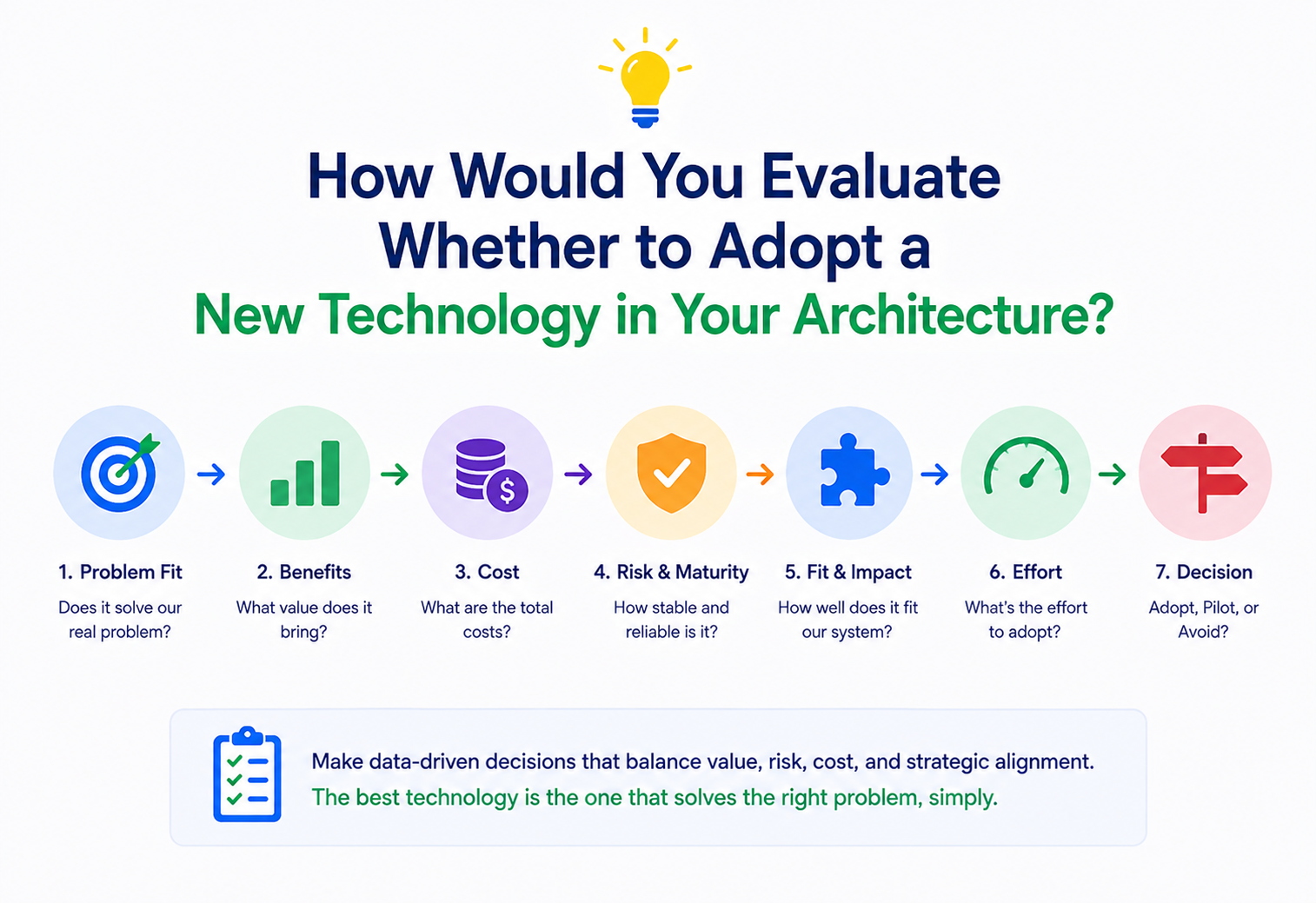
How Would You Evaluate Whether to Adopt a New Technology in Your Architecture?
A complete, beginner-to-production guide to building a repeatable, evidence-based framework for deciding when a new language, framework, database, or platform deserves a place in your system — and when it doesn’t.
Introduction & History
Imagine you are the head chef of a busy restaurant. Every few months, a salesperson knocks on your kitchen door with a shiny new gadget: a faster oven, a chopping machine, a fancy sous-vide device. Some of these gadgets will genuinely make your kitchen better. Others will sit in a corner, unused, costing you money and shelf space. As the head chef, you cannot try every gadget on a busy Saturday night in front of hungry customers. You need a calm, repeatable way to decide, before the gadget touches your kitchen, whether it deserves a spot.
Software architecture faces the exact same problem, except the “gadgets” are new programming languages, frameworks, databases, message queues, cloud services, and tools. Every year, thousands of new technologies are announced. Conferences are full of talks about the “next big thing.” Engineers on your team read a blog post and, excited, want to rewrite a service using it tomorrow. As an architect, your job is not to say “no” to everything new, nor to say “yes” to everything shiny. Your job is to build a disciplined process for asking the right questions, running the right small experiments, and making a decision that the whole team can trust and explain later.
This idea is not new. Long before software existed, engineers building bridges, aircraft, and factories faced the same question: should we use this new material, this new machine, this new process? They developed formal engineering practices — safety margins, prototypes, peer review, and staged rollouts — specifically because untested changes to a system that people depend on can be dangerous or expensive. Software engineering borrowed heavily from this tradition. In the 1980s and 1990s, as companies began building larger, longer-lived software systems, the cost of picking the “wrong” technology became painfully visible: rewrites that took years, teams stuck maintaining unsupported tools, and outages caused by immature software.
Two ideas, both from outside pure computer science, deeply shaped how the industry thinks about technology adoption today. The first is the Gartner Hype Cycle, a model published by the research firm Gartner starting in 1995, which describes how new technologies tend to go through a predictable emotional rollercoaster: an “Innovation Trigger” (excitement about something brand new), a “Peak of Inflated Expectations” (everyone talks about it, some rush to adopt it), a “Trough of Disillusionment” (early adopters hit real problems and complain loudly), a “Slope of Enlightenment” (the technology matures and practical use cases become clear), and finally a “Plateau of Productivity” (mainstream, well-understood adoption). The second is the concept of Total Cost of Ownership (TCO), borrowed from manufacturing and IT procurement, which reminds decision makers that the sticker price of a new tool is only a small fraction of its real cost once you add training, migration, operational overhead, and eventual replacement.
Modern software architecture teams formalized this thinking into practices like Architecture Decision Records (ADRs), popularized around 2011 by engineer Michael Nygard, which are short documents that capture “we decided X, because Y, and we accept trade-off Z.” Companies like ThoughtWorks began publishing a public Technology Radar twice a year, formally recommending which tools to “Adopt,” “Trial,” “Assess,” or “Hold.” Netflix, Amazon, and Google built internal review boards specifically to slow down risky technology bets and speed up safe ones. All of these are attempts to solve the same core problem this tutorial is about: how do you evaluate whether a new technology deserves a place in your architecture, using evidence instead of excitement?
The Problem & Motivation
Why does this topic deserve an entire framework, rather than just “use your judgment”? Because the failure modes are expensive, common, and often invisible until it is too late.
2.1 The two failure directions
Think of technology adoption risk as a see-saw with two ends, and your job is to keep the plank balanced.
Adopting too eagerly
A team falls in love with a new database because a conference talk made it look magical. Six months later, they discover it has no mature backup tooling, the community is tiny, and the one expert who understood it left the company. The team is now stuck maintaining something nobody else can support.
Never adopting anything
A team is so afraid of risk that it keeps using a fifteen-year-old framework long after it stopped receiving security patches. Hiring becomes hard because nobody wants to work with outdated tools. Competitors, using modern tooling, ship features five times faster.
Both failures are real and both are common. A good evaluation framework is not a way to say “no” to new technology — it is a way to say “yes, but only after we know what we are getting into,” and equally, a disciplined way to say “not yet, and here is exactly why,” so the conversation is based on evidence rather than opinion or seniority.
2.2 A simple, relatable example
Imagine you are choosing a new bicycle for your daily commute. You would not just buy the most expensive, most talked-about bicycle at the shop. You would ask: How far do I ride each day? Does it have gears for the hills near my house? Can I get it repaired nearby if something breaks? Is it too heavy to carry up my apartment stairs? You are running, without realizing it, exactly the same kind of evaluation an architect should run before adopting a new message queue or a new frontend framework: understand your real requirements first, then match a tool to those requirements, instead of matching your requirements to whatever tool is currently popular.
2.3 Why this matters even more in production software
Unlike a bicycle, a piece of technology inside your architecture is rarely used in isolation. It talks to other services, it is deployed by your CI/CD pipeline, it is monitored by your observability stack, it is operated by your on-call engineers at 2 a.m., and it may still be running five, ten, or fifteen years from now, long after the person who chose it has moved to a different team. A wrong choice does not just cost money; it costs the compounding interest of maintenance, hiring difficulty, security exposure, and the emotional toll on the engineers who inherit the decision.
Netflix has spoken publicly about retiring services built on technologies that seemed exciting at the time but became operational burdens later, requiring years of careful, incremental migration work. That multi-year migration cost is the real, delayed price of an adoption decision made without a rigorous framework.
Core Concepts
Before we build the evaluation framework itself, let’s learn the vocabulary and mental models that every good evaluation depends on. For each concept: what it is, why it exists, where it is used, a simple analogy, and a concrete example.
3.1 Total Cost of Ownership (TCO)
What it is: The complete cost of using a technology over its whole lifetime — not just the price tag, but licensing, infrastructure, training, migration, operations, and eventual retirement.
Why it exists: Because the upfront cost of adopting something (often zero, for open-source tools) hides the much larger costs that appear later.
Analogy: A free puppy is not free. You still pay for food, vet visits, training classes, and the couch it will chew up. The “free” only refers to the adoption fee.
Beginner example: A free open-source charting library might save you money upfront but cost your team two weeks to learn its unusual API.
Production example: Migrating from a self-hosted message queue to a managed cloud queue may increase your monthly cloud bill, but decrease TCO overall because you no longer need two engineers dedicated to patching and scaling it.
3.2 The Hype Cycle
What it is: A pattern describing how excitement about a new technology rises quickly, crashes as real-world problems appear, and then slowly recovers as the tool matures.
Why it exists: To remind decision makers that a technology’s popularity on social media or at conferences is not the same as its production readiness.
Analogy: Think of a new diet trend. Everyone is excited about it in January. By March, people are posting about how hard it actually is. By next year, only the version of the diet that genuinely worked survives, refined and quietly adopted by people who actually need it.
Software example: Many teams rushed to adopt certain NoSQL databases around 2010 expecting them to replace relational databases everywhere, only to discover, painfully, that they had given up transactional guarantees they actually needed.
3.3 Technical Debt (as it relates to adoption)
What it is: The implied future cost of choosing an easier or faster solution now instead of a better, more thorough one.
Why it matters here: Adopting an immature technology under deadline pressure is one of the most common ways technical debt is created.
Analogy: Taking a loan from a friend to buy something today, knowing you’ll have to pay it back later with interest. Sometimes worth it; sometimes not, depending on how well you understood the terms.
3.4 Lindy Effect
What it is: The observation that for certain kinds of non-perishable things (including technologies), the longer something has already survived, the longer it is likely to keep surviving.
Why it exists: It gives architects a rough heuristic: a database that has been in wide production use for fifteen years has already survived many failure scenarios that a brand-new database has not yet been tested against.
Analogy: A book that has been continuously in print for 100 years is more likely to still be read in another 100 years than a book published last month.
Caution: The Lindy Effect is a heuristic, not a law. It should slow you down, not stop you — every mature technology was new once.
3.5 Reversibility (One-Way vs Two-Way Doors)
What it is: A concept, popularized by Amazon’s leadership principles, that separates decisions into “one-way doors” (hard or impossible to undo, like choosing your core database) and “two-way doors” (easy to reverse, like trying a new logging library for one service).
Why it exists: Because the amount of evaluation effort you should invest should scale with how hard the decision is to reverse, not with how exciting the technology is.
Analogy: Trying a new restaurant for dinner is a two-way door — if you don’t like it, you simply don’t go back. Signing a five-year lease on a restaurant building is a one-way door — you’d better be very sure first.
3.6 Build vs Buy vs Adopt Open Source
What it is: The three broad paths available whenever you need new capability: build it yourself, buy a commercial/managed product, or adopt an open-source project and self-host it.
Analogy: Needing to travel across town, you can walk (build it yourself, full control, slow), take a taxi (buy a managed service, fast, costs money every time), or borrow a friend’s bicycle (open source, free but you must maintain it yourself).
Production example: A company might build its own internal feature-flagging tool (build), pay for a vendor like LaunchDarkly (buy), or self-host an open-source alternative (adopt open source) — each with a different TCO and risk profile.
3.7 Vendor Lock-in
What it is: The situation where switching away from a technology, especially a managed cloud service, becomes expensive or difficult because your systems and your team’s skills have grown deeply dependent on that vendor’s specific way of doing things.
Why it exists as a concern: Vendors have a natural business incentive to make their proprietary features convenient to use and inconvenient to leave. This is not necessarily dishonest, but it is predictable, and an evaluation should account for it deliberately.
Analogy: Signing up for a mobile phone plan that gives you a free phone, but locks you into that carrier’s network for two years. The free phone was real, but so is the cost of leaving early.
Beginner example: Choosing a spreadsheet tool that lets you export your data as a plain CSV file at any time carries far less lock-in risk than one that only lets you export to its own proprietary format.
Production example: A team choosing a cloud provider’s proprietary serverless workflow engine may ship faster initially, but later discover that rewriting those workflows to move to a different cloud provider would take months, because the workflow logic itself, not just the infrastructure, was tied to that vendor’s specific syntax.
3.8 Switching Cost and the Escape Hatch
What it is: The concrete, estimable cost — in engineering time, risk, and money — of moving away from a technology once it is deeply embedded, together with the deliberate practice of designing an “escape hatch” into your architecture before you need one.
Why it exists: Every technology, no matter how good today, will eventually be replaced by something better. An architecture that assumes its current choices are permanent will pay a much higher price on that eventual day than one that planned an exit route in advance.
Analogy: A good hiking trail always has marked side paths back to the trailhead in case the weather turns bad. You hope never to need them, but their presence is what makes venturing further into the trail a reasonable risk in the first place.
Software example: Wrapping a third-party payment provider’s SDK behind your own internal interface, rather than calling the vendor’s SDK directly from dozens of places in your codebase, is a small design decision that dramatically lowers the future switching cost if you ever need to change providers.
Every evaluation you will ever do is really answering one question with many parts: “Does this technology solve a real problem we have, better than our current best alternative, at a cost (money, time, risk, and cognitive load) that we can genuinely afford, for as long as we will need it?”
The Evaluation Framework — Architecture & Components
Now let’s design the actual framework — the “machine” you will run every new technology through. Just like a software system has components that work together, a good evaluation framework has distinct components, each with a clear job.
4.1 The five components
| Component | Purpose | Typical Artifact |
|---|---|---|
| Problem Statement | Forces clarity on what problem you’re actually solving before naming any tool | One-paragraph problem brief |
| Candidate Shortlist | Narrows the universe of options to 2–4 realistic candidates | Comparison table |
| Weighted Scorecard | Turns subjective opinions into a comparable, defensible score | Scorecard spreadsheet or tool |
| Proof of Concept (PoC) / Spike | Tests real, risky assumptions with real code, not slideware | Small working prototype + report |
| Architecture Decision Record (ADR) | Documents the decision, options considered, and trade-offs accepted | Markdown/HTML document in the repo |
4.2 Evaluation criteria categories
A weighted scorecard is only as good as the criteria behind it. Below are the categories every mature evaluation should include. Different projects will weight these differently — a criteria set for choosing a caching library will look different from one for choosing a cloud provider — but skipping a category is how blind spots creep in.
- Functional fit: Does it actually solve the problem you stated in step one?
- Maturity & community health: Age, contributor count, release cadence, issue response time, corporate backing.
- Operability: How hard is it to deploy, monitor, upgrade, and debug at 3 a.m.?
- Performance & scalability: Does it meet your latency and throughput needs at your expected scale, not just at demo scale?
- Security posture: Vulnerability history, patching cadence, compliance certifications.
- Team fit & learning curve: Can your current team realistically become productive in it?
- Ecosystem & integration: Does it play well with your existing stack, or will it require rebuilding other pieces too?
- Cost (TCO): Licensing, infrastructure, and the hidden cost of specialized hiring.
- Reversibility: How expensive would it be to undo this choice in two years?
- Vendor/community risk: What happens if the maintaining company pivots, gets acquired, or the open-source project is abandoned?
4.3 A weighted scorecard in Java
Below is a small, realistic Java program that models a weighted scorecard. An architect fills in raw scores (1–5) per criterion per candidate technology; the program applies importance weights and produces a ranked recommendation. This is exactly the kind of small internal tool many architecture teams build for themselves.
public class TechnologyScorecard {

    // A single evaluation criterion, with how important it is to this decision (0.0 - 1.0)
    record Criterion(String name, double weight) {}

    // A candidate technology being evaluated, holding a raw score (1-5) per criterion
    static class Candidate {
        String name;
        Map<String, Integer> rawScores = new LinkedHashMap<>();

        Candidate(String name) { this.name = name; }

        void score(String criterion, int value) {
            if (value < 1 || value > 5) {
                throw new IllegalArgumentException("Score must be between 1 and 5");
            }
            rawScores.put(criterion, value);
        }

        double weightedTotal(List<Criterion> criteria) {
            double total = 0.0;
            for (Criterion c : criteria) {
                int raw = rawScores.getOrDefault(c.name(), 0);
                total += raw * c.weight();
            }
            return total;
        }
    }

    public static void main(String[] args) {
        List<Criterion> criteria = List.of(
            new Criterion("Functional Fit", 0.25),
            new Criterion("Operability", 0.20),
            new Criterion("Team Fit / Learning Curve", 0.15),
            new Criterion("Community & Maturity", 0.15),
            new Criterion("Security Posture", 0.15),
            new Criterion("Total Cost of Ownership", 0.10)
        );

        Candidate current = new Candidate("Current: In-house Queue");
        current.score("Functional Fit", 3);
        current.score("Operability", 2);
        current.score("Team Fit / Learning Curve", 5);
        current.score("Community & Maturity", 2);
        current.score("Security Posture", 3);
        current.score("Total Cost of Ownership", 3);

        Candidate managedQueue = new Candidate("New: Managed Cloud Queue");
        managedQueue.score("Functional Fit", 5);
        managedQueue.score("Operability", 5);
        managedQueue.score("Team Fit / Learning Curve", 3);
        managedQueue.score("Community & Maturity", 5);
        managedQueue.score("Security Posture", 4);
        managedQueue.score("Total Cost of Ownership", 3);

        for (Candidate c : List.of(current, managedQueue)) {
            double total = c.weightedTotal(criteria);
            System.out.printf("%-30s weighted score: %.2f / 5.00%n", c.name, total);
        }
    }
}
Notice that this program does not “decide” anything by itself. It only makes your reasoning explicit and comparable. The real work — assigning honest raw scores — still requires research, a proof of concept, and conversations with people who have used the technology in production. A scorecard’s real value is forcing disagreements about weights and scores into the open, where they can be discussed, instead of leaving them as unspoken assumptions.
This is exactly like comparing two apartments before renting one. You don’t just pick the one with the nicest photos. You silently score each on rent, commute time, safety, and noise, then weigh commute time more heavily because you have a long workday. The scorecard just writes that mental math down on paper so you can double-check it and explain it to your family later.
Internal Working — The Evaluation Process, Step by Step
Here is how the framework actually runs from start to finish, as a repeatable process any team can follow.
5.1 Step 1 — Write the problem statement first, before naming any tool
This is the single most skipped step, and the most important one. Write one paragraph describing the problem in terms of symptoms and requirements, without mentioning any technology by name. For example: “Our checkout service experiences a 40% error rate during flash sales because our current job queue cannot handle bursts above 2,000 messages per second, and messages are sometimes lost during broker restarts.” Notice this sentence names zero technologies. It only names the pain.
5.2 Step 2 — Define your non-negotiables and your nice-to-haves
Split your requirements into two lists: things a candidate absolutely must do (a message queue with no message-loss guarantee is disqualified immediately for a payments system), and things that are merely preferred (a nicer dashboard UI, for example).
5.3 Step 3 — Build a shortlist of two to four realistic candidates
Do not evaluate ten technologies in depth — that is a research project, not a decision process. Use a quick pass (documentation review, a couple of blog posts, one conversation with a peer company) to narrow the field to two to four genuinely realistic options, including the option of “do nothing, keep the current technology.”
5.4 Step 4 — Score each candidate on paper first
Fill in the weighted scorecard from Section 4 using publicly available information, documentation, and benchmarks. This produces a rough ranking before you spend real engineering time.
5.5 Step 5 — Run a focused proof of concept (PoC) on the top one or two candidates
A PoC should be small, time-boxed (typically one to two weeks), and aimed at testing your riskiest assumptions specifically — not building a full feature. If your biggest worry is throughput under load, your PoC should be a load test, not a pretty demo UI.
Many teams build a PoC that only proves the “happy path” works. A PoC that never triggers a failure (a killed pod, a network partition, a malformed message) has not actually tested the thing you were worried about.
5.6 Step 6 — Re-score using real PoC evidence, not marketing claims
Go back to the scorecard and update the scores using what you actually observed, not what the vendor’s website claimed.
5.7 Step 7 — Write the Architecture Decision Record (ADR)
An ADR is a short, permanent document that records: the context, the options considered, the decision made, and the consequences accepted. It is written once and never silently edited — if the decision changes later, you write a new ADR that supersedes the old one, so the history of “why” is preserved.
ADR-014: Adopt Managed Cloud Message Queue for Checkout Events

Status: Accepted
Date: 2026-07-24

Context
-------
Checkout events are currently processed via a self-hosted message
broker that cannot sustain bursts above 2,000 msgs/sec and has
caused two production incidents due to message loss on restart.

Options Considered
-------------------
1. Scale and harden the current self-hosted broker (rejected: would
   require 2 dedicated engineers for 1 quarter, high operational risk)
2. Adopt Managed Cloud Queue X (chosen)
3. Do nothing, absorb the error rate during flash sales (rejected:
   unacceptable customer impact)

Decision
--------
Adopt Managed Cloud Queue X for the checkout event pipeline,
migrating incrementally service-by-service over 6 weeks.

Consequences
------------
+ Removes need for in-house broker operations expertise
+ Native at-least-once delivery removes the message-loss risk
- Introduces a new monthly cost of ~$1,800 at current volume
- Creates a dependency on a single cloud vendor for this component
- Team requires 1 week of ramp-up training
5.8 Who should be in the room
A common mistake is treating technology evaluation as a purely technical exercise handled entirely by the architect alone. In practice, the best evaluations pull in a small, deliberately diverse group:
- The architect or tech lead, to frame the problem statement and keep the scope disciplined.
- At least one on-call/operations engineer, who will ask the uncomfortable but essential questions about debugging, alerting, and 2 a.m. failure scenarios that a feature-focused engineer might never think to ask.
- A security-minded reviewer, even if only for a short review pass, especially for anything one-way-door or customer-facing.
- A skeptic, deliberately included to counterbalance the enthusiast who first proposed the technology, as discussed in Section 14’s anti-patterns.
- A stakeholder who owns the budget, for any decision with a meaningful recurring cost, so the TCO conversation happens before the contract is signed, not after.
This does not need to be a large committee or a slow, bureaucratic sign-off chain. For most decisions, three or four people spending a few focused hours together produces dramatically better outcomes than one person deciding alone, simply because each role notices different risks.
5.9 Step 8 — Roll out incrementally, never all at once
Even after a positive decision, do not flip every service over on day one. Migrate the lowest-risk service first, observe it in production for a real business cycle, and only then continue. This is covered in depth in Section 12.
Data Flow & Lifecycle of an Adoption Decision
The diagram below shows the full lifecycle as information (not application data, but decision-making data: opinions, benchmarks, scores) flows through the framework from a raw idea to a production rollout.
Two things are worth noticing in this flow. First, the process branches early based on reversibility — a two-way door decision does not deserve the same multi-week ceremony as a one-way door decision, or your team will stop trusting the framework and start bypassing it. Second, notice the loop back from “unclear, need more data” to the PoC step. A good evaluation process expects to sometimes be inconclusive on the first pass, and treats that as normal, not as failure.
Advantages, Disadvantages & Trade-offs
A well-designed framework earns its keep by preventing expensive mistakes — but only if it is applied honestly, and only if its own overhead is scaled to the size of the decision.
7.1 Advantages of a formal evaluation framework
- Removes bias from the loudest voice in the room. Decisions are based on scored criteria and PoC evidence, not on who argued most passionately in the meeting.
- Creates institutional memory. ADRs mean a new engineer joining two years later can read exactly why a technology was chosen, instead of hearing an incomplete oral history.
- Surfaces disagreements early and safely. Disagreeing about a weight in a scorecard is far less personal than disagreeing about a person’s judgment in a meeting.
- Prevents both failure directions from Section 2 by giving structured permission to say both “yes, let’s adopt” and “not yet” with equal confidence.
7.2 Disadvantages and honest limitations
- Process overhead. A full framework applied to every tiny decision will slow a team down and breed resentment; it must be scaled to the size of the decision (Section 6’s reversibility branch exists specifically for this reason).
- False precision. A scorecard that produces “3.42 vs 3.38” can create an illusion of scientific certainty over what is still, underneath, a judgment call based on imperfect information.
- PoCs can mislead. A two-week proof of concept, run by your most senior engineer, will almost always look better than the technology will in the hands of your average engineer under real deadline pressure six months later.
7.3 The core trade-off: speed of decision vs quality of decision
| Approach | Speed | Risk of Bad Decision | Best For |
|---|---|---|---|
| Gut feeling / “let’s just try it” | Very fast | High | Truly low-stakes, easily reversible choices |
| Lightweight scorecard only | Fast (hours) | Medium | Two-way door decisions |
| Full framework with PoC | Slow (weeks) | Low | One-way door, foundational decisions |
| External consultants / vendor-run PoC | Very slow | Low, but biased toward vendor | High-stakes decisions with no in-house expertise |
Performance & Scalability in Evaluation
Performance evaluation is one of the most commonly faked parts of a technology assessment, because it is easy to run an impressive-looking benchmark that has nothing to do with your real traffic pattern.
8.1 Test at your scale, not demo scale
A database that handles 10,000 reads per second beautifully in a vendor benchmark may behave completely differently under your real write-heavy, bursty traffic pattern with your real data shapes (large JSON blobs, deep joins, whatever is specific to you). Always design load tests using a realistic sample of your actual production traffic, or a close synthetic approximation, not the vendor’s idealized dataset.
8.2 Test the failure curve, not just the peak
It is not enough to know a technology’s maximum throughput. You need to know how it degrades as it approaches that maximum: does latency rise gently (graceful degradation), or does it fall off a cliff (cascading failure)? A technology with a lower peak but a gentle degradation curve is often the safer production choice.
8.3 A simple Java load-testing harness for a PoC
public class PoCLoadTester {

    private final ExecutorService pool = Executors.newFixedThreadPool(50);

    public LoadTestResult run(Callable<Boolean> candidateOperation, int totalRequests) throws InterruptedException {
        AtomicInteger successCount = new AtomicInteger();
        AtomicInteger failureCount = new AtomicInteger();
        List<Long> latenciesMs = Collections.synchronizedList(new ArrayList<>());

        CountDownLatch latch = new CountDownLatch(totalRequests);

        for (int i = 0; i < totalRequests; i++) {
            pool.submit(() -> {
                long start = System.currentTimeMillis();
                try {
                    boolean ok = candidateOperation.call();
                    if (ok) successCount.incrementAndGet(); else failureCount.incrementAndGet();
                } catch (Exception e) {
                    failureCount.incrementAndGet();
                } finally {
                    latenciesMs.add(System.currentTimeMillis() - start);
                    latch.countDown();
                }
            });
        }

        latch.await(2, TimeUnit.MINUTES);
        pool.shutdown();

        Collections.sort(latenciesMs);
        long p50 = latenciesMs.get(latenciesMs.size() / 2);
        long p99 = latenciesMs.get((int) (latenciesMs.size() * 0.99));

        return new LoadTestResult(successCount.get(), failureCount.get(), p50, p99);
    }

    record LoadTestResult(int successes, int failures, long p50Ms, long p99Ms) {}
}
Run this same harness, unchanged, against both the current technology and the new candidate, so the comparison is fair. Then look specifically at the p99 latency and the failure count under load, not just the average latency, because average latency hides the painful tail experience real users have.
8.4 Scalability dimensions to check
- Vertical scalability: Can it get more done on a single, bigger machine?
- Horizontal scalability: Can you add more machines/nodes to handle more load, and how much coordination overhead does that add?
- Data scalability: Does performance hold up as your dataset grows from gigabytes to terabytes?
- Team scalability: Can more engineers work on the system built with this technology without stepping on each other?
High Availability & Reliability
A brand-new technology, however impressive its features, has by definition had less real-world time to discover and fix its failure modes than a mature one. Evaluating reliability means actively hunting for how the candidate breaks, not just how well it performs when everything is healthy.
9.1 Questions to ask during evaluation
- What happens if the process crashes mid-write? Is there a documented recovery procedure?
- Does it support replication out of the box, and how is failover handled — automatic or manual?
- What is its documented Recovery Time Objective (RTO) and Recovery Point Objective (RPO) when used as recommended?
- Are there public post-mortems from other companies describing real outages caused by this technology? (These are often more informative than any official documentation.)
9.2 Chaos testing as part of the PoC
A mature evaluation actively injects failure into the PoC environment: kill the process mid-operation, disconnect the network for thirty seconds, fill the disk. If the candidate technology cannot survive controlled chaos in a two-week PoC, it is unlikely to survive real chaos in production.
This is like test-driving a car by also checking how it handles in the rain and on gravel, not only on a smooth, sunny highway. A car that only drives well in perfect conditions is not actually reliable — it is only untested.
9.3 Reliability scoring dimension for your scorecard
| Score | Meaning |
|---|---|
| 1 | No documented failure handling; single point of failure by design |
| 2 | Manual recovery only; no automated failover |
| 3 | Automated failover exists but is unproven at your scale |
| 4 | Automated failover, documented RTO/RPO, verified in your PoC chaos tests |
| 5 | Proven at large scale by multiple independent companies with public reliability data |
Security
Security is one of the categories most often evaluated too late, after the technology is already embedded in production. It belongs in the scorecard, at the shortlist stage, not as an afterthought.
10.1 What to check before adoption
- Vulnerability history: search public vulnerability databases for the project’s past record. A history of vulnerabilities is not automatically disqualifying — what matters more is how quickly and transparently they were patched.
- Authentication & authorization support: does it support your organization’s existing identity standards (OAuth2, SSO, mutual TLS) natively, or will you need to build a custom bridge?
- Default configuration: does it ship secure by default, or does it require the operator to remember to lock it down? Technologies that are insecure by default are a common source of real breaches.
- Supply chain: for open-source candidates, who maintains it, and how are new contributions reviewed before merging?
- Compliance certifications: for managed/cloud offerings, does it hold the certifications (such as SOC 2, ISO 27001) your industry requires?
10.2 A simple Java example — validating that a new library does not silently disable TLS verification
public class SecurityPoCCheck {

    // A quick PoC-stage check: confirm the candidate HTTP client
    // actually rejects an invalid TLS certificate instead of silently
    // accepting it, which some libraries do by default for "convenience".
    public static boolean rejectsInvalidCertificate(HttpClient candidateClient, String untrustedTestUrl) {
        try {
            HttpRequest request = HttpRequest.newBuilder()
                    .uri(URI.create(untrustedTestUrl))
                    .GET()
                    .build();
            candidateClient.send(request, HttpResponse.BodyHandlers.ofString());
            // If no exception was thrown, the client accepted an untrusted
            // certificate -- this is a serious red flag for the candidate.
            return false;
        } catch (SSLHandshakeException expected) {
            // Correct, secure behavior: the client refused the connection.
            return true;
        } catch (Exception other) {
            throw new RuntimeException("Unexpected error during security PoC check", other);
        }
    }
}
This kind of small, targeted check — verifying a security assumption with actual code instead of trusting the documentation — is exactly the spirit of a good PoC: cheap to write, and it tests a real risk instead of a vague feeling.
Monitoring, Logging & Metrics
Evaluation does not stop the day you roll out the new technology. You need to define, in advance, exactly how you will know whether the adoption was actually a success. This is the part most teams skip, and it is why so many adoption decisions are never honestly revisited.
11.1 Define success metrics before rollout, not after
Write down concrete, measurable success criteria as part of the ADR itself. For example: “Error rate for checkout events must stay below 0.1% for four consecutive weeks after full rollout” or “P99 latency for the search endpoint must not exceed 200ms.” Vague goals like “it should feel faster” cannot be honestly measured later.
11.2 What to instrument during rollout
- Golden signals: latency, traffic, error rate, and saturation for the new component, compared side-by-side with the old one during the transition period.
- Business metrics, not just technical ones: did checkout conversion improve or regress after the migration?
- Operational metrics: how many pages/alerts did the on-call team receive related to the new technology in its first month, compared to the old one?
- Cost metrics: is the actual cloud bill tracking with the TCO estimate from the ADR, or is it drifting?
Treat this as a closed feedback loop, not a one-time gate. The scorecard and PoC predicted an outcome; production monitoring tells you whether the prediction was correct. Over time, comparing your predictions to your outcomes is what makes your entire evaluation framework, and your team’s judgment, genuinely improve.
Deployment & Cloud Considerations
Even a technology that passed every evaluation step deserves a cautious rollout, because a PoC environment can never perfectly represent production.
12.1 Incremental rollout strategies
Common, proven rollout strategies include:
- Canary release: route a small percentage (for example 5%) of real production traffic to the new technology, watch closely, then gradually increase.
- Shadow traffic / dark launch: send a copy of real production traffic to the new technology without using its response, purely to observe how it behaves under real load with zero user-facing risk.
- Strangler pattern: for larger migrations, gradually route more and more functionality to the new system while the old system still exists, until the old system can finally be switched off.
12.2 Cloud-native considerations
When the candidate is a managed cloud service, evaluate it as both a technology and a vendor relationship: which regions does it support, does it fit your existing infrastructure-as-code tooling, and what happens to your data and your bill if you ever need to leave that cloud provider?
12.3 A minimal rollout checklist
| Stage | Traffic % | Rollback Trigger |
|---|---|---|
| Internal dogfooding | 0% real users | Any crash or data corruption |
| Canary | 5% | Error rate 2x baseline |
| Partial rollout | 25-50% | P99 latency exceeds ADR target |
| Full rollout | 100% | Business metric regression sustained >48h |
APIs & Microservices Context
In a microservices architecture, an adoption decision is rarely isolated to one team — it has ripple effects across service boundaries, and this changes how you evaluate.
13.1 Blast radius matters more than in a monolith
In a monolith, a risky new library affects one deployable unit. In a microservices system, if a new technology becomes a shared dependency (a shared client library, a shared message format, a shared service mesh feature), a single flaw can affect dozens of independently-owned services at once. Evaluations for anything that will become a shared/platform-level dependency deserve the full framework from Section 4, even if the same technology used inside a single, isolated service might only need the lightweight path.
13.2 API contract stability
When evaluating a new inter-service communication technology (a new RPC framework, a new event schema format, a new API gateway), pay special attention to backward compatibility guarantees. A technology that makes it easy to accidentally introduce breaking changes across dozens of service boundaries is a much bigger risk in a microservices architecture than the same flaw would be in a single monolith.
13.3 Polyglot cost
Microservices architectures make it technically easy for each team to choose a different language or database for their own service. Evaluation must weigh this “local optimization” against the “global cost” of a platform team now needing to support N different technologies for monitoring, security patching, and on-call training. A shared internal Technology Radar (see Section 15) helps individual teams make locally-good, globally-consistent decisions.
Design Patterns & Anti-patterns in Technology Adoption
The small vocabulary of recurring patterns below is what turns a mechanically correct evaluation into a durable one — and the matching set of anti-patterns is what quietly sinks otherwise-strong teams.
14.1 Healthy patterns
The Technology Radar
Maintain a shared, living document listing technologies in four rings — Adopt (safe default), Trial (use with a small team, gather evidence), Assess (worth exploring, not yet ready), Hold (do not start new projects with this). Update it quarterly based on real evaluations.
The Two-Pizza PoC
Keep the team running a proof of concept small enough to fit around two pizzas — typically 2 to 4 engineers — to keep the experiment fast and focused.
The Sunset Clause
When trialing something risky, agree in advance on a specific date or metric at which you will honestly revisit the decision, rather than letting a “temporary trial” quietly become permanent infrastructure by default.
14.2 Anti-patterns to watch for
Choosing a technology primarily because it will look good on an engineer’s resume, rather than because it is the best fit for the actual problem.
Adopting whatever technology was most discussed at the most recent conference, without evaluating fit for your specific constraints.
A two-week PoC that quietly becomes the actual production system because “it’s already mostly working,” skipping the hardening, security review, and monitoring setup a real production system needs.
Applying the full heavyweight framework to a genuinely low-risk, two-way-door decision, until the team becomes so slow that people start bypassing the process entirely.
Continuing to invest in a technology after the evidence turns negative, purely because so much has already been spent on it.
The most dangerous anti-pattern is when the PoC is run by the technology’s biggest internal fan. Enthusiasm is valuable for driving exploration, but the person most excited about a technology is, by nature, the least likely to notice its weaknesses. Where possible, pair an enthusiast with a healthy skeptic on the same PoC team.
Best Practices & Common Mistakes
A short, tactical checklist of what to do — and what to avoid — when actually running an evaluation on real work.
15.1 Best practices
- Always write the problem statement before naming any candidate technology.
- Scale the rigor of the evaluation to the reversibility of the decision, not to how exciting the technology is.
- Involve the people who will operate the technology at 2 a.m., not only the people who will write code against it.
- Time-box every PoC, and define in advance what evidence would make you say no.
- Write the ADR even when the answer is “no” — a rejected option, with reasons recorded, saves the next person from re-litigating the same debate a year later.
- Revisit past ADRs periodically; a “no” from three years ago may deserve a fresh look as the technology and your requirements have both changed.
- Maintain a shared technology radar so individual teams are not re-doing the same evaluation from scratch.
15.2 Common mistakes
- Evaluating only the happy path and never intentionally testing failure scenarios.
- Letting the loudest or most senior voice skip the scorecard entirely “because I already know it’s good.”
- Comparing a mature, hardened current technology against a brand-new candidate’s marketing claims instead of its own real-world track record.
- Forgetting to include the human cost — hiring difficulty, documentation quality, on-call burden — and only scoring technical benchmarks.
- Treating the rollout as instantaneous instead of incremental, removing the safety net a canary release would have provided.
Real-World Industry Examples
The frameworks described in this guide aren’t theoretical — they mirror how the largest, most-scrutinized engineering organizations actually decide what to adopt and what to hold back.
Staged migrations + chaos
Netflix has publicly described using internal review processes and staged, service-by-service migrations when moving critical infrastructure, explicitly favoring incremental, reversible rollouts over big-bang cutovers, and building extensive chaos-testing tools to validate reliability assumptions before trusting a technology broadly across their microservices fleet.
The public Technology Radar
ThoughtWorks formalized the idea of a shared Technology Radar (Adopt / Trial / Assess / Hold), publishing it publicly twice a year, and many enterprises now maintain a private internal version of the same idea to keep hundreds of engineering teams aligned without central bottlenecks.
One-way vs two-way doors
Amazon’s leadership principle of distinguishing “one-way door” and “two-way door” decisions is used explicitly to decide how much process and how many approvals a given technical decision deserves, preventing both reckless one-way-door bets and slow, over-analyzed two-way-door decisions.
Design-review documents
Google’s internal engineering culture is known for extensive design-review documents before large infrastructure changes, requiring authors to explicitly list alternatives considered and rejected — the same spirit as the ADR pattern covered in Section 5, applied at enormous scale.
Standardized service templates
As Uber’s engineering organization scaled into thousands of microservices, the company has described building internal platform tooling and standardized service templates specifically to prevent uncontrolled technology sprawl, steering individual teams toward a shared, evaluated set of approved technologies rather than letting every team independently choose its own stack for common concerns like logging, service discovery, and inter-service communication.
A common thread runs through all four examples: none of these companies rely purely on individual judgment, and none of them freeze technology choices in place forever. They all built lightweight, repeatable structures — radars, ADRs, decision-door heuristics, platform templates — that let hundreds or thousands of engineers make good local decisions that still add up to a coherent, operable system at a global scale. That balance, between local autonomy and global coherence, is really the deeper goal behind every framework covered in this tutorial.
Frequently Asked Questions
The questions teams most often ask when they first try to run this framework on real, high-stakes technology decisions.
How long should a proof of concept take?
Most healthy PoCs are time-boxed to one or two weeks. If you find yourself needing longer, it is often a sign the PoC’s scope has grown beyond testing your riskiest assumption and has quietly become a partial production build.
What if my team disagrees on the scorecard weights?
That disagreement is valuable information, not a problem to hide. Discuss it openly; often the disagreement reveals that different people are optimizing for different underlying priorities (short-term delivery speed vs long-term operability), which is worth surfacing to leadership regardless of which technology wins.
Should every small library really go through this whole framework?
No. Section 6’s reversibility branch exists specifically so small, easily-reversible choices (a utility library, a formatting tool) can skip most of the ceremony. Reserve the full framework for one-way-door, foundational, or widely-shared decisions.
What if the PoC results are genuinely mixed?
Mixed results are a valid outcome, not a failed process. Document the mixed evidence honestly in the ADR, and consider a longer or differently-scoped follow-up PoC rather than forcing a premature yes-or-no decision under deadline pressure.
How do we avoid this framework becoming pure bureaucracy?
Keep every artifact as short as possible, scale rigor to reversibility, and periodically ask the team whether the framework is helping or just slowing things down — and adjust it. A framework that nobody trusts gets quietly bypassed, which is worse than having no framework at all.
Is it ever okay to skip the framework entirely and just decide quickly?
Yes. Truly low-stakes, fully reversible choices — a small utility library used inside a single, isolated service, for example — do not need a scorecard or an ADR at all. The skill being taught here is judgment about which decisions deserve the framework, not applying the framework to absolutely everything.
How do we handle a situation where leadership has already decided, and wants the evaluation to justify it after the fact?
This is worth naming honestly rather than pretending it isn’t happening. If the outcome is already fixed, running a fake evaluation only wastes the team’s time and damages trust in the process for future, genuinely open decisions. It is usually better to skip the scorecard theater, document the decision plainly as directed, and save the full framework’s credibility for the next decision that is genuinely still open.
Summary & Key Takeaways
A framework is only valuable if you can hold its essence in mind long after you’ve stopped reading about it — here is the compact version worth carrying into the next decision meeting you attend.
Key takeaways
- Technology adoption decisions fail in two directions — adopting too eagerly and never adopting at all — and a good framework guards against both.
- Always write a technology-agnostic problem statement before naming any candidate.
- Scale the rigor of your evaluation to how reversible the decision is: two-way doors deserve a light touch, one-way doors deserve the full framework.
- A weighted scorecard does not make the decision for you — it makes your reasoning explicit, comparable, and honest.
- A proof of concept should target your riskiest assumption specifically, be time-boxed, and intentionally include failure testing, not just the happy path.
- Write an Architecture Decision Record for every meaningful decision, including rejected options, so the “why” survives long after the people involved move on.
- Roll out incrementally — canary, shadow traffic, or strangler pattern — and define measurable success criteria before rollout, not after.
- In a microservices architecture, weigh the blast radius of shared/platform-level technology choices more heavily than isolated, single-service choices.
- Watch for anti-patterns like resume-driven development, conference-driven architecture, and silent PoC scope creep.
- The goal is never to eliminate risk entirely — it is to take risks knowingly, with your eyes open, instead of by accident.
If you take only one habit away from this entire tutorial, let it be this: before you ever type the name of a new technology into a search bar, write down, in one honest sentence, the actual problem you are trying to solve. Almost every avoidable technology adoption failure in software history traces back to skipping that one small, unglamorous step. Everything else in this framework — the scorecard, the PoC, the ADR, the incremental rollout — exists only to protect and test the honesty of that first sentence all the way through to production.