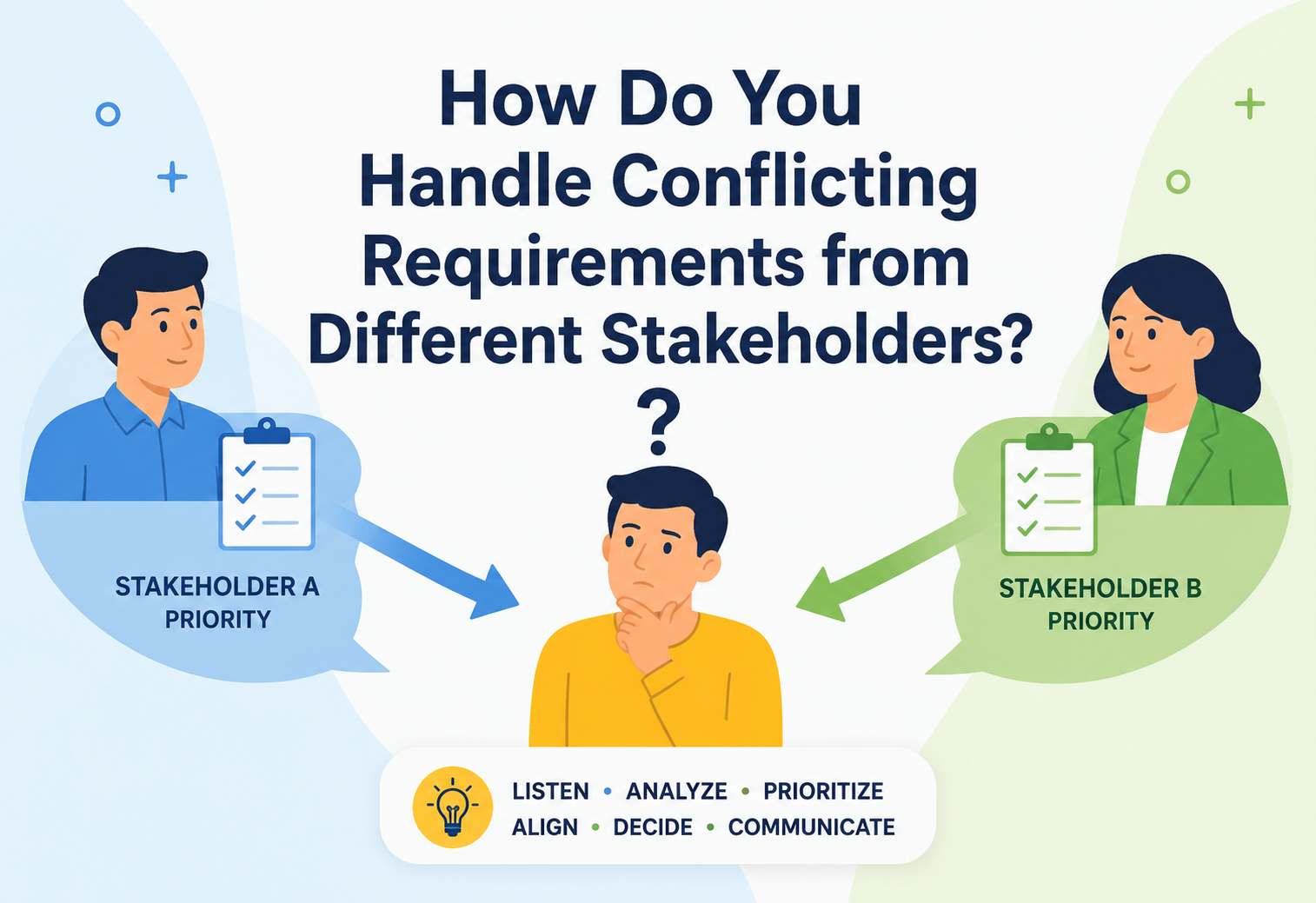
How Do You Handle Conflicting Requirements from Different Stakeholders?
A practical, deeply-explained guide to identifying, negotiating, and resolving competing demands from product owners, engineers, security teams, executives, and customers — with frameworks, diagrams, and real Java-based tooling you can adapt.
The Second, Invisible Layer of Every System
Every piece of software that has ever mattered was built for more than one person. The moment more than one human being cares about a system, that system inherits a second, invisible layer of complexity that has nothing to do with code — the complexity of human agreement.
This guide treats stakeholder-conflict resolution the same way we would treat any other architectural concern: with components, lifecycles, failure modes, metrics, and scaling patterns. The people skills matter enormously, but the focus here is on the structures and repeatable mechanisms that make good outcomes more likely, regardless of who happens to be in the room on a given day.
Introduction & History
Every piece of software that has ever mattered was built for more than one person. A payments API exists because a product manager wants growth, a finance team wants accurate reconciliation, a security team wants fraud prevention, and a customer wants their money to move instantly. The moment more than one human being cares about a system, that system inherits a second, invisible layer of complexity that has nothing to do with code: the complexity of human agreement.
Conflicting requirements simply means two or more stakeholders — people with a legitimate interest in how a system behaves — want things from that system that cannot both be fully true at the same time. One wants the checkout flow to be one click; another wants a mandatory fraud-review step. One wants the mobile app to load in under a second; another wants every screen to carry a full-page consent banner for legal reasons. Neither person is wrong. Their goals simply collide.
This is not a new problem invented by software engineering. Architects designing physical buildings have negotiated between structural engineers, budget owners, and end users for centuries — a cathedral’s stonemason and its bishop wanted different things from the same walls. What software engineering added is speed and scale: we now build systems that must satisfy dozens of stakeholders, across time zones, updated every few weeks, where a bad resolution to a conflict does not just annoy one department — it ships to millions of users within days.
The discipline of formally managing this — sometimes called requirements engineering or stakeholder management — grew out of large government and aerospace projects in the 1970s and 1980s, where a single overlooked disagreement between departments could sink a multi-year, multi-million-dollar program. The waterfall methodologies of that era tried to solve conflicts once, upfront, with a giant signed-off requirements document. Agile and iterative methodologies that followed in the 2000s changed the approach: instead of resolving every conflict perfectly before writing code, teams learned to surface conflicts continuously, negotiate them in small increments, and revisit decisions as new information arrived.
Today, in modern system design and software architecture work, handling conflicting requirements is treated as a first-class engineering skill — as important as knowing how to design a database schema or choose a caching strategy. This tutorial walks through it the same way we would walk through any architectural concern: what the problem really is, the structures and frameworks used to manage it, how the process works internally, how it scales, and what good practice looks like in real organizations.
Think of building software like renovating a house shared by a family. The parent wants an open floor plan for entertaining guests. The teenager wants a soundproof room to play music. The grandparent wants a step-free, accessible layout. The contractor has a fixed budget and a beam that cannot be moved. None of these people are being unreasonable — they simply have different, valid needs pulling on the same physical space. A good architect does not pick one family member and ignore the rest; they find a design (or a sequence of trade-offs) that respects the constraints and gets everyone as close to “good enough” as possible.
It is worth being precise about what this tutorial is not about. It is not about people management in the abstract, and it is not about conflict resolution as a purely interpersonal skill borrowed from human-resources training. It is about treating the resolution of competing requirements as an engineering artifact — something you can design a process for, measure, iterate on, and improve, exactly the way you would design retry logic or a caching layer. The people skills matter enormously, but this guide focuses on the structures, frameworks, and repeatable mechanisms that make good outcomes more likely regardless of who happens to be in the room on a given day.
There is also a subtle but important distinction between requirements gathering and requirements arbitration. Gathering is the act of collecting what stakeholders say they want. Arbitration is the act of deciding what happens when those wants collide. Many teams invest heavily in the first skill — running good discovery interviews, writing detailed user stories — and invest almost nothing in the second. This asymmetry is precisely why so many otherwise well-researched products still ship with confusing, internally contradictory behavior: the requirements were gathered carefully, but nobody built a deliberate mechanism for arbitrating between them once they turned out to disagree with each other.
By the end of this tutorial, you should be able to answer, concretely, four questions for any project you are responsible for: who are the stakeholders and what do they actually care about beneath their stated requests; where is the registry that would let you notice a conflict before it ships to real users; who has the authority to make the final call when stakeholders genuinely cannot agree; and where does the reasoning behind that call get written down so it outlives the meeting where it was made and the memory of the people who attended it.
Problem & Motivation
Why does this deserve a dedicated place in an architect’s toolkit, rather than being left to project managers? Because unresolved requirement conflicts do not stay contained — they leak directly into the system’s architecture, and bad architecture is exponentially more expensive to fix than a bad meeting.
Consider what happens when conflicts are not handled well:
- Silent trade-offs baked into code. An engineer, facing pressure from two directions, quietly picks one side without telling anyone. Six months later, nobody remembers why the system behaves the way it does, and reversing the decision means archaeology, not engineering.
- Feature thrash. The system gets built one way to satisfy Stakeholder A, then rebuilt to satisfy Stakeholder B a sprint later, burning engineering time on rework that a five-minute conversation could have prevented.
- Architecture that tries to please everyone and pleases no one. Systems accumulate feature flags, special cases, and configuration knobs meant to avoid ever saying “no” to any stakeholder. The result is a fragile, over-configurable system that is hard to test, hard to reason about, and slow to change.
- Trust erosion. When conflicts are resolved invisibly or inconsistently, stakeholders stop trusting the process. Product owners start going around engineering leadership. Security teams start blocking releases late instead of negotiating early. Everyone becomes defensive.
It is useful to break the cost of unresolved conflict into three distinct buckets, because each one is fixed by a slightly different intervention. Direct rework cost is the most visible — engineering hours spent building something twice. Coordination cost is less visible but often larger — the meetings, Slack threads, and context-switching spent re-litigating the same disagreement repeatedly because it was never actually closed out. Opportunity cost is the least visible and usually the largest of all — the features and improvements that never got built because the team’s energy was consumed managing an unresolved disagreement instead. A process that only addresses direct rework cost, without also shortening coordination cycles and freeing up capacity for genuinely new work, is only solving a third of the actual problem.
The motivation for treating this as a formal architectural concern is simple: requirements conflicts are inevitable, but requirements chaos is optional. The goal is not to eliminate disagreement — healthy organizations have plenty of it — but to build a repeatable, transparent process for surfacing disagreement early, resolving it deliberately, and recording the reasoning so the decision survives staff turnover, memory loss, and time.
A classic failure pattern: a startup’s sales team promises a large enterprise client a custom data-export feature to close a deal. Simultaneously, the security team is mid-way through a SOC 2 audit that requires locking down all data-export paths. Nobody connects the two conversations. The feature ships, breaks the audit, and the company loses both the deal and the certification — a completely avoidable double failure caused purely by the absence of a conflict-surfacing mechanism, not by any individual’s incompetence.
Trace back to requirements
Of project failures trace back to poor requirements management, according to widely cited industry surveys.
Late-fix multiplier
Cost multiplier to fix a requirement defect found post-release versus pre-design.
Stakeholder groups
Typical distinct stakeholder groups involved in a mid-size product feature.
There is also a psychological dimension to the motivation that is easy to underestimate. Engineers and product managers who repeatedly experience unresolved requirement conflicts tend to develop a defensive posture: they start padding estimates to absorb the inevitable rework, they stop proposing ambitious designs because ambitious designs attract more conflicting opinions, and they quietly route around stakeholders they have learned are difficult to negotiate with instead of engaging them directly. None of this is malicious. It is a completely rational adaptation to an environment where conflict resolution feels unpredictable and costly. The fix is not to ask people to be braver or more collaborative in the abstract — it is to make the process itself predictable enough that engaging with it honestly stops feeling risky.
Finally, there is a competitive dimension worth naming directly. Two companies can have engineers of identical skill, identical budgets, and identical market opportunity, and still diverge sharply in outcomes purely based on how efficiently they resolve internal disagreement about what to build. The organization that can turn a stakeholder conflict into a documented, well-reasoned decision within days will simply ship more, and ship more coherently, than the organization where the same conflict quietly reappears every sprint for six months. In a very real sense, the maturity of this process is a competitive advantage, not just an internal-hygiene concern.
Core Concepts
Before building a process for resolving conflicts, we need a shared vocabulary. Here are the foundational terms, explained simply.
Stakeholder
What: Anyone who is affected by, or can affect, a system’s requirements and success. Why it matters: If you do not know who your stakeholders are, you cannot know whose requirements you are even balancing. Analogy: In a restaurant, stakeholders include the chef, the diners, the health inspector, the investors, and the delivery drivers — all with different, sometimes opposing, opinions about how the kitchen should run. Software example: For an e-commerce checkout page, stakeholders include product managers, UX designers, backend engineers, the fraud team, legal/compliance, customer support, and the end shopper.
Functional vs. Non-Functional Requirements
What: A functional requirement describes what the system should do (“users can add items to a cart”). A non-functional requirement describes how well it should do it (“the cart must update in under 200ms,” “the system must be GDPR compliant”). Why it matters: Most stakeholder conflicts are actually functional-vs-non-functional collisions in disguise — a product team wants a feature (functional), while security wants it to be safe (non-functional), and the two pull in opposite directions on effort and speed.
Requirement Conflict
What: A situation where satisfying one requirement fully means another requirement cannot also be fully satisfied, given real constraints (time, money, technology, law). Types:
- Direct conflicts — two requirements are logically incompatible (e.g., “data must be deleted after 30 days” vs. “data must be retained for 7 years for audit”).
- Resource conflicts — requirements compete for the same limited budget, time, or engineering capacity.
- Priority conflicts — requirements are not logically incompatible, but there is not enough time to build both before a deadline.
- Value conflicts — stakeholders disagree on what “good” even looks like (e.g., growth-at-all-costs vs. privacy-by-design as a philosophy).
Categorizing Stakeholders
Not all stakeholders relate to a system the same way, and lumping them together tends to produce muddled negotiation. It helps to sort them into rough categories before a conflict even arises.
| Category | Description | Typical Example |
|---|---|---|
| Primary users | People who directly interact with the system day to day | App shoppers, API-consuming developers |
| Secondary users | People affected by the system but not its direct operators | Customer support agents handling complaints about it |
| Business owners | People accountable for the system’s commercial outcomes | Product managers, business unit leads |
| Governance stakeholders | People responsible for constraints the system must obey | Security, legal, compliance, finance |
| Technical stakeholders | People responsible for building and operating the system | Engineers, SREs, platform teams |
| External stakeholders | Outside parties with a legitimate interest but no internal authority | Regulators, partners, integrators |
A conflict between a primary user’s need and a governance stakeholder’s constraint should generally be negotiated differently than a conflict between two technical stakeholders arguing over an implementation detail — the former usually needs a business trade-off decision, the latter usually just needs a technical spike or a coin-flip since either option is often equally valid from the user’s perspective. Sorting stakeholders into these categories early helps a facilitator quickly judge how much weight and process a given conflict actually deserves.
Requirement Elicitation
What: The structured process of drawing out what stakeholders actually need — through interviews, workshops, surveys, and observation — rather than assuming you already know. Analogy: A doctor does not just treat the symptom the patient mentions first; they ask follow-up questions to find the real underlying issue. Requirement elicitation is the same: the first thing a stakeholder asks for is rarely the deepest expression of what they actually need.
Prioritization Framework
What: A structured, repeatable method for ranking competing requirements so decisions are not made on gut feeling or the loudest voice in the room. Common frameworks include MoSCoW (Must/Should/Could/Won’t), Weighted Scoring, RICE (Reach, Impact, Confidence, Effort), and Kano Model (basic, performance, and delight features).
Architecture Decision Record (ADR)
What: A short, versioned document that records a significant architectural decision, the context that led to it, the alternatives considered, and the consequences accepted. Why it matters: ADRs turn a conflict resolution from a one-time meeting outcome into permanent, searchable institutional memory.
RACI Matrix
Defines who is Responsible, Accountable, Consulted, and Informed for a given decision — clarifies who actually has authority to break a tie.
Trade-off Slider
A visual tool where stakeholders explicitly rank priorities like speed, cost, quality, and scope against each other.
Definition of Done
A shared, explicit checklist agreed upon in advance, preventing late-stage surprises about what “complete” means.
Escalation Path
A predefined chain of authority for when stakeholders genuinely cannot agree and a decision-maker must break the tie.
The Iron Triangle (and Why It Still Applies)
A classic project-management model holds that Scope, Time, and Cost are interdependent — you can fix any two, but the third must flex. In requirements terms: if stakeholders insist on full scope and a fixed deadline, quality or cost will silently absorb the difference, whether anyone planned for that or not. Naming this triangle explicitly during a negotiation is often enough, by itself, to defuse a conflict, because it reframes “why cannot we have everything” from a personal disagreement into a shared, visible constraint that nobody in the room actually controls.
Stakeholder Salience
What: A more nuanced way of ranking stakeholders than simple influence — considering their power (ability to affect the outcome), legitimacy (whether their claim is socially or contractually valid), and urgency (how time-sensitive their need is). Why it matters: A stakeholder with high urgency but low power and low legitimacy — for example, a single vocal user on social media — should generally not out-rank a stakeholder with high legitimacy and high power, like a regulator, even if the urgent voice is louder in the moment. Salience models give facilitators language to explain, calmly, why volume of complaint is not the same thing as weight of claim.
A practical way to apply salience without turning it into an academic exercise is to score each stakeholder informally, low, medium, or high, on each of the three dimensions, and treat any stakeholder scoring high on all three as automatically warranting a seat at the negotiation table, regardless of how junior or senior their formal title happens to be. This prevents the common failure where organizational hierarchy alone determines who gets heard, even when someone lower in the hierarchy holds the most legitimate and urgent claim on the outcome.
Architecture & Components
Just like a distributed system has components — load balancers, services, databases — a mature conflict-resolution process has its own “components.” Treating it architecturally makes it easier to design, staff, and improve deliberately rather than reinventing it every time a disagreement erupts.
1. Stakeholder Map
A living document (often a simple table or a power/interest grid) that lists every stakeholder group, their primary goals, their level of influence over the decision, and their level of interest in the outcome. High-influence, high-interest stakeholders (e.g., the VP funding the project) need to be actively managed and consulted; low-influence, low-interest stakeholders just need to be kept informed.
Picture a two-by-two grid: on one axis, how much power a stakeholder has over the outcome (low to high); on the other, how much interest they have in it (low to high). Plot each stakeholder as a dot. High-power, high-interest names (a VP sponsor, a security lead) belong in the “manage closely” quadrant. High-power, low-interest names (a legal counsel who only cares about specific clauses) go in “keep satisfied.” Low-power, high-interest names (end users, support teams) belong in “keep informed.” Low-power, low-interest names simply go in “monitor.” The picture is often more useful than the labels themselves.
Plotting stakeholders this way before a conflict occurs — not during one — is one of the most effective ways to avoid a negotiation where someone with genuinely low authority over the outcome ends up dominating the conversation simply because they showed up with the most energy. It gives a facilitator a calm, pre-agreed reference point to fall back on when a discussion starts drifting toward whoever is loudest rather than whoever’s interest actually carries the most legitimate weight.
2. Requirement Registry
A single source of truth — often a backlog tool like Jira, or a structured document — where every requirement is logged with its source stakeholder, priority, status, and any known conflicts. Without this, conflicts are discovered by accident in a meeting instead of being surfaced proactively.
3. Conflict Detection Mechanism
A recurring practice (design reviews, requirement triage meetings, or even automated linting of requirement tags) that actively looks for contradictions between logged requirements before they reach implementation.
4. Negotiation Forum
A structured meeting or asynchronous process where affected stakeholders present their reasoning, not just their demands. This is where techniques like “5 Whys” or “interest-based negotiation” (separating positions from underlying interests) are used.
5. Decision Authority
A clearly named person or small group (often a lead architect, product lead, or a cross-functional steering committee) who has the explicit authority to make the final call when stakeholders cannot converge on their own. Without this, conflicts can loop indefinitely.
6. Decision Record Store
Where ADRs and decision rationale live — searchable, dated, and linked back to the original conflicting requirements, so future engineers understand why, not just what.
The Stakeholder Map feeds the Requirement Registry, which feeds a recurring Conflict Detection check. If no conflict is found, the requirement proceeds straight to design. If a conflict is found, it enters the Negotiation Forum, and if consensus is not reached there, it is passed on to the Decision Authority. Either way — consensus or arbitration — the outcome is written into the Decision Record store as an ADR, and only then does the requirement proceed to design and implementation.
At a mid-size fintech, the Requirement Registry lives in Jira with a custom “Conflicts With” link type. When an engineer or product manager tags two tickets as conflicting, an automated Slack bot posts in the #architecture-review channel and assigns a triage owner. This turns conflict detection from a manual, memory-dependent task into a lightweight, semi-automated architectural component.
These six components rarely need to be built all at once, and a common mistake is assuming a mature process requires expensive new tooling from day one. A two-person startup can implement a genuine version of this architecture using nothing more than a shared spreadsheet for the stakeholder map, a labeled column in the existing backlog tool for the requirement registry, a recurring fifteen-minute weekly sync as the negotiation forum, the founder as the default decision authority, and a single shared document for decision records. What matters is not the sophistication of the tooling but the presence of all six functions somewhere, however lightweight, so that no conflict has nowhere to go.
Boundary-Spanning Roles
Beyond the six structural components, most organizations that handle conflicts well have at least one person — sometimes formally titled, sometimes informal — who acts as a boundary spanner: someone fluent enough in both the technical and business language of a domain to translate between stakeholder groups who might otherwise talk past each other entirely. A staff engineer who can explain a caching trade-off in terms a VP of Sales actually cares about (revenue impact, customer complaints) rather than in terms of cache-eviction algorithms is playing a boundary-spanning role, whether or not that is in their job title. Solutions architects, technical program managers, and principal engineers frequently end up filling this role informally, and organizations that recognize and deliberately cultivate it tend to resolve conflicts faster than those that leave it to chance.
Boundary spanners are also often the first to notice a conflict brewing, precisely because they sit in more conversations across more stakeholder groups than most individual contributors or single-domain leaders do. Giving these people explicit permission — and, ideally, some protected time — to flag and help triage emerging conflicts before they escalate is a low-cost, high-leverage investment many organizations underuse.
As the organization grows, each component typically graduates independently: the spreadsheet stakeholder map becomes a maintained wiki page; the labeled backlog column becomes a dedicated conflict-tracking workflow with automation; the weekly sync splits into domain-specific forums; and the shared document becomes a proper ADR repository with search and tagging. Recognizing which component is currently the weakest link in your own organization is usually the fastest way to decide where to invest process-improvement effort next.
Internal Working
Here is how the components above actually operate together, step by step, when a real conflict shows up.
Surface the Conflict
Someone — an engineer during design review, a PM during backlog grooming, or an automated check — notices that two requirements cannot coexist as written. The conflict is logged explicitly, not just discussed verbally and forgotten.
Identify Underlying Interests
Rather than debating stated positions (“I want X,” “I want Y”), the facilitator asks each stakeholder why they want it. A security team’s demand for a manual approval step might really be about audit-trail coverage — potentially satisfied by automated logging, without the manual friction.
Generate Options
The team brainstorms multiple ways to satisfy the underlying interests, not just the original two positions. Often a third option — a compromise or a sequencing change — satisfies both interests better than either original ask.
Apply a Prioritization Framework
If no option fully satisfies everyone, the group scores the remaining options against agreed criteria (business value, risk, cost, effort) using a framework like weighted scoring or RICE, converting a subjective argument into a semi-objective comparison.
Decide and Record
The decision authority (or the group by consensus) makes the call. An ADR is written capturing the context, the options considered, the decision, and the trade-offs knowingly accepted.
Communicate and Revisit
The decision is broadcast to all affected stakeholders — including the ones who did not get their way — with the reasoning attached. A revisit date or trigger condition is set if the decision was a temporary trade-off.
Notice the pattern: this is structurally identical to how a good distributed system handles contention — detect the conflicting write, apply a resolution strategy (last-write-wins, vector clocks, application-level merge), and log the outcome for auditability. Human requirement conflicts benefit from the same rigor as technical conflicts.
Step 1, Surface: During sprint planning for a fitness-tracking app, the growth team requests daily push notifications to boost re-engagement metrics, while the customer-support lead reports a spike in one-star reviews citing notification fatigue. An engineer flags this as a logged conflict rather than letting both tickets proceed independently.
Step 2, Underlying interests: A short conversation reveals the growth team does not actually need “daily notifications” specifically — they need a measurable lift in seven-day retention. The support lead does not need “zero notifications” — they need the one-star review rate to stop climbing. Neither original position was the real requirement.
Step 3, Generate options: The team brainstorms three options: (a) keep daily notifications but let users pick their own frequency; (b) send notifications only when a genuinely relevant trigger occurs, like a broken workout streak; (c) reduce to three notifications per week for everyone, no personalization.
Step 4, Score the options: Using a weighted scoring pass against criteria like engineering effort, expected retention lift, and expected review-rating impact, option (b) — trigger-based, relevant notifications — scores highest, despite requiring more upfront engineering work than the other two.
Step 5, Decide and record: The decision authority (in this case, the product lead, since the conflict did not require executive escalation) approves option (b) and a two-paragraph ADR is written, explicitly noting that engineering effort was knowingly accepted as higher in exchange for solving both stakeholders’ underlying interests rather than picking a side.
Step 6, Communicate and revisit: Both the growth team and support lead receive the decision with the reasoning attached, plus a note that retention and review-rating metrics will be reviewed again in six weeks to confirm the trade-off actually worked as predicted, rather than assuming the written decision was automatically correct.
Data Flow & Lifecycle
It helps to think of a single requirement as having a lifecycle, much like a request flowing through a distributed system. Understanding this lifecycle shows exactly where conflicts tend to be introduced — and where they should be caught.
A stakeholder submits a requirement into the Registry. The architect or reviewer flags it, checks it against existing requirements, and if a conflict is detected, escalates it to a Negotiation Forum. The forum presents options and trade-offs to the Decision Authority, which returns a call. The forum then updates the requirement status in the Registry, and the Registry notifies the original stakeholder of the outcome — along with the rationale, not just the verdict.
The critical insight in this lifecycle is the “Check against existing requirements” step. Many organizations skip it entirely — requirements go straight from a stakeholder’s mouth into a backlog, and the first time a conflict is discovered is when two features literally break each other in production. Building in an explicit review checkpoint, even a lightweight one, is what converts requirement conflicts from a late, expensive surprise into an early, cheap conversation.
It is also worth noting that a requirement can legitimately move backward through this lifecycle, not just forward. A requirement marked Resolved can re-enter Under Review if the underlying business context changes significantly — a new regulation is passed, a competitor ships something that shifts market expectations, or a previously acceptable trade-off starts producing measurably worse outcomes than predicted. Treating the lifecycle as strictly one-directional is a subtle mistake that causes organizations to keep honoring stale decisions well past the point where the original reasoning still holds. The Revisit-Scheduled state exists precisely to make this backward movement a planned, expected part of the process rather than an emergency reopening that feels like a process failure.
Requirement States
| State | Meaning |
|---|---|
| Proposed | Submitted by a stakeholder, not yet reviewed |
| Under Review | Being checked for conflicts against the existing registry |
| Conflicted | An overlap or contradiction has been identified and logged |
| Negotiating | Actively being discussed in a resolution forum |
| Resolved | Decision made and recorded, ready for design/implementation |
| Implemented | Built and shipped, closing the loop |
| Revisit-Scheduled | Accepted as a temporary trade-off with a future review date |
Advantages, Disadvantages & Trade-offs
Formalizing conflict resolution is itself a trade-off — it costs time and process overhead in exchange for predictability and trust. It is worth being honest about both sides.
What you gain
Conflicts are surfaced early, when they are cheap to resolve, instead of late, when they are expensive. Decisions become traceable — new team members can understand why the system behaves the way it does. Stakeholders trust the process more, because they see their concerns genuinely weighed, even when they do not “win.” Architecture stays cleaner because trade-offs are made deliberately instead of accumulating as ad-hoc special cases. And rework drops sharply — building the wrong thing twice is far more expensive than one extra conversation upfront.
What it costs
Adds process overhead — meetings, documentation, and review cycles take real time. Can slow down fast-moving teams if applied too heavily to low-stakes decisions. Requires a genuinely empowered decision authority — without one, “negotiation forums” become endless debate loops. Poorly facilitated negotiation can still devolve into politics, with the loudest or most senior voice winning regardless of merit. Over-formalizing can create a paper trail without changing actual behavior if leadership does not respect the outcomes.
The practical resolution to this trade-off is proportionality: apply lightweight versions of this process (a quick Slack thread and a one-line decision note) for low-stakes conflicts, and reserve the full negotiation-forum-plus-ADR treatment for decisions with real, lasting architectural or business consequences.
Five Classic Resolution Strategies
Conflict-resolution literature, borrowed and adapted from negotiation theory, generally names five broad strategies for handling any disagreement. Recognizing which one is actually happening in a given negotiation — rather than assuming collaboration is always the goal — helps a facilitator choose the right tool for the situation.
| Strategy | What Happens | When It Fits |
|---|---|---|
| Collaborating | Both interests are fully explored and a new option satisfies both | High-stakes, time available, genuine win-win possible |
| Compromising | Both sides give up something to reach a middle ground | Moderate stakes, limited time, no clear win-win found |
| Accommodating | One side yields fully because the other’s need is clearly more critical | Legal/safety requirements, low-stakes preference conflicts |
| Competing | Decision authority picks a side based on business priority | Deadlock, time pressure, one option is objectively better |
| Avoiding | The conflict is deliberately deferred rather than resolved now | Low urgency, more information genuinely needed first |
The common mistake is defaulting to “collaborating” for every conflict regardless of stakes, which burns enormous time on low-value disagreements that would have been perfectly well served by a quick “competing” decision from the person with clear authority. Matching the strategy to the actual stakes of the conflict is, in many ways, the single highest-leverage skill a facilitator can develop.
One more trade-off deserves explicit mention: formal conflict-resolution processes tend to favor stakeholders who are comfortable writing structured proposals and speaking up in review forums, which can systematically disadvantage stakeholders — including some end users represented only indirectly through research — who communicate their needs differently or less confidently. Deliberately building in alternative channels for input, such as a facilitator who actively solicits the quietest voice in the room before closing a discussion, helps offset this bias without abandoning structure altogether.
Scaling to Large Organizations
A five-person startup can resolve a requirement conflict over lunch. A five-thousand-person enterprise cannot — the same informal approach collapses under the sheer number of stakeholders, teams, and dependencies. Scaling conflict resolution is its own architectural problem.
The Coordination Bottleneck
As an organization grows, the number of potential stakeholder pairs grows roughly quadratically (n stakeholders create up to n(n-1)/2 potential conflicting relationships). A single centralized “negotiation forum” becomes a bottleneck — everyone waits in a queue for the same few architects or leaders to arbitrate.
This mirrors a well-known problem in distributed systems design: a single coordinator handling every write in a cluster works fine at small scale, but becomes the limiting factor on throughput as load grows, forcing a move toward sharding, partitioning, or leaderless designs. Organizational conflict resolution faces the exact same ceiling. A company with ten engineers can route every meaningful disagreement through one architect without anyone noticing a delay. A company with a thousand engineers routing every disagreement through the same single person will watch decisions queue for weeks, not because the architect is slow, but because the volume of legitimate conflicts vastly outpaces any single human’s available attention. The fix, as in distributed systems, is architectural: partition decision authority along natural domain boundaries so that most conflicts never need to leave their local partition at all.
Scaling Strategies
- Federated decision authority. Instead of one central architecture board, large orgs create domain-specific decision owners (e.g., a Payments Architecture Lead, a Platform Architecture Lead) who can resolve conflicts within their domain independently, escalating only cross-domain conflicts upward.
- Tiered escalation. Low-impact conflicts are resolved at the team level; medium-impact conflicts go to a cross-team architecture review; only high-impact, company-wide conflicts reach an executive steering committee.
- Standardized templates. A shared ADR template and requirement-conflict template across the org means any team can run the process consistently without reinventing it, reducing the “human bandwidth” cost of coordination.
- Async-first negotiation. Written proposals with a comment period (similar to an open-source RFC process) scale far better than requiring every stakeholder to be in the same meeting room, especially across time zones.
Large tech companies commonly run an internal “RFC” (Request for Comments) process for significant architectural or product decisions: an engineer or PM writes a structured proposal, tags relevant stakeholder groups, collects async comments over a fixed window (often 3–5 business days), and only escalates to a live meeting if written discussion does not converge. This lets hundreds of engineers participate in conflict resolution without needing a single synchronous meeting per decision.
Conway’s Law Connection
Melvin Conway observed that organizations design systems that mirror their own communication structure. This matters directly here: if your organization’s stakeholder-conflict process is centralized and slow, your architecture will end up centralized and slow too — because every subsystem boundary ends up drawn wherever the coordination overhead was lowest, not wherever technically ideal. Scaling the conflict-resolution process well is, in a very real sense, scaling your architecture well.
Illustrative Java: A Weighted Scoring Engine
When federated decision-owners need a consistent, comparable way to rank conflicting requirement options across many independent teams, a shared weighted-scoring utility helps keep the math — if not the judgment — standardized across the organization.
import java.util.*;

public class WeightedScoringEngine {

    record Criterion(String name, double weight) {}
    record Option(String name, Map<String, Double> scoresPerCriterion) {}

    public Map<String, Double> rank(List<Criterion> criteria,
                                     List<Option> options) {
        Map<String, Double> results = new LinkedHashMap<>();

        for (Option opt : options) {
            double total = 0.0;
            for (Criterion c : criteria) {
                double rawScore = opt.scoresPerCriterion()
                                       .getOrDefault(c.name(), 0.0); // 0-10 scale
                total += rawScore * c.weight();
            }
            results.put(opt.name(), total);
        }

        // Sort descending so the best-scoring option to satisfy
        // the most stakeholder interests appears first
        return results.entrySet().stream()
            .sorted(Map.Entry.<String, Double>comparingByValue().reversed())
            .collect(LinkedHashMap::new,
                (m, e) -> m.put(e.getKey(), e.getValue()),
                Map::putAll);
    }
}
In practice, the criteria (business value, engineering effort, security risk, user impact) and their weights are agreed upon before anyone scores a specific option — this ordering matters enormously. Agreeing on weights while already emotionally attached to a preferred outcome almost always produces reverse-engineered numbers that justify a pre-existing opinion rather than genuinely informing the decision.
Reliability & Consistency of the Process
Just as a distributed system needs to behave predictably under failure, a conflict-resolution process needs to behave predictably under organizational stress — tight deadlines, leadership turnover, or a crisis. “Reliability” here means the process does not collapse exactly when it is needed most.
Failure Modes of a Conflict-Resolution Process
- Single point of failure in decision authority. If only one person can break ties and they are on leave, decisions stall. Mitigate with a documented backup decision-maker.
- Decision drift. The same type of conflict gets resolved differently each time because nobody checks the historical ADRs first. Mitigate with a searchable, well-tagged decision log.
- Silent overrides. A senior stakeholder ignores the agreed process and unilaterally reverses a decision without going through the forum, undermining trust in the whole system. Mitigate by making override paths explicit and requiring the same documentation standard even for executive overrides.
- Process fatigue. Applying the full-weight process to every trivial disagreement burns goodwill until people stop engaging honestly. Mitigate with proportional/tiered rigor, as discussed in the scaling section.
Consistency Techniques
To keep resolutions consistent over time, mature teams treat past ADRs the way engineers treat existing code: as something to check before writing new code. A quick rule — “before proposing a new resolution to a conflict type, search the decision log for precedent” — prevents an organization from quietly relitigating the same argument every quarter with a different outcome each time.
This is very similar to how a database uses a Write-Ahead Log to guarantee that even after a crash, it can replay exactly what happened and recover a consistent state. An ADR log is the organization’s write-ahead log for decisions — it lets the team “replay” the reasoning behind a past trade-off instead of losing it to memory and starting from zero.
Detecting Process Failure Early
Just as a production system needs health checks, a conflict-resolution process benefits from periodic self-audits rather than waiting for a visible breakdown. A simple quarterly exercise — pulling a random sample of five recent conflicts and asking whether they were surfaced early, resolved by the right person, and properly recorded — tends to catch process decay long before it becomes obvious through complaints. Decay is rarely sudden; it usually looks like a slow increase in verbal-only decisions, a slow decline in ADR completeness, or a slow rise in the same disagreement resurfacing under a slightly different name.
Another reliable early-warning sign is a growing gap between how long resolution officially takes according to the process documentation and how long it actually takes in practice. When that gap widens, it usually means people have quietly started working around the formal process — often for good short-term reasons — which, left unaddressed, gradually erodes the very predictability the process was built to provide.
Security & Compliance Conflicts
Some of the sharpest, highest-stakes stakeholder conflicts happen at the intersection of product velocity and security or legal compliance. These deserve special handling because the cost of resolving them badly can be existential — fines, breaches, or loss of certification.
Common Security-vs-Product Conflicts
- Frictionless UX vs. Authentication rigor — product wants one-tap login; security wants multi-factor authentication (MFA) on sensitive actions.
- Fast data access vs. Least privilege — engineering wants broad database access for debugging speed; security wants tightly scoped, audited access per the principle of least privilege.
- Feature richness vs. Data minimization — product wants to collect rich behavioral data for personalization; privacy/legal wants to collect the absolute minimum required under regulations like GDPR.
- Speed to market vs. Threat modeling — a launch deadline pressures teams to skip a proper threat-modeling pass on a new feature.
Handling These Conflicts Well
The key principle: security and compliance requirements are rarely negotiable in the same way a UX preference is — they often come from external, non-negotiable sources (regulation, contractual audit requirements, or genuine attacker capability). The negotiation, therefore, usually is not “should we do this security control,” but “how do we implement this security control with the least possible friction to the legitimate product goal.”
A common and damaging pattern is involving the security team only at the very end of a project, as a final “sign-off gate” before launch. By then, the architecture is fixed, and any conflict discovered forces an expensive last-minute redesign or a risky launch with known gaps. Involving security stakeholders during the requirements phase — not just at release — is one of the highest-leverage fixes available to any organization.
Illustrative Java: A Simple Requirement Conflict Detector
Below is a simplified Java example that models requirements and stakeholders, and flags a basic category of conflict — useful as a mental model, or as a seed for a real internal tool.
import java.util.*;

public class RequirementConflictDetector {

    record Requirement(String id, String description,
                          String stakeholder, Set<String> tags) {}

    // A simple rule: two requirements conflict if they share a "resource tag"
    // but have opposing intents (e.g. "retain" vs "delete")
    public List<String> findConflicts(List<Requirement> requirements) {
        List<String> conflicts = new ArrayList<>();

        for (int i = 0; i < requirements.size(); i++) {
            for (int j = i + 1; j < requirements.size(); j++) {
                Requirement a = requirements.get(i);
                Requirement b = requirements.get(j);

                boolean sharesResource = !Collections.disjoint(a.tags(), b.tags());
                boolean opposingIntent = hasOpposingIntent(a.description(), b.description());

                if (sharesResource && opposingIntent) {
                    conflicts.add("CONFLICT: [%s from %s] vs [%s from %s]"
                        .formatted(a.id(), a.stakeholder(), b.id(), b.stakeholder()));
                }
            }
        }
        return conflicts;
    }

    private boolean hasOpposingIntent(String descA, String descB) {
        Map<String, String> opposites = Map.of(
            "retain", "delete",
            "expose", "restrict",
            "collect", "minimize"
        );
        for (var entry : opposites.entrySet()) {
            boolean aHasFirst = descA.toLowerCase().contains(entry.getKey());
            boolean bHasSecond = descB.toLowerCase().contains(entry.getValue());
            boolean aHasSecond = descA.toLowerCase().contains(entry.getValue());
            boolean bHasFirst = descB.toLowerCase().contains(entry.getKey());
            if ((aHasFirst && bHasSecond) || (aHasSecond && bHasFirst)) {
                return true;
            }
        }
        return false;
    }
}
This example is deliberately simple — real conflict detection tools often use natural-language processing or manual tagging rather than substring matching — but the structural idea holds: model requirements as data, tag them with the resources and intents they touch, and run a systematic check rather than relying purely on human memory.
Integrating Threat Modeling Into Requirement Negotiation
A practical way to make security a design-time participant rather than a launch-time gatekeeper is to require a lightweight threat model — even a fifteen-minute STRIDE-style exercise covering Spoofing, Tampering, Repudiation, Information Disclosure, Denial of Service, and Elevation of Privilege — as a standard input to any negotiation forum that touches sensitive data or authentication. This gives the security stakeholder’s position a concrete, shared artifact to point to, rather than an abstract objection that is easy for other stakeholders to dismiss as overly cautious. It also gives product and engineering stakeholders visibility into which specific threat a security control addresses, which frequently opens the door to a cheaper mitigation that addresses the same threat with less user friction.
Compliance conflicts deserve a similar but distinct treatment, because unlike security threats, which are probabilistic, regulatory requirements are often binary — a system either meets a legal retention period or it does not. When a stakeholder conflict involves a genuine legal requirement, the negotiation forum’s job shifts from “should we do this” to “how do we implement this most cheaply and with the least disruption to other goals,” and framing it that way early prevents a lot of wasted debate over whether the non-negotiable part is actually negotiable.
Metrics, Logging & Decision Records
Just as production systems need observability, a healthy conflict-resolution process needs its own metrics — otherwise you cannot tell if the process is actually working or just generating paperwork.
Useful Metrics to Track
| Metric | What It Tells You |
|---|---|
| Time-to-resolution | How long, on average, from conflict detection to recorded decision. Rising trend signals process bottlenecks. |
| Escalation rate | Percentage of conflicts that could not be resolved at the team level and required higher authority. High rates may signal unclear ownership. |
| Reopened decisions | How often a “resolved” conflict resurfaces. Frequent reopens suggest decisions are not being respected or communicated well. |
| Stakeholder satisfaction | Periodic lightweight surveys asking stakeholders whether they feel heard, regardless of whether they “won” the specific conflict. |
| ADR coverage | Percentage of significant conflicts that actually produced a written decision record, versus those resolved verbally and lost. |
The Architecture Decision Record, in Practice
A good ADR is short — often one page — and follows a consistent structure: Title, Status (proposed/accepted/superseded), Context (what conflict triggered this), Decision, and Consequences (what trade-offs were knowingly accepted). Storing these as plain markdown files alongside the codebase, or in a dedicated wiki space, means future engineers can grep or search for the reasoning behind any non-obvious system behavior.
A small but genuinely useful addition many teams adopt is a “Superseded By” field, linking an old ADR forward to whichever newer decision replaced it. Over a few years, this turns the decision log into a navigable history rather than a flat pile of documents, letting a new team member trace not just what the current rule is, but the sequence of trade-offs and changing circumstances that led to it — often the fastest way for someone new to genuinely understand why a system looks the way it does, faster than reading the code itself could ever explain.
The Tooling Landscape
No single tool “does” stakeholder conflict resolution end to end, and it is worth being skeptical of any vendor claiming otherwise. In practice, most organizations stitch together a small set of general-purpose tools for this purpose: a backlog or issue tracker (Jira, Linear, Azure DevOps) for the requirement registry; a documentation wiki (Confluence, Notion, a Git-backed docs folder) for stakeholder maps and ADRs; a lightweight RFC or proposal template stored in version control alongside code for larger architectural conflicts; and a chat tool (Slack, Teams) with a dedicated channel for real-time surfacing and triage. The specific tools matter far less than whether the six architectural components from earlier in this tutorial — stakeholder map, requirement registry, conflict detection, negotiation forum, decision authority, and decision record store — are all genuinely present and easy to find, regardless of which product happens to host them.
Imagine a small team building a food-delivery app. The delivery-ops stakeholder wants live GPS tracking updated every 2 seconds for accuracy. The mobile-battery-life-conscious engineer wants updates every 30 seconds to save battery. They log a one-page ADR: “Decision: Update every 8 seconds while the app is in the foreground, every 60 seconds in the background. Rationale: balances tracking accuracy stakeholders need against battery complaints from app store reviews. Revisit if battery complaints exceed 2% of 1-star reviews.” That single paragraph saves the next engineer from re-litigating the same argument a year later.
Governance & Organizational Design
Who actually has the authority to resolve a conflict is, at its core, an organizational design question, not just a process question. Getting this structure right prevents most conflicts from becoming political.
Common Governance Models
Single Architect Authority
One senior architect has final say on all cross-team conflicts. Fast, but does not scale and creates a single point of failure.
Architecture Review Board
A small standing committee representing major domains meets regularly to resolve escalated conflicts. Scales better, but can become a bottleneck if meeting cadence is too slow.
Domain-Owned Authority
Each domain (Payments, Platform, Growth) has its own decision owner; only cross-domain conflicts escalate further. Scales well in large orgs, requires strong domain boundaries.
Consensus-Seeking
No single tie-breaker; the group works until genuine agreement is reached. Builds strong buy-in, but can stall indefinitely without a fallback escalation path.
Most mature organizations use a hybrid: consensus-seeking as the default first step (because voluntary agreement produces the best buy-in), backed by a defined escalation path to a review board or domain authority when consensus genuinely cannot be reached within a reasonable time box.
Organizations often define an escalation path on paper but never actually use it, because escalating is seen as a sign of team failure. This causes conflicts to fester unresolved for months. Normalizing escalation — treating it as a healthy, expected part of the process rather than a failure — is essential for the governance model to actually function.
Choosing a Model Based on Organization Size
| Org Size | Recommended Default | Escalation Fallback |
|---|---|---|
| Under 20 engineers | Consensus-seeking, informal | Founder or engineering lead |
| 20–150 engineers | Single architect authority | CTO or VP Engineering |
| 150–1000 engineers | Domain-owned authority | Cross-domain architecture review board |
| 1000+ engineers | Federated domain ownership with formal RFC process | Executive architecture steering committee |
These are starting points, not rules — the right model depends heavily on how tightly coupled your systems are, not just headcount. A 300-engineer organization built on a handful of tightly interdependent monolithic services may need centralized governance more than a 300-engineer organization built on genuinely independent microservices with clean team boundaries. The governance model should mirror the actual coupling of the systems it governs, not an org chart drawn for unrelated reasons.
A Worked RACI Example
Consider a conflict over whether a new analytics pipeline should retain raw user event data for 90 days or 13 months. A simple RACI matrix might designate the Data Platform Lead as Accountable for the final call, the Privacy/Legal team and the Analytics team as Responsible for jointly proposing options, the Security team and Finance (who cares about storage cost) as Consulted before the decision is finalized, and the broader Data Science organization as merely Informed once the decision is made. Writing this matrix down before the negotiation begins — not during it — prevents the common derailment where a stakeholder who is only entitled to be consulted attempts to act as if they were accountable for the outcome, which is one of the most common sources of drawn-out, circular arguments in cross-functional conflicts.
Cross-Team Contracts & API-Level Agreements
In a microservices or multi-team environment, many stakeholder conflicts materialize as disagreements over the “contract” between teams — an API, an event schema, or a shared data model. Treating these contracts formally reduces conflict the same way a well-specified API reduces integration bugs.
Consumer-Driven Contracts
Instead of an upstream team unilaterally deciding an API shape and downstream teams discovering problems after integration, a consumer-driven contract approach has downstream teams specify what they need from the contract in advance. Conflicts between what different downstream teams need surface during contract design, not after a breaking deployment.
API Versioning as a Conflict-Resolution Tool
Sometimes the best resolution to “Team A wants field X removed” versus “Team B still depends on field X” is not a negotiation at all — it is a versioning strategy. Deprecate the old field with a clear sunset date, ship the new version in parallel, and let both stakeholders get what they need on their own timeline. This converts a values conflict into a scheduling problem, which is usually much easier to resolve.
This is like two neighboring countries negotiating a border dispute by agreeing on a transition period with a shared administrative zone, rather than forcing an immediate all-or-nothing redraw of the map. Giving both sides time and a gradual path reduces the perceived stakes of the conflict.
Schema Evolution as Conflict Prevention
Event-driven architectures introduce a particular flavor of stakeholder conflict: the team that owns an event schema wants to simplify or restructure it for their own service’s benefit, while every downstream consumer team wants stability so their own systems do not break. Backward-compatible schema evolution practices — additive-only changes, optional new fields, tolerant readers that ignore unrecognized fields — convert what would otherwise be a recurring negotiation into a largely automatic non-event. When a genuinely breaking change is unavoidable, publishing a new versioned topic or endpoint alongside the old one, with a clearly communicated deprecation timeline, again turns an argument about whose need is more important into a scheduling exercise that both sides can plan around independently.
The deeper lesson generalizes well beyond schemas: many requirement conflicts that appear to be genuine value disagreements are, on closer inspection, disagreements about timing disguised as disagreements about substance. Whenever a negotiation stalls, it is worth explicitly asking whether both stakeholders could get what they want if the constraint were sequencing rather than exclusivity.
Design Patterns & Anti-Patterns
Some habits reliably move a team’s conflict-resolution outcomes upward; others reliably drag them downward. Naming both explicitly helps a team choose the first, deliberately, and catch the second before it becomes a norm.
Patterns Worth Adopting
- Interest-Based Negotiation — dig past stated positions to underlying interests before proposing solutions.
- Timeboxed Escalation — give every conflict a maximum time to resolve at each governance tier before it automatically escalates, preventing indefinite limbo.
- Written-First (RFC) Proposals — force clarity of thought by requiring a written proposal before a live discussion, and let async comments do the first pass of conflict surfacing.
- Decision Log as Code — store ADRs as version-controlled markdown files next to the relevant service’s codebase, so decisions live where engineers already look.
- Pre-Mortems — before finalizing a resolution, explicitly ask “if this decision turns out to be wrong in six months, why would that be?” to surface hidden risk early.
Anti-Patterns to Avoid
Short for “Highest Paid Person’s Opinion” — resolving conflicts purely based on organizational seniority rather than reasoned trade-off analysis. This erodes trust and often produces worse technical outcomes, since the most senior person in the room is rarely the one closest to the technical or user-facing detail.
An engineer, tired of the back-and-forth, quietly builds “a bit of both” without either stakeholder’s full agreement or awareness. This often produces the worst possible outcome: a half-measure that satisfies neither party’s actual need and was never explicitly signed off on.
Revisiting and reversing a resolved conflict every time a new stakeholder joins a meeting, because there is no accessible decision record. This is directly solved by disciplined ADR usage.
Some teams, having learned that snap decisions cause problems, overcorrect into gathering endless additional data and running endless additional review cycles before deciding anything, even for conflicts with genuinely low stakes. This is not rigor — it is a different, quieter way of avoiding a decision. A good facilitator watches for the signal that a team already has enough information to decide and is simply delaying out of risk-aversion, and gently pushes the group toward a timeboxed decision instead.
Two More Patterns Worth Naming
- The Devil’s Advocate Rotation — deliberately assigning someone in the negotiation to argue the weakest option’s case as strongly as possible, rotating who plays this role each time. This surfaces blind spots in the leading option that groupthink would otherwise hide, without any single person having to permanently own the role of “the difficult one.”
- Reversible vs. Irreversible Framing — before entering a full negotiation, explicitly classify whether the decision is easily reversible (a “two-way door”) or hard to undo (a “one-way door”). Two-way-door conflicts can often be resolved quickly with a lightweight trial and a scheduled revisit; one-way-door conflicts genuinely warrant the full weight of the process described in this tutorial. Conflating the two is one of the most common causes of both over-processing trivial decisions and under-processing consequential ones.
Best Practices & Common Mistakes
Beyond patterns and anti-patterns, a small set of everyday habits reliably raises a team’s baseline outcomes — and a matching set of everyday mistakes reliably lowers them.
Best Practices
- Map stakeholders before you need to. Build the stakeholder map at project kickoff, not during a crisis.
- Separate positions from interests. Always ask “why” at least once before proposing a solution.
- Make trade-offs explicit, never implicit. If speed is chosen over completeness, say so out loud and write it down.
- Give every stakeholder a legitimate hearing, even the ones who will “lose.” People accept unfavorable decisions far more gracefully when they feel genuinely heard.
- Right-size the process. Not every disagreement needs a formal ADR — reserve heavy process for decisions with lasting consequences.
- Close the loop. Always communicate the final decision and its reasoning back to everyone who was part of the conflict, including those not in the final decision-making room.
Common Mistakes
- Confusing consensus with unanimity. Waiting for 100% agreement from every stakeholder before proceeding often means nothing ships. Consensus can mean “everyone can live with this,” not “everyone agrees this is their first choice.”
- Only involving stakeholders after the design is finalized. This turns “requirements gathering” into “requirements justification,” which breeds resentment.
- Treating every requirement as equally important. Without prioritization, all conflicts feel equally urgent, which paralyzes decision-making.
- Skipping the written record because “everyone was in the meeting.” Meeting attendees change jobs, forget details, or misremember. Write it down anyway.
- Letting the most articulate stakeholder win by default. Strong communication skills are not the same as having the strongest argument — facilitators should watch for this bias actively.
- Forgetting the end user is a stakeholder too, and often the quietest one. Internal stakeholders — sales, legal, security — are in the room advocating loudly for themselves. The end user usually is not, which means their interests can be systematically underweighted unless someone in the negotiation deliberately represents them, whether through user research data, support ticket trends, or a dedicated UX advocate.
- Optimizing the negotiation process itself instead of the outcome. A perfectly facilitated meeting that produces a technically poor decision is still a poor decision. Process quality and decision quality are correlated but not identical, and it is worth periodically auditing actual outcomes, not just how smoothly the meetings felt.
A useful habit for any architect or technical lead is to keep a personal, informal log — separate from the official ADR repository — of conflicts they personally facilitated and what they would do differently next time. Over a year or two, this personal log tends to surface individual blind spots (a tendency to over-favor engineering elegance over business urgency, for instance) far more effectively than any generic best-practices list, including this one.
Real-World & Industry Examples
Abstract patterns land more concretely when set beside the real, publicly discussed practices of well-known companies. Each of these organizations has, in its own way, treated conflict-surfacing as an architectural component rather than an interpersonal accident.
Personalization vs. Privacy
Netflix’s recommendation stakeholders want maximal behavioral data to improve personalization; privacy and legal stakeholders push for data minimization across global jurisdictions with different regulations. Netflix has publicly discussed using regional data-handling policies and privacy-by-design review processes to balance these, rather than a single global default.
“Working Backwards” Process
Amazon’s well-known practice of writing a press release and FAQ before building a product is, structurally, a stakeholder-conflict-surfacing tool: it forces product, engineering, legal, and customer-facing teams to agree on what is being promised before a single line of code is written, catching conflicts on paper instead of in production.
Launch Readiness Reviews
Google’s internal “Launch Readiness Review” process required sign-off from privacy, security, legal, and accessibility stakeholders before a product could ship — an explicit, formalized checkpoint precisely to catch late-stage conflicts before they reach users.
Rider Experience vs. Driver Economics
Pricing and matching algorithm changes constantly balance rider-facing stakeholders (who want low prices and fast pickups) against driver-facing stakeholders (who want fair, predictable earnings) — a textbook example of a value conflict resolved through continuous experimentation and metric-driven trade-off analysis rather than a single permanent answer.
Host Trust vs. Guest Flexibility
Cancellation policy design at Airbnb constantly balances host stakeholders, who want predictable income and protection against last-minute cancellations, against guest stakeholders, who want flexible, low-risk booking. The company’s tiered cancellation-policy options — letting hosts choose their own strictness level — is a structural resolution that avoids picking a single winner by pushing the trade-off decision down to individual hosts.
Developer Simplicity vs. Regulatory Coverage
Payments infrastructure must satisfy developers who want a simple, uniform integration experience, while simultaneously satisfying wildly different regulatory requirements across dozens of countries. Stripe’s approach of abstracting regional compliance complexity behind a consistent API surface, while still exposing region-specific configuration where genuinely necessary, illustrates resolving a conflict through careful architectural layering rather than forcing developers or compliance teams to compromise on their core need.
Across all of these examples, the common thread is the same: mature organizations do not try to eliminate conflict between stakeholders. They build repeatable, transparent mechanisms — pre-mortems, review boards, written proposals, tiered configuration, and versioned contracts — for surfacing and resolving disagreement deliberately, long before it reaches the customer as an inconsistent or broken experience.
Frequently Asked Questions
These are the questions that come up most often once the safer surface conversation is finished. Each one deserves a direct answer.
What if a stakeholder refuses to compromise at all?
First, confirm they truly understand the trade-off being asked of them — sometimes refusal is really a sign they do not yet trust that their concern was heard. If genuine refusal persists after a fair hearing, escalate to the defined decision authority rather than letting the conflict stall indefinitely; a documented escalation is healthier than an unresolved standoff.
How do you handle conflicts when stakeholders are in different time zones?
Favor asynchronous, written negotiation (RFC-style documents with a comment period) over synchronous meetings. This respects everyone’s working hours and often produces more thoughtful input than a rushed live discussion anyway.
Should engineers be involved in stakeholder conflict resolution, or just product managers?
Engineers, especially architects and tech leads, should absolutely be involved — many “impossible” conflicts turn out to have a technical option nobody outside engineering knew existed (e.g., a caching strategy that satisfies both a speed requirement and a freshness requirement). Excluding engineering from the negotiation, not just the implementation, routinely leads to worse resolutions.
How detailed should an ADR be?
As short as possible while still capturing the context, the decision, and the consequences. One page is a good target for most decisions; reserve longer documents for genuinely complex, high-stakes calls.
What is the difference between a requirement conflict and simple scope creep?
Scope creep is new requirements being added without corresponding trade-offs being acknowledged (more work, same deadline). A requirement conflict is when two existing or newly-added requirements are directly or resource-incompatible with each other. Scope creep often causes requirement conflicts, but they are conceptually distinct problems with different fixes — scope creep needs a change-control process, while conflicts need a negotiation process.
Can this process be partially automated?
Yes, for detection: tagging requirements with structured metadata (as shown in the Java example earlier) lets tooling flag likely conflicts automatically. Resolution, however, remains fundamentally a human judgment activity — tooling should surface conflicts for people to negotiate, not attempt to auto-resolve value trade-offs.
What if the conflict is between two executives, and neither reports to the other?
This is exactly the scenario a well-designed governance model exists for. If no pre-defined escalation path covers cross-functional executive disagreement, that gap itself is worth flagging as an organizational risk, not just a one-time inconvenience. In practice, most organizations resolve this by escalating one level further up, to whichever leader both executives report into, and asking that person to either decide directly or explicitly delegate the decision to a named individual.
How do you keep a negotiation from becoming personal or adversarial?
Ground rules help enormously: focus discussion on the requirement and its underlying interest, not on the person proposing it; have a neutral facilitator run the meeting rather than one of the conflicting parties; and explicitly separate “I disagree with this idea” from “I disagree with you.” When tensions do run high, it is often more productive to pause the live discussion and move to a written, asynchronous exchange, which naturally slows down reactive responses.
Is it ever acceptable to just say no to a stakeholder without a full negotiation?
Yes — not every request deserves the same weight of process. A request that is clearly out of scope, technically infeasible within any reasonable timeframe, or in direct violation of a legal requirement can be declined quickly, as long as the reasoning is communicated clearly and respectfully. The formal negotiation process is for genuine trade-offs between valid, competing interests, not for every request that happens to be inconvenient.
How do junior engineers participate in this process without feeling out of their depth?
Junior engineers often have the clearest view of a conflict’s technical detail, even if they are less experienced at organizational negotiation — encourage them to contribute the concrete, technical trade-off information (what each option actually costs to build, what each option’s failure modes look like) rather than expecting them to arbitrate the business priority themselves. Pairing a junior engineer’s technical clarity with a senior stakeholder’s authority to decide is usually far more effective than either alone.
What is the single fastest improvement a team can make if they have no process at all today?
Start writing a one-paragraph decision record for every non-trivial disagreement, even without any other part of this framework in place. This single habit — cheap, requires no new tooling, and takes less than ten minutes — captures most of the long-term value of the entire process, because the single biggest cost of poor conflict handling is not the disagreement itself but the fact that its resolution and reasoning get lost and have to be re-litigated later.
Summary & Key Takeaways
Handling conflicting requirements from different stakeholders is not a soft skill bolted onto engineering — it is a core architectural discipline with its own components, lifecycle, failure modes, and scaling challenges, just like any distributed system concern. The organizations that do this well do not have fewer conflicts than everyone else; they have a better, more transparent, more consistent process for surfacing and resolving the conflicts that inevitably arise whenever more than one person cares about how a system behaves.
It is worth returning, one last time, to the renovation analogy from the introduction. A skilled architect renovating a shared house does not succeed by making every family member equally happy on every single decision — that is rarely even possible. They succeed by running a process the whole family trusts: everyone gets heard, trade-offs are made visibly rather than secretly, and when someone does not get their first choice, they at least understand why, and know the reasoning was fair rather than arbitrary. Software architecture, at the scale of a real product with real stakeholders, asks exactly the same thing of the people who build it. The frameworks, diagrams, and code in this tutorial are simply structure in service of that same, very human goal: making sure disagreement gets resolved on purpose, by the right people, for reasons someone can still explain a year later.
Key Takeaways
- Conflicting requirements are inevitable whenever multiple stakeholders have a genuine stake in a system — the goal is a repeatable resolution process, not conflict elimination.
- Separate stated positions from underlying interests before proposing solutions; the real conflict is often narrower than it first appears.
- Use structured prioritization frameworks (MoSCoW, RICE, weighted scoring) to convert subjective arguments into comparable, defensible decisions.
- Always record decisions — even briefly — using something like an Architecture Decision Record, so reasoning survives beyond any single meeting or person’s memory.
- Define an explicit, empowered decision authority and a timeboxed escalation path before you need one, not during a crisis.
- Scale the process deliberately in large organizations through federated ownership, tiered escalation, and async-first negotiation like RFCs.
- Treat security and compliance conflicts as early design conversations, not late-stage launch gates.
- Track metrics like time-to-resolution and reopened decisions to know whether your process is actually working.
- Right-size rigor: lightweight for low-stakes disagreements, full negotiation-and-ADR treatment for lasting architectural decisions.
The maturity of this process is, quietly, a competitive advantage. Two organizations with identical engineers, identical budgets, and identical markets can still diverge sharply in what they ship — not because one has better code, but because one has a better way of turning honest disagreement into a documented, well-reasoned decision within days rather than months. That is worth building deliberately.