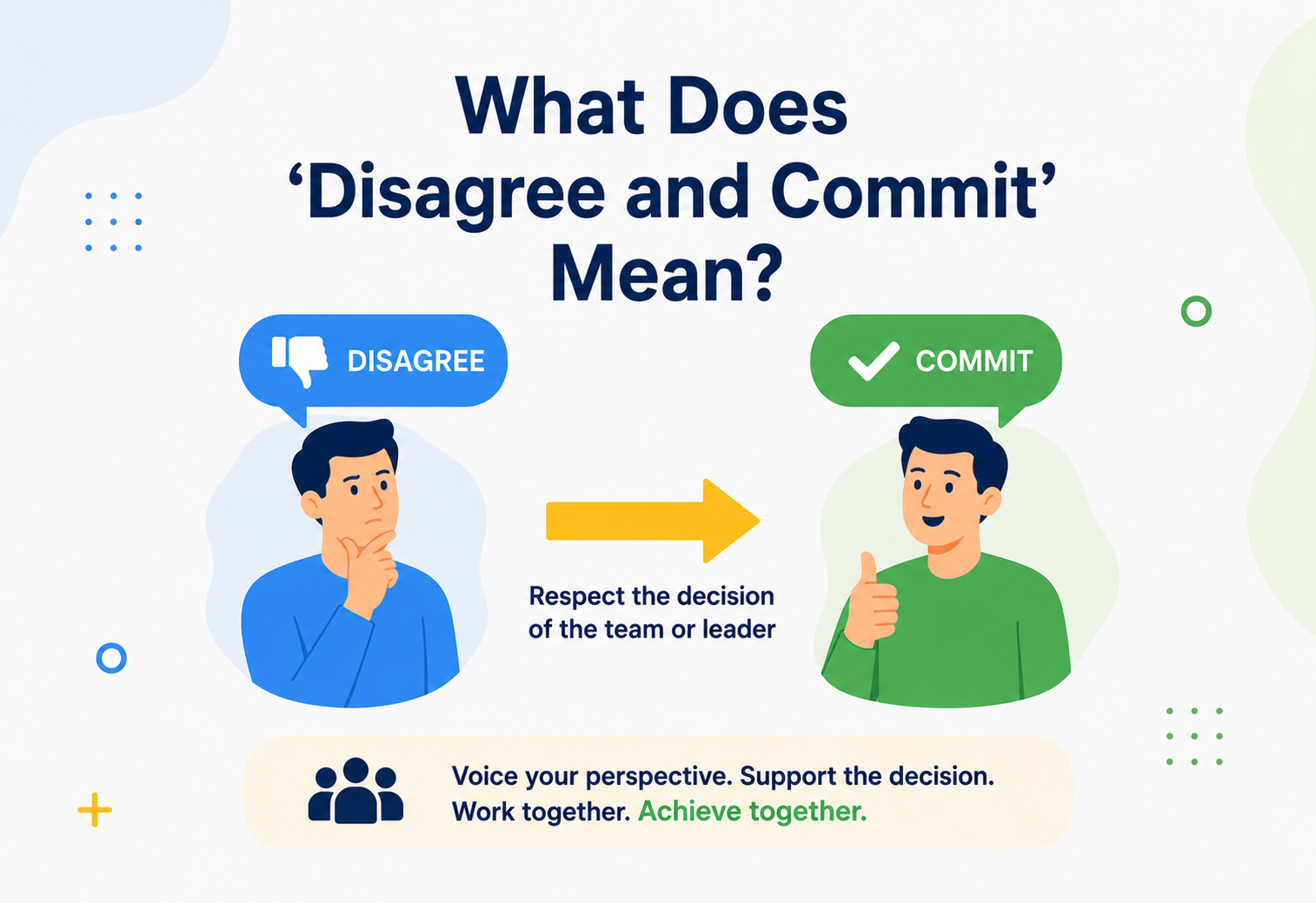
What Does “Disagree and Commit” Mean?
A complete, beginner-friendly guide to one of the most misunderstood ideas in engineering leadership: how to voice real disagreement, and then commit fully to a decision even when it doesn’t go your way.
The Simplest Definition, and Where It Came From
Imagine a team planning meeting. An architect proposes moving the entire order-processing system to an event-driven architecture. One senior engineer strongly disagrees — she believes the added complexity is not worth it for the team’s current scale, and says so clearly, with data to back her view. The discussion goes back and forth for twenty minutes. Eventually, the architect, after genuinely listening, decides to move forward with the event-driven approach anyway.
What happens next is the entire point of this guide: does the senior engineer quietly sabotage the rollout, drag her feet, and tell other engineers “I never thought this was a good idea”? Or does she say, clearly and sincerely, “I still think we’re taking on more risk than we need to, but I’m on board — let’s make this work,” and then genuinely throw her full effort behind making the migration succeed?
That second response is “disagree and commit.” It is a simple phrase describing a surprisingly difficult discipline: separating the right to voice honest disagreement from the obligation to support a decision, once it has actually been made, as if it were your own.
1.1 Where the phrase comes from
The idea itself is much older than its most famous modern phrasing. Alfred Sloan, the long-serving president of General Motors in the mid-20th century, was known for deliberately delaying major decisions until real disagreement had been voiced in the room, precisely because he distrusted decisions made too easily. Decades later, Andy Grove, the influential CEO of Intel during its rise as a semiconductor giant, wrote extensively about the same discipline in his management writing, describing how Intel’s culture depended on people arguing forcefully for their position before a decision, and then supporting that decision fully once it was made, regardless of which way the argument had gone.
The phrase reached its widest modern audience through Amazon. Jeff Bezos, in his 2016 letter to shareholders, described “disagree and commit” as one of the tools Amazon relied on to move fast despite the risk of large-scale disagreement, and the phrase was later formalized as one of Amazon’s published Leadership Principles (“Have Backbone; Disagree and Commit”). Since then, it has spread widely across the technology industry and beyond, becoming a common piece of shared vocabulary in engineering organizations of every size.

1.2 Why this idea needed a name at all
It might seem strange that a fairly intuitive idea — disagree, then support the decision anyway — needed its own formal name and widespread cultural promotion. The reason is that, left unnamed, most organizations default to one of two much worse patterns: either disagreement gets suppressed entirely because raising it feels too costly or risky, or disagreement gets voiced but never resolved, quietly poisoning a decision’s execution long after the meeting has ended. “Disagree and commit” exists as a named, explicit principle precisely because both of these failure patterns are common, costly, and difficult to fix without deliberately naming and teaching the better alternative.
Think of a family choosing where to eat dinner. If nobody speaks up, they end up at a restaurant nobody actually wanted. If everyone speaks up but no one ever agrees, they never eat. “Disagree and commit” is the middle discipline: everyone shares an honest preference before the decision, and once the family walks through the restaurant door, nobody spends the meal complaining about the choice.
The Problem This Principle Was Built to Solve
To understand why “disagree and commit” matters, it helps to clearly see the two dysfunctional patterns it was designed to replace — and the very practical organizational tension it exists to resolve.
2.1 The two failure modes this principle solves
| Failure mode | What it looks like | Why it’s costly |
|---|---|---|
| Silent agreement (false consensus) | People stay quiet in the room, even when they have real concerns, because raising them feels risky, unwelcome, or pointless. | Decisions get made without real scrutiny; serious flaws surface only after it is expensive to change course. |
| Endless re-litigation | People voice disagreement, lose the argument, and then continue relitigating the decision indefinitely — in side conversations, through passive resistance, or by quietly under-investing in execution. | Decisions never actually get fully implemented; teams waste energy fighting battles that were already decided. |
Imagine a family deciding where to go on vacation. If everyone stays quiet about their real preference just to avoid conflict, the family might end up somewhere nobody actually wanted. If, instead, everyone argues their case loudly, a decision gets made, but then one person spends the whole trip complaining “I wanted the mountains, not the beach,” the vacation is ruined for everyone anyway — the disagreement never actually ended, it just moved from the planning table to the vacation itself.
2.2 Why organizations cannot just “vote and move on”
A natural question is: why not just let the person with the most authority decide, and expect everyone to follow without needing a special phrase for it? The problem is that pure top-down authority, without genuine, encouraged disagreement first, tends to produce worse decisions — the person with authority often does not have the most complete picture, especially in a technical organization where the people closest to the code, the data, or the customer frequently see risks and details that a more senior decision-maker cannot see from where they sit. “Disagree and commit” is explicitly designed to capture the best of both approaches: it invites the most complete possible information and challenge before a decision, while still preserving the ability to actually make a decision and move forward with unified effort once the information has been gathered.
2.3 The motivation: speed without either recklessness or paralysis
At its core, this principle exists to solve a very practical organizational problem: how do you move fast on difficult, ambiguous decisions, in a way that is neither reckless (ignoring real disagreement) nor paralyzed (unable to decide until everyone fully agrees, which for many genuinely hard decisions may never happen)? “Disagree and commit” is a deliberate answer to this tension — not a compromise between speed and quality, but a structured way to get both.
Architects sit at the center of exactly this tension constantly: technical decisions are rarely unanimous, timelines rarely allow for endless debate, and yet a technical direction that the team doesn’t genuinely support in execution is often worse than a merely “good enough” direction everyone fully commits to.
2.4 The specific cost of silent agreement in technical organizations
In engineering contexts specifically, silent agreement is especially dangerous because the people most likely to notice a serious technical flaw — the engineers closest to the code, the operational history, or the data — are often not the most senior people in the room, and are therefore also often the people most likely to stay quiet if the environment doesn’t actively invite their disagreement. An architecture review where junior and mid-level engineers routinely defer to the most senior voice in the room, without genuine challenge, tends to systematically miss exactly the kind of ground-level operational risk that later causes painful, expensive production incidents.
2.5 The specific cost of endless re-litigation in technical organizations
Re-litigation carries its own particular cost in technical teams: half-hearted implementation. A team that never fully accepted a technical direction tends to build it to a lower standard — skipping edge cases, deferring cleanup work, avoiding investment in tooling or documentation around it — not out of malice, but because deep, sustained engineering effort is difficult to produce for something you don’t believe in. The resulting system often becomes a self-fulfilling prophecy: it was built without full conviction, so it performs worse than it might have, which then seems to retroactively validate the original disagreement, even though the underlying cause was incomplete commitment, not a flawed original decision.
Core Concepts You Need to Know
Because the phrase is short and easy to misuse, it is worth defining, carefully, what each half of it really means, what it explicitly does not mean, and the deeper preconditions that make it actually work in practice.
3.1 What “disagree” actually means in this phrase
The “disagree” half of the principle is not a passive right to silently hold a different opinion — it is an active obligation to voice that opinion clearly, with reasoning, before a decision is made. Amazon’s own published description of this principle explicitly frames it as needing to “have backbone” — respectfully but genuinely challenging decisions when you disagree, even when doing so is uncomfortable, and even when it would be socially easier to simply go along with the group.

3.2 What “commit” actually means in this phrase
The “commit” half is equally active, not passive. It does not mean merely refraining from actively sabotaging a decision. It means genuinely supporting the decision’s execution — with your full effort, your public tone when discussing it with others, and your actual behavior — as though it had been your own preferred choice, even though it wasn’t. This is the part of the principle that most people find genuinely difficult, because it asks for something psychologically demanding: setting aside a real, sincere disagreement and acting with full conviction anyway.
Think of a sports team choosing a game strategy before kickoff. Players might argue passionately in the locker room about which play to run. But once the coach calls the play and the team steps onto the field, every player executes that specific play with full effort — nobody quietly runs a different route because they preferred another plan. The disagreement happened before the play; full commitment happens during it.
3.3 What this principle is NOT
Because the phrase is short and easy to misuse, it is worth being precise about what “disagree and commit” explicitly does not mean.
| Common misunderstanding | What the principle actually says |
|---|---|
| “Just do what you’re told without pushing back.” | The principle explicitly requires voicing genuine disagreement first — silent, unvoiced compliance is not “disagree and commit,” it’s just compliance. |
| “You can keep arguing after the decision is made, as long as you technically do the work.” | Full commitment includes your tone and public stance, not just your task completion — quietly undermining a decision while doing the minimum required work still violates the principle. |
| “This only applies to junior people deferring to senior people.” | The principle applies in every direction — a senior leader can and should disagree-and-commit to a well-reasoned decision made by a more junior specialist with better information. |
| “Once you’ve disagreed and committed, you can never revisit the decision.” | Commitment applies to executing the current decision in good faith; it does not forbid raising new evidence later that genuinely changes the picture (see Section 3.5). |
3.4 The role of psychological safety
“Disagree and commit” only works if people actually believe that voicing disagreement is safe and welcomed — otherwise, the “disagree” half quietly disappears, and the principle degrades into simple top-down compliance wearing a more appealing name. This connects the concept directly to psychological safety, a well-researched organizational concept describing an environment where people believe they can speak up, take interpersonal risks, and voice concerns without fear of punishment or embarrassment. Leaders who claim to value “disagree and commit” but visibly punish or exclude people who voice disagreement are not practicing the principle at all — they are practicing something closer to its opposite while borrowing its name.
3.5 Disagree and commit versus reopening a decision
A subtle but important distinction: committing to a decision is not the same as promising the decision can never be revisited. If genuinely new evidence emerges after the decision was made — a technical risk that materializes, a cost that turns out far higher than estimated, a business priority that meaningfully shifts — raising that new evidence and asking to revisit the decision is entirely consistent with the principle. What the principle prohibits is relitigating the same original argument, with the same original information, simply because you didn’t like the outcome the first time.
A simple test: if you find yourself saying “I told you this wouldn’t work” using only information you already had at decision time, that’s re-litigation. If you’re saying “here’s new information we didn’t have before, and I think it changes the picture,” that’s a legitimate case for revisiting.
3.6 Why both halves have to be present for the principle to work
It is worth being explicit that “disagree” and “commit” are not two independent options to pick from — the principle only functions when both halves are genuinely present together. Commitment without genuine prior disagreement is not this principle at all; it is simply obedience, and it deprives the decision of the challenge and scrutiny that might have improved it. Disagreement without eventual commitment is also not this principle; it is simply unresolved conflict, dressed up in more polite language. The value of the phrase comes specifically from holding both halves at once: real, honest challenge before the decision, and real, honest support after it.
3.7 A simple mental model: two separate clocks
One way to internalize this distinction is to imagine two separate clocks running during any difficult decision. The “disagreement clock” runs before a decision is made, and during that window, voicing concerns, pushing back, and arguing your case is not just acceptable but expected and valuable. Once the decision is actually made, the disagreement clock stops, and the “commitment clock” starts — and from that point forward, the same energy that went into disagreement is expected to go into making the decision succeed. The most common individual failure of this principle is letting the disagreement clock keep running informally, in side conversations and subtle behavior, long after it should have stopped.
The Structural Anatomy of a Disagree-and-Commit Decision
Just as a system has distinct components that work together, a healthy “disagree and commit” decision has distinct structural elements. Understanding these pieces helps you recognize when the principle is being applied well, and when it is quietly breaking down.
4.1 The components explained
- Open input phase: A genuine window where every relevant voice, regardless of seniority, is invited to share their honest view and reasoning — not just a formality before a predetermined outcome.
- Clear decision owner: Someone specific is accountable for actually making the call. Without a clear owner, “disagree and commit” collapses into endless debate, because nobody has the authority or responsibility to end it.
- Genuine debate: Disagreement backed by reasoning, evidence, or experience — not simply competing preferences stated without justification.
- The call: The decision owner makes an actual decision, which may or may not match what the majority, or the most vocal disagreer, preferred.
- Full commitment: Every participant, including those who disagreed, genuinely supports execution — in effort, in public tone, and in follow-through.
4.2 Why a clear decision owner is non-negotiable
Many organizations that struggle with “disagree and commit” in practice are actually missing a much more basic ingredient: a clear owner. If a decision is made “by the group” with no single accountable owner, there is no legitimate authority to actually end the debate and trigger the “commit” phase — everyone can reasonably claim the decision is still open, because in a real sense, it is. This is why nearly every well-functioning version of this principle pairs it with an explicit norm about decision ownership: someone specific — an architect, a tech lead, a manager — is named as the person who will make the final call if consensus does not emerge naturally.
4.3 Decision ownership does not mean deciding alone
It is worth being precise that naming a clear decision owner is not the same as excluding everyone else from meaningful influence over the outcome. A good decision owner treats the input phase as genuinely consequential — actively weighing dissenting views, sometimes changing their initial instinct because of them — while still retaining the clear responsibility to actually make the final call when consensus does not naturally emerge. The distinction matters because teams sometimes conflate “someone owns this decision” with “input doesn’t really matter,” which undermines the open input phase and, in turn, weakens the quality of the eventual decision.
4.4 What happens when decision ownership is unclear
When no one is clearly accountable for a decision, a few predictable dysfunctions tend to appear: debates run longer than necessary because no one has standing to end them, decisions get made informally and inconsistently depending on who happens to speak last or loudest, and — most damaging for this principle specifically — no one is quite sure whether commitment is actually being asked for, since it is unclear whose decision people would even be committing to. Naming an owner explicitly, even for a decision that will ultimately be made collaboratively, resolves this ambiguity and makes the entire disagree-and-commit process legible to everyone involved.

How It Actually Sounds in a Real Meeting
Let us walk through, moment by moment, what a well-run “disagree and commit” discussion actually sounds like, compared to a poorly-run one. These are the practical scripts you can carry into your very next architecture review.
5.1 Step-by-step: a well-run discussion
- Frame the decision and the owner up front: “We need to decide on the caching strategy for the new checkout service. I’ll make the final call by end of this meeting, but I want to hear everyone’s view first.”
- Invite dissent actively, not passively: The decision owner explicitly asks quieter or more junior voices for their view, rather than only responding to whoever speaks up first or loudest.
- Debate the reasoning, not just the conclusion: Participants are asked to explain why, with evidence or experience, rather than simply stating a preference.
- Acknowledge disagreement honestly when deciding: “I hear the concern about added operational complexity, and I don’t think it’s wrong — I’m still going with the distributed cache approach because I believe the performance gain outweighs that cost at our current scale.”
- Ask for explicit commitment: “Given that, can everyone commit to making this work, even though we know not everyone agrees?” — and genuinely listen for the answer, rather than assuming it.
- Follow through visibly: The people who disagreed visibly support execution afterward — in code reviews, in stand-ups, and especially when talking about the decision with people outside the room.
5.2 Step-by-step: a poorly-run discussion
- The decision feels predetermined; input is requested as a formality, not genuinely considered.
- Disagreement is voiced once, dismissed quickly without real engagement, and not revisited.
- No one explicitly asks for commitment — the meeting simply ends, and people are left to guess whether they are expected to support the outcome.
- People who disagreed continue expressing doubt in side conversations, subtly undermining the decision’s credibility with people who were not in the room.
- Execution suffers because the team’s effort is split between doing the work and quietly hedging against the decision being wrong.
Many experienced leaders use a version of this exact sentence when closing a difficult decision: “I know we don’t all agree, and I want to be clear I heard the concerns. Here’s why I’m making this call anyway. Can I get everyone’s commitment to make this work?” Saying it out loud, rather than assuming it, is often the single biggest difference between principle and practice.
5.3 What “genuine commitment” sounds like versus reluctant compliance
| Reluctant compliance | Genuine commitment |
|---|---|
| “Fine, we’ll do it your way.” (flat tone, no further engagement) | “Okay — here’s what I think we need to watch closely to make this succeed given my concern about X.” |
| Later, to other colleagues: “I never thought this was a good idea, but what can you do.” | Later, to other colleagues: “We decided on this approach for these reasons — here’s how we’re making it work.” |
| Does the assigned work at minimum required quality. | Actively looks for ways to make the chosen direction succeed, even proposing improvements within it. |
The Lifecycle of a Decision, Stage by Stage
Let us trace a single decision through its full lifecycle, from the moment disagreement first surfaces to long after the decision has been implemented. Each stage has its own risks and its own signature failure mode.
6.1 Stage one: surfacing disagreement early
The earlier genuine disagreement surfaces, the cheaper it is to properly consider. A culture that only hears dissent after a decision is functionally announced, rather than while it is still being formed, tends to produce far more resentment and far less genuine commitment, because people reasonably feel their input was never actually wanted.
6.2 Stage two: the decision moment itself
This is the moment described in Section 5 — a decision owner weighs the input gathered and makes an actual call. The clarity of this moment matters enormously: an ambiguous, unstated “I guess we’re doing it this way then” produces much weaker commitment than an explicit, acknowledged decision.
6.3 Stage three: the commitment window
Immediately after a decision, there is a short but critical window where commitment either solidifies or quietly erodes — often through how the decision is first described to people outside the room. A team that hears their architect say “leadership made us do this” is being handed permission to disagree without committing; a team that hears “we decided this together, and here’s why” is being invited into genuine commitment, even for the people who did not get their way.
6.4 Stage four: sustained execution
Genuine commitment is tested most, not at the decision meeting, but weeks later — during the unglamorous, difficult parts of execution when the easiest thing to do would be to quietly under-invest in a direction you did not choose. This is where the principle either proves real or reveals itself as having been performative.
6.5 Stage five: legitimate reopening
As covered in Section 3.5, a decision can be legitimately reopened later — but only on the strength of genuinely new evidence, not a replay of the original argument. Healthy teams distinguish these two clearly, often explicitly, to avoid every disagreement becoming an opportunity to reopen every past decision indefinitely.
6.6 A short worked example across all five stages
To make this lifecycle concrete, consider a team deciding whether to introduce a new internal API gateway. In stage one, a mid-level engineer raises a concern early, in a design document comment, that the added latency has not been measured. In stage two, the architect explicitly weighs this in the decision meeting, commissions a quick latency benchmark, and decides to proceed once the benchmark shows an acceptable overhead. In stage three, the architect tells the wider team, accurately, “we measured the latency concern raised during design, found it acceptable, and are moving forward” — crediting the concern rather than glossing over it. In stage four, the engineer who raised the concern helps write the gateway’s monitoring dashboards, specifically watching the latency metric they were originally worried about. In stage five, three months later, that same dashboard reveals latency has grown beyond the original benchmark under real production load, and the engineer brings this new, concrete data back to the architect — a legitimate reopening, grounded in fresh evidence, not a replay of the original design-time concern.
Advantages, Limits & Trade-offs
Like every organizational discipline, “disagree and commit” is not free, and it is not universally appropriate. Knowing where it shines and where it must be set aside is a core part of using it well.
Advantages
- Faster decisions: Removes the need for full unanimous agreement, which for many genuinely hard technical or business decisions may simply never be achievable.
- Better decisions: Actively invites challenge and dissent before deciding, surfacing risks and blind spots a purely top-down process would miss.
- Stronger execution: A team that has genuinely committed, even after disagreeing, typically executes far better than a team that complied without ever being heard.
- Preserves relationships: Gives people a legitimate, respected way to voice strong disagreement without it becoming personal, adversarial, or career-limiting.
Real Limitations & Risks
- Can be used to suppress dissent if applied dishonestly: A leader who has already decided, and merely performs “listening” before announcing a predetermined outcome, corrupts the principle into a more palatable form of pure top-down control.
- Requires real trust to function: Without genuine psychological safety, people quietly stop voicing disagreement at all, and the principle degrades into simple compliance (see Section 3.4).
- Not every disagreement is equally weighty: The principle works best for decisions with real uncertainty and reasonable people on both sides; using it to wave away a disagreement rooted in a genuine safety, ethics, or correctness concern is a serious misuse.
- Emotional cost: Genuinely committing to a decision you believe is wrong is psychologically demanding, and repeatedly asking the same person to do so, decision after decision, can erode morale and trust over time.
7.1 The critical exception: when NOT to simply commit
“Disagree and commit” is explicitly not meant to apply to concerns involving safety, ethics, legal compliance, or situations where a decision may cause serious, hard-to-reverse harm. In these cases, the appropriate response is not quiet commitment but continued, escalating resistance — including formally escalating the concern to a higher level of authority, or in extreme cases, declining to participate in executing the decision at all. Even Amazon’s own published description of the principle is explicit that this only applies once a decision has been “disagreed” honestly and openly — it was never intended as a tool to pressure people into supporting something they believe is genuinely wrong or dangerous.

“I think this technical approach is riskier than it needs to be” is exactly the kind of disagreement this principle is designed for. “I think this decision is unsafe, unethical, or illegal” is a fundamentally different category, and deserves continued challenge, not quiet commitment.
How It Scales With Seniority & Team Size
Just as technical and leadership expectations scale with seniority, the practice of disagree and commit looks different depending on where someone sits in an organization and how large the group involved actually is.
| Context | What disagree and commit typically looks like |
|---|---|
| Two engineers on a small team | A quick, informal exchange — often resolved in minutes, with low stakes and fast recovery if wrong. |
| An architect and a skeptical senior engineer | A more structured conversation, often referencing data or prior experience, with the architect explicitly acknowledging the disagreement before deciding. |
| Cross-team technical direction, multiple stakeholders | A formal decision process, sometimes with a written proposal (an RFC or architecture decision record), explicit dissent captured in writing, and a clearly named decision owner. |
| Executive-level strategic decisions | Structured debate among senior leaders, often over multiple sessions, followed by a single accountable executive making the final call and explicitly asking for organization-wide commitment. |
8.1 Why written decision records matter more at larger scale
In a two-person conversation, commitment can be confirmed with a simple verbal exchange. At larger scale — a decision affecting many teams, over a long time horizon — verbal commitment alone is fragile, because people join and leave the discussion, memories fade, and the original reasoning gets lost. This is why larger organizations increasingly pair disagree-and-commit decisions with a written record (often called an architecture decision record, or ADR), explicitly capturing the decision, the key dissenting views considered, and the reasoning for the final call — creating a durable artifact that both documents commitment and provides the legitimate basis for reopening the decision later if genuinely new evidence emerges.
8.2 A brief example of a written decision record
# ADR-014: Adopt Event-Driven Integration for Order Fulfillment

## Decision
We will adopt an event-driven integration pattern between the Order
and Inventory services, replacing the current synchronous REST calls.

## Key disagreement considered
Priya raised a strong concern that this adds operational complexity
(dead-letter queues, eventual consistency handling) that may not be
justified at our current traffic volume. This concern is valid and
was weighed seriously.

## Reasoning for the decision
Projected traffic growth over the next two quarters, combined with
recent incidents caused by synchronous coupling during Inventory
service outages, outweighs the added operational complexity.

## Commitment
All contributing engineers, including those who raised concerns,
have agreed to support this direction during implementation.

## Reopening conditions
This decision should be revisited if projected traffic growth does
not materialize within two quarters, or if operational complexity
proves substantially higher than estimated here.
8.3 Scaling commitment across an entire organization
At the largest scale, disagree and commit does not just apply between individuals in a room — it applies to how an entire organization talks about a decision after it is made. A leader’s job includes actively preventing the decision from quietly fragmenting into multiple competing interpretations as it spreads through layers of management, which requires clear, consistent, repeated communication of both the decision and the reasoning behind it, not just a single meeting where it was first announced.
Making Disagreement Genuinely Safe
Just as a distributed system needs deliberate mechanisms to remain reliable under stress, an organization needs deliberate mechanisms to keep disagree-and-commit genuinely fair and safe to practice, rather than quietly becoming a one-way street where only senior people’s disagreement is actually heard.
9.1 The power-distance problem
The single biggest risk to this principle in practice is power distance: junior or less senior team members are often far less likely to voice genuine disagreement with a senior leader, not because they lack opinions, but because the perceived cost of speaking up feels higher, and the perceived benefit feels lower. Left unaddressed, this quietly turns “disagree and commit” into “senior people disagree, everyone else commits,” which defeats the principle’s actual purpose of surfacing the most complete information available before deciding.
In many classrooms, a teacher who says “any questions?” without actively drawing out quieter students will mostly hear from the same few confident voices every time — not because only they have questions, but because raising a hand carries a different social cost for different students. A good teacher, like a good decision owner, actively works to lower that cost for everyone, not just wait passively for volunteers.
9.2 Structural defenses used by mature organizations
- Actively soliciting dissent, not just allowing it: Decision owners explicitly ask quieter or more junior participants for their view, rather than treating silence as agreement.
- Written, asynchronous input channels: Some people express genuine disagreement more comfortably in writing than in a live meeting; offering both channels captures a wider range of honest input.
- Explicitly rewarding good-faith dissent: Recognizing and thanking people for well-reasoned disagreement, even when their view is not adopted, reinforces that raising it was valued, not merely tolerated.
- Separating the disagreement conversation from the person’s performance evaluation: Making clear, through consistent behavior over time, that voicing reasonable disagreement is never held against someone in reviews or promotion decisions.
9.3 What happens when trust is missing
In a low-trust environment, teaching people to “disagree and commit” without first building genuine psychological safety often backfires — it can be perceived as a socially acceptable way to pressure people into silence (“we asked for your input, so now you have to support this”), rather than a genuine invitation to be heard. Leaders who want this principle to function well need to invest in the underlying trust first; the principle is a tool that amplifies whatever trust already exists, not a substitute for it.
9.4 A practical technique: anonymous or written pre-reads
One concrete technique several engineering organizations use to counter the power-distance problem is circulating a written decision proposal in advance, with an explicit, low-pressure channel for written feedback or questions before the live discussion happens. This gives people who are less comfortable pushing back verbally in real time, in front of a group, a genuine alternative way to raise concerns, and it often surfaces disagreement that would otherwise never make it into the room at all. Some teams go further, using anonymous feedback channels specifically for architecture proposals, precisely because anonymity removes the social cost that silences some genuine, valuable disagreement.
9.5 The leader’s own behavior is the real signal, not the stated policy
No amount of stated commitment to psychological safety matters as much as how a leader actually responds the first few times someone disagrees with them in front of others. If that response is visibly defensive, dismissive, or subtly punishing — even through something as small as a curt tone or a later, unrelated slight — the real message that spreads through the team is “disagreement is not actually safe here,” regardless of what any values document says. Conversely, a leader who visibly, warmly welcomes a well-reasoned challenge, especially when they ultimately decide against it, sends the opposite message far more effectively than any written policy could.
Signals, Warning Signs & Retrospectives
Just as a production system needs monitoring to reveal whether it is actually healthy, an organization benefits from deliberately checking whether disagree-and-commit is functioning as intended, rather than assuming it is simply because the phrase gets used often.
Signals It’s Working Well
- People at every level regularly voice disagreement in meetings, not just the most senior or most confident participants.
- Decisions, once made, are executed with visibly consistent effort, regardless of who originally disagreed.
- People who disagreed describe the decision to others outside the room accurately and without undermining tone.
- Past decisions get reopened occasionally, but specifically when new evidence appears — not as a recurring pattern of relitigating old arguments.
Warning Signs It’s Breaking Down
- Disagreement in meetings has quietly stopped, replaced by uniform, fast agreement that does not match the private conversations happening afterward.
- The same small group of senior voices does all the disagreeing; everyone else stays silent.
- Decisions are frequently, informally undermined during execution, without anyone explicitly reopening them.
- People describe past decisions to outsiders in a way that distances themselves from it (“leadership decided this, not me”) rather than owning it as a team decision.
10.1 Using retrospectives as a feedback loop
Many engineering teams use periodic retrospectives, not just to review project outcomes, but specifically to ask how well the team’s disagree-and-commit practice functioned on a given decision: was disagreement genuinely welcomed and heard? Was the reasoning behind the final call clearly communicated? Did commitment actually hold during the harder parts of execution? Treating this as a periodically reviewed team practice, rather than an assumed cultural fact, is one of the more effective ways mature organizations keep the principle healthy over time, similar to how a production system’s alerting thresholds get refined based on real incident reviews.

A simple, low-effort way to monitor this on your own team: after a difficult decision, privately ask one or two people who disagreed, a few weeks later, “how do you feel about how that decision was made?” Their honest answer is often a better signal than anything visible in the meeting itself.
Healthy Patterns & Anti-patterns to Avoid
A handful of structural patterns keep showing up in successful disagree-and-commit practice, and a matching handful of anti-patterns keep tripping up teams that skip them. Learning both lists shortens the road considerably.
11.1 Healthy patterns
- Naming the decision owner up front: Everyone in the room knows who will actually make the call, reducing ambiguity about whether debate is genuine or purely decorative.
- Steelmanning the disagreement before deciding: The decision owner restates the strongest version of the disagreeing view before explaining their decision, proving it was genuinely understood, not dismissed.
- Explicitly asking for commitment out loud: Rather than assuming it, directly asking “can you commit to this?” and listening for the real answer.
- Owning the decision publicly, including its risks: The decision owner takes visible responsibility for the call, including acknowledging what could go wrong, rather than hiding behind vague “we decided” language.
11.2 Anti-patterns to avoid
- Performative listening: Going through the motions of asking for input while having already decided, which people usually detect quickly and which permanently damages trust in the process.
- Weaponizing the phrase: Using “disagree and commit” as a rhetorical tool to shut down further discussion prematurely, before genuine debate has actually happened.
- Silent non-commitment: Nodding along in the room, then quietly under-delivering or badmouthing the decision elsewhere — the most common and most corrosive failure of this principle in practice.
- Applying it to safety or ethics concerns: Using the principle to pressure someone into supporting something they believe is genuinely unsafe, unethical, or non-compliant, which is an explicit misuse (see Section 7.1).
- No clear decision owner: Attempting to run a disagree-and-commit process without anyone actually accountable for making the final call, which usually produces neither a real decision nor real commitment.
11.3 A side-by-side comparison
| Anti-pattern | Healthy pattern |
|---|---|
| “We’ve already decided, but let’s pretend to discuss it for morale.” | “Here’s the decision I’m leaning toward — tell me what I might be missing before I finalize it.” |
| “I disagree, but whatever, do what you want.” (flat, disengaged) | “I disagree, and here’s specifically why — but if we’re going this way, here’s how I’ll help make it work.” |
| Complaining about the decision to peers outside the room. | Explaining the decision and its reasoning accurately to peers outside the room, even while personally disagreeing. |
Best Practices & Common Mistakes
The lists below distill the practical lessons of the previous chapters into a compact reference — one set of habits for the decision owner, one for the person doing the disagreeing, and a ranked list of the mistakes that show up over and over in real teams.
12.1 Best practices for decision owners
- Name yourself explicitly as the decision owner before debate begins, so everyone understands the shape of the conversation.
- Actively invite input from quieter or more junior voices, rather than waiting for volunteers.
- Restate the strongest disagreeing argument in your own words before explaining your decision, proving you engaged with it seriously.
- Be explicit and honest that not everyone agrees, rather than implying false consensus.
- Ask directly for commitment, and treat a hesitant answer as useful information, not an inconvenience to brush past.
- Document significant decisions in writing, especially at larger scale, including the key disagreement considered.
12.2 Best practices for the person disagreeing
- Voice disagreement with clear reasoning and evidence, not just a stated preference.
- Raise it as early as possible, while the decision is still genuinely open.
- Distinguish clearly, even to yourself, between “I’d have chosen differently” and “I believe this is genuinely unsafe or wrong” — the appropriate response differs sharply between these two (see Section 7.1).
- Once a decision is made, be deliberate and consistent about your public tone when discussing it with others, especially people who were not in the room.
- If you find genuine commitment difficult to sustain, say so directly to the decision owner rather than silently disengaging — this is itself a form of honest disagreement, and deserves the same respect as the original one.
12.3 Common mistakes, ranked by frequency
- Silent non-commitment — agreeing in the room, then quietly under-supporting execution — is by far the most common real-world failure.
- No clear decision owner, leaving debate genuinely unresolved and commitment genuinely undefined.
- Performative input-gathering, where the outcome was effectively predetermined, eroding trust in future discussions.
- Confusing preference-based disagreement with safety or ethics concerns, either by dismissing serious concerns too casually, or by treating ordinary preference disagreements as unresolvable moral objections.
- Forgetting to explicitly ask for commitment, leaving people to guess what is expected of them after a decision is made.
If you only change one habit after reading this guide, make it this one: the next time you make a difficult call that not everyone agrees with, say the words “I know we don’t all agree — can I get your commitment to make this work?” out loud, and actually listen to the answer.
Real-World Industry Examples
The clearest way to see this principle in the wild is to look at how well-known organizations, across very different industries, have publicly named and formalized it. Their differences are less important than the striking similarity of the underlying pattern.
Have Backbone; Disagree and Commit
Formalized as one of Amazon’s published Leadership Principles — leaders are expected to respectfully challenge decisions they disagree with, even when uncomfortable, and once a decision is made, to commit wholly without passive-aggressive resistance.
Constructive Confrontation
Andy Grove’s articulation of the same discipline — argue positions forcefully based on facts and reasoning rather than hierarchy, then support whatever decision emerges from that debate.
Radical Candor & Believability-Weighted Decisions
Ray Dalio’s more intensely formalized version — vigorous, evidence-based disagreement especially from people with a strong track record, followed by a clear decision process and expected commitment.
Architecture Decision Records
The engineering-organization equivalent — a durable written artifact naming the decision, the disagreement considered, and the reasoning, making commitment legible over time.
13.1 Amazon’s “Have Backbone; Disagree and Commit”
Amazon’s own published description of this Leadership Principle explicitly frames it in two connected halves: leaders are expected to respectfully challenge decisions they disagree with, even when doing so is uncomfortable or exhausting, and once a decision is made, to commit wholly, without passive-aggressive resistance. This framing directly shaped how the phrase is now understood across the broader technology industry, and it is the most commonly cited source when engineers first encounter the term.
13.2 Andy Grove and Intel
Andy Grove’s writing about management at Intel described a closely related discipline he called “constructive confrontation” — the expectation that people would argue their position forcefully, based on facts and reasoning rather than hierarchy, and then support whatever decision emerged from that debate. Grove’s version placed particular emphasis on decisions being made based on the strength of argument and data, not organizational rank, which remains one of the more influential early articulations of the same underlying idea.
13.3 Ray Dalio and Bridgewater Associates
Outside the technology industry, Ray Dalio’s writing about the investment firm Bridgewater Associates describes a similar, if more intensely formalized, practice of “radical candor” and “believability-weighted decision making” — encouraging vigorous, evidence-based disagreement, particularly from people with a strong track record in the relevant area, followed by a clear decision process and expected commitment to the outcome.
13.4 A common pattern across very different organizations
Despite covering a technology retailer, a semiconductor manufacturer, and an investment firm, these examples share the same underlying structure: genuine, evidence-based disagreement is actively invited before a decision, a clear process exists for actually making the call, and full commitment is explicitly expected afterward, regardless of who “won” the argument. This convergence, across very different industries and eras, is itself meaningful evidence that the underlying problem being solved — how to combine genuine challenge with genuine speed and unity of execution — is a durable, widely shared organizational challenge, not a passing management trend specific to any one company.
13.5 A composite example story (illustrative)
Consider a realistic, composite scenario that ties these ideas together. A platform team is deciding whether to adopt a new internal service mesh across all microservices, or continue with the team’s existing lighter-weight approach. The proposing architect gathers input over a week, including a strongly-worded, well-reasoned objection from a senior engineer who has previously operated a similar service mesh at another company and experienced significant operational overhead from it. The architect explicitly restates this concern in the final decision meeting, acknowledges it is legitimate, and explains that the decision to proceed anyway rests on a specific mitigation — a phased rollout limited to three low-risk services first, with an explicit checkpoint in six weeks to assess real operational cost before wider adoption. The senior engineer, though still personally skeptical, agrees the phased approach directly addresses her core concern, and volunteers to help design the rollout’s monitoring dashboards specifically because her expertise is most relevant there. Six weeks later, at the checkpoint, the data shows moderate but manageable operational overhead, and the team proceeds with wider adoption — a decision that would have been considerably weaker without the senior engineer’s original, honestly voiced disagreement shaping the phased, checkpointed approach in the first place.
Frequently Asked Questions
These are the questions that come up most often in real conversations with engineers and leaders who are just starting to work with this principle deliberately.
Is “disagree and commit” the same as “the boss is always right”?
No. It explicitly requires genuine, encouraged disagreement before a decision, and it applies in every direction, not just downward from senior to junior. A senior leader disagreeing-and-committing to a well-reasoned junior engineer’s decision is a completely valid, and often powerful, application of the same principle.
What if I genuinely cannot bring myself to commit after losing an argument?
This is worth raising directly and honestly with the decision owner, rather than silently disengaging. Sometimes this conversation reveals the disagreement runs deeper than initially understood, which is itself valuable information; sometimes it helps clarify exactly what commitment is actually being asked for, which can resolve the hesitation.
Does this principle mean I should never escalate a decision above the decision owner?
No — legitimate escalation remains appropriate, especially for safety, ethics, or compliance concerns (Section 7.1), or when you believe the decision-making process itself was flawed, not just the outcome. The principle governs how you engage with a decision you disagree with on the merits, not whether escalation paths exist at all.
How is this different from just “being a team player”?
“Being a team player” is often used loosely to mean simply going along with the group, which can suppress valuable disagreement. “Disagree and commit” is more precise: it explicitly protects and expects genuine disagreement first, and only asks for full support after that disagreement has been honestly heard and a real decision has been made.
Can this principle be misused by leaders to avoid real accountability?
Yes, if applied dishonestly — for example, by performing a listening process without genuinely considering the input, or by using the phrase to pressure people into silence rather than genuine commitment. Recognizing this risk (Section 7 and Section 11.2) is part of using the principle well, both as a leader and as a team member.
What if the decision owner changes their mind after hearing disagreement — is that a sign the process failed?
No, the opposite — a decision owner genuinely updating their view based on strong input is exactly what the “open input phase” described in Section 4 is designed to produce. The principle is not about defending a predetermined answer; it is about making the best possible decision after genuinely weighing disagreement, even if that means changing course from an initial instinct.
How do I know if I am truly committing, or just telling myself I am?
A useful check is to notice your own behavior in unobserved moments — how you describe the decision when the decision owner is not in the room, whether you are investing real effort in the unglamorous parts of execution, and whether you would be comfortable if someone repeated your private comments about the decision back to the person who made it. Genuine commitment tends to look the same whether or not anyone is watching.
What to Carry Forward
If there is one idea worth carrying away from this entire guide, it is this: “disagree and commit” is not a rhetorical trick for closing an argument — it is a discipline for making difficult decisions well, and then executing them together.
Key Takeaways
- “Disagree and commit” separates the right and obligation to voice honest disagreement from the obligation to fully support a decision once it is genuinely made.
- It exists to solve two costly failure modes: silent false consensus, and endless relitigation of decisions that never fully move forward.
- A clear, accountable decision owner is essential — without one, there is no legitimate authority to actually end debate and trigger real commitment.
- The principle explicitly does not apply to genuine safety, ethics, or compliance concerns, which deserve continued challenge and escalation, not quiet commitment.
- It only functions well with genuine psychological safety; without trust, it degrades into performative listening followed by simple compliance.
- At larger organizational scale, written decision records (like architecture decision records) help make both the decision and the commitment durable and legible over time.
- Genuine commitment is tested most during the unglamorous work of execution, not in the meeting where the decision was made.
Used honestly, “disagree and commit” is not a tool for silencing dissent, and it is not a euphemism for simply following orders. It is a discipline that asks more of everyone involved than either pure top-down authority or endless consensus-seeking — more honesty in disagreement, and more genuine effort in commitment — precisely because that combination, difficult as it is, tends to produce both better decisions and stronger execution than either extreme alone.
For a Software Architect specifically, this discipline is not optional polish on top of the technical job — it is a core part of the job itself. Every significant architectural decision touches people who will not fully agree with it, and the difference between a design that merely gets approved and one that actually gets built well, maintained well, and defended well when questioned by others later, very often comes down to whether the people who disagreed along the way genuinely committed, or only appeared to.
Voice your disagreement clearly and honestly before the decision, then throw your full weight behind executing the decision after it — and hold the decision owner, and yourself, accountable to doing both.