RESILIENCE · DISTRIBUTED SYSTEMS · FAULT TOLERANCE
What Is The Circuit Breaker Pattern Used For, In Resilience Terms?
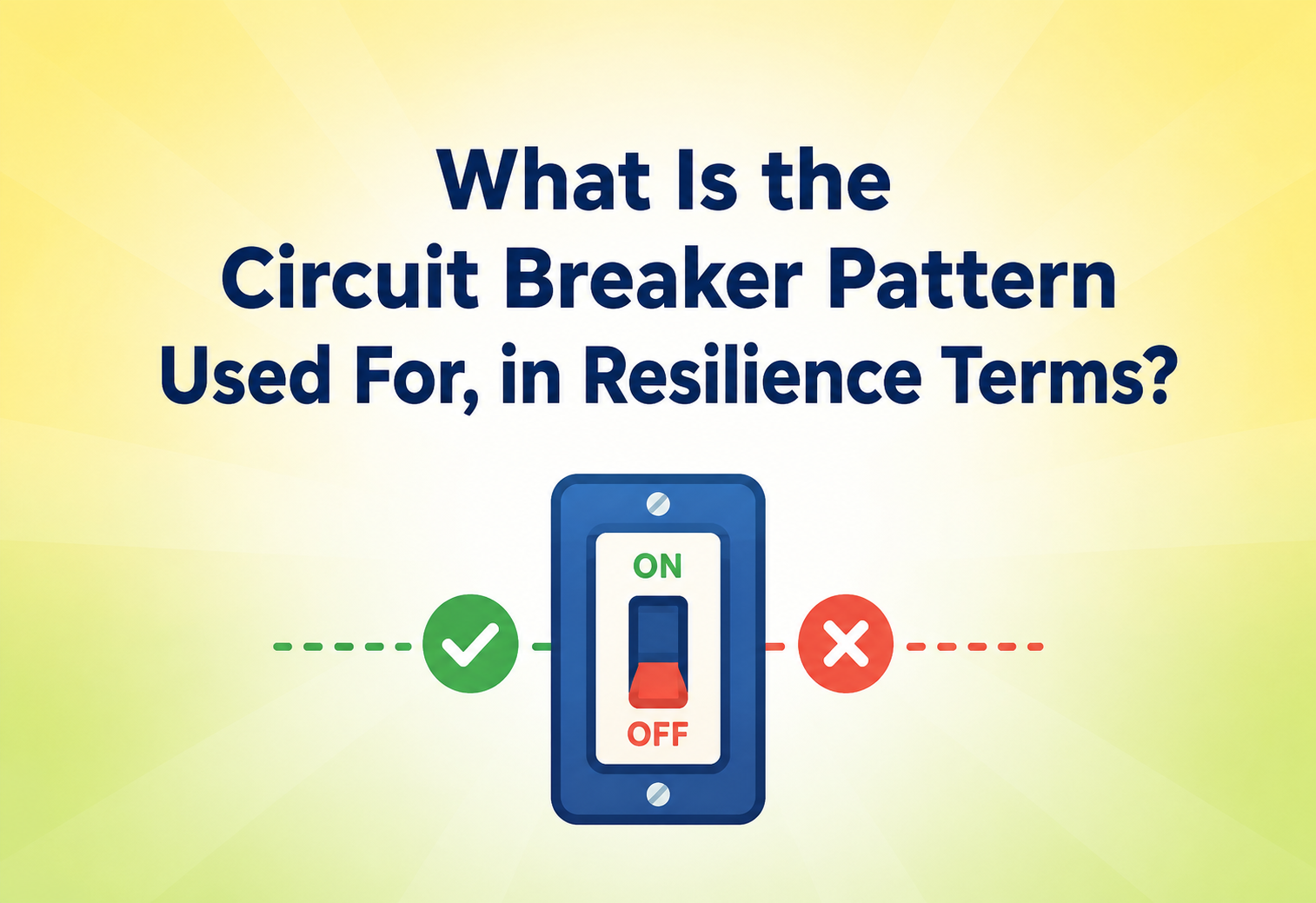
Electricians put a circuit breaker in a fuse box so one faulty appliance cannot burn down the whole house. Software engineers borrow the exact same idea — wrap a risky call to another service in a circuit breaker so one failing dependency cannot burn down the entire application. This guide explains, from the ground up, what a circuit breaker actually does, how its three states work, and how companies like Netflix, Microsoft, and Amazon use it to keep massive systems standing during partial failures.
01 · INTRODUCTION & HISTORY
From A Fuse Box In Your Kitchen To A Trillion Protected Calls A Day
Look at the fuse box or breaker panel in your home. Every circuit in the house — kitchen sockets, bedroom lights, the water heater — has its own small switch. If the kitchen toaster short-circuits and tries to draw far too much current, its breaker switch flips off, cutting power to that one circuit only. The lights in your bedroom stay on. The rest of the house is unaffected. Nobody has to run outside and shut off power to the entire building just because one toaster misbehaved, and once the toaster is unplugged or repaired, that one switch can simply be flipped back on without disturbing anything else in the house.
The circuit breaker pattern in software borrows this exact idea. It is a small piece of logic that sits between your code and a dependency — another service, a database, a third-party API — and watches how that dependency has been behaving recently. If the dependency starts failing repeatedly, the circuit breaker “trips,” and for a while it stops sending it any more requests at all, failing immediately instead, rather than letting every single caller wait, retry, and pile more load onto something that is already struggling to keep up with the demands already placed on it.
Real-life analogy
A restaurant host who sees the kitchen is completely overwhelmed with orders might temporarily stop seating new customers, protecting the kitchen staff already drowning in work, rather than seating everyone and making the whole dining room’s experience worse — resuming normal seating only once the kitchen has clearly caught back up.
Software example
An online store’s checkout page calls a recommendation service to show “customers also bought.” If that service starts timing out repeatedly, a circuit breaker stops calling it for a minute and simply hides that section of the page instead, letting checkout itself continue working normally.
Where the idea came from
The term “circuit breaker,” used in this exact software sense, was popularised by Michael Nygard in his widely read 2007 book “Release It!”, which focused heavily on designing production software that survives real-world failure conditions rather than only being tested against the happy path. Nygard directly borrowed the electrical engineering metaphor because it captured something existing failure-handling techniques of the time did not: the idea of a component actively, deliberately refusing to attempt an operation it already has good reason to believe will fail, rather than trying anyway and wasting time and resources finding out the hard way, every single time, that the same doomed outcome was always going to happen.
The pattern gained enormous mainstream visibility a few years later when Netflix, migrating its systems onto Amazon Web Services and building one of the earliest large-scale microservices architectures, open-sourced a library called Hystrix in 2012 — built specifically around the circuit breaker concept combined with timeouts, thread isolation, and fallback logic. Hystrix became, for much of the following decade, the reference implementation that a huge share of the industry learned this pattern from, and while newer libraries have since taken its place in many organisations, its core ideas remain essentially unchanged in how the pattern is applied today.
A timeout answers “how long do I wait on this one attempt,” while a circuit breaker answers a bigger question: “given everything I’ve seen recently, should I even bother attempting this call at all?”
Electrical circuit breakers
The physical device that gives the software pattern its name and metaphor — a switch that isolates a faulty circuit from the rest of the building.
Michael Nygard · “Release It!”
The book that named and popularised the pattern in software, framed around building systems that survive production failure rather than only passing tests.
Netflix Hystrix (open sourced)
The reference implementation an entire decade of engineers learned this pattern from — built around Netflix’s own AWS migration and early microservices scale.
Resilience4j and successors
Lighter-weight, modular Java implementation that became the modern default after Hystrix moved into maintenance mode.
Service mesh & Envoy
Istio and Envoy bake circuit breaking directly into infrastructure, applied outside application code entirely.
02 · THE PROBLEM & MOTIVATION
Why A Plain Timeout Alone Is Never Enough
Why isn’t a plain timeout enough on its own? Because a timeout only protects a single attempt. It says nothing about what to do the next time, or the time after that, when the same broken dependency is called again moments later.
The problem with retrying blindly against a broken dependency
Imagine a payment service that has genuinely crashed and will not recover for the next few minutes, perhaps while an on-call engineer investigates and restarts it. Without a circuit breaker, every single incoming checkout request keeps trying to call that broken payment service — each one waiting out its own timeout, each one wasting a thread, a connection, and several seconds of the customer’s patience, before eventually failing. Multiply this by thousands of requests per second, and the broken payment service is now being hit with exactly the same volume of traffic it was receiving when healthy, except now every single one of those calls is guaranteed to fail. This wastes enormous resources on both sides for absolutely no benefit, and it can actively make recovery slower, since the struggling or restarting service is still being bombarded with traffic it cannot handle.
Users (thousands/sec)     Checkout Service        Payment Service (crashed)
        |                        |                          |
Every incoming request:
        |----- Place order ----->|                          |
        |                        |------ Charge card ------>|
        |                        |                          |  (not responding)
        |                        |                          |
        |                        |<--- Timeout after 3s ---X|
        |<-- "Something went     |                          |
        |    wrong" after 3s ----|                          |
        |                        |                          |

No circuit breaker — full traffic keeps hitting the broken service.
Every attempt wastes 3 seconds, one thread, and one connection.
Notice what stays the same in that diagram. Nothing about the traffic pattern hitting the crashed Payment Service changes even after its problem has already been observed thousands of times over. Every new request repeats the same expensive, doomed attempt from scratch.
Beginner example
Repeatedly redialling a phone number that always goes to a busy signal, over and over, wastes just as much of your own time and attention as it would if you paused and tried again a few minutes later instead.
Production example
Amazon’s own engineering writing about large-scale outages has described how, without protective mechanisms like circuit breakers, a single failing internal service can cause a wave of retries from every caller — turning a contained problem into a much larger, cascading one across many unrelated systems that had nothing to do with the original failure.
Cascading failure: the bigger danger
The real danger goes beyond wasted resources. If Service A calls Service B, which calls Service C, and C starts failing, B’s own threads or connections can become tied up waiting on C. If B then becomes unresponsive because of this, A’s calls to B also start failing or hanging, and the problem spreads upward through the whole chain of dependent services. What began as one broken component — C — can end up dragging down B and A too, even though neither of them had any bug of their own. This spreading failure is called a cascading failure, and it is one of the most damaging failure patterns in distributed systems — precisely the pattern the circuit breaker pattern exists to interrupt.
“The purpose of a circuit breaker is to allow a subsystem to fail without destroying the entire system.” — Michael Nygard, Release It!, the book widely credited with bringing this pattern into mainstream software engineering practice.
Why retries alone make cascading failure worse, not better
It might seem intuitive that adding retries would help during a partial outage, since some retried calls might eventually succeed. In reality, blind retries without any awareness of a broader failure pattern can actively accelerate a cascading failure: every failed call becomes two attempts instead of one, every timeout becomes two wasted waits instead of one, and the total load on an already struggling dependency can increase substantially at precisely the moment it can least afford it. This is exactly the gap a circuit breaker fills — it recognises when retrying has stopped being helpful and started being harmful, and calls a halt to further attempts until conditions genuinely improve.
Beginner example
Continuing to knock loudly and repeatedly on a door that nobody has answered in several minutes rarely produces a different result — and mostly just adds noise and frustration — compared to pausing and trying again a bit later.
Production example
Several widely discussed public postmortems from major technology companies over the years have specifically identified an absence of circuit breaking, combined with aggressive automatic retries, as a key factor that turned an initially small, contained problem into a much larger, longer outage.
03 · CORE CONCEPTS
The Three States — And Everything That Governs Them
The three states
A circuit breaker is, at its heart, a small state machine with three states, each behaving very differently.
Closed · the healthy state
- The normal, healthy state. Calls to the dependency are allowed through as usual.
- The breaker quietly counts recent successes and failures in the background.
- If failures cross a configured threshold, the breaker trips to Open.
Open · the tripped state
- The “tripped” state. Every call is rejected immediately, without even attempting to reach the dependency.
- Deliberate protection: caller gets a fast failure instead of a slow one, and the struggling dependency gets a break from incoming traffic.
- After a configured cool-down period, the breaker automatically moves to Half-Open.
Half-Open, the third state, is a cautious middle ground. A small number of trial calls are allowed through to test whether the dependency has actually recovered. If those trial calls succeed, the breaker moves back to Closed, resuming normal traffic. If they fail, the breaker returns to Open, and the cool-down timer restarts.
Failure threshold
What it is: the specific rule that decides when enough failures have happened to justify tripping the breaker from Closed to Open — commonly expressed as a percentage, such as “50% of the last 20 calls failed,” rather than a raw count alone.
Why it exists: a single failure should not immediately trip a breaker, since occasional, isolated failures are normal even for a perfectly healthy dependency. The threshold exists to distinguish between ordinary, expected noise and a genuine, sustained problem worth reacting to.
Analogy: a single loud noise at night does not necessarily mean a break-in — a home security system is tuned to react to a sustained, meaningful pattern of activity, not any single random sound.

Sliding window
What it is: the mechanism a circuit breaker uses to decide which recent calls actually count toward the failure threshold — typically either the last N calls (a count-based window) or all calls within the last T seconds (a time-based window).
Why it exists: without a window, a breaker would either need to remember every call ever made, which is impractical, or make decisions based on stale, ancient data that no longer reflects current conditions. A sliding window keeps the breaker’s decision focused on genuinely recent behaviour.
Practical example: a breaker configured with a sliding window of the last 50 calls and a 50% failure threshold trips only once at least 25 of the most recent 50 calls have failed, automatically forgetting calls older than that window as new ones come in — so a burst of failures from an hour ago no longer influences today’s decisions.
Cool-down period (open state duration)
What it is: how long the breaker stays in the Open state before allowing a Half-Open trial — giving the struggling dependency time to recover, restart, or scale up, without being immediately hit with a fresh wave of traffic the moment it starts showing signs of life.
Analogy: a parent letting an overtired toddler nap for a set amount of time before checking in again, rather than repeatedly waking them up every thirty seconds to ask if they feel better yet — since constant interruption would only delay the very recovery the nap was meant to provide.
Fallback
What it is: the alternative response a circuit breaker returns when it is Open and a call is rejected, instead of simply throwing an error up to the end user. This might be a cached value, a simplified default, or an honest, clearly worded error message.
Why it exists: failing fast is only half the benefit. Failing fast and gracefully — by providing something useful instead of nothing at all — is what actually protects the end-user experience, connecting directly to the graceful degradation concept found throughout broader fault-tolerance material.
Practical example: if a “recently viewed items” service is unreachable, a fallback might quietly show nothing in that section of the page rather than displaying an ugly error banner or, worse, crashing the whole page — preserving a smooth experience for everything else on that same page.

A circuit breaker does not fix the underlying problem with the dependency. It only controls how the rest of the system behaves while that problem exists — buying time and preventing further damage while the actual root cause is fixed separately, often by an on-call engineer.
Success threshold in Half-Open
What it is: the specific rule deciding how many of the Half-Open trial calls need to succeed before the breaker is trusted enough to move fully back to Closed — commonly requiring all of a small number of trial calls to succeed, though some implementations allow a slightly more forgiving majority-based rule instead.
Why it exists: a single lucky successful trial call is not always strong enough evidence that a dependency has genuinely, reliably recovered — especially for dependencies whose failures come and go in bursts. Requiring several consecutive or majority successes provides more confidence before fully reopening the floodgates.
Analogy: a doctor clearing a patient to return to full physical activity after an injury typically wants to see several consistent, pain-free check-ins — not just one good day — before declaring a full recovery, since a single good moment is not always strong enough evidence of a durable, lasting recovery on its own.
Manual override
What it is: the ability for an engineer to manually force a circuit breaker into a specific state — most commonly forcing it Open during a known, ongoing incident even before the automatic threshold would have tripped it, or forcing it Closed once a fix has been confirmed and the engineer does not want to wait for the normal Half-Open recovery cycle.
Why it exists: automatic detection is not always the fastest path to safety. If engineers already know, from an alert or a deployment rollback, that a dependency is unhealthy, manually opening its breaker immediately can prevent damage sooner than waiting for the automatic failure threshold to be crossed naturally through live traffic.
Practical example: during a planned database migration, an engineering team might manually open the relevant circuit breaker ahead of time, ensuring all callers immediately switch to fallback behaviour for the migration’s duration — rather than experiencing a wave of live failures the moment the migration actually begins.
04 · ARCHITECTURE & COMPONENTS

A Small Fleet Of Independent Breakers, Not One Global Switch
In a real production system, circuit breakers are not one single global switch. They are deployed as many small, independent instances — each one dedicated to protecting calls to one specific dependency.
Per-dependency breaker instances
A well-designed system creates a separate circuit breaker for each distinct dependency it calls — a payment service, a recommendations service, an inventory database — rather than sharing one single breaker across everything. This matters because dependencies fail independently of each other; if the recommendations service is having a bad day, that should not cause the payment service, which is working fine, to also start rejecting calls.
Circuit breaker registry
Applications calling many different downstream services typically maintain a registry — a central lookup structure mapping each dependency’s name to its own dedicated circuit breaker instance and configuration — so the correct breaker is consistently applied every time that dependency is called from anywhere in the codebase.
Failure detector / call wrapper
The actual code path that executes a protected call is usually wrapped by a thin layer that checks the breaker’s current state before attempting the call, and reports the outcome — success, failure, or timeout — back to the breaker afterward so it can update its internal counts.
Fallback provider
A separate, pluggable piece of logic supplies whatever alternative response should be returned when the breaker is Open or when a call still fails despite being attempted — keeping fallback logic cleanly separated from the core call-and-track logic of the breaker itself.
Metrics and event publisher
Modern circuit breaker implementations publish events, and often metrics, every time the breaker changes state or handles a call — feeding directly into the monitoring and alerting systems discussed later in this guide.
Configuration source
Rather than hardcoding threshold values, window sizes, and cool-down periods directly into application code, well-architected systems externalise this configuration into a centrally managed source, such as a configuration service or feature-flag platform — allowing values to be adjusted quickly during an incident without requiring a full code deployment and redeploy cycle.
Bulkhead-aware call executor
Many production circuit breaker implementations pair naturally with a dedicated thread pool or concurrency limiter for each protected dependency — ensuring that even calls the breaker allows through cannot consume unlimited concurrent resources, tying directly back into the bulkhead pattern discussed in the broader resilience material this guide connects to.
Analogy
A household breaker panel has a separate switch for every circuit — kitchen, bedroom, water heater — precisely so tripping one does not affect the others.
Production example
Netflix’s Hystrix, and its modern successor Resilience4j, both organise circuit breakers around named “command groups” or “instances,” each independently configured and independently tracked — exactly matching the per-dependency architecture described here.
05 · INTERNAL WORKING
Under The Hood — How The State Machine Actually Decides
Let’s look under the hood at how a circuit breaker actually tracks calls and makes its state transition decisions.
Count-based versus time-based sliding windows
A count-based window remembers the outcome of the most recent N calls — for example, the last 100 — regardless of how long they took to accumulate. A time-based window instead remembers all outcomes from the last T seconds — for example, the last 60 seconds — regardless of how many calls that includes. Count-based windows behave more predictably under low traffic, since they always wait for a fixed number of data points before making decisions, while time-based windows react more naturally to real-world time but can behave erratically if traffic volume itself is very low or very spiky.
public class CircuitBreaker {

    public enum State { CLOSED, OPEN, HALF_OPEN }

    private State state = State.CLOSED;
    private final int windowSize = 20;
    private final Deque recentResults = new ArrayDeque<>();
    private final double failureThreshold = 0.5; // 50%
    private long openedAt = 0;
    private final long coolDownMillis = 10_000;
    private final int halfOpenTrialCalls = 3;
    private int halfOpenSuccesses = 0;
    private int halfOpenAttempts = 0;

    public synchronized boolean allowRequest() {
        if (state == State.OPEN) {
            if (System.currentTimeMillis() - openedAt >= coolDownMillis) {
                state = State.HALF_OPEN;
                halfOpenSuccesses = 0;
                halfOpenAttempts = 0;
            } else {
                return false; // fail fast, do not even attempt the call
            }
        }
        if (state == State.HALF_OPEN) {
            return halfOpenAttempts < halfOpenTrialCalls;
        }
        return true; // CLOSED
    }

    public synchronized void recordResult(boolean success) {
        if (state == State.HALF_OPEN) {
            halfOpenAttempts++;
            if (success) halfOpenSuccesses++;
            if (halfOpenAttempts >= halfOpenTrialCalls) {
                if (halfOpenSuccesses == halfOpenTrialCalls) {
                    state = State.CLOSED;
                    recentResults.clear();
                } else {
                    state = State.OPEN;
                    openedAt = System.currentTimeMillis();
                }
            }
            return;
        }

        recentResults.addLast(success);
        if (recentResults.size() > windowSize) recentResults.removeFirst();

        if (recentResults.size() == windowSize) {
            long failures = recentResults.stream().filter(r -> !r).count();
            if ((double) failures / windowSize >= failureThreshold) {
                state = State.OPEN;
                openedAt = System.currentTimeMillis();
            }
        }
    }
}
Why Half-Open only allows a limited trial
If Half-Open allowed unlimited traffic through immediately, a dependency that has only barely started recovering could be instantly overwhelmed again by the full volume of pent-up traffic — tripping the breaker straight back to Open and potentially preventing it from ever fully recovering. Limiting Half-Open to a small, fixed number of trial calls, or a low percentage of normal traffic, gives the breaker a safe, low-risk way to check for real recovery without repeating the very problem it exists to prevent.
Distinguishing failure types
More sophisticated circuit breaker implementations do not treat every kind of failure identically. A slow response that eventually succeeds might count differently than an outright connection refusal, and certain expected, non-critical errors — like a normal “item not found” response — might be explicitly excluded from failure counting entirely, since counting them would trip the breaker for behaviour that was never actually a sign of the dependency being unhealthy.
Minimum call volume before evaluating thresholds
A subtlety that trips up many first-time implementations: a breaker should generally not evaluate its failure threshold at all until it has observed a minimum number of calls, since a tiny handful of calls — say two failures out of two total attempts — could technically represent a 100% failure rate while still being statistically meaningless. Requiring a minimum call volume, often configured separately from the sliding window size itself, prevents a breaker from tripping prematurely during periods of very low traffic where a small sample size could otherwise produce a misleadingly extreme failure rate.
Thread-safety considerations
Because a circuit breaker is typically shared across many concurrent threads all calling the same dependency simultaneously, its internal state — current mode, recent call outcomes, counters — must be updated safely without race conditions. Production implementations commonly use atomic counters, concurrent-safe data structures, or carefully scoped synchronisation to ensure that many threads recording results and checking state at the same moment never corrupt the breaker’s internal bookkeeping or cause it to make an incorrect state transition decision.
06 · DATA FLOW & LIFECYCLE
A Complete 72-Second Incident, Second By Second
Let’s walk through a complete, realistic incident from start to finish — showing exactly how a circuit breaker’s state changes as a dependency degrades and later recovers.
All calm
Everything is healthy. The Inventory Service circuit breaker is Closed, and calls flow through normally.
First timeouts
A database behind the Inventory Service starts running out of connections. Calls to the Inventory Service begin timing out.
Threshold crossed · breaker trips
Within the breaker’s sliding window of the last 20 calls, 11 have now failed — crossing the configured 50% failure threshold. The breaker trips to Open.
Fast fallback for everyone
For the next 10 seconds, every call to the Inventory Service is rejected immediately by the breaker — without even attempting to reach the struggling database. Callers receive a fast fallback response, such as “inventory temporarily unavailable,” instead of waiting out a slow timeout.
First recovery attempt
The cool-down period elapses. The breaker moves to Half-Open and allows exactly 3 trial calls through.
Trial fails, back to Open
All 3 trial calls fail, since the database is still overwhelmed. The breaker immediately returns to Open, and the 10-second cool-down timer restarts.
Engineer paged
Meanwhile, an automated alert fired at T+0:22 has paged an on-call engineer, who begins scaling up the database’s connection pool.
Second Half-Open trial
The database has recovered. The breaker’s next scheduled Half-Open trial sends 3 test calls through, and all 3 succeed.
Back to Closed
The breaker moves back to Closed, and the Inventory Service resumes handling full, normal traffic. Recovery required no human involvement in the actual flip back.
Between T+0:22 and T+1:12 — roughly 50 seconds — the struggling database was actively protected from a flood of retrying traffic, giving the engineer room to fix the real problem instead of fighting against a self-inflicted traffic storm at the same time.
What would have happened without a circuit breaker
It is worth briefly imagining the same 50-second window without any circuit breaker in place. Every incoming request during that period would have attempted a full call to the struggling Inventory Service, each one waiting out its own timeout before failing, tying up threads and connections the entire time. Rather than a clean, fast-failing period followed by an automatic, orderly recovery, the system would have experienced 50 seconds of slow, expensive failures across potentially thousands of requests — worsening exactly the resource pressure the underlying database problem had already created, and very plausibly delaying the database’s own recovery by continuing to receive full traffic throughout the incident rather than the reduced load the circuit breaker’s Open state actually provided.
07 · DESIGN PATTERNS & ANTI-PATTERNS
Patterns That Compose Well — And Combinations That Rot The System
Circuit breaker combined with timeout
A circuit breaker almost always wraps a call that already has its own timeout applied. The timeout decides how long any single attempt is allowed to take; the circuit breaker decides, based on the pattern of recent attempts, whether it is even worth making a new attempt at all.
Circuit breaker combined with retry
Retries should generally happen inside the Closed state, before the breaker trips, and should stop entirely once the breaker is Open — since retrying against a breaker that has already decided a dependency is unhealthy simply wastes effort and, if many callers do this simultaneously, can itself contribute to a retry storm.
public class ResilientClient {

    private final CircuitBreaker breaker;

    public ResilientClient(CircuitBreaker breaker) {
        this.breaker = breaker;
    }

    public String getRecommendations(String userId) {
        if (!breaker.allowRequest()) {
            return fallbackRecommendations(); // fail fast, skip the call entirely
        }
        try {
            String result = callWithTimeout(() -> recommendationClient.fetch(userId), 500);
            breaker.recordResult(true);
            return result;
        } catch (Exception e) {
            breaker.recordResult(false);
            return fallbackRecommendations();
        }
    }

    private String fallbackRecommendations() {
        return "[]"; // empty list — page still renders, just without this section
    }
}
Circuit breaker combined with bulkhead
The bulkhead pattern — isolating resources like thread pools per dependency so one overloaded dependency cannot starve resources meant for others — pairs naturally with circuit breakers: the breaker prevents wasted calls, while the bulkhead ensures that even the calls which are attempted cannot exhaust shared resources needed elsewhere.
Using Resilience4j in practice
Resilience4j — a widely used modern Java library and one of the most common production implementations of this pattern today — provides a ready-made circuit breaker without requiring teams to hand-write the state machine themselves.
CircuitBreakerConfig config = CircuitBreakerConfig.custom()
    .failureRateThreshold(50)                 // trip at 50% failure rate
    .slidingWindowSize(20)                    // count-based window of 20 calls
    .waitDurationInOpenState(Duration.ofSeconds(10))
    .permittedNumberOfCallsInHalfOpenState(3)
    .build();

CircuitBreaker breaker = CircuitBreaker.of("inventoryService", config);

Supplier decorated = CircuitBreaker
    .decorateSupplier(breaker, () -> inventoryClient.checkStock(itemId));

String result = Try.ofSupplier(decorated)
    .recover(throwable -> "stock information temporarily unavailable")
    .get();
Layered circuit breakers across a call chain
In a deep microservices call chain, it is common — and often beneficial — for circuit breakers to exist at multiple layers simultaneously: an API gateway might apply its own coarse breaker across an entire backend service, while that service itself applies finer-grained breakers around each of its own individual downstream dependencies. This layered approach means a problem can be caught and contained at the layer closest to where it actually originates, while still providing a broader safety net further out in case something slips through — similar in spirit to how a building might have both smoke detectors in individual rooms and a master fire alarm system covering the whole structure.
Breaker-aware load shedding
Some advanced implementations tie circuit breaker state directly into a broader load-shedding strategy: when a downstream dependency’s breaker is Open, the calling service might also proactively reduce its own acceptance of new incoming requests that would have relied on that dependency — rather than accepting them only to immediately serve a fallback. This can further reduce unnecessary work and resource consumption during a significant, ongoing outage of a heavily relied-upon dependency.
Common anti-patterns to avoid
Anti-patterns
- One giant global breaker for everything — trips traffic to healthy dependencies just because one unrelated dependency is unhealthy.
- Threshold set far too sensitively — trips on normal, expected noise, causing unnecessary fallback behaviour during genuinely healthy periods.
- Threshold set far too loosely — allows a genuinely broken dependency to keep receiving significant traffic long after it should have been cut off.
- No fallback logic at all — simply turns a slow failure into a fast one, without actually improving the end-user experience.
- Retrying while the breaker is Open — defeats the entire purpose, continuing to generate load the breaker was specifically trying to stop.
- Forgetting to test the Half-Open transition — teams sometimes verify Closed and Open behaviour but never actually confirm recovery works as intended.
How to avoid them
- Create one dedicated breaker instance per distinct dependency — never a shared, catch-all breaker.
- Base thresholds and window sizes on real, measured failure-rate data, not arbitrary guesses.
- Always pair a circuit breaker with a thoughtful, purpose-built fallback response.
- Ensure retry logic checks and respects the breaker’s current state before attempting anything.
- Include Half-Open recovery scenarios explicitly in chaos engineering and failure-injection testing.
08 · ADVANTAGES, DISADVANTAGES & TRADE-OFFS
What The Breaker Buys You — And What It Charges In Return
Advantages
- Prevents wasted effort against a dependency already known to be unhealthy.
- Stops cascading failures from spreading upward through a chain of dependent services.
- Gives a struggling dependency breathing room to recover, rather than being bombarded with retrying traffic.
- Produces fast, predictable failures instead of slow, unpredictable ones.
- Provides clear, actionable signals — through its own state transitions — about which dependencies are currently unhealthy.
- Encourages engineers to think explicitly, ahead of time, about what a good degraded experience looks like for every important dependency — rather than only discovering the answer during a live incident.
Disadvantages / costs
- Adds configuration complexity: thresholds, window sizes, and cool-down periods all need thoughtful tuning per dependency.
- A poorly tuned breaker can trip on normal, healthy variance, causing unnecessary fallback behaviour.
- Fallback logic itself needs to be designed and maintained, which is additional engineering work beyond the breaker itself.
- Can mask a genuinely worsening problem if fallback responses look “successful enough” that nobody investigates the root cause.
The central trade-off: sensitivity versus stability
A circuit breaker configured to trip very easily reacts quickly to real problems but risks tripping unnecessarily during brief, harmless blips — needlessly triggering fallback behaviour. A breaker configured to trip only reluctantly avoids false alarms but reacts more slowly to genuine outages, allowing more wasted calls and more cascading risk before it finally engages. There is no universally correct setting; the right balance depends on how costly a false trip is compared to how costly a slow reaction is for that specific dependency and use case.
Trade-offs in fallback design complexity
Designing a genuinely useful fallback response is often more work than implementing the circuit breaker’s state machine itself, and the effort required scales with how central that dependency is to the overall user experience. A simple, low-stakes dependency might reasonably fall back to an empty result with almost no additional engineering effort, while a core, business-critical dependency might warrant a much more sophisticated fallback — such as serving a recently cached, personalised result, or gracefully degrading to a simplified version of the same feature — representing meaningfully more upfront investment. Teams need to weigh this investment against how often that fallback path is actually expected to be exercised in practice, since building an elaborate fallback for a dependency that essentially never fails may not be the best use of engineering time compared to investing that same effort into a more failure-prone dependency elsewhere in the system.
Why there is no single universally correct configuration
Just as with timeouts, there is no single failure threshold, window size, or cool-down period that works correctly for every dependency in every system. A dependency with naturally variable, bursty traffic needs a more forgiving configuration than one with smooth, predictable load, and a dependency whose failure would be catastrophic for the business deserves a more conservative, cautious configuration than one whose occasional unavailability barely affects anyone. Recognising this upfront — rather than copying one generic configuration everywhere — is itself one of the most important best practices covered in this entire guide.
Circuit breakers as a shared engineering vocabulary
One underappreciated benefit of adopting the circuit breaker pattern broadly across an organisation is the shared vocabulary it creates among engineers who might otherwise struggle to communicate quickly during a stressful incident. Saying “the payment service breaker just opened” conveys, in a handful of words, a very specific, well-understood situation: a known dependency has crossed a failure threshold, traffic to it is currently being rejected, and a fallback is presumably already in effect. Without this shared vocabulary, the same situation might otherwise require a much longer, more ambiguous explanation — slowing down exactly the kind of fast, coordinated response an incident demands. This communication benefit, while less tangible than the technical protection the pattern provides, is one of the quieter reasons it has become such a durable, widely taught part of resilience engineering practice across so many different companies, languages, and platforms over the years.
09 · PERFORMANCE & SCALABILITY
Tiny Overhead When Healthy, Enormous Payoff When Broken
Circuit breakers have a direct, generally positive effect on system performance under stress — though they also introduce a small amount of overhead during normal operation.
Overhead during healthy operation
Checking a breaker’s state and recording a call’s outcome typically takes a fraction of a millisecond — an amount of overhead negligible next to the cost of the actual network call being protected. This small, constant cost is well worth paying given the much larger cost it prevents during genuine incidents.
Capacity protection during failure
The real performance benefit shows up specifically during a dependency failure. Without a breaker, every caller’s thread or connection may be tied up waiting on a doomed call; with a breaker Open, those same calls fail in microseconds instead, freeing up capacity almost immediately for genuinely useful work elsewhere in the system.
Scaling breaker configuration across many services
As a system grows to include dozens or hundreds of independent circuit breakers — one per dependency — manually tuning each one individually becomes impractical. Larger organisations often adopt sensible, shared defaults, applied automatically to every new dependency, with individual overrides reserved only for dependencies with genuinely unusual traffic or failure characteristics.
Impact on latency percentiles
Circuit breakers have a particularly strong, positive effect on tail latency — the slowest requests in a system, often measured as the 99th percentile response time. Without a breaker, requests hitting a failing dependency contribute some of the very slowest response times in the entire system, since each one waits out a full timeout before failing. With a breaker Open, those same requests fail almost instantly instead — which can dramatically improve tail latency metrics during an incident, even though the underlying dependency itself has not gotten any faster or healthier.
Memory and CPU footprint of breaker state tracking
Because a circuit breaker only needs to track a bounded sliding window of recent outcomes, rather than an ever-growing history, its memory footprint remains small and constant regardless of how long the application has been running or how much total traffic it has served over its lifetime. This makes circuit breakers well suited even to long-running, high-throughput services, since the overhead of tracking state does not grow unbounded over time the way a naive, unbounded logging or history-tracking approach might.
10 · HIGH AVAILABILITY & RELIABILITY
Making The Rest Of The System Keep Working, Even When One Piece Cannot
Circuit breakers contribute directly to a system’s overall availability, but in an interesting, somewhat indirect way: they do not make a failing dependency work again — they make the rest of the system keep working despite that dependency’s failure.
Reducing blast radius
By stopping a single unhealthy dependency’s problems from spreading through cascading failure, circuit breakers dramatically shrink the “blast radius” of any one incident — keeping an outage contained to the specific feature relying on the broken dependency, rather than letting it spread into a much larger, unrelated outage.
Circuit breakers and MTTR
Mean Time To Recovery, a key reliability metric discussed throughout broader fault tolerance material, benefits directly from circuit breakers in two ways: they reduce load on a struggling dependency, which can genuinely speed up its own recovery, and their Half-Open trial mechanism automatically detects recovery and resumes normal traffic without requiring a human to manually flip anything back on.
Analogy
Giving an exhausted, overworked employee a scheduled break, rather than continuing to pile new tasks onto them, often lets them recover and become productive again far faster than if they were never allowed to pause at all.
Production example
Netflix has described, in public engineering talks, how Hystrix’s circuit breakers were specifically credited with containing the impact of numerous dependency failures over the years, preventing what could have been much larger, platform-wide outages.
Circuit breakers as part of a broader availability strategy
Circuit breakers rarely operate in isolation within a highly available system; they typically sit alongside redundancy, replication, and load balancing. A useful way to think about the relationship: redundancy and failover handle “what do we do when an entire instance or replica dies,” while circuit breakers handle “what do we do when a dependency is technically still running but behaving badly enough that calling it is actively harmful.” Both are necessary, since neither technique alone covers every realistic failure scenario a production system will eventually encounter.
Availability during partial versus total dependency failure
It is worth distinguishing between a dependency that has failed completely and one that is only partially degraded — perhaps succeeding for some requests while failing for others based on load or specific request characteristics. A well-tuned circuit breaker, using a percentage-based threshold rather than an all-or-nothing rule, handles this partial-failure case gracefully — tripping only once the proportion of failures becomes genuinely concerning, rather than reacting the same way to a dependency that is failing 5% of the time as it would to one that has failed 100% of the time.
11 · SECURITY
Where “Fail Fast” And “Fail Safe” Diverge
Circuit breakers and denial-of-service resilience
A system already using circuit breakers to handle ordinary dependency failures gains a meaningful side benefit against certain denial-of-service scenarios: an attacker attempting to overwhelm one specific downstream dependency will trigger the very same breaker behaviour a genuine outage would — protecting the rest of the system from being dragged down alongside the targeted component.
Fail-safe defaults for security-sensitive dependencies
Special care is required when the protected dependency is itself security-related — such as an authentication or authorisation service. If that service becomes unreachable and its circuit breaker trips, the fallback behaviour must default to denying access, not granting it, exactly matching the fail-safe principle. A poorly designed fallback that quietly skips an authorisation check when the auth service’s breaker is Open would turn a resilience feature into a serious security hole.
Never let a circuit breaker’s fallback for a security-critical dependency default to “allow.” When in doubt during an outage of an authentication or authorisation service, the safe fallback is always to deny the action, even at the cost of some availability.
Preventing circuit breaker state from being manipulated
In systems exposing any administrative interface for manually inspecting or resetting circuit breaker state, that interface itself needs proper access controls — since an attacker able to force a breaker closed prematurely could reintroduce exactly the cascading failure risk the breaker exists to prevent, or force a breaker open to intentionally deny service to legitimate users.
Circuit breakers and information disclosure
Fallback responses returned while a breaker is Open should be reviewed with the same care given to any other error response, since a poorly designed fallback message could inadvertently reveal internal implementation details — such as specific internal service names, infrastructure details, or stack traces — information that is generally not useful to a legitimate end user and could be valuable to an attacker probing the system’s internal structure during a period of visible instability.
DoS side-benefit
An attacker flooding one specific downstream trips its breaker, protecting everything else that shares infrastructure with it.
Fail-safe defaults
For auth & authz dependencies, the safe fallback is always deny — never allow.
Admin access controls
Any UI or API that can force a breaker’s state needs strong access controls of its own.
Information disclosure
Fallback messages should not leak internal service names, hostnames, or stack traces to end users.
12 · MONITORING, LOGGING & METRICS
The Loudest, Most Actionable Signals In A Distributed System
A circuit breaker’s state transitions are some of the most valuable, high-signal events available anywhere in a distributed system — and they deserve dedicated visibility.
What to track
| Signal | What it tells you |
|---|---|
| Current state per breaker | A live dashboard showing Closed, Open, or Half-Open for every protected dependency — often the very first thing an on-call engineer checks during an incident. |
| State transition events | A time-stamped log of every time a breaker changed state — invaluable for reconstructing the timeline of an incident afterward. |
| Rejected call count | How many calls were failed fast while a breaker was Open — showing the real scale of protection the breaker provided. |
| Fallback invocation count | How often fallback logic actually executed, and, where measurable, how it affected user-facing metrics like conversion or engagement. |
[Breaker state change]
        |
        v
  New state?
   |    |    |
  Open  Half-Open  Closed (from Half-Open)
   |    |    |
   |    |    +--> Log recovery confirmed, auto-resolve alert
   |    +-------> Log recovery attempt in progress
   +------------> Fire alert: dependency unhealthy
        |
        v
  Dashboard updates state indicator (Closed / Open / Half-Open)
Every breaker state change is an event worth surfacing somewhere. Moving to Open should typically fire an alert; moving back to Closed from Half-Open is good news worth automatically resolving that same alert — closing the loop without requiring manual action.
During an active incident, a dashboard simply listing which circuit breakers are currently Open is often the fastest way for an engineer to understand exactly what is broken — without needing to dig through detailed logs first.
Correlating breaker state with business metrics
Beyond purely technical dashboards, mature organisations often correlate circuit breaker Open events directly with business-facing metrics — such as checkout completion rate or search result click-through rate — to understand the real, tangible cost of a given dependency’s downtime. This connection helps prioritise which dependencies deserve the most engineering investment in redundancy and reliability, since a breaker tripping on a rarely used, low-impact feature matters far less than one tripping on a core, revenue-critical path.
Alert fatigue and breaker-specific alerting thresholds
Not every circuit breaker trip necessarily warrants an immediate page to an on-call engineer. Some dependencies are known to be less reliable by nature — such as certain third-party integrations — and their breakers might trip occasionally as part of normal, expected operation. Thoughtful alerting policy distinguishes between a brief, quickly self-resolving trip and one that persists for an extended period or recurs frequently, reserving urgent paging for the pattern that genuinely indicates an ongoing problem requiring human attention — rather than treating every single state transition as equally urgent.
13 · DEPLOYMENT & CLOUD
Application Code, Service Mesh, Or Managed Cloud — Where The Breaker Lives
Service mesh circuit breaking
Service meshes such as Istio and Linkerd can apply circuit breaking at the infrastructure layer — entirely outside individual application code — configured through simple policy files. This lets an entire organisation apply consistent circuit breaking rules across many independently developed microservices without every single team needing to implement the logic themselves.
apiVersion: networking.istio.io/v1beta1
kind: DestinationRule
metadata:
  name: inventory-service-cb
spec:
  host: inventory-service
  trafficPolicy:
    outlierDetection:
      consecutive5xxErrors: 5
      interval: 10s
      baseEjectionTime: 30s
      maxEjectionPercent: 50
This configuration, using Istio’s “outlier detection” feature, ejects an unhealthy backend instance from the load-balancing pool after 5 consecutive server errors, keeping it out of rotation for 30 seconds — conceptually very similar to a circuit breaker’s Open state, but applied at the level of individual backend instances rather than an entire logical service.
Envoy proxy and circuit breaking
Envoy, the proxy underlying many service meshes including Istio, has circuit breaking as a first-class, built-in feature — limiting things like the maximum number of concurrent connections or pending requests to a given upstream cluster, tripping into a protective state once those limits are exceeded, entirely independent of anything the application code itself does.
Cloud provider managed circuit breaking
Major cloud providers increasingly bake circuit-breaker-like behaviour directly into managed services; for example, some managed API gateway and load balancer products can automatically stop routing to a backend that is failing health checks or returning excessive errors — providing a basic layer of circuit breaking even for teams that have not implemented anything themselves at the application level.
Circuit breakers in containerised and serverless environments
In containerised deployments managed by platforms like Kubernetes, application-level circuit breakers work alongside — rather than in place of — the platform’s own self-healing behaviour, such as automatically restarting or rescheduling unhealthy containers. In serverless environments, where individual function instances are often short-lived and stateless, circuit breaker state typically needs to live in an external, shared store — such as a distributed cache — so that state observed by one function invocation is visible to the next, since a purely in-memory breaker would otherwise reset every time a fresh function instance is created.
Configuration drift across environments
Teams running separate staging and production environments need to be deliberate about keeping circuit breaker configuration consistent, or intentionally and clearly different, between them. A breaker tuned very loosely in staging — where failures are common and expected during active development — but never adjusted before reaching production might fail to protect production traffic adequately; conversely, a breaker tuned very tightly for production’s high-volume, well-understood traffic patterns could trip constantly and unhelpfully if left unchanged in a lower-traffic staging environment.
Service mesh
Istio, Linkerd — policies applied outside app code, consistently across the whole org.
Envoy
Circuit breaking as a first-class primitive at the proxy layer, independent of app code.
Managed cloud
API gateways and load balancers with health-check-based routing act as basic breakers.
Kubernetes
App-level breakers complement the platform’s own self-healing container restarts.
Serverless
Store breaker state in an external cache so it survives short-lived function instances.
Config drift
Keep staging vs. production configs deliberately aligned — never blindly copied or forgotten.
14 · DATABASES, CACHING & LOAD BALANCING
Where Breakers Meet The Rest Of The Data Path
Circuit breakers around database connections
Just as circuit breakers protect calls to other services, they can protect calls to a database as well — particularly relevant when a database is shared across many application instances and could otherwise be overwhelmed by every instance simultaneously retrying failed queries during a database problem.
Circuit breakers versus connection pool limits
Connection pool limits cap how many simultaneous connections an application can open to a database. Circuit breakers complement this by stopping an application from even attempting new queries once a database is known to be struggling — reducing pressure on the pool itself and on the database, rather than simply queuing up requests waiting for a connection to free up.
Circuit breakers and caching as complementary fallbacks
A cache, such as Redis, often serves as the natural fallback behind a circuit breaker protecting a database call: when the breaker is Open, the application serves a slightly stale cached value instead of failing outright — combining two resilience techniques, caching and circuit breaking, into a single, more resilient outcome than either would provide alone.
Load balancer outlier ejection as a form of circuit breaking
Modern load balancers commonly support “outlier detection” — temporarily removing a specific backend instance from the pool of servers receiving traffic if it starts returning errors at an unusually high rate. Conceptually a circuit breaker applied at the level of one physical server instance rather than one logical dependency, and often used alongside application-level circuit breakers rather than instead of them.
Circuit breakers around distributed cache clusters
Distributed caching systems, often deployed as clusters of multiple nodes for both performance and redundancy, can still experience partial failures where one node becomes slow or unreachable while others remain healthy. A circuit breaker applied per cache node — rather than treating the entire cache cluster as one monolithic dependency — allows an application to continue benefiting from the healthy portion of the cluster while automatically avoiding the specific struggling node, rather than either failing the entire caching layer or blindly continuing to hit a node that is clearly having problems.
Read replicas and breaker-aware routing
In systems using read replicas, a circuit breaker can be applied per replica — allowing an application’s routing logic to automatically prefer healthy replicas and temporarily avoid ones whose breaker has tripped — providing a natural, automatic way to route around a single struggling replica without requiring a full failover of the entire read path.
| Layer | Breaker role |
|---|---|
| Database connections | Stop attempting new queries once the DB is known to be struggling. |
| Cache (Redis, etc.) | Serve slightly stale cached values as the natural fallback when DB breaker is Open. |
| Load balancer | “Outlier detection” ejects individual bad instances from the pool. |
| Distributed cache cluster | One breaker per node — keep using the healthy nodes, avoid the sick one. |
| Read replicas | One breaker per replica — auto-route around a single struggling replica. |
15 · APIs & MICROSERVICES
Non-Negotiable For Any Serious Microservices Deployment
Circuit breakers as a microservices necessity
In a microservices architecture, where a single user-facing request might touch a dozen or more independent services, the risk of cascading failure grows sharply with every additional network hop. Circuit breakers are widely considered one of the small set of genuinely non-negotiable resilience techniques for any serious microservices deployment — alongside timeouts and bulkheads.
API gateway-level circuit breaking
An API gateway sitting at the edge of a system can apply its own circuit breaking across all traffic to a given backend service — providing a first line of defence before requests even reach individual application instances, and centralising configuration in one place rather than duplicating it across every service that happens to call that backend.
Hystrix’s historical influence and its successors
Netflix’s Hystrix, introduced earlier in this guide’s history section, was eventually placed into maintenance mode by Netflix itself, but its core design directly shaped the newer libraries widely used today — including Resilience4j for Java, Polly for .NET, and various built-in circuit breaking features now found in service meshes. Learning the concepts behind Hystrix remains valuable specifically because nearly every modern alternative follows essentially the same Closed / Open / Half-Open model it popularised.
GraphQL and gRPC-specific considerations
In GraphQL APIs, where a single request can resolve data from many different underlying services or data sources within one query, circuit breakers are often applied per individual resolver or per underlying data source — rather than to the GraphQL endpoint as a whole — so that one failing data source can gracefully return a partial, degraded result, missing only the specific field it was responsible for, rather than failing the entire query. In gRPC-based microservices, circuit breakers are commonly implemented as client-side interceptors, wrapping every outgoing call transparently without requiring changes scattered throughout individual service implementation code.
Contract testing and circuit breaker assumptions
Teams practising consumer-driven contract testing — verifying that a service continues to honour the expectations its callers depend on — sometimes extend this practice to also verify assumptions baked into circuit breaker configuration, such as expected normal latency or expected normal error rates, catching cases where a dependency’s real-world behaviour has quietly drifted away from the assumptions its callers’ circuit breakers were originally tuned around.
Beginner example
A relay team where one runner suddenly cannot continue should not force the entire team to stop; a well-prepared team has a plan — perhaps a substitute or an adjusted strategy — for exactly this situation.
Production example
Microsoft’s own architecture guidance for Azure explicitly documents the circuit breaker pattern as a recommended, standard technique for cloud-native applications calling remote services or resources — describing largely the same Closed / Open / Half-Open model covered throughout this guide.
16 · BEST PRACTICES & COMMON MISTAKES
A Portable Checklist For Every Breaker You Ever Add
Best practices
- Use one circuit breaker per dependency, never a single shared breaker covering multiple unrelated services.
- Tune thresholds using real, measured failure-rate data, rather than guessing round numbers.
- Always pair a breaker with a genuinely useful fallback, not just a bare error being returned faster.
- Keep Half-Open trial volume small, so a recovering dependency is not immediately overwhelmed again.
- Expose breaker state on dashboards prominently enough that on-call engineers check it first during an incident.
- Test the full state cycle deliberately, including recovery through Half-Open, using chaos engineering practices rather than assuming it works.
- Combine breakers with timeouts and bulkheads, never relying on a circuit breaker alone to fully solve resilience.
- Review and re-tune thresholds periodically, since a dependency’s normal failure-rate baseline can shift over time.
Common mistakes
- Setting identical thresholds for every dependency, regardless of how different their normal traffic and error patterns actually are.
- Forgetting fallback logic entirely, leaving users with a fast but still unhelpful failure.
- Allowing unlimited retries even while a breaker is Open, undermining the entire point of tripping in the first place.
- Never testing Half-Open behaviour, discovering only during a real incident that recovery does not actually work as intended.
- Treating a circuit breaker as a substitute for actually fixing the underlying dependency problem, rather than as a temporary containment measure.
A circuit breaker that has been Open for a long time is not “handled” just because users are no longer seeing slow failures. It is a loud, ongoing signal that a real dependency problem still needs a human to investigate and resolve.
Runbooks for circuit breaker incidents
Well-prepared on-call teams maintain a written runbook specifically covering circuit-breaker-related alerts — describing what a given breaker tripping typically means, what dashboards to check first, and what immediate actions, if any, an engineer should take beyond simply waiting for automatic recovery. Having this documented in advance, rather than figuring it out live during a stressful incident, meaningfully shortens response time and reduces the chance of a well-intentioned but poorly informed manual intervention making the situation worse.
Reviewing breaker configuration as part of dependency onboarding
When a team adds a brand-new dependency to their service, deciding on appropriate circuit breaker configuration should be treated as a standard part of that onboarding process — alongside more familiar steps like setting up authentication and basic error handling. Waiting until after a painful incident to add circuit breaker protection to a dependency that has been running unprotected for months is a common, avoidable pattern that proactive onboarding checklists can prevent entirely.
Do
- One breaker per dependency, always.
- Tune with real measured data, not guesses.
- Pair every breaker with a useful fallback.
- Test Half-Open in chaos engineering.
- Expose current state on the on-call dashboard.
- Write a runbook per breaker family.
Don’t
- Ship one shared global breaker for everything.
- Copy the same threshold config everywhere.
- Skip fallback logic — a fast error is still an error.
- Retry blindly while the breaker is Open.
- Treat a breaker as a substitute for a root-cause fix.
- Assume Half-Open works — verify it.
17 · REAL-WORLD & INDUSTRY EXAMPLES
How Netflix, Microsoft, Amazon And Banks Actually Use This Pattern
Netflix and Hystrix
Netflix’s Hystrix, discussed throughout this guide, was built specifically to protect Netflix’s streaming platform from cascading failures across its hundreds of internal microservices — and Netflix has publicly credited it with containing numerous incidents that could otherwise have caused much larger, platform-wide outages during the company’s rapid growth on AWS in the early 2010s.
Microsoft Azure architecture guidance
Microsoft’s official Azure Architecture Center documents the circuit breaker pattern as a standard, recommended cloud design pattern — providing guidance closely matching the Closed / Open / Half-Open model covered in this guide, and recommending it specifically for calls to remote services that might be temporarily unavailable or overloaded.
Amazon & dependency isolation
Amazon’s internal engineering culture, referenced in various public talks by Amazon engineers, treats isolating and protecting calls to internal and external dependencies as a core reliability discipline — with circuit-breaker-style protection considered essential for any service calling another service across a network boundary, given Amazon’s scale and the outsized cost of cascading failures. This same culture is reflected in Amazon’s well-known internal principle that services should be built assuming their dependencies will fail, rather than assuming they will remain available.
Resilience4j · the modern Java standard
As Hystrix moved into maintenance mode, Resilience4j emerged as a widely adopted successor across the Java ecosystem — offering a lighter-weight, more modular implementation of circuit breaking along with complementary patterns like rate limiting and bulkheads, and is now commonly recommended in Spring-based microservices tutorials. Its modular design, letting teams adopt just the circuit breaker module without pulling in an entire heavier framework, has been frequently cited as a major reason for its broad adoption.
Envoy & Istio at scale
Companies operating large service mesh deployments built on Envoy and Istio rely on built-in outlier detection and circuit breaking features to apply consistent protective behaviour across potentially thousands of services — without every individual team needing to implement application-level circuit breakers themselves.
Financial services & regulation
In banking and financial technology, where a failed or hanging transaction call can have direct monetary consequences and strict regulatory reporting requirements, circuit breakers are frequently mandated as part of internal architecture standards — not left to individual teams’ discretion. Some financial institutions’ public engineering blogs have described building custom circuit breaker implementations specifically tuned around transaction processing requirements.
18 · FREQUENTLY ASKED QUESTIONS
The Questions That Come Up In Every Design Review
What is the difference between a circuit breaker and a timeout?
A timeout controls how long a single attempt is allowed to take before giving up. A circuit breaker looks at the pattern across many recent attempts and decides whether a new attempt should even be made at all. They are almost always used together: the timeout limits each individual call, and the circuit breaker decides whether to keep making those calls in the first place. Neither one is a replacement for the other; a system with only timeouts still wastes effort retrying a known-broken dependency, while a system with only a circuit breaker but no timeout risks each individual attempt hanging far longer than necessary before the breaker even gets a chance to record that attempt as a failure.
Does a circuit breaker fix the underlying problem with a failing dependency?
No. A circuit breaker only controls how the calling side behaves while a dependency is unhealthy. It buys time, reduces wasted load, and prevents cascading failure — but the actual root cause still needs to be diagnosed and fixed separately, usually by an engineer investigating the dependency itself.
Why does Half-Open only allow a small number of trial calls instead of resuming full traffic immediately?
Because a dependency that has just started recovering — perhaps a service that only just finished restarting — could easily be overwhelmed again by the full volume of traffic that had been building up while the breaker was Open. A small, cautious trial confirms real recovery before committing to full traffic again.
Should every single network call in an application be wrapped in a circuit breaker?
Not necessarily every one, but generally yes for any call to an external dependency that could genuinely fail independently — such as another microservice, a third-party API, or a database. Very low-risk, trivial in-process operations do not need this protection, since circuit breakers exist specifically to handle failures that occur outside the immediate, local process.
Can a circuit breaker itself become a single point of failure?
If poorly implemented, a shared, misconfigured, or buggy circuit breaker could itself become a problem — for example if a bug causes it to trip and never recover, or if one giant shared breaker incorrectly blocks calls to healthy dependencies alongside genuinely unhealthy ones. This is exactly why per-dependency breaker instances, careful testing, and good monitoring — all covered in this guide — matter so much in practice.
How is a circuit breaker different from simple retry logic?
Retry logic tries an operation again after a failure, hoping the problem was temporary, without necessarily tracking any broader pattern across multiple calls. A circuit breaker tracks that broader pattern and, once it recognises sustained failure, actively stops further attempts altogether for a while — something plain retry logic never does on its own.
What is “outlier detection” and how does it relate to circuit breaking?
Outlier detection, a feature found in many modern load balancers and service meshes, temporarily removes one specific unhealthy backend instance from a pool of otherwise healthy instances serving the same logical service, based on its recent error rate. It follows the same underlying philosophy as a circuit breaker — react to a sustained pattern of failure rather than a single error — but applied at the level of one physical instance rather than one entire logical dependency.
How is a circuit breaker different from a simple feature flag that disables a feature?
A feature flag is typically a manual, deliberate switch controlled by an engineer, used to turn a feature on or off, often for reasons unrelated to real-time failure, such as a planned rollout schedule. A circuit breaker, by contrast, is an automatic mechanism that reacts to observed failures in real time, without requiring a human to notice a problem and flip a switch. In practice, some teams do wire circuit breaker state into a feature-flag-like mechanism, letting the automatic detection trigger the same kind of feature disabling a human might otherwise do manually.
Can circuit breakers be tested safely before relying on them in production?
Yes, and this is strongly recommended. Chaos engineering practices, discussed broadly in resilience engineering material, are commonly used to deliberately simulate a dependency failure in a controlled test or staging environment — confirming that a circuit breaker actually trips as expected, that its fallback behaves correctly, and that it successfully recovers through the Half-Open state once the simulated failure is resolved — rather than discovering any of this for the first time during a genuine production incident.
Does using a circuit breaker mean I no longer need redundancy or failover for a dependency?
No. A circuit breaker and redundancy solve different problems and are not substitutes for one another. Redundancy and failover ensure there is a healthy alternative to actually serve a request when one instance or replica fails. A circuit breaker decides how the calling side should behave while a dependency — healthy alternative or not — is being observed as unreliable. Many production systems use both together: the circuit breaker protects against wasted calls to a struggling dependency, while redundancy provides an alternate path that might let some of those calls succeed anyway.
19 · SUMMARY & KEY TAKEAWAYS
Bending Instead Of Breaking
The circuit breaker pattern exists to answer one specific, important question that a plain timeout cannot: given everything observed recently about a dependency’s health, should a new call even be attempted at all? By tracking recent successes and failures and moving between Closed, Open, and Half-Open states, a circuit breaker protects both the calling system — which fails fast instead of wasting resources on doomed attempts — and the struggling dependency itself, which gets a chance to recover without being bombarded by retrying traffic.
This guide has walked through the pattern from its electrical origins, through its formal introduction into software engineering practice by Michael Nygard, its rise to industry-wide prominence through Netflix’s Hystrix, and its continued relevance today in modern libraries and infrastructure like Resilience4j, Istio, and Envoy. Across every one of these contexts, the underlying mechanics remain remarkably consistent: watch recent outcomes, trip fast when a pattern of failure emerges, wait cautiously, and verify recovery before fully trusting a dependency again.
What makes this pattern so enduring — more than a decade after it entered mainstream software engineering practice — is how directly it addresses a failure mode that is otherwise easy to overlook until it has already caused real damage: the slow, silent spread of one component’s problems into every other component that happens to depend on it. Timeouts alone stop a single call from hanging forever, but only a mechanism that remembers the pattern across many calls — exactly what a circuit breaker does — can recognise that a dependency has crossed from “occasionally slow” into “genuinely unhealthy,” and react accordingly before the damage compounds further.
For anyone new to this topic, the practical takeaway is straightforward even if the underlying engineering is subtle: identify every remote call your system depends on, ask what should happen if that specific dependency became reliably unhealthy for the next several minutes, and build a dedicated circuit breaker — with a thoughtful fallback — around every answer that is not already “nothing bad would happen.” Over time, as more of these are built and tuned using real production data, a system gradually becomes something that bends under partial failure rather than something that breaks.
That distinction — bending instead of breaking — is ultimately what resilience engineering as a whole is trying to achieve, and the circuit breaker pattern remains one of its clearest, most teachable examples: a small, well-understood piece of logic that quietly does an enormous amount of work protecting a system the moment something inevitably goes wrong somewhere within it.
Key takeaways
- A circuit breaker is a state machine with three states: Closed (normal), Open (failing fast), and Half-Open (cautiously testing recovery).
- It exists specifically to prevent cascading failure, where one broken dependency drags down every service that depends on it, directly or indirectly.
- Failure thresholds and sliding windows determine when a breaker trips from Closed to Open; a cool-down period and limited trial calls determine how it cautiously moves back.
- A circuit breaker without a thoughtful fallback only turns a slow failure into a fast one; the real user-experience benefit comes from combining both.
- Circuit breakers should be applied per dependency, never as one shared, global switch covering unrelated services.
- The pattern works best combined with timeouts, retries, and bulkheads — not used in isolation.
- Popularised by Michael Nygard’s Release It! and brought to mainstream attention through Netflix’s open-source Hystrix library, the pattern’s core three-state model remains essentially unchanged in modern tools like Resilience4j, Istio, and Envoy.
- A circuit breaker never fixes the underlying problem with a dependency; it only controls how the rest of the system behaves while that problem exists, buying time for the real root cause to be addressed.
“The purpose of a circuit breaker is to allow a subsystem to fail without destroying the entire system.” — Michael Nygard