What Is a Rollback?
A patient, beginner‑friendly walk‑through of rollbacks — from single database transactions to full production deployments — explained the way an unhurried professor would explain it on day one.
Introduction & History
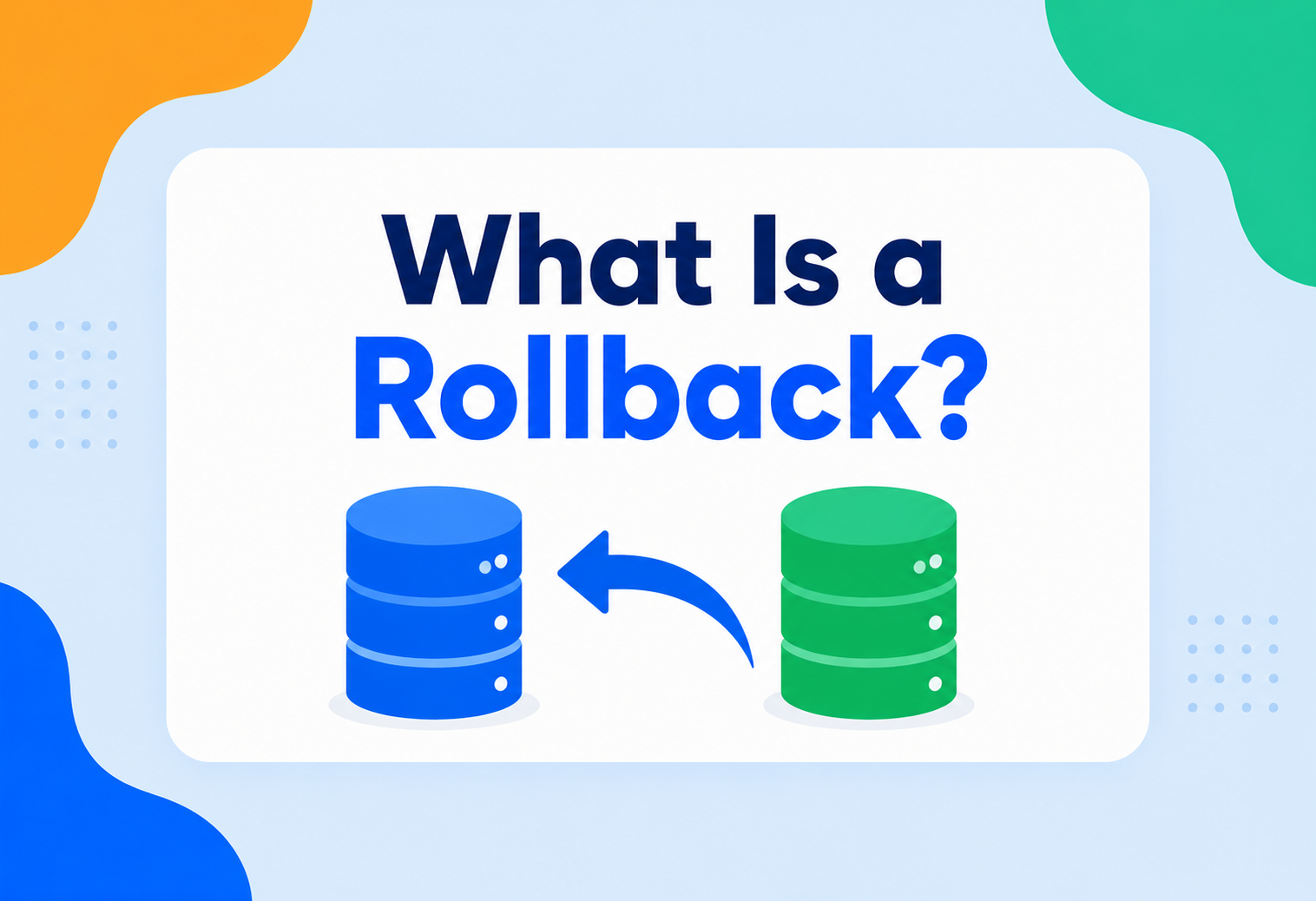
A rollback is the software equivalent of the eraser sitting next to your pencil — the act of undoing a change and returning a database, an application, a configuration, or an entire deployment back to a previous, known‑good state.
Imagine you are writing a story in a notebook with a pencil, and an eraser sits right beside you. If a sentence ruins the story, you erase it and put things back the way they were. A rollback is exactly that eraser, but for software. It is the act of undoing a change and returning a system — a database, an application, a configuration, or a whole deployment — back to a previous, known‑good state.
In software engineering, the word “rollback” shows up in two closely related but distinct worlds:
- Database rollback — undoing a transaction (a group of database operations) so that none of its changes are saved, keeping the data consistent.
- Deployment or release rollback — reverting a running application or piece of infrastructure back to a previous version after a new release starts causing problems.
Both share the same core idea: something changed, the change turned out to be bad, so undo it and get back to safety. This guide covers both, because understanding one deepens your understanding of the other — they descend from the same engineering philosophy of “always have a way back.”
A Short History
The concept of rollback traces back to the 1970s, when database researchers such as Jim Gray were formalising the idea of a transaction — a unit of work that should either fully succeed or fully fail, with no in‑between. This thinking led to the famous ACID properties (Atomicity, Consistency, Isolation, Durability), which we will unpack shortly. IBM’s System R and other early relational database systems in the mid‑1970s were among the first to implement transaction logs and rollback mechanisms, allowing a database to “forget” a transaction that did not finish cleanly — for example, because of a power failure or a program crash.
Decades later, as software moved from shipping on CDs to being deployed continuously over the internet, the word “rollback” took on a second life. When companies started deploying new code multiple times a day (a practice enabled by continuous delivery and DevOps culture through the 2000s and 2010s), they needed a fast, safe way to undo a bad release without waiting for a slow, manual fix. Deployment rollback became a standard safety net, especially as container orchestration platforms like Kubernetes (released in 2014) and cloud deployment tools began to build rollback support directly into their systems.
Think of a rollback as the “Undo” button (Ctrl+Z) you already use in a word processor — except instead of undoing a single keystroke, it can undo an entire database transaction or an entire software release, and it has to work correctly even if a thousand other people are editing the same document at the same time.
The Problem & Motivation
Software systems are never perfect and changes to them are risky. Two big problems — partial failures that corrupt data, and new code that breaks production — are the reason rollback mechanisms exist at all.
Why do we even need rollbacks? Because software systems are never perfect, and changes to them are risky. Two big problems motivate the existence of rollback mechanisms.
Problem 1: Partial Failures Corrupt Data
Imagine a banking application that transfers $100 from Alice’s account to Bob’s account. This requires two steps:
- Subtract $100 from Alice’s balance.
- Add $100 to Bob’s balance.
Now imagine the server crashes right after step 1 but before step 2. Without a rollback mechanism, Alice has lost $100 and Bob never received it — the money has simply vanished. This is called a partial failure, and it is one of the most dangerous problems in computing. A rollback mechanism guarantees that if step 2 never completes, step 1 is undone too, so Alice keeps her $100.
Problem 2: New Code Can Break Production
Now imagine a completely different scenario: an engineering team deploys a new version of a mobile banking app’s backend. Within minutes, users start seeing errors when they try to log in. Every minute the bad code stays live, the company loses trust, and potentially money. The team could try to quickly write and test a fix, but that could take thirty minutes or more. Instead, they can simply roll back to the previous version that was working seconds ago, restoring service almost immediately, and investigate the bug calmly afterwards.
Without rollback strategies, every change to a live system is a one‑way door. Engineers would be terrified to ship anything, slowing innovation to a crawl. Rollback is what turns “scary, risky changes” into “safe, reversible experiments.”
The Underlying Motivation
At its heart, rollback exists to protect a handful of things that matter above almost everything else in engineering:
Data Integrity
Nobody loses information, money, or state because of a crash or bug in the middle of an operation.
System Availability
Users can keep using the system, even after a bad release, because engineers can revert quickly.
Engineer Confidence
Teams can ship changes frequently and boldly, knowing there is always a safety net one command away.
Trust
Customers trust systems that behave consistently — either the whole thing worked, or nothing changed at all.
Core Concepts
Before going deeper, it helps to build a solid vocabulary. Each term below is explained simply, using the same “what, why, and an example” pattern so nothing hides behind jargon.
Transaction
What: A transaction is a group of one or more database operations (inserts, updates, deletes) that are treated as a single unit.
Why: Because some operations only make sense together — like the bank transfer example above.
Example: “Book a flight seat AND charge the customer’s card” should happen together, or not at all.
Commit
What: Commit means “save these changes permanently, for real.”
Why: It marks the successful, final end of a transaction.
Example: After both the seat booking and payment succeed, the system commits — now it is official.
Rollback
What: Rollback means “undo everything since the transaction started, as if it never happened.”
Why: Because something went wrong and we cannot commit safely.
Example: The card payment fails, so the system rolls back the seat booking too — the seat becomes available again.
ACID Properties
ACID is an acronym describing the four guarantees a reliable database transaction system is expected to provide. It is the theoretical backbone of why rollback works at all.
| Letter | Stands For | Simple Meaning |
|---|---|---|
| A | Atomicity | All steps happen, or none do — an “all or nothing” contract. |
| C | Consistency | The database moves from one valid state to another valid state — no rule is ever broken. |
| I | Isolation | Transactions happening at the same time do not interfere with each other. |
| D | Durability | Once committed, the change survives even a power outage. |
Rollback is the mechanism that makes Atomicity possible — it is the “or none do” part of “all or nothing.”
Savepoint
What: A named “checkpoint” inside a larger transaction that you can roll back to, without undoing the entire transaction.
Why: Sometimes you only want to undo part of your work, not everything.
Example: In a long transaction with five steps, you set a savepoint after step 3. If step 5 fails, you can roll back just to the savepoint, keeping steps 1–3.
Rollback (Deployment Context)
What: Reverting a running application, service, or piece of infrastructure to a previous, previously‑working version.
Why: A new release has introduced bugs, performance problems, or outages.
Example: A team deploys version 2.5 of their app; users report crashes; the team rolls back to version 2.4 within two minutes using their deployment tool.
Rollforward (Roll Forward)
What: The opposite idea — instead of undoing a bad change, you push forward with a new fix.
Why: Sometimes rolling back is harder or riskier than shipping a quick fix (for example, if a database schema changed in a way that is hard to reverse).
Example: Instead of reverting to version 2.4, the team quickly ships version 2.6 with the bug patched.
A database rollback undoes data changes within a transaction that has not been committed yet. A deployment rollback undoes an entire release — code, configuration, sometimes infrastructure — that has already been “committed” to production.
Architecture & Components
Two very different sets of moving parts make rollback possible: the logs and managers inside a database, and the pipelines and artifact stores that surround a deployed application.
Let us look at the pieces of a system that make rollback possible, in both the database world and the deployment world.
Database Rollback: The Moving Parts
Transaction Log (WAL)
A Write‑Ahead Log records every change before it is applied, so the database can “replay” or “reverse” it whenever needed.
Undo Log
Stores the “before” version of data so it can be restored exactly if a rollback happens.
Redo Log
Stores the “after” version, used to reapply committed changes after a crash (this supports durability, the “D” in ACID).
Transaction Manager
The component that tracks which transactions are active, committed, or need rolling back.
Lock Manager
Ensures other transactions cannot see uncommitted, “dirty” data while a transaction is still in progress.
Buffer / Cache
In‑memory copies of data pages that get modified before being flushed to disk — rollback often just discards these.
Deployment Rollback: The Moving Parts
Version Control (Git)
Stores every past version of the code so any commit can be checked out or reverted.
Artifact Registry
Stores built, versioned packages (like Docker images) so old versions can be redeployed instantly.
Deployment Tool / Orchestrator
Kubernetes, ECS, or a CI/CD pipeline that knows how to switch running instances from one version to another.
Load Balancer / Router
Directs live traffic and can be pointed at the old version during a rollback.
Feature Flags
Toggle switches that can disable a risky new feature instantly, without a full redeploy.
Migration Scripts
Manage database schema changes, which are the trickiest part of any deployment rollback.
Internal Working — How a Rollback Actually Happens
Two very different mechanics power the same word. A database rollback rewinds an undo log step by step. A deployment rollback swaps back to an older artifact that was quietly kept around just in case.
Inside a Database Rollback
Let us walk through what really happens, step by step, when a database rolls back a transaction:
- Transaction starts. The database assigns it a transaction ID and begins recording every change it makes.
- Changes are logged before they are applied. This is the Write‑Ahead Log principle: before modifying an actual data page, the database writes a log record describing the old value and the new value.
- Something goes wrong — an error, a constraint violation, a deadlock, or the application explicitly calls
ROLLBACK. - The database reads the undo log backwards, from the most recent change to the oldest, restoring each piece of data to its pre‑transaction value.
- Locks are released so other transactions can proceed.
- The transaction is marked as aborted — as if it never happened, from an outside observer’s point of view.
A Java Example — Manual Transaction Rollback with JDBC
Here is a simplified example showing how a Java application explicitly controls a rollback using JDBC (Java Database Connectivity).
Connection conn = null;
try {
    conn = dataSource.getConnection();
    conn.setAutoCommit(false); // start manual transaction control

    // Step 1: withdraw from Alice's account
    PreparedStatement withdraw = conn.prepareStatement(
        "UPDATE accounts SET balance = balance - ? WHERE owner = ?");
    withdraw.setBigDecimal(1, new BigDecimal("100.00"));
    withdraw.setString(2, "Alice");
    withdraw.executeUpdate();

    // Step 2: deposit into Bob's account
    PreparedStatement deposit = conn.prepareStatement(
        "UPDATE accounts SET balance = balance + ? WHERE owner = ?");
    deposit.setBigDecimal(1, new BigDecimal("100.00"));
    deposit.setString(2, "Bob");
    deposit.executeUpdate();

    conn.commit(); // both steps succeeded — make it permanent
    System.out.println("Transfer successful.");

} catch (SQLException e) {
    if (conn != null) {
        try {
            conn.rollback(); // undo everything since setAutoCommit(false)
            System.out.println("Transfer failed. Rolled back.");
        } catch (SQLException rollbackEx) {
            rollbackEx.printStackTrace();
        }
    }
} finally {
    if (conn != null) {
        try { conn.close(); } catch (SQLException ignored) {}
    }
}
Notice the pattern: setAutoCommit(false) tells the database “do not save anything until I say so.” If any step throws an exception, we call conn.rollback(), and both updates disappear as if they never ran.
Using Savepoints in Java
conn.setAutoCommit(false);
Savepoint sp1 = conn.setSavepoint("afterStep1");

try {
    doStep1(conn);
    doStep2(conn); // suppose this one fails
    conn.commit();
} catch (SQLException e) {
    conn.rollback(sp1); // undo only step 2, keep step 1
    conn.commit();
}
Inside a Deployment Rollback
A deployment rollback works differently because there is no single “undo log” — instead, the system relies on having kept the old, working version around. Here is the typical sequence in a modern container‑based system like Kubernetes:
- Detect the problem. Monitoring alerts fire, or an engineer notices errors spiking after a new deployment.
- Identify the last known‑good version. Most systems keep a revision history (Kubernetes keeps a “rollout history” by default).
- Trigger the rollback command. For example,
kubectl rollout undo deployment/my-app. - The orchestrator gradually replaces new pods with old‑version pods, the same way it gradually rolled out the new version (often called a rolling update, just in reverse).
- Health checks confirm the old pods are healthy before removing the last of the bad ones.
- Traffic is fully restored to the previous, stable version.
Code can simply be swapped for an older version. But if version 2.5 changed the database schema (say, it added a new required column), rolling back the code to version 2.4 might crash immediately because 2.4 does not know how to read the new schema. This is why database migrations must be designed to be “backward compatible” — a topic we return to in Best Practices.
Data Flow & Lifecycle
Every change — whether a database transaction or a full deployment — passes through a small handful of clearly named states. Knowing them makes the whole rollback story feel a lot less mysterious.
Let us trace the full lifecycle of a change, from the moment it is proposed to the moment it is either kept or rolled back.
Lifecycle of a Database Transaction
Active
The transaction has started and is executing statements.
Partially Committed
The last statement has executed, but changes are not yet permanent.
Committed
All changes are made permanent and durable.
Failed
An error occurred and the transaction cannot proceed normally.
Aborted (Rolled Back)
The database has restored all data to its state before the transaction began.
Lifecycle of a Deployment
Build
Code is compiled and packaged into a versioned artifact (e.g. a Docker image tagged v2.5).
Test
Automated tests run against the new artifact in a staging environment.
Release
The artifact is gradually rolled out to production traffic.
Observe
Metrics, logs and error rates are watched closely.
Decide
Either the release is confirmed healthy, or a rollback is triggered.
Rollback (if needed)
Traffic is shifted back to the previous version, and the incident is investigated.
Advantages, Disadvantages & Trade‑offs
Rollback is powerful, but it is not free and it does not cover everything. A quick, honest look at both sides prevents nasty surprises later.
Advantages
- Protects data integrity during partial failures.
- Reduces downtime after a bad release — often to minutes or even seconds.
- Gives engineers the confidence to ship changes frequently.
- Simplifies error handling logic in application code.
- Enables safe experimentation (canary releases, A/B tests).
Disadvantages / Trade‑offs
- Rollback mechanisms add overhead — logging every change costs CPU, memory and disk I/O.
- Long‑running transactions can hold locks for a long time, hurting concurrency.
- Deployment rollbacks are hard when database schema changes are not backward compatible.
- Rolling back can sometimes reintroduce an old bug that was already fixed.
- Rollback does not undo external side effects — like a sent email or a triggered payment to a third party.
Rollback only undoes what the system itself controls. If your code already called an external payment API or sent a text message before failing, rolling back your own database will not “unsend” that message. This is why some systems use patterns like the Saga pattern (covered in Design Patterns) for multi‑service operations.
Performance & Scalability
Rollback mechanisms are not free — they cost resources, and at scale those costs matter. Big transactions and big deployments both take real time to undo.
Rollback mechanisms are not free — they cost resources, and at scale, those costs matter.
Database Performance Considerations
- Log write overhead: every change requires writing to the undo/redo log before the actual data page is touched, adding I/O latency.
- Lock contention: long transactions hold locks longer, which can slow down other transactions waiting on the same rows.
- Rollback cost scales with transaction size: rolling back a transaction that changed one row is instant; rolling back one that changed ten million rows can take a long time, because every change must be individually reversed.
- Isolation level trade‑offs: stricter isolation levels (like Serializable) reduce anomalies but increase locking and reduce throughput.
Deployment Rollback Performance Considerations
- Rolling vs. instant rollback: a gradual rolling rollback is safer but slower; a “blue‑green” switch is nearly instant because the old version is already fully running and just needs traffic redirected.
- Cold starts: if old instances were shut down entirely, restarting them takes time — keeping a few “warm” can speed up rollback.
- Cache invalidation: rolling back code does not always roll back cached data, which can cause temporary inconsistencies.
High Availability & Reliability
Rollback is one of the most important tools for keeping systems highly available — meaning they stay up and working, even when things go wrong.
Rollback is one of the most important tools for keeping systems highly available — meaning they stay up and working, even when things go wrong.
Rollback as Part of Disaster Recovery
Rollback works hand‑in‑hand with backups and replication:
- Point‑in‑time recovery: databases like PostgreSQL can “roll back” the entire database to any exact moment in time using continuous transaction log archiving — useful if bad data was committed hours ago, not just seconds ago.
- Replication and failover: if a primary database fails mid‑transaction, a replica can take over. Uncommitted transactions on the failed primary are simply lost (rolled back implicitly), keeping the replica consistent.
- Automated rollback triggers: many deployment systems support automatic rollback if error rates or latency cross a defined threshold, without waiting for a human to notice.
Some systems combine rollback with a circuit breaker: if the new version’s error rate exceeds, say, 5% within the first two minutes, the deployment pipeline automatically halts the rollout and reverts — no human needed. This is sometimes called a “self‑healing” deployment pipeline.
The Cost of NOT Having Rollback
Systems without a rollback plan tend to suffer from what is sometimes called “deploy paralysis” — teams become afraid to ship changes because there is no safety net, which ironically makes the system less reliable over time, since bugs pile up in big, risky, infrequent releases instead of small, easily reversible ones.
Security
Rollback mechanisms sit at the intersection of reliability and security. Used well, they contain damage; used carelessly, they can quietly reopen old vulnerabilities or expose data that was on its way out.
Rollback mechanisms intersect with security in a few important ways.
Rollback Attacks
A rollback attack (also called a downgrade attack) is when a malicious actor deliberately forces a system back to an older, less secure version — for example, tricking a device into “rolling back” to firmware with a known vulnerability that has since been patched. This is a real concern in IoT devices, mobile apps, and even TLS (the protocol that secures web traffic), where attackers might try to force a “downgrade” to a weaker encryption version.
Secure systems prevent rollback attacks by cryptographically signing versions and refusing to install or run anything older than the last known‑secure version, unless explicitly authorised by an administrator.
Auditability
Every rollback — whether of a database transaction or a deployment — should be logged: who triggered it, when, and why. This audit trail is essential for security investigations, compliance (like SOC 2 or HIPAA), and simply understanding what happened during an incident.
Sensitive Data & Rollback
When rolling back a database, be careful: rollback can sometimes re‑expose data that a later (now‑undone) transaction was trying to delete or mask, such as an in‑progress GDPR “right to be forgotten” deletion. Systems handling regulated data need to design rollback windows carefully with legal and compliance teams.
Monitoring, Logging & Metrics
You cannot roll back what you do not know is broken. Observability is what tells engineers a rollback is needed in the first place — and what makes the rollback itself something you can learn from later.
You cannot roll back what you do not know is broken. Observability is what tells engineers a rollback is needed in the first place.
Key Metrics to Watch After a Deployment
Error Rate
Percentage of requests returning 5xx errors — a sudden spike is a classic rollback trigger.
Latency (p50 / p95 / p99)
How long requests take. A new version that is suddenly slow may need reverting.
Saturation
CPU, memory and disk usage — a memory leak in new code often shows up here first.
Rollback Count
How often rollbacks happen — a rising trend can signal quality or testing gaps.
Transaction Abort Rate
In databases, a high percentage of rolled‑back transactions may indicate deadlocks or bad application logic.
Logging Best Practices
- Log the exact reason a rollback occurred (exception message, failed health check, manual trigger with operator name).
- Include the transaction ID or deployment version in every log line, so rollback events are traceable.
- Emit a distinct metric or event (e.g.
deployment.rollback.triggered) so dashboards and alerts can react to it directly.
Deployment & Cloud
Modern cloud platforms bake rollback support directly into their tools. Kubernetes, AWS and several deployment strategies each take a slightly different route to the same “get me back to the last good version” destination.
Modern cloud platforms bake rollback support directly into their tools. Let us look at how a few popular ones handle it.
Kubernetes
Kubernetes keeps a history of ReplicaSets for every Deployment. Rolling back is a first‑class command:
# View rollout history
kubectl rollout history deployment/my-app

# Roll back to the previous revision
kubectl rollout undo deployment/my-app

# Roll back to a specific revision
kubectl rollout undo deployment/my-app --to-revision=3
Kubernetes performs this as a rolling update in reverse — gradually replacing new pods with old‑version pods while keeping the service available throughout.
AWS (Elastic Beanstalk, CodeDeploy, ECS)
- Elastic Beanstalk keeps previous application versions and lets you redeploy any of them with a few clicks or a CLI command.
- CodeDeploy supports automatic rollback on failed deployments or CloudWatch alarm triggers.
- ECS can roll back to the previous task definition revision if health checks fail during a deployment.
Common Deployment Strategies and How Rollback Works in Each
| Strategy | How It Works | Rollback Speed |
|---|---|---|
| Blue‑Green | Two full environments; traffic flips between them. | Instant (just flip back) |
| Rolling Update | Instances replaced gradually; old and new run briefly together. | Fast, but gradual |
| Canary Release | New version gets a small % of traffic first, then increases. | Very fast, limited blast radius |
| Recreate | All old instances stopped, then new ones started. | Slow (downtime both ways) |
Because only a small slice of users see the new version first, a rollback affects far fewer people, and problems are caught before they impact everyone — like tasting a small spoonful of soup before serving the whole pot.
Databases, Caching & Load Balancing
The three layers that hold your production state — databases, caches and load balancers — each need their own rollback thinking. Miss any one of them and your carefully planned revert can still hurt.
Database Migration Rollbacks
Schema changes (like adding a column or renaming a table) are usually managed with migration tools (Flyway, Liquibase, Django Migrations, Rails Migrations). Most support a “down” migration that reverses an “up” migration.
-- Example "up" migration
ALTER TABLE users ADD COLUMN loyalty_points INT DEFAULT 0;

-- Corresponding "down" migration (the rollback)
ALTER TABLE users DROP COLUMN loyalty_points;Dropping a column that had data in it, or a destructive data transformation, cannot be perfectly undone unless you first back up the data. Always ask: “if I roll this back, do I lose anything permanently?”
Caching and Rollback
Caches (like Redis or a CDN) do not automatically know that an application rolled back. If cached data reflects the “new” version’s format, a rollback to the old code might misread that cached data. Strategies to handle this:
- Version your cache keys (e.g.
user:v2:123) so old and new code never read each other’s cached shapes. - Set short TTLs (time‑to‑live) on caches holding data whose format might change.
- Explicitly flush relevant cache keys as part of the rollback procedure.
Load Balancers
During a rollback, the load balancer is the traffic cop — it decides which version of your app receives requests. Health checks are critical here: the load balancer should only send traffic to instances that pass a health check, automatically pulling unhealthy (new, broken) instances out of rotation even before a human triggers a formal rollback.
APIs & Microservices
The moment a single business operation crosses more than one service, classical rollback stops being enough. The saga pattern — a chain of compensating actions — steps in as the distributed replacement.
In a microservices architecture, a single business operation (like “place an order”) often spans multiple independent services, each with its own database. This makes traditional rollback much harder, because there is no single database transaction spanning all of them.
The Distributed Transaction Problem
Suppose placing an order involves three services: Inventory, Payment and Shipping. If Shipping fails after Inventory and Payment succeeded, how do you “roll back” across three separate databases?
The Saga Pattern
The Saga pattern solves this by breaking a distributed transaction into a sequence of local transactions, each with a corresponding compensating action that undoes it if a later step fails.
Each service exposes both a “do” action and an “undo” (compensating) action. There is no true rollback here in the database sense — instead, the system deliberately performs new, opposite operations to reach the same end state as if the original had never happened.
API Versioning & Rollback
APIs themselves need rollback thinking too. If you roll back a backend service, but a newer version of its API contract is still being used by client apps, you can break them. Best practice: keep API changes backward compatible for at least one version, so a rollback of the server never surprises the client.
Compensating actions (like “refund the card”) should be idempotent — safe to run more than once without causing harm — because retries are common in distributed systems, and you do not want to accidentally refund a customer twice.
Design Patterns & Anti‑Patterns
A handful of patterns show up again and again wherever rollback is done well — and a matching handful of anti‑patterns show up wherever rollback quietly hurts more than it helps.
Good Patterns
Feature Flags
Decouple deployment from release — turn a broken feature off instantly without redeploying code.
Blue‑Green Deployment
Keep two full environments so rollback is a near‑instant traffic switch.
Canary Release
Limit the blast radius of a bad release, making rollback cheap and low‑impact.
Backward‑Compatible Migrations
Design schema changes in two phases (expand, then contract) so old and new code can coexist safely.
Automated Rollback Triggers
Let monitoring systems trigger rollback automatically when error thresholds are crossed.
Anti‑Patterns to Avoid
Anti‑Patterns
- Big‑bang deployments: shipping huge, infrequent releases makes rollback risky and painful because so much changed at once.
- Non‑reversible migrations shipped with app code: dropping a column in the same release that also needs that column rolled back is a classic trap.
- Silent rollbacks: rolling back without logging or alerting anyone hides valuable signal about system health.
- No health checks before rollback: rolling back to a version that is now also broken (e.g. due to an external dependency change) without verifying first.
- Manual‑only rollback in critical systems: relying purely on a human to notice and act, instead of automated safety nets.
The Expand‑Contract Fix
- Expand: add the new column/table alongside the old one; both old and new code can run.
- Migrate: backfill data and switch application code to use the new structure.
- Contract: only after the new version has been stable for a while, remove the old column/table in a separate, later release.
Best Practices & Common Mistakes
The best rollback strategy is the one you have already tried in practice. Short transactions, well‑guarded catch blocks, backward‑compatible migrations and rehearsed game days are the habits that keep it trustworthy.
Best Practices
- Keep transactions short. Long transactions hold locks longer and are more expensive to roll back.
- Always use try / catch / finally (or try‑with‑resources) around database transactions to guarantee rollback happens on any unexpected error.
- Make schema migrations backward compatible using the expand‑contract pattern.
- Automate deployment rollback — do not rely on a tired on‑call engineer typing commands correctly at 3 a.m.
- Practise rollbacks regularly (game days / chaos engineering) so the team is confident it actually works when needed.
- Version your API contracts and cache keys to avoid mismatches between old and new code during a rollback window.
- Always log the “why” behind every rollback for future learning and audits.
Common Mistakes
- Forgetting to test the rollback path itself — teams often test that a deployment works, but never test that rolling it back works too.
- Assuming rollback is instant and free — for large transactions or large‑scale deployments, it takes real time and can itself briefly disrupt users.
- Rolling back code without rolling back (or accounting for) an incompatible database migration.
- Not communicating a rollback to the team or stakeholders, causing confusion when “the bug fix disappeared.”
- Treating rollback as the end of the incident instead of the start of the investigation — always follow up with a root cause analysis.
If you cannot confidently answer “how would we undo this?” before shipping a change, you are not ready to ship it.
Real‑World & Industry Examples
Netflix, Amazon, Google, banks, Etsy and GitHub have all built their reputations for reliability on the same quiet idea: make change small, make it observable, and make undoing it cheap.
Netflix
Netflix pioneered many resilience engineering practices, including automated canary analysis: new versions are automatically compared against the current baseline on key metrics, and if the new version underperforms, it is automatically rolled back before most users ever see it — often within minutes of the first anomaly.
Amazon
Amazon’s internal deployment systems are built around the principle of small, frequent, reversible deployments. Amazon famously deploys code extremely often, which is only possible because rollback is fast, automated, and deeply trusted across the organisation.
Google’s Site Reliability Engineering (SRE) practices, described in their well‑known SRE books, emphasise “error budgets” — if a service is burning through its allowed error budget too fast after a change, automated systems can pause rollouts or trigger rollbacks, balancing the pace of innovation against reliability.
Banking Systems
Traditional banking core systems rely heavily on strict ACID‑compliant database transactions with rollback, since even a tiny inconsistency (like the earlier Alice‑and‑Bob example) can mean real financial loss and regulatory consequences.
Etsy & GitHub
Both companies have written publicly about deploying dozens or hundreds of times per day, made possible by feature flags that let them “roll back” a feature instantly by flipping a switch, without needing a full code rollback or redeploy.
Frequently Asked Questions
Six questions come up in nearly every conversation about rollbacks. Short, honest answers — from “is it the same as undo?” to “what happens to in‑flight requests?”.
Is a rollback the same as an “undo”?
Conceptually yes — both restore a previous state. The difference is scale and mechanism: “undo” is often a single, user‑facing action, while “rollback” usually refers to a formal, system‑level mechanism (database transactions or deployments) with guarantees behind it.
Can you always roll back a database transaction?
Only if it has not been committed yet. Once a transaction commits, its changes are durable and permanent — rolling back after that requires a different tool, like restoring from a backup or using point‑in‑time recovery, not a simple ROLLBACK command.
What’s the difference between rollback and rollforward?
Rollback undoes a change to get back to the previous state. Rollforward pushes ahead with a new fix instead of undoing anything. Teams often prefer rollback for speed and safety, but rollforward when the rollback itself would be riskier (e.g. because of an irreversible database migration).
Why can’t we just always roll back instead of debugging?
Rollback buys time and restores service, but it does not fix the underlying bug — the team still needs to investigate and fix the root cause before trying to deploy again, or the same problem will simply happen next time.
Does rollback work for microservices?
Yes, but it is more complex. Individual services can roll back their own code and database independently, but coordinating a rollback across a distributed transaction usually requires patterns like the Saga pattern with compensating actions, rather than a single atomic rollback.
What happens to in‑flight requests during a rollback?
Well‑designed systems use graceful draining: existing in‑flight requests are allowed to finish on the old version’s instances before those instances are removed, while new requests are routed to the version being rolled back to.
This page is educational content about software engineering concepts. If you are troubleshooting a live production incident, follow your organisation’s incident response runbook rather than relying solely on general guidance here.
Summary & Key Takeaways
If you remember nothing else from this guide, remember these seven ideas — and the quiet habit of always being able to answer “how would we undo this?” before you ship anything at all.
Wrapping It Up
- A rollback is the act of undoing a change to return a system to a previous, known‑good state — whether that is a database transaction or an entire software deployment.
- Database rollback is grounded in the ACID properties, especially Atomicity, and relies on undo/redo logs managed by the transaction manager.
- Deployment rollback relies on keeping previous, versioned artifacts around and using orchestration tools (Kubernetes, cloud platforms) to switch traffic back to them.
- Rollback protects two critical things: data integrity and system availability.
- Not everything can be perfectly rolled back — irreversible migrations and external side effects (emails, payments) require careful design, like the expand‑contract pattern and the Saga pattern with compensating actions.
- Modern engineering favours small, frequent, easily reversible changes over big, risky, hard‑to‑undo ones.
- The best rollback is one you never actually need — but the confidence that you could is what lets teams move fast safely.