What is Domain Events Pattern in Microservices?
A beginner-to-production field guide to one of the most important ideas in modern distributed systems — how services should talk about what happened instead of what to do, and why that single mental flip is what actually makes microservices work, from the simplest toy-shop analogy all the way to production-grade reliability, security, and scaling concerns.
1. Introduction: What Is a Domain Event?
Picture a small neighbourhood toy shop. The instant a customer walks out with a wooden train set, something important has just happened in your business. You didn’t merely “bump a counter in a spreadsheet” — a real-world event took place: “A toy was sold.”
That one sentence — a toy was sold — is the seed of everything we’re going to unpack in this guide. In software, we call a sentence like that a domain event.
A domain event is a small, factual record of something meaningful that has already happened inside a business (the “domain”). It is always phrased in the past tense — OrderPlaced, PaymentReceived, UserRegistered — because it describes history, not an instruction.
Inside a microservices system, many small, independently owned services need to know about each other’s business without being tightly wired together. The Domain Events pattern is the mechanism that lets one service announce “this happened” and lets any number of other services react on their own terms — without the first service ever needing to know who is listening, how many are listening, or what any of them will actually do next.
This single idea — announcing facts instead of issuing orders — is one of the biggest mental shifts a developer makes when moving from monolithic applications to microservices. It is asked about constantly in system design interviews, and it quietly powers almost every large-scale platform you touch daily: Amazon shipping notifications, Uber ride-status updates, Netflix’s recommendation engine, and your bank’s fraud alerts.
Think of a school notice board. When the librarian returns a stack of books, she does not personally walk into every teacher’s classroom to say “the books are back.” She simply pins up a notice: “Library books restocked.” Any teacher who cares — the reading-club teacher, the class monitor, the librarian’s assistant — reads the board and decides for themselves what to do. The librarian doesn’t know, and doesn’t need to know, who read the notice. That notice board is a domain events system.
By the end of this guide, you will understand exactly how that “notice board” is built in real software: the message brokers, the code, the failure modes, the sibling patterns that travel with it (Outbox, Saga, CQRS, Event Sourcing), and the mistakes that trip up even experienced engineers.
2. History & Origins
To understand why domain events exist, it helps to know where the idea actually came from.
2.1 Domain-Driven Design (2003)
The term “domain event” was formally introduced by software engineer Eric Evans in his 2003 book on Domain-Driven Design (DDD). DDD is an approach to building software where the code is organised around the real business (“the domain”) rather than around technical layers like databases and controllers. Evans argued that important business happenings — a customer placing an order, a shipment leaving a warehouse — deserved to be modelled as first-class objects in code, not hidden inside a method that quietly updates a database row.
2.2 The Monolith Era
Through the 2000s, most applications were monoliths: one big codebase, one database, one deployment. Inside a monolith, when something happened, you could just call another piece of code directly — same process, same transaction, same memory. There was no real need to “announce” events across a network, because everything lived in the same house.
2.3 The Rise of Microservices (2011–2015)
As companies like Netflix, Amazon, and Uber grew, monoliths became painful to change and painful to scale. Teams broke their systems into microservices — small, independently deployable services, each owning its own database. This solved scaling and team-autonomy problems, but it created a fresh one: how do services that don’t share a database stay in sync?
Direct function calls no longer worked, because services now lived on separate machines. Engineers first tried direct synchronous HTTP calls between services (Service A calls Service B’s REST API directly), but this quietly recreated many of the tight-coupling problems of monoliths, just over a network. Domain events, delivered by message brokers like Kafka and RabbitMQ, became the standard answer.
2.4 Event-Driven Architecture Goes Mainstream (2015–Present)
Today, the domain events pattern sits at the heart of event-driven architecture (EDA), and modern tools — Apache Kafka, Amazon EventBridge, Google Pub/Sub, Azure Service Bus, and change-data-capture tools like Debezium — exist largely to make publishing and consuming domain events reliable at massive scale.
2.5 Why the Idea Endures
It would be easy to assume domain events are just “a messaging trick,” but the deeper reason the pattern has lasted for over two decades is that it maps cleanly onto how organisations themselves are structured. As companies grow, they split into teams that each own a slice of the business — a payments team, a shipping team, a fraud team. Domain events give those teams a way to stay informed about each other’s work without needing to ask permission or co-ordinate a release schedule every time something changes. This organisational fit, sometimes described informally through Conway’s Law (systems tend to mirror the communication structure of the organisations that build them), is a big part of why the pattern keeps reappearing across completely different industries — retail, banking, ride-hailing, streaming media — even though the underlying business problems look nothing alike.
3. The Problem & Motivation
Let’s build the motivation from scratch with a concrete example: an e-commerce platform.
When a customer places an order, several things need to happen across different teams’ services:
- The Inventory service must reduce stock.
- The Payment service must charge the customer.
- The Shipping service must create a delivery task.
- The Notification service must send a confirmation email.
- The Analytics service must record the sale for reporting.
3.1 The Naive (and Painful) Approach
A beginner’s first instinct is often to make the Order service directly call each of the others:
It looks simple at first, but it quietly creates five serious problems:
1. Tight Coupling
The Order service must know the exact API of every other service. If Shipping renames an endpoint, Order service breaks along with it.
2. Fragile Chains
If the Notification service is slow or down, should the entire order fail? Almost never — but a direct call chain makes that hard to avoid.
3. No New Listeners Without Code Changes
If the company later adds a Fraud-Detection service, someone must edit and redeploy Order service just to add another call.
4. Poor Scalability
Order service now carries the latency of four separate network calls before it can even respond to the customer.
5. Shared Failure Domain
Any one downstream outage effectively becomes an Order outage — the exact problem microservices were supposed to eliminate.
Many new engineers treat microservices as “a monolith split into folders that call each other over HTTP.” That’s not a microservices architecture — it’s a distributed monolith, and it usually performs worse and fails more often than the original monolith it replaced.
3.2 The Domain Events Solution
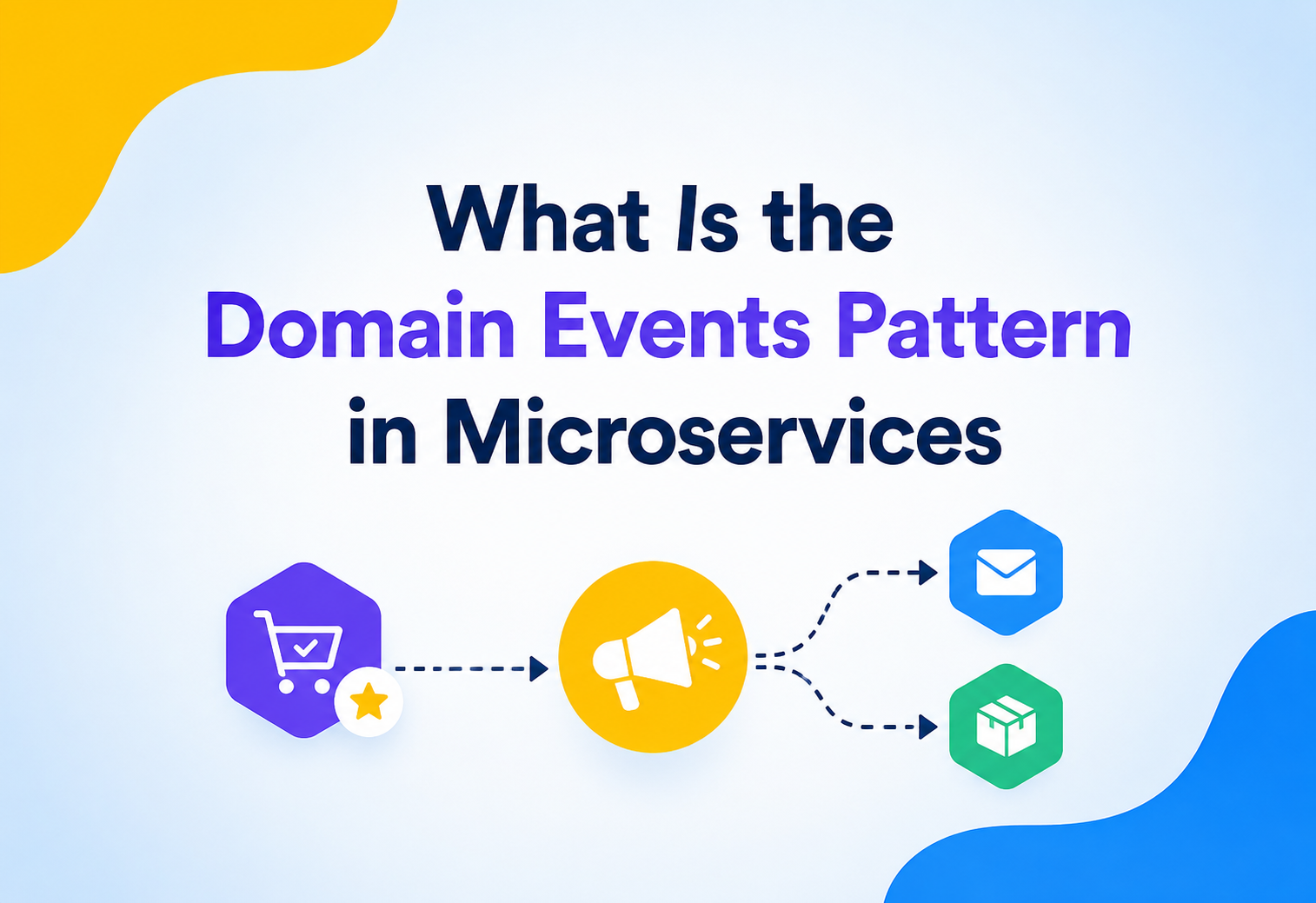
Instead of the Order service calling everyone, it does one thing: it publishes a fact — OrderPlaced — to a shared message broker. Any service that cares about orders subscribes to that fact and reacts on its own schedule, in its own way.
Commands say “you must do this now” (tight coupling, synchronous). Domain events say “this already happened, do what you need to” (loose coupling, asynchronous). Domain events flip control from the publisher to the subscribers.
This flip in control has a subtle but important consequence: it moves the decision of “who cares about this fact” away from the publisher and into each subscriber. The Order service no longer needs a mental map of every team that might eventually want to know about orders. A brand-new Fraud Detection service, built two years later by a team that didn’t even exist when Order Service was written, can simply start listening to the same order-events topic on day one, with zero changes required anywhere else in the system. This is the property architects usually mean when they say a system is “open for extension, closed for modification” at the integration level, not just inside a single class.
4. Core Concepts
Before going further, let’s pin down every term we’ll use. Each one gets a plain explanation, why it exists, where it’s used, an analogy, and an example.
4.1 Domain Event
What it is: An immutable record describing something that has already happened in the business domain. Named in past tense.
Why it exists: To let services communicate facts without dictating actions, enabling loose coupling.
Where it’s used: Order systems, banking, ride-hailing, inventory, user management — anywhere multiple services must react to the same business fact.
A wedding invitation card doesn’t tell guests what to do minute-by-minute. It states a fact: “Priya and Raj are getting married on 12th December.” Each guest decides independently how to respond — buy a gift, book a flight, plan a toast.
public final class OrderPlacedEvent {
    private final String orderId;
    private final String customerId;
    private final BigDecimal totalAmount;
    private final Instant occurredAt;

    public OrderPlacedEvent(String orderId, String customerId,
                             BigDecimal totalAmount, Instant occurredAt) {
        this.orderId = orderId;
        this.customerId = customerId;
        this.totalAmount = totalAmount;
        this.occurredAt = occurredAt;
    }
    // getters only — no setters, events are immutable facts
}
4.2 Event vs. Command vs. Query
This distinction is one of the most frequently confused topics for beginners — and one of the most common interview questions.
| Type | Tense | Meaning | Example |
|---|---|---|---|
| Command | Imperative (“do this”) | An instruction directed at exactly one receiver, who may refuse it | PlaceOrder, CancelSubscription |
| Event | Past tense (“this happened”) | A fact broadcast to anyone interested; cannot be refused, only reacted to | OrderPlaced, SubscriptionCancelled |
| Query | Question (“what is”) | A request for data with no side effects | GetOrderStatus |
4.3 Aggregate & Aggregate Root
What it is: In DDD, an aggregate is a cluster of related objects treated as one unit for data changes (for example, an Order together with its OrderLineItems). The aggregate root is the single entry-point object (here, Order) that guards the rules for the entire cluster.
Why it exists: Domain events are almost always raised by an aggregate root, right after it changes its own state, because that is the one place that truly knows a business rule was satisfied.
A car is an aggregate: the engine, wheels, and doors are all parts, but you don’t sell the engine separately — you sell “the car” as one unit, and only the car (through its ignition) can legitimately say “I started.”
4.4 Event Publisher & Event Subscriber
Publisher: the service that detects the business fact and announces it. Subscriber (consumer): any service that has registered interest in that type of fact. A publisher never needs to know its subscribers by name — this is called publish-subscribe (pub/sub).
4.5 Message Broker / Event Bus
What it is: Middleware software that receives published events and reliably delivers them to all interested subscribers, even if some subscribers are temporarily offline.
Where it’s used: Apache Kafka, RabbitMQ, Amazon SNS/SQS, Amazon EventBridge, Google Cloud Pub/Sub, Azure Service Bus.
The message broker is the post office. You (the publisher) don’t personally deliver a letter to every recipient’s door — you drop it at the post office, which guarantees it reaches every subscribed address, even the ones on holiday that will collect their mail later.
4.6 Eventual Consistency
What it is: A guarantee that, given enough time and no permanent failures, all services will agree on the state of the data — but not necessarily at the exact same instant.
Why it matters: Domain events are usually processed asynchronously, so there is a short window (milliseconds to seconds, sometimes longer) where the Order service knows an order was placed but Shipping does not — yet.
When you post a photo on social media, your friend in another country doesn’t see it in the same millisecond. The system guarantees they will eventually see it — that delay is eventual consistency, and it’s a completely normal trade-off, not a bug.
4.7 Idempotency
What it is: A property of an operation where doing it once, or doing it five times by accident, produces the exact same end result.
Why it matters: Message brokers commonly guarantee “at-least-once” delivery, meaning a subscriber might receive the same event twice. Idempotent handlers make that harmless.
Pressing an elevator call button five times doesn’t call five elevators. The system is designed so repeated presses have the same effect as one press. That’s idempotency.
4.8 Domain Event vs. Integration Event
Some teams distinguish between an internal domain event (used only inside one service’s boundary, sometimes just to trigger side effects within the same process) and an integration event (a version of that event, often simplified, that is actually published outward to other services). This guide mostly focuses on the outward-facing use, since that is what “domain events in microservices” usually means in interviews and production systems.
Why keep them separate at all? Inside one service, a domain event might carry rich internal detail — full object references, internal identifiers, even domain objects themselves — because everything stays inside a trusted boundary. The moment that fact needs to leave the service and travel across the network to a team you may not even know about, it needs to become a stable, minimal, well-documented public contract. Many mature teams literally have a translation step: the aggregate raises a rich internal domain event, and a small mapper converts it into a lean integration event before it ever touches the outbox table.
4.9 Bounded Context
What it is: A bounded context is the explicit boundary within which a particular business model and its vocabulary apply consistently. Outside that boundary, the same word can mean something different.
Why it matters for domain events: The word “Customer” might mean something different inside the Billing service (someone with a payment method) than inside the Support service (someone with open tickets). When Billing publishes a CustomerCreated event, it is really publishing “a fact about a customer, from Billing’s point of view” — and the Support service, on receiving it, translates that fact into its own local understanding of “customer,” rather than assuming Billing’s model is universally correct.
The word “pitch” means something completely different to a cricket player, a musician, and a startup founder. Each of them lives in their own bounded context. A domain event crossing between contexts is like translating a sentence between languages — the meaning must be preserved deliberately, not assumed.
4.10 Consumer Groups
What it is: A named cluster of consumer instances that share the work of processing a topic’s events, so each event is handled by exactly one member of the group (while other, differently named groups each get their own independent copy of every event).
Why it exists: It lets you scale a single subscribing service horizontally (more instances in the same group share the load) while still allowing many completely different services (each its own group) to independently receive every event.
Think of a newspaper delivery round split among three paperboys (one consumer group, three instances) — together they deliver every house exactly once. Meanwhile, a completely separate group of paperboys delivers a different newspaper to the same houses, unaware of the first group. Both groups get full coverage, independently.
5. Architecture & Components
A production domain-events system typically has five building blocks. Let’s walk through each with the e-commerce example.
5.1 The Publishing Service
Owns the aggregate whose state change is meaningful. Only this service is allowed to create events about its own domain — Order Service is the only one allowed to say an order was placed.
5.2 The Domain Event Object
A simple, immutable, serialisable data structure. It should carry enough information for subscribers to act, plus metadata: event ID, event type, version, timestamp, and correlation ID for tracing.
5.3 The Outbox (Reliability Bridge)
A local database table that stores the event in the same transaction as the business data change, solving the classic “dual-write” problem, explained in depth in Section 17.
5.4 The Message Broker
The durable, ordered, replicated middle layer. It decouples publishers from subscribers in time (subscribers don’t need to be online at publish time) and in space (publisher doesn’t need subscriber addresses).
5.5 The Subscribing Services
Each subscriber owns its own reaction logic and, usually, its own copy of just the data it needs (a technique called data replication via events), so it doesn’t need to call the Order service every time it needs order details.
6. Internal Working — How an Event Actually Moves
Let’s trace the exact internal mechanics, step-by-step, for the moment a customer clicks “Place Order.”
- Command received. The Order Service receives a
PlaceOrdercommand (usually via a REST or gRPC API call from the front-end or an API gateway). - Business rules validated. The
Orderaggregate checks invariants — is the cart non-empty? Is the address valid? Business rule failures stop right here and never become events. Events represent facts that are already true, not requests that might fail. - State changes. The aggregate transitions from “draft” to “placed” and internally records that it wants to raise
OrderPlacedEvent. - Persist atomically. The order row and the event (as a row in an outbox table) are written to the database in one single transaction. This is critical: either both are saved, or neither is.
- Relay publishes. A background relay process (or a change-data-capture tool like Debezium) notices the new outbox row and publishes the event to the broker.
- Broker persists and distributes. The broker durably stores the event (Kafka, for example, writes it to disk and replicates it across brokers) and makes it available to every subscribed consumer group.
- Subscribers consume independently. Inventory, Shipping, and Notification each read the event at their own pace, from their own position (offset) in the stream.
- Each subscriber reacts and may raise its own events. For example, once Inventory reduces stock, it might raise its own event,
StockReserved, continuing the chain. - Acknowledgement. Once a subscriber has safely processed and persisted the effect of the event, it acknowledges the message so the broker won’t redeliver it (though redelivery can still happen — hence idempotency, Section 4.7).
If you simply do “save order to database” then “publish event to broker” as two separate steps, there is a dangerous gap: what if the database save succeeds but the app crashes before publishing? The event is lost forever, and other services never learn the order exists. The Outbox Pattern (Section 17) exists to close exactly this gap.
7. Data Flow & Lifecycle Diagram
Here is the complete lifecycle of one OrderPlaced event, shown as a sequence over time.
Notice the important detail: the customer’s browser gets a fast response (order confirmed) well before Inventory, Shipping, or Notification have even processed the event. This is intentional — the customer-facing path stays fast and synchronous, while everything else happens asynchronously in the background.
8. Related Design Patterns
Domain events rarely travel alone. They are usually paired with a small family of supporting patterns. Here’s how each one relates.
8.1 Event Sourcing
What it is: Instead of storing only the current state of an entity, you store the full sequence of domain events that led to that state, and rebuild current state by replaying them.
Your bank doesn’t store “your balance is ₹42,000” as the only truth — it stores every deposit and withdrawal, and your balance is simply the sum of that history. That is event sourcing.
Domain events and event sourcing are related but distinct. You can absolutely use domain events for cross-service communication (this whole guide) without using event sourcing as your storage strategy. Event sourcing is one specific, more advanced way of persisting an aggregate’s state.
8.2 CQRS (Command Query Responsibility Segregation)
What it is: Splitting the model used to write data (commands) from the model used to read data (queries), often letting the read model be built and kept up to date by subscribing to domain events.
A restaurant kitchen (write side, complex, transactional) is organised completely differently from the menu board customers read (read side, simple, fast). CQRS lets each side be optimised for its own job.
8.3 Saga Pattern
What it is: A way to manage a business transaction that spans multiple services (which cannot share one database transaction) by chaining domain events and compensating actions if a step fails partway through.
There are two flavours:
| Style | How it works | Trade-off |
|---|---|---|
| Choreography | Each service reacts to events and publishes its own next event; no central coordinator | Very decoupled, but hard to see the “whole flow” at a glance |
| Orchestration | A central saga orchestrator issues commands and tracks progress explicitly | Easy to visualise and debug, but the orchestrator becomes a critical component |
8.4 Change Data Capture (CDC)
What it is: A technique for automatically generating events by watching a database’s transaction log for row changes, using tools like Debezium, instead of hand-writing publishing code in application logic.
8.5 Publish-Subscribe (Pub/Sub)
Already introduced in Section 4.4 — this is the general messaging pattern that domain events are built on top of.
9. Anti-Patterns to Avoid
Knowing the pattern isn’t enough — most of the pain teams experience with domain events comes not from the pattern itself, but from a handful of well-known misuses. Recognising these early, ideally during design review rather than after a production incident, saves months of painful refactoring later.
Events as RPC
Publishing an event and then blocking, waiting synchronously for a specific reply, defeats the entire purpose. If you need an immediate answer, use a direct API call, not an event.
Fat Events / “God Events”
Cramming the entire Order object (with 40 fields) into every event “just in case someone needs it” creates hidden coupling and huge payloads. Include only what consumers genuinely need.
Shared Mutable Event Schema Owned by No One
If five teams edit the same event schema with no ownership or versioning discipline, it breaks unpredictably. Every event type needs one clear owning team and a versioning strategy.
Non-Idempotent Consumers
Assuming an event will only ever be delivered exactly once. Brokers commonly guarantee at-least-once delivery — duplicates will happen.
Distributed Monolith via Events
If Service A must wait for Service B, which waits for Service C, which waits for Service A again before any of them can finish “one business operation,” you’ve just rebuilt tight coupling with extra network hops and extra failure modes.
No Dead-Letter Queue
If a consumer keeps crashing on one malformed event, without a dead-letter queue it can block the entire stream forever (“poison message”).
10. Java Code Walkthrough
Below is a simplified, production-flavoured example using Spring Boot conventions. Explanations are kept short on purpose — the code itself, together with its comments, does most of the teaching.
10.1 The Domain Event Class
public final class OrderPlacedEvent {
    private final String eventId;      // unique ID for this event instance
    private final String orderId;      // which order this fact is about
    private final String customerId;
    private final BigDecimal totalAmount;
    private final Instant occurredAt;
    private final int schemaVersion;   // supports safe evolution later

    public OrderPlacedEvent(String orderId, String customerId,
                             BigDecimal totalAmount) {
        this.eventId = UUID.randomUUID().toString();
        this.orderId = orderId;
        this.customerId = customerId;
        this.totalAmount = totalAmount;
        this.occurredAt = Instant.now();
        this.schemaVersion = 1;
    }
    // getters omitted for brevity — no setters, this object is immutable
}
10.2 Raising the Event from the Aggregate
public class Order {
    private String id;
    private OrderStatus status;
    private final List<Object> domainEvents = new ArrayList<>();

    public void place(BigDecimal totalAmount, String customerId) {
        if (this.status != OrderStatus.DRAFT) {
            throw new IllegalStateException("Order already placed");
        }
        this.status = OrderStatus.PLACED;
        // record the fact — but don't publish yet
        this.domainEvents.add(new OrderPlacedEvent(id, customerId, totalAmount));
    }

    public List<Object> pullDomainEvents() {
        List<Object> events = List.copyOf(domainEvents);
        domainEvents.clear();
        return events;
    }
}
10.3 Persisting Order + Event Atomically (Outbox)
@Service
public class OrderApplicationService {

    private final OrderRepository orderRepository;
    private final OutboxRepository outboxRepository;
    private final ObjectMapper objectMapper;

    @Transactional // single DB transaction covers BOTH writes below
    public void placeOrder(PlaceOrderCommand command) {
        Order order = new Order(command.getOrderId());
        order.place(command.getTotalAmount(), command.getCustomerId());

        orderRepository.save(order); // write #1: business data

        for (Object event : order.pullDomainEvents()) {
            OutboxMessage message = new OutboxMessage(
                UUID.randomUUID().toString(),
                event.getClass().getSimpleName(),
                toJson(event),
                Instant.now()
            );
            outboxRepository.save(message); // write #2: event, same TXN
        }
    }

    private String toJson(Object event) {
        try {
            return objectMapper.writeValueAsString(event);
        } catch (JsonProcessingException e) {
            throw new IllegalStateException("Failed to serialize event", e);
        }
    }
}
10.4 The Relay: Publishing from Outbox to Kafka
@Component
public class OutboxRelay {

    private final OutboxRepository outboxRepository;
    private final KafkaTemplate<String, String> kafkaTemplate;

    @Scheduled(fixedDelay = 500) // poll every 500ms; CDC tools avoid polling
    @Transactional
    public void relayPendingEvents() {
        List<OutboxMessage> pending = outboxRepository.findUnpublished(100);

        for (OutboxMessage message : pending) {
            kafkaTemplate.send("order-events", message.getAggregateId(),
                                message.getPayload());
            message.markPublished(); // idempotent flag, avoids re-sending
        }
    }
}
10.5 A Subscriber: Reserving Inventory
@Component
public class InventoryEventHandler {

    private final ProcessedEventRepository processedEvents; // for idempotency
    private final InventoryService inventoryService;

    @KafkaListener(topics = "order-events", groupId = "inventory-service")
    public void onOrderPlaced(ConsumerRecord<String, String> record) {
        OrderPlacedEvent event = parse(record.value());

        // idempotency guard: skip if we've already handled this exact event
        if (processedEvents.exists(event.getEventId())) {
            return;
        }

        inventoryService.reserveStockFor(event.getOrderId());
        processedEvents.markProcessed(event.getEventId());
    }
}Notice three deliberate choices: (1) the Outbox table guarantees the event is never silently lost, (2) the relay is a separate step so a slow broker never blocks the customer’s checkout request, and (3) the consumer checks a processed-events table before acting, making duplicate delivery harmless.
11. Advantages, Disadvantages & Trade-offs
Loose Coupling
Publishers never need to know who is listening, so new consumers can be added with zero changes to the publisher.
Independent Scalability
Each subscriber scales on its own schedule based on its own load, rather than being limited by the publisher’s capacity.
Resilience to Partial Failure
If the Notification service is down, orders can still be placed; the email simply gets sent a bit later once the service recovers and reads the backlog.
Natural Audit Trail
A stream of “what happened” events doubles as a historical record, useful for debugging, analytics, and compliance.
Eventual Consistency Complexity
Developers and users must accept that different parts of the system may briefly show different “truths” — this needs careful UX and business buy-in.
Harder Debugging
A single business action can trigger a chain of asynchronous reactions across many services — tracing “why did this happen” requires distributed tracing tooling (Section 15).
Operational Overhead
You now operate and monitor a message broker cluster, schema registry, dead-letter queues, and outbox relays — real infrastructure with real failure modes.
Schema Evolution Discipline
Changing an event’s shape without breaking existing consumers requires careful versioning; it’s easy to accidentally break a consumer the team didn’t know existed.
If two operations must both succeed or both fail together (strict atomicity), or if the caller genuinely needs an immediate answer before proceeding, a direct synchronous call (or a single-service transaction) is usually simpler and more correct than forcing an asynchronous event flow.
12. Performance & Scalability
Domain events, done well, tend to improve overall system throughput, because slow downstream work (sending emails, updating analytics) is moved off the customer’s critical path. But there are specific performance levers worth understanding.
12.1 Partitioning
Modern brokers like Kafka split a topic into partitions, each handled independently, so throughput scales roughly linearly with partition count and consumer instances. Events for the same aggregate (say, the same orderId) are typically routed to the same partition using a partition key, which preserves ordering for that specific order while still allowing massive parallelism across different orders.
12.2 Batching
Both producers and consumers benefit from processing events in small batches rather than one at a time, trading a small amount of latency for a large gain in throughput — a classic space-time trade-off you’ll also see in database write-ahead logs.
12.3 Backpressure
If a consumer can’t keep up with the rate of incoming events, a durable broker naturally acts as a buffer (the events wait safely in the log), instead of overwhelming the consumer the way a direct synchronous call chain would.
12.4 Consumer Group Scaling
Adding more instances of a consumer service (up to the number of partitions) increases parallel processing capacity without any code change — this is one of the biggest scalability wins of the pattern.
12.5 Hot Partitions and Skew
Choosing a good partition key matters more than it looks. If you accidentally key every event by something with very few distinct values (say, a fixed region field with only three possible values, in a system with a hundred partitions), most of your partitions sit idle while a handful become bottlenecks — a classic case of data skew. Keying by something naturally high-cardinality and evenly distributed, like orderId or customerId, spreads load far more evenly across the cluster, which is why aggregate identifiers are the default choice for partition keys in most production systems.
12.6 Throughput vs. Latency Trade-off
Every batching or buffering decision is really a trade-off between throughput (events processed per second, in aggregate) and latency (how quickly any single event is fully handled). A checkout confirmation email can usually tolerate a few extra seconds of latency in exchange for much higher overall throughput, while a fraud-detection consumer might deliberately choose smaller batches and lower latency, accepting somewhat lower throughput, because catching fraud a few seconds sooner has real business value.
13. High Availability & Reliability
13.1 Delivery Guarantees
| Guarantee | Meaning | Risk |
|---|---|---|
| At-most-once | Message sent, no confirmation required | Messages can be silently lost |
| At-least-once | Message resent until acknowledged | Duplicates can occur — requires idempotency |
| Exactly-once | Delivered and processed exactly one time | Achievable within some systems (e.g. Kafka transactions) but adds complexity and cost; still commonly approximated via idempotency rather than relied on end-to-end |
Most production systems target at-least-once delivery paired with idempotent consumers, since it offers the best balance of simplicity and safety.
13.2 Replication
Brokers replicate each partition across multiple nodes (Kafka typically uses a replication factor of 3 in production), so the failure of one broker node doesn’t lose data — a surviving replica is promoted automatically.
13.3 Dead-Letter Queues (DLQ)
When a consumer repeatedly fails to process a specific event (a malformed payload, for instance), it should be moved to a separate dead-letter queue after a bounded number of retries, so it doesn’t block the rest of the stream. Engineers can then inspect and reprocess DLQ messages manually.
13.4 Retry Strategies
Transient failures (a brief network blip) should be retried with exponential backoff. Permanent failures (an event referencing an order that will never exist) should go straight to the DLQ rather than retrying forever.
13.5 Disaster Recovery
Production brokers are usually deployed across multiple availability zones, sometimes multiple regions, with the event log itself acting as a natural backup — since consumers can always replay from an earlier offset to rebuild derived state after an incident.
13.6 Consensus Behind the Scenes
None of these replication guarantees happen by magic — they rely on consensus algorithms so that broker nodes agree on things like “who is the current leader for this partition” even when nodes crash or the network misbehaves. Kafka, for example, historically relied on ZooKeeper and has since moved to its own built-in consensus protocol (KRaft), while systems like RabbitMQ use quorum queues built on the Raft consensus algorithm for similar guarantees. As a working engineer, you rarely implement consensus yourself, but understanding that it exists explains why adding or removing broker nodes isn’t instantaneous, and why a broker cluster briefly pauses writes to a partition during a leader election after a node failure.
Domain-events-based systems lean toward AP (Availability + Partition tolerance) rather than CP (Consistency + Partition tolerance) for cross-service data. You accept temporary inconsistency (eventual consistency) in exchange for services staying available even when others are down or the network is partitioned.
14. Security
Because domain events often travel between services owned by different teams — and sometimes even between different companies in a partner integration — the broker itself becomes a security boundary that deserves the same scrutiny as any public API. A leaked or tampered event can be just as damaging as a compromised REST endpoint, so the following practices are treated as non-negotiable in most production environments rather than optional hardening.
- Authentication between broker and services: Use mutual TLS or SASL so only authorised services can publish or subscribe to a topic.
- Authorisation (topic-level ACLs): Restrict which services can publish to sensitive topics (e.g. only Payment Service may publish
PaymentReceived), and which can subscribe to sensitive topics containing personal data. - Payload minimisation (PII): Avoid embedding sensitive personal data (full card numbers, passwords) directly in event payloads; use references/IDs and fetch sensitive details through a secured, audited API when truly needed.
- Encryption in transit and at rest: Enable TLS for broker connections and disk encryption for the broker’s storage.
- Schema validation: Reject malformed or unexpected events at the boundary to prevent injection-style attacks through crafted payloads.
- Audit logging: Because events already form a natural history, they can double as an audit trail for compliance (e.g. who changed what and when) — but this must be deliberately designed, not assumed.
- Least-privilege service accounts: Each service should own only the credentials it strictly needs — publish rights on the topics it owns, subscribe rights on the ones it consumes, nothing more.
15. Monitoring, Logging & Metrics
15.1 Distributed Tracing
Since one customer action can fan out into many asynchronous consumers, each event should carry a correlation ID (and often a causation ID pointing to the event that triggered it) so tools like OpenTelemetry, Jaeger, or Zipkin can reconstruct the full chain of what happened, across every service, for debugging.
15.2 Key Metrics to Track
| Metric | Why it matters |
|---|---|
| Consumer lag | How far behind a consumer is from the latest published event — rising lag signals a struggling service |
| Publish latency | Time from business action to event durably stored in the broker |
| DLQ size | Growing dead-letter queues indicate a systemic processing bug |
| Duplicate delivery rate | Confirms idempotency logic is actually needed and working |
| Outbox relay delay | Time between DB write and successful publish — a widening gap suggests relay problems |
15.3 Logging Best Practices
Log the event ID, type, and correlation ID at every hop (publish, broker receipt, consume, completion) using structured (JSON) logs, so logs from different services can be joined together in a central log-aggregation tool (e.g. ELK stack, Splunk, Datadog).
16. Deployment & Cloud
| Platform | Broker Options | Notes |
|---|---|---|
| AWS | Amazon EventBridge, SNS + SQS, Amazon MSK (managed Kafka) | EventBridge is purpose-built for domain-style event routing with schema registry support |
| Google Cloud | Pub/Sub, Confluent Cloud on GCP | Pub/Sub offers simple global-scale pub/sub with at-least-once delivery |
| Azure | Azure Service Bus, Event Grid, Event Hubs | Service Bus supports advanced routing (topics/subscriptions with filters) |
| Self-hosted / Kubernetes | Apache Kafka, RabbitMQ, NATS | Common with Strimzi (Kafka on Kubernetes) or the RabbitMQ Cluster Operator |
In containerised deployments, brokers are typically run as their own stateful service (often with dedicated, high-performance disks), separate from the application services, with the application services themselves deployed as stateless, horizontally scalable pods that can be freely restarted or scaled by an orchestrator like Kubernetes without any risk of losing events — because the events live durably in the broker, not in application memory.
16.1 Cost Optimisation
Message brokers are not free, and a few decisions have an outsized effect on cost. Retention period is the biggest lever — keeping every event forever “just in case” multiplies storage costs for little practical benefit once you have durable snapshots or a data warehouse for long-term analytics; most teams retain raw event streams for a few days to a few weeks and archive older data to cheaper cold storage (like Amazon S3) if it’s needed for audits or replay. Over-provisioning partitions is another common waste — more partitions than your actual parallelism needs simply adds coordination overhead without adding real throughput. Finally, right-sizing consumer instances to actual consumer lag (rather than guessing) avoids paying for idle compute that isn’t keeping pace with any real backlog.
17. Databases, the Outbox Pattern & Caching
17.1 The Outbox Pattern, In Detail
We touched on this in Sections 6 and 10 — here is the full picture. The Outbox Pattern solves the dual-write problem by writing the business change and the event to be published into the same local database transaction, using an extra “outbox” table in that same database.
17.2 Change Data Capture as an Alternative
Instead of a polling relay process, tools like Debezium tail the database’s write-ahead log directly and stream row changes (including outbox inserts) to Kafka with very low latency and without adding polling load to the database.
17.3 Database-per-Service
Domain events are what make the “database-per-service” principle of microservices actually workable: each service owns its data privately, and other services get the information they need not through direct database access (strongly discouraged) but through subscribing to events and building their own local, denormalised read copies.
17.4 Caching Read Models
A subscriber can maintain a fast local cache (Redis, for example) that’s kept up to date purely by consuming events — for example, a Product Catalog service could keep a cached “current stock count” updated by listening to StockReserved and StockReplenished events, avoiding a live call to Inventory Service on every page view.
18. APIs & Microservices — How Domain Events Fit In
Real systems blend synchronous APIs and asynchronous domain events deliberately:
Use Synchronous APIs (REST/gRPC) When
You need an immediate answer (checking current price), the caller cannot proceed without a response, or the operation must be strongly consistent right now.
Use Domain Events When
Multiple services need to react to a fact, you want to decouple the sender from unknown future subscribers, or the work can safely happen “shortly after,” not instantly.
Many real APIs are actually a hybrid: the front-end calls a synchronous POST /orders endpoint (fast, confirms the order was accepted), while everything downstream is driven by domain events (Fig 3). This gives users a responsive experience while keeping services decoupled.
19. Best Practices & Common Mistakes
The practices below are drawn from patterns that repeat across large-scale production systems, regardless of which specific broker or cloud provider is in use. Treat them as defaults to start from, not rigid rules — but be able to explain, to yourself and to your team, exactly why you’re deviating from any of them in a specific case.
19.1 Best Practices
- Name events in the past tense and make the name describe a business fact, not a technical action (
OrderPlaced, notUpdateOrderTable). - Keep events immutable — once published, never edit an event’s meaning; publish a new, versioned event type if the meaning changes.
- Version your event schemas from day one, even if you think you’ll never need it — you will.
- Design for idempotent consumers as a default assumption, not an afterthought.
- Use a schema registry (like Confluent Schema Registry) so producer and consumer teams have a shared, enforced contract.
- Include correlation IDs on every event for tracing across service boundaries.
- Prefer the Outbox pattern (or CDC) over ad-hoc “save then publish” code.
- Keep event payloads lean — include IDs and essential facts; let consumers fetch more detail only if truly needed.
19.2 Common Mistakes
- Treating events as a replacement for all synchronous communication, even where an immediate answer is genuinely required.
- Letting the number of event types and topics grow without documentation or ownership, until nobody knows what publishes or consumes what.
- Assuming ordering is guaranteed across different partitions or topics when it usually is not — only ordering within the same partition/key is typically guaranteed.
- Forgetting that consumers can and will occasionally receive duplicate events, and not testing for it.
- Publishing events before the underlying transaction is guaranteed to commit (the dual-write problem, Section 6).
20. Real-World & Industry Examples
Amazon
Order-related domain events flow across dozens of independent teams’ services — fulfilment, billing, recommendations, and notifications — each reacting independently to facts like an order being placed or shipped, without those teams’ services calling each other directly.
Netflix
Netflix’s internal event pipeline (built on tools like Kafka) propagates playback and interaction events across services, feeding recommendation systems, billing, and analytics pipelines asynchronously and at very high volume.
Uber
Ride lifecycle facts — a ride requested, a driver assigned, a trip completed — are published as events consumed by pricing, matching, payments, and analytics services, each evolving independently.
Banking & Fintech
Domain events like PaymentReceived or FraudSuspected let fraud detection, ledger, and customer notification systems all react to the same underlying fact without being tightly coupled to the core payments engine.
Across these examples, the pattern is the same one you learned in the toy-shop analogy: one system announces a fact, and many independent systems listen and react, each in its own way, at its own pace.
Every one of these companies grew past the point where a single team could co-ordinate every change. Domain events are what let those independent teams keep shipping without breaking each other’s services in the process.
21. Frequently Asked Questions
Is a domain event the same as a Kafka message?
No. A domain event is a concept — a fact that happened in the business. Kafka (or RabbitMQ, or SNS/SQS) is one possible transport mechanism used to deliver that fact between services. You could theoretically deliver domain events through other means too.
Do I need Kafka to use domain events?
No. Smaller systems often start with RabbitMQ, Amazon SNS/SQS, or even a simple database-backed queue, and move to Kafka only when they need very high throughput, long retention, or replay capability.
What’s the difference between domain events and event sourcing?
Domain events are about communicating facts between services. Event sourcing is about how you persist an aggregate’s state — as a sequence of events rather than a single current snapshot. You can use domain events without event sourcing, and vice versa, though they combine naturally.
How do I handle ordering across multiple event types?
Most brokers only guarantee order within a single partition (typically keyed by aggregate ID). If your business logic depends on cross-aggregate ordering, you generally need to redesign the flow (often using a saga orchestrator) rather than relying on the broker.
What happens if a subscriber is down for a long time?
As long as the broker retains the events (Kafka, for example, can retain data for days, weeks, or indefinitely depending on configuration), the subscriber simply resumes from where it left off once it comes back online — no events are lost.
Should every microservice communicate only through events?
No. Most healthy architectures use a deliberate mix: synchronous APIs for real-time needs, domain events for decoupled, fan-out reactions. Using events for absolutely everything usually creates unnecessary complexity and latency.
How large should an event payload be?
As a rule of thumb, an event should carry the identifiers and the specific facts a typical consumer needs to act, not the entire aggregate. If many different consumers each need very different additional details, it is usually better to let them fetch that detail from a well-defined API on demand (or from their own locally built read model) than to bloat every event for every consumer’s rare edge case.
What is the difference between choreography-based sagas and simply “a lot of events”?
A choreography-based saga is a deliberately designed sequence — each service knows exactly which event it reacts to and which event it produces next, and the team has thought through compensating actions if a step fails. “A lot of events” with no designed flow is just implicit coupling wearing an event-driven costume; it looks decoupled on a diagram, but in practice, changing one service’s event still silently breaks three others’ assumptions. The difference is intentional design and documentation, not the number of events involved.
This is a sensitive-free, purely technical topic — no personal support resources are needed here. If you found any section confusing, re-reading the analogy boxes usually clears it up before diving back into the code.
22. Summary & Key Takeaways
- A domain event is an immutable record of something that already happened in the business, named in the past tense.
- Domain events enable loose coupling between microservices — publishers don’t need to know their subscribers.
- They are delivered through a message broker (Kafka, RabbitMQ, EventBridge, Pub/Sub, Service Bus), which provides durability, ordering (per partition/key), and independent consumption.
- The Outbox Pattern (or Change Data Capture) solves the dual-write problem, guaranteeing an event is never silently lost.
- Idempotent consumers are mandatory, because most systems guarantee at-least-once delivery, meaning duplicates will happen.
- Domain events pair naturally with Event Sourcing, CQRS, and the Saga pattern to solve larger distributed-transaction and read-model problems.
- The trade-off is eventual consistency and added operational complexity, in exchange for resilience, independent scalability, and team autonomy.
- Production-grade systems combine synchronous APIs (for immediate answers) with asynchronous domain events (for decoupled, fan-out reactions) — rarely one or the other exclusively.
- Security is not optional: topic-level ACLs, mutual TLS, and PII-minimised payloads are the default posture, not a hardening pass added later.
- Observability is not optional either: correlation IDs, consumer-lag alerts, and DLQ monitoring are what turn a mysterious distributed system into a debuggable one.
Domain events let services announce facts about the past instead of issuing commands about the future — and that one shift is what makes independently-owned, independently-scaled microservices actually work together.
If you take just one habit from this entire guide into your next design discussion, let it be this: before wiring two services together, ask whether the second service genuinely needs an answer right now, or whether it just needs to know that something happened. That single question, asked consistently, is usually enough to steer a team toward the right mix of synchronous APIs and asynchronous domain events — which, in the end, is what good microservices architecture actually comes down to.