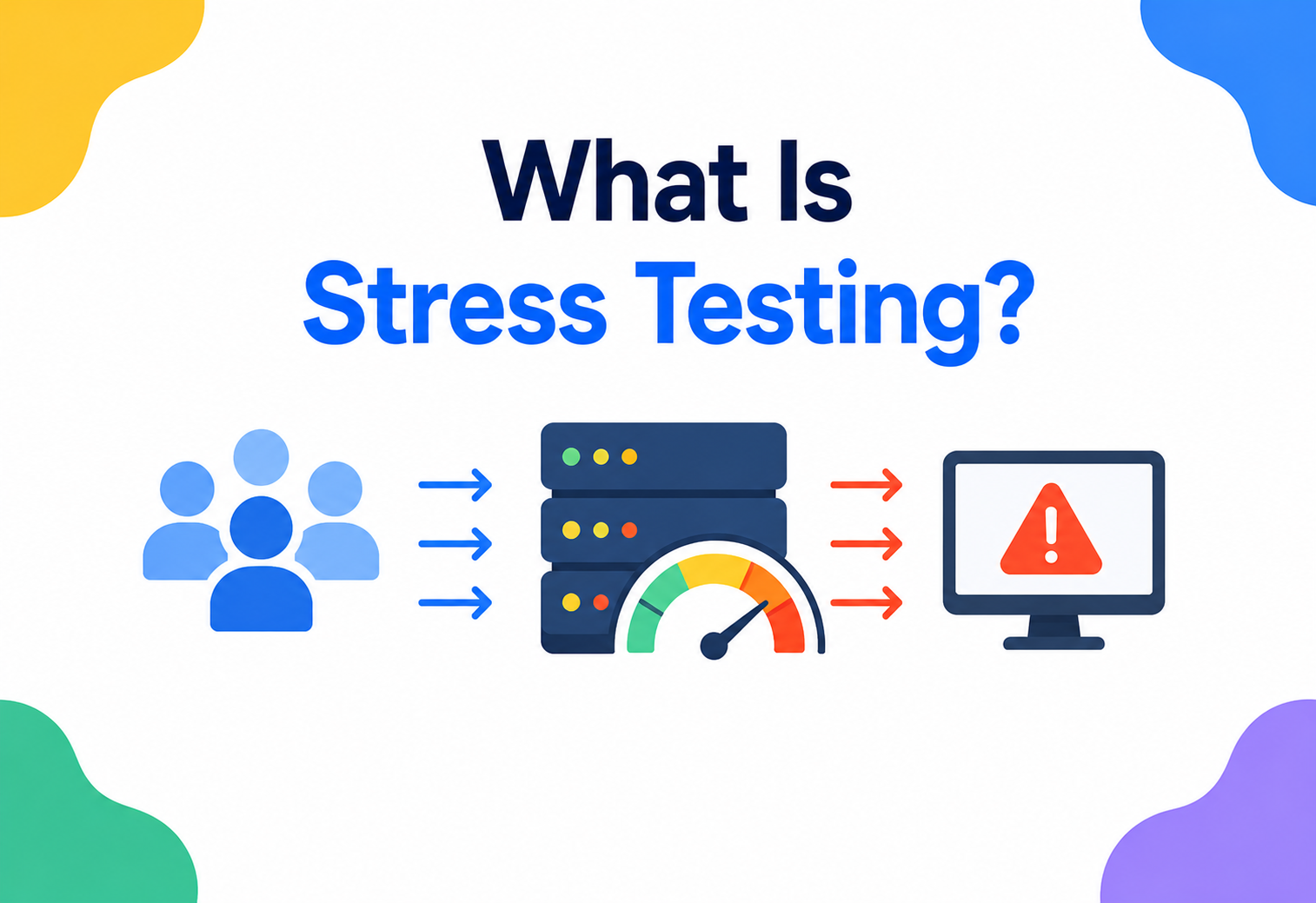
What Is Stress Testing? Finding the Breaking Point Before Your Users Do
Every bridge has a load limit an engineer deliberately tests before it ever opens to traffic. Every software system has one too, but far too many teams only discover theirs during a Black Friday sale, a viral moment, or a product launch, when it is far too late to fix calmly. Stress testing is the deliberate practice of pushing a system past its normal limits, on purpose, in a controlled setting, to find out exactly where it breaks and how it behaves when it does — before real users ever have to find out the hard way.
Introduction & History
Before a new bridge ever opens to the public, engineers drive heavy trucks across it, load it well beyond its expected daily traffic, and measure exactly how much it bends, creaks, and holds. They are not hoping the bridge survives; they already expect it to, based on the math. What they are really doing is confirming that their math matches reality, and finding out, in a safe and controlled way, exactly how much extra capacity exists beyond what is normally needed.
This same discipline, confirming theory against measured reality rather than trusting calculation alone, shows up across nearly every serious engineering field, from aerospace to civil engineering to electronics manufacturing. Software has simply been slower, historically, to adopt the same rigor, partly because a piece of code failing under extreme load does not produce the same dramatic, immediately visible consequences as a physical structure failing, even though the financial and reputational damage from a major software outage can be every bit as significant in its own right.
Stress testing, in software and systems engineering, is the same idea applied to computer systems. It means deliberately pushing a system, a website, an API, a database, far beyond its normal expected traffic or resource usage, specifically to discover where it starts to slow down, where it starts returning errors, and eventually where it fails completely, along with how gracefully or badly it fails, and how well it recovers once the extreme load is removed.
It is worth being precise about what “far beyond normal” actually means in practice: a well-designed stress test does not simply apply an arbitrary, unrealistically enormous amount of traffic for its own sake. It applies a deliberately chosen, steadily increasing amount of load, informed by real expected traffic patterns and reasonable growth projections, specifically calibrated to reach and then exceed the point where the system genuinely starts to struggle, wherever that point actually turns out to be for that particular system.

The Furniture Maker
A furniture maker testing a new chair design by having increasingly heavy people sit on it, and eventually intentionally overloading it far beyond any realistic customer’s weight, to find out exactly when and how it breaks, rather than waiting for a customer to find out by falling, and possibly getting hurt in the process.
The Ticketing Platform
An online ticketing platform deliberately simulates 50 times its normal traffic hitting the “buy tickets” button at the exact same second, mimicking what happens the moment a hugely popular concert goes on sale, well before the real on-sale date arrives.
Where the Idea Came From
Stress testing as a formal engineering discipline predates computing entirely, rooted in mechanical and structural engineering practices going back over a century, where materials and structures were deliberately tested to failure to understand their true limits rather than relying purely on theoretical calculations. The term crossed over into computing and software engineering as systems grew large and complex enough that their real-world behavior under extreme conditions could no longer be reliably predicted just by reasoning about the code; the only way to really know what happens at ten times normal load was to actually generate that load and observe what happened.
As the internet grew through the 1990s and 2000s, and especially once e-commerce, ticketing, and social platforms started experiencing massive, sudden traffic spikes tied to real-world events, Black Friday sales, ticket on-sales, viral moments, breaking news, stress testing evolved from a niche practice used mainly by large enterprises into a standard, expected part of the software development lifecycle for any system that might realistically face unpredictable surges in demand. Dedicated tools built specifically for this purpose, such as Apache JMeter, released in the late 1990s, and later Gatling and Locust, made it dramatically easier for ordinary engineering teams, not just specialized performance labs, to generate large, realistic amounts of simulated traffic against their own systems.
Cloud computing accelerated this shift further still, since generating and receiving genuinely large-scale test traffic once required significant dedicated hardware that most ordinary engineering teams simply did not have access to. With on-demand cloud infrastructure, a team can now provision temporary, large-scale load generation capacity for the duration of a test and tear it down immediately afterward, making serious, large-scale stress testing accessible to organizations of nearly any size, not just the largest technology companies with dedicated performance engineering labs.
A simple way to remember the goal of stress testing: it is not about proving a system works under normal conditions, that is what regular functional testing already covers. It is specifically about discovering what happens when conditions stop being normal.
Problem & Motivation
Why does a team need to deliberately break their own system on purpose? Because the alternative, waiting to discover the breaking point during a real traffic surge, is dramatically more expensive, more visible, and more damaging than finding it in a controlled test.
The Gap Between “Works” and “Works at Scale”
A system can pass every functional test, every code review, and every manual check performed by a small team of testers, and still collapse completely the moment real-world traffic arrives at a scale nobody tested for. This happens because many serious problems, a database connection pool that is too small, a cache that becomes a bottleneck under concurrent access, a memory leak that only manifests after sustained heavy use, simply do not appear at all under light, everyday testing conditions. They only reveal themselves once a system is pushed hard enough, for long enough, that these usually-invisible weaknesses finally become the limiting factor.
This gap is especially treacherous precisely because it is invisible during ordinary development. A pull request can pass every automated test, look completely correct during manual review, and perform beautifully when a single developer tries it locally, all while harboring a serious scalability flaw that only concurrent, high-volume access would ever expose. Nothing about the code looks wrong; the problem only exists in how it behaves once many things are happening simultaneously, a dimension that ordinary, low-volume testing simply never explores.
Normal Testing vs. a Real Traffic Surge
- Normal testing: light traffic → everything passes → team ships confidently.
- Real traffic surge arrives: 20x normal.
- Was this load ever tested?
- No → database connections exhausted, site goes down.
- Yes, in a stress test → known limits, autoscaling configured, graceful degradation in place.
The Practice Exam
A student who has only ever practiced easy math problems has no real idea how they will perform on a much harder exam until they actually attempt harder problems ahead of time, under exam-like pressure and time constraints.
Amazon Prime Day
Amazon has publicly discussed extensively preparing and stress testing its systems well ahead of major shopping events like Prime Day and Black Friday, specifically because the cost of an outage during those few, highly concentrated hours of peak sales is disproportionately enormous compared to an ordinary day.
The Cost of Discovering Limits the Hard Way
When a breaking point is discovered during a real incident rather than a planned test, the consequences compound quickly: real customers experience the failure directly, engineers are debugging under intense time pressure and public visibility rather than calmly reviewing test results, and the fix often has to be found and deployed in the middle of the very peak traffic conditions that caused the problem in the first place, which is by far the worst possible time to be making risky, rushed changes to a live production system.
— A phrase widely used across site reliability engineering circles to capture the idea that assuming a system will handle a big traffic spike, without ever actually testing that assumption, is not meaningfully different from simply hoping for the best.
Why Intuition About Capacity Is Frequently Wrong
Even experienced engineers regularly underestimate or overestimate how much traffic a system can genuinely handle, since modern systems involve so many interacting components, application code, network behavior, database internals, caching layers, operating system limits, that reasoning about their combined behavior under extreme conditions purely from first principles is extraordinarily difficult. A component that seems, on paper, like it should scale linearly with added traffic might in practice hit a sharp, unexpected wall well before that theoretical limit, due to some interaction between components that was never obvious from looking at any single piece in isolation. This gap between intuition and reality is precisely the gap stress testing is designed to close, replacing educated guesses with concrete, measured evidence, the kind of evidence that holds up under real scrutiny during a genuine incident review rather than being quietly revised after the fact once reality has already proven the original assumption wrong.
Easy Practice, Hard Exam
A student might feel confident they understand a subject well after reviewing easy practice problems, only to discover significant gaps in their understanding the moment they attempt a genuinely difficult exam question that stresses a different, less obvious part of their knowledge.
Launch-Day Outages
Multiple well-documented public postmortems from major e-commerce and ticketing companies have described launch-day or sale-day outages traced back to a specific component whose real-world capacity limit turned out to be significantly lower than engineers had confidently assumed based on theoretical calculations alone.
Core Concepts
Before going further, let’s build a precise vocabulary. Every term below shows up again and again in real engineering teams, and being able to name the pieces clearly is what turns a vague sense of “we should test more” into a program that can actually be planned and measured.
Stress Testing Versus Load Testing
What it is: Load testing checks how a system behaves under an expected, realistic amount of traffic, confirming it meets performance goals under normal or moderately busy conditions. Stress testing deliberately goes beyond that, pushing traffic past the system’s expected capacity specifically to find the point where it starts to degrade or fail.
Why the distinction matters: A system can pass load testing perfectly, proving it handles expected traffic just fine, while still having an unknown, potentially dangerous breaking point only slightly beyond that expected level, something only stress testing would reveal.
Analogy: Load testing is like confirming a delivery van comfortably carries its rated capacity of packages. Stress testing is deliberately continuing to add packages well past that rated capacity to find out exactly when the axle actually breaks, and how the van handles that failure once it happens.
Breaking Point
What it is: The specific level of load, measured in requests per second, concurrent users, or data volume, at which a system’s performance degrades so severely that it can no longer be considered functioning correctly, whether through unacceptably slow responses, a sharp rise in errors, or a complete crash.
Why it exists as a concept: Every system, no matter how well built, has some finite capacity. Knowing exactly where that limit sits, rather than guessing, is the single most valuable, concrete piece of information a stress test produces.
Practical example: A checkout API might handle up to 8,000 requests per second with acceptable response times, but beyond that point, response times climb sharply and error rates spike, marking 8,000 requests per second as that API’s practical breaking point under the tested conditions.
Degradation Curve
What it is: The pattern describing how a system’s performance changes as load increases, not usually a sudden cliff from perfectly fine to completely broken, but a gradual curve, response times slowly rising, then rising faster, then finally spiking sharply as the true breaking point is approached and crossed.
Why it matters: Understanding the shape of this curve, not just the final breaking point, tells engineers how much warning they realistically have before a real failure, and how sharply performance falls off once things start going wrong, both critical inputs into decisions like when autoscaling should trigger, and how much lead time on-call engineers can realistically expect between the first warning sign and a genuinely serious, user-facing problem.

Soak Testing (Endurance Testing)
What it is: A related technique that applies a sustained, moderate to high load over a much longer period of time, hours or even days, rather than a short, intense burst, specifically to catch problems that only appear gradually, such as memory leaks, slowly growing log files filling up disk space, or gradually accumulating database bloat.
Analogy: Stress testing is like checking how much weight a rope can hold in one intense pull; soak testing is like checking whether that same rope, holding a lighter but still substantial weight, slowly frays and weakens over many days of continuous use, a very different kind of failure than the rope simply snapping all at once under a single, brief, extreme pull.
Spike Testing
What it is: A test that applies an extremely sudden, sharp increase in load, rather than the gradual ramp-up typically used in standard stress testing, specifically to see how a system reacts to an abrupt, unexpected surge, such as a sudden mention on a hugely popular social media account.
Analogy: A gradual stress test is like slowly turning up the volume on a speaker to find the point where it starts to distort; a spike test is like instantly jumping the volume to maximum with no warning at all, to see whether anything breaks from the shock of the sudden jump itself.
Recovery Behavior
What it is: How well, and how quickly, a system returns to normal, healthy operation once the extreme load is removed, an aspect of stress testing that is just as important as identifying the breaking point itself.
Why it matters: A system that breaks under extreme load but recovers cleanly within seconds once load returns to normal is in a fundamentally healthier position than one that, once pushed past its limit, stays broken or degraded even after the load has already dropped back down. This second, unhealthier pattern, sometimes called a failure to self-heal, can turn what should have been a brief, temporary spike into a much longer outage that persists well after the original triggering traffic surge has already passed.
A very common beginner misunderstanding is thinking stress testing exists just to prove a system will crash. The real goal is almost the opposite: to know exactly where and how it will struggle, so that limit can either be pushed higher through engineering work, or safely planned around through capacity planning and autoscaling, well before real users ever get close to it.
Saturation Point Versus Breaking Point
What it is: The saturation point is the load level at which a specific resource, CPU, memory, a connection pool, first becomes fully utilized, while the breaking point is the load level at which the overall system, as experienced by users, actually stops functioning acceptably. These two points are often different, and a system can reach saturation on one internal resource well before it reaches its true, user-facing breaking point, or the two can coincide precisely, depending on how much internal slack and queuing capacity exists between resource saturation and actual user-visible failure.
Why the distinction matters: Identifying the saturation point of individual resources gives engineers early warning and a specific target for improvement, well before things become bad enough to be called an actual breaking point, letting capacity problems be addressed proactively rather than only once user experience has already visibly suffered.
Throughput Versus Latency Under Load
What it is: Throughput measures how many requests a system successfully completes per unit of time, while latency measures how long each individual request takes. Under increasing load, these two metrics interact in an important way: throughput typically rises as load increases, up to a point, while latency simultaneously creeps upward, and eventually, past the true capacity limit, throughput itself begins to fall even as more load is applied, since the system spends an increasing share of its effort managing congestion rather than completing useful work.
Analogy: A highway carries more cars per hour as more cars enter, right up until it becomes so congested that traffic jams actually reduce the total number of cars able to pass through per hour, even though far more cars are still trying to use the road than before.
Architecture & Components
Running a serious stress test requires more than simply hitting a website with traffic. A proper stress testing setup has several distinct, deliberately designed pieces, each with its own job and its own way of failing if you get it wrong.
Load Generator
The component, or often cluster of components, responsible for actually generating simulated traffic against the system under test, capable of producing far more request volume than a single machine could realistically manage on its own, since the load generator itself must never become the bottleneck limiting how much stress can be applied.
System Under Test
The actual application, service, or infrastructure being evaluated, ideally running in an environment that closely mirrors production in terms of hardware, configuration, and data volume, since testing against a drastically smaller or differently configured environment can produce results that are misleading or simply do not transfer to real production conditions.
Test Scenario Definition
A script or configuration describing exactly what simulated users do: which pages they visit, which APIs they call, in what sequence, and with what realistic variation, since simply hammering one single endpoint repeatedly rarely reflects how real traffic actually behaves across a genuine application.
Monitoring & Observability Stack
The dashboards, metrics, and logging systems watching the system under test throughout the stress test, since the entire value of the exercise depends on being able to see exactly what is happening internally, response times, error rates, resource usage, as load increases, not just observing the final, obvious crash.
Results Analyzer
A component, sometimes built into the load testing tool itself and sometimes a separate reporting layer, that aggregates raw results into meaningful summaries: percentile response times, error rate over time, and the specific load level at which meaningful degradation began.
Test Data Manager
A dedicated component responsible for generating or provisioning realistic test data at sufficient volume, since a database seeded with only a handful of sample records behaves very differently under load than one holding realistic production-scale data, and queries that perform perfectly well against a small dataset can become the true bottleneck once tested against genuinely representative data volume.
Safety Controller
Especially important when testing against production or shared infrastructure, a safety controller enforces hard limits, maximum test duration, an automatic kill switch, and clear escalation alerts, ensuring a stress test cannot spiral into an unintended, genuine outage even if something about the test itself behaves unexpectedly.
A Realistic Stress Test Setup
- Load Generator Cluster → sends simulated traffic (ramping up) to the System Under Test.
- The System Under Test talks to a Database and a Cache Layer.
- All three — system under test, database, cache — stream metrics into the Monitoring Stack.
- The Monitoring Stack feeds the Results Analyzer / Report.
Crash-Testing a Car
Crash-testing a car requires more than just a wall to hit; it requires the car itself, sensors placed throughout the vehicle and dummy passengers, high-speed cameras, and engineers carefully analyzing the resulting data afterward.
Netflix Performance Tooling
Netflix’s own internal tooling for large-scale performance testing has been described in public engineering blog posts as combining distributed load generation with the same detailed observability tooling used to monitor real production traffic, so results from a test are directly comparable to real incidents.
Internal Working
How does a load generator actually simulate thousands, or millions, of concurrent users, and how does a stress test decide when to increase load further? Under the hood, most tools rely on a small number of well-understood techniques.
Virtual Users and Concurrency
Rather than literally running thousands of separate browser instances, which would be extremely resource-intensive, most load testing tools simulate many “virtual users” using lightweight threads or asynchronous request patterns, each one independently following the defined test scenario, sending requests, waiting for responses, and repeating, closely mimicking real user behavior without the overhead of an actual full browser.
public class LoadGenerator {

    public static void runStressTest(String targetUrl, int startUsers, int maxUsers,
                                     int stepSize, long stepDurationMillis)
            throws InterruptedException {

        HttpClient client = HttpClient.newHttpClient();

        for (int users = startUsers; users <= maxUsers; users += stepSize) {
            ExecutorService pool = Executors.newFixedThreadPool(users);
            AtomicInteger successCount = new AtomicInteger();
            AtomicInteger errorCount = new AtomicInteger();
            long stepStart = System.currentTimeMillis();

            for (int i = 0; i < users; i++) {
                pool.submit(() -> {
                    while (System.currentTimeMillis() - stepStart < stepDurationMillis) {
                        try {
                            HttpRequest request = HttpRequest.newBuilder(URI.create(targetUrl)).build();
                            HttpResponse<Void> response = client.send(request, HttpResponse.BodyHandlers.discarding());
                            if (response.statusCode() < 400) successCount.incrementAndGet();
                            else errorCount.incrementAndGet();
                        } catch (Exception e) {
                            errorCount.incrementAndGet();
                        }
                    }
                });
            }

            pool.shutdown();
            pool.awaitTermination(stepDurationMillis + 5000, TimeUnit.MILLISECONDS);
            System.out.printf("Users: %d | Success: %d | Errors: %d%n",
                users, successCount.get(), errorCount.get());
        }
    }
}
Ramp-Up Strategies
Most stress tests increase load gradually rather than jumping instantly to maximum, following a defined ramp-up pattern, for example adding 100 additional concurrent users every 30 seconds, allowing engineers to observe exactly how the system responds at each successive level rather than only seeing the final, most extreme state.
Distributed Load Generation
For very large-scale stress tests, a single load-generating machine simply cannot produce enough traffic, and the load generation itself is spread across many machines, sometimes across multiple geographic regions, coordinated by a central controller that aggregates results from every generating node into one unified view of the test.
Distributed Load Generation
| Step | Actor | What happens |
|---|---|---|
| 1 | Test Controller → Generator Nodes 1, 2, 3 | Start test, ramp each generator to 1,000 virtual users. |
| 2 | Generator Nodes 1, 2, 3 → System Under Test | Each node applies simulated traffic in parallel. |
| 3 | Generator Nodes → Test Controller | Each node streams its own results batch back. |
| 4 | Test Controller | Aggregates all three batches into a single combined 3,000-user result. |
Closed Versus Open Workload Models
Load generators typically follow one of two workload models. A closed model has a fixed number of virtual users, each one waiting for a response before sending its next request, meaning total request rate naturally slows down if the system under test becomes slower, since each virtual user is effectively “blocked” waiting. An open model instead sends new requests at a defined, independent rate regardless of how quickly previous requests are completing, more closely mirroring how real, independent users actually behave, since real users do not coordinate with each other or wait for the system to catch up before making their own separate requests.
Choosing the wrong model can meaningfully distort test results: a closed model can understate how badly a system degrades under real, independent traffic, since it naturally reduces effective load exactly when the system starts struggling, masking the very problem the test is trying to find.
Synchronizing Load Generation With Monitoring Timestamps
For results to be meaningfully analyzed, timestamps recorded by the load generator, the application under test, and the monitoring system must all be reliably synchronized, typically through a shared time synchronization protocol across all machines involved. Without this, correlating a specific spike in error rate with the exact load level that caused it becomes unreliable, undermining the core value the entire exercise is meant to provide.

Data Flow & Lifecycle
Let’s walk through a complete, realistic stress test from planning to final report, so the components from the previous sections click together into a single, believable story of what actually happens on the day of a test.
| Stage | What actually happens |
|---|---|
| Planning | Engineers define the goal: confirm the checkout API can handle at least 5,000 requests per second, and find the actual breaking point beyond that, ahead of an upcoming major sales event. |
| Environment setup | A staging environment closely mirroring production, same instance types, same database size, same configuration, is prepared, since testing against a much smaller environment would produce misleading results. |
| Baseline measurement | A short test at normal, everyday traffic levels is run first, establishing a baseline for response times and error rates under known-healthy conditions. |
| Ramp-up begins | Load increases gradually from a low level, 500 requests per second, then 1,000, then 2,000, with the system holding up well and response times staying flat and healthy. |
| Early strain appears | At 6,000 requests per second, response times begin climbing noticeably, though still within acceptable bounds, and monitoring shows the database connection pool utilization rising sharply. |
| Breaking point reached | At 7,500 requests per second, the database connection pool is fully exhausted. Response times spike dramatically, and the error rate jumps from near zero to over 30% within seconds. |
| Test halted | Engineers stop increasing load, holding steady briefly to observe behavior at this failure point, then begin reducing load to observe recovery. |
| Recovery observed | As load drops back toward normal levels, the system recovers within about 45 seconds, connection pool utilization falls, and error rates return to near zero, a genuinely good sign about the system’s resilience even though its capacity limit was found to be lower than hoped. |
| Analysis and action | The team increases the database connection pool size and adds a caching layer for the most frequently read data, then reruns the same test to confirm the new breaking point is comfortably above the expected real traffic for the upcoming sales event. |
Notice that the most valuable output of this entire exercise was not simply “it broke at 7,500 requests per second.” It was the specific, actionable insight, the database connection pool, that pointed directly at what to fix, and the reassuring evidence of clean recovery, which matters just as much as the failure point itself.
What Would Have Happened Without This Test
It is worth briefly imagining the same sales event without this stress test ever having been run. The connection pool exhaustion discovered calmly at 7,500 requests per second in a controlled test would instead have been discovered for the first time during the actual live event, at the exact moment the largest number of real customers were trying to make real purchases. Engineers would have been diagnosing an unfamiliar, high-pressure production incident in real time, under intense visibility, rather than calmly reviewing a test result and planning a fix on a normal working day well ahead of the actual event. The specific fix, increasing the connection pool size and adding a caching layer, might well have been the same fix either way, but the cost of arriving at it, in lost sales, damaged customer trust, and engineer stress, would have been dramatically higher.
Design Patterns & Anti-Patterns
Not every stress test is a good stress test. A handful of structural patterns reliably produce useful results, and a handful of anti-patterns produce numbers that look convincing but tell you almost nothing real about your system.
Gradual Ramp-Up Pattern
Increasing load in defined, measured steps, rather than jumping straight to an extreme level, lets engineers observe the full degradation curve, discussed in the Core Concepts section, rather than only ever seeing the system in either a perfectly healthy or a fully broken state.
Realistic Traffic Mix Pattern
A well-designed stress test simulates a realistic mixture of different actions a real user might take, browsing, searching, adding to cart, checking out, in roughly realistic proportions, rather than simply hammering one single endpoint in isolation, since real production traffic is rarely uniform and different endpoints often have very different performance characteristics and resource costs.
Break-Then-Recover Pattern
Deliberately pushing a system past its breaking point and then reducing load again to observe recovery, rather than stopping the moment failure is first observed, provides crucial information about resilience, discussed in depth throughout broader fault tolerance material this guide connects to, that a test stopping at the very first sign of trouble would never reveal.
Isolated Component Stress Pattern
Rather than always stressing an entire end-to-end system at once, this pattern deliberately targets a single component, one specific database, one specific caching layer, one specific downstream API, with load calibrated well beyond what the whole-system test alone would apply to it. This isolates cause and effect more clearly, since observed degradation can be attributed with much greater confidence to that one specific component rather than needing to be untangled from many simultaneously stressed parts of a larger system.
public class LatencyTracker {
    private final List<Long> latenciesMillis = Collections.synchronizedList(new ArrayList<>());

    public void record(long latencyMillis) {
        latenciesMillis.add(latencyMillis);
    }

    public long percentile(double p) {
        List<Long> sorted = new ArrayList<>(latenciesMillis);
        Collections.sort(sorted);
        if (sorted.isEmpty()) return 0;
        int index = (int) Math.ceil(p / 100.0 * sorted.size()) - 1;
        return sorted.get(Math.max(0, Math.min(index, sorted.size() - 1)));
    }

    public void printSummary() {
        System.out.printf("p50: %dms | p95: %dms | p99: %dms%n",
            percentile(50), percentile(95), percentile(99));
    }
}
Common Anti-Patterns to Avoid
Anti-Patterns
- Testing against a drastically smaller environment than production, producing a breaking point number that has little to do with real production capacity.
- Testing only one endpoint in isolation, missing how a realistic mix of traffic across many endpoints actually stresses shared resources like a database or cache.
- Stopping the test the instant errors first appear, missing valuable information about the shape of the degradation curve and how the system recovers.
- Running a stress test directly against production without safeguards, risking a real, unintended outage for real users during the test itself.
- Never repeating the test after fixes, leaving teams unsure whether a fix for a discovered bottleneck actually raised the breaking point as intended.
How to Avoid Them
- Test against an environment that mirrors production as closely as practically possible.
- Model a realistic mixture of real user actions, not just a single repeated request.
- Continue past the first sign of trouble to observe the full degradation and recovery pattern.
- If testing production directly is necessary, use strict safeguards, time limits, and an easy abort mechanism.
- Always rerun the same test after implementing a fix, to confirm the breaking point genuinely improved.
Advantages, Disadvantages & Trade-offs
Stress testing pays for itself many times over in the right situations, but it is not free and it is not risk-free. Here are the honest trade-offs a senior engineer weighs before signing off on a program.
Advantages
- Reveals a system’s true capacity limits before real users ever discover them the hard way.
- Surfaces hidden bottlenecks, like undersized connection pools, that never appear under light, everyday testing.
- Provides concrete, measured data to guide capacity planning and infrastructure investment decisions.
- Validates whether autoscaling, failover, and other resilience mechanisms actually trigger and work as intended under real extreme load.
- Builds genuine engineering confidence ahead of known high-traffic events, rather than relying on hope alone.
- Turns capacity conversations from subjective opinion and guesswork into an objective, shared, measured reference point everyone on a team can align around.
Disadvantages / Costs
- Requires meaningful engineering time and infrastructure cost to set up and run properly.
- Testing against production, if not done very carefully, carries real risk of causing an actual, unintended outage.
- A test environment that does not closely match production can produce misleading, overly optimistic or pessimistic results.
- Results can go stale relatively quickly as a system’s code, infrastructure, and typical traffic patterns evolve over time.
The Central Trade-off: Realism Versus Safety
The most realistic possible stress test would run directly against live production infrastructure with real, unfiltered extreme traffic. But doing so carries genuine risk of causing the very outage the test is trying to prevent. Testing against a separate, staging-like environment is safer but only as valuable as how closely that environment actually mirrors real production characteristics. Most mature organizations resolve this trade-off by investing heavily in keeping a staging environment realistic, while reserving carefully safeguarded, limited production testing for validating the very final, most critical assumptions.
The Trade-off Between Test Scope and Diagnostic Clarity
A broad, whole-system stress test most closely resembles what will actually happen during a real traffic surge, since real surges rarely stress just one isolated component in a vacuum. But this same broad scope makes it harder to pinpoint exactly which specific component is the true root cause of observed degradation, since many components are all under strain simultaneously. A narrower, single-component test, discussed in the Design Patterns section as the isolated component stress pattern, provides much clearer diagnostic attribution but risks missing genuine interaction effects between components that only appear when everything is stressed together at once. Thorough testing programs typically use both approaches at different times, broad tests to validate overall real-world readiness, and narrower, isolated tests to drill down once a broad test has revealed that something, somewhere, is a problem.
Performance & Scalability
Stress testing exists specifically to answer performance and scalability questions with real, measured data rather than assumption, replacing confident-sounding guesses with numbers you can defend in a room full of skeptics.
Finding the True Scalability Ceiling
Theoretical capacity calculations, based on hardware specifications and expected per-request resource usage, are useful starting estimates, but they routinely miss real-world factors like connection pool limits, garbage collection pauses, lock contention, and cache behavior under genuine concurrent load. Stress testing replaces these estimates with an empirically measured, real breaking point.
Identifying the True Bottleneck, Not Just the Symptom
A system under extreme stress often shows several symptoms simultaneously, slow response times, rising error rates, high CPU usage, but only careful, layered monitoring during the test reveals which one is the actual root bottleneck versus which are simply downstream consequences of that one true limiting factor. A database connection pool being the true bottleneck, for example, commonly shows up as high CPU usage everywhere else in the system, since application threads spend increasing amounts of time simply waiting for an available connection rather than doing useful work.
Scalability Headroom as a Planning Target
Rather than aiming only to survive exactly the expected peak traffic, mature teams typically stress test toward a target with comfortable headroom, commonly two to five times the expected real peak, providing a safety margin against underestimated demand, unexpected viral moments, or the natural, gradual growth of traffic between the test and the actual event it was meant to prepare for.
Vertical Versus Horizontal Scaling Discovered Through Testing
Stress testing often reveals whether a system’s true bottleneck can be resolved simply by adding more identical instances, horizontal scaling, or whether the bottleneck lies in a single, non-distributed component, a single primary database, a single shared cache node, that cannot be helped at all by adding more application instances, requiring a fundamentally different kind of fix such as sharding, read replicas, or architectural redesign. This distinction, uncovered directly through testing rather than theoretical analysis alone, often determines whether solving a capacity problem is a quick, inexpensive configuration change or a much larger engineering investment.
High Availability & Reliability
Stress testing and high availability, discussed extensively in broader fault tolerance material this guide connects to, are deeply linked: a system’s true reliability under real-world conditions cannot be fully known until it has actually been pushed to, and past, its limits under controlled observation.
Validating Failover and Redundancy Under Real Stress
Many resilience mechanisms, automatic failover, circuit breakers, autoscaling, are configured based on assumptions about how the system will behave under heavy load. Stress testing is one of the only reliable ways to confirm those assumptions actually hold up in practice, rather than only being validated the first time a genuine, unplanned incident puts them to the test for real.
Stress Testing as an Input to Disaster Recovery Planning
Understanding exactly how a system behaves under extreme load, and how long it takes to recover once that load subsides, feeds directly into disaster recovery planning, particularly the Recovery Time Objective discussed in broader fault tolerance material, since a genuinely accurate recovery time estimate depends on real, measured data about system behavior under stress, not just an assumption.

The Fire Drill
A fire drill does more than test whether people can exit a building; it validates whether the actual evacuation plan, the specific doors, routes, and procedures, genuinely works under realistic, somewhat chaotic conditions, not just in calm, ideal theory.
Netflix’s Simian Army
Netflix’s well-known Chaos Monkey and broader “Simian Army” tooling, discussed in wider resilience engineering material, complements stress testing by validating not just capacity limits but also failure-handling behavior under a combination of high load and deliberately injected component failures simultaneously.
Stress Testing Reveals Hidden Single Points of Failure
A system that appears fully redundant under normal conditions can sometimes reveal an unexpected single point of failure only once genuinely pushed to extreme load, for example if a supposedly independent backup component quietly shares an underlying resource, a network link, a power supply, a rate-limited shared service, with the primary component it is meant to protect against. This kind of hidden coupling frequently remains invisible until the exact moment extreme load exposes it, making stress testing a genuinely valuable complement to architectural review alone.
The Relationship Between Stress Testing Frequency and Reliability Posture
Organizations that stress test only rarely, perhaps once before a major known event, tend to have less confidence in their true, current capacity limits between those events, since code changes, traffic pattern shifts, and infrastructure changes can all quietly erode a previously validated breaking point. Organizations that build stress testing into a regular, ongoing cadence maintain a much more current, trustworthy picture of their actual reliability posture at any given moment, rather than relying on data that may already be meaningfully out of date.
Security
A stress test and a denial-of-service attack can, at a purely technical level, look identical from the outside. What separates them is authorization, intent, and safeguards — and that difference has real legal, contractual, and operational teeth.
Stress Testing Versus a Denial-of-Service Attack
A stress test and a denial-of-service attack can, at a purely technical level, look remarkably similar, both involve generating a large volume of traffic against a system. The critical difference lies entirely in authorization, intent, and safeguards: a legitimate stress test is planned, approved, scoped, and monitored by the very team responsible for the system, with clear limits and an ability to stop immediately, while an attack has none of these things.
Never run a large-scale stress test against any system, including third-party services or shared infrastructure, without clear authorization from whoever owns and operates it. Doing so, even with good intentions, can be difficult to distinguish from an actual attack and may have serious legal and professional consequences.
Discovering Rate Limiting and Authentication Behavior Under Load
Stress testing is also a valuable way to confirm that security controls, such as rate limiting and authentication checks, continue to function correctly under heavy load, rather than being accidentally bypassed or disabled as a side effect of a system struggling under stress, a genuine risk if error-handling code paths taken only under extreme load have not been as thoroughly reviewed as the normal, everyday code paths.
Safeguarding the Load Generator Itself
The infrastructure used to generate stress test traffic must itself be properly secured and access-controlled, since a powerful load generation capability, if left open or poorly protected, could be misused by an unauthorized party to launch a genuine denial-of-service attack against the very system it was built to help protect.
Legal and Contractual Considerations
When testing systems that involve third-party infrastructure, cloud providers, content delivery networks, external APIs, teams must review relevant terms of service and acceptable use policies beforehand, since many providers explicitly require advance notice before large-scale load testing, and some prohibit it entirely without prior written approval, treating unannounced large traffic surges as indistinguishable from an actual attack from their own monitoring perspective.
Data Privacy in Test Environments
Realistic stress testing often benefits from realistic data volume, discussed in the Architecture section, but using genuine production customer data directly in a test environment raises real privacy and compliance concerns. Mature testing practices instead use carefully anonymized, synthetically generated, or otherwise sanitized data that preserves realistic volume and distribution characteristics without exposing actual sensitive customer information to a test environment that may have different, often weaker, security controls than production itself.
Monitoring, Logging & Metrics
The entire value of a stress test depends on being able to see, in detail, exactly what happened inside the system as load increased, not just observing the final, obvious failure from the outside.
What to Track During a Stress Test
- Response time percentiles — tracking p50, p95, and p99 latency continuously throughout the test, since the shape of how these numbers change as load increases reveals the degradation curve discussed in the Core Concepts section.
- Error rate over time — the percentage of failed requests at each load level, showing precisely when errors begin appearing and how quickly they escalate.
- Resource utilization per component — CPU, memory, database connections, thread pool usage, tracked separately for each individual component, since this is what actually reveals which specific piece of the system is the true bottleneck.
- Throughput achieved versus throughput attempted — comparing how much traffic the load generator tried to send against how much the system actually successfully processed, revealing exactly where the gap between the two begins to widen.
Watching the Right Signals as Load Increases
- Load increases each step.
- At each step, collect three signals in parallel:
- p50 / p95 / p99 latency.
- Error rate.
- Resource utilization per component.
- Ask, at each step:
- Latency degrading sharply?
- Error rate rising?
- Any single resource near saturation?
- If any answer is yes → mark this load level as near the breaking point.
- Continue briefly at that level, then begin reducing load to observe recovery.
Always keep the exact same monitoring dashboards used during a stress test also available and familiar during real production incidents. Engineers who already know precisely what a dashboard looks like right before a breaking point respond far faster during a genuine live incident showing the same warning signs.
Correlating Logs With Specific Load Milestones
Beyond raw metrics, detailed application logs collected throughout a stress test, particularly around the moment of breaking point, often contain the specific error messages, stack traces, or warning patterns that most directly point toward root cause, information a purely numeric dashboard alone cannot fully convey. Well-organized testing practice tags or timestamps these logs clearly against the specific load milestone being tested at that moment, so that after the test, engineers can quickly jump to exactly the right slice of logs corresponding to when things first started going wrong.
Building a Permanent Record for Future Comparison
Results from every stress test, not just the most recent one, are worth preserving in a consistent, comparable format over time, since tracking how a system’s breaking point changes across successive tests, ideally trending upward as the system scales and improves, provides one of the clearest, most concrete signals of whether ongoing engineering investment in performance and capacity is actually paying off.
Deployment & Cloud
Cloud infrastructure changes the economics of stress testing profoundly — large-scale tests that once required a dedicated performance lab can now be spun up on demand for a few hours — but it also introduces its own set of deployment-specific concerns worth thinking through carefully.
Testing Autoscaling Behavior
In cloud environments, stress testing is one of the only reliable ways to confirm that autoscaling rules, discussed broadly in fault tolerance material, actually trigger correctly under real load, adding capacity quickly enough to keep pace with rising demand rather than lagging behind it long enough for users to already experience degraded service before new capacity comes online.
Cost Considerations of Running Large-Scale Tests in the Cloud
Generating enough simulated traffic to genuinely stress a large, cloud-hosted system, and running enough infrastructure to receive and process that traffic, both cost real money. Teams commonly schedule intensive stress tests during off-peak hours specifically to avoid interfering with real production traffic, and carefully tear down any temporary, expanded test infrastructure immediately afterward to avoid ongoing, unnecessary cost.
Isolating Stress Tests From Real Production Traffic
Well-designed stress testing setups use clearly separated environments, dedicated staging accounts, isolated network segments, or careful traffic tagging, specifically to ensure that simulated test traffic can never accidentally mix with or affect real, paying customers, even when the test environment closely mirrors production configuration.
Infrastructure as Code for Reproducible Test Environments
Teams increasingly define their stress testing environments using infrastructure as code tools, ensuring the exact same environment configuration can be reliably recreated for every test run, making results genuinely comparable over time rather than being subtly skewed by unnoticed differences between one test’s environment and the next.
Blue-Green and Canary Considerations During Testing
Teams practicing blue-green or canary deployment strategies, discussed in broader fault tolerance material, sometimes use a newly provisioned but not-yet-live environment as a convenient, low-risk target for stress testing, since it closely mirrors production configuration while remaining fully isolated from real user traffic, providing a uniquely safe and realistic testing opportunity that a traditional, permanently separate staging environment cannot always match as closely.

Containerized Environments and Resource Limit Testing
In containerized deployments, stress testing takes on an additional dimension: confirming that configured resource limits, CPU and memory caps applied to individual containers, are set appropriately, neither so tight that the application is throttled or killed well before genuine hardware capacity is reached, nor so loose that a single struggling container can consume resources needed by its neighbors on the same physical machine.
Databases, Caching & Load Balancing
In practice, the bottleneck a stress test finds is almost never in the application code itself. It is usually in a database connection pool, a cache, or a load balancer — the shared, stateful pieces underneath the application. This section walks through the classic patterns.
Database Connection Pool Exhaustion
One of the single most common bottlenecks discovered through stress testing is a database connection pool, discussed in the broader context of timeouts, that is simply too small for genuine peak load, causing requests to queue up waiting for an available connection, and eventually time out entirely, well before the database server itself is actually working at its true hardware capacity.
Cache Stampede Scenarios
Stress testing frequently reveals a specific, damaging pattern called a “cache stampede,” where a popular cached item expires at exactly the moment extreme load hits, causing a huge number of simultaneous requests to bypass the cache entirely and hit the underlying database all at once, potentially overwhelming it even though the system was handling the same overall traffic volume perfectly well just moments earlier while the cache was still warm.
Load Balancer Behavior Under Extreme Load
Stress tests also validate how a load balancer itself behaves as backend capacity becomes strained, confirming that it correctly distributes load evenly, correctly detects and routes around unhealthy backend instances, discussed in the broader context of health checks, and does not itself become an unexpected bottleneck at very high request volumes.
Read Replica and Sharding Limits
For systems using read replicas or database sharding, discussed in broader database scalability material, stress testing reveals whether traffic is actually being distributed evenly across replicas or shards as intended, or whether an uneven distribution, sometimes called a “hot shard,” is quietly limiting overall capacity well before the theoretical combined capacity of all replicas or shards has actually been reached.
Write Contention and Locking Under Concurrent Load
Stress testing frequently surfaces database write contention issues invisible under light traffic, situations where many concurrent requests attempt to update the same row or a small set of frequently updated rows simultaneously, causing lock waits that compound sharply as concurrency increases, a pattern common in scenarios like inventory counters or account balances being updated by many simultaneous transactions, and one that theoretical capacity planning based on average query time alone would never predict.
Connection Pool Sizing Across Multiple Layers
In systems with several layers between the application and the ultimate data store, an application-level connection pool, a separate database proxy layer, the database’s own maximum connection limit, each layer can independently become the true bottleneck, and stress testing is often the only reliable way to determine which of several possible connection limits is actually the binding constraint in a real, fully assembled production-like environment.
APIs & Microservices
In a microservices world, the interesting failures usually happen across service boundaries, not inside a single service. Stress testing a microservices architecture without exercising the call chain is a bit like crash-testing a car by testing each seatbelt separately.
Discovering Cascading Failure Risk Through Stress Testing
In a microservices architecture, stress testing one specific service in isolation often understates real risk, since the true danger frequently lies in how stress on one service cascades into others through the call chain, discussed extensively in the broader circuit breaker and fault tolerance material this guide connects to. A thorough stress testing strategy therefore often includes tests that apply load across an entire realistic chain of dependent services, not just one service at a time.
Validating Timeouts, Retries, and Circuit Breakers Under Real Load
Stress testing provides a genuine, practical opportunity to confirm that timeouts, retry logic, and circuit breakers, all discussed in depth elsewhere in this guide’s broader resilience material, actually behave as designed under real extreme conditions, rather than only being validated through smaller, artificial unit tests that may not accurately capture real concurrent load and timing behavior.
API Rate Limits and Stress Testing
When stress testing a system that depends on external, third-party APIs, careful attention must be paid to that third party’s own rate limits and terms of service, since an aggressive internal stress test could inadvertently trigger those external limits, producing misleading results that reflect the third party’s rate limiting rather than genuine capacity limits within your own system.
Contract Testing Alongside Stress Testing
Some teams combine stress testing with consumer-driven contract testing, discussed in broader circuit breaker material, specifically to confirm that a downstream service’s actual response format and behavior under heavy load still matches what calling services expect, since some services subtly change their error response format or content specifically under high-load, degraded conditions in ways that a calling service’s normal error handling was never actually tested against.
API Versioning and Backward Compatibility Under Load
For public-facing APIs serving many different client versions simultaneously, stress testing sometimes reveals that certain older client versions generate disproportionately expensive requests compared to newer versions, information valuable both for capacity planning and for prioritizing efforts to encourage clients to upgrade to more efficient, newer API versions.
The Paper Chain
Testing whether one single link in a paper chain holds under strain tells you little about whether the whole chain, made of many links working together, will hold under the same or greater strain.
Uber’s Chain Testing
Uber’s public engineering writing has described stress testing entire realistic chains of microservices together, rather than testing each service in complete isolation, specifically because their real production incidents have often involved stress cascading unexpectedly across multiple services rather than staying contained within just one.
Best Practices & Common Mistakes
The difference between a team that occasionally runs a load test and a team that has a real stress testing program is a handful of habits — and the discipline to avoid a handful of common traps. Here is the shortlist.
Best Practices
- Define clear, specific goals before testing, such as a target throughput with acceptable latency, rather than testing without a clear success criterion in mind.
- Test in an environment that closely mirrors production, including realistic data volume, not just similar code and configuration.
- Model a realistic mixture of real user behavior, not a single repeated request against one isolated endpoint.
- Monitor every layer simultaneously, application, database, cache, network, not just the single, most visible top-level metric.
- Continue past the first sign of trouble to observe the full degradation curve and recovery behavior, not just the very first failure.
- Rerun tests after every significant change, to confirm fixes genuinely raised the breaking point as intended.
- Schedule large-scale tests carefully, avoiding interference with real production traffic or other teams’ work.
- Document findings clearly and share them broadly, since a discovered bottleneck often has implications well beyond the specific team that ran the test.
Common Mistakes
- Testing against a much smaller or differently configured environment than production, producing results that do not transfer to reality.
- Only ever testing the happy path, missing how error-handling and fallback code paths themselves behave under genuine extreme load.
- Treating the load generator as infinitely capable, when it can itself become the actual bottleneck, producing a misleadingly low breaking point for the real system under test.
- Running a test once and never repeating it, even as the system’s code, traffic patterns, and infrastructure continue to change significantly over time.
- Skipping authorization and safeguards when testing shared or production infrastructure, risking real harm or being mistaken for a genuine attack.
A stress test that has never actually caused the system to fail has not really told you where the limit is, only that the limit is somewhere above whatever was tested. Genuinely useful stress testing requires being willing to push all the way to, and past, an actual breaking point.
Building a Stress Testing Culture, Not Just a Stress Testing Tool
Adopting a load testing tool is only the first step; genuinely useful stress testing requires an organizational habit of treating capacity and breaking points as things worth knowing precisely, not just vaguely estimating. Teams that build regular stress testing into their normal engineering cadence, alongside code review and regular deployments, tend to catch capacity regressions early, while a change is still small and recent and therefore much easier to diagnose, rather than discovering a capacity problem months later during an unrelated real traffic surge, by which point many possible contributing changes have accumulated.
Sharing Results Beyond the Immediate Testing Team
A discovered bottleneck, such as an undersized connection pool or a cache stampede risk, often has implications for teams well beyond whichever team happened to run the specific stress test. Establishing a clear, consistent way to document and broadly share findings, rather than leaving results buried in one team’s private notes, ensures the same underlying lesson does not need to be painfully rediscovered independently by every other team facing a structurally similar risk elsewhere in the same organization.
Real-World & Industry Examples
Different companies with different constraints all landed on remarkably similar answers. Here are the ones most often cited in public engineering writing, and what each one contributes to the shared playbook.
Prime Day Preparation
Amazon has publicly discussed extensive internal load and stress testing performed well ahead of major shopping events such as Prime Day and Black Friday, deliberately simulating traffic levels far beyond ordinary daily volume to validate that infrastructure, from web servers through to payment processing, can comfortably handle the concentrated surge these events reliably produce.
Large-Scale Performance Engineering
Netflix’s public engineering writing has described dedicated internal tooling for generating realistic, large-scale simulated traffic against its streaming infrastructure, closely paired with the same detailed observability used for real production monitoring, allowing engineers to directly compare stress test behavior with genuine incident data when investigating real-world performance issues.
On-Sale Traffic Surges
Large ticketing platforms handling high-demand concert and event on-sales have described building specialized “virtual waiting room” systems specifically informed by stress testing, deliberately limiting how many users are allowed to actively hit checkout systems at once, a design decision directly shaped by discovering, through stress testing, the exact traffic level at which checkout systems begin to degrade.
Coordinated Large-Scale Testing
LinkedIn’s engineering organization has publicly discussed running large, coordinated stress tests across its infrastructure, deliberately generating traffic well beyond typical daily peaks to validate capacity ahead of anticipated growth, treating this kind of testing as a routine, recurring part of capacity planning rather than a one-time exercise performed only before major, unusual events.
Realistic Microservice Chains
Uber’s engineering blog has described the importance of stress testing realistic chains of dependent microservices together, rather than testing individual services in isolation, specifically because real incidents at that scale have often involved stress and failure cascading unpredictably across multiple interdependent services rather than remaining neatly contained within just one.
Launch-Day Load Failures
Several large public sector technology projects, including major government benefits and healthcare enrollment platforms, have experienced widely reported launch-day failures traced back at least partly to insufficient stress testing ahead of a hard, publicly announced launch date with a known, unavoidable traffic surge. These well-documented public incidents are frequently cited in engineering and public policy discussions alike as cautionary examples of the real, tangible cost of skipping or under-investing in this kind of testing ahead of a predictable, high-stakes event.
Live Event Traffic
Streaming and broadcast platforms handling major live events, championship sporting events, high-profile product launches, award shows, routinely conduct extensive stress testing in the weeks beforehand, since these events produce an unusually concentrated, precisely time-boxed traffic spike unlike the more gradually building traffic patterns a typical retail or ticketing scenario might otherwise produce.
Frequently Asked Questions
A short set of the questions engineers, engineering managers, and product owners most often ask when they first start thinking seriously about a stress testing program.
What is the difference between stress testing and load testing?
Load testing confirms a system meets performance expectations under realistic, expected traffic. Stress testing deliberately goes beyond expected traffic, specifically to find the point where the system begins to degrade or fail, information load testing alone would never reveal.
Is stress testing the same thing as chaos engineering?
They are related but distinct. Stress testing primarily varies the amount of load applied to find capacity limits. Chaos engineering, discussed broadly in fault tolerance material, primarily involves deliberately injecting component failures, killing a server, adding network latency, to validate resilience mechanisms. Some advanced testing practices combine both, applying heavy load and deliberate failures simultaneously.
How often should stress testing be repeated?
At minimum, after any significant change to code, infrastructure, or expected traffic patterns, and ideally on a regular, recurring schedule, since a system’s true capacity can shift meaningfully over time even without any single dramatic change being obviously responsible.
Is it safe to stress test directly against production?
It can be, but only with careful safeguards: strict time limits, an immediate abort mechanism, close real-time monitoring, and ideally testing during genuinely low-traffic periods. Many organizations prefer to reserve direct production testing for validating only the very final, most critical assumptions, after extensive testing has already been done in a closely mirrored staging environment.
What tools are commonly used for stress testing?
Apache JMeter, one of the earliest and still widely used open-source tools, along with newer alternatives like Gatling and Locust, are common choices, alongside cloud-provider-specific load testing services and custom-built internal tooling at larger technology companies with especially specialized needs.
Does passing a stress test guarantee a system will never fail in production?
No. A stress test confirms behavior under the specific conditions actually tested, a certain traffic mix, a certain data volume, a certain infrastructure configuration. Real production conditions can differ in ways the test did not anticipate, which is exactly why realistic environments, realistic traffic mixes, and regularly repeated testing all matter so much.
Why does recovery behavior matter as much as the breaking point itself?
A system that fails at a lower load but recovers cleanly and quickly once load subsides is often in a healthier overall position than one with a higher breaking point that, once exceeded, remains degraded or broken for an extended period afterward. Real traffic surges are rarely permanent, and how gracefully a system bounces back matters enormously to the real-world user experience during and after a genuine spike.
Should stress testing be automated as part of a continuous integration pipeline?
Many mature engineering organizations do run smaller, automated performance checks on every significant code change, catching obvious regressions early, while reserving full-scale stress testing, closely mirroring production and pushing genuinely to the breaking point, for a less frequent but still regular schedule, since a truly large-scale test typically requires more infrastructure, coordination, and careful monitoring than fits comfortably into every single automated build.
What is a reasonable first step for a team that has never done any stress testing before?
Starting small is entirely reasonable: pick the single most critical user-facing flow, checkout, login, the core API most other things depend on, define a clear target based on realistic expected peak traffic with some safety margin, and run a modest, carefully monitored test in a non-production environment first. The goal of a first attempt is building organizational confidence and establishing a repeatable process, not immediately achieving a comprehensive, fully mature testing program covering every possible scenario on day one.
Should stress testing be done by a dedicated performance team or by the engineers who build the system?
Both models exist in practice and each has trade-offs. A dedicated performance testing team brings specialized tooling expertise and can apply consistent standards across many different systems, while the engineers who actually built a given system often have the deepest understanding of where its likely weak points are and can interpret results with the most context. Many mature organizations combine both, with a central team providing tooling, infrastructure, and best practices, while individual engineering teams run and interpret tests against their own specific systems.
How much load headroom is actually enough?
There is no single universal answer, since it depends heavily on how predictable a system’s traffic patterns are and how costly a failure at that specific point in its usage would be. A back-office internal tool with steady, predictable usage might reasonably target only modest headroom above its known peak, while a consumer-facing platform prone to sudden, unpredictable viral moments often benefits from much larger headroom, since the cost of being caught by an unexpectedly large surge can be severe and highly visible.
Summary & Key Takeaways
Stress testing exists to answer a simple but critically important question that no amount of ordinary, everyday testing can answer on its own: what actually happens when this system is pushed well beyond what it normally experiences?
By deliberately, safely, and gradually pushing load past expected levels, engineers can discover a system’s real breaking point, understand exactly how it degrades as that point approaches, and confirm how well it recovers once extreme conditions pass, all under controlled, observed conditions rather than during a real, high-stakes incident.
What makes this discipline so valuable is precisely what makes it uncomfortable: it requires deliberately causing a system to fail, in a controlled way, rather than simply hoping it never will. That discomfort is exactly the point. A breaking point discovered on a quiet Tuesday afternoon during a planned test, with the whole team watching dashboards and ready to respond, costs almost nothing beyond the engineering time invested. The same breaking point discovered for the first time during an actual, unplanned traffic surge, with real customers affected and engineers debugging under public pressure, costs vastly more, in direct terms and in the harder to measure but very real damage to user trust and to the confidence of the engineering team itself in the systems they have built.
For any team building a system that might realistically face unpredictable or seasonal spikes in demand, the practical message of this entire guide is straightforward: find your system’s limits deliberately, on your own schedule, before the world finds them for you.
Perhaps the single most important shift in mindset this guide can offer is this: a system’s breaking point is not a fixed, permanent fact discovered once and then filed away. It shifts constantly as code changes, as traffic patterns evolve, as infrastructure is upgraded or reconfigured, and as new features and dependencies are added. Treating stress testing as an ongoing relationship with a living, changing system, rather than a single box to check off before one big launch, is what separates organizations that are occasionally caught off guard by a surprising capacity failure from those that catch capacity regressions early, calmly, and on their own terms, well before those regressions have any chance to become a real, customer-facing incident.
Key Takeaways
- Stress testing deliberately pushes a system beyond its expected normal capacity to find its true breaking point, distinct from load testing, which only confirms behavior under expected, realistic traffic.
- The degradation curve, how performance changes as load increases, is often just as valuable a finding as the final breaking point number itself.
- Recovery behavior, how cleanly and quickly a system returns to normal once extreme load subsides, matters as much as the breaking point.
- A proper stress testing setup requires a capable load generator, a realistic system under test, thorough monitoring across every layer, and careful results analysis.
- Realistic traffic mixes, gradual ramp-up, and testing past the first sign of trouble all produce far more useful results than a single, isolated, worst-case request repeated in a vacuum.
- Stress testing directly validates whether resilience mechanisms like autoscaling, circuit breakers, and failover actually work as intended under genuine extreme conditions.
- Clear authorization and careful safeguards are essential, since a large-scale stress test can otherwise closely resemble, or accidentally cause the same damage as, a genuine denial-of-service event.
- Companies like Amazon, Netflix, LinkedIn, and Uber treat stress testing as a routine, recurring engineering discipline, not a one-time checkbox, precisely because real traffic patterns and system capacity continue to shift over time.