The STAR Method — A Complete Guide to Answering Behavioural Interview Questions
A ground-up guide to the four-part storytelling structure that turns “tell me about a time when…” from the most dreaded interview question into your strongest, most controllable opportunity to stand out.
Introduction & History
The oldest and most reliable way to answer the dreaded “tell me about a time when…” question is not a clever line or a memorised script — it is a four-part shape you can lean on when nerves are highest. That shape has a name, and this guide is about learning to use it well.
Imagine two candidates are asked the exact same interview question: “Tell me about a time you disagreed with a coworker.” The first candidate says, “Oh, that happens all the time, I’m pretty good at handling conflict, I just try to stay calm and professional.” The second candidate says, “In my last role, our team had to choose between two vendors for a critical tool, and I disagreed with my manager’s preferred choice. Here is exactly what the situation was, what I was responsible for deciding, the specific steps I took to make my case, and what happened as a result.” Even though both candidates might be equally capable, the second candidate gives the interviewer something concrete to evaluate — a real, verifiable story with a beginning, middle, and end — while the first gives only a vague self-assessment. The STAR method is simply the name for the structure the second candidate, whether consciously or not, just used.
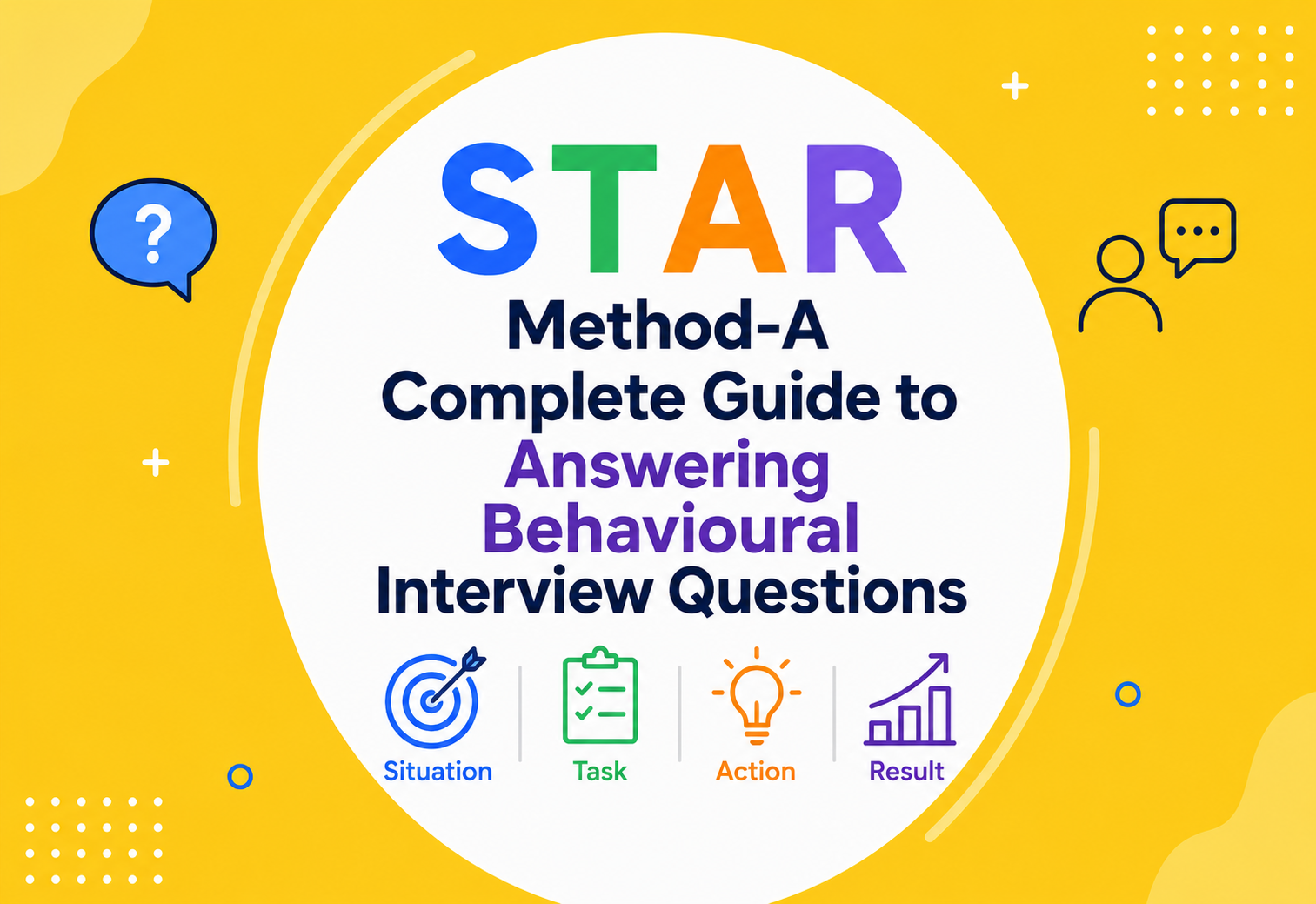
STAR stands for Situation, Task, Action, Result — a four-part framework for answering behavioural interview questions (questions that ask you to describe a specific past experience, usually starting with “Tell me about a time when…” or “Give me an example of…”) by telling a short, structured, real story instead of giving a general, abstract answer.
Think of the STAR method as the four-act structure behind almost every satisfying short story or movie scene: first you establish the world (Situation), then you introduce the specific problem the main character must solve (Task), then you show the character actually doing something about it (Action), and finally you show what happened because of what they did (Result). Skip any one of these four beats and the story feels incomplete — either confusing, aimless, or oddly anticlimactic.
What makes this four-part shape so durable is that it maps almost perfectly onto how human memory naturally organises a meaningful past experience: we remember where we were and what was happening (Situation), what we were trying to accomplish (Task), the specific choices we made under those circumstances (Action), and how things turned out (Result). STAR does not impose an artificial structure on memory so much as it gives candidates permission and a vocabulary to surface a structure that was, in some sense, already there — which is a large part of why the framework is so quick to teach and so widely adopted across such different industries and interview formats.
1.1 Where the STAR method comes from
The STAR method’s roots trace back to industrial and organisational psychology research from the 1970s and 1980s, particularly the development of behavioural interviewing as an alternative to traditional, hypothetical interview questions. Researchers, including notably psychologist Tom Janz in his influential 1986 work on behaviour description interviewing, found something intuitive but powerful: asking candidates to describe how they actually behaved in real past situations predicted future job performance far better than asking candidates to speculate about how they would behave in a hypothetical scenario. The reasoning is simple and well-supported: past behaviour, described concretely and specifically, is a much stronger predictor of future behaviour than a candidate’s untested opinion of their own hypothetical judgment.
Once behavioural interviewing caught on — first in psychology and human-resources circles, then rapidly across corporate hiring in the 1990s and 2000s — interviewers needed candidates to answer these new “tell me about a time when” questions in a way that was actually evaluable, rather than rambling and unstructured. The STAR acronym emerged as a simple, teachable mnemonic to help candidates (and, just as importantly, to help interviewers scoring those candidates) organise a real experience into a consistent, comparable shape. It has since become one of the most widely taught interview frameworks in the world, used from campus recruiting workshops to executive coaching, and explicitly built into the hiring processes of companies like Amazon, Google, and countless others.
Some organisations use a close variant called STARL or STAR+L, which adds a fifth beat — Learning — asking the candidate to reflect on what they took away from the experience. Others use CAR (Context, Action, Result), a slightly compressed version of the same idea. All of these variants share the same underlying DNA: establish the situation, show the specific action you personally took, and prove the outcome.
Problem & Motivation
Why does a simple four-letter acronym deserve an entire guide? Because without it, candidates — even highly capable, experienced ones — reliably fall into a small number of costly, avoidable traps when faced with a behavioural question.
2.1 Problem 1 — vague, generic answers that give the interviewer nothing to evaluate
Without structure, most people answer “tell me about a time when you showed leadership” the way they would answer “are you a good leader?” — with a general self-description (“I’m a natural leader, I always step up”) rather than a specific, real example. An interviewer cannot score, compare, or trust a self-description the way they can a concrete story with a real outcome.
2.2 Problem 2 — rambling stories that never get to the point
The opposite failure is just as common: a candidate who does think of a real story but tells it the way they would tell it to a friend over coffee — meandering, heavy on irrelevant background detail, light on the candidate’s own specific actions, and often running out of time before ever reaching a clear result. Interviewers have limited time per question (often just 3 to 5 minutes) and a rambling story wastes that time without demonstrating the candidate’s actual capability.
2.3 Problem 3 — taking credit for a team’s success without showing individual contribution
A very common and very damaging pattern: “We redesigned the onboarding flow and conversion went up 30%.” This tells an interviewer almost nothing about the individual candidate — what did they personally do, as opposed to the rest of the team? Without a structure that explicitly separates the candidate’s task and action from the surrounding situation, this “we” pattern is easy to fall into, and it leaves interviewers unable to assess the one thing they are actually trying to assess: this specific person’s individual judgment and capability.
Behavioural interview performance is frequently the single largest factor separating otherwise similarly qualified candidates in a final hiring decision, particularly at companies (like Amazon, whose culture is explicitly built around its Leadership Principles) where behavioural rounds make up the majority of the interview loop. A candidate with a strong resume but a disorganised, generic answer to “tell me about a time you failed” can genuinely lose an offer to a slightly less experienced candidate who tells a sharp, structured story — because the interview is, ultimately, judging the story that gets told in the room, not the resume that got the candidate into the room.
The STAR method exists to solve exactly these three problems: it forces specificity (a real situation, not a general trait), it forces brevity and pacing (a natural, time-bounded structure), and it forces individual accountability (a dedicated beat, “Action,” that is explicitly about what you did).
Core Concepts
Let us define each of the four letters precisely — what it means, why it exists, and what a beginner commonly gets wrong about it.
The context
What. The specific context your story takes place in — where you worked, what the broader circumstance was, and any details the interviewer needs to understand what was at stake.
Why it exists. Without context, “Action” and “Result” are meaningless — an interviewer cannot judge whether restarting a server was impressive or trivial without knowing it was 3 A.M. during a company’s biggest sales event of the year.
Common beginner mistake. Spending too long here. The Situation should be a handful of sentences, not a five-minute company history.
Your responsibility
What. Your specific responsibility or goal within that situation — what you personally were on the hook to do or solve, distinct from what the team as a whole was doing.
Why it exists. This is what separates “here is a situation that happened around me” from “here is what I, specifically, was responsible for.”
Common beginner mistake. Merging Task into Situation so thoroughly that the interviewer never hears a clear statement of what the candidate was actually trying to accomplish.
What you did
What. The specific steps you took — not your team, not your manager, not “we.” This is the heart of the answer and should take up the majority of your speaking time.
Why it exists. This is the part of the story that actually reveals your judgment, skills, and behaviour — the entire reason the interviewer asked a behavioural question in the first place.
Common beginner mistake. Describing the action too briefly (“I talked to my manager and we fixed it”) without the specific reasoning, trade-offs considered, or concrete steps that would let an interviewer actually evaluate the quality of the thinking behind it.
What happened
What. What happened because of your actions — ideally with a concrete, quantified outcome, plus what you learned or would do differently.
Why it exists. A story without a result is an anecdote, not evidence. The result is the proof that the action actually worked (or, in a “tell me about a failure” question, the proof that you learned something real from it).
Common beginner mistake. Ending on the action and never actually stating the outcome, or stating a vague result (“it went well”) instead of something specific and, wherever possible, measurable.
| Letter | Question it answers | Ideal share of your answer |
|---|---|---|
| Situation | “What was going on?” | ~15% |
| Task | “What were you responsible for?” | ~10% |
| Action | “What did you specifically do?” | ~55–60% |
| Result | “What happened, and what did you learn?” | ~15–20% |
3.5 Behavioural question vs. hypothetical question
It is worth distinguishing the question type STAR is built for. A behavioural question asks about a real past experience (“Tell me about a time…”). A hypothetical (or situational) question asks how you would handle an imagined future scenario (“What would you do if…”). STAR is designed for the former; for the latter, candidates typically still benefit from a similarly structured answer, but grounded in “here is how I would approach it” reasoning rather than a real past story.
Architecture & Components — Anatomy of a STAR Answer
Just as a well-designed document has recognisable, purposeful sections, a well-constructed STAR answer has an internal architecture worth understanding in detail — not just what each letter means, but how the pieces are actually assembled into 90 seconds to 3 minutes of spoken delivery.
4.1 The opening line (part of Situation)
The strongest STAR answers open with a single, information-dense sentence that orients the interviewer immediately: who, where, and roughly when. For example: “In my previous role as a support team lead at a 200-person software company, we had just launched a major product update.” This single sentence does more work than three vague sentences trying to build up to the same context.
4.2 The stakes statement (bridges Situation to Task)
A brief, explicit statement of why the situation mattered — the stakes — helps the interviewer understand the weight of what is about to happen. “This update had already caused a spike in support tickets, and my manager was on a call with an unhappy enterprise client” tells the interviewer this is not a trivial story.
4.3 The ownership statement (Task, made explicit)
A single, clear sentence stating personal responsibility: “I was responsible for figuring out the root cause and getting a fix communicated to affected customers within the hour.” This sentence is what separates a story about a team from a story about a specific individual’s accountability.
4.4 The action sequence (the structural core)
This is typically 3 to 5 concrete steps, told in order, each revealing a specific decision or skill: “First, I did X. Because of what I found, I then decided to do Y instead of Z, since [reasoning]. Then I coordinated with [specific person / team] to do W.” Notice the presence of small but important decision points (“instead of Z, since…”) — these are what actually demonstrate judgment, not just activity.
4.5 The result statement (quantified wherever possible)
Ideally a specific number or concrete outcome: “We resolved the issue within 45 minutes, the client renewed their contract the following quarter, and I wrote a runbook so the next person would not have to rediscover the same fix.” Notice this example even connects back to institutional memory — a nice, concrete detail interviewers remember.
4.6 The reflection tag (optional but powerful, especially for STARL)
A closing sentence connecting the story to a broader lesson or principle: “That experience taught me to always check the deployment logs before assuming a customer-reported bug is a new issue rather than a known one.” This final beat signals self-awareness and growth, which many interviewers explicitly listen for.
S — “At my last company, we launched a pricing change with almost no advance notice to the support team, and within a day we had a 40% spike in support tickets, many from confused long-term customers.”
T — “As the support lead, I was responsible for stopping the bleeding — reducing ticket volume and preventing customer churn — within the same week.”
A — “I first pulled ticket data to identify the two most common complaints, rather than trying to address every version of the confusion individually. I drafted a short, plain-language FAQ addressing those two issues and got it approved by legal within a few hours instead of the usual multi-day review, by explaining the urgency directly to the legal lead. I also proposed, and got approval for, a one-time loyalty discount for customers who had been with us over two years, to rebuild goodwill.”
R — “Ticket volume dropped by roughly 60% within three days, we retained all but two of the affected long-term accounts, and the FAQ became a template our team still uses for future pricing changes.”
4.7 Word budget and pacing in practice
Thinking of a STAR answer in terms of an approximate word budget, rather than just a time budget, makes the structure easier to rehearse. A typical spoken answer runs somewhere between 250 and 400 words at a natural, unhurried pace. Using the roughly 15 / 10 / 60 / 15 split from the earlier table, that means the Situation might be 40–60 words, the Task 25–40 words, the Action 150–240 words, and the Result 40–60 words. Candidates who write out their stories in full sentences and then literally count words often discover their “Situation” section alone is 150 words — more than a third of their entire budget — before they have said a single thing about what they actually did. Trimming ruthlessly here is almost always the single highest-leverage edit available.
4.8 Signposting language
A small but surprisingly powerful technique is using explicit signposting phrases that verbally mark which part of the structure you are in — phrases like “the situation was…”, “my specific responsibility was…”, “so here is what I did, step by step…”, and “as a result…”. These phrases cost almost nothing to say, but they make the architecture of your answer audible in real time, which directly supports the note-taking behaviour interviewers rely on, discussed further in Section 5. A candidate who narrates their own structure this way is, in effect, doing some of the interviewer’s organisational work for them — and interviewers consistently rate these answers as easier to follow and more impressive, even when the underlying content is comparable to a less clearly signposted answer.
4.9 Nonverbal architecture: pacing, pauses, and emphasis
The written structure of a STAR answer is only half the picture — how it is delivered matters just as much. A brief, deliberate pause between the Situation and the Task signals a transition the same way a paragraph break does on the page. Slowing down slightly and adding a touch more emphasis on the specific decision points within the Action section (the “instead of Z, because…” moments discussed in Section 9) draws the interviewer’s attention exactly where it matters most. Conversely, rushing through the Result section — the part most candidates under-rehearse — undercuts an otherwise strong story, since the ending is often what an interviewer remembers most vividly once the conversation moves on to the next question.
Internal Working — How Interviewers Actually Score It
Understanding what happens on the other side of the table — how an interviewer actually processes and scores a STAR answer — makes the framework far easier to use well, because you can build your answer to match exactly what is being evaluated.
5.1 The competency being tested
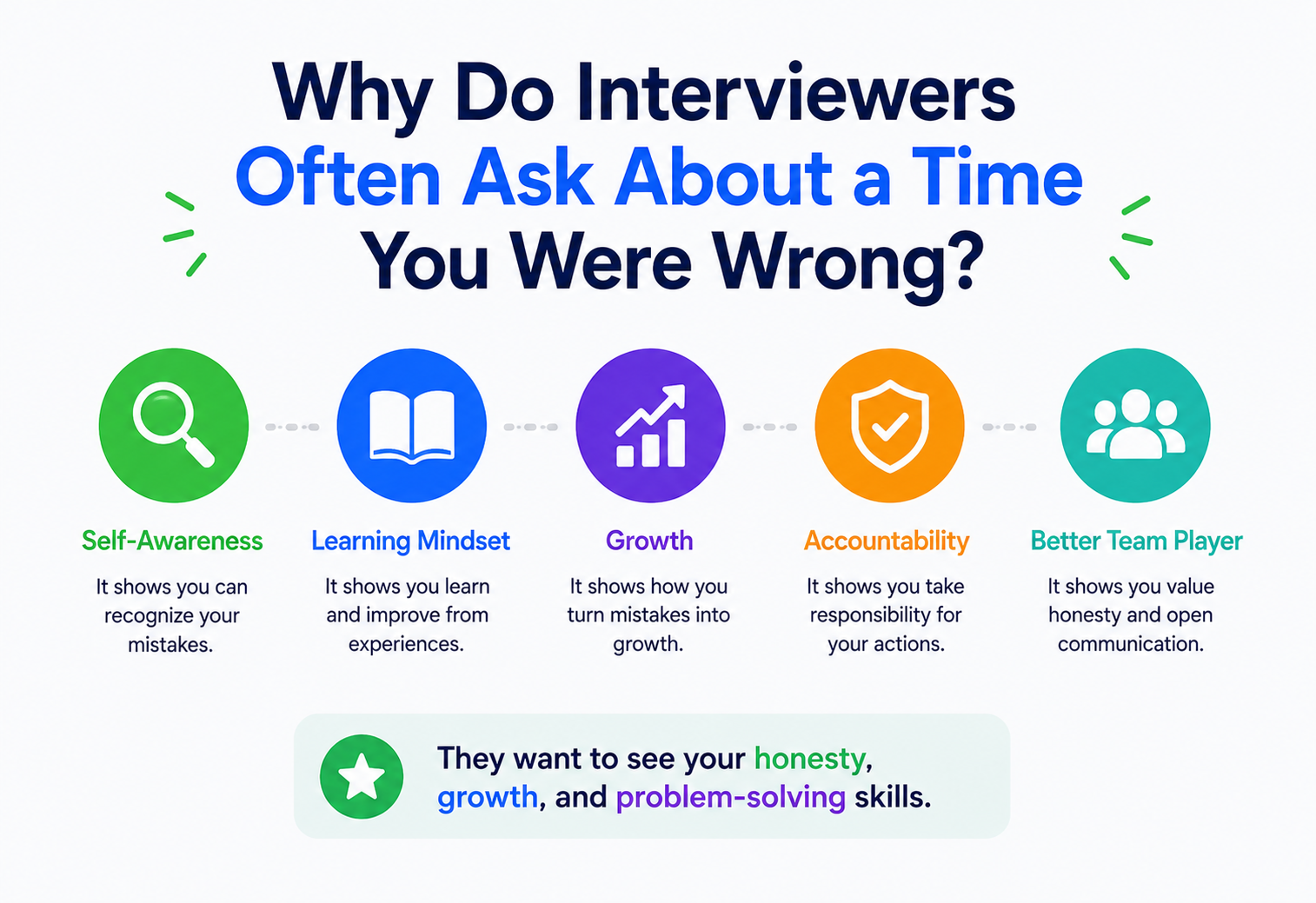
Every behavioural question is secretly mapped to a specific competency the company cares about — ownership, conflict resolution, dealing with ambiguity, customer obsession, bias for action, and so on. “Tell me about a time you disagreed with your manager” is not really about the disagreement itself; it is a proxy for testing whether you can advocate for a position respectfully and effectively. Interviewers are listening for evidence of the underlying competency, not just an interesting anecdote.
5.2 The scoring rubric
Many structured interview processes use an explicit rubric, often scoring a candidate’s answer on a scale (commonly 1 to 4 or 1 to 5) against specific, predefined behavioural indicators for that competency — phrases like “took initiative without being asked” or “considered multiple options before acting” that the interviewer is trained to listen for and check off. A candidate has no way of seeing this rubric, but understanding that it exists explains why specificity and concrete decision-making detail in the Action section score so much higher than vague activity descriptions — the interviewer is often literally trying to find a sentence in your answer that matches a bullet point on their rubric.
5.3 The note-taking behaviour
Interviewers are typically writing notes throughout your answer, and the structure of STAR is what makes those notes possible. A well-organised answer lets the interviewer jot down “S: pricing change, no notice, 40% ticket spike / T: support lead, reduce churn / A: prioritised top 2 issues, fast-tracked FAQ approval, proposed loyalty discount / R: -60% tickets in 3 days, retained accounts” almost verbatim as you speak — because your structure mirrors the structure they need for their own evaluation. A rambling answer forces the interviewer to do the structuring work themselves, after the fact, which is both harder for them and more likely to lose the details that would have helped you.
5.4 Follow-up probing
Skilled interviewers frequently probe deeper into the Action section specifically — “why did you choose that approach over the alternative?” or “how did your manager react when you pushed back?” This is precisely why the Action section deserves the most preparation: it is the part most likely to be interactively tested, not just passively listened to.
Your job is not just to tell a nice story — it is to make the interviewer’s scoring job easy by clearly signalling which sentence maps to Situation, which to Task, which to each discrete action, and which to the measurable result, so nothing you say gets lost or misattributed in their notes.
Data Flow & Lifecycle — Prepare, Practise, Deliver, Refine
A strong STAR answer does not appear spontaneously in the interview room — it moves through a lifecycle, much like any other piece of prepared communication, and skipping stages is the most common reason otherwise-qualified candidates underperform in behavioural rounds.
6.1 Stage 1 — gathering raw material
Before writing a single polished answer, the candidate should brainstorm a broad set of real past experiences — ideally 8 to 12 — spanning different competencies: a time you led something, a time you failed, a time you resolved conflict, a time you dealt with ambiguity, a time you went above and beyond. At this stage, messy bullet points are fine; polish comes later.
6.2 Stage 2 — mapping stories to likely competencies
Each raw story is then mapped against the competencies commonly tested by the target company or role (many companies, like Amazon, publish their competencies — its Leadership Principles — directly, making this mapping straightforward). A single strong story often maps cleanly to two or three different competencies depending on which part of it is emphasised.
6.3 Stage 3 — drafting the STAR structure
Each selected story is deliberately broken into its S, T, A, and R components, written out in full sentences — not to be memorised word for word, but to ensure every beat is genuinely present and none is accidentally skipped.
6.4 Stage 4 — practising aloud, not just reading silently
This stage is frequently skipped and is arguably the most important. A story that reads well on paper often runs long, rambles, or loses its structure when spoken aloud under mild pressure. Practising out loud — ideally timed, ideally in front of another person or a recording — surfaces these problems before the real interview does.
6.5 Stage 5 — delivering in the interview
During the actual interview, the candidate listens carefully to which competency the question is really testing, selects the best-matching prepared story (adapting emphasis as needed), and delivers it — ideally sounding natural and conversational rather than robotically memorised.
6.6 Stage 6 — refining after each interview
After each real interview (or mock interview), the candidate should note which stories felt strong, which fell flat, which follow-up questions came up, and revise the story bank accordingly — treating the story bank as a living document that improves over an entire job search, not a one-time exercise.
6.7 Stage 7 — rehearsing with a second person
Practising aloud alone catches pacing and structural problems, but a mock interview with a real second person — a friend, mentor, or professional coach — catches a different, equally important class of problem: whether the story actually lands the way the candidate thinks it does. A common discovery in this stage is that a detail the candidate considered minor turns out to be the most interesting part of the story to an outside listener, or conversely, that a section the candidate assumed was compelling is actually confusing without context only the candidate has in their head. This outside perspective is difficult to fully replace with solo practice, no matter how much of it a candidate does.
Candidates frequently believe they have “prepared” because they have thought about a few stories in their head, without ever writing them down in full STAR form or practising them aloud. This is the interview equivalent of feeling like you understand a topic because you have read about it, without ever testing that understanding by actually explaining it to someone else — the gap between the two only becomes visible under real pressure, which is exactly the worst time to discover it.
Advantages, Disadvantages & Trade-offs
Every technique has a shape it fits well and a shape it fits badly. STAR is no different — understanding both sides makes it far easier to use the framework as a lens rather than a straitjacket.
7.1 Advantages
- Gives structure under pressure. A memorised shape to fall back on prevents rambling or freezing when nerves are high.
- Forces genuine specificity. The framework naturally pushes a candidate away from vague self-description and toward a real, checkable example.
- Matches how interviewers actually take notes and score. As discussed in Section 5, it directly mirrors the mental (or literal) rubric being applied on the other side of the table.
- Reusable across many questions. A well-built story bank (Section 8) can answer dozens of different behavioural questions with only minor adaptation.
- Transfers beyond interviews. The same structure sharpens how someone writes a performance review self-assessment, a promotion packet, or even a project retrospective.
7.2 Disadvantages
- Can sound rehearsed or robotic if over-memorised word-for-word rather than internalised as a flexible shape.
- Risk of sounding formulaic to experienced interviewers who hear the same structural cadence dozens of times a week — meaning delivery and genuine detail matter as much as structure.
- Not every question fits cleanly. Some questions ask for a philosophy or opinion (“how do you handle prioritisation in general?”) rather than a specific past story, and forcing a STAR answer onto these can feel unnatural.
- Requires real preparation time. Unlike a general answer improvised on the spot, a genuinely strong STAR answer usually cannot be produced well without prior thought — it rewards preparation more than pure spontaneity.
7.3 Trade-offs to weigh deliberately
| Trade-off | More structure / more rehearsed | More spontaneous / less rehearsed |
|---|---|---|
| Consistency under pressure | High — hard to derail once the shape is internalised | Lower — easier to ramble or freeze |
| Naturalness of delivery | Risk of sounding scripted if over-memorised | Feels more conversational, but riskier |
| Preparation time required | Significant, up front | Minimal, but shifts risk into the interview itself |
The best outcome in practice is a middle position: internalise the shape of each story deeply enough to deliver it fluidly and adapt it live, without memorising the exact wording so tightly that it sounds like a recitation.
7.4 The trade-off between honesty and polish
A subtler trade-off worth naming directly: heavy polishing of a story — smoothing out awkward details, tidying up a messy real outcome into a cleaner narrative — can make an answer sound more impressive, but it also raises the risk of the story no longer matching reality closely enough to survive a skeptical follow-up question. Experienced interviewers are often specifically trained to probe stories that sound “too clean,” asking pointed questions precisely to test whether the polish is covering up an answer with no real substance underneath. The candidates who fare best under this kind of probing are usually the ones who polished their story’s clarity — the structure, the pacing, the specific numbers — without polishing away the genuine, sometimes messy, human details that make a real story survive scrutiny: the wrong turn taken before the right one, the colleague who pushed back, the version of the plan that did not work the first time.
Performance & Scalability — Building a Story Bank
“Performance” here means how quickly and effectively a candidate can produce a strong answer to any behavioural question thrown at them, and “scalability” means how well their preparation holds up across an entire job search involving dozens of interviews, multiple companies, and many different competencies — rather than just one lucky, well-rehearsed answer.
8.1 The story bank concept
Rather than preparing a separate story for every conceivable question (an impossible, unscalable task, since companies can phrase the same underlying competency in dozens of different ways), experienced candidates build a compact story bank of 8 to 12 well-developed stories, each mapped to two or three competencies it can flexibly serve. A single strong story about resolving a vendor disagreement might answer “tell me about a conflict,” “tell me about a time you influenced without authority,” and “tell me about a time you made a decision with incomplete information,” depending on which part of the story is emphasised.
8.2 Scaling across seniority levels
The same underlying story often needs to be told differently depending on the seniority of the role being interviewed for. A junior candidate might emphasise the specific technical or tactical action taken; a senior or manager-level candidate answering a similar question might instead emphasise how they influenced a team, made a judgment call under ambiguity, or balanced competing stakeholder needs — even if drawing on a similar underlying experience. Scaling a story bank well means having, for each core story, a clear sense of which details to foreground for which level of seniority.
8.3 Scaling across company cultures
Different companies emphasise different competencies (Amazon’s Leadership Principles, Google’s structured “Googleyness” and general cognitive ability assessments, a consulting firm’s emphasis on structured problem-solving). A scalable story bank includes a short mapping — sometimes literally a spreadsheet — of “which of my stories best demonstrates this specific company’s stated values,” so preparation for a new company is a matter of remapping existing stories rather than starting from zero each time.
A story bank works like a musician’s setlist of well-rehearsed songs rather than a single memorised speech: a skilled performer does not write a brand-new song for every single audience request — they have a repertoire, deeply practised, that can be reordered, re-emphasised, or lightly adapted on the spot to fit whatever the room actually asks for.
8.4 Time-boxing as a performance discipline
A frequently overlooked “performance” dimension is simply pacing: a strong STAR answer typically fits in 90 seconds to 3 minutes. Candidates who never time their practice answers routinely discover, only in the real interview, that their story runs 6 or 7 minutes — eating into the interviewer’s time for follow-up questions and other prepared questions, which can itself hurt the overall interview score regardless of the story’s quality.
8.5 Building a practical story-bank reference sheet
The most scalable version of a story bank is not just a set of written-out stories — it is a compact reference table a candidate can mentally scan in the seconds after a question is asked, before choosing which story to tell. A simple two-column structure works well: one column listing each story by a short memorable name (“the pricing-change FAQ,” “the vendor disagreement,” “the missed deadline”), and a second column listing every competency and common question phrasing that story could plausibly answer. Built well, this table turns “which story should I use for this question?” from a moment of on-the-spot panic into a quick, almost automatic lookup — freeing up mental bandwidth to focus on delivery and adaptation rather than recall.
| Story (short name) | Primary competency | Also answers |
|---|---|---|
| The pricing-change FAQ | Customer focus under pressure | Bias for action; working with legal / cross-functional teams |
| The vendor disagreement | Conflict resolution | Influencing without authority; disagree and commit |
| The missed deadline | Ownership of failure | Learning from mistakes; prioritisation under pressure |
| The onboarding redesign | Initiative / going above and beyond | Data-driven decision-making; measuring impact |
8.6 Refreshing the story bank over a long job search
A job search can stretch across many months, and a story bank built once at the very start risks going stale in two specific ways: the stories themselves age (a two-year-old example starts to feel less current, especially for fast-moving roles), and the candidate’s own understanding of which stories land well improves with practice. Reviewing and lightly refreshing the story bank every few weeks — swapping in a more recent example, sharpening a result that tested poorly in a real interview, retiring a story that consistently confused interviewers — keeps the whole system scaling gracefully across a long search rather than degrading the further it goes.
Design Patterns & Anti-Patterns
The small vocabulary of recurring patterns below is what turns a mechanically correct STAR answer into a memorable one — and the matching set of anti-patterns is what quietly sinks otherwise-strong candidates.
9.1 Good patterns
Pattern: the specific number
Whenever possible, replace a vague result (“it went well,” “the client was happy”) with a specific, even approximate, number (“support tickets dropped by roughly 60% within three days”). Numbers are memorable, checkable-feeling, and far more persuasive than adjectives.
Pattern: the “instead of” decision point
Explicitly naming a road not taken — “I decided to fast-track the FAQ instead of waiting for the standard multi-day legal review, because…” — is one of the highest-value sentences in any STAR answer, because it is the clearest possible window into a candidate’s actual judgment and reasoning process, not just their activity.
Pattern: the callback
Ending a story with a detail that connects back to a broader, lasting impact — a process that is still used today, a relationship that is still strong, a lesson explicitly applied again later — signals that the result was not a one-off fluke but had lasting value.
9.2 Anti-patterns to avoid
As discussed in Section 2, a story told entirely in terms of what “the team” or “we” did, with no clear sentence about the candidate’s own specific individual contribution, fails to answer the actual question being asked.
A story that ends on the action (“…and then I sent the proposal to my manager”) without ever stating what actually happened leaves the interviewer to assume the best or the worst — never a good position to leave an evaluator in.
When asked “tell me about a failure,” answering with something that is secretly a strength (“I just work too hard and sometimes forget to eat lunch”) is a well-known, heavily penalised pattern that experienced interviewers recognise immediately and read as a lack of genuine self-reflection.
Spending two of your three available minutes explaining company background and org structure before ever getting to what you actually did leaves too little time for the Action section — the part actually being evaluated.
Preparing stories that are technically accurate but emotionally flat or low-stakes — “I once had to reformat a spreadsheet under a tight deadline” rarely showcases meaningful judgment, conflict, or growth. The strongest stories usually involve genuine tension: a real disagreement, a real risk, a real ambiguity — not just a busy day.
9.3 Pattern: matching story stakes to seniority
A related, more advanced pattern involves deliberately choosing stories whose scale and stakes match the seniority of the role being interviewed for. A candidate interviewing for an individual-contributor role can tell a strong story about a specific technical decision or a disagreement with one colleague. A candidate interviewing for a senior manager or director-level role is generally expected to demonstrate judgment at a broader scale — influencing multiple teams, navigating a cross-functional disagreement involving several stakeholders, or making a call whose consequences played out over months rather than days. Telling an entry-level-scale story in a senior-level interview, even if it is well-structured, can unintentionally signal a mismatch between the candidate’s actual experience and the scope of the role, regardless of how polished the STAR delivery is.

9.4 Anti-pattern: outsourcing the climax to someone else
A subtler version of the “we” anti-pattern happens even in stories that otherwise sound individually focused: the story builds up real tension, but then the actual turning point — the clever idea, the persuasive argument, the key decision — is credited to a manager, a mentor, or a teammate, with the candidate cast mainly as the person who “helped implement” someone else’s insight. This can happen unintentionally, out of genuine modesty, but it quietly undermines the entire purpose of the Action section, which exists specifically to reveal the candidate’s own judgment. A useful gut check while drafting a story: if you removed yourself entirely from this story, would the outcome have unfolded any differently? If the honest answer is “probably not,” the story likely needs a different climax — or a different candidate-centred detail needs to be surfaced and emphasised.
Best Practices & Common Mistakes
A short, tactical checklist of what to do — and what to avoid — when actually using STAR in the moments before, during, and after a real interview.
10.1 Best practices
- Prepare a written story bank in advance, not just mental notes — writing forces you to notice missing beats.
- Practise aloud and time yourself, ideally recording it once to hear how it actually sounds, not just how it feels in your head.
- Lead with a strong opening sentence that orients the interviewer immediately, rather than building up slowly.
- Quantify the result whenever genuinely possible, even with an approximate or relative number rather than a precise one.
- Listen for the real competency behind the question and select the story from your bank that best matches it, rather than always reaching for your favourite story regardless of fit.
- Prepare for the natural follow-up questions an interviewer is likely to ask about your Action section, since this is where probing most often happens.
10.2 Common mistakes
- Memorising word-for-word instead of internalising the shape, leading to a stiff, unnatural delivery or visible panic if interrupted.
- Choosing a story where the candidate was not really the primary actor, even if it is tempting because the overall outcome was impressive.
- Failing to adapt a prepared story to the specific question asked, instead forcing an ill-fitting story because it is the only one that is rehearsed.
- Not preparing enough distinct stories, leading to reusing the same one repeatedly across a single interview loop, which interviewers on a shared panel will notice and penalise.
- Neglecting negative or failure-oriented questions during preparation, then panicking when asked “tell me about a time you failed” without a ready, honest example.
After building your initial story bank, deliberately test it against a broad list of common behavioural prompts — leadership, conflict, failure, ambiguity, going above and beyond, disagreeing with authority, prioritisation under pressure — and confirm each prompt has at least one strong, ready story mapped to it, rather than discovering a gap live in an interview.
10.3 Adapting STAR for remote and virtual interviews
Delivering a STAR answer over video introduces a few practical wrinkles worth preparing for directly. Small delays and occasional audio lag can make natural pauses — like the deliberate pause between Situation and Task described in Section 4 — feel awkward or get misread as the candidate finishing their answer early, so slightly clearer verbal signposting (“so, moving on to what I actually did…”) becomes more useful in a virtual setting than it might be in person. It is also worth keeping a short, private outline of story names and their key beats visible just off-camera — not to read from verbatim, which tends to sound stilted, but as a quiet safety net for recalling which story fits which competency without the added pressure of holding an entire story bank in working memory during a live call.
10.4 Adapting STAR for written interview formats
Some hiring processes, particularly at larger companies with early-stage screening, ask candidates to answer behavioural questions in writing rather than aloud — through an online application form or a written assessment. The same STAR structure applies, but the medium shifts what “good” looks like: a written answer can be edited and tightened before submission in a way a spoken answer cannot, so there is little excuse for a written STAR response to run long, ramble, or omit a clear, quantified result. Candidates preparing for written behavioural assessments benefit from treating their story bank drafts, described in Section 6, as close to submission-ready text rather than just speaking notes.
Real-World Industry Examples
The STAR method is not just interview advice — it is baked directly into how many of the largest and most demanding organisations in the world actually design and score their interviews.
11.1 Amazon
Amazon is perhaps the most well-known example of a company building its entire interview process explicitly around behavioural questions mapped to a published set of competencies — its 16 Leadership Principles, such as “Customer Obsession,” “Ownership,” “Bias for Action,” and “Disagree and Commit.” Amazon interviewers are trained to ask “tell me about a time when…” questions tied directly to specific principles and to score candidates using a structured rubric very similar to the one described in Section 5 — making Amazon interviews one of the clearest real-world proofs that the STAR method is not just interview advice, but a direct mirror of how a major company’s hiring process is actually built and scored.
11.2 Google
Google’s interview process similarly includes dedicated “Googleyness and leadership” behavioural rounds alongside its well-known technical and problem-solving interviews, explicitly assessing collaboration, comfort with ambiguity, and general conduct through past-experience questions, using structured interviewer guides to keep scoring consistent across a large, distributed interviewer pool.
11.3 Management consulting firms
Firms like McKinsey, Bain, and BCG traditionally split their interviews into a case-study component (testing structured problem-solving) and a “fit” or “personal experience” component that is almost entirely behavioural — asking candidates to walk through real past leadership, teamwork, and challenge experiences using exactly the kind of structured storytelling STAR describes, since consulting work itself depends heavily on being able to communicate complex situations clearly and concisely to clients.
11.4 Healthcare and clinical hiring
Behavioural interviewing, including STAR-style structured answers, has also become standard well beyond the technology sector — hospitals and healthcare systems widely use behavioural questions to assess how clinical staff have handled high-stakes situations (a disagreement with a colleague over patient care, a time protocol had to be adapted under pressure), reflecting how broadly applicable the underlying idea is: real past behaviour, told with structure, predicts future behaviour far better than a general self-assessment.
11.5 Startups and fast-growing companies
Smaller, fast-growing companies without large dedicated recruiting teams often adopt behavioural interviewing informally, without a published competency list or a formal rubric, simply because a hiring manager intuitively wants to know “has this person actually done something like what we need before, and how did they handle it?” In these settings, a candidate’s ability to bring their own structure to the conversation matters even more, since there is no interviewer training or rubric doing any of the organising work on the other side of the table — a well-told STAR answer can single-handedly carry the entire signal of the interview.
Every one of these organisations, from a tech giant to a hospital system to an early-stage startup, converged on the same underlying insight: asking someone to describe a real, specific, structured past experience reveals far more reliable signal about their future behaviour than asking them to describe themselves in the abstract.
Frequently Asked Questions
The questions candidates most often ask once they have understood the shape of STAR but are figuring out how to apply it inside a real interview loop.
How long should a STAR answer actually take to deliver?
Most well-structured STAR answers run 90 seconds to 3 minutes when spoken aloud at a natural pace. Shorter risks feeling thin on detail; much longer risks losing the interviewer’s attention and eating into time for follow-up questions.
What if I genuinely cannot think of a real example for a question?
It is reasonable to ask for a brief moment to think, or to say, “let me think of the best example for that” rather than forcing an ill-fitting story. If truly nothing directly fits, the next best option is choosing your closest available example and being honest about the difference — interviewers generally respect honesty over a strained, unconvincing stretch.
Is it okay to use the same story for multiple questions in one interview loop?
Occasionally unavoidable, but risky — many companies debrief interviewers together after a loop, and a candidate who tells the identical story to three different interviewers can come across as having a very shallow well of experience. A story bank of 8 to 12 distinct stories, as discussed in Section 8, exists specifically to avoid this.
Should I mention teamwork at all, or focus purely on myself?
Acknowledging real collaborators is fine and often adds credibility — but the Action section should always make clear which specific pieces you personally drove, decided, or executed, rather than blending your contribution invisibly into a general “we.”
What if the interviewer interrupts my story with a follow-up question partway through?
This is common and not a bad sign — it often means the interviewer is genuinely engaged and probing for more detail, exactly as described in Section 5. Answer the follow-up directly and specifically, then return to finishing your original structure (particularly the Result, if you had not reached it yet) rather than abandoning the story’s shape entirely.
Do I need a different story for every single possible behavioural question?
No — this is precisely what the story bank approach in Section 8 avoids. A well-chosen set of 8 to 12 richly detailed stories, each flexible enough to be told with different emphasis, can realistically cover the vast majority of behavioural questions across most interview loops.
Is it a problem if my best example happened a long time ago, or during a school project rather than a job?
Not inherently. Interviewers generally care far more about the quality, specificity, and relevance of the judgment shown in a story than about exactly how recent it is or whether it happened in a paid role, an internship, a school project, or a volunteer position. That said, when a candidate has more recent, professionally relevant examples available, using those tends to feel more credible for assessing current-level competency — so an older or non-professional story is often best reserved for competencies where no stronger, more recent example exists.
What is the difference between STAR and the similar-sounding CAR or SOAR frameworks?
CAR (Context, Action, Result) is essentially a compressed version of STAR that merges Situation and Task into a single “Context” beat, useful for shorter answers or written formats with tight word limits. SOAR (Situation, Obstacle, Action, Result) adds an explicit “Obstacle” beat to draw out what specifically made the situation challenging, which can help candidates who tend to under-explain the stakes of their story. All of these frameworks share the same underlying goal described throughout this guide — they differ mainly in how finely they subdivide the setup versus the outcome, not in their fundamental approach.
Summary & Key Takeaways
The STAR method endures, decades after its origins in behavioural-psychology research, because it solves a problem that has not gone away: real human judgment is best revealed not by asking someone to describe themselves in the abstract, but by asking them to walk through a specific, real moment where that judgment was actually tested — and giving them a clear, simple structure so that story can be told well, under pressure, in a way the person listening can actually evaluate.
Key takeaways
- STAR stands for Situation, Task, Action, Result — a four-part structure for answering “tell me about a time when…” questions with a real, specific, evaluable story.
- The Action section deserves the majority of your time and preparation, since it is what actually reveals your individual judgment and is most likely to be probed with follow-up questions.
- Interviewers are typically scoring your answer against a specific competency and, often, a structured rubric — understanding this shapes exactly what to emphasise.
- A reusable story bank of 8 to 12 well-developed stories, each mapped to multiple competencies, scales far better across a real job search than preparing a new answer for every conceivable question.
- The best delivery internalises the shape of each story deeply enough to sound natural, without memorising it so rigidly that it sounds recited.
- From Amazon’s Leadership Principles to hospital hiring panels, organisations across every industry have converged on the same underlying idea: structured, specific, real stories are simply better evidence of future behaviour than general self-description.
The next time you are asked “tell me about a time when…,” the difference between a forgettable answer and a genuinely memorable one very often comes down to nothing more than four familiar letters, prepared in advance and delivered with real, specific detail.
Whether you are a new graduate walking into your first real interview loop or a seasoned executive preparing for a board-level conversation, the underlying discipline is the same: think through your real experiences in advance, structure them honestly, and practise saying them out loud until the shape feels natural rather than rehearsed. That preparation is almost entirely within your control, unlike the specific questions you will be asked or the mood of the person across the table — which is exactly why it deserves real, deliberate time before any interview that matters to you.
It is worth remembering, too, that the STAR method is ultimately a communication tool, not a test of memorisation or performance. Its entire purpose is to help a real, capable person show an interviewer what they are actually capable of, as clearly and honestly as possible, in a format that fits the constraints of a short conversation between two people who have never met before. Candidates who internalise this — who treat STAR as a lens for clarity rather than a script to be recited — tend to sound more natural, more confident, and ultimately more convincing than those who treat it as a rigid formula to be filled in mechanically. The four letters are a means to an end: helping your real experience speak for itself, as clearly as it deserves to.