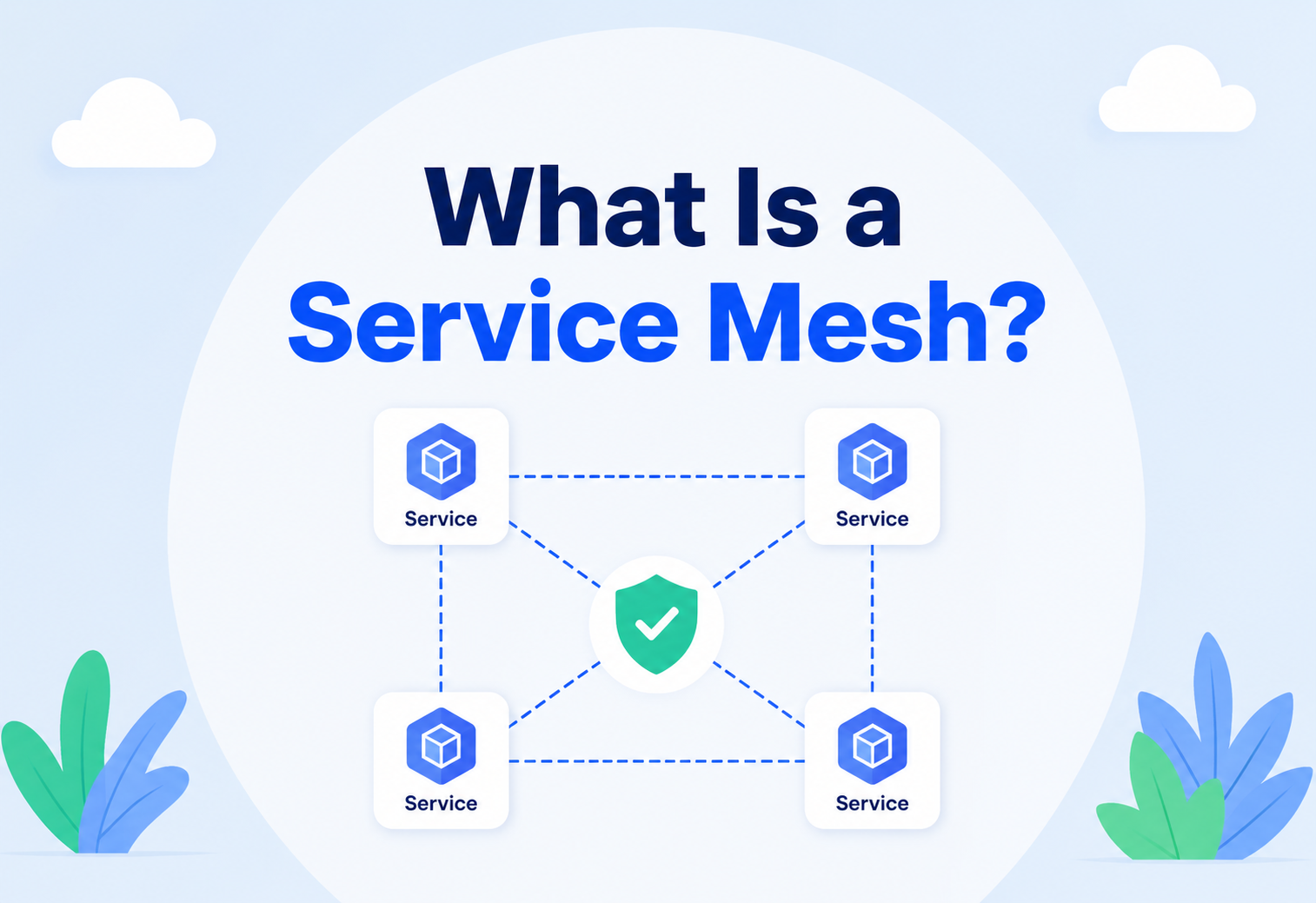
What Is a Service Mesh?
A complete, beginner-to-production walkthrough of one of the most important ideas in modern backend engineering — explained with plain-English analogies, real diagrams, Java code, and the same patterns used inside Netflix, Uber, Google, and Amazon.
Introduction & History
Where the idea of a “service mesh” came from, and why it had to be invented.
Imagine a school with just one classroom and one teacher. If a student needs help, they simply raise a hand and the teacher answers. Easy. Now imagine that school grows into a huge campus with 500 classrooms, and every classroom needs to constantly talk to twenty other classrooms — asking questions, sending notes, borrowing books. Very quickly, the hallways get chaotic. Notes get lost. Some classrooms are slow to reply. Some rooms are on fire (figuratively) and nobody notices until the whole floor is affected.
That is almost exactly what happened to software. In the beginning, applications were built as one single large program — this style is called a monolith. A monolith is one big classroom: everything lives in one place, so talking to “another part of the program” is just a regular function call inside the same process. Simple, but as the application grows, the monolith becomes slow to build, scary to deploy, and hard for many teams to work on at once.
To fix this, companies split their monolith into many small, independent programs called microservices — one service for “user accounts,” one for “payments,” one for “search,” and so on. Each microservice runs on its own, usually inside a lightweight container, and they talk to each other over the network instead of through simple in‑memory function calls. This solved the “one giant classroom” problem, but it created the “500 classrooms shouting across hallways” problem instead.
Analogy: from one big office to a city of small offices
A monolith is like one giant office building where every department sits in the same open floor — you just shout across the room to talk to Sales. Microservices are like tearing that building apart and scattering each department into its own small office across the city. Now, every conversation between departments needs a phone call, a courier, a working phone line, and some way to know which building the other department even moved into. A service mesh is the city’s private phone and courier network built specifically for these offices — reliable, secure, and monitored — so no department has to build its own postal service from scratch.
1.1 A short history: how we got here
Understanding the timeline helps the ideas click into place:
| Era | What was happening | Why it matters for service mesh |
|---|---|---|
| 2000s — the monolith era | Most applications shipped as single large deployable units. | Networking concerns barely existed inside an app because there was almost no “inside-app” networking to begin with. |
| Early 2010s — the microservices wave | Netflix, Amazon, and others broke huge systems into small, independently deployed services. | Netflix built libraries like Hystrix (circuit breaking), Ribbon (client-side load balancing), and Eureka (service discovery). Powerful, but every team, in every language, had to import and configure them. |
| 2016 — the sidecar idea matures | Engineers at Lyft built Envoy Proxy: a small, fast network proxy that sits next to each service. | For the first time, retries, timeouts, load balancing, and security could live entirely outside the application code — in a language-independent way. |
| 2017 — term coined, Istio ships | Google, IBM, and Lyft released Istio, layering a centralized control plane on top of a fleet of Envoy sidecars. | One dashboard, one policy language, one CA — for every microservice in the fleet. Linkerd (from Twitter/Buoyant) matured in parallel as a lighter alternative. |
| 2020s — mesh goes mainstream | Kubernetes becomes the default home for microservices; service mesh becomes an expected companion. | Newer designs like Istio Ambient Mesh and Cilium (eBPF-based) emerge to remove the “one sidecar per service” tax, moving mesh logic closer to the kernel for lower overhead. |
In one sentence
A service mesh is a dedicated, transparent infrastructure layer that manages all the network communication between microservices — handling retries, security, traffic routing, and visibility — without requiring the services themselves to write that logic.
The Problem & Motivation
Why does this problem exist at all, and why can’t we just “write good code” to fix it?
Picture a food delivery app split into microservices: OrderService, PaymentService, InventoryService, NotificationService, and DeliveryService. When a customer places an order, these five services must talk to each other over the network in the right sequence. Now ask yourself: what could possibly go wrong?
- PaymentService is slow today. Should OrderService wait forever? Retry? Give up after 2 seconds?
- InventoryService crashed for 10 seconds. Should every other service that calls it also crash, like dominoes falling?
- An attacker gets into the internal network. Can they now read raw, unencrypted traffic between DeliveryService and NotificationService?
- DeliveryService has 40 running copies for scale. How does OrderService know which of the 40 copies is healthy and least busy right now?
- Nobody can explain why an order took 9 seconds. Which of the five services was the slow one? Nobody knows, because there is no shared way to trace a request across all five.
Before service mesh existed, every team solved these problems by writing the same networking code — retry logic, timeouts, encryption, load balancing, logging — again and again, inside every single microservice, often in a different programming language each time. This is called cross-cutting concern duplication, and it is expensive, error-prone, and inconsistent (one team’s retry logic might be buggy while another team forgot to add it entirely).
Beginner example: retry logic scattered everywhere
Imagine 30 microservices, each written by a different small team. If every team hand-writes their own “retry 3 times if the network call fails” code, you now have 30 slightly different implementations of the same idea. Some retry too aggressively and overload a struggling service even further (making the outage worse). Some don’t retry at all. A service mesh replaces all 30 of those custom implementations with a single, consistent, centrally-configured retry policy that lives outside the application entirely.
2.1 Why can’t application code just “handle it well”?
It can — and for a long time, that is exactly what libraries like Netflix’s Hystrix and Ribbon did. But this approach has three structural weaknesses:
- Language lock-in. A retry/circuit-breaker library written in Java cannot be reused by a service written in Python or Go. Every language needs its own re-implementation.
- Coupling of business logic and networking logic. Developers writing “calculate the order total” should not also need to be experts in TLS certificates and exponential backoff algorithms.
- No fleet-wide visibility or control. Even if every service has good retry logic, there is no single place to say “reduce all timeouts to 500ms for the next hour” during an incident — you would need to redeploy dozens of services.
The service mesh’s core motivation is to move all of this “how do services talk to each other safely and reliably” logic out of application code and into infrastructure — a separate, dedicated layer that every microservice automatically benefits from, in any language, without rewriting a single line of business logic.
Core Concepts
The vocabulary you need before anything else makes sense. Read this section slowly.
3.1 Microservice
What it is: A small, independently deployable program that does one job well (e.g., “manage user accounts”) and talks to other microservices over the network, usually using HTTP or gRPC.
Why it exists: So different teams can build, test, deploy, and scale their part of a system independently, without waiting for everyone else.
Simple analogy: One employee in a company who has one clear job — the receptionist only answers phones and directs calls; they don’t also do the company’s accounting.
3.2 Sidecar Proxy
What it is: A small helper program that runs right next to each microservice (usually in the same Kubernetes Pod) and intercepts every bit of network traffic going in or out of that microservice. The most popular sidecar proxy is called Envoy.
Why it exists: So the microservice itself never has to deal with retries, encryption, or load balancing directly — the sidecar quietly does it on the microservice’s behalf.
Simple analogy: Think of a famous singer who never talks to the press directly. Instead, a personal assistant stands right next to them, handles every journalist’s question, decides which questions get answered, translates languages, and keeps a record of every conversation. The singer just focuses on singing. The sidecar is that assistant, standing right next to every microservice.
Practical example: When OrderService wants to call PaymentService, it doesn’t even know a mesh exists. It just makes a normal network call to localhost. Its sidecar quietly intercepts that call, decides the safest and fastest real destination, encrypts it, sends it, retries if needed, and returns the result — completely invisibly.
3.3 Data Plane
What it is: The collection of all sidecar proxies across the whole system, working together to actually move and manage every request.
Why it exists: This is the layer that does the real, moment-to-moment work: forwarding packets, encrypting connections, load balancing, retrying failed calls.
Simple analogy: If the mesh were a city’s postal system, the data plane is every delivery truck and courier actually driving around delivering letters right now.
3.4 Control Plane
What it is: The “brain” of the mesh — a central set of components that decide the rules (which service can talk to which, what security certificates to use, what percentage of traffic goes to a new version) and push those rules down to every sidecar proxy.
Why it exists: Someone has to tell all those thousands of couriers (sidecars) what the current delivery rules are, keep those rules updated, and issue them ID badges (security certificates).
Simple analogy: The postal service’s head office, which decides delivery routes, prints ID badges for couriers, and publishes the rulebook — while never delivering a single letter itself.
3.5 mTLS (Mutual Transport Layer Security)
What it is: A way for two services to prove their identity to each other and encrypt their conversation, using digital certificates on both sides (normal HTTPS on the web usually only proves the server’s identity to your browser, not the other way around).
Why it exists: So that even if an attacker gets inside the internal network, they cannot read traffic or pretend to be a trusted service — every service mutually checks the other’s ID badge before talking.
Simple analogy: Two secret agents meeting in person, where both must show a verified ID badge to each other before either will say a single word — not just one showing a badge to the other.
3.6 Service Discovery
What it is: A live, constantly updated directory of every running instance of every microservice — including its network address and health status.
Why it exists: Microservice instances come and go constantly (scaling up, scaling down, crashing, restarting). Nobody can hardcode IP addresses; there must be a live phonebook.
Simple analogy: A hotel’s front desk that always knows exactly which guests are checked into which room right now, even though guests check in and out all day long.
3.7 Load Balancing
What it is: Spreading incoming requests across multiple healthy instances of a service, instead of hammering just one instance.
Why it exists: To avoid overloading a single instance and to keep response times fast and even.
Simple analogy: A supermarket manager who opens a new checkout counter and directs the next customer there, instead of letting one line grow to 40 people while others sit empty.
3.8 Circuit Breaker
What it is: A safety mechanism that stops sending requests to a service that is clearly failing, for a short cooldown period, instead of continuing to hammer it and making things worse.
Why it exists: To prevent one struggling service from causing a cascading failure across the whole system (the “dominoes falling” problem).
Simple analogy: A home electrical circuit breaker: if there’s a dangerous overload, it trips and cuts power immediately, rather than letting your house catch fire.
3.9 Retry & Timeout Policy
What it is: Rules that define how many times to retry a failed request, how long to wait between retries, and how long to wait before giving up entirely.
Why it exists: Networks are unreliable. A single dropped packet shouldn’t fail an entire user request if a quick retry would succeed.
Simple analogy: If you call a friend and the call drops, you naturally try calling again once or twice before giving up and texting instead — a sensible, bounded retry.
3.10 Observability (Metrics, Logs, Traces)
What it is: The ability to see, in detail, what is happening inside a running system: numbers over time (metrics), event records (logs), and the full journey of one request across many services (traces).
Why it exists: You cannot fix — or even notice — what you cannot see. In a system with hundreds of microservices, humans need automated visibility.
Simple analogy: An airport’s flight-tracking board (metrics), a black-box flight recorder (logs), and the complete route map of one specific flight from takeoff to landing (a trace).
Architecture & Components
How the pieces from Section 3 fit together into one working system.
A service mesh always has two layers: the data plane (sidecar proxies that move traffic) and the control plane (the brain that configures those proxies). Let’s look at how these connect, using Istio — the most widely adopted mesh — as our running example. Most other meshes (Linkerd, Consul Connect, AWS App Mesh) follow the same two-layer shape.
4.1 Data plane components
| Component | Job | Real example |
|---|---|---|
| Sidecar proxy | Intercepts all in/out traffic for one service instance | Envoy Proxy (used by Istio, AWS App Mesh) |
| Ingress gateway | Front door — controls traffic entering the mesh from outside | Istio Ingress Gateway |
| Egress gateway | Controls and monitors traffic leaving the mesh to the outside world | Istio Egress Gateway |
4.2 Control plane components
| Component | Job | Real example |
|---|---|---|
| Configuration / traffic manager | Converts high-level rules (YAML) into low-level proxy configuration | Istiod (Pilot) |
| Certificate Authority | Issues and rotates short-lived identity certificates to every sidecar for mTLS | Istiod (Citadel function) |
| Policy engine | Enforces access rules — who is allowed to call whom | Istio Authorization Policies |
| Telemetry collector | Gathers metrics / traces from every sidecar for dashboards | Istio Telemetry, Prometheus adapters |
Production example: how Google’s Istio team frames this
Istio deliberately renamed its historically separate control-plane processes (Pilot, Citadel, Galley) into a single unified binary called Istiod starting from Istio 1.5, to reduce operational overhead. This is a good lesson in itself: even mesh vendors constantly work to simplify the very complexity meshes are meant to hide from application teams.
4.3 Sidecar injection
In Kubernetes, sidecars are usually added automatically through a process called sidecar injection. When you deploy a Pod, an admission webhook (a piece of code that Kubernetes calls before finalizing the Pod) automatically adds the Envoy sidecar container into your Pod definition — you never have to add it by hand.
# Simplified example: what a Kubernetes Pod looks like AFTER automatic sidecar injection
apiVersion: v1
kind: Pod
metadata:
  name: order-service
  labels:
    app: order-service
spec:
  containers:
    - name: order-service          # your application container (unchanged)
      image: myregistry/order-service:1.4.0
      ports:
        - containerPort: 8080
    - name: istio-proxy            # automatically injected sidecar
      image: istio/proxyv2:1.22.0
      ports:
        - containerPort: 15001     # intercepts outbound traffic
        - containerPort: 15006     # intercepts inbound traffic
Every network packet leaving or entering the order-service container is silently rerouted through istio-proxy using iptables (Linux packet-routing rules) — the application code is never modified and often doesn’t even know the sidecar exists.
Internal Working
What actually happens, step by step, at the packet level.
Let’s trace exactly what happens when OrderService calls PaymentService inside a mesh:
1. Interception
OrderService’s code makes a totally normal HTTP call tohttp://payment-service. It has no idea a mesh exists. Linux’siptablesrules (installed during sidecar injection) silently redirect this outbound packet to the local Envoy sidecar instead of letting it leave the Pod directly.2. Service discovery lookup
The sidecar asks (or already has cached, pushed from the control plane) the current list of healthy
PaymentServiceinstances and their addresses.3. Load balancing decision
The sidecar picks one healthy instance using a configured algorithm — commonly round robin, least connections, or random with weighting.
4. mTLS handshake
Before any data is sent, the caller’s sidecar and the destination’s sidecar perform a mutual TLS handshake, each proving its cryptographic identity using a short-lived certificate issued minutes earlier by the control plane’s Certificate Authority.
5. Request forwarding with policy applied
The sidecar applies timeout limits, retry budgets, and circuit-breaker rules while forwarding the now-encrypted request across the network to the destination sidecar.
6. Destination-side interception
On the
PaymentServicePod, the inbound sidecar receives the encrypted request, decrypts it, checks authorization policy (“is OrderService allowed to call this endpoint?”), and hands the plain request to the actualPaymentServiceapplication code overlocalhost.7. Telemetry capture
Both sidecars independently record metrics (latency, status code, bytes transferred) and forward trace spans to the observability backend — without either application ever writing logging code for this specific call.
8. Response returns the same way
Back through both sidecars, timing and status recorded again.
5.1 How this looks from the Java developer’s side
This is the most important idea to internalize: application code stays boring and simple. Here is what an engineer actually writes, with or without a mesh underneath:
// OrderService.java - a plain, mesh-unaware REST client call
@Service
public class PaymentClient {

    private final RestTemplate restTemplate;

    public PaymentClient(RestTemplate restTemplate) {
        this.restTemplate = restTemplate;
    }

    public PaymentResult charge(Order order) {
        // Just a normal HTTP call to a logical service name.
        // No retry loop, no manual TLS, no load-balancer code here -
        // the sidecar proxy quietly provides all of that underneath.
        String url = "http://payment-service/api/v1/charge";
        return restTemplate.postForObject(url, order, PaymentResult.class);
    }
}
Before service mesh existed, this same file often looked like this
Developers used to hand-write retry loops, manual circuit breakers (e.g. wrapping calls with Netflix Hystrix’s @HystrixCommand), and manual TLS context setup directly inside business logic classes like PaymentClient. This worked, but it mixed “how do I talk to the network safely” with “what does charging a customer mean” — two very different concerns tangled into one file.
Data Flow & Lifecycle
Following one user click, all the way from browser to database and back.
Let’s follow a real user action: tapping “Place Order” in a food delivery app.
6.1 Lifecycle stages of one request
| Stage | What happens | Mesh responsibility |
|---|---|---|
| 1. Entry | Request enters cluster from the public internet | Ingress gateway applies TLS termination, rate limiting, and initial routing |
| 2. Routing | Order Service call is routed to the right internal service | Sidecar performs service discovery + weighted routing (e.g., 95% to stable version, 5% to canary) |
| 3. Security check | Request crosses a service boundary | mTLS encryption + authorization policy enforcement |
| 4. Resilience | A downstream call is slow or fails | Timeout, retry, and circuit breaker logic applied automatically |
| 5. Observation | Request completes (success or failure) | Metrics, logs, and a distributed trace span are recorded |
| 6. Exit | Notification Service needs to call an external SMS API | Egress gateway monitors and controls traffic leaving the mesh |
Notice something important: at no point in this lifecycle did any application developer write code for encryption, retries, or tracing. Every one of these behaviors is configured once, in YAML, at the mesh level, and applied uniformly to every service automatically — a property called transparency, one of the defining features of a service mesh.
Advantages, Disadvantages & Trade‑offs
A service mesh is powerful, but it is not free. Be honest about both sides.
Advantages
- Uniform security (mTLS everywhere) without touching app code
- Consistent retries, timeouts, and circuit breaking across every language
- Rich, automatic observability — metrics, logs, and traces for free
- Fine-grained traffic control for canary releases and A/B testing
- Centralized policy — change behavior fleet-wide without redeploying services
- Zero-trust network posture becomes achievable at scale
Disadvantages
- Extra latency per hop — typically 1–5 ms added per sidecar traversal
- Higher resource usage — every Pod now runs an extra proxy container
- Real operational complexity — a new system to learn, upgrade, and debug
- Steep learning curve for teams new to Kubernetes-style infrastructure
- Another moving part that itself can fail and needs monitoring
- Overkill for small systems — a handful of services rarely need this
7.1 When you actually need a service mesh
| Situation | Recommendation |
|---|---|
| 2–5 microservices, one team | Skip it. Handle retries/timeouts in a shared library instead. |
| 20+ microservices, multiple teams, multiple languages | Strong candidate. The consistency payoff is large. |
| Strict compliance requirements (finance, healthcare) | Strong candidate — mTLS-everywhere and audit trails are valuable. |
| Frequent canary releases / progressive delivery | Strong candidate — traffic-splitting is a mesh’s specialty. |
| Extremely latency-sensitive systems (sub-millisecond budgets) | Evaluate carefully — sidecar hops add measurable latency. |
The engineering trade-off in one line
A service mesh trades a small amount of latency and operational complexity for a large amount of consistency, security, and visibility across a growing fleet of services. It is a classic case of moving complexity from “many places, done inconsistently” to “one place, done uniformly” — which is usually, but not always, a good trade.
Performance & Scalability
The honest numbers, and how meshes are evolving to reduce their own overhead.
8.1 Latency overhead
Every sidecar hop typically adds somewhere between 1 ms and 5 ms of latency, depending on the proxy implementation, CPU contention, and whether mTLS handshakes are being newly established or reused from a cached connection pool. For a request that crosses four services (client → gateway → service A → service B), you could see roughly 4–8 sidecar hops in total (in and out of each Pod), adding a cumulative few milliseconds — usually acceptable for typical web and mobile applications, but worth measuring for latency-critical paths like real-time bidding or high-frequency trading systems.
8.2 Resource overhead
Each sidecar proxy consumes its own CPU and memory — commonly in the range of tens to a few hundred MB of RAM and a fraction of a CPU core per instance, though this varies heavily by proxy and traffic volume. At the scale of thousands of Pods, this adds up to a real and budgetable infrastructure cost, which platform teams must account for.
8.3 How the industry is reducing this overhead
| Approach | Idea |
|---|---|
| Lightweight proxies (Linkerd’s micro-proxy) | Purpose-built, minimal proxy written in Rust for lower memory/CPU footprint than general-purpose Envoy. |
| Ambient mesh (Istio Ambient) | Removes the per-Pod sidecar entirely; shared per-node proxies handle mTLS, with per-namespace proxies for L7 features — a service only “pays” for the mesh features it actually uses. |
| eBPF-based meshes (e.g., Cilium) | Moves networking logic into the Linux kernel itself using eBPF programs, skipping user-space proxy hops almost entirely for many operations. |
8.4 Scalability of the control plane
The control plane must push configuration to every sidecar whenever anything changes (a new service deploys, an instance dies, a routing rule updates). At very large scale (thousands of services), naive “push everything to everyone” designs become a bottleneck. Modern control planes solve this with:
- Scoped configuration — only sending a sidecar the configuration relevant to the services it actually talks to, not the entire mesh’s configuration.
- Incremental updates (xDS incremental protocol) — sending only the diff of what changed, instead of the full configuration snapshot every time.
- Control plane sharding — running multiple control plane instances, each responsible for a subset of the mesh, in very large deployments.
Production example
Large-scale mesh adopters commonly report running Istio (or similar) across clusters with thousands of Pods by carefully scoping configuration (“Sidecar” resources in Istio limit what configuration each proxy receives) and by dedicating specific node pools with extra CPU headroom to absorb sidecar resource costs, rather than treating sidecars as “free.”
High Availability & Reliability
How a mesh keeps the overall system standing even when individual pieces fail.
9.1 Retries with budgets
Naive retries can make an outage worse — if ten callers each retry three times, a struggling service now receives 4x its original load. Modern meshes support a retry budget: a cap on the percentage of total traffic that is allowed to be retries, protecting a failing service from a retry storm.
9.2 Circuit breaking with outlier detection
A mesh continuously tracks error rates per instance. If one instance of PaymentService starts failing far more than its peers, the mesh automatically ejects it from the load-balancing pool for a cooldown window — a technique called outlier detection — without any human intervention.
Analogy
Imagine four cashiers at a store. If one cashier’s till keeps jamming and customers keep complaining, a good manager temporarily closes that till, sends customers to the other three, and quietly checks on it a few minutes later — instead of letting frustrated customers keep queueing at the broken till.
9.3 Health checking
Sidecars perform active health checks (periodically pinging an instance) and passive health checks (watching real traffic for failures) to keep the “healthy instances” list accurate at all times.
9.4 Multi-cluster and multi-region meshes
For true high availability, many companies run a mesh across multiple Kubernetes clusters, often in different cloud regions. If an entire region goes down, the mesh can automatically route traffic to a healthy region using locality-aware load balancing (prefer the closest healthy instance, but fail over to another region if needed).
9.5 Connecting this to CAP theorem
The CAP theorem states that a distributed system can only fully guarantee two of three properties at once during a network partition: Consistency (every read sees the latest write), Availability (every request gets a response), and Partition tolerance (the system keeps working despite network failures between nodes). A service mesh does not change the CAP trade-offs of your databases, but it directly affects the Availability corner: through retries, circuit breaking, and failover routing, it helps an application keep responding — sometimes with slightly stale or degraded data — rather than failing outright when part of the system is partitioned or slow.
Security
How a mesh implements “zero trust” — trust nothing by default, verify everything.
10.1 Mutual TLS (mTLS) everywhere
By default, in a traditional network, once an attacker is inside your internal network (e.g., through one compromised Pod), they can often read unencrypted traffic between other services — this is called “trusting the perimeter.” A service mesh flips this assumption: every single connection, even between two services sitting in the same data center, is encrypted and mutually authenticated. This is the foundation of the zero trust security model.
10.2 Short-lived, automatically rotated certificates
Instead of long-lived certificates that, if stolen, remain dangerous for months or years, mesh certificates typically live for just hours, and are automatically rotated by the control plane’s Certificate Authority. A stolen certificate becomes useless almost immediately.
10.3 Authorization policies
Beyond just “is this connection encrypted,” meshes let you define exactly who can call what.
# Example authorization policy (Istio-style YAML)
apiVersion: security.istio.io/v1
kind: AuthorizationPolicy
metadata:
  name: payment-service-policy
  namespace: payments
spec:
  selector:
    matchLabels:
      app: payment-service
  action: ALLOW
  rules:
    - from:
        - source:
            principals: ["cluster.local/ns/orders/sa/order-service"]
      to:
        - operation:
            methods: ["POST"]
            paths: ["/api/v1/charge"]
In plain English, this rule says: “Only the Order Service’s identity is allowed to call POST /api/v1/charge on the Payment Service. Everyone else, including other internal services, is denied by default.” This is the same principle as a bank vault that only opens for one specific authorized employee’s badge, even though many employees work in the same building.
10.4 Encryption in transit vs. encryption at rest
A service mesh secures data in transit (while traveling across the network). It does not automatically secure data at rest (stored in a database or disk) — that remains the responsibility of your database and storage layer, using separate encryption mechanisms.
Common misunderstanding
A service mesh is not a replacement for application-level authentication (like verifying a user’s login token) or for securing your database. It secures the network layer between services — it is one important layer in a defense-in-depth strategy, not the entire strategy.
Monitoring, Logging & Metrics
How a mesh turns every request into data you can actually use.
Because every request already flows through a sidecar, the mesh is in a perfect position to record consistent, high-quality telemetry for free — without any application code changes.
11.1 The three pillars of observability
| Pillar | What it answers | Common tool |
|---|---|---|
| Metrics | “How many requests? How fast? How many errors, over time?” | Prometheus + Grafana dashboards |
| Logging | “What exactly happened for this one specific request?” | Fluentd / Loki / ELK stack |
| Distributed tracing | “Which of the 6 services in this call chain was slow?” | Jaeger, Zipkin, OpenTelemetry |
11.2 Golden signals every mesh dashboard should show
- Latency — how long requests take (usually tracked as p50, p95, p99 percentiles, not just an average).
- Traffic — requests per second, per service, per route.
- Errors — rate of failed requests (5xx responses, timeouts, connection resets).
- Saturation — how “full” a service is: CPU, memory, connection pool usage.
11.3 Distributed tracing, explained simply
When a request enters the mesh, it is tagged with a unique trace ID. As that request bounces from service to service, each hop records a span — a timed segment with the trace ID attached — and reports it to a tracing backend. Afterward, all those spans are stitched back together into one waterfall diagram showing exactly where time was spent.
Beginner example
Without tracing, “why was this order slow?” means manually reading five separate log files and trying to line up timestamps by hand. With mesh-provided tracing, it means opening one dashboard, searching by trace ID, and immediately seeing a visual timeline — like the one above — showing exactly which service ate the most time.
11.4 What a mesh cannot see
A mesh sees network-level detail (this HTTP call took 140 ms and returned a 500). It cannot see inside your application logic (it doesn’t know why your code was slow — that still requires application-level logging or profiling). Meshes complement, but don’t replace, application observability.
Deployment & Cloud
Where a service mesh actually lives, and how it fits your cloud strategy.
12.1 Kubernetes is the natural home
Nearly all popular meshes (Istio, Linkerd, Consul Connect) are designed around Kubernetes because Kubernetes already provides the building blocks a mesh needs: Pods to inject sidecars into, a built-in API for the control plane to watch, and a scheduler that keeps services running.
12.2 Popular service mesh options compared
| Mesh | Proxy technology | Best known for |
|---|---|---|
| Istio | Envoy (or ambient / eBPF mode) | Richest feature set; most widely adopted; steeper learning curve |
| Linkerd | Custom lightweight Rust proxy | Simplicity, low resource footprint, fast to adopt |
| Consul Connect | Envoy | Strong multi-platform support beyond just Kubernetes (VMs too) |
| AWS App Mesh | Envoy | Deep AWS/ECS integration for teams already on AWS |
| Cilium Service Mesh | eBPF (kernel-level) | Very low overhead; combines networking + security + mesh in one |
12.3 Progressive delivery: canary releases and blue-green deployments
Because the mesh controls routing, it becomes trivial to send a small percentage of real traffic to a new version of a service before fully rolling it out — a technique called a canary release.
# Example: send 95% of traffic to v1, 5% to the new v2 (canary)
apiVersion: networking.istio.io/v1
kind: VirtualService
metadata:
  name: payment-service
spec:
  hosts:
    - payment-service
  http:
    - route:
        - destination:
            host: payment-service
            subset: v1
          weight: 95
        - destination:
            host: payment-service
            subset: v2
          weight: 5
If v2 starts throwing errors, an engineer (or an automated system watching error-rate metrics) can instantly shift that weight back to 0%, rolling back the release in seconds — without a single new deployment.
12.4 Multi-cloud and hybrid deployments
Because a mesh’s control plane manages identity and routing logically (not tied to a specific cloud provider’s networking), meshes are commonly used to connect services running across multiple clouds, or across a mix of Kubernetes clusters and older virtual machines during a gradual migration — giving a consistent security and routing model across a messy, real-world, hybrid environment.
Databases, Caching & Load Balancing
Where a mesh’s responsibility ends and your data layer’s responsibility begins.
13.1 A mesh load-balances services, not databases (usually)
Service mesh load balancing typically applies to stateless HTTP/gRPC traffic between microservices. Databases are usually accessed differently — through connection pools and database-aware drivers — and are often placed outside the mesh’s direct load-balancing logic, though the network path to the database can still be secured with mTLS if the database proxy is mesh-aware.
13.2 Where caching fits
A mesh does not replace an application cache (like Redis) or a CDN cache. What it can do is intelligently route requests — for example, directing read requests to a read-replica service while sending writes to a primary service, based on routing rules, if your architecture separates those as different service endpoints.
Practical example
A “product catalog” service might have a fast in-memory cache inside the application (using a library like Caffeine in Java) to avoid hitting the database for every request. The service mesh has no knowledge of this cache at all — caching is an application-level concern. The mesh’s job is only to reliably and securely deliver the request to whichever instance of the product catalog service should handle it.
13.3 Load balancing algorithms, compared
| Algorithm | How it works | Good for |
|---|---|---|
| Round robin | Requests are sent to instances in strict rotating order | Simple, uniform workloads where every request costs about the same |
| Least connections | Send the next request to whichever instance currently has the fewest active connections | Workloads with variable request duration |
| Random (weighted) | Pick a random instance, optionally weighted by instance capacity | Very large fleets where per-request bookkeeping is expensive |
| Consistent hashing | Same request key (e.g., user ID) always routes to the same instance | Session affinity or when an instance holds request-specific cached state |
How this connects to data structures
Consistent hashing is a classic distributed-systems technique: it maps both servers and request keys onto a circular numeric space (a “hash ring”), so that when one server is added or removed, only a small fraction of keys need to move to a different server — instead of reshuffling everything, which is what a naive hash-and-modulo approach would cause. This is exactly why consistent hashing is prized in load balancers and distributed caches alike.
APIs & Microservices
How a mesh interacts with the API layer of your system.
14.1 Mesh vs. API Gateway — a common point of confusion
These two are related but solve different problems, and many real systems use both together.
| API Gateway | Service Mesh | |
|---|---|---|
| Primary direction | North-south traffic (outside world → your services) | East-west traffic (service → service, inside your system) |
| Typical concerns | Authentication of end users, API rate limiting, request transformation, developer API keys | mTLS between services, retries, internal load balancing, internal observability |
| Who uses it | External clients — mobile apps, browsers, third-party developers | Your own internal microservices, talking to each other |
Analogy
The API Gateway is the front reception desk of an office building — it checks visitor IDs and decides who’s allowed in at all. The service mesh is the internal phone and badge-access system used only by employees moving between departments once they’re already inside the building.
14.2 gRPC and service mesh
Many microservice systems use gRPC (a fast, binary RPC framework built on HTTP/2) instead of plain REST for internal service-to-service calls, because it is more efficient and strongly typed. Because gRPC runs over HTTP/2, meshes like Istio and Linkerd have first-class support for gRPC load balancing — which is actually a place where a mesh solves a real, tricky problem: plain HTTP/2 connections are long-lived and multiplexed, so naive load balancers often send all requests down one persistent connection to only one instance. A mesh’s Layer-7-aware sidecar fixes this by load balancing individual gRPC requests, not just raw TCP connections.
14.3 REST client example without and with a mesh
// Without a mesh: business logic tangled with resilience logic
public PaymentResult chargeWithManualResilience(Order order) {
    int attempts = 0;
    while (attempts < 3) {
        try {
            return restTemplate.postForObject(
                "https://payment-service.internal:8443/api/v1/charge",
                order, PaymentResult.class);
        } catch (ResourceAccessException timeoutOrConnectionError) {
            attempts++;
            sleepWithBackoff(attempts);
        }
    }
    throw new PaymentServiceUnavailableException();
}

// With a mesh: the same business method, resilience logic removed entirely
public PaymentResult charge(Order order) {
    return restTemplate.postForObject(
        "http://payment-service/api/v1/charge",
        order, PaymentResult.class);
    // Retries, timeouts, TLS, and load balancing now live in the
    // sidecar's configuration - not in this method.
}
Notice the second version is not just shorter — it is also more correct, because the retry policy is now centrally tuned by the platform team, consistently applied, and can be updated without redeploying the OrderService application at all.
Design Patterns & Anti‑patterns
Patterns that work well with a mesh, and traps engineers commonly fall into.
15.1 The Sidecar Pattern (the foundation of everything)
Already introduced above — deploy a helper container alongside your main application container, sharing the same lifecycle (same Pod), to extend the application’s capabilities without changing its code. This is the single design pattern that makes service mesh possible.
15.2 The Ambassador Pattern
A specialization of the sidecar pattern where the helper specifically acts as a proxy for outbound calls, simplifying connections to external, possibly complex, backend services — the application talks to “localhost,” and the ambassador handles the messy real-world details.
15.3 Circuit Breaker Pattern
Covered in Section 9 — stop calling a failing dependency for a cooldown period rather than repeatedly failing against it. First widely popularized by Netflix’s Hystrix library, now commonly implemented at the mesh layer instead of in application code.
15.4 Bulkhead Pattern
Named after ship design: a ship’s hull is divided into separate watertight compartments (bulkheads) so that if one compartment floods, the whole ship doesn’t sink. Applied to software, this means isolating resources (like connection pools) per downstream dependency, so a problem calling one service doesn’t exhaust resources needed to call a completely different, healthy service. Meshes can enforce this via per-destination connection pool limits.
15.5 Strangler Fig Pattern (for mesh adoption itself)
Named after a vine that gradually grows around a tree until it fully replaces it. Teams migrating a large existing system into a mesh typically don’t switch everything at once — they onboard one service at a time, letting the mesh gradually “strangle” the old, unmanaged networking approach until the whole system is covered.
15.6 Common anti-patterns
Anti-pattern: mesh-as-a-magic-fix
Adopting a service mesh hoping it will automatically fix a poorly designed system — for example, services with unclear boundaries or chatty, overly fine-grained calls. A mesh manages network traffic well; it cannot fix bad architecture underneath it.
Anti-pattern: retry storms from stacked retries
If OrderService retries 3 times, and it calls PaymentService which also retries 3 times downstream, one original failure can silently multiply into 9 actual attempts. Always configure retry budgets and be deliberate about which layer owns retry responsibility.
Anti-pattern: treating the mesh as the only security layer
mTLS secures the network path. It does not replace application-level authorization (checking whether this specific user is allowed to see this specific order), input validation, or secure coding practices. Meshes secure service-to-service trust, not user-to-data trust.
Anti-pattern: turning on every feature at once
Enabling strict mTLS, complex traffic-splitting rules, rate limiting, and custom authorization policies all in the same rollout makes it nearly impossible to isolate the cause when something breaks. Mature teams roll out mesh features incrementally, observing at each step.
Best Practices & Common Mistakes
Lessons distilled from teams who have run service meshes in production for years.
16.1 Best practices
1. Adopt incrementally
Start with a subset of services, using a “permissive” mTLS mode (accepts both encrypted and unencrypted traffic during migration) before switching to strict mode.
2. Set sane default timeouts everywhere
An unset timeout effectively means “wait forever,” which is almost never the right behavior.
3. Monitor the mesh’s own health
Track sidecar CPU/memory usage and control plane push latency — the mesh itself needs observability too.
4. Version your traffic policies alongside your application code
Store mesh YAML configuration in the same Git repository / process as the services it governs.
5. Automate certificate rotation testing
Regularly verify that expired or rotated certificates don’t silently break connectivity.
6. Use canary releases for mesh upgrades too
Upgrade the mesh’s own control plane and sidecars gradually, the same way you would roll out an application change.
7. Document ownership of shared mesh policies
Clearly, since traffic rules now live outside individual teams’ repositories and can affect multiple teams at once.
16.2 Common mistakes
| Mistake | Why it hurts | Fix |
|---|---|---|
| Forgetting the sidecar in resource planning | Under-provisioning Pod CPU/memory limits without accounting for the extra sidecar container’s needs | Include a fixed “sidecar budget” when sizing every Pod |
| Ignoring startup ordering | The app container starts and tries to make network calls before its own sidecar is ready to intercept traffic, causing early request failures | Use proper Pod readiness / startup probes and delayed-start hooks |
| Applying overly broad authorization policies | “Allow everything from everywhere” just to make errors go away — defeats the entire point of zero-trust security | Fix the underlying missing identity or namespace mapping, not the policy |
| Not load-testing after enabling new mesh features | Every added policy (rate limiting, complex routing) has a real, measurable performance cost | Run realistic load tests before and after every mesh feature rollout |
| Treating mesh dashboards as a replacement for application logs | You lose the application-level context needed to debug many bugs | Keep application logs alongside mesh telemetry — they complement each other |
Real‑World & Industry Examples
How major companies actually use these ideas at scale.
Netflix
Netflix pioneered many of the ideas a service mesh now provides out of the box — through Java libraries like Hystrix (circuit breaking), Ribbon (client-side load balancing), and Eureka (service discovery) — well before the term “service mesh” existed. Netflix’s early work is one of the direct intellectual ancestors of modern service mesh design.
Lyft
Lyft built and open-sourced Envoy Proxy in 2016 to solve exactly the sidecar networking problem described in this tutorial, at a time when Lyft was rapidly splitting a monolith into many microservices across multiple languages. Envoy went on to become the default data-plane proxy for Istio and several other meshes.
Google, IBM & the Istio project
Google and IBM, working with Lyft, released Istio in 2017 to provide a unified control plane on top of Envoy, aiming to give large organizations a consistent way to secure, observe, and control traffic across huge fleets of Kubernetes-hosted microservices, a challenge Google had already faced internally at massive scale.
Buoyant / Twitter lineage (Linkerd)
Linkerd’s design lineage traces back to load-balancing and resilience work at Twitter, later rebuilt as a lightweight, Kubernetes-native mesh by Buoyant — emphasizing simplicity and minimal resource overhead as a deliberate alternative to Istio’s broader but heavier feature set.
Financial services and healthcare
Organizations operating under strict compliance regimes (PCI-DSS for payments, HIPAA for healthcare) commonly adopt service mesh specifically for its mTLS-everywhere and detailed audit trail capabilities, since regulators increasingly expect proof that internal service-to-service traffic — not just traffic facing the public internet — is encrypted and access-controlled.
Frequently Asked Questions
Short, direct answers to the questions beginners ask most.
Q1: Is a service mesh the same as an API Gateway?
No. An API Gateway manages traffic coming in from outside your system (north-south traffic). A service mesh manages traffic between your own internal services (east-west traffic). Many production systems use both together.
Q2: Do I need Kubernetes to use a service mesh?
Not strictly — some meshes (like Consul Connect) support virtual machines too — but the vast majority of service mesh adoption happens on Kubernetes, since it already provides the infrastructure (Pods, a control API) a mesh relies on.
Q3: Does a service mesh replace load balancers like NGINX or an ALB?
Partially. A mesh handles internal, service-to-service load balancing very well. An external load balancer (like a cloud provider’s Application Load Balancer) is typically still used at the very edge, in front of the mesh’s ingress gateway, to receive public internet traffic.
Q4: Does adding a service mesh mean rewriting my application?
No — this is one of the mesh’s biggest selling points. Because the sidecar transparently intercepts network traffic, your existing application code usually needs zero or minimal changes to benefit from a mesh.
Q5: What happens if the control plane goes down?
Existing sidecars keep working with their last-known configuration (data plane traffic doesn’t stop instantly), but the mesh cannot push new routing or security rules until the control plane recovers — which is why control plane high availability (running multiple replicas) is critical in production.
Q6: Is service mesh only for huge companies like Netflix or Google?
No, but it delivers the most value once you have enough services and teams that consistency and centralized control genuinely save more time than the operational overhead costs. Smaller systems often get more value from a shared library first.
Q7: What is “ambient mesh,” and is it the future?
Ambient mesh removes the requirement of one sidecar container per application Pod, instead using shared node-level and namespace-level proxies. It significantly reduces resource overhead and operational complexity, and represents the direction the industry is actively moving toward — though sidecar-based meshes remain the most battle-tested and widely deployed option today.
Summary & Key Takeaways
The whole tutorial, compressed into what actually matters.
- A service mesh is a dedicated infrastructure layer that manages service-to-service communication — security, reliability, and observability — outside application code.
- It emerged because microservices moved networking concerns (retries, encryption, discovery, load balancing) out of a single process and onto an unreliable, shared network, and hand-written per-service networking code didn’t scale across teams and languages.
- It has two layers: the data plane (sidecar proxies moving real traffic) and the control plane (the brain that configures those proxies and issues security identities).
- Core capabilities: mTLS security, service discovery, load balancing, retries / timeouts, circuit breaking, and observability — all delivered transparently, without application code changes.
- It is not free: expect real added latency, resource overhead, and operational complexity — it earns its keep at meaningful scale, not in every system.
- It complements, rather than replaces, API gateways, application-level authentication, database security, and application logging.
- The industry is actively working to reduce mesh overhead through designs like ambient mesh and eBPF-based meshes, while keeping the same core security and reliability guarantees.
The one idea to remember
A service mesh takes the messy, repetitive, easy-to-get-wrong problem of “how do dozens (or thousands) of independent programs talk to each other safely and reliably” and answers it exactly once, consistently, for the entire system — freeing every application team to focus only on the actual business problem they were hired to solve.