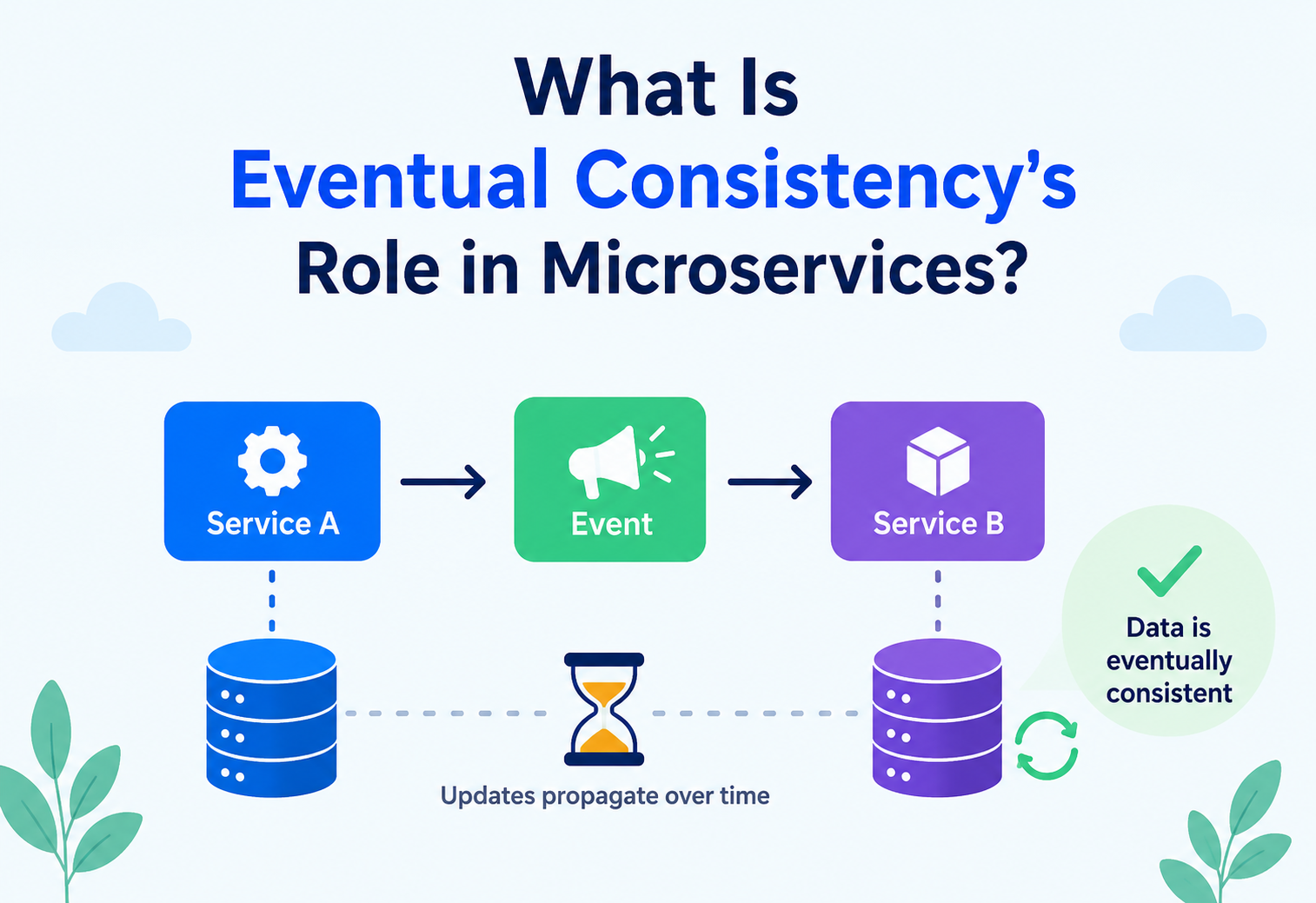
What Is Eventual Consistency’s Role in Microservices?
A complete, no‑jargon guide to why microservices give up “everyone sees the same data right now” — and how they still work correctly, at massive scale, without falling apart. Beginner‑friendly. CAP‑theorem accurate. Saga‑pattern practical.
Introduction & History
Imagine you and your best friend both keep a copy of the same notebook. You write “buy milk” in your notebook. Your friend’s notebook does not update immediately — she is on a bus, far away, with no signal. An hour later, when she gets home, her notebook finally shows “buy milk” too. For that one hour, the two notebooks disagreed. But eventually, they matched.
That is the entire idea behind eventual consistency, described in one sentence, before we add any technical words to it. It is a promise that says: “I cannot guarantee that every copy of this data agrees with every other copy right this second — but I promise that if you stop making changes, all copies will eventually agree.”
This idea sounds almost too simple to be an entire pillar of modern software architecture. Yet it quietly powers nearly every large system you use daily: when you like a photo on Instagram, when Amazon shows “12 people bought this in the last hour,” when your Uber driver’s location updates on your map, when a bank statement takes a moment to reflect a transfer. Behind each of these, some part of the system chose to be eventually consistent instead of instantly consistent — and that choice was not laziness. It was a deliberate engineering trade‑off.
Where did this idea come from?
Long before “microservices” was a popular word, computer scientists were already wrestling with a much older problem: how do you keep multiple copies of the same data correct when those copies live on different machines, in different buildings, sometimes in different countries? Early distributed databases in the 1970s and 1980s tried to solve this with strict, all‑or‑nothing coordination — every machine had to agree before any write was considered successful. This worked, but it was slow, and it broke completely the moment a network cable failed.
In the late 1990s and early 2000s, engineers at companies running enormous websites — Amazon among them — hit a wall. Their systems had grown too large for one database to handle, and strict coordination between many database copies was making the site slow and, worse, prone to total outages whenever any single node had a hiccup. Amazon’s engineers published a landmark 2007 paper describing a system called Dynamo, which deliberately gave up instant agreement between copies in exchange for a system that almost never went down. The term “eventual consistency” itself was popularized around this time by computer scientist Werner Vogels (Amazon’s CTO) and researcher Douglas Terry, who had studied “weak consistency” models at Xerox PARC years earlier.
Around the same period, Eric Brewer, a professor and engineer, proposed what became known as the CAP theorem — a rule that explains, mathematically, why a distributed system cannot have everything (we will unpack this fully in Section 4). CAP gave engineers a formal vocabulary to justify a decision they were already making in practice: sometimes, being available and fast matters more than being instantly correct everywhere.
Fast‑forward to today. Software is no longer built as one giant program (a “monolith”) running on one big machine. It is built as dozens, sometimes hundreds, of small independent programs called microservices, each responsible for one piece of business logic, each usually owning its own private database, and each talking to the others over a network. This shift is exactly why eventual consistency stopped being a niche database concept and became a core architectural skill every backend engineer needs.

Eventual consistency is a rule that says: “Different copies of the same piece of data are allowed to be temporarily out of sync, as long as they are guaranteed to become the same again once new changes stop arriving.” It trades a small, temporary gap in accuracy for a big gain in speed and uptime.
Why does this matter specifically for microservices?
In a monolith, one database transaction can update ten different tables at once, and either all ten succeed or all ten fail together — that is called an ACID transaction, and we will explain that acronym shortly. In microservices, those ten tables often live inside ten different services, each with its own separate database. There is no single transaction that can reach across all of them anymore. This single architectural fact — separate databases owned by separate services — is the root cause of almost everything this tutorial will teach you.
The Problem & Motivation
Let’s build the problem from scratch, using a story a 10‑year‑old could follow, and then translate it into engineering terms.
The birthday party problem
Imagine you are organizing a birthday party. You have three helpers: one buys the cake, one sends invitations, one books the party hall. If you insist that nothing can happen until all three helpers finish their job and confirm with each other at the exact same second, your party planning will be incredibly slow — everyone has to wait for the slowest helper, and if any one helper is unreachable (stuck in traffic, phone died), the whole plan freezes.
Now imagine a different approach: each helper does their job independently and reports back when done. The cake helper doesn’t need to wait for the invitation helper. If the hall‑booking helper is temporarily unreachable, the other two can still make progress. Eventually, all three tasks get done, and the full picture comes together. This is faster and far more resilient — but for a little while, the “party plan” is incomplete or inconsistent (you might have a cake before you have a confirmed hall).
Microservices face exactly this choice, at the scale of millions of requests per second.
From monoliths to microservices
A traditional monolithic application typically has one codebase and one database. When an online store processes an order in a monolith, a single database transaction can:
- Deduct the item from inventory
- Charge the customer’s card
- Create the order record
- Update the customer’s loyalty points
All four steps happen inside one atomic transaction. If step 3 fails, the database automatically undoes (rolls back) steps 1, 2, and 4 as if nothing happened. This is the safety net that relational databases have given developers for decades, through a set of guarantees known by the acronym ACID: Atomicity, Consistency, Isolation, Durability.
ACID is like a vending machine transaction: you either get your snack AND your money is taken, or you get nothing AND your money is returned. There is no in‑between state where the machine ate your money but gave no snack.
BEGIN TRANSACTION, four SQL UPDATE statements, then COMMIT. If any statement throws an error, the database runs ROLLBACK and every change is undone automatically.
Now split that same order flow into microservices: an Order Service, an Inventory Service, a Payment Service, and a Loyalty Service — each with its own database, each deployed independently, each possibly written in a different programming language, each possibly maintained by a different team. There is no longer a single database that can wrap all four updates into one atomic transaction. The moment you cross a network boundary between two services, you lose ACID guarantees across that boundary.
You cannot run one ACID transaction across multiple microservices’ databases without tightly coupling them together and destroying the independence that made you choose microservices in the first place. Trying to force distributed ACID (using something like two‑phase commit) reintroduces the very slowness and fragility microservices were meant to escape.
Why not just force everything to stay in sync instantly?
You could, in theory, make every service wait for every other service to confirm before responding to the user — a “strong consistency” approach. But this has real costs:
- Latency stacks up. If Order Service must wait for Inventory, which waits for Payment, which waits for Loyalty, the user’s “Place Order” button might spin for seconds instead of milliseconds.
- One slow service slows everyone. If Loyalty Service is having a bad day (maybe its database is under heavy load), the entire checkout flow stalls, even though loyalty points are not critical to completing a purchase.
- Availability drops. If Loyalty Service crashes entirely, should the customer be unable to buy anything? That seems like a poor trade — losing revenue because a “nice‑to‑have” feature is down.
- It doesn’t scale. Coordinating agreement across many machines gets exponentially harder as you add more services and more servers.
This is the motivation for eventual consistency: accept that some parts of the system will be briefly “behind,” in exchange for a system that stays fast and stays up even when individual pieces are struggling.
Fig 1 — Order Service responds to the customer immediately after saving the order and publishing an event. Inventory, Payment, and Loyalty update independently and eventually.
Notice something important in Figure 1: the customer gets a fast “Order Confirmed” response the moment Order Service saves the order and publishes an event. Inventory, Payment, and Loyalty each react to that event on their own schedule — usually within milliseconds, but not in the same instant. For a brief window, the Order Service “knows” about an order that Inventory Service hasn’t processed yet. That window is exactly what we mean by “eventual” in eventual consistency.
Core Concepts
Before going further, let’s build a solid vocabulary. Each term below follows the same pattern: what it is, why it exists, where it’s used, an analogy, and a concrete example.
3.1 Consistency (in distributed systems)
WhatA guarantee about whether different readers of data see the same value at the same time.
WhyOnce you have more than one copy of data (for speed, backup, or geographic reasons), you must decide what happens when those copies temporarily disagree.
Where usedDatabases, caches, replicated file systems, distributed logs, microservices communicating over events.
Think of a school WhatsApp group with three teachers as admins, each keeping a written attendance list. If one teacher marks a student “present” before telling the others, for a moment the three lists disagree. Consistency is the property that says how quickly, and under what rules, those lists must match.
A MySQL primary database instantly reflects a write. A read‑replica MySQL instance, which copies changes a few milliseconds later, might return the old value if queried immediately after the write. That replication delay is a real‑world instance of “not‑yet‑consistent” data.
3.2 Strong Consistency
WhatEvery read, from any node, always returns the most recent write. There is no window of disagreement — the system behaves as if there is only one, single copy of the data.
WhyCertain data — bank balances, seat reservations, medical records — must never be shown as stale, because acting on stale data can cause real financial or safety harm.
Where usedPayment processing, inventory counts for the last unit of a product, distributed locks, banking ledgers.
A single, shared physical whiteboard in a room. Everyone in the room sees the exact same writing at the exact same time because there is only one whiteboard — no copies to disagree.
A bank’s core ledger system typically enforces strong consistency for the “balance” field: two ATMs must never both successfully withdraw the last $50 from the same account.
3.3 Eventual Consistency
WhatIf no new writes occur, all replicas will, given enough time, converge to the same value. During the “in‑between” period, different readers might see different (but each individually valid, previously‑written) versions of the data.
WhyTo achieve very high availability and low latency across geographically distributed or independently‑owned systems, without the cost of coordinating every single node before every single write.
Where usedSocial media feeds, product review counts, search index updates, DNS (Domain Name System) propagation, shopping cart totals, “read” models built from events in microservices.
Gossip spreading through a school playground. You tell two friends a piece of news; they each tell two more friends. Within a few minutes, everyone knows — but for those few minutes, some kids know and some don’t. Eventually, everyone converges on the same information.
When you post a tweet, it may take a second or two before it appears in every follower’s timeline across the world, because the write has to propagate through caches and replicated data stores. X (formerly Twitter) accepts this delay in exchange for handling hundreds of millions of users.
3.4 Beyond the two extremes: a spectrum of consistency models
“Strong” and “eventual” are not the only two options — they are two ends of a spectrum. Real systems often pick something in between, chosen precisely for the guarantees a particular feature needs.
| Model | Guarantee | Typical Use Case |
|---|---|---|
| Strong / Linearizable | Every read sees the latest write, globally ordered | Bank balances, inventory of the very last item |
| Sequential Consistency | All nodes see operations in the same order, but not necessarily “real‑time” latest | Distributed logs, replicated state machines |
| Causal Consistency | Operations that are causally related are seen in the same order by everyone; unrelated ones may differ | Comment threads (a reply always appears after its parent comment) |
| Read‑Your‑Writes | A user always sees their own most recent write, even if others don’t yet | Profile updates — you see your new avatar immediately |
| Monotonic Reads | Once you’ve seen a value, you never see an older value later | Feed refreshes that never go “backwards” in time |
| Eventual Consistency | All replicas converge, eventually, with no ordering guarantee in between | Product ratings, follower counts, search indexes |
Consistency is not a single on/off switch for an entire application. Mature systems apply different consistency models to different pieces of data, based on how much harm a stale read would cause. Your bank balance: strong. Your “liked by 4,201 people” counter: eventual.
3.5 Idempotency
WhatAn operation is idempotent if performing it multiple times has the exact same effect as performing it once.
WhyIn eventually consistent, event‑driven systems, messages can be delivered more than once (due to retries after network failures). Idempotency protects the system from processing the same event twice by accident.
Where usedPayment processing, message consumers, retried API calls.
Pressing an elevator call button five times doesn’t call five elevators — the first press already registered the request, and the rest are ignored. The button is idempotent.
Instead of “increase balance by $10” (which is dangerous to repeat), an idempotent design says “set balance to $110, only if current balance is $100” or tracks a unique transaction ID and ignores duplicates.
3.6 Convergence
WhatThe property that, given enough time and no new updates, all replicas of a piece of data will reach the identical final value.
WhyConvergence is the mathematical promise underneath “eventual” — without it, “eventual consistency” would just mean “permanently inconsistent,” which is useless.
3.7 Conflict Resolution
What it is: the rule used to decide the winning value when two replicas received different, conflicting writes at nearly the same time.
Common strategies:
- Last‑Write‑Wins (LWW): whichever write has the latest timestamp wins. Simple, but can silently discard a valid update.
- Vector Clocks: a data structure that tracks the causal history of a value across nodes, letting the system detect true conflicts (rather than just “later” timestamps) and sometimes merge them.
- CRDTs (Conflict‑free Replicated Data Types): special data structures (counters, sets, maps) mathematically designed so that any order of merging updates always produces the same, correct final result — no conflict possible by construction.
- Application‑level merge: custom business logic decides the winner (e.g. “the highest bid wins,” “the cart with more items wins”).
CAP Theorem & PACELC
If eventual consistency has a “constitution,” it is the CAP theorem. Understanding it properly will make every future design decision in this tutorial feel obvious rather than arbitrary.
4.1 What CAP actually says
Proposed by Eric Brewer in 2000 and later formally proven by Seth Gilbert and Nancy Lynch, the CAP theorem states that a distributed data system can provide, at most, two out of three of the following guarantees at the same time, whenever a network partition occurs:
- Consistency (C): every read receives the most recent write, or an error.
- Availability (A): every request receives a (non‑error) response, without the guarantee that it contains the most recent write.
- Partition Tolerance (P): the system continues to operate despite an arbitrary number of messages being dropped or delayed between nodes (i.e. the network breaks somewhere).
Fig 2 — During a network partition, a system must choose between Consistency and Availability. Partition Tolerance is not optional in a real distributed system.
People often say “pick any 2 of C, A, P.” In practice, real networks will experience partitions eventually — cables get cut, routers fail, cloud availability zones lose connectivity. So Partition Tolerance is not really a choice; it is a fact of life. The real, practical decision CAP forces on you is: when a partition happens, do you sacrifice Consistency, or do you sacrifice Availability?
4.2 CP vs. AP systems
| Type | Behavior during a partition | Example Systems | Good fit for |
|---|---|---|---|
| CP (Consistency + Partition Tolerance) | Refuses requests it cannot guarantee are correct — returns an error or blocks rather than risk stale data | ZooKeeper, etcd, HBase, traditional RDBMS clusters with synchronous replication | Payments, inventory of the last item, distributed locks, leader election |
| AP (Availability + Partition Tolerance) | Keeps answering requests using whatever local data it has, even if it might be stale | Cassandra, DynamoDB, CouchDB, Riak | Product catalogs, social feeds, shopping carts, session data, analytics counters |
An important, often‑missed point: a large real‑world system is almost never purely CP or purely AP. Different microservices — even different fields within the same service — make different choices. Your Payment Service might behave like a CP system for the “charge the card” step, while your Recommendation Service behaves like an AP system for “products you might like.”
4.3 PACELC: the more complete picture
CAP only describes behavior during a partition. But partitions are (hopefully) rare. What about the other 99.9% of the time, when the network is healthy? Daniel Abadi extended CAP into a more useful model called PACELC:
Partition happens → choose Availability or Consistency (this is plain CAP).
Else (network is healthy) → choose Latency or Consistency.
This second half is the part most engineers forget. Even when nothing is broken, forcing every replica to confirm a write before responding to the user adds latency. PACELC makes explicit that low latency and strong consistency are in tension even in the happy path, not only during failures. This is precisely why many systems choose eventual consistency as their everyday default, not just as an emergency fallback.
4.4 Applying CAP/PACELC to a microservices checklist
A practical rule of thumb, useful in interviews and in real design reviews:
- If showing slightly old data could cause financial, legal, or safety harm → lean CP / strong consistency (e.g. “charge the customer,” “confirm the last hotel room”).
- If the data is informational or convenience‑oriented, and staleness is harmless → lean AP / eventual consistency (e.g. “number of likes,” “recently viewed items,” “estimated delivery time”).
- One service in your architecture is allowed to be CP while its neighbor is AP. You are composing a system out of many small, individually‑tuned trade‑offs — not picking one label for the whole company.
Architecture & Components
Now let’s look at the actual building blocks engineers use to implement eventual consistency inside a microservices architecture.
5.1 Event‑Driven Architecture
WhatAn architectural style where services communicate by publishing and reacting to events — immutable facts about something that already happened — rather than by directly calling each other and waiting for a response.
WhyDirect, synchronous calls between services create tight coupling and cascading failure risk (if Service B is down, Service A’s request hangs or fails). Event‑driven communication decouples services in time — the publisher doesn’t need the subscriber to be online right now.
A notice board in a school hallway. The person who pins up a notice (“Sports Day moved to Friday”) doesn’t need to personally track down every student and teacher. Anyone interested checks the board whenever they walk by, and reacts on their own time.
An OrderPlaced event, published to a topic. Inventory Service, Payment Service, and Notification Service each subscribe independently and process it at their own pace.
5.2 Message Brokers & Event Streams
What it is: middleware software that reliably transports events/messages from publishers to subscribers, usually with durability (messages survive a crash) and ordering guarantees.
Common technologies: Apache Kafka (a distributed, durable event log), RabbitMQ (a traditional message queue/broker), Amazon SQS/SNS, Google Pub/Sub, Apache Pulsar.
Netflix uses Apache Kafka extensively to move billions of events per day between microservices for things like viewing activity, recommendations, and operational telemetry, allowing each downstream service to process the stream at its own pace without blocking upstream producers.
5.3 The Transactional Outbox Pattern
What it is: a pattern that solves a subtle but critical problem: how do you guarantee that “save data to my database” and “publish an event about that save” either both happen or neither happens — without a distributed transaction across the database and the message broker?
Why it exists: if a service saves an order to its database and then, in a separate step, tries to publish an “OrderPlaced” event to Kafka, there’s a dangerous gap: what if the service crashes after the database write but before the event is published? The order exists, but nobody else in the system will ever find out.
How it works: instead of publishing directly, the service writes the event into an “outbox” table in the same local database transaction as the business data. A separate background process (or a tool like Debezium, using a technique called Change Data Capture) reads new rows from the outbox table and reliably publishes them to the message broker, then marks them as sent.
Fig 3 — The Transactional Outbox Pattern guarantees the database write and the event publish are never out of sync, without a distributed transaction.
Java example: writing to the outbox in the same transaction
@Service
public class OrderService {

    @Autowired private OrderRepository orderRepository;
    @Autowired private OutboxRepository outboxRepository;

    @Transactional // single local DB transaction covers BOTH inserts
    public Order placeOrder(OrderRequest request) {
        Order order = new Order(request.getCustomerId(), request.getItems());
        orderRepository.save(order);

        String payload = toJson(new OrderPlacedEvent(order.getId(), order.getItems()));
        OutboxMessage message = new OutboxMessage(
                "Order", order.getId().toString(), "OrderPlaced", payload);
        outboxRepository.save(message); // same transaction, same commit

        return order; // event publishing happens later, via the relay process
    }
}
Both the order and its outbox event are committed atomically — a normal, local, single‑database transaction. No distributed coordination needed.
5.4 The Saga Pattern
What it is: a way to manage a business process that spans multiple services — like “place an order” — as a sequence of local transactions, where each step publishes an event that triggers the next step, and every step has a matching compensating action to undo it if a later step fails.
Why it exists: since you can’t wrap multiple services’ databases into one ACID transaction, sagas give you a structured, testable way to keep the overall business process correct — even if individual steps fail — by “undoing” completed steps rather than pretending the whole thing was one atomic unit.
Booking a multi‑city trip: flight, hotel, car rental. If the hotel booking fails after you’ve already booked the flight, you don’t panic — you cancel the flight (a compensating action) and try a different plan. Each booking is reversible.
There are two common ways to coordinate a saga:
- Choreography: no central coordinator. Each service listens for events and publishes its own events in response, like a chain reaction. Simple for small flows, but can get hard to trace as the number of steps grows.
- Orchestration: a dedicated “saga orchestrator” service explicitly tells each participant what to do next and listens for their responses, similar to a conductor directing an orchestra. Easier to monitor and reason about for complex flows.
Fig 4 — Orchestrated Saga: when Shipping fails, the orchestrator issues compensating actions to undo the earlier, already‑successful steps.
Java sketch: a simple saga orchestrator step
public class OrderSagaOrchestrator {

    public void handle(PaymentSucceededEvent event) {
        try {
            inventoryClient.reserveStock(event.getOrderId(), event.getItems());
        } catch (InventoryUnavailableException e) {
            paymentClient.refund(event.getOrderId());       // compensating action
            orderRepository.markFailed(event.getOrderId());
        }
    }

    public void handle(StockReservedEvent event) {
        try {
            shippingClient.createShipment(event.getOrderId());
        } catch (ShippingUnavailableException e) {
            inventoryClient.releaseStock(event.getOrderId()); // compensate step 2
            paymentClient.refund(event.getOrderId());         // compensate step 1
            orderRepository.markFailed(event.getOrderId());
        }
    }
}
Each failure triggers compensations for every step that already succeeded, in reverse order — the essence of the saga pattern.
5.5 CQRS (Command Query Responsibility Segregation)
What it is: a pattern that splits the model used for writing data (commands) from the model used for reading data (queries), allowing each to be optimized and scaled independently.
Why it exists: write operations often need strict validation and normalized data structures. Read operations often need to be extremely fast and denormalized (pre‑joined, pre‑aggregated) for the exact shape a screen needs. Combining both needs in a single model is often a compromise that serves neither well.
Fig 5 — The write model is the single source of truth (often strongly consistent); read models are eventually consistent projections optimized for specific screens.
5.6 Event Sourcing
What it is: instead of storing only the current state of an entity (e.g. “order status = shipped”), you store the full sequence of events that led to that state (“OrderCreated,” “PaymentReceived,” “OrderShipped”). Current state is derived by replaying events.
Why it exists: gives you a full audit trail for free, makes debugging production issues far easier (“what exactly happened to this order, in order?”), and pairs naturally with CQRS — read models are just projections built by replaying the event stream.
Banking and fintech systems frequently use event sourcing for ledgers, since regulators require a complete, immutable history of every change — not just the final balance.
Internal Working & Data Flow / Lifecycle
Let’s trace the full lifecycle of a single piece of data as it travels through an eventually consistent microservices system — from the moment a user clicks a button to the moment the entire system has “caught up.”
6.1 The five stages of an eventually consistent write
- Acceptance: the originating service (say, Order Service) validates the request and writes to its own local database. This step is fast and usually strongly consistent within that one service.
- Publication: the service publishes an event describing what happened (via the outbox pattern, ideally), and returns a response to the caller — often before any other service has even seen the event.
- Propagation: the message broker delivers the event to all interested subscriber services. This can take anywhere from single‑digit milliseconds to, in unhealthy conditions, several seconds.
- Application: each subscribing service processes the event, updating its own local state (e.g. Inventory Service decrements stock).
- Convergence: once every subscriber has applied the event, the system as a whole reflects the new reality consistently. Until then, the system is in a valid, but temporarily divergent, intermediate state.
Fig 6 — The lifecycle of one write, from acceptance to full convergence across all services.
6.2 Replication lag
WhatThe time delay between a write being accepted at the source and that write becoming visible at a replica or downstream service.
WhyReplication lag is the literal, measurable size of the “eventual” in eventual consistency. Engineering teams track this as a real metric (often in milliseconds or seconds) because it directly affects user experience — e.g. “why doesn’t my new comment show up yet?”
Live TV broadcast delay. The event happens on the field, but by the time it reaches your television, a few seconds have passed. That gap is a form of “lag” — noticeable, but tolerable for most viewers.
Amazon’s product review count doesn’t update on every page instantly across every data center; it converges within a short window, which is imperceptible to almost every shopper but is a deliberate, measured trade‑off.
6.3 Handling out‑of‑order and duplicate events
Two real‑world hazards must be handled by every consumer in an event‑driven system:
- Out‑of‑order delivery: network retries and partitioned topics mean event B can sometimes arrive before event A, even though A happened first. Consumers typically attach a version number or timestamp to events and discard/reorder anything older than what they’ve already applied.
- Duplicate delivery: most message brokers offer “at‑least‑once” delivery, meaning a message might be delivered more than once after a retry. This is why idempotency (Section 3.5) is not optional — it’s a required defense.
Java example: an idempotent event consumer
@Component
public class InventoryEventConsumer {

    @Autowired private ProcessedEventRepository processedEvents;
    @Autowired private InventoryRepository inventoryRepository;

    @KafkaListener(topics = "order-events")
    @Transactional
    public void onOrderPlaced(OrderPlacedEvent event) {

        // Idempotency guard: skip if we've already handled this exact event
        if (processedEvents.existsById(event.getEventId())) {
            return;
        }

        inventoryRepository.decreaseStock(event.getItems());
        processedEvents.save(new ProcessedEvent(event.getEventId(), Instant.now()));
    }
}
Recording every processed event ID inside the same transaction as the business update makes re‑delivery harmless.
Advantages, Disadvantages & Trade‑offs
Every architectural choice trades one thing for another. Being honest about both sides is what turns eventual consistency from a fashionable buzzword into an engineering discipline.
7.1 Advantages
| Benefit | Why it happens |
|---|---|
| Higher availability | Services don’t block waiting for every other service to confirm; a slow or down dependency doesn’t freeze the whole request |
| Lower latency | No cross‑service coordination delay on the critical response path |
| Better horizontal scalability | Services and their databases can be scaled independently without needing tight, synchronous coordination |
| Loose coupling | Services depend on events, not on each other’s uptime or internal schema, easing independent deployment |
| Resilience to partial failure | One service being down delays, but doesn’t necessarily block, the rest of the system |
7.2 Disadvantages
| Cost | Why it happens |
|---|---|
| Temporary data staleness | Some services will show older information for a brief window after a write |
| Increased complexity | Developers must design for compensating actions, idempotency, retries, and out‑of‑order events |
| Harder debugging | A bug might only appear during the “in‑between” window, making it hard to reproduce |
| User experience surprises | Users may see confusing states, like “Order Placed” but “Item still in cart,” unless the UI is designed to account for this |
| Testing difficulty | Race conditions and timing‑dependent bugs are harder to write automated tests for than simple synchronous logic |
Eventual consistency doesn’t remove complexity — it moves it. Instead of complexity living inside a slow, fragile distributed transaction, it lives inside carefully designed compensations, idempotent handlers, and UI patterns that gracefully handle “not yet updated” states.
Performance & Scalability
Eventual consistency is, fundamentally, a performance and scalability strategy dressed up as a data‑correctness policy. Let’s look at exactly how it delivers on that promise.
8.1 Why synchronous coordination doesn’t scale
Imagine 5 services must all confirm a write before it’s considered “done” (a form of strong consistency called two‑phase commit). As you add more replicas or more participating services, the probability that at least one of them is slow or briefly unavailable rises. The whole operation is only as fast as its slowest participant, and only as reliable as its least reliable participant. This is sometimes summarized as: coordination cost grows with the number of participants.
Asynchronous, event‑based propagation avoids this by decoupling “the operation the user is waiting on” from “the operations that can happen afterward.” The user‑facing latency is bounded by just the first service’s local write — everything else happens in the background, in parallel, without the user waiting for it.
8.2 Read scaling through replicas and caches
Because eventually consistent systems don’t require every replica to be perfectly up to date, you can freely add more read replicas (extra copies of data used only for reading) to absorb traffic. A read that goes to a replica a few milliseconds “behind” the primary is still almost always acceptable for the vast majority of use cases — product listings, search results, dashboards.
8.3 Backpressure and consumer lag
What it is: when event producers generate messages faster than consumers can process them, a backlog (“lag”) builds up in the message broker.
Why it matters: consumer lag is a direct, measurable indicator of how “eventual” your eventual consistency currently is. High lag means downstream services are seeing increasingly stale data. Engineering teams monitor this number (e.g. Kafka consumer group lag) as a first‑class production metric, exactly like CPU or memory usage.
Set alerting thresholds on consumer lag, not just on error rates. A consumer that is “up” but falling behind can silently degrade the user experience for minutes before anyone notices, unless lag itself is tracked as a metric.
High Availability & Reliability
Availability in eventually consistent systems is not free — it is engineered, at every hop, using replication, retries, and thoughtful failure handling.
9.1 Replication for fault tolerance
Databases and message brokers in an eventually consistent architecture typically keep multiple copies (replicas) of data across different servers, racks, or data centers. If one node fails, another replica can take over, usually without the client noticing beyond a brief blip. This replication is itself eventually consistent in most AP systems — a follower replica might be a few milliseconds behind the leader.
9.2 Retry, timeout, and circuit breaker patterns
Reliability in an eventually consistent system depends heavily on how failures are handled at each network hop:
- Retries with backoff: if a call to a downstream service fails, retry after a short, increasing delay rather than immediately hammering an already‑struggling service.
- Timeouts: never wait forever for a response; give up after a sensible limit so resources aren’t tied up indefinitely.
- Circuit Breakers: after repeated failures, “trip” the circuit and stop sending requests to a failing dependency for a cooldown period, giving it room to recover and protecting the caller from wasting resources on doomed calls.
A household circuit breaker trips and cuts power when there’s a dangerous overload, protecting the rest of the house from damage, rather than letting the fault spread.
Libraries like Resilience4j (Java) or Hystrix (legacy, Netflix) implement circuit breakers around HTTP or messaging calls between services.
9.3 Dead Letter Queues (DLQs)
WhatA separate queue where messages are routed after repeated processing failures, instead of being retried forever or silently dropped.
WhySome messages will always fail (e.g. malformed data, a permanently unknown product ID). DLQs let engineers inspect and manually resolve these “poison messages” without blocking the healthy message stream behind them.
9.4 Disaster recovery in eventually consistent systems
Because state is often derivable by replaying an event log (especially with event sourcing), disaster recovery can be as straightforward as rebuilding a service’s database from the event stream from a known checkpoint, rather than relying purely on traditional backups. Regularly testing this “replay and rebuild” path is a best practice for critical services.
Security Considerations
Eventual consistency introduces security nuances that a simple monolith doesn’t have to think about as much.
10.1 Authorization staleness
If a user’s permissions are revoked (e.g. an employee is terminated and their access should be removed immediately), an eventually consistent permissions cache or read model might briefly still grant access. This is a real security risk, not just a UX quirk. Security‑sensitive data — authentication tokens, permission flags, access control lists — often needs to lean toward strong consistency, or at least a very short, tightly bounded replication lag with active invalidation.
Never let “eventual” mean “unbounded.” For anything security‑relevant, put a strict maximum staleness window on it (e.g. “permission changes must propagate within 2 seconds”), and prefer active invalidation (push a “revoke now” event) over waiting for a cache to naturally expire.
10.2 Event tampering and validation
Since services trust events coming from a shared broker, that broker and its topics must be secured: authenticated producers, authorization on which services can publish to which topics, and schema validation to reject malformed or malicious payloads before they corrupt downstream state.
10.3 Replay attacks
An attacker who can capture and resend (replay) a legitimate event might trigger unintended duplicate actions if idempotency isn’t enforced. This is another reason idempotency isn’t just a reliability feature — it’s also a security control.
10.4 Auditability
On the positive side, event‑driven, eventually consistent architectures — especially with event sourcing — naturally produce a detailed audit trail: every state change is a recorded, timestamped event. This is genuinely useful for security investigations and compliance requirements (e.g. PCI‑DSS, HIPAA, SOC 2).
Monitoring, Logging & Metrics
You cannot manage what you cannot measure — and eventual consistency, by nature, hides its “state of being incomplete” from a casual glance. Deliberate observability is essential.
11.1 Key metrics to track
| Metric | What it tells you |
|---|---|
| Consumer lag | How far behind, in messages or time, a consumer is from the latest published event |
| Replication lag | Delay between a write on the primary and its appearance on a replica |
| Event processing latency | Time between an event being published and successfully applied by a consumer |
| Dead letter queue size | Volume of messages that repeatedly failed processing and need attention |
| Saga failure / compensation rate | How often multi‑step business processes need to roll back, signaling upstream reliability issues |
| Duplicate event rate | How often the same event is redelivered, hinting at broker or network instability |
11.2 Distributed tracing
What it is: a technique that attaches a unique “trace ID” to a request as it flows through many services and asynchronous event hops, so engineers can reconstruct the full journey of one business operation across the whole system.
Why it exists: in a synchronous monolith, a stack trace tells you what happened. In an asynchronous, eventually consistent microservices system, a single user action can trigger a chain of events across a dozen services over several seconds — without tracing, this is nearly impossible to debug.
Common tools: OpenTelemetry (the current industry standard), Jaeger, Zipkin, and vendor platforms like Datadog or Honeycomb.
11.3 Structured, correlated logging
Every log line, across every service, should carry the same correlation/trace ID for a given business operation, so engineers can filter logs from ten different services down to just the ones relevant to one customer’s one order, in chronological order.
11.4 Alerting philosophy
Because “temporarily inconsistent” is expected and normal, naive alerting on “data mismatch detected” will create constant noise. Effective monitoring instead alerts on durations exceeding an agreed threshold — e.g. “replication lag has exceeded 30 seconds” rather than “replication lag is non‑zero.”
Deployment & Cloud
Every major cloud provides managed building blocks for eventually consistent architectures — from Kafka clusters to multi‑region databases — so most teams no longer roll their own from scratch.
12.1 Managed message brokers
Most cloud providers now offer managed, highly available messaging infrastructure so teams don’t have to operate Kafka or RabbitMQ clusters themselves: Amazon MSK and SNS/SQS, Google Cloud Pub/Sub, Azure Service Bus and Event Hubs, and Confluent Cloud (managed Kafka). These handle replication, partitioning, and failover for you, which is especially valuable since correctly operating a distributed message broker is itself a hard distributed‑systems problem.

12.2 Multi‑region deployments
Global applications often deploy services and databases across multiple geographic regions for lower latency and disaster recovery. Multi‑region setups almost always rely on eventual consistency between regions, because forcing strong consistency across continents (with round‑trip network delays of 100 ms or more) would make every write painfully slow. Techniques like active‑active replication, conflict‑free data types (CRDTs), and region‑local reads with asynchronous cross‑region sync are standard here.
12.3 Kubernetes and service resilience
In containerized deployments (typically orchestrated with Kubernetes), pods restart, get rescheduled, and scale up and down constantly. Event‑driven, eventually consistent designs tolerate this churn naturally — a consumer pod that restarts simply resumes reading from its last committed offset in the event log, rather than losing in‑flight synchronous calls.
12.4 Schema evolution and versioning
As services deploy independently, event schemas must evolve without breaking existing consumers. Best practice is to use a schema registry (e.g. Confluent Schema Registry, AWS Glue Schema Registry) with backward‑compatible changes — adding optional fields rather than renaming or removing existing ones — so that a producer and consumer on different deployment versions can still communicate correctly during a rollout.
Databases, Caching & Load Balancing
The data layer is where consistency choices become concrete. Each store below exposes different knobs for tuning how “eventual” the eventual actually is.
13.1 Choosing a database for eventual consistency
| Database | Consistency Model | Notes |
|---|---|---|
| Apache Cassandra | Tunable (AP by default) | Lets you choose consistency level per query (e.g. ONE, QUORUM, ALL) |
| Amazon DynamoDB | Eventual by default, strong optional | Offers “strongly consistent reads” as an explicit, slightly costlier option |
| MongoDB | Configurable via read/write concerns | Replica sets can be tuned for stronger or weaker guarantees per operation |
| PostgreSQL / MySQL (with read replicas) | Strong on primary, eventual on replicas | Common default for OLTP workloads with read scaling needs |
| Redis | Eventual across replicas; strong on single node | Often used as a fast, eventually‑consistent cache layer |
13.2 Caching and staleness
Caches are, by definition, a deliberate form of eventual consistency: a cached value is a snapshot from the past, valid until it’s invalidated or expires. Common cache‑consistency strategies include:
- Time‑to‑Live (TTL) expiration: the cache automatically discards a value after a set duration, accepting bounded staleness in exchange for simplicity.
- Cache invalidation on write: the write path actively deletes or updates the cached value, tightening the staleness window at the cost of extra coordination.
- Write‑through / write‑behind caching: writes go through the cache to the database (write‑through, more consistent) or are queued and written to the database later (write‑behind, faster but more eventually consistent).
13.3 Load balancing and read routing
Load balancers in eventually consistent architectures often route read traffic to the nearest or least‑loaded replica rather than always the primary. Some systems support “sticky sessions” or read‑your‑writes routing, ensuring a specific user’s subsequent reads are directed to a replica known to have their latest write, softening the visible effects of replication lag for that individual user even while the system overall remains eventually consistent.
Design Patterns & Anti‑patterns
Patterns you should reach for, and anti‑patterns you should learn to spot in design reviews.
14.1 Patterns that support eventual consistency well
- Transactional Outbox (Section 5.3) — guarantees atomic “save + publish.”
- Saga Pattern (Section 5.4) — manages multi‑service business transactions with compensations.
- CQRS (Section 5.5) — separates write correctness from read performance.
- Event Sourcing (Section 5.6) — full history, natural audit trail, rebuildable state.
- Idempotent Consumer (Sections 3.5 & 6.3) — makes duplicate delivery safe.
- Change Data Capture (CDC): tools like Debezium watch a database’s internal transaction log and turn every row change into an event automatically, without requiring application code changes — a lightweight way to retrofit eventual consistency onto an existing system.
- Materialized View / Read Model: a precomputed, denormalized view built by consuming events, kept in sync asynchronously, optimized purely for fast reads.
14.2 Anti‑patterns to avoid
Writing to the database and publishing to the message broker as two separate, unrelated operations (without an outbox). This creates a real gap where one can succeed and the other fail, leaving the system permanently inconsistent — the exact problem the outbox pattern exists to solve.
Splitting code into separate “microservices” that still call each other synchronously for every operation and share a single database. This gives you all the network overhead and deployment complexity of microservices with none of the independence or resilience benefits.
Treating “eventual” as “whenever it happens to get there,” with no monitoring, no SLA, and no upper bound. Without a target (e.g. “under 2 seconds, 99% of the time”), staleness silently grows until it becomes a serious, hard‑to‑diagnose user‑facing bug.
Assuming messages will only ever be delivered exactly once. Nearly every real message broker offers “at‑least‑once” delivery by default; treating message handlers as if duplicates can’t happen leads to double‑charging, double‑shipping, and similarly costly bugs.
Building one giant saga that coordinates an unreasonably large number of services and steps, becoming a single point of complexity and failure that is nearly as hard to reason about as a distributed transaction — defeating the original purpose of breaking the system apart.
Best Practices & Common Mistakes
These are the habits that separate teams who ship eventual consistency confidently from teams who fight their own architecture every week.
15.1 Best Practices
- ClassifyClassify data by consistency need, per field, not per service. Not everything in a service needs the same guarantee.
- OutboxAlways use the transactional outbox pattern (or CDC) instead of dual writes when publishing events tied to a local database change.
- IdempotencyMake every event consumer idempotent by design, using unique event IDs and a “processed events” record.
- SchemaVersion your events and use a schema registry to allow independent service deployments without breaking compatibility.
- SLADefine and monitor explicit staleness SLAs (“replication lag must stay under X seconds”) rather than leaving “eventual” undefined.
- UIDesign the UI to acknowledge eventual consistency — e.g. “Your order is being processed” instead of implying instant, complete certainty.
- FlowPrefer choreography for simple, 2–3 step flows; prefer orchestration for complex, multi‑step business processes where visibility and control matter.
- TracingInvest in distributed tracing early — retrofitting it after a production incident is much harder than building it in from day one.
- CompensationsWrite compensating actions as carefully as the original actions — a compensation that can itself fail needs its own retry and failure‑handling logic.
15.2 Common Mistakes
- Treating eventual consistency as “eventually, someday, maybe.” Without bounded, monitored lag, this becomes a serious reliability risk.
- Forgetting that events can arrive out of order. Applying an “OrderCancelled” event before an “OrderPlaced” event (due to network timing) can corrupt state if not defended against with versioning.
- Using eventual consistency for data where it’s clearly wrong — e.g. allowing two customers to both “successfully” book the very last hotel room because inventory checks were eventually, not strongly, consistent.
- Not testing failure scenarios. Sagas and compensations are often only tested on the happy path; the compensating logic itself can have bugs that go unnoticed until a real outage.
- Overusing synchronous calls “just to be safe.” This quietly reintroduces tight coupling and defeats much of the benefit of choosing microservices and eventual consistency in the first place.
Real‑World & Industry Examples
Everything above already runs, at enormous scale, inside companies whose products you use every day.
Amazon’s original Dynamo system, described in its influential 2007 paper, deliberately chose an eventually consistent, highly available design for its shopping cart service, reasoning that it was better to occasionally show a slightly outdated cart (easily fixed by merging) than to ever refuse a customer the ability to add an item to their cart.
Netflix relies on event streaming (built substantially on Apache Kafka) to propagate viewing activity, ratings, and operational signals across hundreds of microservices, allowing each team’s service to scale and evolve independently while the overall system stays eventually synchronized.
Uber’s rider app shows a driver’s location updating on the map every few seconds — a classic eventually consistent data feed. Instant, perfectly synchronized location data isn’t necessary for a good user experience, but high availability of the location feed, even under massive concurrent load, is essential.
Like/follower counts, comment threads, and “trending” lists on major platforms are eventually consistent by design — small, brief discrepancies (a like count off by a handful for a few seconds) are invisible to users, while forcing strong consistency at that scale would be prohibitively expensive.
Even large fintech and banking systems, which need strong consistency for account balances, still use eventual consistency extensively for adjacent features: fraud‑detection dashboards, transaction history views, and notification systems are typically built as eventually consistent read models fed by events from the strongly consistent core ledger — a clear real‑world example of mixing both models within one company.
The Domain Name System itself is the internet’s most successful eventually consistent database: when a DNS record is changed, caches across the world converge to the new value over minutes to hours, and everyone accepts this small propagation window in exchange for a globally scalable naming system.
FAQ
Short, direct answers to the questions that come up most often in interviews and design reviews.
Is eventual consistency the same as “eventually correct”?
Not quite. Eventual consistency guarantees that replicas will converge to the same value — but that value is only “correct” from a business standpoint if your compensating logic, conflict resolution, and validation rules are also correct. Consistency is about agreement between copies; correctness is a broader guarantee about business rules being upheld.
Does using microservices always mean giving up strong consistency?
No. Individual services can still use strong, ACID‑guaranteed transactions within their own database. What you generally give up is the ability to wrap a transaction across multiple services’ databases. Many teams deliberately keep strongly‑related data inside a single service specifically to preserve strong consistency where it truly matters.
How long does “eventual” usually take in practice?
It varies widely by system — anywhere from single‑digit milliseconds (a healthy Kafka pipeline) to several seconds (cross‑region replication) or even longer during outages. Well‑run systems define and monitor an explicit target, rather than leaving it open‑ended.
Can I mix strong and eventual consistency in the same application?
Yes — and in practice, almost every large production system does. The decision is typically made per data type or per operation, based on how much harm stale data would cause, not applied uniformly to the whole application.
What’s the difference between the Saga pattern and a distributed transaction (like two‑phase commit)?
A distributed transaction tries to make multiple systems agree atomically before anything is considered final, holding locks and blocking until every participant confirms. A saga instead lets each step commit locally and immediately, and relies on compensating actions to undo completed steps if a later step fails — trading strict atomicity for availability and scalability.
Is eventual consistency a new idea?
The underlying concept dates back decades in distributed systems research (including work on replicated databases in the 1980s), but it became mainstream engineering practice in the mid‑to‑late 2000s, driven by internet‑scale systems like Amazon’s Dynamo, and became especially central to everyday backend engineering as microservices architecture grew popular through the 2010s and beyond.
Summary & Key Takeaways
A compact wrap‑up of everything you now know — and the ten ideas worth carrying into every future design review.
Eventual consistency exists because distributed systems face a fundamental, mathematically‑proven trade‑off (captured by the CAP theorem and its extension, PACELC): you cannot have instant agreement across every copy of your data everywhere, all the time, without paying for it in availability or latency. Microservices architecture makes this trade‑off unavoidable, because splitting a system into independently‑owned services with independent databases removes the single ACID transaction that used to paper over the problem in monolithic applications.
The good news is that this is not a flaw to be tolerated — it is a well‑understood, well‑tooled engineering discipline. Patterns like the transactional outbox, sagas, CQRS, and event sourcing give teams a reliable way to build systems that are fast, resilient, and scalable, while carefully containing the “temporary disagreement” window to exactly the data where it’s safe to allow.
Key Takeaways
- 01Eventual consistency guarantees convergence over time, not instant agreement — it trades brief staleness for high availability and low latency.
- 02The CAP theorem forces a choice between Consistency and Availability only during a network partition; PACELC reminds us that Latency vs. Consistency is a trade‑off even when everything is healthy.
- 03Microservices lose the ability to run one ACID transaction across services, making event‑driven, eventually consistent communication the natural default for cross‑service workflows.
- 04The transactional outbox pattern prevents the classic “dual write” bug where a database update and an event publish fall out of sync.
- 05The saga pattern replaces distributed transactions with a sequence of local transactions plus compensating actions for failure recovery.
- 06CQRS and event sourcing let you optimize reads and writes separately, and give you a full, replayable history of every change.
- 07Idempotency is not optional — message brokers commonly deliver “at least once,” so every consumer must safely handle duplicates.
- 08Not all data deserves the same consistency model — classify by business risk, and mix strong and eventual consistency deliberately within the same system.
- 09Observability (consumer lag, replication lag, distributed tracing) is what turns “eventual” from a vague promise into a measured, managed engineering guarantee.
“Eventual consistency does not remove complexity from a distributed system — it moves that complexity to the places where humans can reason about it, name it, and monitor it.”
With this foundation, you are equipped to design microservices that stay fast and resilient under real‑world traffic, to spot dual‑write and unbounded‑staleness bugs before they ship, and to have the confident, specific conversations about trade‑offs that distinguish an experienced backend engineer from someone chasing patterns for their own sake.