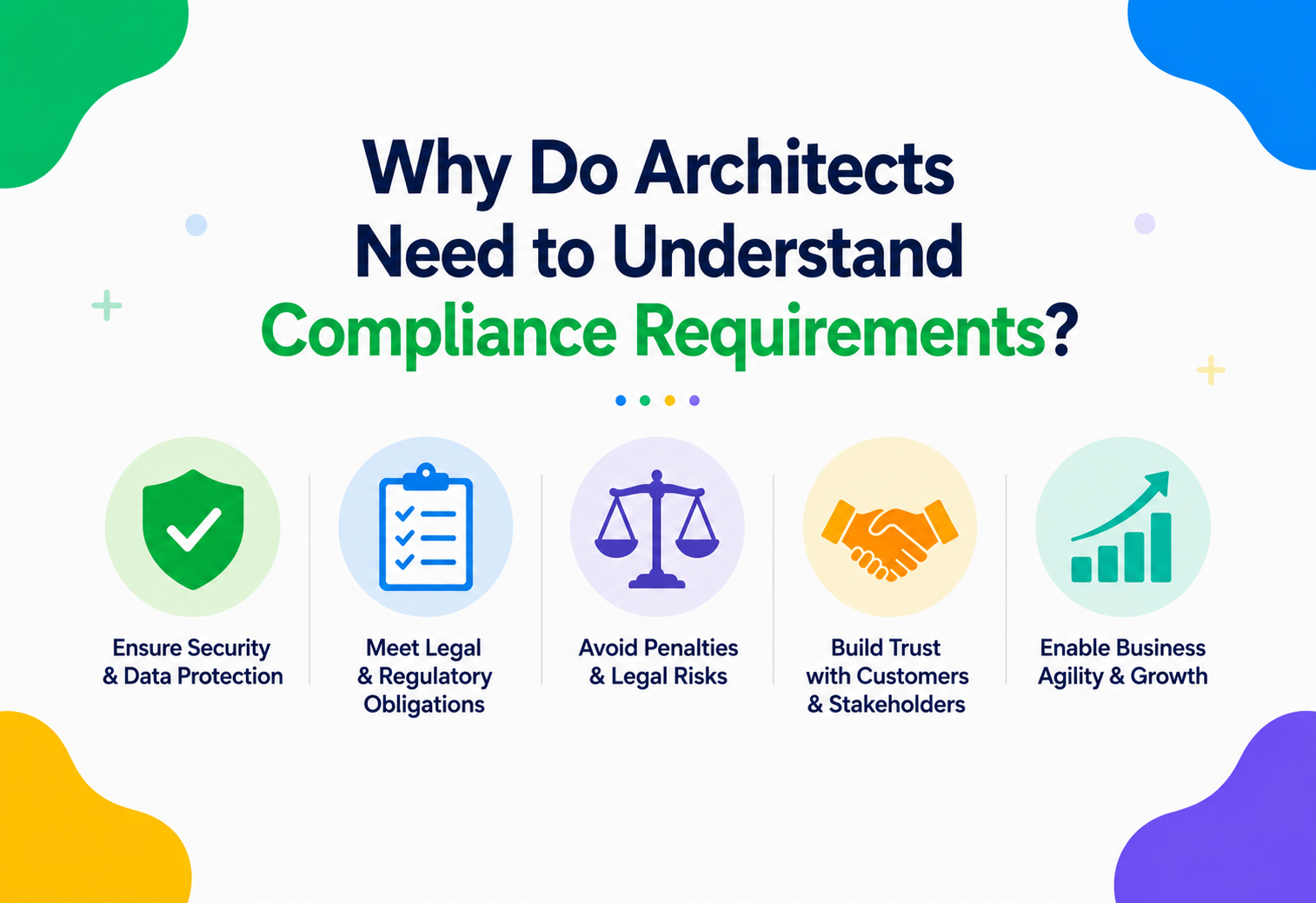
Why Do Architects Need to Understand Compliance Requirements?
A ground-up guide for software, cloud and enterprise architects on why compliance is not a legal afterthought but a first-class design input — covering history, architecture, security, deployment, patterns and real-world lessons.
Introduction & History
Imagine you are building a house. Before you pour a single foundation stone, a building inspector hands you a rulebook: how thick the walls must be, how far the house must sit from the road, how many exits a room needs, what kind of wiring is legal. You did not write that rulebook, and you may not even agree with every line of it, but if you ignore it, the house can be condemned, torn down or worse — someone could get hurt. Software architecture works the same way. The “rulebook” is called compliance, and the architect is the person who has to make sure the entire building — the system — is designed so that the rules are satisfied everywhere, from the foundation to the roof.
Compliance, in the simplest terms, means following the rules set by laws, industry standards and internal company policy about how data and systems must be handled. Those rules exist because software today touches almost everything precious to a person: their money, their health records, their private messages, their children’s information, their location, even their fingerprints. When systems mishandle that information, real people get hurt — money is stolen, medical histories are leaked, elections are manipulated and trust in technology erodes.
The idea of “compliance” is not new; it is simply the digital-age descendant of much older ideas. Long before computers, banks had rules about how to store gold and ledgers. Hospitals had rules about patient confidentiality dating back to the Hippocratic Oath. Governments had rules about census data. What changed with computers is scale and speed. A clerk mishandling one paper file might affect one person. A misconfigured cloud storage bucket can leak the records of two hundred million people in a single afternoon. That leap in scale is exactly why compliance moved from being a back-office legal concern to something architects must actively design for.
1.1 A Short History of Compliance for Software
1970s — Early data protection laws
Countries like Sweden and Germany pass some of the first data protection laws as mainframe computers begin centralising citizen records.
1996 — HIPAA
The U.S. Health Insurance Portability and Accountability Act creates strict rules for handling health information, forcing healthcare software to be architected around privacy from day one.
2002 — Sarbanes-Oxley (SOX)
After major accounting scandals, SOX requires strict controls over financial reporting systems, pushing architects toward auditable, tamper-evident data pipelines.
2004 — PCI DSS
The payment card industry creates a unified standard for handling credit card data, directly shaping how e-commerce systems are architected.
2018 — GDPR
The European Union’s General Data Protection Regulation becomes the modern turning point — giving people the right to see, correct and delete their data, and requiring “privacy by design” in every system.
2020s — A patchwork of global laws
CCPA in California, LGPD in Brazil, PDPA in Singapore and dozens of sector-specific rules mean architects today must design systems flexible enough to satisfy many overlapping regimes at once.
That history matters because it shows a pattern: compliance rules almost always arrive after a painful failure. Someone lost money, someone’s health data leaked or an entire market crashed, and lawmakers responded. Architects who understand this history stop seeing compliance as red tape and start seeing it as a collection of hard-won lessons about what goes wrong when systems are built carelessly.
The Problem & Motivation
Why does this matter specifically to the architect, rather than only to lawyers or compliance officers? Because compliance is not something you can bolt onto a finished system, the way you might add a coat of paint to a house after it is built. It has to be part of the blueprint.
If an architect designs a database where every user’s data lives in one giant, undifferentiated table with no way to tag its sensitivity, no way to track who accessed what and no way to delete a single person’s records without a risky manual query — no amount of legal advice can fix that after the fact without a costly, disruptive rebuild.
Think of it like plumbing in a house. If you forgot to plan for a bathroom on the second floor, you cannot just “add compliance” later without ripping open walls. The same is true of software: if a system was not designed to track consent, encrypt sensitive fields or produce an audit trail, retrofitting those capabilities after launch is enormously expensive, error-prone and sometimes practically impossible without downtime and data-migration risk.
Many companies discover compliance gaps only when a regulator investigation, a customer’s legal team or a security researcher asks a simple question: “Can you show me exactly who accessed this specific user’s data, and when?” If the architecture cannot answer that question quickly, the company is already in trouble — not because the answer is bad, but because the system was never built to answer it at all.
2.1 The Business Motivation
There is also a business motivation, not just a legal one. Enterprise customers routinely refuse to sign contracts with vendors who cannot demonstrate compliance with standards like SOC 2 or ISO 27001. Banks will not integrate with a fintech startup that cannot prove PCI DSS compliance. Hospitals will not adopt software that cannot demonstrate HIPAA safeguards. In other words, compliance is not just about avoiding fines — it is often the entry ticket to entire markets. An architect who ignores this is not just risking a lawsuit; they are risking the company’s ability to sell its product at all.
2.2 The Trust Motivation
Finally, there is a trust motivation. Users increasingly care about how their data is handled. A system that is provably compliant — that can show its work, prove its safeguards and respect user rights — earns trust that becomes a genuine competitive advantage. A system that cannot do these things, even if it never suffers an obvious breach, quietly loses the confidence of its most careful and valuable users over time.
Core Concepts You Must Know
Before going further, let us build a shared vocabulary. Each of these terms will come up again and again, so it helps to understand what they mean, why they exist and see a simple example.
Regulation
A law passed by a government body. Example: GDPR in the European Union. Think of it as a rule made by the “town council” that everyone in that town must follow, whether they like it or not.
Standard
A set of best-practice rules created by an industry group, not a government. Example: PCI DSS for card payments. It is like a sports league’s rulebook — you do not have to join the league, but if you want to play, you must follow its rules.
Framework
A structured way of organising controls to meet one or more regulations / standards. Example: NIST Cybersecurity Framework. Think of it as a recipe book that helps you cook the dish (compliance) correctly.
Data Classification
Labelling data by sensitivity — public, internal, confidential, restricted. Like sorting laundry into whites and colours before you wash, so you do not ruin anything.
PII / PHI
Personally Identifiable Information and Protected Health Information — data that can identify a specific person or reveal their health status, such as a name, a fingerprint or a diagnosis.
Data Residency
The rule that certain data must physically stay stored within a specific country or region, like a rule that says a family’s photo album must never leave the house.
Audit Trail
A tamper-resistant record of who did what, and when. Like a guest book at a museum exhibit that no one is allowed to tear pages out of.
Consent
Explicit permission from a person before their data is collected or used a certain way — like asking before borrowing your neighbour’s ladder, not just taking it.
Data Minimisation
Collecting only the data you truly need, nothing extra — the digital version of packing light for a trip instead of bringing your whole closet.
Right to Erasure
A person’s legal right to ask a company to delete their data — like asking a library to remove your name from a borrower’s list permanently.
Notice a pattern in these definitions: almost every concept maps directly onto an architectural decision — a database schema, a storage location, a logging pipeline, an API contract. That mapping is exactly why compliance cannot live only in a legal document; it has to live in the design of the system itself.
Architecture & Components of a Compliance-Aware System
A system designed with compliance in mind usually contains a handful of recurring building blocks. None of these are exotic — they are ordinary architectural components, just designed with a compliance lens.
Let us walk through each component:
4.1 Policy Enforcement Point (PEP)
This is usually the API gateway or a middleware layer that checks every incoming request against access rules before it reaches business logic. Think of it as the security guard at the front door of a building who checks your ID badge before letting you past the lobby.
4.2 Identity & Access Management (IAM)
This determines who a user is and what they are allowed to do — the digital equivalent of an employee badge that only opens certain doors, not every door in the building.
4.3 Data Classification & Encryption Layer
Sensitive fields (like a social security number or a medical diagnosis) are tagged and encrypted differently from ordinary fields (like a display name). This is like storing your passport in a locked safe while your grocery list sits on the kitchen counter.
4.4 Audit & Logging Pipeline
Every meaningful action — a login, a data export, a record update — gets written to a separate, tamper-evident log store, distinct from normal application logs, because auditors need to trust that these records cannot be quietly edited later.
4.5 Consent & Preference Service
A dedicated component tracks what each user has agreed to — marketing emails, data sharing with partners, cookie tracking — so that every other part of the system can check “is this actually allowed?” before acting.
4.6 Data Retention & Deletion Engine
An automated process that enforces “how long can we keep this?” and “how do we truly delete it, everywhere, when asked?” — including backups, caches and downstream systems, not just the primary database.
If you can draw a compliance requirement as its own box on your architecture diagram, you have done your job well. If compliance is invisible — scattered as tiny “if” statements buried inside unrelated business logic — that is usually a sign trouble is coming.
Internal Working — How Compliance Actually Runs Inside a System
To make this concrete, let us trace what happens, step by step, when a user in the European Union submits a form containing their name, email and health condition to a telehealth app.
Gateway receives the request
The client sends the request to the API gateway. The gateway checks the caller’s authentication token and confirms the request is coming from an approved application version.
Identity + consent lookup
The gateway forwards the request to the identity service, which resolves who the user is and looks up their consent record: have they agreed to share health data with this specific feature?
Field-level classification
If consent is present, the request proceeds to the business service, which separates the payload into classified fields: name and email are marked “PII”, and health condition is marked “PHI — highly sensitive”.
Key-separated encryption
The PHI field is encrypted using a dedicated encryption key associated with health data, separate from the general-purpose encryption key used for ordinary fields.
Storage with residency + retention metadata
The service writes the record to the primary database, tagging it with metadata: which region it must stay in, a retention period (e.g., “delete after 7 years unless legally required otherwise”) and a data owner.
Immutable audit event
Simultaneously, an event is emitted to the audit pipeline: “User X submitted a health record at Time Y from IP Z, consent version V.” This event is written to an append-only store that even system administrators cannot silently modify.
Downstream deletion on request
If the user later asks to delete their account, the deletion engine finds every place this data lives — the primary database, search indexes, caches, backups and any downstream analytics pipeline — and either deletes or irreversibly anonymises it, then logs proof that deletion occurred.
Notice that “compliance” here was never a single big function called checkCompliance(). It was a set of small, deliberate decisions distributed across almost every layer of the system. That is the essence of what it means for an architect to “understand” compliance: not memorising legal text, but recognising which architectural decision each rule maps onto, and making that decision correctly the first time.
// A simplified Java example showing a compliance-aware write path
public class HealthRecordService {

    private final EncryptionService phiEncryption;
    private final ConsentService    consentService;
    private final AuditLogger       auditLogger;
    private final DataStore         dataStore;

    public void submitHealthRecord(UUID userId, HealthRecord record, RequestContext ctx) {
        if (!consentService.hasConsent(userId, ConsentType.HEALTH_DATA_SHARING)) {
            throw new ConsentRequiredException(userId, ConsentType.HEALTH_DATA_SHARING);
        }

        String encryptedCondition = phiEncryption.encrypt(record.getCondition(), userId);

        StoredRecord toSave = StoredRecord.builder()
            .userId(userId)
            .name(record.getName())                 // classified as PII
            .email(record.getEmail())               // classified as PII
            .encryptedCondition(encryptedCondition) // classified as PHI
            .region(ctx.getDataResidencyRegion())
            .retentionUntil(record.getSubmittedAt().plusYears(7))
            .build();

        dataStore.save(toSave);

        auditLogger.log(AuditEvent.builder()
            .actor(userId)
            .action("HEALTH_RECORD_SUBMITTED")
            .ipAddress(ctx.getIpAddress())
            .consentVersion(consentService.getActiveVersion(userId))
            .timestamp(ctx.getRequestTime())
            .build());
    }
}
Notice how short this code is, yet it touches consent, encryption, classification, data residency, retention and auditing — six separate compliance concerns living inside one ordinary-looking method. That is what “compliance by design” looks like at the code level: not a separate module bolted on, but a habit built into everyday service logic.
Data Flow & Lifecycle
Compliance requirements rarely apply to data at a single moment; they apply across the entire lifecycle of that data, from the second it is collected to the moment it is permanently destroyed. Architects need to design for every stage of this lifecycle, not just the “happy path” of storing and reading data.

| Stage | What the architect must design for |
|---|---|
| Collection | Only capture data the system genuinely needs (data minimisation); show consent prompts where legally required. |
| Classification | Tag every field with a sensitivity level as soon as it enters the system, not after the fact. |
| Storage & Encryption | Encrypt sensitive data at rest; enforce regional storage boundaries (data residency). |
| Processing & Use | Ensure only authorised services and people can read or transform the data; log every access. |
| Sharing / Transfer | Check legal basis before sending data to a third party or across a border; encrypt data in transit. |
| Retention Countdown | Attach an expiration policy to every record based on legal and business requirements. |
| Archival or Deletion | Automatically archive or destroy data once its retention period ends, including copies in backups and caches. |
| Proof of Disposal | Keep a verifiable record that deletion actually happened, in case a regulator or user asks. |
Think of data like a library book with a strict due date. The library must know exactly which shelf the book sits on, who has checked it out, when it must be returned and be able to prove the book was actually returned or destroyed — not just assume it happened.
Advantages, Disadvantages & Trade-offs
Designing for compliance from the start is not free. It has real costs, and a good architect weighs them honestly rather than treating compliance as an unquestionable good or a pure burden.
Advantages
- Avoids costly, disruptive re-architecture later
- Unlocks enterprise and regulated markets (healthcare, finance, government)
- Builds durable customer and partner trust
- Reduces the blast radius and cost of a future data breach
- Forces cleaner data modelling and access-control discipline overall
Disadvantages / costs
- Slower initial development due to extra design and review steps
- Additional infrastructure cost (encryption, audit stores, regional deployments)
- More operational complexity (more moving parts to monitor and patch)
- Risk of over-engineering for regulations that may never apply to the business
- Ongoing cost of audits, certifications and legal review
The trade-off an architect must navigate is proportionality: a five-person startup building an internal tool does not need the same compliance machinery as a hospital network processing millions of patient records. Good architecture calibrates the level of compliance investment to the actual sensitivity of the data and the real regulatory exposure of the business — not to fear, and not to laziness.
Performance & Scalability
Compliance controls are not free at runtime either. Encryption, logging and consent checks all consume CPU cycles, add network hops and can become bottlenecks if designed carelessly. An architect has to make these controls scale gracefully, not just correctly.
8.1 Encryption Overhead
Encrypting and decrypting sensitive fields on every read adds latency. A common pattern is to cache decrypted values briefly in memory (never on disk) for the duration of a single request, and to use hardware-accelerated encryption (like AES-NI instructions on modern CPUs) so the overhead stays in the single-digit percentage range rather than doubling response times.
8.2 Audit Logging at Scale
If every request synchronously writes to an audit database before responding to the user, that database quickly becomes a bottleneck under load. The common fix is to publish audit events asynchronously to a durable queue (such as Kafka), and have a separate consumer write them into the tamper-evident audit store. This decouples “the user gets a fast response” from “the audit record eventually lands durably”.
8.3 Consent Lookups
Checking consent on every single request can add a network round-trip. A well-designed system caches a short-lived, signed “consent token” alongside the user’s session, refreshing it periodically, so most requests avoid a live database lookup while still respecting near-real-time consent changes.
Teams sometimes solve performance problems by quietly skipping audit logging or consent checks “just for this one high-traffic endpoint”. This creates an invisible compliance gap that is extremely hard to find later, because nothing crashes — the system simply stops honouring a rule silently.
High Availability & Reliability
Regulations often have their own expectations about uptime and disaster recovery, especially in finance and healthcare, where system outages can directly harm people or markets. An architect must treat “the compliance system stays available” as seriously as “the main product stays available”.
9.1 Redundant Audit Stores
If the audit log itself goes down, the business may be unable to prove compliance during exactly the window regulators are asking about. Audit stores are typically replicated across multiple availability zones, with their own independent monitoring and alerting, separate from the main application’s dashboards.
9.2 Disaster Recovery for Regulated Data
Backups of sensitive data must honour the same data residency and encryption rules as the live system. It does no good to encrypt a production database in Frankfurt if its nightly backup is quietly replicated to a data centre in another region with weaker protections.
9.3 Failover Without Breaking the Rules
When a system fails over to a backup region during an outage, architects must ensure that failover does not accidentally move regulated data across a legal boundary it is not allowed to cross. This sometimes means designing region-locked failover pairs (e.g., an EU primary failing over only to another EU region) rather than a single global failover strategy.

Treat your compliance controls (audit logging, consent checks, encryption keys) as tier-1 infrastructure — just as important to keep alive as the database that serves your main product, because if they go down quietly, no one may notice until it is too late.
Security & Compliance Frameworks
Security and compliance overlap heavily, but they are not identical. Security asks, “can an attacker get in?” Compliance asks, “even if no attacker ever shows up, are we following the rules we promised to follow?” A system can be reasonably secure yet still non-compliant — for example, a perfectly locked-down database that nonetheless stores health data in a country its contract forbids.
GDPR
EU regulation covering personal data rights: access, correction, deletion and consent. Applies to any company serving EU residents, regardless of where the company itself is based.
HIPAA
U.S. law covering protected health information, requiring safeguards like encryption, access logging and breach notification for healthcare-related systems.
PCI DSS
Standard for anyone storing, processing or transmitting credit card data — mandates network segmentation, encryption and strict access control around cardholder data.
SOC 2
An audit framework proving a company’s systems meet trust principles like security, availability and confidentiality — frequently required by enterprise B2B customers.
ISO 27001
An international standard for information security management systems, widely used as a baseline for global enterprise deals.
CCPA / CPRA
California’s privacy laws giving residents rights similar to GDPR, including the right to opt out of data sale.
10.1 Where Security Controls Map to Compliance Needs
- Encryption at rest and in transit — satisfies HIPAA, PCI DSS and GDPR expectations around protecting personal data.
- Role-based access control (RBAC) — enforces the “least privilege” principle almost every framework requires.
- Network segmentation — isolates systems that touch regulated data (like cardholder data environments under PCI DSS) from the rest of the network.
- Key management — separate, tightly controlled encryption keys prevent one compromised service from decrypting everything.
// Simple role-based access check before returning sensitive data
public class AccessControlService {

    public void assertCanViewHealthRecord(User requester, HealthRecord record) {
        boolean isOwner = requester.getId().equals(record.getUserId());
        boolean isAuthorizedClinician = requester.hasRole(Role.CLINICIAN)
            && requester.isAssignedTo(record.getPatientCareTeamId());

        if (!isOwner && !isAuthorizedClinician) {
            throw new AccessDeniedException("User not authorized to view this health record");
        }
    }
}
Monitoring, Logging & Metrics
An architecture is only as compliant as its ability to prove itself. Monitoring and logging turn compliance from a paper promise into something verifiable.
11.1 Audit Trails vs. Ordinary Application Logs
Ordinary application logs are meant for debugging and can usually be rotated, compressed or deleted after a few weeks. Audit trails serve a different purpose entirely: they must be tamper-evident, kept for years and answer very specific questions like “who viewed this specific patient’s record on this date”. These two log types should live in different systems with different retention and access rules.
11.2 Key Metrics an Architect Should Expose
| Metric | Why it matters |
|---|---|
| Consent check failure rate | A spike may mean a bug is silently blocking legitimate users, or that a feature is being used without proper consent. |
| Audit event lag | Measures the delay between an action happening and its audit record landing — long lag threatens the ability to answer regulator questions quickly. |
| Data deletion completion rate | Tracks whether “right to erasure” requests are actually completing across every downstream system. |
| Cross-region data transfer count | Flags unexpected movement of regulated data across legal boundaries. |
| Access to highly sensitive fields | An unusual spike (e.g., one employee viewing thousands of records overnight) is often the first sign of insider misuse. |
Set up automated alerts on the metrics above just like you would for CPU usage or error rates. A compliance failure that goes unnoticed for six months is far more damaging than one caught within an hour.
Deployment & Cloud Compliance
Moving to the cloud does not transfer compliance responsibility away from the architect — it changes its shape. Cloud providers operate under a shared responsibility model: the provider secures the underlying infrastructure (the physical data centres, the hypervisor, the network backbone), while the customer is responsible for how they configure and use that infrastructure.
12.1 Region Selection
Choosing where to deploy is itself a compliance decision. A system serving European users may need its primary data stores physically located within the EU to satisfy data residency rules, regardless of how convenient another region might be operationally.
12.2 Infrastructure as Code for Auditable Deployments
Defining infrastructure using code (Terraform, CloudFormation, etc.) rather than manual console clicks gives architects a version-controlled, reviewable history of every infrastructure change — which itself becomes valuable evidence during a compliance audit.
12.3 Multi-Tenant Isolation
In SaaS systems serving many customers from shared infrastructure, architects must guarantee that one customer’s data can never leak into another’s — through careful use of tenant IDs, row-level security and sometimes fully separate databases for the most sensitive customers.
Assuming that “the cloud provider is certified for HIPAA / PCI / SOC 2” automatically makes your application compliant. Certification of the underlying platform only covers the provider’s side of the shared responsibility model — misconfigured storage buckets, overly broad IAM roles or unencrypted databases on top of a compliant platform are still entirely your problem.
Databases, Caching & Load Balancing
Some of the most consequential compliance decisions live at the data layer, where architects choose how information is stored, cached and distributed.
13.1 Databases
- Field-level encryption for highly sensitive columns, so even someone with raw database access sees ciphertext, not plaintext.
- Row-level security to enforce that a query can only ever return rows the requesting user or service is authorised to see.
- Schema design for deletability — avoiding tightly intertwined foreign keys that make it nearly impossible to delete a single user’s data without breaking unrelated records.
13.2 Caching
Caches are often overlooked in compliance design, yet they frequently hold copies of sensitive data in plaintext for performance. Architects must ensure caches respect the same encryption and expiration rules as the primary store, and that a deletion request also purges any cached copies — otherwise “deleted” data can quietly linger in a cache for hours or days.
13.3 Load Balancing & Data Residency
A naive global load balancer might route a European user’s request to a server in another region purely for performance reasons, inadvertently violating data residency rules. Compliance-aware load balancing uses geo-aware routing to keep regulated traffic within its required legal boundary, even at some cost to raw latency.
// Example: purging a user's cached data as part of deletion
public class CacheInvalidationService {

    private final CacheClient cache;

    public void purgeUserData(UUID userId) {
        cache.deleteByPattern("user:"          + userId + ":*");
        cache.deleteByPattern("session:"       + userId + ":*");
        cache.deleteByPattern("search-index:"  + userId + ":*");
    }
}
APIs & Microservices
In a microservices world, a single user request might touch a dozen independent services. Compliance cannot be the job of just one “compliance service” — it must be a contract every service agrees to honour.
14.1 Consistent Data Contracts
Every service that passes around a user record should use a shared schema that already marks which fields are PII or PHI, so downstream teams do not have to guess. A field named ssn should never silently show up in a service’s logs simply because no one flagged it as sensitive.
14.2 Propagating Consent and Classification Across Service Boundaries
When Service A calls Service B, metadata about consent and classification should travel with the request (for example, in a signed context object), so Service B does not need to re-derive it from scratch — and so it cannot accidentally use data it was never authorised to use.
14.3 API Design for the Right to Erasure and Access
APIs exposed to end users (or to internal admin tools) should include first-class endpoints like DELETE /users/{id}/data and GET /users/{id}/data-export, rather than expecting engineers to write one-off scripts every time someone exercises these rights. Treating these as core API surface — tested and monitored like any other endpoint — is what separates a mature compliance posture from an improvised one.
Design Patterns & Anti-Patterns
A handful of patterns keep showing up in teams that stay ahead of their compliance obligations, and an equally short list of anti-patterns keeps showing up in the ones that fall behind. Naming both explicitly is the fastest way to raise the baseline for a team.
15.1 Helpful Patterns
Compliance as Code
Encoding rules (retention periods, allowed regions, required encryption) as automated policy checks that run in CI/CD, so violations are caught before deployment, not after an audit.
Data Tagging at Ingestion
Classifying every field’s sensitivity the moment it enters the system, rather than trying to reverse-engineer classification later.
Event-Sourced Audit Log
Using an append-only event log as the source of truth for audit history, since events are naturally immutable and ordered.
PDP / PEP Split
Separating “what is the rule?” (Policy Decision Point) from “where is the rule applied?” (Policy Enforcement Point) so policies can change without redeploying every service.
15.2 Anti-Patterns to Avoid
Anti-patterns
- Compliance as an afterthought: bolting on encryption or logging right before a big customer’s security review.
- Shadow data copies: exports, spreadsheets and ad-hoc backups that live outside the system’s compliance controls entirely.
- One giant “users” table: mixing highly sensitive and harmless fields together, making classification and deletion nearly impossible.
- Undocumented manual overrides: support staff bypassing normal access controls “just this once”, with no audit trail.
- Compliance logic hardcoded per-feature: instead of centralised, reusable policy checks, leading to inconsistent enforcement across the product.
Why the alternative works better
- Centralised checks are testable, reviewable and consistent across features.
- Clear data ownership makes deletion and export requests tractable.
- Every access, including “emergency” ones, remains fully auditable.
- Policies can evolve as regulations change without a per-service rewrite.
Best Practices & Common Mistakes
A compact set of habits that separate teams whose compliance posture strengthens over time from those whose posture silently degrades.
- Involve legal and compliance teams early, during design, not during code review the week before launch.
- Build a data map — a living diagram of what data exists, where it lives and who can touch it — updated as the system evolves.
- Automate what you can: retention enforcement, deletion propagation and policy checks in CI/CD reduce reliance on manual diligence.
- Design for the worst question first: “show me everything you know about this one person, and prove you can delete it”. If your architecture can answer that easily, most compliance requirements fall into place naturally.
- Avoid over-collecting data just because it might be useful someday — every extra field is extra compliance surface area forever.
- Test compliance controls like you test features: write automated tests that verify a deletion request actually removes data from every downstream system, not just the primary database.
“Compliance is not a checklist you complete once — it is a property the architecture must keep proving, every single day, automatically.”
The most common mistake is treating compliance as a one-time certification exercise — pass the audit, get the certificate, move on. In reality, systems change constantly: new features add new fields, new regions add new legal obligations and new integrations add new data flows. An architecture that cannot continuously re-prove its compliance will drift out of compliance quietly, long before anyone notices.
Real-World Industry Examples
Large, well-known technology and financial companies offer instructive, publicly discussed lessons about why compliance-aware architecture matters.
17.1 Streaming Platforms and Regional Content Rules
Global video streaming services must architect their content delivery and licensing systems around region-specific rules — certain shows are licensed only for certain countries, and certain types of content face stricter regulation in specific markets. This forces an architecture where content availability, user location and licensing metadata are tightly and correctly linked, or the company risks breaching licensing agreements and regulations simultaneously.
17.2 E-Commerce and Payment Data
Large online retailers processing millions of card transactions daily architect strict network segmentation around any system that touches raw card data, isolating it from the much larger, more loosely coupled systems that handle product catalogues or recommendations — a direct architectural response to PCI DSS requirements.

17.3 Ride-Sharing and Location Data
Ride-sharing platforms handle extremely sensitive location history. Many have had to redesign their systems to minimise how long precise location data is retained, and to give riders and drivers visibility and control over that history — a direct response to privacy regulation and public pressure.
17.4 Cloud Providers and Regional Data Centres
Major cloud providers have built entire regional data centre strategies substantially in response to data residency laws, allowing enterprise customers in banking and healthcare to keep data within specific legal jurisdictions — turning compliance into a core product feature rather than a constraint.
In every one of these examples, compliance requirements did not just add a rule on top of an existing architecture — they reshaped fundamental architectural decisions: how data is partitioned, where it is stored and how systems are segmented from one another.
Frequently Asked Questions
The questions that come up most often when engineers first start owning compliance-shaped design decisions.
Is not compliance the legal team’s job, not the architect’s?
Legal teams interpret the law and tell you what the rules mean. Architects translate those rules into concrete system design — data models, encryption schemes, service boundaries. Without that translation, legal requirements remain words on paper that the system does not actually satisfy.
Does every system need this level of rigour?
No. A small internal tool with no personal or sensitive data needs far less machinery than a system handling health records or payments. The right approach is proportional: match the depth of compliance architecture to the real sensitivity and regulatory exposure of the data involved.
Can compliance and good performance coexist?
Yes, though it requires deliberate design — asynchronous audit logging, cached consent tokens and hardware-accelerated encryption all allow systems to stay compliant without sacrificing significant speed, as discussed in the performance section above.
What happens if compliance is ignored?
Consequences range from regulatory fines and lawsuits to losing the ability to sell into regulated markets, reputational damage and — in the worst cases — real harm to the people whose data was mishandled.
How do architects keep up with constantly changing regulations?
By designing flexible, configurable compliance components (like a rules engine for retention periods or region routing) rather than hardcoding today’s regulations directly into business logic — so that when the rules change, the system adapts through configuration, not a rewrite.
Summary & Key Takeaways
Compliance is not paperwork bolted onto a finished system — it is a design input as fundamental as scalability or security. An architect who understands compliance requirements builds systems that can answer hard questions honestly: who accessed this data, why and can we prove it was deleted when asked. That capability cannot be added after the fact without enormous cost, so it has to be part of the blueprint from day one.
Key Takeaways
- Compliance is architecture, not paperwork. Legal requirements translate directly into concrete design decisions about data models, encryption and service boundaries.
- Retrofitting is far more expensive than designing for it up front. Compliance gaps discovered after launch often require costly rebuilds.
- Compliance touches every layer. From databases and caching to APIs, microservices and cloud deployment, no single component owns the whole responsibility.
- Proof matters as much as intent. Audit trails, monitoring and automated policy checks turn compliance from a promise into something verifiable.
- Proportionality is key. Match the level of compliance investment to the real sensitivity of the data and regulatory exposure of the business.
- Compliance is a moving target. Systems must be designed to adapt as regulations, data flows and features evolve, not certified once and forgotten.