Jitter in Retry Strategies
A complete, from-first-principles guide to why naive retries can bring a system down, what jitter actually is, and how a tiny dose of randomness becomes one of the most important survival tools in distributed systems.
A Tiny Dose of Randomness With Outsized Effect
In any system made of multiple parts talking over a network, things occasionally fail — a request times out, a server is momentarily overloaded, a packet gets lost. The natural, sensible response is to retry: try the operation again, on the assumption the failure was temporary. Retrying is one of the oldest and simplest reliability techniques in computing.
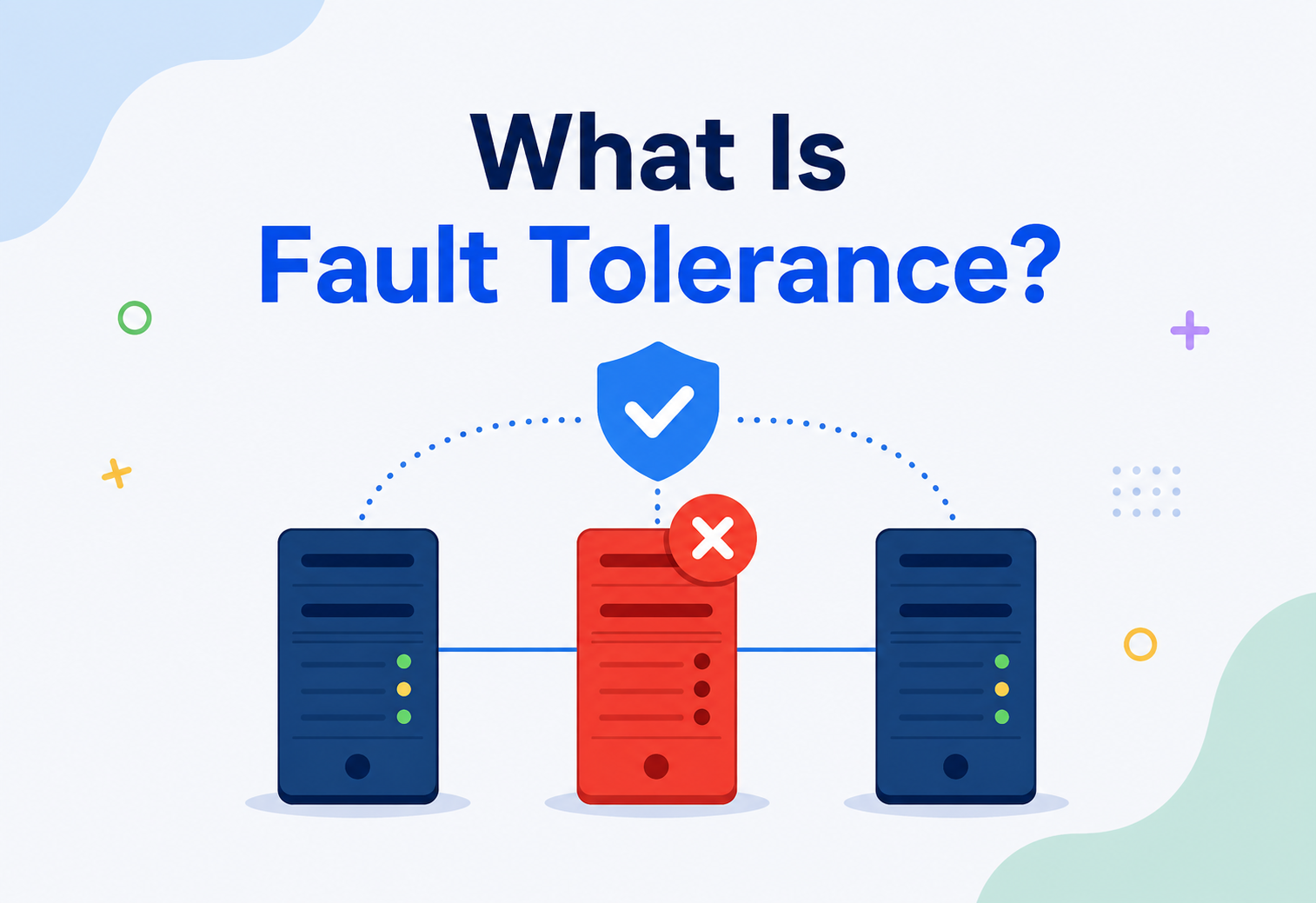
But retries have a dark side. If a failure affects many clients at once — say, a server briefly slows down under load — and all of those clients retry at the exact same moment, the retry attempts themselves arrive as a synchronized burst that can be just as damaging as the original problem, sometimes worse. This synchronized, self-inflicted burst is called a thundering herd or retry storm.
Jitter is the fix: deliberately adding randomness to the timing of retries so that clients spread their attempts out over time instead of firing all at once. It sounds almost too simple to matter, but jitter is one of those small ideas with an outsized effect on real-world system stability.
Imagine a power outage hits an entire apartment building, and the power comes back on at exactly 6:00 PM. If every single resident’s air conditioner, water heater, and oven switches back on at the very same instant, the building’s electrical system can get hit with a surge far bigger than if everyone’s appliances happened to restart at slightly different times. Utility companies actually design “cold load pickup” restoration with randomized delays for exactly this reason — jitter in retry strategies borrows the same fix for software systems.
A short history
The core idea of randomized backoff has deep roots — Ethernet’s original collision-detection protocol (CSMA/CD) from the 1970s used a randomized backoff so that two devices whose transmissions collided wouldn’t simply collide again immediately by retrying in lockstep. This is, in essence, jitter applied to network hardware decades before “retry storm” was a phrase used in web architecture.
As distributed web systems scaled up in the 2000s and 2010s, engineers kept rediscovering the same painful lesson: naive retry logic (fixed delay, or even exponential backoff without randomness) could cause cascading outages, because every client computing the exact same backoff formula from the exact same failure timestamp would retry in near-perfect synchrony. The most widely cited, influential treatment of this problem is Amazon’s 2015 “Exponential Backoff And Jitter” architecture blog post, which formalized several concrete jitter algorithms (full jitter, equal jitter, decorrelated jitter) that are still the reference implementations engineers reach for today, and which we’ll walk through in detail in this guide.
Today, jitter is considered a baseline requirement — not an optional nicety — for any retry logic running at meaningful scale, and it’s built directly into the default retry behavior of major cloud SDKs (AWS SDK, Google Cloud client libraries), API gateways, service meshes (Istio, Envoy), and resilience libraries (Resilience4j, Polly, Spring Retry).
Almost every real-world distributed system will eventually experience a partial degradation that triggers retries. Whether that degradation stays a two-second blip or becomes a twenty-minute outage often comes down to whether the retry logic was jitter-aware. Understanding this pattern is one of the highest-leverage reliability lessons a working engineer can internalise.
How a Retry Storm Actually Forms
To understand jitter, you first have to understand exactly how a retry storm forms — it’s a surprisingly natural, almost inevitable outcome of “obvious” retry logic done without care.
Step one · a shared failure hits many clients at once
Picture a service with 1,000 active clients, all calling the same downstream API. That API briefly slows down or returns errors — maybe due to a deploy, a garbage collection pause, or a transient network blip. Because all 1,000 clients were calling at roughly the same time, they all experience the failure at roughly the same time too.
Step two · naive retry logic computes an identical delay
If every client uses the same fixed retry delay — say, “wait exactly 2 seconds and try again” — then all 1,000 clients, having failed at nearly the same instant, will retry at nearly the same instant, 2 seconds later. The retries arrive as a synchronized wave.
Step three · the wave makes recovery harder, not easier
The cruel irony is that the very mechanism meant to help the system recover — retrying — becomes an additional, self-inflicted load spike arriving exactly when the downstream service is most fragile: mid-recovery. If the service was recovering and had, say, regained 30% of its normal capacity, a synchronized wave of 1,000 simultaneous retries can knock it back down, extending the outage far longer than the original blip would have lasted on its own.
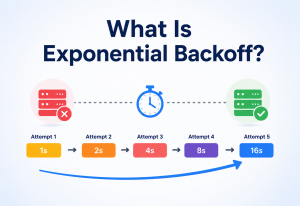
A common first instinct is: “let’s use exponential backoff instead of a fixed delay” — waiting 1s, then 2s, then 4s, then 8s, and so on. This helps reduce overall retry volume over time, but if every client computes the exact same exponential sequence from the exact same failure timestamp, they are still perfectly synchronized with each other at every step — just synchronized at increasingly spaced-out intervals. Exponential backoff, on its own, solves the wrong half of the problem: it reduces the number of retries but not their synchronization.
The core insight
The fix is to break the synchronization directly: instead of every client computing the same delay, each client should compute a randomized delay, so that even though they all failed at the same moment, their retries land spread out across a window of time rather than in one synchronized spike. This single idea — adding controlled randomness to retry timing — is what jitter is.
The Vocabulary You Need First
Let’s build a shared vocabulary before going further. Every term below will be used repeatedly in the rest of this guide.
Retry
Re-attempting a failed operation on the assumption the failure was transient (temporary) rather than permanent.
Backoff
Waiting before retrying, and typically increasing that wait time with each successive failed attempt.
Exponential Backoff
A backoff strategy where the delay grows exponentially with attempt number — e.g. 1s, 2s, 4s, 8s, 16s.
Jitter
Randomness deliberately added to a retry delay so that different clients’ retries don’t land at the same instant.
Thundering Herd
A surge of simultaneous requests or retries from many clients arriving at once, overwhelming a system.
Retry Storm
A thundering herd specifically caused by synchronized retry logic, often triggered by the original failure itself.
Base Delay
The starting wait time before the first retry, before any exponential growth or jitter is applied.
Cap / Max Delay
An upper bound on how long a backoff delay is allowed to grow to, preventing unbounded waits.
Max Attempts
The maximum number of retries allowed before giving up and surfacing the failure to the caller.
Idempotency
A property of an operation where repeating it produces the same result as doing it once — a prerequisite for safe retries.
Retry Budget
A cap on the overall proportion of traffic allowed to be retries, protecting the system even if individual retry logic is sound.
Circuit Breaker
A pattern that stops sending requests (and retries) entirely once a downstream service is detected as unhealthy.
Picture a school fire drill. If the alarm goes off and the instructions were “everyone exits through the front door in exactly 30 seconds,” you get a crowd crush at the door — a thundering herd. Good fire drill training instead teaches slightly different, spread-out timing per classroom (jitter), an increasing gap between waves if the first wave doesn’t clear (backoff), a rule that you stop trying that exit after 3 failed pushes and use another (max attempts), and a rule that if the door is clearly jammed shut, nobody keeps pushing at all (circuit breaker).
A quick tour of where retry-with-jitter shows up
You will rarely need to invent this logic entirely from scratch — nearly every mature language ecosystem and cloud platform has a tested implementation. Knowing the landscape helps you recognize the same handful of concepts wearing different names.
| Library / Tool | Ecosystem | Notes |
|---|---|---|
| Resilience4j | Java / JVM | Modern standard for retries, circuit breakers, and bulkheads; integrates with Spring Boot. |
| Spring Retry | Java / Spring | Annotation-driven retry (@Retryable) with configurable exponential backoff and jitter. |
| Polly | .NET | Popular resilience library supporting retry, jitter, circuit breakers, and bulkheading policies. |
| AWS SDK retry handlers | Multi-language (any AWS SDK) | Jittered exponential backoff built in by default for throttling and transient errors. |
| Envoy / Istio retry policy | Service mesh (any language) | Centralizes retry-with-jitter as infrastructure config rather than per-service code. |
| gRPC service config | Multi-language (any gRPC client) | Declarative retry policy with backoff multiplier applied by the RPC runtime itself. |
| Tenacity | Python | General-purpose retry decorator library supporting several jitter strategies out of the box. |
| node-retry / p-retry | Node.js | Widely used retry utilities supporting exponential backoff with randomized jitter factors. |
Despite different names and configuration styles, every one of these tools implements the same handful of ideas covered in this guide: classify the failure, compute a randomized delay bounded by a growing cap, and stop after a maximum number of attempts. Once you understand the concept once, reading any of these libraries’ documentation becomes fast, because you’re mapping onto vocabulary you already know.

The Layered Wrapper Around Every Retry
Retry-with-jitter logic is usually a small, self-contained piece of client-side code, but in a mature system it cooperates with several other components to actually be safe and effective.
Component breakdown
- Retry wrapper — the code (often a library like Resilience4j, Spring Retry, or a hand-rolled utility) that intercepts a failed call and decides whether and when to retry.
- Failure classifier — logic that distinguishes retryable failures (timeouts, 503s, connection resets) from non-retryable ones (a 400 Bad Request, a validation error) — retrying the latter wastes time and can mask real bugs.
- Backoff + jitter calculator — computes the actual delay before the next attempt, combining a growing base delay with a randomized component.
- Retry budget — a safety net that limits what fraction of total traffic is allowed to be retries, even if individual jitter math is correct, protecting against pathological cases like a permanently failing downstream dependency.
- Circuit breaker — a complementary pattern that stops attempts entirely (no retries at all) once a downstream dependency is confirmed unhealthy, rather than continuing to politely-but-persistently hammer it.
- Metrics/logging — records retry counts, delays, and outcomes, which (as covered later) are essential for detecting retry storms before they cause an outage.
A typical Java microservice calling another internal service wraps that call in a Resilience4j Retry instance configured with exponential backoff and jitter, itself wrapped in a Resilience4j CircuitBreaker, with both instruments exporting metrics to Micrometer/Prometheus — three cooperating components, not just “add a retry loop.”
Four Jitter Algorithms, Side by Side
Let’s get concrete about exactly how a delay is computed, walking through the major jitter algorithms from Amazon’s widely referenced architecture blog post, since these are the versions you’ll encounter in real libraries.
1. No jitter (the naive baseline)
delay = min(cap, base * 2^attempt)
Every client with the same attempt number computes the exact same delay. This is the synchronized-wave problem described earlier.
2. Full jitter
delay = random_between(0, min(cap, base * 2^attempt))
Instead of using the full exponential value directly, treat it as an upper bound and pick a uniformly random delay anywhere between zero and that bound. This spreads retries across the widest possible window, minimizing the odds of synchronization, at the cost of some retries happening quite early (close to zero delay) and others close to the full bound.
3. Equal jitter
temp = min(cap, base * 2^attempt)
delay = (temp / 2) + random_between(0, temp / 2)
Half of the exponential value is kept as a guaranteed minimum wait, and randomness is only applied to the other half. This guarantees some minimum backoff always happens (useful when you don’t want retries firing near-instantly) while still de-synchronizing clients.
4. Decorrelated jitter
delay = min(cap, random_between(base, previous_delay * 3))
Rather than being purely a function of the attempt number, each new delay is randomly chosen based on the previous delay, growing the random range as attempts continue. Amazon’s own benchmarking in the original blog post found this variant produced the best overall client latency and lowest total request count against a struggling service, of the options they tested — though “full jitter” remains simpler to reason about and is still an excellent default for most systems.
Java implementation
// Full jitter backoff calculator
public class FullJitterBackoff {

    private final long baseMillis;
    private final long capMillis;
    private final Random random = new Random();

    public FullJitterBackoff(long baseMillis, long capMillis) {
        this.baseMillis = baseMillis;
        this.capMillis = capMillis;
    }

    public long nextDelayMillis(int attempt) {
        long exponential = (long) (baseMillis * Math.pow(2, attempt));
        long bound = Math.min(capMillis, exponential);
        return (long) (random.nextDouble() * bound); // uniform in [0, bound)
    }
}
// Decorrelated jitter backoff calculator
public class DecorrelatedJitterBackoff {

    private final long baseMillis;
    private final long capMillis;
    private long previousDelay;
    private final Random random = new Random();

    public DecorrelatedJitterBackoff(long baseMillis, long capMillis) {
        this.baseMillis = baseMillis;
        this.capMillis = capMillis;
        this.previousDelay = baseMillis;
    }

    public long nextDelayMillis() {
        long upperBound = previousDelay * 3;
        long delay = baseMillis + (long) (random.nextDouble() * (upperBound - baseMillis));
        previousDelay = Math.min(capMillis, delay);
        return previousDelay;
    }
}
// Putting it together in a retry loop
public <T> T callWithRetry(Callable<T> operation, int maxAttempts) throws Exception {
    FullJitterBackoff backoff = new FullJitterBackoff(200, 10_000);
    Exception lastError = null;

    for (int attempt = 0; attempt < maxAttempts; attempt++) {
        try {
            return operation.call();
        } catch (RetryableException e) {
            lastError = e;
            long delay = backoff.nextDelayMillis(attempt);
            Thread.sleep(delay);
        } // non-retryable exceptions propagate immediately, uncaught here
    }
    throw new RetriesExhaustedException(lastError);
}
Never seed a shared Random instance with a fixed or predictable seed for jitter — that defeats the entire purpose, since predictable “randomness” from the same seed under the same conditions produces the same delays, recreating the synchronization problem jitter exists to solve. Use a properly seeded PRNG per instance, or a cryptographically secure source if you need stronger guarantees against adversarial synchronization.
Comparing the algorithms with concrete numbers
It helps to see what each formula actually produces. Assume base = 100ms, cap = 10,000ms, and we’re looking at attempt number 4 (so the raw exponential value before any jitter would be 100 * 2^4 = 1600ms):
| Strategy | Formula result at attempt 4 | Behavior |
|---|---|---|
| No jitter | Always exactly 1600ms | Every client waits identically — perfect synchronization. |
| Full jitter | Uniformly random between 0ms and 1600ms | Widest possible spread; some retries fire almost immediately. |
| Equal jitter | Between 800ms and 1600ms | Guarantees a minimum wait of half the exponential value, still spreads the rest. |
| Decorrelated jitter | Between 100ms and 3× the previous delay | Growth is driven by the actual previous delay, not just the attempt count, giving a different and often smoother spread across many attempts. |
Notice a key structural difference: full jitter and equal jitter both derive their bound purely from the attempt number, meaning two clients that happen to be on the same attempt number always share the same upper bound (even though the actual chosen delay differs). Decorrelated jitter instead grows organically from each client’s own randomly-chosen previous delay, so even the bound diverges between clients over successive attempts — one reason Amazon’s original benchmarking found it produced the lowest overall completion time under sustained load in their tests.
The State Machine Every Retried Call Moves Through
Every retried operation moves through a predictable sequence of states. Understanding this flow is what lets you reason correctly about edge cases like partial failures and exhausted retries.
Walking through a real request
Invocation
Application code calls a downstream service through a retry-wrapped client.
First failure
The call fails — say, with a connection timeout.
Classify
The failure classifier checks: is this the kind of error worth retrying? A timeout is; a 401 Unauthorized is not (retrying won’t fix bad credentials).
Budget check
Assuming it’s retryable, the wrapper checks the retry budget — if the service is in a broad, ongoing outage and retry volume is already high system-wide, it may deliberately skip retrying this particular call to avoid adding to the problem.
Compute delay
If budget allows, the backoff-with-jitter calculator computes a randomized delay based on the current attempt number.
Wait
The calling thread waits for that computed delay (ideally without blocking other work — see the Performance section).
Retry & exit
The operation is attempted again. This repeats until success, a non-retryable error, or max attempts being reached.
Retrying a request that will deterministically fail again — like one with malformed input — wastes time, adds load, and delays the caller from seeing the real, actionable error. Good retry logic always separates “this might work if I try again” from “this will never work no matter how many times I try,” and only applies backoff-and-jitter to the former category.
Advantages, Disadvantages & Trade-offs
Jitter is one of the cheapest, highest-leverage reliability upgrades available — but every engineering choice has a cost, and it’s worth being clear-eyed about both sides.
- Breaks synchronization — prevents many clients from retrying in lockstep and recreating the original failure.
- Smooths recovery load — spreads retry traffic over a window instead of a spike, giving a recovering service breathing room.
- Improves overall latency under load — Amazon’s benchmarks showed jittered strategies reduce total time-to-success across many clients versus non-jittered backoff.
- Cheap to implement — a few lines of randomization added to existing backoff logic; no new infrastructure required.
- Composable with other resilience patterns — works cleanly alongside circuit breakers, retry budgets, and timeouts.
- Slightly less predictable latency — any individual request’s retry timing becomes probabilistic rather than fixed, complicating some latency SLAs.
- Doesn’t fix an unhealthy downstream on its own — jitter smooths load but can’t rescue a service that’s fundamentally overloaded or down; circuit breakers and backpressure are still needed.
- Harder to reason about in tests — non-deterministic delays make some kinds of test assertions trickier; usually solved by injecting a seeded or mock random source in tests.
- Can mask systemic problems if overused — aggressive retrying-with-jitter can quietly paper over a real underlying reliability issue instead of surfacing it for a fix.
Jitter trades a small amount of per-request timing predictability for a large, usually decisive, reduction in the risk of a self-inflicted retry storm — but it’s a mitigation for synchronized load, not a substitute for fixing the underlying reliability of the downstream system.
When jitter matters less
It’s worth being honest about the boundary cases too. If a system has only a small, fixed number of clients that are unlikely to fail at the exact same instant — for example, a handful of internal batch jobs each on independent schedules — the synchronization risk jitter addresses is inherently lower, and the marginal benefit is smaller than in a large horizontally-scaled fleet. Similarly, if a downstream dependency has effectively unlimited headroom relative to any plausible retry volume, synchronized retries are less likely to cause real harm. Jitter remains cheap enough that most teams apply it universally regardless, but understanding why it matters more in some contexts than others helps prioritize where to spend tuning effort first.
Protecting a System’s Ability to Recover
Jitter’s effect on scalability is almost entirely about protecting a system’s ability to recover once it’s already under stress — which is precisely the moment scalability tends to matter most.
Why synchronized retries are worse than the original failure
A single transient blip — a garbage collection pause, a brief network partition — is usually a small, self-limiting event. What turns it into a multi-minute outage is very often the retry storm that follows, not the original blip itself. This is a well-documented pattern in real incident postmortems: the “second wave” caused by synchronized retries frequently causes more damage, and lasts longer, than the initiating event.
Little’s Law intuition applied to retries
Recall that a downstream service has a fixed real capacity — a certain number of requests per second it can actually process, tied to its CPU, threads, or connection pool (see the companion guide on connection pooling for the deeper mechanics). During a partial outage, that effective capacity may be temporarily reduced. Jitter’s scalability value is in keeping offered load close to, but not wildly exceeding, that reduced capacity during recovery — rather than periodically slamming it with synchronized spikes many multiples larger than it can currently absorb.
Suppose a service that normally handles 5,000 requests/second degrades to handling only 1,000 requests/second during a partial outage, and 4,000 clients experience a failure at the same instant. Without jitter, all 4,000 retry at the same computed delay — a spike of 4,000 requests hitting a system that can currently only absorb 1,000, guaranteeing a second wave of failures. With full jitter spreading those same 4,000 retries across, say, a 4-second window, the effective retry rate becomes roughly 1,000 requests/second — landing right at the reduced capacity instead of quadrupling it.
Jitter and horizontal scaling
In a horizontally scaled fleet — many client instances calling a shared downstream dependency — jitter’s benefit compounds with fleet size. A fleet of 5 instances synchronizing retries is a nuisance; a fleet of 5,000 instances (common in large microservice deployments) synchronizing retries can be catastrophic, since the retry spike scales linearly with the number of clients. This is exactly why jitter is treated as non-negotiable, baseline configuration in any SDK or client library meant to be used by large, horizontally-scaled fleets — the bigger your fleet, the more a synchronized retry storm can hurt, and the more jitter’s spreading effect helps.
| Symptom | Likely retry-related scalability implication |
|---|---|
| Load graph shows repeating spikes at regular intervals | Classic signature of synchronized, non-jittered retries. |
| Outage duration much longer than the triggering event | Retry storm is likely extending recovery time. |
| Error rate oscillates rather than steadily declining after a blip | Retry waves repeatedly re-triggering partial failure. |
| Smooth, gradually declining error rate after a blip | Healthy sign that jitter (and/or a circuit breaker) is doing its job. |
A common real-world pattern at scale: combine full jitter backoff at the client level with a retry budget (e.g. capping retries at 10% of total request volume) and a circuit breaker that stops attempts entirely once error rates cross a threshold — three layered defenses, because jitter alone smooths load but doesn’t cap it, and a circuit breaker alone stops all traffic rather than gracefully reducing it.
The retry amplification factor
It’s useful to think of retries as an amplification factor on top of your base offered load. If a dependency has a 5% failure rate and clients retry up to 2 times on failure, the effective load reaching that dependency isn’t simply the base request rate — it’s inflated by the extra attempts those failures generate. Roughly, if p is the per-attempt failure probability and n is the max retry count, the expected number of attempts per logical request is approximately 1 + p + p² + … + pⁿ, which stays close to 1 when p is small (a healthy system) but grows sharply as p rises — meaning the same retry configuration that’s harmless during normal operation can itself become a meaningful additional load source precisely when the dependency is already struggling and p is elevated. This is the mathematical heart of why jitter, retry budgets, and circuit breakers are complementary rather than redundant: jitter controls the timing of that amplified load, while a retry budget and circuit breaker control its magnitude and duration.
Jitter as One Layer of a Defence in Depth
Retry logic sits directly on the path of nearly every cross-service call, so getting its reliability behavior right has an outsized effect on overall system availability.

Failure handling patterns that pair with jitter
- Timeouts on every attempt — a retry strategy without a per-attempt timeout can leave a thread waiting indefinitely on a hung call; jitter controls the gap between attempts, but a timeout is what bounds any single attempt.
- Circuit breakers — once a downstream dependency is clearly unhealthy (not just occasionally slow), a circuit breaker stops sending requests entirely for a cooldown period, which is more effective than continuing to retry-with-jitter against something that isn’t recovering.
- Retry budgets / token buckets — a hard cap on the proportion of traffic allowed to be retries protects against pathological cases, like a bug that makes every request retryable, from turning into an amplifying feedback loop.
- Bulkheading — isolating retry behavior per downstream dependency so a storm caused by one flaky dependency can’t exhaust thread pools or connections needed for calls to healthy dependencies.
Retrying with jitter across multiple layers of a call chain (e.g. a gateway retries, and the service it calls also retries, and that service’s database client also retries) can produce a multiplicative explosion of actual attempts — a single user-facing failure can silently become dozens of real backend calls. This is a well-known distributed-systems trap; the fix is to make retry decisions at one clear layer of the stack (commonly the outermost client-facing layer) and disable or tightly cap retries at inner layers, or propagate a “don’t retry me, I’m already a retry” signal down the call chain.
Quantifying the amplification trap
The multiplication is worth spelling out with numbers, because it’s easy to underestimate. Suppose a call chain is four layers deep — a gateway calls service A, which calls service B, which calls a database client — and each layer independently retries up to 3 times on failure. In the worst case, a single failure at the database layer can trigger 3 × 3 × 3 × 3 = 81 real underlying attempts, even though from the gateway’s perspective it looks like “just a few retries.” Jitter smooths the timing of each individual layer’s retries, but it does nothing to prevent this multiplicative blow-up in raw count — that’s specifically what disciplined, single-layer retry ownership is for.
Many systems solve this by attaching a header or context flag (e.g. x-retry-attempt: true) to any outgoing call that is itself already a retry, and configuring inner layers to skip their own retry logic when they see that flag set. This keeps retry decision-making concentrated at one layer, typically the one closest to the original caller, where the full picture of “has this already been retried upstream?” is available.
Where Retry Logic Quietly Touches Security
Retry-with-jitter logic doesn’t look like an obvious security topic at first glance, but it intersects with security in a few concrete ways.
- Denial-of-service amplification — poorly designed retry logic (especially without a retry budget or circuit breaker) can turn a small, attacker-triggered failure into an amplified flood against your own downstream systems, effectively letting an attacker use your own clients as an unwitting DDoS tool against yourself.
- Randomness source — for most retry jitter, a standard non-cryptographic PRNG (like Java’s
java.util.RandomorThreadLocalRandom) is perfectly sufficient; jitter isn’t a security control, so there’s no need for the overhead of a cryptographically secure random source here. - Retrying on authentication failures — blindly retrying a 401/403 response can trigger account lockouts or rate-limit bans on the calling credential, turning a single legitimate failure into a self-inflicted lockout; auth failures should generally be excluded from the retryable-error classification described earlier.
- Idempotency keys and replay safety — for operations that aren’t naturally idempotent (like charging a payment), retries must be paired with an idempotency key so that a retried request is recognized as a duplicate and not accidentally executed twice, which is as much a correctness issue as a security one when money or irreversible actions are involved.
Retrying non-idempotent operations (like “charge this credit card” or “send this email”) without an idempotency mechanism can cause real, user-visible harm — duplicate charges, duplicate emails — precisely because jitter and backoff make retries safer for the system without automatically making the underlying operation safe to repeat.
Making Retry Behavior Visible
Because retry behavior is often invisible until it causes a problem, it deserves explicit, first-class monitoring.
| Metric | What it tells you |
|---|---|
| Retry rate (retries / total requests) | A rising retry rate is often the earliest sign of a downstream dependency degrading. |
| Retry success rate | Low success-after-retry suggests the downstream issue isn’t actually transient — a circuit breaker may be more appropriate than continued retrying. |
| Attempt count distribution | Reveals whether most calls succeed on the first try (healthy) or are routinely needing 3+ attempts (early warning sign). |
| Retry-induced load spikes | Correlating request-volume graphs with retry events reveals whether jitter is actually smoothing load as intended. |
| Circuit breaker state transitions | Frequent open/half-open cycling indicates a persistently unhealthy dependency, not a transient blip. |
// Example: exposing retry metrics via Micrometer + Resilience4j
@Bean
public RetryRegistry retryRegistry(MeterRegistry meterRegistry) {
    RetryRegistry registry = RetryRegistry.ofDefaults();
    TaggedRetryMetrics.ofRetryRegistry(registry).bindTo(meterRegistry);
    // exposes: resilience4j.retry.calls (tagged by kind: successful_without_retry,
    // successful_with_retry, failed_with_retry, failed_without_retry)
    return registry;
}
A good baseline alerting rule: page the on-call engineer if the retry rate for a given dependency crosses a threshold (e.g. more than 5% of calls needing a retry) sustained over a rolling window — this is often the clearest, earliest signal that a downstream dependency is degrading, well before end-user error rates climb enough to be noticed independently.
Good dashboards typically overlay retry volume on top of the request-volume graph for the same dependency, making it visually obvious whether retries are contributing a small, smoothed tail (healthy) or a large, spiky second hump (a sign jitter configuration or retry budgets need attention).
Correlating retries with distributed tracing
In a microservices environment, a single logical user request can span many internal calls, and understanding whether retries are helping or hurting often requires seeing the whole trace, not just an isolated metric. Distributed tracing systems (like OpenTelemetry, Jaeger, or Zipkin) can annotate each span with retry attempt number and computed delay, letting engineers visually see, for a single slow or failed request, exactly how many retries occurred, at which layer, and how much of the total end-to-end latency was consumed by backoff waiting versus actual work. This is often the fastest way to diagnose the call-chain amplification trap described above — a trace showing the same downstream call attempted a dozen times across nested spans is a much clearer signal than aggregate metrics alone.
Where Retry Policy Should Actually Live
Where and how a system is deployed changes how retry-with-jitter should be configured and where it should live.
Client-side vs. infrastructure-level retries
Retry-with-jitter can be implemented in application code, but it’s increasingly common to push it into shared infrastructure instead: service meshes like Istio (via Envoy proxy) and API gateways can apply retry-with-jitter policy uniformly across many services without each team hand-rolling their own logic, ensuring consistent behavior and centralized tuning.
Cloud SDKs
Major cloud provider SDKs — the AWS SDK, Google Cloud client libraries, Azure SDKs — ship with jitter-aware exponential backoff enabled by default for retryable errors (like throttling responses). It’s worth explicitly checking your SDK’s default retry configuration rather than assuming, since some older SDK versions or specific service clients may use simpler, non-jittered backoff, or defaults tuned for a different workload than yours.
Serverless considerations
In serverless environments (AWS Lambda, Cloud Functions), a burst of concurrent invocations triggered by an upstream retry storm can itself cause a secondary cost and throttling problem, since each invocation is billed and rate-limited independently. Jitter at the caller level reduces the odds of a burst of simultaneous invocations in the first place, which matters as much for cost control as for raw reliability in serverless architectures.
Message queues and asynchronous retries
Not all retries happen synchronously in the request path. Message queue systems (Amazon SQS, RabbitMQ, Kafka consumers) commonly implement retry-with-jitter for failed message processing through a combination of visibility timeouts and dead-letter queues: a message that fails processing becomes invisible for a randomized, growing period before becoming available for another consumer to attempt again, and after enough failed attempts is routed to a dead-letter queue for manual inspection rather than retried indefinitely. This is structurally the same jitter-and-cap pattern covered throughout this guide, just applied to asynchronous message redelivery instead of a synchronous network call — a useful reminder that the underlying principle travels well beyond the request/response calls used as examples elsewhere in this document.
Fleets, Fan-out, and Consistent Policy
In a microservices architecture, nearly every inter-service call is a candidate for retry-with-jitter, which makes consistent policy across the fleet especially important.
An OrderService calling an InventoryService wraps that call in retry logic with jitter, so a brief blip in InventoryService doesn’t cause OrderService’s calls to synchronize into a spike the moment InventoryService starts recovering.
The call-chain amplification trap described in the High Availability section is especially relevant in microservices, where a single user request can fan out into many internal service-to-service calls, each potentially wrapped in its own retry logic. A disciplined approach — deciding which single layer “owns” retry responsibility for a given call path, and propagating a marker so downstream layers know not to retry an already-retried request — is standard practice in mature microservice architectures.
gRPC and HTTP-level retry support
Modern RPC frameworks build jitter-aware retry directly into their client libraries: gRPC supports a declarative retry policy (including backoff multiplier and jitter) configured via service config, and HTTP clients built on top of resilience libraries expose similar configuration, meaning teams increasingly configure retry-with-jitter as data/config rather than hand-writing loop-and-sleep logic per call site.
// Example: gRPC service config retry policy (JSON), jitter is implicit
// in the exponential backoff multiplier applied by the gRPC runtime
{
  "methodConfig": [{
    "name": [{"service": "inventory.InventoryService"}],
    "retryPolicy": {
      "maxAttempts": 4,
      "initialBackoff": "0.2s",
      "maxBackoff": "5s",
      "backoffMultiplier": 2,
      "retryableStatusCodes": ["UNAVAILABLE", "DEADLINE_EXCEEDED"]
    }
  }]
}
Good Shapes and Familiar Traps
Patterns and anti-patterns cluster around retry logic in fairly predictable ways — being able to name them makes design reviews faster.
- Full jitter as a sane default — simple to implement and reason about, and effective for the vast majority of use cases.
- Layered defenses — combining jitter with retry budgets and circuit breakers, since each addresses a different failure mode the others don’t fully cover.
- Single-layer retry ownership — deciding explicitly which layer of a call chain performs retries, avoiding multiplicative retry explosions.
- Idempotency keys for non-idempotent operations — making retries safe at the business-logic level, not just the network level.
- Config-driven retry policy — expressing retry-with-jitter as declarative configuration (service mesh policy, gRPC service config) rather than duplicated ad-hoc code.
- Fixed-delay retries with no jitter — recreates synchronized retry storms exactly as described in the Problem section.
- Exponential backoff without jitter — still synchronizes clients at each successive backoff step, just at wider intervals.
- Retrying non-retryable errors (4xx client errors) — wastes time, adds load, and delays surfacing a real, actionable bug.
- Unbounded retries — no max attempts or cap; can retry forever against a permanently broken dependency, exhausting resources.
- Retrying at every layer of a deep call chain independently — multiplicative retry explosion.
- Retrying non-idempotent operations without an idempotency key — can cause duplicate charges or emails.
// ANTI-PATTERN: no jitter, no classification, no cap
while (true) {
    try {
        return operation.call();
    } catch (Exception e) {
        Thread.sleep(2000); // fixed delay — synchronizes every failing client
        // retries EVERY exception, including permanent ones; no max attempts
    }
}
// CORRECT: classified, capped, jittered
for (int attempt = 0; attempt < maxAttempts; attempt++) {
    try {
        return operation.call();
    } catch (RetryableException e) {
        if (attempt == maxAttempts - 1) throw e;
        Thread.sleep(backoff.nextDelayMillis(attempt)); // jittered, capped
    } // NonRetryableException is not caught here — propagates immediately
}
A Practical Playbook
The following practices distil what mature teams tend to end up doing after they’ve been bitten — ideally you can adopt them without the biting.
Default to full jitter
Simple, well-tested, and effective for the vast majority of retry scenarios.
Cap max delay and max attempts
Prevents unbounded waiting against a permanently broken dependency.
Classify errors before retrying
Only retry genuinely transient failures — never validation or auth errors.
Pair jitter with a circuit breaker
Jitter smooths load; a circuit breaker stops it entirely once a dependency is clearly unhealthy.
Own retries at one layer
Decide explicitly which layer of the call chain performs retries to avoid multiplicative retry explosions.
Use idempotency keys
For non-idempotent operations, keys make retries safe at the business-logic level, not just the network level.
Monitor retry rate as an SLI
Retry rate is often a leading indicator that signals a degrading dependency before user-facing errors climb.
Test with a seeded random source
Injecting a seeded PRNG in tests keeps jittered retry logic deterministic and assertable.
Rolling out or changing retry configuration safely
Retry policy is the kind of configuration that looks harmless but sits on the path of nearly every cross-service call, so changes deserve care:
Change one parameter at a time
Base delay, cap, and max attempts each have distinct effects; changing them together makes it hard to attribute a regression.
Roll out gradually
Apply new retry configuration to a small percentage of traffic first, watching downstream load and success rate before expanding.
Load-test failure scenarios
Deliberately inject failures in a staging environment to observe whether retry-with-jitter actually smooths the resulting load as intended — happy-path tests can’t reveal a retry-storm bug.
Document the reasoning
Note why a given base delay, cap, and max-attempts combination was chosen, so future engineers can tell when assumptions (like the downstream service’s real capacity) have gone stale.
Choosing sensible starting values
For teams implementing retry-with-jitter for the first time, a reasonable, well-tested starting point looks like: a base delay in the range of 100–250ms (long enough to give a transient blip a real chance to clear, short enough not to noticeably harm user-perceived latency on the first retry), a cap somewhere between 5 and 30 seconds depending on how tolerant the calling context is of a slow eventual failure, and a maximum of 3–5 attempts total. These starting values are deliberately conservative and should be tuned against real measured behavior of your specific downstream dependency — a dependency that reliably recovers within 500ms benefits from a tighter cap than one that occasionally takes tens of seconds to stabilize after a deploy.
Common mistakes, ranked by how often they show up in real incidents
- No jitter at all — fixed or purely exponential backoff that synchronizes clients perfectly.
- Retrying non-retryable errors — wasting cycles and load on failures that will never succeed.
- Unbounded retries — no cap on attempts or delay, against a dependency that’s genuinely down.
- Multiplicative retries across call-chain layers — each layer retrying independently, multiplying real load far beyond what’s visible at any single layer.
- No monitoring on retry volume — teams discover a retry storm from a full-blown outage instead of an early metric spike.
Where You Have Already Been Using Jitter
Once you know what to look for, jitter is everywhere — baked into the SDKs, meshes, and libraries you already run every day.

Amazon Web Services
AWS’s own 2015 architecture blog post, “Exponential Backoff And Jitter,” remains the most widely cited reference implementation for this exact topic, and the AWS SDK itself bakes jittered exponential backoff into its default retry behavior for throttling and transient errors across virtually every AWS service client.
Google Cloud
Google’s Site Reliability Engineering book explicitly discusses retry storms and thundering herds as a recurring, well-understood failure pattern, and Google Cloud client libraries implement jittered exponential backoff by default for retryable API errors, following the same underlying principle.
Netflix
Netflix’s Hystrix and its successor patterns in the broader resilience-engineering space (now largely represented by Resilience4j in the JVM ecosystem) popularized combining retries, circuit breakers, and bulkheading as layered defenses precisely because any single mechanism, jitter included, is not sufficient on its own against every failure mode.
Ethernet / IEEE 802.3
Long before “microservices” existed, Ethernet’s CSMA/CD collision-detection protocol used randomized exponential backoff so that two network devices whose transmissions collided wouldn’t simply collide again in lockstep — a direct hardware-era ancestor of the exact same idea applied in modern software retry logic.
The Questions That Come Up Every Time
Is jitter the same thing as exponential backoff?
No — they solve related but different problems. Exponential backoff reduces the total volume of retries over time by spacing them further apart; jitter breaks synchronization between different clients’ retries. The two are usually combined, but neither replaces the other.
Which jitter algorithm should I use by default?
Full jitter is a strong, simple default for most systems. Decorrelated jitter can perform slightly better in some benchmarks (per Amazon’s original testing) but is marginally more complex to implement correctly since it depends on the previous delay rather than just the attempt number.
Does jitter guarantee a downstream service won’t get overloaded?
No — jitter reduces the odds and severity of synchronized spikes, but it doesn’t cap total retry volume on its own. A retry budget and/or circuit breaker are still needed as an explicit safety net, especially against a dependency that stays unhealthy for an extended period.
Should client-side and server-side retries both use jitter?
Yes, wherever retries happen — client SDKs, service mesh proxies, background job queues — the same synchronization risk applies, so the same jitter principle should be applied consistently at every layer that performs retries.
Can jitter make testing retry logic harder?
It can, if tests rely on exact timing. The standard fix is to inject a seeded or mock random source in test environments so retry delays become deterministic and assertable, while production continues to use genuine randomness.
Does jitter matter for a system with only a handful of clients?
The risk scales with the number of synchronized clients, so a system with just a few callers faces much lower thundering-herd risk than a fleet of thousands — but jitter is cheap enough to implement that most teams apply it as a default regardless of current scale, since fleets tend to grow over time.
How is jitter different from randomized load balancing or randomized cache expiry?
They’re cousins, not the same mechanism, but they share the identical underlying motivation: avoiding synchronized behavior across many independent actors. Randomized cache TTLs (sometimes called “cache jitter”) prevent many cache entries from expiring at the same instant and causing a synchronized wave of cache-miss database load — structurally the same fix applied to a different trigger than retries.
Can jitter be applied to things other than network retries?
Yes — the same principle applies anywhere many independent actors might otherwise synchronize: scheduled batch jobs (add jitter to cron start times so thousands of jobs don’t all fire at the top of the hour), health check polling intervals, and cache expiration, to name a few common examples beyond network retries.
What to Remember Long After You Close This Guide
If you leave with only a handful of things, let them be these — they cover 90% of what jitter actually does for a real production system.
- Retrying failed operations is a natural, simple reliability technique — but naive retry logic can synchronize many clients into a “retry storm” that’s worse than the original failure.
- Jitter adds deliberate randomness to retry delays, spreading synchronized retries out over a window of time instead of a single spike.
- Exponential backoff alone reduces retry volume but does not fix synchronization — jitter is what specifically addresses the synchronization problem.
- Full jitter, equal jitter, and decorrelated jitter are the standard reference algorithms, each trading off simplicity against benchmarked performance under load.
- Jitter should always be paired with failure classification (only retry transient errors), a cap on attempts and delay, and ideally a circuit breaker and retry budget as layered defenses.
- The scalability payoff is real and measurable: jitter keeps retry-induced load close to a recovering system’s actual reduced capacity, instead of repeatedly spiking well past it.
- The risk of a retry storm scales with fleet size — the bigger your horizontally-scaled deployment, the more valuable jitter becomes.
- Multiplicative retries across nested call-chain layers are a well-known trap; retry ownership should be deliberate, not duplicated at every layer.
- Non-idempotent operations need idempotency keys alongside retry logic — jitter makes retries safe for the system, not automatically safe for the business operation being repeated.
- Retry rate and retry-success-rate are leading indicators worth dashboards and alerts of their own, often surfacing a degrading dependency before user-facing error rates do.
- The idea extends well beyond network calls — the same spread-things-out principle underlies randomized cache expiry, jittered cron schedules, and asynchronous message-queue redelivery, wherever many independent actors might otherwise synchronize.