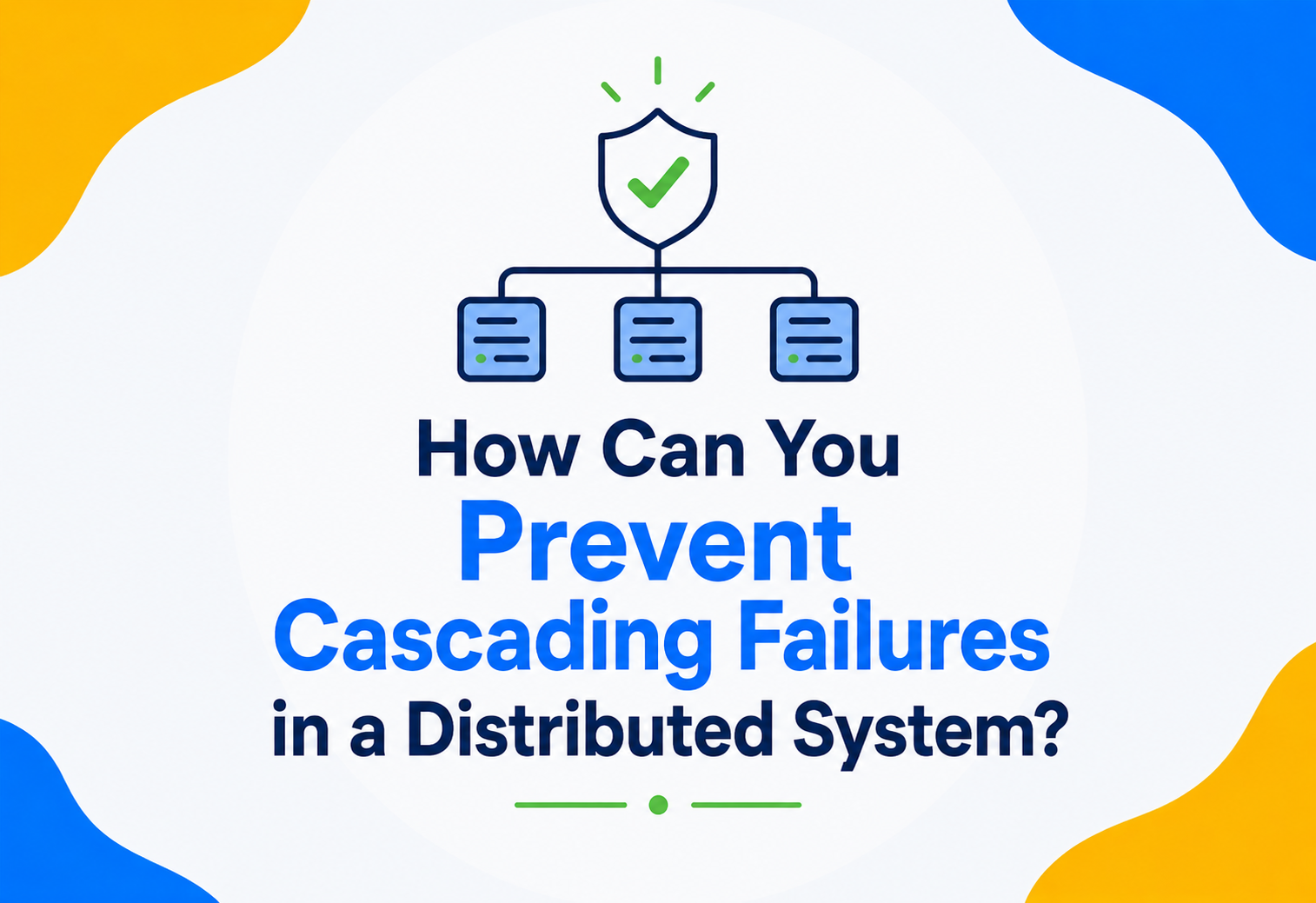
How Can You Prevent Cascading Failures in a Distributed System?
A complete, beginner-to-production guide to understanding why one small failure can bring down an entire system — and the battle-tested patterns (circuit breakers, bulkheads, timeouts, backpressure, load shedding, and more) that stop it from happening.
One Domino, One Thousand Dominoes
Imagine one tiny domino falling over. By itself, that is nothing — a single piece of wood tipping onto a table. But if you have lined up a thousand dominoes in a row, that one tiny fall knocks over the next one, which knocks over the next one, and within a few seconds all one thousand dominoes are lying flat. Nobody pushed all one thousand of them. One push was enough, because they were all connected in a chain.
A cascading failure in a distributed system is exactly this domino effect, except instead of wooden blocks, the dominoes are computers, servers and services — and instead of a few seconds, the collapse of an entire company’s website can happen in minutes.
A distributed system is simply a group of computers that work together, over a network, to look like one single system to the people using it. When you open an app like Amazon, Netflix or Swiggy, you are not talking to one computer. You are talking to hundreds or thousands of computers, each doing a small job — one checks your login, one shows you products, one processes your payment, one calculates delivery time, and so on. These computers depend on each other constantly, sending requests back and forth, the way departments in a large office depend on each other to get work done.
This dependency is powerful, because it lets each part of the system specialise and scale independently. But it is also dangerous, because if one part slows down or breaks, and nothing stops the damage from spreading, every part that depends on it can slow down or break too. That spreading of failure from one component to its neighbours, and then to their neighbours, is what engineers call a cascading failure.

A short history of the problem
Cascading failures are not a new invention of the internet age. Electrical engineers have studied them for over a century in power grids — a single transformer overheating in one city can trip breakers that overload transformers in a neighbouring city, which then trip more breakers, until an entire region goes dark. The famous Northeast United States blackout of 2003 started from a handful of overloaded power lines in Ohio and eventually left 50 million people without electricity within a few hours. The pattern in software is almost identical: one component gets overloaded, the systems around it try to compensate, and that compensation makes things worse instead of better.
In software specifically, cascading failures became a headline problem as companies moved from single, giant applications (called monoliths) running on one or a few large machines, to systems built from dozens or hundreds of small, independent services (called microservices) that all talk to each other over a network. In a monolith, if one internal function is slow, it mostly just slows down that one request. But in a microservices world, a request might travel through ten different services before a user sees a result, and if any one of those ten services becomes slow or unavailable, the failure can ripple outward to every other service that depends on it — and to every other request waiting behind it.
Companies like Netflix, Amazon and Google were among the first to hit this problem at massive scale, and much of what the industry now considers “best practice” for preventing cascading failures — circuit breakers, bulkheads, timeouts, retries with backoff, load shedding, chaos engineering — was born out of real production outages at these companies during the 2008–2015 period, as they scaled from a few services to thousands.
Whether you are building your first API or designing systems that serve millions of users, understanding cascading failures is one of the highest-leverage skills in software architecture. A system that stays up during a partial outage — showing “recommendations unavailable” instead of a blank white error page — is the difference between a company that survives a bad day and one that makes national news for the wrong reasons.
Why One Small Slowdown Can End a Whole Day
Why does this problem exist at all?
The problem exists because of one unavoidable fact: every computer, network and piece of software has limits. A server can only handle so many requests per second before its CPU, memory or network connections run out. A network can only carry so much data before it gets congested. A database can only process so many queries before its disk and connections are saturated. When traffic (the number of requests coming in) stays under these limits, everything works fine. The trouble begins the moment traffic — or slowness — pushes any single component past its limit.
Picture a restaurant kitchen with one chef who prepares a sauce that every dish on the menu needs. On a normal night, the chef makes sauce quickly and every dish comes out on time. Now imagine the chef gets a little slower — maybe the stove is acting up. Waiters keep bringing in the same number of orders, but now each order takes longer. Orders start piling up at the chef’s station. Other chefs, who need that sauce to finish their dishes, start standing around waiting, unable to plate anything. Customers wait longer, more of them complain, waiters spend more time apologising instead of taking new orders, and the whole restaurant grinds to a halt — even though only one small part (the sauce station) actually slowed down. That is a cascading failure in a kitchen.
The exact mechanics of a cascade
In software, the process usually goes through five recognisable stages:
- Trigger: One service becomes slow or unavailable. This could be caused by a spike in traffic, a bad code deployment, a database running out of connections, a network glitch, or simply a burst of unusually large requests.
- Local saturation: The requests trying to reach the slow service start piling up — either in a queue, or as open connections held by callers waiting for a response.
- Resource exhaustion in callers: Every other service that calls the slow one starts running out of its own resources — thread pools fill up, connection pools are exhausted, memory used to hold pending requests grows — simply because those resources are being held hostage waiting for a response that is not coming back quickly.
- Failure spreads upstream: Now those calling services are themselves slow or unresponsive, because all their capacity is tied up waiting. Any service that depends on them starts to experience the exact same symptoms.
- System-wide collapse: Within minutes, a problem that started in one small, possibly unimportant service (like a “recommended products” microservice) has taken down checkout, login and search — services that had nothing to do with the original failure.
Why “just add more servers” does not fix it
A common beginner instinct is: if a service is overloaded, just run more copies of it. This helps with pure capacity problems, but it does not stop a cascade by itself, for two reasons. First, adding servers takes time — auto-scaling systems typically take one to several minutes to detect load and spin up new instances, and a cascade can fully unfold in under sixty seconds. Second, if the root cause is a slow downstream dependency (like a struggling database), adding more application servers just means more servers get stuck waiting on that same slow dependency — you have multiplied the number of things stuck in the traffic jam, not cleared the jam.
Preventing cascading failures is not primarily about having more capacity. It is about containing damage — making sure that when one part of the system is unhealthy, the unhealthy part fails on its own, quickly and predictably, instead of dragging every other healthy part down with it.
The Vocabulary You Need First
Before we can prevent cascading failures, we need a shared vocabulary. Below are the essential concepts, each explained in plain language with an analogy, a simple example and how it appears in real software.
3.1 Timeout
What it is: a timeout is a maximum amount of time a caller will wait for a response before giving up and treating the call as failed.
If you call a friend and they do not pick up after 30 seconds of ringing, you hang up instead of holding the phone to your ear for an hour. That “I will wait 30 seconds and no more” rule is a timeout.
Why it exists: without a timeout, a caller can wait forever for a reply that may never come, tying up memory and threads indefinitely — this is one of the single biggest causes of cascading failures.
Software example: an HTTP client configured to wait a maximum of 2 seconds for a response from a payment API, after which it gives up and returns an error to the user instead of hanging silently.
Production example: Netflix’s internal service clients are configured with strict timeouts (often under a second) for calls between microservices, because a single slow call left unbounded can exhaust an entire service’s thread pool within seconds under load.

3.2 Retry (and retry storms)
What it is: when a call fails, a retry means trying the same call again, hoping it succeeds the second time.
If a phone call drops, you call back. That is a retry. But if a hundred people all call the same busy person back the instant their call drops, and that person’s phone can only handle a few calls at once, the constant retrying keeps the line permanently busy — that is a retry storm.
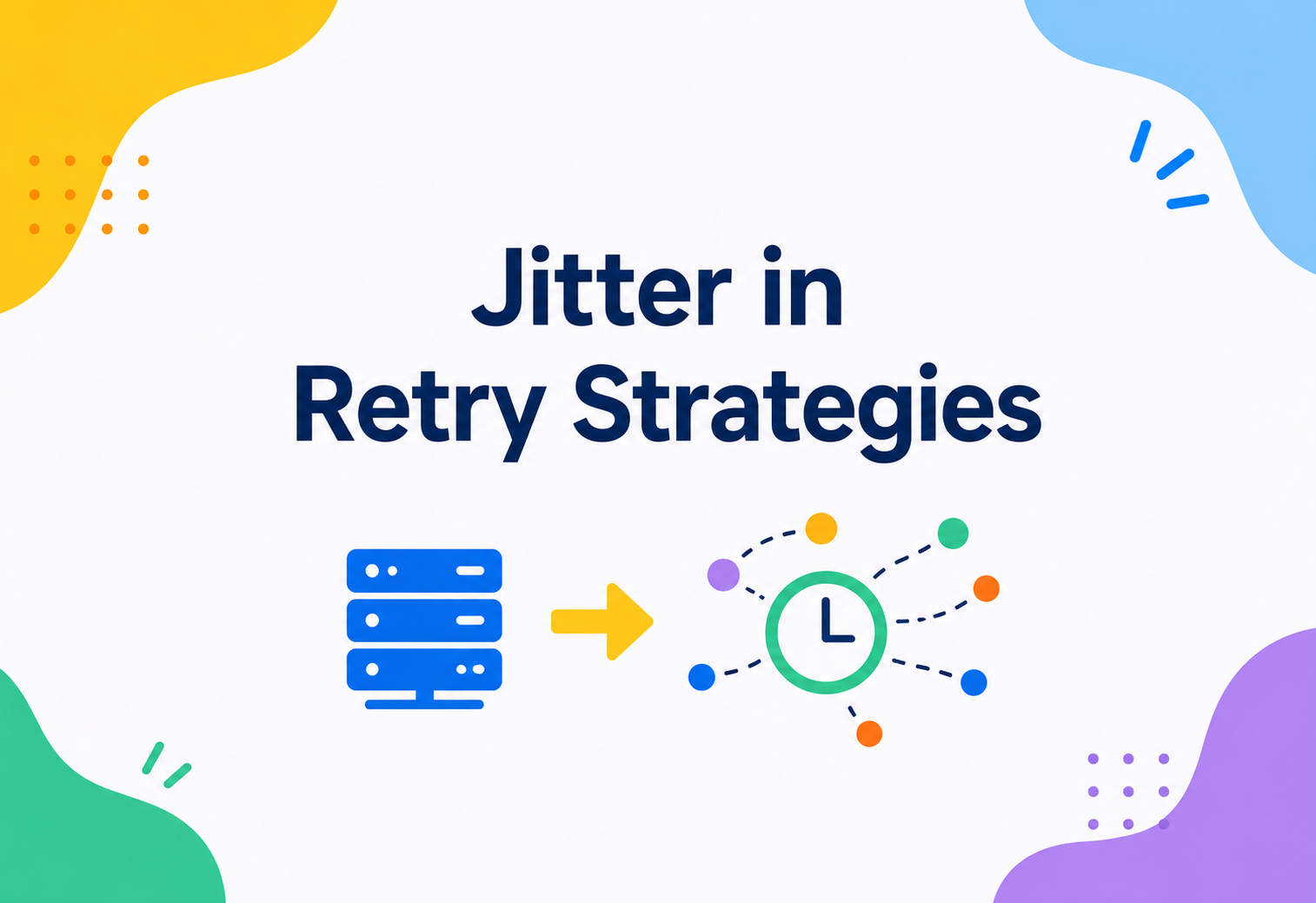
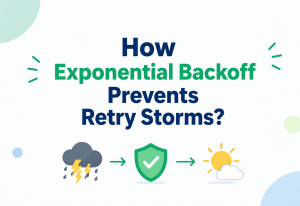
Why it is dangerous without care: a naive retry policy (retry immediately, retry many times, no limit) can multiply load on an already struggling service, turning a minor slowdown into a full outage. This is why retries must be combined with exponential backoff (waiting longer between each attempt) and jitter (adding randomness so many clients do not retry at the exact same moment).
3.3 Circuit Breaker
What it is: a circuit breaker is a safety mechanism that watches calls to a dependency, and when failures cross a threshold, it “opens” and stops sending further calls to that dependency for a while, failing fast instead.
It is named after the electrical circuit breaker in your home. If an appliance draws too much current (a short circuit), the breaker trips and cuts power to that circuit, protecting the rest of your house’s wiring from catching fire. It does not fix the appliance — it just stops the damage from spreading.
Software example: a circuit breaker library wrapping calls to an external weather API — if 50% of the last 20 calls failed, it “opens” for 30 seconds, immediately returning a fallback response for any call during that window instead of trying (and likely failing) again.
We will go deeper into circuit breaker states in the Architecture section below.
3.4 Bulkhead
What it is: a bulkhead isolates resources (like thread pools or connection pools) for different dependencies, so that one dependency running out of resources cannot starve the resources needed to call a different, healthy dependency.
Ships are built with watertight compartments called bulkheads. If the hull is punctured in one compartment, that compartment floods, but steel walls stop the water from flooding the entire ship. The Titanic famously had bulkheads, but they did not extend high enough — water spilled over the tops from one compartment to the next, which is part of why it sank despite the design.
Software example: giving the “recommendations” call its own pool of 10 threads and the “checkout” call its own separate pool of 50 threads, so that if recommendations hangs and exhausts its 10 threads, checkout’s 50 threads are completely unaffected.
3.5 Rate Limiting
What it is: rate limiting caps the number of requests a client (or the system as a whole) can make in a given time window, rejecting excess requests before they consume resources.
A nightclub bouncer only lets people in once the club is under its fire-safety capacity. It is better to have some people wait in a line outside than to let everyone in and have the building become dangerously overcrowded.
3.6 Load Shedding
What it is: load shedding means deliberately rejecting or dropping some requests when the system is overloaded, so that the requests which do get through can be served reliably.
Analogy: this is exactly like power companies conducting “rolling blackouts” during extreme heat waves — cutting power to a few neighbourhoods on a rotating basis so the entire grid does not collapse and leave everyone without power for days.
3.7 Backpressure
What it is: backpressure is a signal sent backward through a chain of components telling upstream callers to slow down, because a downstream component cannot keep up.
Analogy: when a highway on-ramp has a metering light that only lets one car merge every few seconds, that is backpressure protecting the highway from becoming a parking lot.
3.8 Graceful Degradation
What it is: designing a system so that when a non-critical part fails, the system keeps working with reduced functionality instead of failing completely.
Example: if Amazon’s “customers who bought this also bought” service is down, the product page still loads — it just does not show that section, instead of showing an error page for the whole site.
3.9 Idempotency
What it is: an operation is idempotent if performing it multiple times has the same effect as performing it once. This matters because retries can cause the same request to be processed more than once.
Example: “Set my account balance to ₹500” is idempotent — running it five times leaves the balance at ₹500. “Add ₹500 to my account balance” is not — running it five times adds ₹2,500. Payment systems use idempotency keys (a unique ID per logical request) so that a retried payment request is recognised as a duplicate and not charged twice.
| Concept | Protects Against | Analogy |
|---|---|---|
| Timeout | Waiting forever on a stuck call | Hanging up after 30 seconds of ringing |
| Retry with backoff | Giving up too early on transient blips | Calling back later, not immediately |
| Circuit breaker | Hammering a service that is already down | Electrical fuse tripping |
| Bulkhead | One dependency starving others of resources | Ship’s watertight compartments |
| Rate limiting | Being overwhelmed by too many requests | Club bouncer at the door |
| Load shedding | Total collapse under extreme load | Rolling blackouts |
| Backpressure | Producers overwhelming slow consumers | Highway on-ramp metering lights |
| Graceful degradation | A minor failure looking like a total outage | Restaurant removing a dish, not closing |
A Layered Defence, Not One Silver Bullet
Preventing cascading failures is not one single tool — it is a layered defence, similar to how a car protects passengers with seatbelts, airbags and crumple zones together, not just one of those things. Let us look at where each defensive component sits in a typical request path.
4.1 The Circuit Breaker’s internal state machine
A circuit breaker is not just a simple on/off switch — it moves through three distinct states:
- Closed: the normal state. Requests flow through to the dependency, and the breaker quietly counts successes and failures.
- Open: once failures cross a configured threshold (for example, 50% of the last 20 calls failed), the breaker “trips” open. Every call is immediately rejected with a fallback response, without even attempting to contact the struggling dependency. This gives the dependency room to recover, since it is no longer being hammered with traffic.
- Half-Open: after a cooldown period, the breaker allows a small number of trial requests through. If they succeed, it closes again and resumes normal traffic. If they fail, it goes back to open and waits longer before trying again.
4.2 Key architectural components
API Gateway
Single entry point for external traffic. Ideal place for rate limiting, authentication and coarse-grained request shaping before traffic reaches internal services.
Service Mesh
A network layer (Istio, Linkerd) that automatically applies timeouts, retries and circuit breaking to every service-to-service call, without each service having to implement this logic itself.
Thread / Connection Pools
Fixed-size pools of workers or connections. Sizing these correctly, and separating them per dependency (bulkheading), is central to containment.
Message Queue
Kafka or RabbitMQ decouple producers from consumers in time, acting as a shock absorber — producers can keep publishing even if a consumer is temporarily slow, up to the queue’s capacity.
Health Check Endpoints
Lightweight endpoints (/health, /ready) that load balancers poll to decide whether to keep sending traffic to an instance.
Fallback / Cache Layer
A cached or default response served when the real dependency is unavailable, so users see slightly stale data instead of an error.
What Happens Inside — With and Without Protection
Let us trace, step by step, what happens technically inside a service when a downstream dependency starts to misbehave, first without protection and then with it.
Without protection
- Service A receives a request and calls Service B over HTTP.
- Service B is overloaded and takes 45 seconds to respond instead of its usual 50 milliseconds.
- The HTTP client inside Service A has no timeout configured, so the calling thread blocks, waiting.
- Service A’s thread pool has, say, 200 threads. As more requests arrive needing Service B, more threads block in the same way.
- Within a minute, all 200 threads are blocked waiting on Service B. New incoming requests to Service A — even ones that do not need Service B at all — cannot get a free thread and start queueing or timing out.
- Service A’s own health check endpoint, which also needs a free thread to respond, starts timing out. The load balancer marks Service A as unhealthy and stops sending it traffic (or worse, keeps sending traffic that piles up further).
- Every service that calls Service A now experiences the exact same symptoms Service A experienced with Service B. The failure has propagated one hop further.
With protection (timeout + circuit breaker + bulkhead)
- Service A calls Service B with a strict 500 ms timeout.
- Service B is slow; the call is abandoned by Service A at the 500 ms mark, and Service A immediately receives a timeout exception instead of waiting 45 seconds.
- A circuit breaker wrapping the call to Service B notices repeated timeouts. After the failure threshold is crossed, it opens.
- All further calls to Service B fail instantly (in microseconds) without even attempting the network call, and a fallback (like a cached or default response) is returned.
- Because calls fail in milliseconds instead of blocking for 45 seconds, Service A’s thread pool is never exhausted — threads are freed almost immediately and can serve other requests.
- Because Service B’s calls used a dedicated bulkhead (say, 20 threads out of Service A’s 200), even during the brief window before the breaker opened, at most 20 threads could ever be blocked — the other 180 threads kept serving unrelated requests normally.
- Service A stays healthy. Its health checks pass. The load balancer keeps routing traffic to it normally. Users see a page with a missing “recommended items” section instead of a broken checkout.
Every technique for preventing cascading failures works by putting a hard, predictable ceiling on how much time, memory or resources a failure is allowed to consume — instead of letting a failure consume resources without limit.
Java example — timeout + circuit breaker + bulkhead with Resilience4j
import io.github.resilience4j.circuitbreaker.CircuitBreaker;
import io.github.resilience4j.circuitbreaker.CircuitBreakerConfig;
import io.github.resilience4j.timelimiter.TimeLimiter;
import io.github.resilience4j.timelimiter.TimeLimiterConfig;

import java.time.Duration;
import java.util.concurrent.*;

public class RecommendationClient {

    // Open if 50% of the last 20 calls fail, stay open 10s, then allow 5 trials.
    private final CircuitBreaker circuitBreaker = CircuitBreaker.of(
        "recommendationService",
        CircuitBreakerConfig.custom()
            .failureRateThreshold(50)
            .slidingWindowSize(20)
            .waitDurationInOpenState(Duration.ofSeconds(10))
            .permittedNumberOfCallsInHalfOpenState(5)
            .build()
    );

    // Never wait more than 500 ms for a response.
    private final TimeLimiter timeLimiter = TimeLimiter.of(
        TimeLimiterConfig.custom()
            .timeoutDuration(Duration.ofMillis(500))
            .build()
    );

    // Bulkhead: a dedicated, bounded pool for this dependency only.
    private final ExecutorService executor =
        new ThreadPoolExecutor(20, 20, 0L, TimeUnit.MILLISECONDS,
            new ArrayBlockingQueue<>(50));

    public List<String> getRecommendations(String userId) {
        Supplier<CompletableFuture<List<String>>> futureSupplier =
            () -> CompletableFuture.supplyAsync(
                () -> callRecommendationApi(userId), executor);

        Supplier<List<String>> decorated = CircuitBreaker
            .decorateSupplier(circuitBreaker, () -> {
                try {
                    return timeLimiter.executeFutureSupplier(futureSupplier);
                } catch (Exception e) {
                    throw new RuntimeException(e);
                }
            });

        try {
            return decorated.get();
        } catch (Exception e) {
            // Fallback: return an empty list instead of failing the whole page.
            return Collections.emptyList();
        }
    }

    private List<String> callRecommendationApi(String userId) {
        return recommendationHttpClient.fetch(userId);
    }
}
Notice three protections working together in this small example: a time limiter (timeout) capping the wait at 500 ms, a circuit breaker that stops calling the API entirely once it is clearly unhealthy, and a bulkhead (the dedicated, bounded thread pool with only 20 threads and a queue of 50) that guarantees this one dependency can never consume more than a small, fixed slice of the application’s total capacity.
Following a Single Request End to End
Let us follow a single request end-to-end through a well-protected system, and see exactly where each defence mechanism activates.
Lifecycle of a failing dependency, minute by minute
| Time | Without protection | With protection |
|---|---|---|
| T+0s | Dependency starts slowing down | Dependency starts slowing down |
| T+5s | Callers’ threads begin blocking | Timeouts trigger; calls fail fast at 500 ms |
| T+15s | Caller’s thread pool nearing exhaustion | Circuit breaker trips open; no more calls sent |
| T+30s | Caller unresponsive; health checks failing | Fallback responses served; caller stays healthy |
| T+60s | Upstream services also degrading | Users see partial functionality, not an outage |
| T+5min | Full site outage; on-call paged; incident declared | Breaker probes half-open, dependency recovers, traffic resumes normally |
Notice that in the protected scenario, the dependency itself may take just as long to recover in both cases — protection does not necessarily fix the root cause faster. What changes is that the rest of the system stays healthy while the root cause is being fixed, converting a full outage into a partial, contained degradation.
Advantages, Disadvantages & Honest Costs
Contained blast radius
A failure in one service stays local instead of spreading system-wide, dramatically reducing the scope and cost of incidents.
Faster recovery
Because unhealthy components fail fast instead of hanging, once the root cause is fixed, healthy callers resume normal operation within seconds via half-open probing — not minutes of manual intervention.
Better user experience
Users see graceful degradation (a missing feature) rather than a completely broken page, which preserves trust and revenue during incidents.
Predictable capacity planning
Bulkheads and rate limits make resource usage bounded and predictable, which makes capacity planning and cost estimation far more accurate.
Added complexity
- Every additional resilience mechanism is more code, more configuration and more failure modes of its own to understand and test.
Tuning is hard
- Timeouts set too aggressively cause false failures on legitimately slow-but-healthy calls.
- Set too loosely, they do not protect anything. Getting thresholds right requires real production data and iteration.
Fallbacks can mask real problems
- If fallback responses are too good, teams may not notice a dependency has been down for hours, delaying the actual fix.
Operational overhead
- Someone has to own, monitor and tune circuit breaker dashboards, rate limit configs and bulkhead sizes as the system evolves — this is ongoing work, not a one-time setup.
Key trade-off · availability vs consistency vs simplicity
Resilience patterns often trade strict correctness for availability. Serving a slightly stale cached response when a dependency is down means the user sees data that might be a few minutes old — usually a perfectly acceptable trade for continuing to function. But for some operations (like checking real-time account balance before a bank transfer), stale fallback data would be actively harmful, so different parts of the same system may need different resilience strategies depending on how critical correctness is for that specific operation.
Sizing, Algorithms & Real-World Overhead
Sizing thread pools and bulkheads
A common formula, adapted from Little’s Law, for sizing a bulkhead’s thread pool is:
pool_size = (requests_per_second) × (average_response_time_in_seconds) × (safety_margin)

// Example: a dependency handles 100 req/s, each taking 50 ms (0.05 s),
// with a 1.5x safety margin for spikes:
pool_size = 100 × 0.05 × 1.5 = 7.5 → round up to 8 threads
Undersized pools cause unnecessary rejections during normal traffic; oversized pools let a struggling dependency consume more of the application’s total resources than intended, weakening the bulkhead’s protective effect.
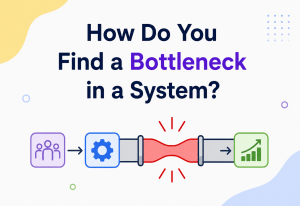
Rate limiting algorithms compared
| Algorithm | How it works | Best for |
|---|---|---|
| Fixed window | Counts requests in fixed time buckets (e.g. per minute) | Simplicity; can allow bursts at window edges |
| Sliding window log | Tracks exact timestamp of every request | Precision; higher memory cost |
| Token bucket | Tokens refill at a steady rate; each request consumes one | Allowing controlled bursts smoothly |
| Leaky bucket | Requests processed at a constant output rate regardless of input rate | Smoothing traffic to a strict, steady rate |
Performance impact of resilience patterns
Well-implemented circuit breakers and timeouts add negligible latency (typically well under 1 millisecond of overhead) to the healthy path, since they mostly just track counters. Their real performance benefit shows up during incidents: without them, response times during a partial outage can balloon to tens of seconds per request; with them, failing calls return in milliseconds, keeping the overall system’s throughput high even while one dependency is unhealthy.
Scalability consideration · distributed rate limiting
When a service runs across many instances behind a load balancer, a simple in-memory rate limiter on each instance does not produce a correct global limit — ten instances each allowing 100 requests/second results in 1,000 requests/second overall, not 100. Production systems typically use a shared, fast store like Redis with atomic increment operations to track request counts across all instances consistently.
Redundancy, Failover & Chaos Engineering
Redundancy · removing single points of failure
Cascading failures are far more likely when a system has single points of failure — one database, one server, one region — because there is no healthy alternative to fall back on. High-availability design runs multiple redundant copies of critical components (multiple database replicas, multiple service instances across different physical machines, sometimes multiple entire data centre regions) so that if one fails, traffic can be routed to a healthy copy without the user ever noticing.
Failover
What it is: automatically switching traffic from a failed component to a healthy standby.
A hospital’s backup generator that kicks in automatically within seconds of a power outage, so life-support machines never actually lose power even though the main electrical grid failed.
Chaos Engineering
One of the most important reliability practices to emerge from this problem space is chaos engineering — deliberately injecting failures into a production or production-like system to verify that resilience mechanisms actually work, before a real failure tests them for the first time. Netflix’s famous “Chaos Monkey” tool randomly terminates production instances during business hours, forcing engineers to build systems that tolerate individual instance failures as a matter of routine, not as a rare emergency.
Most cascading failures in real incidents happen because a resilience mechanism existed on paper but was misconfigured, disabled, or simply never tested under real failure conditions. Regularly and deliberately breaking things in a controlled way is the only reliable way to know your circuit breakers, timeouts and fallbacks actually work when it counts.
Disaster recovery and backup strategy
Beyond moment-to-moment resilience, systems need a plan for larger-scale disasters — an entire data centre or cloud region going offline. Key metrics here are RTO (Recovery Time Objective — how long can we be down?) and RPO (Recovery Point Objective — how much data can we afford to lose?). Multi-region deployments with regular data backups and tested failover runbooks are the standard approach for organisations where extended downtime is unacceptable.
Where Resilience and Security Overlap
Cascading failure prevention and security overlap more than people expect, because many resilience mechanisms are also the primary defence against a category of attack called Denial of Service (DoS).
Rate limiting as a security control
The same rate limiter that protects a system from an accidental traffic spike also protects it from an attacker deliberately flooding an endpoint with requests to overwhelm it. Rate limits are typically applied per user, per API key and per IP address, so that one bad actor’s traffic can be capped without punishing legitimate users.
Retry storms as an attack vector
Attackers who understand a system’s retry behaviour can sometimes deliberately trigger errors, knowing that clients will retry, in order to amplify a small amount of malicious traffic into a much larger wave of retried requests — this is sometimes called a “retry amplification” attack. Sensible backoff and retry budgets (a cap on total retries allowed system-wide in a time window) mitigate this.
Fallback responses must not leak information
A fallback or error response returned when a circuit breaker is open should never expose internal details — stack traces, database error messages, internal hostnames — since these give attackers a map of your internal architecture. Fallback responses should be generic and safe by default.
Authentication and authorization must fail closed, not open
While graceful degradation is good for non-critical features, a critical exception applies to authentication and authorisation checks: if the service that verifies whether a user is allowed to perform an action becomes unavailable, the system must deny the action by default (“fail closed”), never grant it by default (“fail open”). Bulkheading and circuit breakers protect availability, but they must never be configured in a way that turns a security check’s failure into an accidental bypass.
You Cannot Prevent What You Cannot See
Observability is what turns resilience patterns from theoretical protections into ones you can trust and tune with confidence.
Key metrics to track per dependency
- Latency percentiles (p50, p95, p99): averages hide problems — a p99 latency spike (the slowest 1% of requests) is often the earliest warning sign of a brewing cascade, well before averages move.
- Error rate: the percentage of calls failing, tracked per dependency, is the primary signal circuit breakers act on.
- Circuit breaker state: dashboards should show, in real time, which breakers are closed, open or half-open across the system.
- Thread / connection pool saturation: tracking “active threads / max threads” per bulkhead reveals resource exhaustion before it becomes total.
- Queue depth: a growing queue in front of a service is a leading indicator that the service cannot keep up with incoming work.
- Rate limit rejections: a sudden spike in 429 (Too Many Requests) responses reveals whether legitimate traffic or an attack is being throttled.
Distributed tracing
Because a single user request can pass through a dozen services, tools like Jaeger, Zipkin or AWS X-Ray attach a correlation ID to each request and record how long it spent in each service. During an incident, distributed tracing lets engineers pinpoint exactly which service in the chain introduced the slowdown, instead of guessing across a dozen dashboards.
Alerting philosophy
Good alerting for cascading-failure prevention distinguishes between symptom alerts (user-facing error rates, latency) and cause alerts (specific circuit breaker opened, specific pool saturated). Symptom alerts should page a human immediately; cause alerts help that human diagnose the problem quickly once paged. Alerting on every circuit breaker trip as a page, without context, trains engineers to ignore alerts — a phenomenon called “alert fatigue” that is itself a reliability risk.
Java example — exposing custom metrics with Micrometer
import io.micrometer.core.instrument.MeterRegistry;
import io.micrometer.core.instrument.Timer;

// @Service
public class RecommendationClient {

    private final MeterRegistry meterRegistry;

    public RecommendationClient(MeterRegistry meterRegistry) {
        this.meterRegistry = meterRegistry;
    }

    public List<String> getRecommendations(String userId) {
        Timer.Sample sample = Timer.start(meterRegistry);
        try {
            List<String> result = callRecommendationApi(userId);
            meterRegistry.counter("recommendation.calls", "outcome", "success").increment();
            return result;
        } catch (Exception e) {
            meterRegistry.counter("recommendation.calls", "outcome", "failure").increment();
            throw e;
        } finally {
            sample.stop(meterRegistry.timer("recommendation.latency"));
        }
    }
}
Progressive Delivery & Cloud-Native Guardrails
Progressive delivery · canary and blue-green
A large fraction of real-world cascading failures are triggered not by traffic spikes but by bad deployments — new code that behaves unexpectedly under production load. Two deployment strategies significantly reduce this risk:
- Canary deployment: new code is rolled out to a small percentage of traffic (say, 5%) first. Metrics are compared against the stable version, and the rollout only proceeds to 100% if the canary looks healthy — otherwise it is automatically rolled back.
- Blue-green deployment: two identical production environments exist (“blue” = current, “green” = new). Traffic is switched entirely from blue to green once green is verified healthy, and can be switched back instantly if problems appear.
Service mesh in cloud-native deployments
In Kubernetes-based deployments, a service mesh like Istio or Linkerd can apply timeouts, retries and circuit breaking uniformly across every service-to-service call via configuration, without each team writing this logic into their own application code. This is especially valuable in large organisations with many teams, since it guarantees a consistent baseline of protection rather than relying on every team to remember to implement it correctly themselves.
Kubernetes-native protections
- Resource requests and limits: capping CPU and memory per pod prevents one misbehaving service from starving others on the same node.
- Readiness and liveness probes: Kubernetes stops routing traffic to a pod that fails its readiness probe, and restarts pods that fail liveness probes, automatically removing unhealthy instances from rotation.
- Horizontal Pod Autoscaling (HPA): automatically adds pod replicas as load increases — a useful complement to, but not a replacement for, circuit breakers and bulkheads.
- Pod Disruption Budgets: ensure a minimum number of healthy replicas remain available even during voluntary disruptions like node upgrades.
Multi-region and multi-cloud deployment
For systems where an entire cloud region going down cannot be tolerated, deploying across multiple geographic regions (and sometimes multiple cloud providers) provides the ultimate bulkhead: an entire region’s failure is contained to that region, with traffic automatically routed to healthy regions via global load balancing (for example, AWS Route 53 health checks, Google Cloud’s Global Load Balancer).
Databases, Caching & Load Balancing
Connection pool exhaustion · a classic cascade trigger
Databases are one of the most common origin points for cascading failures, because every application server typically shares a limited number of database connections. If queries slow down (due to a missing index, a lock, or a burst of expensive queries), connections stay checked out longer, the pool empties, and every subsequent request — even ones needing a completely unrelated, fast query — has to wait for a free connection.
Setting a database connection pool size too high, thinking “more connections = more throughput,” often backfires. Too many concurrent connections can overwhelm the database’s own internal resources (CPU, locks, memory), making the problem worse, not better. Tools like PgBouncer for PostgreSQL exist specifically to pool and multiplex connections efficiently.
Read replicas as a bulkhead for read traffic
Directing read-heavy queries (like product listings or search) to read replicas, separate from the primary database used for writes (like checkout or payments), is itself a form of bulkheading — a surge in read traffic or a slow analytical query cannot exhaust the connections needed for critical write operations.
Caching as a shock absorber
A well-placed cache (using something like Redis or Memcached) in front of a database serves the vast majority of read requests without ever touching the database, dramatically reducing the load the database needs to handle and giving it far more headroom before it becomes a bottleneck. Caching also enables graceful degradation: if the database becomes unavailable, cached data can still be served (possibly marked as “may be slightly outdated”) rather than failing entirely.
If a popular cache entry expires and thousands of concurrent requests all miss the cache at the same instant, they can all hit the database simultaneously, causing exactly the kind of sudden load spike that triggers a cascade. Techniques like staggered expiration times, request coalescing (only one request actually queries the database while others wait for that result) and “stale-while-revalidate” caching all mitigate this.
Load balancing strategies
| Strategy | How it works | Cascading-failure relevance |
|---|---|---|
| Round robin | Requests distributed evenly in sequence | Simple, but can send traffic to an already-struggling instance |
| Least connections | Sends new requests to the instance with fewest active connections | Naturally avoids overloading an already-busy instance |
| Health-check aware | Removes unhealthy instances from rotation automatically | Directly prevents sending traffic into a black hole |
| Weighted / latency-based | Favours instances with lower observed latency | Reduces load on slowing instances before they fail completely |
Designing Interfaces That Do Not Cascade
Designing APIs for resilience
API contracts themselves can be designed to make cascading failures less likely. A few concrete practices:
- Pagination limits: capping how much data a single request can ask for prevents a single expensive request from consuming disproportionate resources.
- Explicit timeouts documented in the API contract: consumers should know exactly how long to wait before giving up, rather than guessing.
- Versioned, backward-compatible changes: a breaking API change deployed without warning is a very common trigger for unexpected downstream failures.
- Bulk / batch endpoints: allowing clients to request multiple items in one call, rather than issuing many individual calls, reduces the total number of requests during traffic spikes.
Synchronous vs asynchronous communication
Cascading failures spread fastest through synchronous, blocking call chains, where Service A waits directly on Service B, which waits directly on Service C. Asynchronous communication — using message queues or event streams instead of direct calls — decouples services in time, so a slow consumer does not directly block a producer. This is a major reason many microservice architectures shift non-urgent operations (like sending a confirmation email after checkout) to asynchronous, event-driven flows instead of synchronous API calls.
The Saga pattern for distributed transactions
In a microservices architecture, a single business operation (like placing an order) often needs to update multiple services’ data (inventory, payment, shipping). The Saga pattern breaks this into a sequence of local transactions, each with a defined compensating action to undo it if a later step fails — for example, if payment fails after inventory was already reserved, a compensating action releases that reserved inventory. This avoids holding long-lived distributed locks across services, which would themselves become a resource-exhaustion risk during any slowdown.
API Gateway as a central resilience layer
Placing rate limiting, authentication and coarse circuit breaking at the API gateway (the single entry point for external traffic) means these protections apply consistently to every request, and internal services can trust that a baseline of protection already exists before a request even reaches them.

Design Patterns & Anti-patterns
Proven patterns
Circuit Breaker
Covered in depth above — stops calling a known-unhealthy dependency.
Bulkhead
Isolates resources per dependency so one cannot starve another.
Retry with Exponential Backoff & Jitter
Retries failed calls but waits progressively longer between attempts, with randomness added to avoid synchronised retry storms across many clients.
Timeout
Bounds how long any single call is allowed to take.
Fallback / Default Response
Serves a safe, pre-defined response when the real one is unavailable.
Load Shedding
Deliberately drops lower-priority requests under extreme load to protect capacity for critical ones.
Backpressure
Signals producers to slow down when consumers cannot keep pace.
Health Check / Self-Preservation
A service actively monitors its own resource usage and can refuse new work (return 503) before it collapses entirely.
Common anti-patterns to avoid
Unbounded retries
- Retrying forever, or retrying immediately without backoff, actively amplifies load on a struggling service.
No timeouts anywhere
- Relying on default client library timeouts (which are sometimes infinite) instead of explicitly setting sensible ones.
Shared thread pool for all dependencies
- Without bulkheading, one slow dependency can consume every available thread meant for all other work.
Synchronous chains many levels deep
- Deep call chains (A→B→C→D→E, all synchronous) multiply the chance any single hop fails and the blast radius when it does.
Silent fallback with no monitoring
- Fallbacks that hide failures from dashboards mean an outage can persist for hours before anyone notices.
Testing resilience only in theory
- Configuring a circuit breaker but never actually testing it against a real failure (via chaos engineering) means you are trusting code that has never been proven to work.
When a dependency comes back online after an outage, every circuit breaker across every calling service may transition to half-open and send trial traffic at nearly the same moment, potentially overwhelming the just-recovered service all over again. Staggering half-open probe timing, and ramping recovered traffic up gradually rather than all at once, avoids re-triggering the same failure immediately after recovery.
Checklist & Common Mistakes
Best practices checklist
- Set a timeout on every network call, with no exceptions. Base it on real observed latency (for example, p99 latency × 1.5), not a guess.
- Wrap every external dependency call in a circuit breaker, with sensible failure-rate thresholds tuned from production data.
- Bulkhead resources per dependency, especially for dependencies with meaningfully different reliability or latency characteristics.
- Use exponential backoff with jitter for all retries, and cap the total number of retries.
- Design meaningful fallbacks for every critical call — even “return an empty list” is often better than failing the whole request.
- Rate limit at the edge to protect the whole system from traffic spikes and abuse.
- Load test and chaos test regularly, not just once during initial development.
- Monitor p99 latency and error rate per dependency, not just averages and overall uptime.
- Practise incident response — run game days where the team simulates and responds to a real cascading failure scenario.
- Document dependency criticality — know which calls are “must succeed” (payment) versus “nice to have” (recommendations), and treat them differently.
Common mistakes teams make
- Treating resilience as a one-time setup. Traffic patterns, dependencies and scale change over time; thresholds set correctly a year ago may be dangerously wrong today.
- Copy-pasting timeout values without understanding them. A 30-second timeout copied from a batch job into a user-facing API request is far too generous and will let cascades build up before it even triggers.
- Forgetting that health checks themselves need protection. If a health check endpoint shares the same overloaded thread pool as the rest of the application, it fails right when you need it most to correctly report “unhealthy.”
- Not testing the fallback path. A fallback that itself throws an exception (a bug in rarely-executed code) can be worse than no fallback at all.
- Ignoring dependency graphs. Not knowing which services indirectly depend on a given service makes it impossible to predict the blast radius of that service failing.
- Over-retrying idempotency-unsafe operations. Retrying a non-idempotent “charge customer” call can cause duplicate charges if the original request actually succeeded but the response was lost.
How Big Companies Learned These Lessons the Hard Way
Netflix and the birth of Hystrix
Netflix, migrating from a monolithic architecture to hundreds of microservices on AWS in the early 2010s, experienced repeated cascading failures where a single struggling service would take down large parts of their streaming platform. In response, they built and open-sourced Hystrix, one of the earliest widely-adopted circuit breaker libraries, along with their broader Simian Army suite of chaos engineering tools including Chaos Monkey. Hystrix has since been succeeded in the Java ecosystem by newer libraries like Resilience4j, but the architectural patterns it popularised — circuit breakers, bulkheads and fallback methods as first-class application concerns — remain industry standard today.
Amazon’s “everything fails all the time” philosophy
Amazon’s engineering culture, as described publicly by its architects, operates on the assumption that any individual component will eventually fail, and designs every service to expect and tolerate the failure of its dependencies rather than assuming they will always be available. This philosophy directly shaped AWS’s own infrastructure, including services like Amazon SQS (a managed message queue) that many companies use specifically to decouple services and absorb load spikes asynchronously.
Google’s approach · SRE and error budgets
Google’s Site Reliability Engineering (SRE) discipline introduced the concept of an “error budget” — an acceptable amount of unreliability (say, 99.9% uptime allows about 8.7 hours of downtime per year) that teams can deliberately spend on things like faster feature releases. This reframes reliability not as an absolute goal but as one that is explicitly balanced against velocity, with cascading-failure prevention mechanisms as key tools for staying within budget even as change accelerates.
Uber’s ringpop and cell-based architecture
Uber, operating a large real-time dispatch system, adopted a “cell-based” architecture pattern where the system is partitioned into independent cells (each serving a subset of users or a geographic region), so that a failure or overload in one cell cannot spread to others — an architectural-level bulkhead applied at massive scale.
A cautionary tale · the 2012 Knight Capital incident
While not purely a “cascading failure” in the microservices sense, the Knight Capital trading incident, where a botched deployment left old and new trading code running simultaneously, caused automated systems to execute a runaway sequence of unintended trades, resulting in a loss of over $460 million in about 45 minutes. It is frequently cited in resilience engineering literature as a stark example of how quickly automated systems without adequate safeguards (kill switches, canary deployments, rate limits on trading volume) can turn a small deployment mistake into a catastrophic, rapidly cascading event.
Wrap-Up & What to Remember
Frequently Asked Questions
Is a cascading failure the same as a single point of failure?
No. A single point of failure is a component whose failure alone takes down the whole system, because nothing redundant backs it up. A cascading failure is a process by which a failure in one component spreads to others through their dependencies — it can happen even in systems that have redundancy, if the failure propagates faster than the redundancy can compensate.
Do I need all of these patterns for a small application?
Not necessarily all at once. A small application with a handful of services should still set sensible timeouts and basic retry logic from day one, since these cost little to implement. Circuit breakers, bulkheads and chaos engineering become increasingly valuable as the number of services, dependencies and traffic grows — but it is far easier to build these habits early than to retrofit them into a system already struggling under production incidents.
Can a circuit breaker itself become a point of failure?
Yes, if misconfigured. A circuit breaker with too aggressive a threshold can trip on minor, harmless blips and unnecessarily degrade functionality that would have recovered on its own. This is why thresholds should be tuned using real production data, not guessed values, and revisited periodically.
What is the difference between a timeout and a circuit breaker?
A timeout limits how long a single call is allowed to take. A circuit breaker tracks the outcome of many calls over time and stops sending traffic entirely once a pattern of failure is detected. They work together: timeouts make individual failures fail fast, and circuit breakers use the resulting fast failure signal to detect and react to an unhealthy dependency.
Is load shedding unfair to the users whose requests get dropped?
In the short term, yes — some users experience an error instead of success. But without load shedding under extreme overload, the more likely outcome is that the entire system becomes unresponsive for every user, which is a worse outcome overall. Well-designed load shedding also tries to prioritise (for example, keeping checkout working while shedding less critical browsing traffic) rather than dropping requests randomly.
Summary
A cascading failure happens when one component’s slowdown or unavailability consumes the limited resources (threads, connections, memory) of everything that depends on it, spreading the failure outward until the whole system is affected — much like a line of falling dominoes. Preventing this requires a layered set of defences working together: timeouts to bound how long any call can take, circuit breakers to stop calling a known-unhealthy dependency, bulkheads to isolate resources per dependency, rate limiting and load shedding to protect the system from being overwhelmed, backpressure to let slow consumers signal producers to slow down, and graceful degradation to keep the system partially functional instead of completely broken. These patterns are supported by strong observability (latency percentiles, error rates, distributed tracing), careful deployment practices (canary releases, service meshes), sound database and caching architecture, and a culture of deliberately testing failure through chaos engineering rather than waiting for real incidents to reveal weaknesses.
Key Takeaways
- Cascading failures spread because unbounded waiting lets one slow dependency exhaust the finite resources of everything calling it.
- Prevention is about containing damage, not just adding capacity — a struggling component must be allowed to fail fast and in isolation.
- Timeouts, circuit breakers, bulkheads, rate limiting, load shedding, backpressure and graceful degradation are complementary, not interchangeable — production systems need several working together.
- Observability (percentile latency, per-dependency error rates, distributed tracing) is what makes these patterns tunable and trustworthy over time.
- Chaos engineering is the only reliable way to confirm resilience mechanisms actually work before a real incident tests them for you.
- Security and resilience overlap significantly — rate limiting and circuit breaking defend against both accidental overload and deliberate attacks, but critical checks like authorisation must always fail closed, never open.
- These are not “set and forget” mechanisms — thresholds, pool sizes and fallback behaviour need to be revisited as the system and its traffic patterns evolve.