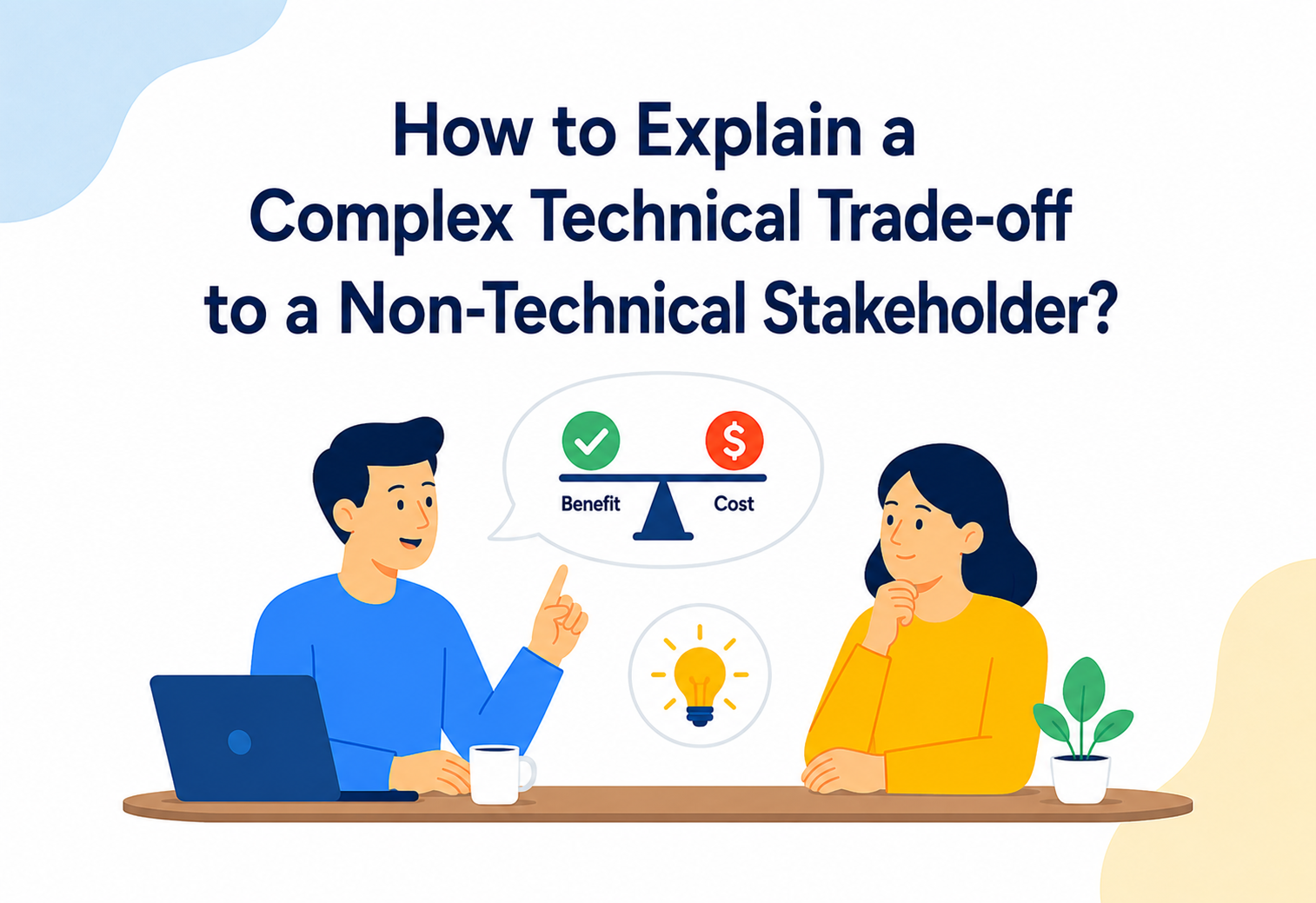
How to Explain a Complex Technical Trade-off to a Non-Technical Stakeholder
A ground-up guide to the skill that quietly decides whether good engineering judgment actually shapes a business decision — or gets nodded through, misunderstood, and revisited too late.
The Translation Skill Nobody Puts on a Roadmap
Picture an engineer walking into a planning meeting to explain why a new feature will take six weeks instead of the two the product manager was hoping for. The engineer says: “We need to refactor the authentication middleware to support horizontal sharding before we can safely add multi-tenant support, otherwise we risk race conditions under load.”
The room nods politely. Nobody understands a word of it, nobody feels equipped to push back or ask a good question, and the meeting moves on with a vague, uneasy sense that engineering is asking for “more time, for some reason.” Six weeks later, when the feature slips anyway because a genuinely hard problem surfaced mid-build, the business has no context for why, and trust erodes a little more. This scene, or something close to it, repeats constantly in organizations everywhere — and it is almost never caused by bad engineering judgment. It is caused by a translation failure.
Explaining a complex technical trade-off to a non-technical stakeholder is the skill of taking a decision that is genuinely difficult to reason about even for experts — one with real uncertainty, competing costs, and no perfect answer — and making its consequences, if not its mechanism, clear enough that someone without technical training can meaningfully participate in the decision. It is not “dumbing down” a technical topic. It is translating it, the way a skilled interpreter carries the true meaning of a sentence across a language barrier without losing what mattered in the original.
A ship’s engineer and a ship’s captain both need to understand why the vessel cannot simply go full speed through a storm. The engineer thinks in terms of hull stress, engine load, and fuel efficiency curves. The captain needs to know: how much slower, how much safer, and is it worth the delay to the passengers. Neither view is wrong, and neither can fully replace the other — the ship sails best when the two translate for each other clearly enough to decide together.
This distinction matters because it changes what “success” looks like. An explanation that leaves a stakeholder able to recite a technical term back correctly has not necessarily succeeded; an explanation that leaves a stakeholder able to reason, in their own words, about why one option costs more risk and the other costs more time — and to ask a genuinely sharp follow-up question about which risk matters more given something only they know about the business — has succeeded, even if not a single piece of technical jargon was ever used.

1.1 Where this skill comes from
This is not a new problem invented by the software industry, but software has made it unusually acute. In earlier eras of engineering — building bridges, ships, power plants — technical specialists and the business or government stakeholders funding them were often separated by similarly steep expertise gaps, and the practice of translating engineering risk into terms decision-makers could act on has a long history in fields like civil and aerospace engineering, where a miscommunicated trade-off can be catastrophic and highly visible (the loss of the Tacoma Narrows Bridge in 1940 and the Space Shuttle Challenger disaster in 1986 are both, in part, remembered as failures of technical risk being communicated clearly enough to decision-makers who could have acted on it).
This deep history matters for a simple reason: it means the challenge being addressed here is not a modern quirk of the software industry or a symptom of engineers being poor communicators. It is a structural feature of any collaboration between deep specialists and the people who must act on their findings, and it has been studied, refined, and formalized across multiple serious disciplines for nearly a century. Software engineers picking up this skill today are not inventing a new solution from scratch; they are joining a long, well-tested tradition.
Software engineering inherited this same fundamental challenge but multiplied its frequency: where a civil engineer might explain a major structural trade-off a handful of times across an entire career-defining project, a software engineer may face some version of this exact challenge weekly — in sprint planning, in roadmap reviews, in incident postmortems, in vendor negotiations. As software teams professionalized through the 1990s and 2000s, and as cross-functional collaboration between engineering, product, and business stakeholders became the default operating model (accelerated by the rise of product management as its own discipline and by agile methodologies emphasizing tight collaboration over long technical specifications), the ability to explain a trade-off clearly moved from a “nice soft skill” to a genuinely core professional competency — one companies like Amazon and Google now explicitly train, coach, and evaluate engineers on as part of promotion and leadership criteria.
Why This Deserves Deliberate Study
Why does this deserve careful, deliberate study rather than being left to instinct? Because when it goes wrong, it goes wrong in a small number of predictable, expensive ways.
2.1 Problem 1: Decisions get made without real understanding
When an explanation is too technical, a stakeholder often defaults to one of two unhelpful postures: rubber-stamping (“I trust you, just do what you think is best,” which removes their own valuable business judgment from a decision that genuinely needs it) or blanket resistance (“this sounds expensive and I don’t understand why, so let’s not,” which can block genuinely necessary technical work). Neither outcome reflects an actual, informed decision — both are symptoms of a communication gap being papered over rather than closed.
2.2 Problem 2: Trust erodes when consequences were not set correctly
If a trade-off’s real risk was not clearly communicated up front, the business is caught by surprise when that risk materializes later — a slower rollout, an unexpected bug, a security gap. From the stakeholder’s point of view, this often feels like “engineering did not warn us,” even when, technically, someone did mention it once, in a way that did not register as a real, concrete risk. Repeated enough times, this pattern quietly convinces business stakeholders that engineering’s estimates and warnings cannot be fully relied on — a reputational cost that is difficult to earn back.
2.3 Problem 3: Good judgment gets overridden in either direction
Without a shared, clear picture of the actual trade-off, decisions can swing too far in either direction: a business stakeholder might push for the fastest, cheapest option without understanding the real long-term cost being deferred, or an engineer might insist on the technically “purest” solution without appreciating a real business constraint (a looming contractual deadline, a competitor’s move, a regulatory requirement) that should reasonably change the calculus. The goal of a good explanation is not to win the stakeholder over to the engineer’s preferred answer — it is to make sure both sides are reasoning from the same real picture before a decision is made together.
A well-known pattern across the industry: technical debt or a shortcut taken under business pressure, without the long-term cost being clearly communicated at the time, frequently resurfaces twelve to twenty-four months later as a much larger, much more expensive problem — at which point the business is understandably frustrated that “nobody told us this would happen,” even though, in many cases, an engineer did try to say something, just not in a way that landed as a real, weighted business risk rather than routine technical grumbling.
The motivation for developing this skill deliberately, rather than leaving it to chance, is simple: the quality of a technical decision is capped by the quality of the shared understanding behind it. A brilliant technical analysis that never successfully reaches the person who needs to act on it has, for practical purposes, no more impact than no analysis at all.
The Vocabulary Behind the Skill
Before assembling techniques, it helps to name the five underlying concepts every good explanation quietly relies on.
3.1 Technical trade-off
What: A decision where improving one desirable property (speed, cost, flexibility, security) necessarily worsens another, with no option that maximizes everything at once.
Why it exists: Nearly every meaningful engineering decision involves finite resources — time, money, computing capacity, human attention — being allocated among competing goods.
Beginner example: Choosing between a quick, hacky fix now versus a slower, more robust rebuild later.
3.2 Mechanism vs. consequence
Mechanism: How something technically works — the actual gears turning, understood in engineering terms.
Consequence: What happens as a result, in terms a stakeholder already cares about — money, time, risk, customer experience.
A defining discipline of good stakeholder communication is deliberately leading with consequence and only including as much mechanism as is strictly necessary to make the consequence believable and specific.
3.3 The curse of knowledge
A well-documented cognitive bias in which someone with deep expertise in a topic finds it genuinely difficult to imagine what it is like not to know what they know — leading them to unconsciously skip explanatory steps that feel “obvious” to them but are, in fact, the exact steps a non-expert needs. Recognizing that this bias is active in yourself, by default, every time you try to explain something you understand deeply, is the single most important mental shift behind this entire skill.
3.4 Analogy and mental model
An analogy borrows a structure the listener already understands (a bridge, a kitchen, a filing cabinet) to stand in for an unfamiliar technical structure, letting the listener reason about the new idea using intuitions they already have. A good analogy does not need to be technically perfect — it needs to correctly transfer the one or two properties of the trade-off that actually matter for the decision at hand.
3.5 Framing
How a trade-off is presented — which details are foregrounded, which comparison is used, which order the options are listed in — measurably shapes how a stakeholder perceives its risk, even when the underlying facts are identical. Framing is not manipulation when done honestly; it is an unavoidable and legitimate part of communication, and a skilled communicator uses it deliberately rather than by accident.
Jargon: “We’re currently using synchronous replication across all three regions, which adds roughly 80ms of write latency per request.”
→ Plain: “Every time someone saves something right now, it takes a small extra fraction of a second — because we’re double-checking it is saved correctly everywhere before confirming.”
Jargon: “This library has a known memory leak in its connection pooling under high concurrency.”
→ Plain: “There’s a tool we’re relying on that slowly uses up more computer memory over time under heavy traffic, and eventually it needs a restart — like a car that needs an oil change more often than it should.”
Architecture & Components
A well-constructed explanation of a technical trade-off, like a well-constructed document, has recognizable, purposeful parts. Skilled communicators rarely improvise this structure from scratch each time — they reach for a repeatable shape.
4.1 The one-sentence headline
The single most important sentence in the entire explanation, delivered first: a plain-language statement of the actual decision at hand, before any supporting detail. “We can ship this feature in two weeks with a real risk of occasional slowdowns during peak hours, or in five weeks with much stronger reliability guarantees.” Everything that follows supports or elaborates this one sentence — it should never be buried at the end.
4.2 The stakes
A brief statement of why this decision actually matters to the business — what is at risk, who is affected, and how big a deal it really is. This calibrates the stakeholder’s attention correctly: a trade-off worth five minutes of discussion should not be introduced with the same weight as one worth an hour of discussion.
4.3 The options, framed symmetrically
Each realistic option is described with the same structure — what it costs, what it buys — so the stakeholder can compare them fairly rather than having one option described enthusiastically and the alternative described dismissively (a common, usually unconscious bias when the engineer already has a preferred answer).
4.4 The anchor: an analogy or comparison
A single, well-chosen analogy or comparison that lets the stakeholder reason about the trade-off using an intuition they already have — covered in depth in Section 3.4 and Section 8.
4.5 The recommendation, clearly labeled as a recommendation
An explicit statement of what the engineer suggests, and why — clearly separated from the neutral description of the options, so the stakeholder knows exactly which part of the conversation is fact and which part is judgment they are free to weigh in on or push back against.
4.6 The invitation to ask
A closing, genuine invitation for questions — not a rhetorical “any questions?” tossed out while already packing up, but a real pause that signals the engineer expects and welcomes pushback, since the whole point of the explanation was to enable a real, two-way decision rather than deliver a verdict.
Headline
The plain-language decision, stated first in a single sentence.
Stakes
Why this matters and roughly how much.
Options
Each realistic path, described with the same structure.
Anchor
One clear analogy or comparison that transfers the key property.
Recommendation
Explicitly labeled as opinion, not fact.
Invitation
A real pause that expects pushback and follow-up questions.
Fig. 1 — The anatomy of a stakeholder-ready explanation, in the order it should typically be delivered.
“We can launch the new checkout flow in two weeks using our current payment provider, or in five weeks after switching to a more reliable one. [Headline] Checkout failures directly cost us sales, and our current provider has had two outages in the last six months. [Stakes] Staying with the current provider means faster launch but a real chance of another outage during a busy sales period; switching means a longer wait but meaningfully lower risk of that happening. [Options] It is a bit like choosing between renewing with a caterer who has been unreliable twice this year versus booking a more dependable one who needs more lead time. [Anchor] My recommendation is to take the extra three weeks, given how much revenue rides on checkout working during peak periods — but I want to hear if there is a business reason the two-week timeline matters more than I realize. [Recommendation + Invitation]”
4.7 Ordering the components for different meeting formats
The six components above represent an ideal, complete structure, but real conversations rarely unfold as a clean, uninterrupted monologue. In a fast-moving standup or a hallway conversation, an engineer might only get through the headline and the recommendation before being asked a direct question, with the stakes, options, and anchor woven in reactively as follow-ups arise. In a formal steering-committee review, by contrast, all six components might be written out in advance as a short document, read in full before any discussion begins. Recognizing which format you are in — and adapting the pacing of the six components accordingly, without dropping any of them entirely — is itself part of the skill; a headline-and-recommendation-only version delivered in a formal review can feel abrupt and under-explained, while a full six-part version delivered in a two-minute hallway conversation can feel like a presentation nobody asked for.
4.8 Visual aids as a seventh, optional component
For trade-offs involving a genuine numeric comparison — cost over time, risk probability, performance under different loads — a single simple chart or diagram can do more work than several sentences of description, precisely because it lets a stakeholder see the shape of a trade-off (a rising cost curve, a widening gap between two options) rather than having to construct that shape mentally from spoken numbers. The key discipline here is restraint: one clear, simply labeled visual showing exactly the comparison that matters, not a dense technical chart borrowed directly from an engineering dashboard, which often reintroduces the exact jargon and cognitive overload the rest of the explanation was designed to avoid.
How Non-Technical Minds Actually Process a Trade-off
Understanding what is happening inside a listener’s mind while they process an unfamiliar technical trade-off explains why certain explanation techniques consistently work better than others.
5.1 Cognitive load and working memory
Human working memory can hold only a handful of new, unfamiliar pieces of information at once — often cited as somewhere around four to seven discrete “chunks.” Every unfamiliar term introduced (sharding, middleware, race condition) occupies one of these precious slots, competing directly with the stakeholder’s ability to actually reason about the decision itself. This is the concrete, cognitive-science reason jargon-heavy explanations fail: it is not that the listener is unintelligent, it is that their limited working memory is being spent parsing vocabulary instead of evaluating a trade-off.
5.2 Schema activation via analogy
When a listener hears a well-chosen analogy, their brain activates an existing, richly detailed mental structure (a “schema”) they already deeply understand — a kitchen, a bridge, a filing cabinet — and can immediately reason within it, without spending working memory building a brand-new mental model from scratch. This is why a good analogy does not just make an explanation more pleasant; it measurably reduces the cognitive effort required to actually understand and reason about the trade-off.

5.3 Loss aversion and framing effects
Behavioral-science research (notably the work of psychologists Daniel Kahneman and Amos Tversky) shows people weigh potential losses more heavily than equivalent potential gains, and that how a choice is framed — as an avoided loss versus an achieved gain — measurably changes decisions, even when the underlying facts are unchanged. “This choice avoids a 10% chance of an outage” and “this choice gives us 90% uptime” describe the identical fact but often land very differently — a skilled communicator is aware of this and frames the trade-off honestly rather than exploiting the bias to push a particular answer.
5.4 The credibility check
Non-technical stakeholders often, quite reasonably, cannot evaluate the technical accuracy of an explanation directly — so they instead look for proxy signals of credibility: does the explanation acknowledge trade-offs and downsides honestly, rather than presenting only one side? Does the speaker seem to understand the business stakes, not just the technical mechanism? Does a similar explanation, given previously, turn out to have been accurate in hindsight? Building this kind of track record of honest, calibrated communication is, over time, what earns an engineer the standing to be trusted on judgment calls the stakeholder genuinely cannot verify themselves.
5.5 The role of emotional state and meeting context
How a trade-off is processed also depends heavily on the listener’s emotional and situational state at the moment it is explained — a stakeholder hearing about a risk calmly during routine planning processes it very differently than the same stakeholder hearing about the same risk in the middle of an active incident, under time pressure, with their own leadership asking them pointed questions. Under stress, working memory capacity effectively shrinks further, and the tolerance for anything resembling a tangent or an unnecessary technical detour drops sharply. This is why experienced engineers deliberately simplify further — sometimes to just the headline and recommendation, with supporting detail offered only if asked — during live incidents, reserving the fuller six-part structure from Section 4 for calmer, more deliberate planning conversations where there is room to unpack nuance.
5.6 Repetition and the illusion of understanding
A well-documented effect in learning research is that repeated exposure to an explanation increases a listener’s felt sense of understanding faster than it increases their actual understanding — meaning a stakeholder who has heard a trade-off explained twice may feel confident they understand it well, without actually being able to reconstruct or apply that understanding independently. This is precisely why the verification technique described in Section 6.7 (asking the stakeholder to restate the trade-off in their own words) is so much more reliable than simply asking “does that make sense?”, a question whose “yes” answer is compatible with both real understanding and this illusion of understanding, and therefore reveals almost nothing on its own.
Preparing, Delivering, Refining
A strong explanation, like a strong presentation or a strong piece of writing, moves through a lifecycle — and skipping stages is the most common reason a technically sound trade-off gets poorly received.
Understand deeply yourself
You cannot simplify what you do not fully grasp — vague explanations usually come from vague understanding.
Identify the audience
A CFO, a PM and a support lead care about very different consequences of the same technical fact.
Choose analogy & framing
Reach into your toolkit for one that correctly transfers the property that matters.
Draft the headline
Write the single sentence first — if it is hard to write, the trade-off is not yet clear in your own mind.
Test on a non-expert
Say it out loud to a friend or colleague from a different discipline before the real conversation.
Deliver & adapt live
Watch for confusion in real time, and be willing to switch angle mid-flight.
Refine the toolkit
Note what worked; fold it back in for next time.
Fig. 2 — The lifecycle of a stakeholder-ready explanation, from raw technical understanding to a tested, refined delivery.
6.1 Stage 1: Understand the trade-off deeply yourself first
It is impossible to simplify something you do not fully understand — attempts to do so tend to produce explanations that are vague rather than genuinely simple. The first stage is making sure you, the engineer, can articulate the real trade-off precisely, including its edge cases and its genuine uncertainty, before attempting to translate it for anyone else.
6.2 Stage 2: Identify the specific audience
A CFO, a product manager, and a customer-facing support lead care about very different consequences of the same technical trade-off — cost, timeline, and customer experience, respectively. Tailoring which consequence you foreground to the specific person in front of you is a deliberate, necessary step, not an afterthought.
6.3 Stage 3: Choose the right analogy and framing
Drawing on a personal toolkit of tested analogies (Section 8), select or adapt one that correctly transfers the one or two properties of the trade-off that matter most for this specific decision.
6.4 Stage 4: Draft the one-sentence headline
Before drafting the full explanation, write the single sentence that captures the actual decision in plain language. If this sentence is hard to write, that is a signal the trade-off itself is not yet fully clear in your own mind — a valuable diagnostic, not just a delivery step.
6.5 Stage 5: Test the explanation on a genuine non-expert
Before the real, high-stakes conversation, explain the trade-off out loud to a friend, a family member, or a colleague from a different discipline, and watch closely for confusion, glazed eyes, or the wrong question coming back — all signs the explanation needs another pass.
6.6 Stage 6: Deliver, listen, and adapt live
In the real conversation, deliver the prepared explanation but stay genuinely responsive — watching for confusion in real time and being ready to try a different angle or analogy if the first one visibly is not landing, rather than repeating the same explanation more slowly or more loudly.
6.7 Stage 7: Refine the toolkit afterward
After the conversation, note which analogy worked, which question came up that you had not anticipated, and fold that lesson back into your personal toolkit for next time — treating this as an ongoing skill built over many conversations, not a one-time trick.
Believing an explanation “worked” simply because the stakeholder nodded and did not ask any questions. Silence is not the same as understanding — it is frequently the opposite, a signal that the listener felt too lost to even formulate a good question. A real test of whether an explanation landed is whether the stakeholder can, afterward, restate the trade-off and its consequence in their own words.
6.8 Handling the moment understanding visibly breaks down
Even a well-prepared explanation sometimes visibly loses the room — a furrowed brow, a question that reveals a fundamental misunderstanding, a long pause where enthusiasm was expected. The instinct in this moment is often to simply repeat the same explanation more slowly, but this rarely works, since the problem usually is not pacing, it is that the chosen analogy or framing did not correctly transfer for this particular listener. A more effective response is to pause, acknowledge directly that the explanation is not landing (“let me try a different way of putting this”), and switch to a genuinely different analogy or angle rather than a slower version of the same one. This kind of visible adaptability, rather than being a sign of weakness, is usually read by stakeholders as a sign of real communication skill and genuine care about being understood, which itself builds trust.

6.9 Documenting the decision after it is made
Once a trade-off has been discussed and a decision reached, a short written record — even just a few sentences in a shared document or a follow-up message — capturing the options considered, the reasoning, and the decision itself pays for itself many times over. This record becomes invaluable if the decision is questioned months later, if the original stakeholder moves to a different role and someone new inherits the project, or if the trade-off needs to be revisited as circumstances change. Skipping this step is a common reason the exact same trade-off ends up being re-explained, from scratch, more than once.
Even the Explanation Style Has Its Own Trade-offs
Even the strategy of “how to explain” involves its own trade-offs, worth weighing deliberately rather than defaulting to a single favorite technique.
7.1 Analogy-first explanations
Advantages: Fast to grasp, memorable, works well even under time pressure or with a first-time audience.
Disadvantages: Every analogy breaks down somewhere; leaning on it too heavily, or being pressed on a detail the analogy does not actually cover, can undermine credibility if not handled carefully.
7.2 Data-and-numbers-first explanations
Advantages: Feels rigorous and concrete, especially persuasive with analytically-minded stakeholders (many CFOs and operations leaders respond very well to a clear number).
Disadvantages: A number without context or comparison can be just as opaque as jargon — “80 milliseconds” means nothing to most people without a felt sense of what that delay actually costs in real experience.
7.3 Story-and-scenario-first explanations
Advantages: Highly memorable and emotionally resonant — walking a stakeholder through “imagine a customer trying to check out during our biggest sale of the year” makes an abstract risk feel real and urgent.
Disadvantages: Can feel manipulative or overly dramatic if the underlying risk is genuinely small, and overuse dilutes its persuasive power over time.
7.4 Full technical transparency
Advantages: Builds deep trust with stakeholders who want to understand the real mechanism, and can be genuinely appropriate for a technically curious or highly experienced audience.
Disadvantages: Risks overwhelming most audiences, consuming meeting time on details that do not change the decision, and triggering the working-memory overload discussed in Section 5.
| Approach | Best for | Watch out for |
|---|---|---|
| Analogy-first | Time-pressured, first-time conversations | Analogy breaking down under scrutiny |
| Data-first | Analytically-minded stakeholders | Numbers without felt context |
| Story-first | Making an abstract risk feel real and urgent | Overuse feeling manipulative |
| Full transparency | Technically curious, highly invested stakeholders | Cognitive overload, wasted meeting time |
The strongest communicators do not pick one approach permanently — they blend a light analogy, one well-chosen number, and a brief, honest recommendation, adapting the mix to the specific audience and stakes described in Section 6.
7.5 The trade-off of who owns the final call
One more dimension worth naming explicitly: explaining a trade-off well does not automatically resolve who actually makes the final decision, and different organizations handle this differently, each with its own trade-offs. In some teams, engineering explains the trade-off and the business stakeholder makes the final call, since they hold the budget and the accountability for the outcome. In others, especially on deeply technical matters, engineering retains the final call and the explanation exists purely to keep the stakeholder informed rather than to solicit a decision. Neither model is universally correct, but ambiguity about which model is in play for a given decision — whether the explanation is a genuine request for input or simply a courtesy heads-up — is itself a common source of frustration on both sides, and worth clarifying explicitly, ideally before the explanation even begins, rather than leaving both parties to guess at their own role in the conversation.
Building an Analogy Toolkit That Lasts a Career
“Performance” here means how quickly and effectively an engineer can produce a clear explanation on demand, and “scalability” means how well this skill holds up across dozens of different stakeholders, trade-offs, and meetings over an entire career — rather than working well once, by luck, in a single well-prepared presentation.
8.1 The analogy toolkit concept
Rather than inventing a new analogy from scratch under pressure every single time, experienced communicators build and maintain a personal, reusable set of analogies for common categories of technical trade-off: speed versus correctness, flexibility versus simplicity, upfront cost versus long-term maintenance, security versus convenience. A single well-developed analogy (a home renovation, a restaurant kitchen, a road trip) can often be adapted to explain several different, unrelated trade-offs, because the underlying shape of “faster but riskier versus slower but safer” recurs constantly across totally different technical domains.
| Trade-off category | Reusable analogy | What it correctly transfers |
|---|---|---|
| Speed vs. correctness | Proofreading a letter vs. mailing it immediately | The cost of skipping a verification step |
| Flexibility vs. simplicity | A custom-tailored suit vs. one off the rack | Upfront cost and time vs. long-term fit |
| Upfront cost vs. long-term maintenance | Buying a cheap appliance vs. a durable one | Short-term savings vs. compounding future cost |
| Security vs. convenience | A house with one lock vs. several, plus an alarm | Extra friction in exchange for reduced risk |
8.2 Scaling across different audiences
A mature toolkit includes not just analogies but a sense of which framing resonates with which type of stakeholder — a finance-oriented stakeholder responding better to a cost-and-numbers framing, an operations-oriented stakeholder responding better to a risk-and-reliability framing, a customer-facing stakeholder responding better to a scenario framed around a specific customer’s experience. Scaling this skill means building a working mental map of “who responds to what,” refined over many real conversations, rather than using one fixed style for every audience.
8.3 Scaling across increasing seniority and stakes
As trade-offs grow larger in scope — from a single sprint’s technical decision to a multi-quarter architecture bet worth real budget and reputation — the same underlying skill needs to scale up in rigor: more careful pre-testing of the explanation (Section 6.5), more explicit acknowledgment of uncertainty, and often a written version of the explanation (a one-page summary or a short memo) to accompany the verbal one, so the reasoning survives being repeated secondhand to stakeholders who were not in the original room.
Building an analogy toolkit is like a teacher building up a set of trusted classroom examples over many years of teaching the same subject to different students — the first year, every explanation is invented from scratch and hit-or-miss; by the tenth year, the teacher has a refined, tested set of examples they know reliably work, and can adapt on the fly depending on which specific student, or which specific point of confusion, is in front of them.
8.4 Recognizing when an analogy is starting to break down
Every analogy is a simplification, and every simplification has a point where it stops accurately representing the real trade-off — the skill is not just choosing a good analogy, but recognizing in real time when a stakeholder’s follow-up question has pushed past the point where the analogy still holds. If a stakeholder asks “so if the caterer analogy is right, could we not just ask the current provider to also add more staff?”, and the honest technical answer is “no, that particular option is not actually available here, unlike with catering,” the right move is to say so plainly — “that’s a great question, and here is where the analogy actually stops applying” — rather than stretching the analogy further to avoid the awkwardness of admitting its limits. Stakeholders generally respect this kind of honesty about a model’s limits far more than they penalize it, and it reinforces exactly the kind of credibility discussed in Section 5.4.
8.5 Scaling the toolkit across a growing team
In larger engineering organizations, an individual’s personal analogy toolkit can become a shared team or company asset — some organizations maintain a lightweight internal reference of “trade-offs we explain often, and how we have explained them well before,” built collaboratively over time from real conversations that worked. This prevents each new engineer from having to rediscover the same effective analogies independently, and it creates a degree of consistency in how the whole organization communicates about recurring trade-offs (cost versus reliability, speed versus quality) to the same recurring set of business stakeholders, who come to recognize and trust a consistent way of framing these familiar decisions.
What Consistently Works, and What Consistently Fails
Across many real conversations, a small number of patterns tend to repeat — both the ones that work and the ones that quietly sabotage otherwise good explanations.
9.1 Good patterns
Lead with the decision, not the derivation
State the plain-language headline and the recommendation early, then offer supporting detail for those who want it — rather than building up through technical steps toward a conclusion revealed only at the end, which risks losing the audience before the point that actually matters is ever reached.
The “so what” check
After drafting any technical sentence intended for a stakeholder, ask “so what does that actually mean for them?” and keep asking until the answer lands on something the stakeholder already cares about — money, time, risk, customer experience — rather than stopping at a technical fact that, while true, does not yet connect to a consequence.
Show both sides honestly, every time
Presenting genuine downsides of your own preferred option, not just its upsides, is one of the most reliable ways to build durable credibility — a stakeholder who sees an engineer acknowledge real trade-offs, including inconvenient ones, learns to trust that engineer’s future recommendations even on topics they cannot personally verify.
9.2 Anti-patterns to avoid
Jargon-as-armor
Sometimes, often unconsciously, technical language is used less to inform and more to shut down further questioning — a subtle way of signaling “trust me, this is complicated” without actually inviting scrutiny. This might work once, but it corrodes trust and collaboration over time, and skilled non-technical stakeholders often sense when this is happening even without being able to name it directly.
The false binary
Presenting a trade-off as only two extreme options (“either we do it perfectly, which takes six months, or we do it badly, which takes one week”) when a more nuanced middle option genuinely exists is a common way explanations mislead, even unintentionally — and stakeholders who later discover a reasonable middle path existed all along, unmentioned, understandably feel misled.
Over-apologizing for complexity
Constantly prefacing an explanation with “this is really complicated, I’m not sure I can explain it simply” undermines the listener’s confidence before the explanation even begins, and often becomes a self-fulfilling prophecy. It is usually more effective to simply begin with the plain-language headline and let the clarity of the explanation itself demonstrate that the topic is, in fact, explainable.
Explaining to persuade rather than to inform
An explanation deliberately shaped to lead the stakeholder toward a predetermined answer, rather than to give them an honest, balanced picture they can reason about themselves, might win the immediate argument but damages the stakeholder’s ability to trust future explanations once they notice the pattern — and skilled stakeholders eventually do notice.
Assuming that because a stakeholder is non-technical, they cannot meaningfully evaluate a trade-off at all, and therefore skipping real explanation in favor of a simple appeal to authority (“trust me, this is the right call”). Most business stakeholders are highly skilled at evaluating cost, risk, and consequence — they simply need those concepts translated out of unfamiliar technical vocabulary, not simplified into a decision made entirely on their behalf.
9.3 Pattern: The pre-mortem question
A particularly effective technique for surfacing a trade-off’s real stakes is to ask, out loud, in the explanation itself: “if we chose this option and it turned out to be the wrong call, what would that actually look like six months from now?” This “pre-mortem” framing, borrowed from decision-science research on imagining a future failure before it happens, tends to surface far more concrete, memorable consequences than a dry list of pros and cons — and it invites the stakeholder into genuinely thinking through the risk alongside the engineer, rather than passively receiving a verdict.
9.4 Anti-pattern: Confusing thoroughness with clarity
A well-intentioned but common mistake is believing that covering every possible edge case and caveat makes an explanation more honest or more complete. In practice, an explanation crowded with minor exceptions and qualifications often ends up less honest in effect, because the listener can no longer identify which caveat actually matters for their decision and which is a minor technical footnote. A better discipline is to state the one or two caveats that could genuinely change the decision, and consciously leave out the rest — offering to go deeper only if specifically asked. Thoroughness and clarity are not the same virtue, and pursuing the former at the expense of the latter often produces an explanation that is technically unimpeachable but practically useless.
Habits Worth Adopting, Mistakes Worth Naming
Distilling everything above into practical checklists you can actually reach for before, during, and after a stakeholder conversation.
10.1 Best practices
- Prepare the one-sentence headline before the meeting, not during it — if you cannot write it clearly in advance, you likely do not yet understand the trade-off well enough yourself.
- Test explanations on a genuine non-expert before a high-stakes conversation, as described in Section 6.5.
- Always name at least one real downside of your own recommended option, to build durable, long-term credibility.
- Match your framing to the specific stakeholder in the room — cost for finance, risk for operations, experience for customer-facing roles.
- End with a genuine invitation for questions, and treat silence as a signal to check understanding, not a signal of success.
- Follow up in writing for high-stakes decisions, so the reasoning survives being repeated to stakeholders who were not in the room and can be referenced later if the decision is revisited.
10.2 Common mistakes
- Leading with mechanism instead of consequence, burying the actual decision under technical build-up.
- Using an analogy without checking it actually transfers the relevant property of the real trade-off, rather than just sounding vaguely similar.
- Presenting only one side of the trade-off to steer the stakeholder toward a preferred answer, damaging long-term trust.
- Treating a single explanation as one-and-done, without noticing when confusion resurfaces later and needs a different angle.
- Overcorrecting into condescension — oversimplifying to the point that a stakeholder, quite reasonably, feels talked down to, which can be just as damaging to trust as excessive jargon.
After any important explanation, ask the stakeholder to briefly restate the trade-off and the recommendation in their own words. This is not a test of the stakeholder — it is the single most reliable way to catch a misunderstanding while there is still time to correct it, rather than discovering it weeks later when the decision’s consequences arrive as a surprise.
How Big Companies and Whole Industries Handle This
Every discipline that has depended on aligning deep expertise with decision-making authority has eventually converged on similar practices — often quietly rediscovering the same underlying principles under different names.
11.1 Amazon’s six-page narrative memos
Amazon is well known for banning slide-deck presentations in many internal meetings in favor of structured, six-page written narrative memos, explicitly designed to force the author to explain context, trade-offs, and reasoning in full sentences rather than terse bullet points — a practice widely credited with improving the quality of cross-functional decision-making precisely because it forces the “so what” translation described in Section 9 to happen on paper, where gaps in reasoning are much harder to hide than in a live, jargon-heavy verbal explanation.
11.2 Google’s technical design review culture
Google engineering teams have written publicly about maintaining structured design-review documents that explicitly separate a proposal’s technical design from a plain-language summary of its trade-offs and risks, specifically so that non-engineering stakeholders (and engineers outside the immediate team) can engage meaningfully with a decision’s consequences without needing to parse its full technical detail.
11.3 The airline and aerospace industries
Following high-profile communication failures like the Challenger disaster, aerospace and aviation industries developed formal frameworks (such as structured pre-flight risk briefings and standardized incident-reporting formats) specifically designed to translate deep technical risk assessments into clear, actionable language for decision-makers under time pressure — a lineage this entire guide’s approach draws directly on, since the underlying communication challenge is identical, even though the stakes involved are of an entirely different magnitude.
11.4 Management consulting’s “pyramid principle”
Popularized by Barbara Minto, a former McKinsey consultant, the “pyramid principle” is a widely taught communication framework built on exactly the same core idea as Section 4’s anatomy: lead with the conclusion, then support it with structured, clearly organized reasoning — rather than building up through evidence toward a conclusion revealed only at the end. Its widespread adoption across the consulting industry, where communicating complex analysis to non-technical executives is a daily core skill, is strong independent validation of the “headline first” architecture described throughout this guide.
Every one of these very different fields and companies converged on a similar underlying insight: complex technical or analytical reasoning only creates real business value once it is translated into a form the actual decision-maker can understand and act on — and that translation is a distinct, learnable skill, not an automatic byproduct of technical expertise.
Frequently Asked Questions
These are the questions engineers most often ask off the record after any real conversation about this skill — each one honest, each one worth answering directly.
What if the stakeholder pushes back and insists they want the “real,” full technical detail?
Some stakeholders genuinely do want more depth, and it is reasonable to offer it — but even then, it is usually best to still lead with the plain-language headline and stakes first, then layer in as much technical detail as they want afterward, rather than abandoning structure entirely. Offering a follow-up written technical appendix is often a good middle ground.
Is not simplifying a technical trade-off inherently a little dishonest?
Simplifying the mechanism while preserving the true consequence and the genuine trade-off is not dishonest — it is the entire point of translation. The line into dishonesty is crossed only if the simplification hides a real downside, overstates certainty the engineer does not actually have, or omits an option that a stakeholder would reasonably want to know about.
How do I handle a trade-off where I am genuinely uncertain myself?
Say so, plainly and specifically — “we estimate this at roughly a 30% chance of the slower option still being needed later, based on similar past projects” is far more useful and more trustworthy than false confidence in either direction. Stakeholders generally handle honestly communicated uncertainty far better than they handle discovering, after the fact, that confidence was overstated.
What if I only have two minutes, not a full meeting, to explain something important?
Compress to just the one-sentence headline and the recommendation, with a single number or analogy if there is time for one more sentence — and explicitly offer a longer follow-up conversation if more depth is needed. A clear, honest two-sentence version is far more useful than a rushed, incomplete attempt at the full six-part structure from Section 4.
Does this skill only matter for engineers talking to executives?
No — the same skill applies any time technical and non-technical perspectives need to align: an engineer explaining a decision to a sales team, a data scientist explaining a model’s limitations to a marketing lead, a security engineer explaining a policy trade-off to legal or HR. Anywhere expertise and decision-making authority sit with different people, this translation skill is what lets them work together effectively.
What if my analogy is technically imperfect — is that a problem?
Almost every useful analogy is technically imperfect in some respect; that is an inherent property of analogies, not a flaw unique to a poorly chosen one. What matters is whether the specific property the analogy is being used to illustrate is transferred correctly. A caterer analogy for a vendor-reliability trade-off does not need to perfectly model every aspect of a payment processor’s architecture — it only needs to correctly convey “a track record of unreliability versus a longer lead time for more dependable service.” Judge an analogy by whether it gets the one relevant point right, not by whether it holds up under unrelated scrutiny.
How do I get better at this skill over time, deliberately rather than by accident?
Treat each real explanation as a small experiment: before the conversation, predict which parts might confuse the listener; during it, watch closely for where confusion actually surfaces; afterward, briefly note what worked and what did not, and fold that lesson into your personal toolkit described in Section 8. Over a few dozen real conversations, this deliberate reflection compounds into a genuinely reliable, well-tested set of instincts — far faster than simply hoping experience alone will sharpen the skill passively.
Summary and Key Takeaways
Explaining a complex technical trade-off well is not a matter of dumbing anything down — it is the deliberate, learnable craft of carrying real meaning across a genuine gap in expertise, so that the people with the authority to decide can decide with the same honest picture the engineer sees. Done well, it turns a one-sided technical monologue into a real, collaborative decision; done poorly, it produces either blind trust or blind resistance — and either failure quietly caps how much good technical judgment can actually shape the business.
Key Takeaways
- Lead with the plain-language consequence, not the technical mechanism — the “so what,” stated as the very first sentence.
- A good analogy works because it borrows a mental structure the listener already has, reducing the cognitive load of reasoning about something unfamiliar.
- Always show both sides of a trade-off honestly, including real downsides of your preferred option — this is what builds the kind of durable credibility that lets a stakeholder trust your judgment on things they cannot personally verify.
- Test your explanation on a genuine non-expert before a high-stakes conversation, and treat a stakeholder’s silence as a signal to check understanding, not a sign of success.
- Build a reusable personal toolkit of analogies and framings, refined over many real conversations, rather than reinventing an explanation from scratch under pressure every time.
- From Amazon’s narrative memos to aerospace risk briefings to the consulting world’s pyramid principle, every field that depends on aligning expertise with decision-making authority has converged on the same underlying discipline: lead with the conclusion, support it honestly, and never assume understanding without checking it.
The next time you find yourself holding a genuinely difficult technical trade-off that someone else needs to weigh in on, the difference between a decision made together and a decision made past someone very often comes down to a single choice: whether you start with the mechanism you find interesting, or the consequence they actually need to act on.
This skill rewards patience with itself. The first few attempts at translating a genuinely complex trade-off rarely land perfectly, and that is an expected part of the process, not a sign the skill is not for you. Each real conversation — including the ones that go a little awkwardly, where an analogy falls flat or a stakeholder asks a question you had not anticipated — adds something concrete and lasting to the personal toolkit described in Section 8, making the next explanation measurably easier to deliver well. Very few engineers are born naturally fluent in this kind of translation; nearly all of the ones who become genuinely excellent at it got there the same way, one honestly reflected-on conversation at a time.