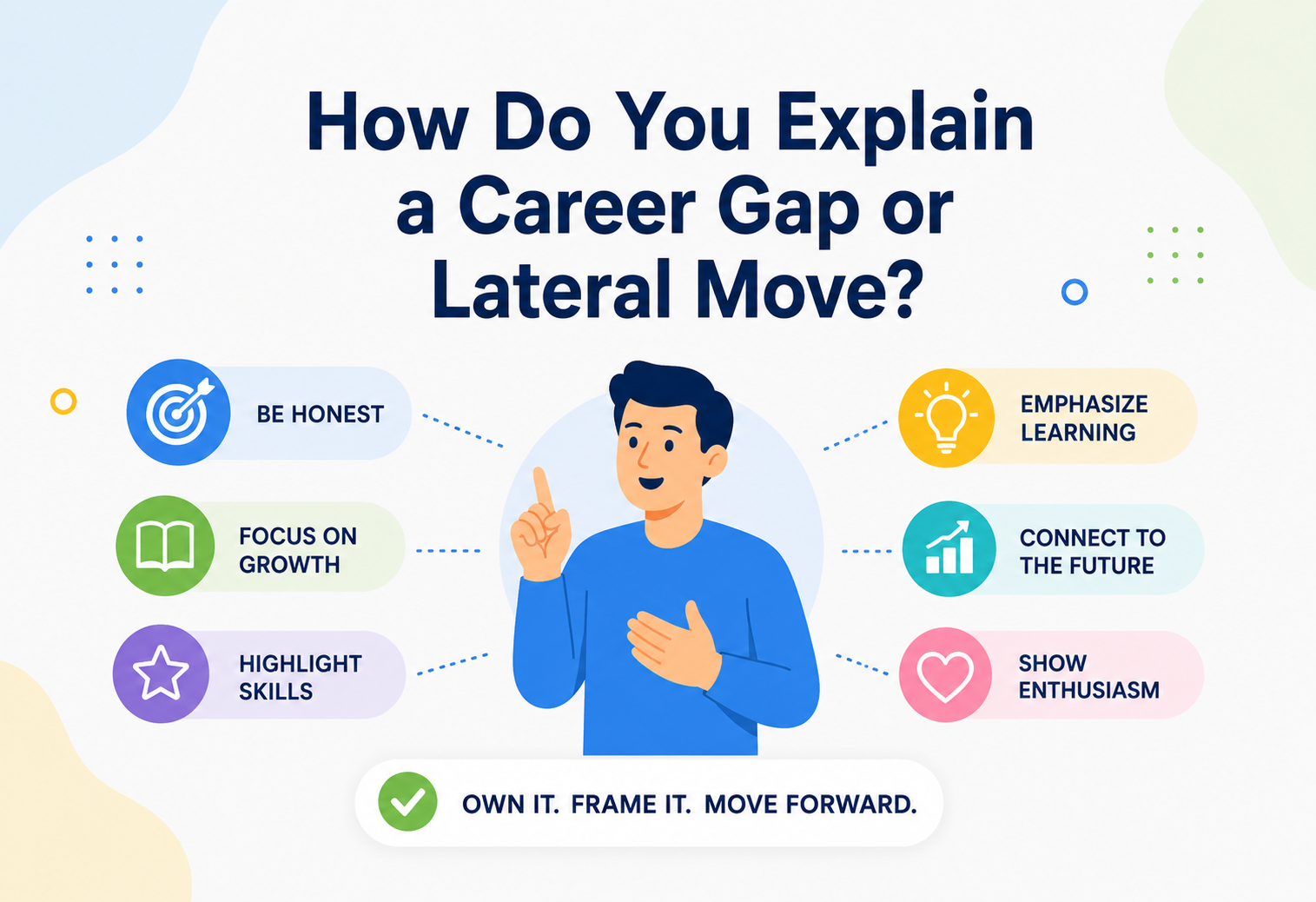
How Do You Explain a Career Gap or Lateral Move?
A break in the line does not need hiding — it needs a gold seam. A career gap or a lateral move is not a flaw in your timeline that needs to be sanded down until nobody notices. Told plainly and without apology, it is usually just a fact — one that says far less about you than the story you have been quietly rehearsing in your head.
The Line You Keep Rewriting
Almost everyone reading this has, at some point, hovered over a line on their resume, unsure how much of the truth it can hold. This is about finding out that it can usually hold more than you think.
You know the moment. You are updating your resume, and you reach the line that covers eleven months between two jobs, or the sideways move that does not obviously read as progress on paper. You have rewritten it four different ways already. Too vague, and it looks like you are hiding something. Too detailed, and it reads like an apology nobody asked for. You close the laptop, tell yourself you will figure out the wording tomorrow, and tomorrow you do the same thing again.
Here is what is easy to forget in that moment: almost every hiring manager reading resumes today has a gap or a sideways move of their own somewhere in their history. Career paths stopped being straight lines a long time ago, if they ever really were. What actually unsettles a reader is not the gap itself — it is the sense that the person explaining it is uneasy about it, because unease reads, unfairly but reliably, as something being withheld. The people who navigate this best are not the ones with the cleanest timelines. They are the ones who have made peace with an honest, calm account of what happened, and can deliver it in one steady sentence instead of four defensive ones.
This piece is about building that steady sentence — for a career gap, for a lateral move, or for both, since they often show up together. It is not about spin, and it is not about oversharing. It is about the specific, learnable skill of framing a true story so it lands as information instead of confession.
Picture someone who left a demanding role to care for a parent through a long illness, then spent four more months afterward simply recovering — from the loss, and from a level of exhaustion that does not resolve the day the caregiving ends. On paper, that is a fourteen-month gap. In early drafts of their resume, it appeared as a single euphemistic line, “personal leave,” which satisfied no one and invited exactly the kind of guessing they had hoped to avoid. The version that finally worked was three plain sentences, delivered without apology, that named what happened and what came next.
What changed between the two versions was not the underlying facts — those stayed exactly the same. What changed was the relationship to the facts. The euphemistic version had been written by someone still bracing for judgement, choosing vague language as a kind of armour. The plain version was written, several months later, by someone who had simply stopped expecting to be judged for it, and the difference showed up in every word choice, not just the level of detail. Interviewers who would have quietly wondered about “personal leave” responded, almost without exception, with a brief nod and a genuine “thank you for sharing that” to the plainer account — not because the facts had become more flattering, but because the telling had stopped asking them to read between the lines.
The break in a piece of pottery does not have to disappear for the object to be whole again. The old Japanese craft of kintsugi joins the pieces with gold on purpose, so that the repair is visible — not to hide the past, but to honour it. A resume line works the same way. The break does not need erasing. It needs a seam that says, calmly: this happened, this is where the pieces met again, and the whole is still here.
What a Hiring Manager Actually Hears
Job seekers tend to imagine a gap or a lateral move triggers a specific, damning thought: “this person could not hold down a job” or “this person is settling for less.” In reality, most experienced hiring managers are running a much simpler, less judgemental check, and it is worth knowing what it actually is.
Can you explain it plainly?
Not “is the reason impressive,” just: can you state it clearly, without visible discomfort. Composure here reads as far more reassuring than the content of the explanation itself.
What did you do with the time?
Gaps read very differently depending on whether they sound passive or intentional — even a difficult, unchosen gap can be described in terms of what you learned or maintained during it.
Are you actually ready now?
The real question underneath most gap-related hesitation is not about the past at all — it is whether you are rested, current, and genuinely prepared for the role in front of them today.
Does the lateral move make sense on its own terms?
For a sideways move, the check is simply whether it was a decision or a fallback — and that is almost entirely a matter of how it is framed, not what actually happened.
None of these checks require an extraordinary story. They require a clear one. The gap between “I do not want to talk about this” and “here is exactly what happened, briefly” is where almost all of the anxiety in this topic actually lives — and it is a gap that is fully within your control to close, regardless of what the underlying reason for the gap or move actually was.
It is worth sitting with that pull-quote for a moment, because it inverts the assumption most job seekers walk into an interview holding. The instinct is to prepare a defence for the gap itself — to build the strongest possible case for why the reason was legitimate. The room is almost never asking for that case. The room is asking whether the person in front of them seems settled about their own history. Composure is not a substitute for a good reason; it is what allows a good reason to be heard at all.
Why These Gaps and Moves Happen — and Why None of Them Need Shrinking
Every gap and every lateral move has a story behind it, and it helps to see the range of ordinary stories laid out clearly. What follows is not an exhaustive taxonomy — it is a reminder that the reasons are almost always more human, and more common, than the internal voice narrating them tends to admit.
Caregiving
Stepping away to care for a child, a parent, or a partner through illness is one of the most common reasons for a gap, and one of the most consistently misunderstood by the person living through it, who often assumes it reads as less “professional” than other reasons. It does not. It reads as a fact about a season of someone’s life, no more disqualifying than any other.
Layoffs and restructuring
A layoff says almost nothing about individual performance in the vast majority of cases, and hiring managers, many of whom have been laid off themselves at some point, generally know this better than job seekers give them credit for. The gap that follows a layoff is often less about the layoff itself and more about how long a genuinely difficult job market took to yield the next role — worth naming plainly rather than treating as evidence of something wrong.
Burnout and health
Stepping back to recover — physically, mentally, or both — is an increasingly common and increasingly well-understood reason for a gap, though it is still the one people feel most tempted to disguise. It does not require a clinical explanation. “I took time to focus on my health and I am glad to say I am in a strong place now” is a complete, sufficient sentence.
Further study or a deliberate sabbatical
Time spent on a certification, a degree, or a planned pause to travel or reset reads, when framed with intention, as evidence of self-direction rather than drift. The framing carries almost the entire weight here — the same six months can sound aimless or purposeful depending on how it is described.
A venture that did not work out
Time spent building something of your own that ultimately did not succeed is not a liability to minimise. Most experienced hiring managers read entrepreneurial attempts, even unsuccessful ones, as a sign of initiative and risk tolerance — qualities that are often in short supply and genuinely valued, provided the story is told with a clear, unembarrassed account of what was learned.
The lateral move made for reasons other than title
Moving sideways — same level, different function, sometimes even a smaller scope on paper — for better mentorship, a healthier team, a skill you needed, or simply to escape a role that had become a dead end, is a strategic decision, not a step backward. The confusion here is almost always caused by describing the move in terms of what changed on the org chart rather than in terms of what it was actually for.
A Few Honest Categories
Underneath every one of the causes above, the shape of the story usually collapses into one of three broader kinds — and it can help to know which one you are actually telling, because each one carries its own natural framing.
An unchosen, external cause — a layoff, a family crisis, an illness — is framed most naturally by naming the fact and pivoting quickly to how you responded. A chosen, personal cause — a sabbatical, caregiving, a health reset — is framed most naturally by owning the choice calmly and describing what it protected or produced. A chosen, strategic cause — a lateral move for a specific skill, a venture, a deliberate pause between chapters — is framed most naturally by leading with the intent and the outcome, so the shape of the plan becomes visible before anyone has to guess at it.

The Cost of Over-Explaining or Hiding It Entirely
There are two ways this usually goes wrong, and they sit at opposite ends of the same discomfort.
Failure 01 — Over-Explaining
- A resume bullet quietly turning into three sentences of justification
- An interview answer that keeps going past the point where the room has already accepted it
- Length itself signals anxiety, and anxiety is more memorable than the history
- Even a good reason starts to sound weak when it is defended too long
Failure 02 — Hiding It Entirely
- Stretching adjacent dates to paper over the gap
- Describing a lateral move in vague language designed to look like a promotion
- Background checks, references and simple arithmetic tend to surface the truth
- Discovering a small dishonesty late in hiring damages trust more than the gap ever would
The first failure is over-explaining: a resume bullet that quietly turns into three sentences of justification, or an interview answer that keeps going well past the point where the room has already accepted the explanation. This does real damage, not because the reasons offered are unconvincing, but because length itself signals anxiety, and anxiety about your own history is far more memorable — and far more concerning to a listener — than the history itself.
The second failure is the opposite one: erasing the gap almost entirely, stretching adjacent dates to paper over it, or describing a lateral move in deliberately vague language designed to make it look like an ordinary promotion. This tends to backfire in a very specific way — background checks, reference calls, and simple arithmetic on a timeline usually surface the truth eventually, and discovering a small dishonesty late in a hiring process does far more damage to trust than the original gap ever would have on its own. It also, quietly, costs you the chance to frame the story on your own terms, in your own words, at the moment of your own choosing.
A resume date that has been quietly stretched by two months to close a gap rarely fools anyone experienced enough to be reading it closely. It just moves the moment of discomfort from a conversation you could have controlled to one you cannot.
Signs Your Current Explanation Is Not Landing
Long before an interview goes well or badly, the explanation itself tends to leak signals about how settled it is. Five of those signals are worth learning to notice in yourself — they are much easier to fix once you can see them clearly.
You apologise before you have been asked
If your explanation of a gap opens with “I am sorry, I know this looks bad,” you have already framed it as a problem before the other person had a chance to decide for themselves.
The explanation keeps getting longer, not shorter, with practice
A well-settled explanation tends to compress over time, as you get more comfortable with it. If yours keeps expanding, that is usually a sign the discomfort has not actually resolved yet.
You avoid eye contact or visibly brace when the topic comes up
Interviewers register physical unease more than the specific words used to describe a gap, and that unease is what tends to linger in their notes afterward.
You have rehearsed several versions depending on who is asking
A story that shifts meaningfully by audience often signals that you have not yet settled on the true, simple version — the one that would work for anyone.
Friends or mentors keep gently suggesting you “just leave it off”
This advice usually comes from people who care about you and can see the discomfort clearly, even if removing the gap entirely is not actually the fix they think it is.
None of these signs mean the underlying reason for your gap is a problem. They mean the story you are telling about the reason has not fully settled yet, and every one of them tends to soften on its own once the underlying discomfort does — usually through repetition, honest reflection, and a little time, in that order.
What Actually Helps
A small set of concrete practices, applied honestly, will do more than any amount of resume rewriting on its own. Each one is simple in principle and slightly uncomfortable in the doing — which is roughly the shape of most useful career advice.
Write the one-line version first, before anything else
Before touching the resume format or drafting a cover letter, write a single sentence that states what happened, plainly, the way you would say it to a friend rather than a stranger. “I left to care for my father during his illness and took a few extra months afterward before starting my search.” Everything else — the resume wording, the interview answer, the LinkedIn summary — is really just a longer or shorter version of this same sentence, so it is worth getting this one right first.
Choose a resume format that fits the shape of your story
A strict reverse-chronological format works well when a gap is short or easily explained in a line. A hybrid format — a skills or focus summary at the top, followed by a chronological history — gives more room to lead with what you can do now, particularly useful after a longer gap or a meaningful pivot. Neither format is inherently more honest than the other; the choice is really about which one lets your strongest, most current material appear first.

Name the gap on the resume itself, briefly, rather than leaving it to be noticed
A short, calm line during the relevant period — “Family caregiving leave, 2023” or “Independent study and certification, 2022–2023” — does more to settle a reader’s mind than leaving the space blank and hoping nobody does the arithmetic. An unexplained blank space invites guessing, and guesses are reliably less generous than the truth.
Frame a lateral move around its purpose, not its position
Instead of describing a sideways move only by title and function, describe what it was actually for: “moved to the platform team to build hands-on infrastructure experience ahead of a systems architecture path.” This reframes the same factual move from something that needs defending into something that clearly served a plan — because, in the vast majority of real cases, it genuinely did.
Lead with what the time produced, even when the time was not chosen
Even an unchosen gap almost always contains something worth naming: a certification finished in the spare hours, a volunteer commitment that kept a skill current, a caregiving role that built genuine, transferable capacities in patience, coordination, and crisis management. This is not spin — it is simply choosing to describe the whole of what happened, rather than only the part that feels hardest to say.
Prepare the verbal version separately from the written one
A resume line and an interview answer do not need to be identical, and trying to make them so often results in something too clipped for a conversation or too long for a page. Prepare a short spoken version — three sentences, practised enough to feel calm rather than rehearsed — that can flex slightly depending on how much the conversation invites.
Ask a trusted person to listen before you use it live
The gap between an explanation that feels fine in your own head and one that actually lands well out loud is often wider than expected, and the only reliable way to close it is to say it to another person and watch how they receive it. A friend, a mentor, or even a career counsellor who is not emotionally invested in the outcome will usually catch the moments where your tone tightens or your pace speeds up — exactly the signals worth smoothing out before an actual interview.
Let the reference check confirm rather than contradict
Where a former manager or colleague is willing to serve as a reference, a short, friendly heads-up about how you have described the gap or the move helps ensure their account lines up with yours — not to coordinate a story, but because references are sometimes asked open questions they have not thought carefully about in advance, and a little warning helps them speak about it as calmly as you have.
One sentence first, then resume, then verbal version, then a trusted listener, then the reference heads-up. Doing them in that order takes a fraction of the effort of doing them in a different one, because each step becomes shorter once the step before it is genuinely settled.
How the Approach Shifts Depending on Your Situation
The underlying principles — plain language, brevity, framing around purpose — hold steady everywhere. How much explanation is actually expected, and by whom, varies quite a bit depending on where you are in your career and what kind of role you are pursuing.
Early career, first few years in
A gap here is usually read more generously than later in a career, partly because early resumes are expected to be less linear, and partly because hiring managers assume, correctly, that someone this early has had less opportunity to build a long unbroken track record in the first place. The bigger risk at this stage is often under-explaining out of nervousness rather than over-explaining — a short, confident line goes a long way.

Mid-career, an established track record already in place
Here a gap or lateral move is measured more against the pattern around it than against any absolute standard. A single, well-explained gap in an otherwise strong and coherent history rarely raises real concern. The framing question shifts slightly, from “what happened” to “did it change your trajectory,” and it is worth directly addressing that second question in the explanation, even if it was not asked outright.
Senior or executive level
At this level, a gap or lateral move is often read through the lens of judgement and self-awareness as much as circumstance — search committees and boards tend to want to see that a senior candidate can narrate their own history with the same clarity and composure they would bring to narrating a business decision. The three-sentence structure matters just as much here, perhaps more, because a senior candidate who over-explains a personal chapter can inadvertently raise doubts about executive presence more broadly.
Returning after an especially long break
For a gap measured in years rather than months, the honest framing usually needs one additional element: a clear, current demonstration that your skills are active and up to date — a recent course, a volunteer project, a portfolio piece — since the concern shifts from “what happened” to “are you current,” and that concern deserves a direct, evidence-based answer rather than just a well-worded sentence about the past.
The Conversations That Make the Difference
Four short scripted exchanges, drawn from the shapes real interviews tend to take. None of them are meant to be memorised word-for-word — the point is the structure underneath: what happened, what came after, and a clean pivot to the present.
Explaining a caregiving gap in an interview
Interviewer — “I noticed a gap in 2023 — can you walk me
              through that?”

Candidate  — “Of course. My father was diagnosed with a serious
              illness that year, and I stepped away to care for
              him through it. Afterward, I took a few more months
              to properly recover before starting my search, which
              I think made me a much stronger candidate than I
              would have been rushing back too soon. I am glad to
              say I am fully ready now, and genuinely excited
              about this role.”
Notice the shape: what happened, what came after, and a clean pivot to the present. No apology, no extended detail beyond what is needed, and a confident close that redirects attention to readiness rather than the past.
Explaining a layoff-driven gap
Candidate — “My previous company went through a significant
             restructuring last year and my whole team, myself
             included, was let go. It took longer than I expected
             to find the right next role, partly because I was
             being deliberate rather than taking the first offer
             — but I used the time to finish a certification I had
             been putting off, which turned out to be useful
             preparation for exactly this kind of role.”
Explaining a lateral move
Candidate — “That move might look sideways on paper, but it was
             a deliberate one. I wanted hands-on infrastructure
             experience before stepping into a systems
             architecture role, and the fastest way to get it
             honestly was to go and build it myself for a year
             rather than talk my way past not having it. It is
             exactly what has made me ready for a role like this
             one.”
When someone pushes for more detail than you want to give
Interviewer — “Can you say more about what led to that leave?”

Candidate  — “I would rather keep the details private, if that
              is alright — it was a personal matter I have fully
              worked through, and I am in a strong place now. I am
              happy to talk in as much depth as you would like
              about how I have prepared for this role
              specifically.”
This is a complete, professional answer. You are never obligated to disclose more than you are comfortable sharing, and a calm, warm redirection like this one is rarely read as evasive — it is read as someone with healthy boundaries, which is, if anything, a quiet point in your favour.
None of this requires performing an upbeat spin on a genuinely hard chapter of your life. It is entirely possible, and often more convincing, to acknowledge that a period was difficult while still describing it steadily. “That year was genuinely hard, and I am glad it is behind me” is an honest, complete sentence that does not require pretending the difficulty was not real in order to sound composed about it now.
Knowing Where the Honest Boundary Sits
Being calm and forthcoming about a gap does not mean owing anyone a complete account of a difficult chapter of your life.
Medical details, the specifics of a family crisis, the exact reasons a venture failed, or the interpersonal details behind leaving a difficult workplace are all yours to share only as much as you choose. A short, true summary — “a personal health matter,” “a family situation,” “the venture did not find its market” — is a complete answer on its own, and repeating it calmly, without adding detail just because a question is repeated, is a perfectly reasonable response.
The useful test here is simple: are you withholding detail out of privacy, or out of shame? Privacy is a boundary you are entitled to keep exactly where you set it. Shame tends to want the whole story hidden rather than simply kept brief, and it is worth noticing which one is actually driving a given instinct to say less.
If a close friend had lived through exactly what I lived through, would I think less of them for it — or would I think it was simply a hard, human chapter, handled as well as it could be? Most people, asked this honestly about someone else’s gap, answer far more generously than they answer about their own.
The generosity you would extend to a friend is not a naive misreading of the situation. It is closer to the truth than the harsher story you tell yourself about your own history. Interview rooms, on the whole, tend to be much closer to the friend’s reading than to your own inner critic’s — and the sooner you begin trusting that, the sooner the explanation begins landing the way it deserves to.
Rebuilding the Confidence Underneath the Wording
Wording only goes so far if the underlying discomfort has not settled yet. It is worth doing some of that settling before the interviews start, not during them.
Saying the explanation out loud to a trusted friend, several times, until it stops catching in your throat, does more for how it lands than any amount of further polishing the written sentence. Confidence in this specific context is not really about believing the gap was a good thing — some gaps genuinely were not. It is about believing, fully, that it does not disqualify you from what comes next, and that belief tends to arrive through repetition and time rather than through finding the perfect phrase on the first attempt.
It also helps to remember that this discomfort rarely disappears in one sitting. Most people who have navigated a difficult gap well describe a gradual process — the explanation feels raw and heavy the first few times it is spoken aloud, noticeably lighter by the tenth, and eventually almost unremarkable, delivered with the same even tone you would use to mention any other fact about your background. There is no shortcut to that gradual settling, but there is a reliable direction: every honest, calm repetition moves you further along it, even the ones that still feel a little effortful in the moment.
Once a day, for a week, say your one-sentence explanation out loud — to yourself in the car, on a walk, into a voice memo. Do not adjust the wording between attempts; adjust only how you feel about saying it. You will notice, somewhere around day four or five, that the sentence has quietly stopped needing bracing for. That is exactly the moment it becomes ready for the room.
Frequently Asked
Short, direct answers to the questions that come up most often once someone starts taking the framing of a gap or a lateral move seriously.
Should I put an explanation directly on the resume, or save it for the interview?
A brief, neutral line on the resume for longer gaps tends to prevent unnecessary guessing before you ever get to a conversation, and it lets you control the framing rather than leaving a blank space for someone else to interpret. Shorter gaps, under a few months, often do not need any special resume treatment at all.

How do I handle this on LinkedIn, where the date fields are more rigid?
Adding a short, honest entry for the gap period itself — “Family caregiving,” “Independent study,” “Career break” — as its own line item tends to read as more complete and less concerning than an unexplained space between two roles.
What if the lateral move actually was a step back, not a strategic choice?
It is still worth being honest, simply framed around what you learned or what it protected — “I took a smaller role deliberately to get out of a team that was not sustainable long-term” is a complete, respectable answer, and it is considerably more convincing than an unconvincing claim that the smaller role was secretly a promotion.
Does the explanation need to change for a more conservative industry?
The core honesty and brevity hold everywhere. What can reasonably shift is the amount of personal warmth in the delivery — a slightly more formal register in a more traditional industry, without needing to become clinical or evasive.
What if I still feel emotional talking about the reason for the gap?
That is human, and it does not need to be hidden entirely. A brief acknowledgement — “this was a hard year, and I am glad to be past it” — paired with a steady tone is usually received warmly. What matters most is that the emotion does not derail the conversation, not that it is entirely absent from it.
Should a cover letter mention the gap at all, or is that better left for the resume and interview?
Generally, no — a cover letter works best focused entirely on what you bring to the specific role, and inserting an explanation there can unintentionally make the gap feel like the headline of your application rather than a minor factual detail in a much larger, more relevant story. Save the explanation for where it is actually asked for.
How do I stop the explanation from sounding rehearsed, even after a lot of practice?
Practise the content and the key phrases, but allow the exact wording to vary slightly each time rather than memorising a fixed script word for word. A completely fixed script tends to sound more rehearsed under pressure, precisely because any tiny slip breaks the illusion of spontaneity; a well-understood set of points, delivered a little differently each time, holds up far better under real conversational pressure.
What Is Actually Worth Remembering
A gap or a lateral move on a resume is a fact, not a confession, and it only becomes a liability when it is told with more anxiety than the facts themselves actually require.
The pieces worth carrying with you
- Write the one true sentence first — everything else is just a longer or shorter version of it.
- Name the gap briefly rather than leaving it blank — unexplained space invites guessing, and guesses are reliably less generous than the truth.
- Frame a lateral move around its purpose, not its position on an org chart — a move described in terms of what it was for rarely needs defending.
- Keep the private parts private — brevity born of a boundary is never the same thing as evasion, and a calm redirect is often read as a quiet point in your favour.
- Practise the explanation out loud until it stops catching — confidence, here, is mostly a matter of repetition, not of finding the perfect phrase.
- Let the reference check confirm rather than contradict — a short, friendly heads-up to a former manager is a small kindness that pays back reliably.
- Trust the room to be closer to the friend’s reading than to your inner critic’s — on the whole, it usually is.
Every honest explanation you deliver, calmly, moves the shape of your own timeline a little closer to the one you actually want to carry — not a straight line without breaks, but a whole line with the mends visible and made peace with. That is not a compromise. In every field that matters, in every life worth telling honestly, it is closer to the real thing.