What Is Infrastructure Drift?
A complete, ground-up guide to understanding, detecting, preventing, and fixing infrastructure drift in modern Infrastructure-as-Code environments — with real Java examples, architecture diagrams, and lessons from Netflix, Amazon, Google, and the broader Terraform and Kubernetes ecosystems.
Introduction & History
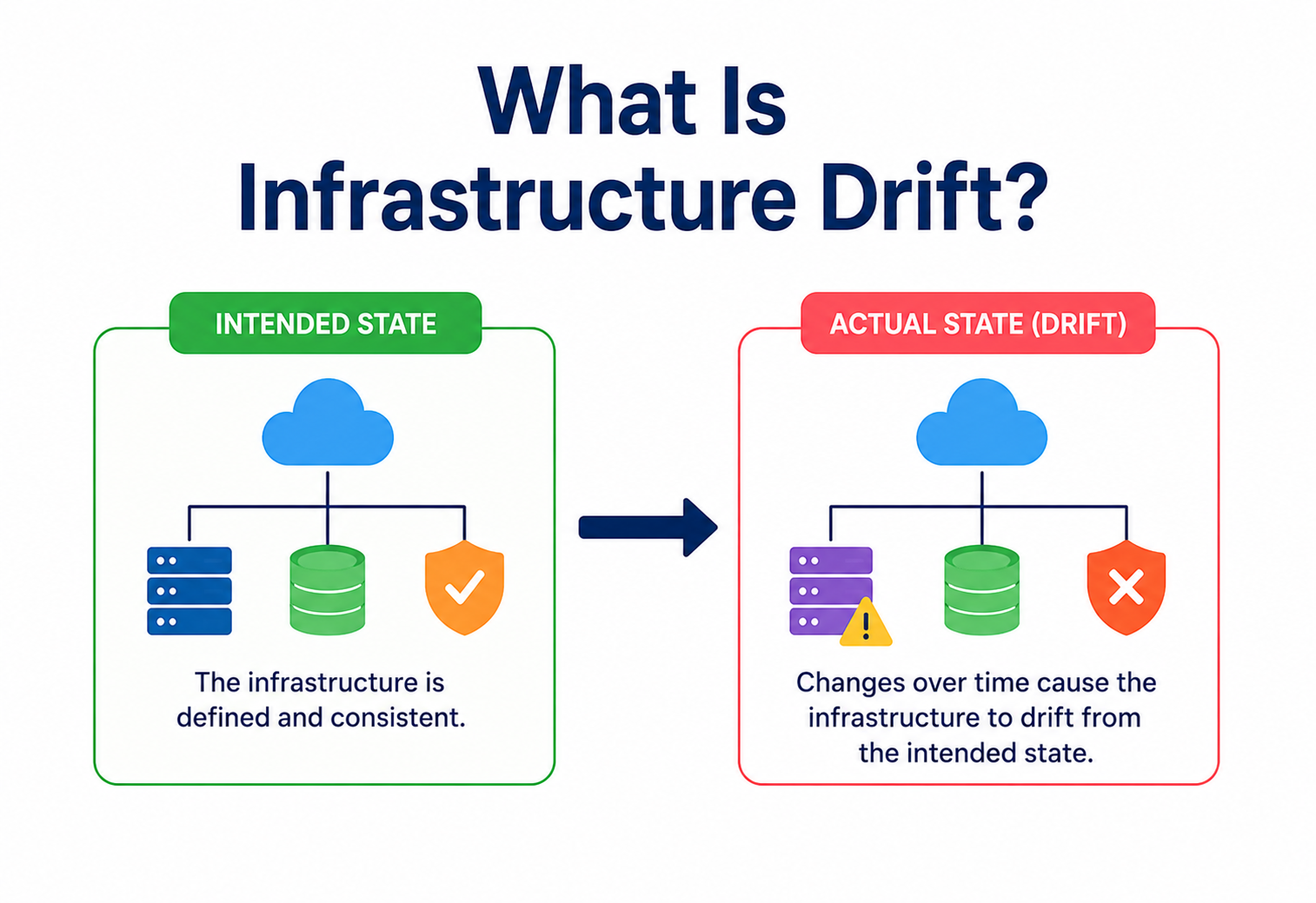
Infrastructure drift (also called configuration drift) happens when the actual, running state of your infrastructure — servers, databases, load balancers, networking rules, IAM policies — no longer matches the state that is declared in your Infrastructure-as-Code (IaC) source, such as a Terraform file, a CloudFormation template, or an Ansible playbook. In plain words: your code says one thing, but the real world is doing something else, and nobody told the code.
Think of a restaurant kitchen that runs on a fixed recipe book (the “declared state”). One night, a chef is short on butter and swaps in oil “just this once.” Nobody updates the recipe book. Weeks later, a new chef follows the book exactly, but the dish tastes different from what regular customers expect — because the kitchen’s actual practice (reality) quietly drifted away from the written recipe (the source of truth). Infrastructure drift is the same gap, except the “kitchen” is your cloud environment and the “recipe book” is your IaC repository.
The term became prominent as teams moved from manually clicking around cloud consoles to declaring infrastructure in version-controlled code during the early-to-mid 2010s. Tools like Chef and Puppet (2009–2011) first popularized the idea of “desired state” configuration for servers. When Terraform arrived in 2014, it extended the same philosophy to entire cloud environments — networks, compute, storage, identity — not just individual machines. As soon as teams had a single declarative source of truth, they also inherited a new problem: what happens when someone (or something) changes the real infrastructure without going through that source of truth? That gap needed a name, and “drift” stuck.
Today, drift is one of the most common causes of “it works on paper but not in production” incidents. It is a first-class concern in every major IaC tool: Terraform has terraform plan and drift detection features, AWS has CloudFormation Drift Detection, Pulumi has pulumi refresh, and Ansible has idempotent playbook runs that implicitly reveal drift.
The Problem & Motivation
Why does drift matter enough to deserve an entire discipline of tooling around it? Because the promise of Infrastructure-as-Code is that your code is the truth. The moment reality disagrees with the code, that promise breaks, and several serious problems follow.
2.1 Why drift happens
- Manual “hotfixes” under pressure. An engineer is paged at 2 AM, opens the AWS console, bumps a security group rule to unblock an outage, and fixes the underlying Terraform file “tomorrow” — which never happens.
- Multiple tools managing the same resource. A Kubernetes operator and a Helm chart both try to own the same Deployment object.
- Out-of-band automation. Auto-scaling, AWS Auto Healing, or a separate CI/CD pipeline changes instance counts or tags that IaC doesn’t know about.
- Provider-side auto-updates. Cloud vendors silently patch default AMI versions, TLS policies, or managed database minor versions.
- Partial or failed applies. A
terraform applycrashes halfway through, leaving some resources updated and others not. - Multiple teams, one account. Without strict ownership boundaries, two teams both “own” a shared VPC and each assumes the other isn’t touching it.
Drift is dangerous precisely because it is invisible until something breaks. Your CI/CD pipeline still runs green. Your Terraform state file still “looks” fine until someone runs a plan. Meanwhile the real system might have an open security group, a downgraded instance type, or a missing backup policy — and nobody knows until an audit, an outage, or an attacker finds it first.
2.2 The business cost of drift
Left unmanaged, drift produces three compounding costs:
- Reliability cost — environments that were supposed to be identical (staging vs production) silently diverge, so bugs that “never happened in staging” show up in production.
- Security cost — manual changes bypass code review, so unreviewed permission grants or open ports can sit unnoticed for months.
- Operational cost — engineers lose trust in the IaC codebase itself (“the Terraform doesn’t match reality anyway”), so they stop using it, which accelerates further drift — a vicious cycle.
Imagine your Terraform file declares an AWS S3 bucket with public access blocked. A well-meaning intern, trying to quickly share a file with a client, disables “Block Public Access” directly in the AWS console. Now: (a) the bucket is publicly readable, (b) your Terraform code still says it shouldn’t be, and (c) the next terraform apply from someone else could either silently leave it public (if that resource isn’t touched) or suddenly “fix” it back to private and break the client’s access with no warning. That mismatch — code says private, reality says public — is infrastructure drift.
2.3 The psychology behind drift
It’s worth understanding why drift keeps happening even on teams that fully understand the risk, because the causes are more human than technical. Under incident pressure, going through a pull request, waiting for CI, and getting a review feels unacceptably slow compared to a thirty-second console click — and in the moment, that tradeoff is often genuinely correct for restoring service quickly. The mistake isn’t making the manual change; it’s the absence of a fast, low-friction path to backport that change into code afterward. Teams that treat “no manual changes, ever” as an absolute rule tend to see more drift in practice, not less, because engineers route around a rule that conflicts with real incident response needs. Teams that instead build a fast, well-lit “break glass” path — manual change now, automatic ticket and short deadline to backport — tend to see drift resolved quickly rather than accumulating indefinitely.
Core Concepts
3.1 Desired state vs. actual state vs. state file
To understand drift you need to separate three distinct “states” that most IaC tools juggle:
| Concept | What it is | Where it lives |
|---|---|---|
| Desired state | What your code says infrastructure should look like | .tf, YAML, JSON templates in version control |
| Recorded / cached state | The tool’s last known snapshot of what it believes exists | Terraform state file, CloudFormation stack metadata |
| Actual state | What is really running right now in the cloud provider | The provider’s own systems (AWS, GCP, Azure APIs) |
Drift is formally defined as a mismatch between the recorded state (or desired state) and the actual state. Some tools distinguish two flavors:
- Unmanaged drift — a resource exists in the cloud but was never created by, or known to, the IaC tool.
- Managed resource drift — a resource the IaC tool does track has had one or more of its attributes changed outside the tool.
3.2 Idempotency
Idempotency means applying the same operation multiple times produces the same result as applying it once. Good IaC tools are built to be idempotent: running terraform apply twice in a row with no changes should be a no-op the second time. Drift detection relies heavily on this property — if a “plan” or “diff” command reports zero changes, the system is confidently in sync; if it reports changes with no corresponding code edit, that’s drift.
3.3 Reconciliation
Reconciliation is the act of bringing actual state back in line with desired state — either by updating the cloud resources to match the code (the common approach) or by updating the code to match reality (used when the manual change was actually correct and should be “adopted”).
Think of a car’s GPS navigation. The “desired state” is the route it calculated. The “actual state” is where the car really is, based on GPS signal. When you miss a turn, the actual position drifts from the planned route. The GPS doesn’t panic — it detects the drift and reconciles by recalculating a new route from your actual position. Good drift management works the same way: detect the gap, then decide whether to reroute the infrastructure back to plan, or accept the new position as the new plan.
3.4 Detection vs. prevention vs. remediation
These three are often confused but are distinct disciplines:
- Detection — finding out that drift exists (e.g.,
terraform plan, CloudFormation Drift Detection,pulumi preview). - Prevention — reducing the chance drift occurs in the first place (locking down console access, enforcing change through pipelines only).
- Remediation — actually fixing detected drift, either by reapplying code or updating code to reflect reality.
3.5 Categorizing drift by cause
Not all drift comes from the same place, and knowing the category helps you pick the right long-term fix rather than just patching the symptom each time.
| Category | What it looks like | Typical long-term fix |
|---|---|---|
| Human-initiated drift | An engineer changes a resource directly in the console or CLI | Restrict write access, enforce pipeline-only changes |
| Automation-initiated drift | A separate script, autoscaler, or scheduled job modifies a resource IaC also manages | Establish single ownership per resource; teach automation to update IaC state, not bypass it |
| Provider-initiated drift | The cloud vendor changes a default value, patches a managed service, or rotates a certificate | Pin explicit values in code where possible; treat some provider-driven fields as intentionally “ignored” from drift checks |
| Tooling drift | Two IaC tools (e.g., Helm and a Kubernetes operator) both believe they own the same object | Draw clear ownership boundaries per resource, per tool |
| State corruption drift | The state file itself becomes stale or lost, so the tool’s “memory” is wrong even if nothing changed | Remote, locked, versioned state storage; periodic state file integrity checks |
3.6 Detection latency
Every drift management strategy has an implicit “detection latency” — the maximum time drift can exist before it’s noticed. A nightly batch job has a latency measured in hours; an event-driven system triggered by cloud audit logs has a latency measured in minutes or seconds. Choosing an acceptable latency per resource class is itself a design decision: a publicly-exposed security group might warrant near-real-time detection, while a cosmetic resource tag can tolerate a weekly check without meaningful risk.
Architecture & Components
A drift-aware infrastructure system typically has five cooperating components.
4.1 IaC source code
The version-controlled files that declare desired state: Terraform HCL, CloudFormation YAML/JSON, Pulumi TypeScript/Python/Go, Ansible playbooks, or Kubernetes manifests.
4.2 State store
Many IaC engines keep a separate record of what they last provisioned, distinct from the source code itself. Terraform’s state file (often stored remotely in an S3 bucket with DynamoDB locking) is the classic example. This store lets the tool know “I created this resource with ID x-123” without re-scanning the entire cloud account every time.
4.3 Cloud provider APIs
The ground truth. AWS, GCP, and Azure APIs report what is actually deployed right now — instance types, security group rules, IAM policies, and so on.
4.4 Drift detection engine
The comparison logic. This is what runs terraform plan, CloudFormation’s drift detection API, or a scheduled job that diffs desired vs. actual and produces a structured report.
4.5 Alerting & remediation layer
Systems like Slack/webhook alerts, CI/CD gating, or GitOps controllers (e.g., a reconciliation loop that automatically re-applies desired state) that act on the drift report.
At companies using GitOps patterns (popularized by tools like Argo CD and Flux for Kubernetes), a controller continuously polls both the Git repository (desired state) and the live cluster (actual state) every few minutes, and automatically reconciles differences — effectively turning “drift detection” into a background, always-on process rather than something a human has to remember to run.
Internal Working — How Drift Detection Actually Happens
5.1 The refresh step
Most IaC tools implement drift detection through a “refresh” operation. Before computing a plan, the tool re-queries the cloud provider for the current attributes of every resource it manages, and updates its in-memory (or persisted) state to reflect reality. It then compares this refreshed state against the desired state expressed in code.
terraform plan is really a sequence of read-only queries against the cloud provider, followed by an attribute-by-attribute diff against your source of truth.5.2 A minimal Java simulation of a drift checker
While Terraform itself is written in Go, understanding the core comparison algorithm is language-agnostic. Below is a simplified Java example that models the essential logic: fetch desired state, fetch actual state, and diff them attribute by attribute.
// A simplified drift detector for a single resource type: EC2-like servers
public class DriftDetector {

    public record ServerConfig(String id, String instanceType, boolean publicAccess, int diskSizeGb) {}

    // Desired state — normally parsed from Terraform/CloudFormation source
    public Map<String, ServerConfig> loadDesiredState() {
        Map<String, ServerConfig> desired = new HashMap<>();
        desired.put("web-01", new ServerConfig("web-01", "t3.medium", false, 50));
        return desired;
    }

    // Actual state — normally fetched live from a cloud provider SDK
    public Map<String, ServerConfig> fetchActualState(CloudClient client) {
        Map<String, ServerConfig> actual = new HashMap<>();
        for (var instance : client.describeInstances()) {
            actual.put(instance.getId(), new ServerConfig(
                instance.getId(),
                instance.getInstanceType(),
                instance.isPublicAccessEnabled(),
                instance.getRootVolumeSizeGb()
            ));
        }
        return actual;
    }

    public List<String> detectDrift(Map<String, ServerConfig> desired,
                                      Map<String, ServerConfig> actual) {
        List<String> driftReport = new ArrayList<>();

        for (var entry : desired.entrySet()) {
            String id = entry.getKey();
            ServerConfig want = entry.getValue();
            ServerConfig have = actual.get(id);

            if (have == null) {
                driftReport.add("MISSING: " + id + " exists in code but not in cloud");
                continue;
            }
            if (!want.instanceType().equals(have.instanceType())) {
                driftReport.add(id + ": instanceType drifted from "
                    + want.instanceType() + " to " + have.instanceType());
            }
            if (want.publicAccess() != have.publicAccess()) {
                driftReport.add(id + ": publicAccess drifted from "
                    + want.publicAccess() + " to " + have.publicAccess()
                    + " (SECURITY RISK)");
            }
            if (want.diskSizeGb() != have.diskSizeGb()) {
                driftReport.add(id + ": diskSizeGb drifted from "
                    + want.diskSizeGb() + " to " + have.diskSizeGb());
            }
        }

        for (String actualId : actual.keySet()) {
            if (!desired.containsKey(actualId)) {
                driftReport.add("UNMANAGED: " + actualId + " exists in cloud but not in code");
            }
        }
        return driftReport;
    }
}
This tiny example captures the essence of every real drift detector: build a map of desired attributes, build a map of actual attributes, and compute a structured diff — flagging both “changed” resources and entirely “unmanaged” ones that exist outside the code’s knowledge.
5.3 Exposing drift checks as a service
In larger organizations, drift detection often stops being “a CLI command someone runs” and becomes a proper internal platform service — a small backend that other teams’ pipelines call to check drift status before deploying, or that a dashboard polls to render an org-wide drift view. Below is a slightly larger Java example using Spring Boot that wraps the same detection logic behind a REST endpoint, so it can be scheduled, called from CI, or hit by a dashboard.
// A Spring Boot controller exposing drift status as an API
@RestController
@RequestMapping("/api/drift")
public class DriftController {

    private final DriftDetectionService driftService;

    public DriftController(DriftDetectionService driftService) {
        this.driftService = driftService;
    }

    // GET /api/drift/{resourceGroupId} — check a single team's resources
    @GetMapping("/{resourceGroupId}")
    public ResponseEntity<DriftReport> checkDrift(@PathVariable String resourceGroupId) {
        DriftReport report = driftService.checkGroup(resourceGroupId);
        HttpStatus status = report.hasCriticalDrift()
            ? HttpStatus.CONFLICT   // 409 signals "do not deploy" to CI
            : HttpStatus.OK;
        return ResponseEntity.status(status).body(report);
    }
}

@Service
public class DriftDetectionService {

    private final CloudClient cloudClient;
    private final DesiredStateRepository desiredStateRepo;

    public DriftDetectionService(CloudClient cloudClient,
                                  DesiredStateRepository desiredStateRepo) {
        this.cloudClient = cloudClient;
        this.desiredStateRepo = desiredStateRepo;
    }

    public DriftReport checkGroup(String resourceGroupId) {
        var desired = desiredStateRepo.loadFor(resourceGroupId);
        var actual = cloudClient.describeResources(resourceGroupId);

        List<DriftItem> items = new ArrayList<>();
        for (var entry : desired.entrySet()) {
            var have = actual.get(entry.getKey());
            if (have == null) {
                items.add(DriftItem.missing(entry.getKey()));
                continue;
            }
            items.addAll(diffAttributes(entry.getKey(), entry.getValue(), have));
        }
        return new DriftReport(resourceGroupId, items, Instant.now());
    }

    private List<DriftItem> diffAttributes(String id, ServerConfig want, ServerConfig have) {
        // Attribute-by-attribute comparison, tagging severity per field
        List<DriftItem> found = new ArrayList<>();
        if (want.publicAccess() != have.publicAccess()) {
            found.add(new DriftItem(id, "publicAccess", want.publicAccess(),
                have.publicAccess(), Severity.CRITICAL));
        }
        if (!want.instanceType().equals(have.instanceType())) {
            found.add(new DriftItem(id, "instanceType", want.instanceType(),
                have.instanceType(), Severity.LOW));
        }
        return found;
    }
}
Notice the design choice of returning HTTP 409 Conflict when critical drift is present: this lets a CI/CD pipeline treat drift status as a deploy gate — a service call, not a manual dashboard check, decides whether it’s safe to proceed. This pattern (drift-as-a-gate) is one of the most effective ways to make drift management enforceable rather than aspirational.
5.4 How real tools differ
| Tool | Drift detection mechanism |
|---|---|
| Terraform | terraform plan performs an implicit refresh, then diffs against .tf code |
| AWS CloudFormation | Explicit DetectStackDrift API call, compares stack template to live resources |
| Pulumi | pulumi refresh updates state from the cloud, pulumi preview shows the diff |
| Ansible | Idempotent task execution — a “changed” result on a re-run implies prior drift or first-time convergence |
| Kubernetes / GitOps (Argo CD, Flux) | Continuous reconciliation loop comparing live cluster objects to Git manifests, typically every few minutes |
Data Flow & Lifecycle of a Drift Event
Understanding drift as a lifecycle — rather than a one-time check — helps teams build durable processes around it.
In sync
Right after a successful apply, desired and actual state match exactly.
Drift introduced
A manual console change, a failed partial apply, or external automation modifies a resource.
Detection
A scheduled CI job, a pre-deploy plan check, or a continuous GitOps controller notices the mismatch.
Triage
Someone (or an automated policy) decides: is this drift dangerous (an open security group) or benign (a tag that changed)?
Reconciliation
Either the code is reapplied (overwriting the manual change) or the code is updated to formally adopt the change.
Back to in sync
The loop closes, until the next drift event.
Treat “detected but ignored” drift as technical debt with a security multiplier. A drifted resource that nobody triages doesn’t just sit still — new drift tends to accumulate on top of old drift, because engineers who see an already-messy environment feel less friction about making one more undocumented change.
Pros, Cons & Tradeoffs
Drift itself isn’t inherently “bad” — it’s a signal. The real tradeoffs are about how much investment you put into detecting and preventing it.
Benefits of active drift management
- Environments stay predictable and reproducible.
- Security posture stays auditable — no silent permission creep.
- Staging truly mirrors production, reducing “works on my env” bugs.
- Disaster recovery is trustworthy, because IaC can actually rebuild what’s really running.
- Faster onboarding — new engineers can trust the code as documentation.
Costs & tradeoffs
- Continuous detection consumes cloud API calls and compute (cost at scale).
- Strict “always reapply code” policies can be too rigid for legitimate emergency fixes.
- Automated remediation risk: blindly reapplying code can undo a valid emergency change.
- Tooling and process overhead — someone must own triage.
- False positives from provider-side cosmetic changes (e.g., auto-added default tags).
7.0 How much should you invest?
Not every team needs the same level of drift-management sophistication. A five-person startup running a handful of services on a single AWS account gets most of the value from simply running terraform plan before every deploy and reviewing the diff by eye — building an event-driven, severity-tiered, auto-remediating pipeline would be over-engineering relative to their actual risk. A regulated enterprise running thousands of resources across dozens of accounts, on the other hand, genuinely needs the fuller architecture described in this guide, because manual review simply cannot scale to that volume, and the compliance cost of missed drift is much higher. Right-sizing this investment to your actual scale and risk profile is itself part of doing drift management well.
7.1 Reapply vs. adopt — the central tradeoff
Every drift event forces a choice between two remediation strategies, and picking the wrong one has real consequences:
| Strategy | When to use | Risk if wrong |
|---|---|---|
| Reapply code (overwrite reality) | The manual change was unauthorized or accidental | Can undo a legitimate emergency fix, causing a repeat outage |
| Update code (adopt reality) | The manual change was a valid, necessary fix | Normalizes bypassing code review if done carelessly |
Performance & Scalability
Drift detection has real performance implications once an infrastructure estate grows past a handful of resources.
8.1 API rate limits
Refreshing state means calling the cloud provider’s “describe” or “get” APIs for every managed resource. At scale (thousands of resources), naive full-refresh drift checks can hit provider rate limits (e.g., AWS EC2 API throttling) or simply become slow — a terraform plan on a huge state file can take minutes.
8.2 Strategies for scaling drift detection
- State splitting — break one giant Terraform state into smaller, independently-refreshed states per team or service, so drift checks run in parallel and blast radius stays contained.
- Targeted refresh — refresh only high-risk resource types (IAM, security groups, network ACLs) frequently, and lower-risk types (tags, descriptions) less often.
- Caching with TTLs — cache provider responses for a short window to avoid redundant calls across parallel jobs.
- Event-driven detection — instead of polling on a timer, subscribe to cloud provider change events (e.g., AWS CloudTrail + EventBridge) and trigger a targeted drift check only for the resource that changed.
- Sampling for very large fleets — for thousands of near-identical resources (e.g., auto-scaled instances), check a representative sample rather than every instance.
Large-scale platform teams often move from “run a full plan nightly” to event-driven drift detection specifically because a nightly full-account scan on tens of thousands of resources can take hours and generate noisy, stale reports by the time anyone reads them. Reacting to change events narrows detection latency from “up to 24 hours” to “within minutes.”
8.3 Capacity planning for drift infrastructure
Drift detection is itself a workload that needs capacity planning like any other production system. Three factors typically drive its footprint:
- Resource count growth — as a company adds accounts, regions, and services, the number of describe/list calls per drift cycle grows roughly linearly, so a check that took seconds at 500 resources can take minutes at 50,000.
- Check frequency — doubling how often you check doubles API load; this is why tiered frequency (critical resources checked often, low-risk resources checked rarely) is both a security and a cost decision.
- Fan-out of parallel workers — running checks in parallel across many worker processes speeds up wall-clock time but concentrates API calls into a shorter window, which is exactly when provider rate limits bite hardest; teams often need to tune concurrency down even as they scale up total resource count.
A practical approach many platform teams converge on is a two-speed model: a fast, narrow, event-driven path for high-risk resource types, and a slower, broad, scheduled sweep that acts as a safety net catching anything the event stream might have missed (for example, due to a missed webhook or an audit log gap).
High Availability & Reliability
9.1 Drift as a threat to HA
Infrastructure drift is a direct threat to high availability because HA architectures depend on symmetry — multiple availability zones, replica sets, or standby regions that are supposed to be configured identically. If one zone’s load balancer health-check settings drift from the others, a failover during an incident may route traffic to a zone that silently can’t handle it.
A disaster recovery drill can pass cleanly and still hide a landmine: if the DR region’s infrastructure was provisioned once and has since drifted from the primary region (different instance sizes, different autoscaling limits), the drill might succeed on paper while the real failover — under real load, months later — fails because the drifted DR environment can’t actually absorb full production traffic.
9.2 Reliability practices
- Immutable infrastructure — instead of patching servers in place (a common drift source), replace them entirely with new instances built from a versioned image (AMI, container image). This eliminates most in-place drift by construction.
- Continuous reconciliation loops — GitOps-style controllers that constantly self-heal drift within seconds to minutes, rather than waiting for a human-triggered check.
- Cross-region parity checks — periodically diff the desired state of primary vs. DR region configurations, not just each region against its own code.
- Change freezes with enforcement — during high-risk periods (e.g., major sales events), technically block console write access, not just ask people nicely not to use it.
9.3 Testing for drift-related failure modes
Reliability engineering practices like chaos engineering can be extended specifically to drift scenarios: intentionally introduce a small, controlled configuration difference between two supposedly-identical environments in a test setting, then run the normal failover or scaling procedure against it to see whether the system degrades gracefully or fails outright. This surfaces “silent assumption” bugs — code that assumes both regions have identical instance types, or that a security group in region B has the same rules as region A — before a real, unplanned drift event does it for you during an actual incident.
Include a drift check as part of your disaster recovery drill runbook itself, not just as a separate quarterly audit. Confirming “DR region matches primary region’s IaC” right before a failover test gives much higher confidence that the drill’s results will hold up during a real event.
Security
Security is where drift stops being an operational annoyance and becomes a genuine risk vector.
10.1 Drift as an attack surface
- Privilege creep — an IAM policy manually broadened “temporarily” for debugging and never reverted.
- Exposed resources — a database or storage bucket manually made public for a quick data-sharing need.
- Disabled controls — encryption, logging, or MFA requirements manually turned off to unblock a task, then forgotten.
- Compromise cover — an attacker who gains console access might make changes that look like “normal drift,” blending malicious modifications in with the noise of legitimate manual fixes.
Many compliance frameworks (SOC 2, ISO 27001, PCI-DSS) require evidence that infrastructure changes go through a controlled, auditable process. Undetected drift is effectively an unauthorized, unreviewed change — which auditors treat as a control failure even if the change itself was harmless.
10.2 Security-focused mitigations
- Least-privilege console access — restrict who can make direct changes in the cloud console at all; route routine operations exclusively through pipelines.
- Policy-as-code guardrails — tools like Open Policy Agent (OPA), AWS Config Rules, or Sentinel that continuously validate live resources against security policies, independent of whether IaC “owns” them.
- High-severity drift alerting — treat drift on IAM roles, security groups, and encryption settings as a P1 security alert, distinct from lower-priority cosmetic drift.
- Audit trail correlation — tie every detected drift event back to a CloudTrail/Activity Log entry to identify who (or what) made the change.
10.3 Threat-modeling drift
It helps to think about drift the way you’d think about any other attack surface, asking three questions for each resource class: What’s the worst realistic change someone could make here? How quickly would we notice it? What’s the blast radius if we didn’t? For a public-facing load balancer’s listener rules, the worst case (silently allowing unencrypted traffic) is severe and detection needs to be fast. For an internal resource tag used only for cost reporting, the worst case is a minor accounting inconvenience, and slow, batch-style detection is perfectly acceptable. Building this kind of severity map once, per resource type, turns “detect all drift equally” into a much more defensible, resource-efficient security program.
Pair drift detection with least-privilege IAM reviews. A permissive IAM policy that never drifts is still a risk; drift detection catches change, not existing over-permissioning. The two practices are complementary, not substitutes for each other.
Monitoring, Logging & Metrics
11.1 What to measure
| Metric | Why it matters |
|---|---|
| Drift detection frequency | How often you check determines maximum drift “age” before it’s caught |
| Mean time to detect (MTTD) drift | Time from drift occurring to it being flagged |
| Mean time to remediate (MTTR) drift | Time from detection to resolution |
| Drift count by severity | Tracks whether security-critical drift is trending up or down |
| Drift recurrence rate | Same resource drifting repeatedly signals a process gap, not a one-off mistake |
| % of resources under IaC management | Unmanaged resources are invisible to drift detection entirely |
11.2 Logging drift events
Good drift logs capture: resource ID, attribute that changed, old value, new value, timestamp, and (when available) the identity that made the change, sourced from the cloud provider’s audit log (e.g., AWS CloudTrail, GCP Audit Logs, Azure Activity Log). Structured, correlated logs make it possible to answer “who changed this and why” instead of just “something changed.”
Feed drift events into the same alerting pipeline as other production incidents (PagerDuty, Opsgenie, Slack) — not a separate, easy-to-ignore dashboard. Drift that only lives in a report nobody opens might as well not be detected at all.
11.3 Dashboards
Effective drift dashboards typically show a rolling trend line of open drift items by severity, a breakdown by team/service ownership, and an “age” column highlighting drift that has sat unresolved longest — since old, ignored drift is the highest-risk category.
A useful habit borrowed from broader observability practice is to review drift metrics in the same forum where teams already review other operational health signals — incident counts, error rates, deployment frequency — rather than spinning up a separate, easily-forgotten “compliance meeting.” When drift trend lines sit next to reliability metrics that leadership already cares about, they get the same level of attention and follow-through instead of being treated as a lower-priority side concern.
Deployment & Cloud Considerations
12.1 Multi-cloud and drift
Each cloud provider exposes drift differently. AWS CloudFormation has a native DetectStackDrift API; Terraform’s drift handling is provider-agnostic but relies on each provider plugin correctly implementing “read” operations; GCP Deployment Manager and Azure Resource Manager have their own preview/what-if mechanisms (Azure’s what-if deployment feature is a close analog to terraform plan).
12.2 CI/CD integration pattern
terraform plan becomes the trigger, and severity routes each finding to auto-apply, human review, or on-call paging.12.3 Environment parity
Deploying the same IaC modules across dev, staging, and production — with only parameterized differences (instance sizes, replica counts) — dramatically reduces drift risk, because a single, well-tested module is far less likely to be hand-edited per environment than three separately maintained copies.
12.4 Rollbacks and drift
Rollbacks interact with drift in a subtle but important way: rolling back to a previous version of your IaC code assumes the infrastructure was exactly what that previous code described. If drift occurred after that version was applied, a “rollback” can produce a state nobody has ever actually seen running — a new, untested combination of old code and whatever drifted changes happen to still be present. Running a drift check immediately before any rollback, and treating a dirty (drifted) environment as a reason to pause and investigate rather than proceed, avoids this trap.
Organizations running large fleets on AWS commonly use AWS Config’s continuous configuration recording alongside Config Rules to detect drift against internal policies in near real time, independent of which IaC tool originally created the resource — useful because it also catches drift on resources created manually and never brought under Terraform/CloudFormation management at all.
Databases, Caching & State Backends
The state store itself — the record of “what did we last create” — deserves the same rigor as any production data store, because a corrupted or lost state file is one of the most severe forms of drift: the tool completely loses track of reality.
13.1 Remote state storage
- Remote backends (e.g., an S3 bucket for Terraform state) prevent divergent local copies of state across different engineers’ laptops — a classic, very avoidable source of drift.
- State locking (e.g., DynamoDB lock tables alongside S3) prevents two concurrent applies from racing and leaving state inconsistent.
- Versioned state (S3 bucket versioning) allows rollback if a bad apply corrupts the state file.
13.2 Caching drift check results
For very large environments, a short-TTL cache layer (e.g., Redis) in front of provider “describe” API calls avoids redundant network round-trips when multiple drift-check jobs run close together, at the cost of introducing a small window where the cache itself could be slightly stale — a deliberate, bounded tradeoff between check freshness and API load.
13.3 Databases as drift-prone resources
Managed database services (RDS, Cloud SQL) are a particularly common drift source because operational tasks — manually adjusting a parameter group during a performance incident, adding a read replica by hand, changing a maintenance window — are frequently done directly through the console under time pressure, then never backported into code.
APIs & Microservices Context
14.1 Drift across microservice boundaries
In a microservices architecture, each service team often owns its own slice of infrastructure (its own database, its own subnet, its own IAM role). This ownership model is good for autonomy but multiplies the number of independent places drift can occur — instead of one shared infrastructure repo, you might have fifty, each with its own drift risk profile.
A monolith with drift is one messy garage. Fifty microservices each with their own infrastructure are fifty separate garages — harder to check on all at once, but a mess in one doesn’t necessarily spill into the others. The tradeoff is between blast radius and detection coverage.
14.2 Bounded contexts and infrastructure ownership
Aligning infrastructure repositories to service bounded contexts (one IaC module per service or team) makes drift detection more tractable: each team can run frequent, fast, narrowly-scoped plans instead of one slow, contention-heavy check across a shared monorepo of infrastructure.
14.3 API gateways and drift
API gateway configuration (routes, rate limits, auth policies) is itself a common drift target — a manually added route “just for testing” that quietly becomes permanent, bypassing the versioned gateway config entirely and creating an undocumented API surface.
14.4 Service meshes and sidecar configuration
In environments using a service mesh (such as Istio or Linkerd), routing rules, retry policies, and mutual-TLS settings are themselves declarative configuration objects that can drift just like any other infrastructure resource. Because mesh configuration directly affects how services talk to each other, drift here can produce especially confusing symptoms — intermittent timeouts or authentication failures that look like application bugs but actually trace back to a manually-edited traffic policy that no longer matches what’s checked into the mesh’s own configuration repository. Treating mesh configuration as first-class IaC, subject to the same detection and review discipline as compute and networking resources, avoids this class of hard-to-diagnose incident.
Design Patterns & Anti-patterns
15.1 Effective patterns
- GitOps reconciliation loop — a controller continuously compares live state to a Git-declared desired state and self-heals differences automatically, turning drift correction from a manual chore into a background property of the system.
- Immutable infrastructure — replace, don’t patch; drastically reduces in-place drift by removing the ability to hand-edit a running resource at all.
- Policy-as-code guardrails — independent of the IaC tool, continuously validate live resources against security/compliance rules (catches drift even on unmanaged resources).
- Break-glass process — a documented, audited emergency path for manual changes during incidents, which automatically creates a follow-up ticket to backport the change into code — acknowledging that some manual changes are legitimate rather than pretending they’ll never happen.
- Scoped, small state files — smaller blast radius, faster and more frequent drift checks, clearer ownership.
- Drift-as-a-deploy-gate — as shown in the Spring Boot example earlier, wire drift status directly into CI/CD so pipelines refuse to deploy on top of critically-drifted infrastructure rather than compounding an existing unknown state with a new, untested change.
- Severity-tiered detection frequency — check high-risk resource types (identity, network boundary, encryption) far more often than low-risk ones (tags, descriptions), balancing detection latency against API and compute cost.
15.2 Anti-patterns
Manual emergency changes made without a forcing function to backport them into code almost never get backported. The fix: automatically open a tracked ticket the moment an out-of-band change is detected, rather than relying on memory or goodwill.
A single Terraform state covering an entire organization’s infrastructure means every plan is slow, every lock contends with every other team, and one bad apply can affect unrelated systems. Split state along team or service boundaries instead.
Treating a changed resource tag with the same urgency as an opened security group either causes alert fatigue (if everything pages someone) or missed critical issues (if everything is low-priority noise). Severity-tiered alerting is essential.
Automatically reapplying code to “fix” all drift without exceptions can undo a legitimate emergency fix mid-incident, effectively causing a self-inflicted second outage. Auto-remediation needs a risk-based allowlist, not a blanket policy.
Best Practices & Common Mistakes
16.1 Best practices checklist
- Restrict direct console/API write access; route routine changes exclusively through IaC pipelines.
- Run drift detection on a schedule and in response to change events, not one or the other alone.
- Classify drift by severity and route each class to an appropriate response (auto-fix, ticket, page).
- Store IaC state remotely, with locking and versioning.
- Split state/stacks along team or service ownership boundaries.
- Maintain a documented, audited break-glass process for legitimate emergency manual changes.
- Correlate drift events with audit logs to always know “who and why.”
- Regularly review and reduce the set of resources that exist outside IaC entirely.
- Prefer immutable infrastructure patterns where feasible to reduce the surface area for in-place drift.
16.2 Common mistakes
| Mistake | Consequence | Fix |
|---|---|---|
| No scheduled drift checks, only checking “when something feels off” | Drift can persist for months undetected | Schedule regular automated checks plus event-driven triggers |
| Treating all drift as equally urgent | Alert fatigue or missed critical issues | Severity tiering with different SLAs per tier |
| Giving broad console access to everyone “to move fast” | High drift volume, hard to trace ownership | Least-privilege access, pipeline-only changes for routine work |
| Never revisiting unmanaged resources | Growing blind spot outside IaC coverage | Periodic “import or delete” sweeps of unmanaged resources |
| Single, huge, org-wide state file | Slow, contentious, high blast radius | Split state by team/service |
16.3 A practical rollout roadmap
Teams starting from scratch, or trying to bring an already-drifted environment under control, generally get the best results by moving through roughly four stages rather than attempting everything at once:
Stage 1 — Visibility
Get a baseline: run a full drift check across everything you manage, and separately inventory resources that exist outside IaC entirely. Don’t fix anything yet; just measure the size of the problem.
Stage 2 — Triage and quick wins
Classify existing drift by severity, fix the critical security-relevant items first (open ports, over-broad IAM), and either import or intentionally delete the highest-risk unmanaged resources.
Stage 3 — Prevention
Tighten console access, introduce a break-glass process, and route routine changes through pipelines so new drift stops accumulating as fast as old drift is being cleaned up.
Stage 4 — Continuous management
Move from one-off cleanup to an ongoing system: scheduled and event-driven detection, severity-tiered alerting, and periodic review of drift trend metrics as part of normal operational reviews.
Trying to jump straight to Stage 4 tooling on top of an environment that hasn’t been through Stages 1–3 tends to produce an overwhelming, noisy first report that teams end up ignoring — establishing a clean baseline first makes the ongoing system far more trustworthy and actionable.
Real-World Industry Examples
DetectStackDrift API) and into AWS Config (continuous configuration recording plus Config Rules), reflecting how central drift management has become to running reliable infrastructure at cloud scale — customers can query whether any stack resource has been changed outside CloudFormation and get a structured drift status per resource.17.1 What these examples have in common
Across very different companies and stacks, the same underlying pattern repeats: teams start with manual or ad-hoc infrastructure changes, adopt IaC to get a single source of truth, quickly discover that the source of truth alone doesn’t guarantee reality matches it, and then layer on some combination of continuous detection, policy enforcement, and reconciliation automation to close the gap. The specific tools differ — CloudFormation drift APIs, GitOps controllers, Config Rules, Terraform Cloud — but the lifecycle in Chapter 6 shows up in essentially every mature infrastructure organization’s story.
FAQ, Summary & Key Takeaways
18.1 Frequently asked questions
Is infrastructure drift the same as configuration drift?
They’re used almost interchangeably in most teams. “Configuration drift” is the older, broader term (originating with server configuration management tools like Chef and Puppet), while “infrastructure drift” is often used specifically in the context of cloud infrastructure and IaC tools like Terraform. The underlying concept — actual state diverging from declared state — is the same.
Can drift ever be a good thing?
Drift itself is neutral — it’s a signal, not automatically bad. Sometimes a manual emergency change was the right call and should be adopted into code. The danger isn’t that drift happened; it’s that drift goes undetected and untriaged.
Does using Terraform automatically prevent drift?
No. Terraform (like any IaC tool) declares desired state and can detect drift when you run a plan, but it does nothing to physically stop someone from making a manual change in the console. Preventing drift requires access controls and process, not just having IaC in place.
How often should we run drift detection?
There’s no single universal number — it depends on the resource’s risk level. Security-critical resources (IAM, network boundaries) benefit from near-continuous or event-driven checks; lower-risk resources might be checked daily or weekly. Many teams combine a scheduled baseline (e.g., every few hours) with event-driven triggers for high-risk changes.
What’s the difference between drift detection and a security scanner?
Drift detection compares live infrastructure to your own declared IaC code. A security/compliance scanner (like AWS Config Rules or OPA policies) compares live infrastructure to external policy rules, regardless of whether IaC manages that resource at all. They’re complementary — drift detection catches “code vs reality” gaps; policy scanning catches “reality vs rules” gaps, including on unmanaged resources.
Should all drift be auto-remediated?
Generally, no — blanket auto-remediation is risky because it can silently undo a legitimate emergency fix. A safer pattern is a risk-tiered allowlist: auto-remediate low-risk, well-understood drift (e.g., a tag change), and route higher-risk drift (security groups, IAM) to human review.
Does immutable infrastructure eliminate drift entirely?
It eliminates a large category of drift — in-place manual edits to a running server — but not all of it. Immutable infrastructure still has configuration around it (networking, IAM, load balancer rules, autoscaling policies) that can drift independently of the immutable instances themselves. Immutability shrinks the problem significantly; it doesn’t remove the need for drift detection altogether.
Is drift detection only relevant to cloud infrastructure?
No — the same underlying concept applies anywhere a declared configuration can diverge from a running system: application configuration files, database schemas (via migration tooling), DNS records, or even CI/CD pipeline definitions. Cloud infrastructure is simply where the term is used most, because IaC tooling for cloud resources made “desired state” an explicit, checkable artifact earlier and more thoroughly than most other domains.
18.2 Summary
Infrastructure drift is the gap between what your Infrastructure-as-Code says should exist and what actually exists in your cloud environment. It arises naturally from manual hotfixes, competing automation, partial applies, and provider-side changes — and if left undetected, it erodes reliability, security, and trust in your codebase. Managing it well requires combining detection (scheduled and event-driven), severity-based triage, sound reconciliation strategy (reapply vs. adopt), and preventive practices like least-privilege access, immutable infrastructure, and GitOps-style continuous reconciliation. None of this requires perfection on day one — even a small team can get most of the benefit by starting with a simple, regularly-reviewed terraform plan habit, and scaling up detection sophistication only as the size and risk of the environment genuinely demands it.
Key takeaways
- Definition Drift = actual infrastructure state diverging from declared/desired state.
- Root cause Most drift comes from manual out-of-band changes and uncoordinated automation.
- Detection Combine scheduled full checks with event-driven, targeted checks for scale and speed.
- Security Undetected drift is an unreviewed change — a real audit and attack-surface risk.
- Remediation Always choose deliberately between reapplying code and adopting reality into code.
- Prevention Least-privilege console access, immutable infrastructure, and GitOps reconciliation loops reduce drift at the source.
- Scale Split state, use event-driven triggers, and tier severity as your infrastructure grows.