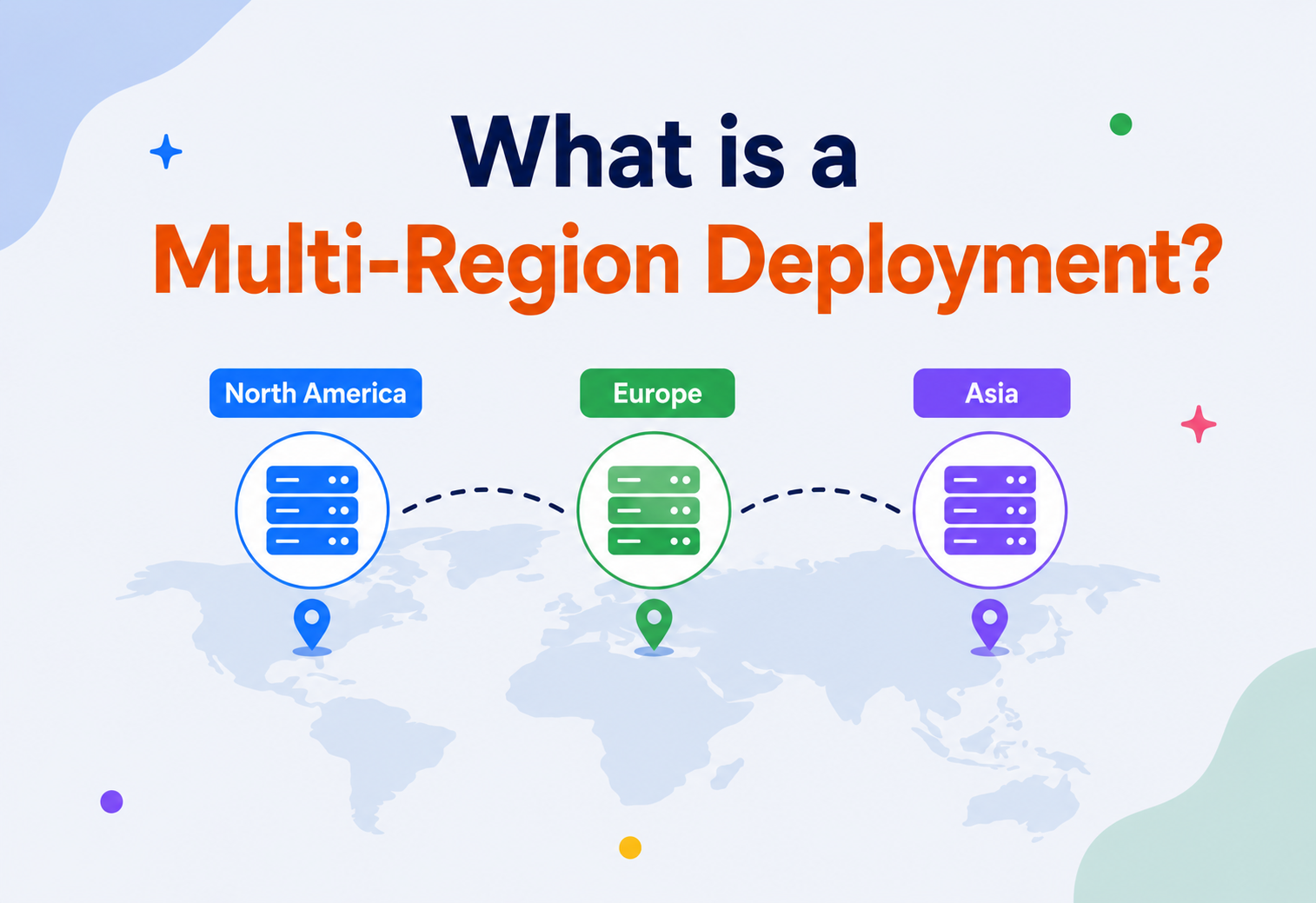
What is a Multi‑Region Deployment?
A complete, beginner‑to‑production guide to running applications across multiple geographic regions — why companies do it, how the pieces fit together, and how to avoid the mistakes that turn “highly available” into “highly confusing.”
Introduction & History
A multi‑region deployment means running copies of your application — and usually your data — in more than one geographic region of the world, instead of just one data center or one cloud region. If you have ever used a website that felt instant no matter whether you were in Mumbai, London, or São Paulo, there is a good chance a multi‑region architecture was working quietly behind the scenes.
Think of a popular pizza chain. If the chain had only one kitchen in the entire country, every order — no matter where you live — would have to travel from that single kitchen, getting cold and late along the way. Instead, the chain opens kitchens in every major city. Each kitchen can independently cook, and if one kitchen catches fire, the others keep serving customers. A multi‑region deployment is the “many kitchens” model applied to software.
To understand why this matters, it helps to look at how deployment strategies evolved over the last three decades:
Single data center era
Companies ran their own physical servers in one building. If that building lost power or its internet link failed, the website went down completely.
Multi‑server, single site
Businesses added more servers, but usually in the same city or data center, protecting against a single server failing — not against the whole site failing.
Content Delivery Networks
Static assets like images and videos began being cached at “edge” locations closer to users, an early hint of the “put things closer to users” philosophy.
Cloud regions go mainstream
AWS, Google Cloud, and Azure made it possible to spin up entire application stacks in different countries within minutes, not months. This is when true multi‑region deployment became realistic for ordinary companies, not just tech giants.
Multi‑region as reliability + compliance requirement
Regulations like the EU’s GDPR started requiring that certain user data stay within specific geographic boundaries, and businesses began treating “what happens if an entire cloud region goes down” as a serious, planned‑for scenario rather than a hypothetical.
Today, multi‑region deployment sits at the intersection of three concerns that used to be handled separately: performance (serve users fast, wherever they are), availability (survive the failure of an entire region), and compliance (keep data within legally required boundaries). Understanding multi‑region deployment is now considered a core skill for any software architect, not an exotic specialty reserved for hyperscale companies.
“Multi‑region” is often confused with “multi‑availability‑zone” (multi‑AZ). They are not the same thing, and the difference matters a lot. We untangle this in the Core Concepts section below.
It’s worth pausing on why this problem didn’t get solved once and for all decades ago. The honest answer is that physics gets in the way. No matter how clever your software is, data cannot travel faster than the speed of light, and real‑world fiber‑optic cables carry signals at roughly two‑thirds of that speed. A request from Delhi to a server in Virginia covers roughly 12,000 kilometers one way — even in a perfect straight line at maximum signal speed, that’s tens of milliseconds each way before any actual computation happens. Multiply that by several back‑and‑forth exchanges needed to establish a secure connection and fetch data, and the physical distance alone can easily add several hundred milliseconds to a page load. Multi‑region deployment is, at its core, an engineering response to a physical constraint that no amount of clever code can eliminate on its own — you have to move the computation itself closer to the user.
This is also why multi‑region strategy tends to be one of the more senior architectural decisions in a company’s technical roadmap. It touches every layer of the stack simultaneously: networking, application design, database engineering, security policy, cost management, and even legal compliance. A junior engineer might add a caching layer or optimize a slow query independently; multi‑region deployment, by contrast, requires coordinated buy‑in across infrastructure, backend, security, and often legal teams, because a mistake in any one layer can undermine the benefits the others were trying to deliver.
The Problem & Motivation
Imagine you run an e‑commerce platform hosted entirely out of a single AWS region — say, ap-south-1 (Mumbai). Your business is growing, and now you have three categories of pain showing up at once.
Problem 1: Users far away experience high latency
Every request from a user in New York has to physically travel to Mumbai and back. Even at the speed of light through fiber‑optic cable, that round trip takes roughly 250–300 milliseconds before your server has even started processing the request. Add server processing time, and a page that should feel instant now feels sluggish. Studies on user behavior consistently show that delays of even a few hundred milliseconds measurably increase how often users abandon a page.
Problem 2: A single region failure takes down your entire business
Cloud regions do fail — rarely, but they do. Power substations fail, cooling systems malfunction, fiber cuts sever connectivity, and human error during maintenance has caused real, well‑documented multi‑hour outages at every major cloud provider. If your entire application — web servers, application servers, and database — lives in one region, a regional outage means your business is completely offline until that region recovers. For a company processing payments or handling healthcare data, that is not just embarrassing; it can be catastrophic and expensive.
Problem 3: Legal and regulatory requirements demand data locality
Many countries and regions now have data residency laws. The EU’s GDPR expects certain categories of personal data belonging to EU citizens to be processed and stored within specific jurisdictions. India’s Digital Personal Data Protection Act (DPDP Act, 2023) similarly places conditions on how personal data of Indian citizens can be handled and transferred. If your entire infrastructure lives in a single U.S. region, you may simply be non‑compliant for customers in other jurisdictions — a legal, not just technical, problem.
Imagine you are a student in Delhi trying to watch a lecture video hosted on a server in California. The video buffers constantly. Now imagine the same lecture is also copied onto a server in Mumbai. Your laptop automatically connects to the Mumbai copy instead, and the video plays instantly. That’s the performance motivation for multi‑region in a nutshell.
Netflix designed its systems so that if an entire AWS region becomes unhealthy, traffic can be shifted to other regions within minutes using a technique they call “regional evacuation.” This was born directly out of painful real‑world outages and is now a core part of their reliability engineering culture.
Multi‑region deployment exists to solve exactly these three problems together: it brings the application physically closer to users (lower latency), it removes any single region as a single point of failure (higher availability), and it lets you keep specific data within specific legal boundaries (compliance). The rest of this guide walks through how that is actually built, piece by piece.
The business cost of getting this wrong
It helps to translate these technical problems into numbers a business actually feels. Industry research on e‑commerce conversion consistently shows that even small increases in page load time correlate with measurably higher cart abandonment — a few hundred milliseconds of extra latency is not a minor inconvenience, it is lost revenue at scale. On the availability side, a single hour of downtime for a mid‑sized online business can mean lost transactions, support ticket surges, and — perhaps most damaging over the long run — a dent in customer trust that outlasts the outage itself. And on the compliance side, the cost of getting data residency wrong isn’t measured in milliseconds or minutes at all; it’s measured in regulatory fines, forced product shutdowns in specific markets, and the far more expensive emergency re‑architecture that follows when a company has to relocate customer data after the fact instead of designing for it from day one.
Framed this way, multi‑region deployment stops looking like an “advanced” or “nice to have” architecture pattern reserved for companies the size of Google or Amazon, and starts looking like a direct, calculable response to three business risks: losing users to slow performance, losing revenue to outages, and losing market access to non‑compliance. The specific solution — how many regions, which topology, how much investment — will vary enormously by company size and stage, but the underlying motivation is the same regardless of scale.
Core Concepts
Before diagrams and code, you need a shared vocabulary. Multi‑region architecture leans on a handful of concepts that show up again and again.
Region vs. Availability Zone (AZ)
A region is a distinct geographic location — for example, Mumbai, Frankfurt, or N. Virginia. Each region is made up of multiple Availability Zones, which are physically separate data centers within that same region, usually a few kilometers apart, each with independent power, cooling, and networking.
| Aspect | Multi‑AZ | Multi‑Region |
|---|---|---|
| Distance | A few kilometers apart | Hundreds or thousands of kilometers apart |
| Network latency between them | Sub‑millisecond to a few ms | Tens to hundreds of ms |
| Protects against | Single data center failure (power, cooling, hardware) | Entire region failure, natural disasters, large‑scale outages |
| Data replication complexity | Low — often synchronous | High — usually asynchronous due to distance |
| Typical use | Baseline high availability for almost every serious application | Global scale, disaster recovery, regulatory data residency |
As a rule of thumb: every production system should be multi‑AZ at minimum. Multi‑region is an additional, more expensive investment you make once you need global performance, disaster recovery across an entire region, or data residency compliance.
Latency vs. Throughput
Latency is how long a single request takes (measured in milliseconds). Throughput is how many requests your system can handle per second. Multi‑region deployment primarily attacks latency for geographically distributed users — it does not automatically increase throughput unless you also scale the number of servers.
The CAP Theorem
The CAP theorem, formulated by Eric Brewer, states that a distributed data system can only guarantee two of the following three properties at the same time, during a network partition:
- Consistency (C): every read receives the most recent write, or an error.
- Availability (A): every request receives a (non‑error) response, even if it isn’t the latest write.
- Partition tolerance (P): the system continues to operate despite network failures between nodes.
In multi‑region systems, network partitions between regions are not a rare edge case — they are a routine reality, because you are relying on long‑distance internet links. This means partition tolerance is non‑negotiable, and the real design decision becomes a choice between CP (consistent but may refuse requests during a partition) and AP (available but may briefly serve stale data during a partition).
A banking core ledger typically favors CP — it would rather reject a transaction than risk an inconsistent balance. A social media “like” counter typically favors AP — showing a slightly stale like count is a far smaller problem than the app becoming unusable.
Replication
Replication means keeping copies of the same data in multiple locations. In multi‑region systems, replication is usually:
- Synchronous replication: a write is only confirmed to the client after all (or a quorum of) replicas have acknowledged it. Strongly consistent, but slow across long distances because you must wait for the round trip.
- Asynchronous replication: a write is confirmed immediately by the primary region, and the data is copied to other regions shortly afterward. Fast, but there is a small window where other regions have stale data.
Partitioning (Sharding)
Partitioning splits data across multiple nodes based on some key (like user ID or region). In a multi‑region context, a common pattern is geo‑partitioning: a European user’s data lives primarily in the Frankfurt region, an Indian user’s data lives primarily in the Mumbai region, and so on — which also happens to help with data residency compliance.
Consensus
Consensus algorithms (like Raft and Paxos) allow a group of distributed nodes to agree on a single value or ordering of events, even when some nodes fail. They’re the mathematical backbone behind things like leader election in distributed databases (deciding which region’s copy is currently the “primary” one accepting writes).
Concurrency and Conflict Resolution
When two regions can both accept writes (a “multi‑primary” or “active‑active” setup), it’s possible for the same piece of data to be modified in two places at nearly the same moment. Systems must define a strategy — like “last write wins” based on timestamps, vector clocks, or application‑specific merge logic — to resolve these conflicts consistently.
Failure Recovery
Failure recovery in multi‑region systems covers the mechanisms for detecting a region has failed (health checks, heartbeats) and redirecting traffic and, if needed, promoting a replica in another region to become the new primary — a process called failover.
Consistency Models, in Practice
Beyond the binary “consistent or not” framing of CAP, real systems operate along a spectrum of consistency models, each offering a different practical guarantee:
- Strong consistency: every reader sees the latest write immediately, no matter which region they read from. Expensive to achieve across long distances because it typically requires waiting for cross‑region acknowledgment on every write.
- Eventual consistency: all replicas will converge to the same value eventually, given enough time without new writes, but a read immediately after a write might return stale data.
- Read‑your‑own‑writes consistency: a middle ground where a specific user is guaranteed to see their own recent writes (even if other users might briefly see stale data), often implemented by routing that user’s subsequent reads to the primary region for a short window.
- Causal consistency: guarantees that operations which are causally related (like a comment appearing only after the post it replies to) are seen by everyone in the same order, even if unrelated operations can appear in different orders to different observers.
Imagine a WhatsApp group. If your friend replies to a message, everyone should see the original message before the reply — that’s causal consistency. But if two unrelated people send messages at almost the same moment, it’s usually fine if different group members see those two messages in a very slightly different order — strict global ordering isn’t necessary there.
Choosing the right consistency model per data type — rather than picking one model for the entire application — is one of the defining skills of designing a good multi‑region system. A shopping cart total, a bank balance, and a “last seen online” timestamp all have very different tolerances for staleness, and treating them identically usually means either overpaying in latency for the data that didn’t need strong consistency, or under‑protecting the data that did.
Architecture & Components
A production‑grade multi‑region deployment is not a single technology — it is a stack of coordinated components. Let’s walk through each layer, from the moment a user types a URL to the moment data is written to disk.
Global DNS / Traffic Routing
The entry point. Services like AWS Route 53, Google Cloud DNS, or Cloudflare Load Balancing use latency‑based routing, geo‑DNS, or anycast IPs to send each user to the nearest healthy region automatically, without the user ever knowing multiple regions exist.
Content Delivery Network
Static assets — images, CSS, JavaScript bundles, videos — are cached at edge locations spread across hundreds of cities. This offloads a huge percentage of traffic before it ever reaches your application servers.
Regional Load Balancers
Within each region, a load balancer distributes incoming requests across multiple application server instances, and continuously performs health checks so it can stop sending traffic to unhealthy instances.
Application Layer (Stateless)
Application servers deployed independently in each region — usually as containers orchestrated by Kubernetes. The core rule: these servers should be stateless, because the next request from the same user might land on a completely different server or region.
Data Layer
Primary/replica databases, distributed caches, and message queues, all of which need a clear replication and consistency strategy across regions — usually the hardest part of multi‑region architecture.
Global Control Plane
A lightweight, highly available coordination service (built on consensus algorithms) that tracks “which region is currently primary for this data partition” or “is region X currently healthy.” Tools: etcd, ZooKeeper, or cloud‑native equivalents.
Component Summary Table
| Layer | Purpose | Common Tools |
|---|---|---|
| Global routing | Send users to the nearest/healthiest region | Route 53, Cloudflare, Google Cloud DNS |
| CDN | Cache static content near users | CloudFront, Akamai, Fastly, Cloudflare |
| Regional load balancer | Distribute traffic within a region | ALB/NLB, Nginx, HAProxy, Envoy |
| Application layer | Stateless business logic | Spring Boot, Kubernetes, Docker |
| Data layer | Store and replicate data | Aurora Global DB, Cosmos DB, CockroachDB, Cassandra |
| Coordination | Leader election, health tracking | etcd, ZooKeeper, Consul |
Teams often build the application and routing layers to be multi‑region, but leave a single database in one region as an afterthought. The result: your “multi‑region” system still has one giant single point of failure — the database. Data layer strategy must be designed first, not last.
Internal Working
Let’s trace what actually happens, step by step, when a user in Singapore requests their profile page from an application deployed across Mumbai (primary) and Singapore (secondary read region).
- DNS resolution: The user’s browser asks the global DNS service to resolve
api.example.com. Because the DNS provider uses latency‑based routing, it returns the IP address of the load balancer in the Singapore region — the closest healthy region to the user. - TLS handshake: The browser establishes a secure connection with the Singapore regional load balancer.
- Load balancing: The load balancer picks one of several healthy application server instances in Singapore using a strategy like round‑robin or least‑connections.
- Cache check: The application server checks the regional cache (e.g., Redis) for the user’s profile. If present and fresh, it’s returned immediately — this is the fast path.
- Database read (cache miss): If not cached, the server reads from the Singapore read replica of the database, which is kept in sync with the Mumbai primary through asynchronous replication.
- Handling a write: If the user updates their profile, the write cannot go to the Singapore replica (it’s read‑only). The application routes the write request to the Mumbai primary region, either directly or through an internal proxy layer that knows where the “source of truth” lives for that data.
- Replication propagation: After the write commits in Mumbai, the change is streamed asynchronously to Singapore (and any other read regions), typically within tens to a few hundred milliseconds.
- Eventual consistency window: For that brief window, a read in Singapore might return the old profile data — this is the practical, everyday manifestation of the CAP theorem tradeoff discussed earlier.
Imagine mailing a letter to update your address with a company that has offices in five cities. The head office (Mumbai) updates its master file instantly. But it takes a day for that update to reach the branch office in Singapore by internal courier. If someone checks your address at the Singapore branch during that one day, they’ll see your old address — that’s eventual consistency in action.
Java / Spring Boot Example: Routing Writes to the Primary Region
A common internal pattern is a “region‑aware” data source router that decides, per query, whether to hit the local read replica or forward to the primary region.
@Component
public class RegionAwareDataSourceRouter extends AbstractRoutingDataSource {

    @Override
    protected Object determineCurrentLookupKey() {
        // Reads use the local regional replica; writes always
        // go to the primary region's data source.
        return TransactionSynchronizationManager.isCurrentTransactionReadOnly()
                ? "LOCAL_REPLICA"
                : "PRIMARY_REGION";
    }
}

@Configuration
public class DataSourceConfig {

    @Bean
    public DataSource routingDataSource(
            @Qualifier("primaryDataSource") DataSource primary,
            @Qualifier("replicaDataSource") DataSource replica) {

        RegionAwareDataSourceRouter router = new RegionAwareDataSourceRouter();
        Map<Object, Object> sources = new HashMap<>();
        sources.put("PRIMARY_REGION", primary);
        sources.put("LOCAL_REPLICA", replica);

        router.setTargetDataSources(sources);
        router.setDefaultTargetDataSource(replica);
        return router;
    }
}
The @Transactional(readOnly = true) annotation on a service method causes Spring’s transaction manager to mark the transaction as read‑only, which this router then uses to decide the correct data source — quietly keeping writes flowing to the single source of truth while reads stay fast and local.
Data Flow & Lifecycle
Understanding data flow means tracing a piece of data from creation to eventual consistency across every region. Let’s follow an order placed on an e‑commerce platform.
Lifecycle stages
Ingestion
The write enters the system at whichever region the user is closest to, but is routed to the authoritative primary for that data partition.
Commit
The primary region’s database commits the write, typically after satisfying its configured durability guarantee (e.g., write to disk, or acknowledgment from a quorum of nodes).
Propagation
The committed change streams out to other regions via replication logs (e.g., MySQL binlog, PostgreSQL WAL streaming, or a database‑native global replication feature).
Convergence
All regions eventually hold identical data — this is the “eventual” in eventual consistency.
Read serving
Once converged, reads from any region return the same value, until the next write starts the cycle again.
Track replication lag — the time gap between a write committing at the primary and it appearing at a replica — as a first‑class metric. It’s the single most important number for understanding how “eventually consistent” your eventual consistency really is.
Pros, Cons & Trade‑offs
Multi‑region is a serious lever. Both sides of the ledger are worth stating out loud before committing to it.
| Pros | Cons / Trade‑offs |
|---|---|
| Lower latency for globally distributed users | Significantly higher infrastructure cost — you’re running (and paying for) N copies of your stack |
| Survives an entire region outage, not just a server or AZ outage | Much higher operational complexity: deployments, monitoring, and debugging all get harder |
| Enables compliance with data residency laws | Data consistency becomes genuinely hard — CAP theorem trade‑offs are unavoidable |
| Can isolate blast radius — a bad deploy in one region doesn’t have to affect others | Cross‑region network calls add latency and can introduce subtle bugs under partial failure |
| Improves disaster recovery posture (lower RTO/RPO) | Requires disciplined schema/versioning strategy since regions may run different code versions briefly during rollout |
The core trade‑off to internalize: multi‑region buys you resilience and speed, and it charges you in cost and complexity. It is rarely the right first investment for an early‑stage startup with a few hundred users in one country — but it becomes close to mandatory once you have a global user base, strict uptime SLAs, or regulatory obligations.
A very common middle ground is “warm standby” multi‑region: one active region serving all traffic, and a second region kept ready with replicated data but not actively serving, to be promoted only during a disaster. This captures much of the disaster‑recovery benefit at a fraction of the operational cost of a full active‑active setup.
Performance & Scalability
Multi‑region deployment interacts with performance and scalability in several distinct ways.
Latency reduction
By serving users from the nearest region, you cut down the physical distance data has to travel. As a general rule of thumb, network latency roughly correlates with distance: intra‑city trips might add 1–5 ms, intra‑continental trips 20–60 ms, and intercontinental trips 100–300 ms round trip. Multi‑region deployment collapses that number down to the intra‑region figure for most users.
Horizontal scalability
Each region can independently scale its application tier up or down based on local demand (for example, scaling up the India region during Indian business hours while the US region scales down overnight). This is more efficient than a single global region trying to serve every timezone’s peak load simultaneously.
Read scalability via replicas
Read replicas in each region absorb read traffic locally, which both reduces latency and reduces load on the primary database, letting the whole system handle a much higher aggregate read throughput than a single‑region setup could.
The write scalability limit
Multi‑region does not automatically solve write scalability. In a single‑primary architecture, all writes for a given partition still funnel through one region, so that region’s write capacity remains a ceiling. Techniques like geo‑partitioning (splitting data by region so each region is primary for its own slice) or multi‑primary databases (e.g., CockroachDB, Cosmos DB in multi‑write mode) are needed to scale writes globally — at the cost of more complex conflict resolution.
Amazon’s DynamoDB Global Tables lets you designate multiple regions as simultaneous write regions, using a “last writer wins” conflict resolution strategy based on timestamps, so that write scalability isn’t bottlenecked by a single region.
Capacity planning across regions
Scaling a multi‑region system well requires thinking about capacity in at least two dimensions at once: how much total capacity the whole system needs, and how that capacity should be distributed across regions to match real traffic patterns. A common mistake is provisioning every region identically, “just to be safe,” which usually means wildly over‑provisioning smaller regions and under‑provisioning the busiest one. A better approach uses historical and projected traffic data per region — factoring in local time zones, seasonal shopping patterns, and regional marketing campaigns — to size each region’s autoscaling limits independently.
The hidden cost of cross‑region chatter
As systems scale, it’s tempting to let services “just call” a dependency in another region when it’s convenient during development. At small scale, this barely registers. At production scale, with thousands of requests per second each paying a 100–200 ms cross‑region tax, that convenience becomes a serious throughput and cost problem — cross‑region data transfer is typically billed separately and can become a significant line item on a cloud bill once traffic grows. Performance‑conscious teams treat “does this call cross a region boundary?” as a standard question during code review for any new service dependency, the same way they’d scrutinize a new database query for missing indexes.
High Availability & Reliability
High availability (HA) in a multi‑region system is built through several layered mechanisms.
Health checks and automated failover
Global traffic managers continuously send health check probes to each region. If a region fails enough consecutive checks, it is automatically removed from DNS/traffic routing, and traffic shifts to the remaining healthy regions — usually within seconds to a couple of minutes, depending on health check intervals and DNS TTLs.
RTO and RPO
Two metrics define your disaster recovery posture:
- RTO (Recovery Time Objective): how long it takes to restore service after a failure.
- RPO (Recovery Point Objective): how much data you can afford to lose, measured in time (e.g., “at most 30 seconds of writes”).
| Strategy | Typical RTO | Typical RPO | Cost |
|---|---|---|---|
| Backup & restore | Hours | Hours | Lowest |
| Pilot light (minimal standby) | 10s of minutes | Minutes | Low |
| Warm standby | Minutes | Seconds to minutes | Medium |
| Active‑active (multi‑region) | Seconds | Near zero | Highest |
Failure recovery walkthrough
- Monitoring detects the Mumbai region is unhealthy (elevated error rates, failed health checks).
- An automated or human‑triggered failover process promotes the Singapore read replica to become the new primary.
- DNS/traffic manager stops routing any traffic to Mumbai.
- Application configuration is updated so all regions now treat Singapore as primary for writes.
- Once Mumbai recovers, it rejoins as a replica, resynchronizing from the new Singapore primary — never silently resuming as primary, to avoid a dangerous “split‑brain” scenario.
Never let a recovered region automatically reclaim “primary” status without explicit confirmation that its data is fully resynced. Doing so can silently cause a split‑brain, where two regions each believe they are the authoritative primary and accept conflicting writes.
Security
Security in multi‑region systems must be designed with the assumption that data and requests will cross public networks between regions.
Encryption in transit and at rest
All inter‑region traffic — replication streams, service‑to‑service calls — should be encrypted with TLS. Data at rest in each region’s storage should be encrypted using region‑specific keys, often through a cloud provider’s KMS (Key Management Service).
Identity and access management per region
Access policies should be scoped per region where possible, so that a compromised credential in one region doesn’t automatically grant access to every region’s resources.
Data residency and sovereignty
Certain data must never leave a specific jurisdiction. This is enforced not just through policy, but architecturally — for example, by ensuring the database engine physically stores EU citizens’ data only on EU‑region infrastructure, and by auditing replication configuration to guarantee it never targets a disallowed region.
Secrets management
Secrets (API keys, database credentials, certificates) should be stored in region‑local secret managers (e.g., AWS Secrets Manager per region) rather than a single global secret store, to avoid that store becoming both a single point of failure and a single point of compromise.
Cross‑region attack surface
Every additional region is an additional network boundary, additional set of firewall rules, and additional IAM policy set that must be kept correctly configured. Security misconfiguration risk grows with the number of regions, so infrastructure‑as‑code with automated policy validation becomes essential rather than optional at multi‑region scale.
Treat inter‑region traffic with the same scrutiny as traffic crossing the public internet — because in most cloud setups, it effectively is, even if it stays within the provider’s private backbone.
Regional compliance frameworks vary — and so should your controls
Security and compliance requirements are rarely uniform across the regions a company operates in. A region serving European users needs to account for GDPR’s requirements around data subject rights, breach notification timelines, and lawful basis for processing. A region serving Indian users needs to account for the DPDP Act’s consent and data fiduciary obligations. A region serving U.S. healthcare data may need to satisfy HIPAA. Rather than trying to build one security posture that satisfies the strictest requirement everywhere (which often means over‑engineering for regions that don’t need it, or under‑protecting the ones that do), mature organizations build a shared security baseline and then layer region‑specific controls on top, tracked explicitly against each jurisdiction’s requirements.
Incident response across time zones
A security incident in a multi‑region system doesn’t respect business hours in any single country. Security and on‑call rotations for multi‑region systems typically need “follow‑the‑sun” coverage, or at minimum, clearly documented escalation paths so that an incident detected at 3 AM in one region’s time zone doesn’t sit unaddressed until a team wakes up on the other side of the world.
Monitoring, Logging & Metrics
Observability across multiple regions requires a global view stitched together from many local sources.
Key metrics to track
- Replication lag per region‑pair — the most critical multi‑region‑specific metric.
- Regional error rate and latency (p50/p95/p99) — tracked separately per region, not just globally averaged, since averaging can hide a struggling region.
- Cross‑region call latency — for any service‑to‑service calls that cross region boundaries.
- Failover events and duration — how often failovers happen, and how long they take.
- DNS/traffic‑routing health — confirming that traffic is actually being routed to the intended, healthy regions.
Centralized logging
Logs from every region should be shipped to a centralized system (e.g., an ELK/OpenSearch stack, or a managed observability platform), tagged with a region label and a correlation ID so a single user request that spans multiple services and regions can be traced end‑to‑end.
Distributed tracing
Tools like OpenTelemetry propagate a trace ID across service and region boundaries, letting engineers visualize exactly how long each hop — including the cross‑region ones — contributed to total request latency.
@RestController
public class OrderController {

    private static final Logger log = LoggerFactory.getLogger(OrderController.class);

    @PostMapping("/orders")
    public ResponseEntity<OrderResponse> createOrder(@RequestBody OrderRequest request,
                                                       @RequestHeader("X-Correlation-Id") String correlationId) {
        MDC.put("correlationId", correlationId);
        MDC.put("region", System.getenv("DEPLOY_REGION"));
        try {
            log.info("Processing order for user {}", request.getUserId());
            OrderResponse response = orderService.createOrder(request);
            return ResponseEntity.status(HttpStatus.CREATED).body(response);
        } finally {
            MDC.clear();
        }
    }
}Dashboards should default to per‑region views before global aggregates. A global p99 latency of 120 ms can hide the fact that one region is silently degraded at 800 ms while others compensate at 40 ms.
Deployment & Cloud
Rolling out changes safely across multiple regions requires more discipline than a single‑region deploy.
Progressive regional rollout
Rather than deploying a new version to all regions simultaneously, teams typically deploy to one “canary” region first, monitor error rates and latency for a defined period, and only then proceed to the remaining regions. This limits the blast radius of a bad deployment to a single region.
Infrastructure as Code
Multi‑region infrastructure is almost never managed by hand — tools like Terraform, Pulumi, or AWS CDK define the entire regional stack as code, with region‑specific parameters (like region name, replica endpoints) injected as variables. This ensures every region is configured identically apart from intentional differences.
module "app_region" {
  for_each = toset(["ap-south-1", "eu-central-1", "us-east-1"])
  source   = "./modules/regional-stack"

  region              = each.value
  is_primary_region   = each.value == "ap-south-1"
  replica_of          = each.value != "ap-south-1" ? "ap-south-1" : null
  min_instances       = 2
  max_instances       = 20
}
Managed multi‑region services
Cloud providers offer purpose‑built multi‑region services to reduce the engineering burden: AWS Aurora Global Database, Azure Cosmos DB with multi‑region writes, Google Cloud Spanner (globally consistent by design), and Kubernetes multi‑cluster tools like Istio for service mesh across regions.
Prefer a managed multi‑region database service over building custom cross‑region replication yourself, unless you have a very strong reason not to. Getting consensus and replication correct is genuinely one of the hardest problems in distributed systems.
Databases, Caching & Load Balancing
The data layer is where most of the genuinely hard multi‑region decisions live. Getting topology, caching and load balancing right here is what separates a real multi‑region deployment from a single‑region system that just happens to have some spare compute in another region.
Database replication topologies
| Topology | Description | Best for |
|---|---|---|
| Single‑primary, multi‑replica | One region accepts writes; others hold read‑only replicas | Read‑heavy workloads, simpler consistency reasoning |
| Multi‑primary (active‑active) | Multiple regions accept writes; conflicts resolved automatically | Low write‑latency needs across regions, tolerant of eventual consistency |
| Geo‑partitioned (sharded by region) | Each region is primary for its own slice of data | Data residency requirements, naturally region‑local data (e.g., per‑country users) |
Caching strategy
Each region typically runs its own local cache (e.g., Redis or Memcached cluster) to avoid cross‑region cache calls, which would defeat the latency benefits of multi‑region in the first place. Cache invalidation across regions is handled by publishing invalidation events through a message bus that fans out to all regional caches.
Load balancing layers
There are effectively two layers of load balancing in a multi‑region system: global (which region should this user hit?) using DNS or anycast, and regional (which specific server instance within that region?) using a traditional load balancer like an ALB or Nginx.
Java example: Region‑local cache with fallback
@Service
public class ProductCatalogService {

    private final RedisTemplate<String, Product> regionalCache;
    private final ProductRepository repository;

    public Product getProduct(String productId) {
        String cacheKey = "product:" + productId;
        Product cached = regionalCache.opsForValue().get(cacheKey);
        if (cached != null) {
            return cached;
        }
        Product product = repository.findById(productId)
                .orElseThrow(() -> new ProductNotFoundException(productId));
        regionalCache.opsForValue().set(cacheKey, product, Duration.ofMinutes(10));
        return product;
    }
}Sharing a single global cache cluster across regions to “save costs” reintroduces the exact cross‑region latency problem multi‑region deployment was meant to solve. Keep caches regional.
APIs & Microservices
In a microservices architecture spread across multiple regions, a few extra design questions become unavoidable.
Should a service call another region directly?
Generally, avoid synchronous cross‑region service‑to‑service calls in the hot path of a user request wherever possible — each cross‑region hop adds tens to hundreds of milliseconds. Prefer either keeping the full call chain within one region, or decoupling cross‑region communication through asynchronous messaging.
API Gateway per region
Each region typically runs its own API gateway instance, configured identically, so that a user’s entire request path — gateway, services, database read — stays within their local region whenever possible.
Event‑driven communication across regions
For cases where regions genuinely need to know about each other’s events (for example, inventory changes needing to reach every region’s cache), an event bus with cross‑region replication (like Kafka with MirrorMaker, or a cloud‑native equivalent) lets each region consume events independently and asynchronously, avoiding synchronous cross‑region coupling.
Versioning and backward compatibility
Because regions may briefly run different application versions during a progressive rollout, APIs and event schemas must be backward and forward compatible during the transition window — a new field being added should never break an older region’s consumer.
Design Patterns & Anti‑Patterns
A short taxonomy of the multi‑region patterns you’ll see reused across nearly every mature system, and the anti‑patterns that quietly undo them.
Active‑Passive (Warm Standby)
One region actively serves all traffic; a second region continuously receives replicated data but serves no live traffic until failover. Simpler to reason about, lower cost than active‑active, but the passive region’s capacity to actually handle full load should be tested regularly (a “fire drill”), not assumed.
Active‑Active
Multiple regions simultaneously serve live traffic and, often, simultaneously accept writes. Maximizes performance and resource utilization but requires solving multi‑primary conflict resolution.
Geo‑Partitioning
Data is split by geography so each region owns its local slice outright, minimizing cross‑region write traffic and naturally satisfying data‑residency rules. The trade‑off is that queries spanning multiple regions’ data (e.g., a global admin dashboard) become more complex.
Cell‑Based Architecture
Instead of just splitting by region, large‑scale systems sometimes split each region further into independent “cells,” each a self‑contained, fully functional slice of the system serving a subset of users — limiting the blast radius of any failure to a single cell rather than an entire region.
Hidden Single Point of Failure
Building a beautiful multi‑region application and database layer, but routing all traffic through one global authentication service in a single region. If that service goes down, every region’s users are locked out — the “multi‑region” benefit is an illusion.
Chatty Cross‑Region Calls
Microservices making several synchronous, sequential calls across regions to complete a single user request. Each hop compounds latency, and the request often ends up slower than if it had simply stayed in a single distant region to begin with.
Assuming Replication is Instant
Code that writes data and then immediately reads it back from a different region, assuming it will already be there. Under replication lag, this produces confusing, intermittent bugs that are hard to reproduce in testing but show up regularly in production.
“Read‑your‑own‑writes” bugs are one of the most frequent multi‑region issues reported in production. A user updates their profile and immediately refreshes the page, only to see stale data because the refresh happened to hit a replica that hasn’t caught up yet. Mitigate this by routing a user’s own subsequent reads to the primary region for a short window after they write, or by using session‑based consistency tokens.
Best Practices & Common Mistakes
These are the disciplines mature multi‑region operators internalize — and the mistakes that show up in nearly every incident postmortem when they’re missing.
Best practices
- Design for statelessness first. Stateless application servers make regional failover and scaling dramatically simpler.
- Choose your consistency model deliberately, per data type — not as a single blanket decision for the whole system. Payment balances might need strong consistency; product view counts don’t.
- Automate failover, but keep a manual override. Fully automatic failover is fast but can occasionally overreact to transient issues; a manual override lets humans intervene when needed.
- Test failover regularly with real “game day” exercises, not just on paper. A failover process that has never actually been executed should not be trusted.
- Monitor replication lag as a primary metric, with alerting thresholds, not just an occasional manual check.
- Keep region configuration identical via Infrastructure as Code to avoid subtle, hard‑to‑debug configuration drift between regions.
- Start with active‑passive, evolve to active‑active only once you have a proven, specific need for it — the operational complexity jump is significant.
Common mistakes
- Treating multi‑region as “multi‑AZ but further apart” without addressing the additional latency and consistency implications.
- Under‑provisioning the passive/standby region’s capacity, discovering during an actual disaster that it can’t handle full production load.
- Forgetting to replicate supporting infrastructure — secrets, configuration, feature flags — alongside application data.
- Not accounting for the cost multiplier; multi‑region can easily double or triple infrastructure spend, which needs to be budgeted and justified, not discovered on a cloud bill.
- Ignoring data residency requirements until a compliance audit forces an expensive re‑architecture.
Before committing to multi‑region, ask: “What specific outage, latency complaint, or compliance requirement are we solving?” If you can’t answer concretely, you may not need it yet — and the complexity cost is real.
A simple maturity path
Most successful multi‑region journeys follow a similar sequence rather than jumping straight to full active‑active complexity. Teams typically start with a single region hardened to be multi‑AZ, add a CDN for static assets to get an early performance win with minimal complexity, introduce a warm‑standby second region for disaster recovery once the business can’t tolerate extended downtime, and only move to active‑active once there’s a clear, measured need for lower write latency in multiple geographies or a hard regulatory requirement for local data processing. Skipping straight to the most complex pattern before validating the need for it is one of the more expensive architectural mistakes a growing engineering organization can make, both in direct infrastructure cost and in the ongoing tax of operational complexity paid by every engineer who touches the system afterward.
Real‑World / Industry Examples
A short walk through the companies whose multi‑region engineering choices have publicly shaped how the rest of the industry thinks about this problem.
Netflix
Netflix operates across multiple AWS regions and has published extensively about their “regional evacuation” capability — the ability to shift all traffic away from an unhealthy region within minutes. This was driven directly by real production incidents and is tested regularly through deliberate chaos engineering exercises.
Amazon
Amazon’s DynamoDB offers Global Tables, letting customers replicate tables across regions with multi‑region, multi‑primary writes and automatic conflict resolution — productizing a pattern Amazon itself built internally for its e‑commerce platform’s global scale.
Google Cloud Spanner is a globally distributed database that offers strong (externally consistent) transactions across regions, made possible by Google’s TrueTime API, which uses atomic clocks and GPS receivers to bound clock uncertainty across data centers worldwide — an unusually deep engineering investment specifically to make multi‑region strong consistency practical.
Uber
Uber operates region‑local “cells” to contain the blast radius of failures and to keep ride‑matching latency low, given how latency‑sensitive real‑time ride dispatch is to driver and rider experience.
Banking and Financial Services in India
Indian banks and payment processors under RBI guidelines are required to maintain data localization for payment data — all data relating to payment systems must be stored only in India — directly shaping how these companies architect their regional deployment strategy even when they operate globally.
Meta (Facebook, Instagram, WhatsApp)
Meta operates data centers across multiple continents and has invested heavily in globally distributed infrastructure so that billions of users experience low‑latency access to social feeds and messaging. Their engineering blog has described techniques for geographically routing traffic and replicating data close to where it’s consumed, balancing consistency needs (like message delivery order) against the scale of a truly global user base.
Salesforce
As an enterprise SaaS provider serving customers across many regulatory environments, Salesforce operates region‑specific infrastructure (sometimes called “instances”) partly to satisfy enterprise customers’ data residency and sovereignty requirements, illustrating how B2B compliance pressure — not just consumer‑facing latency — can be a primary driver of multi‑region architecture.
What these examples have in common
Across every one of these companies, the underlying motivation maps back to the same three forces introduced earlier in this guide: performance for a geographically spread user base, resilience against regional failures at a scale where downtime is extremely costly, and compliance with data protection regimes that increasingly vary by country. The specific technology choices differ — Spanner’s atomic‑clock‑based consistency is a very different engineering bet than DynamoDB’s last‑writer‑wins conflict resolution — but the motivating problems, and the fundamental trade‑offs described by the CAP theorem, are the same ones every team building a multi‑region system has to confront.
FAQ, Summary & Key Takeaways
Five questions that come up almost every time a team seriously considers going multi‑region, followed by a compact summary of everything above.
Is multi‑region the same as multi‑cloud?
No. Multi‑region means multiple geographic regions within one cloud provider (or your own data centers). Multi‑cloud means using more than one cloud provider (e.g., AWS and GCP together) — a separate, even more complex strategy usually aimed at avoiding vendor lock‑in.
Do small applications need multi‑region deployment?
Usually not at first. Multi‑AZ within a single region already provides strong protection against the most common failure modes at a much lower cost and complexity. Multi‑region becomes valuable once you have a genuinely global user base, strict availability SLAs, or regulatory data residency needs.
What’s the difference between active‑active and active‑passive?
Active‑active means multiple regions simultaneously serve live production traffic. Active‑passive means one region serves traffic while another stays synchronized and ready, only taking over during a failure.
How is data consistency handled across regions?
Through a deliberate choice of replication strategy (synchronous vs asynchronous) and consistency model, guided by the CAP theorem trade‑offs, applied per data type based on how much staleness that particular data can tolerate.
What is replication lag and why does it matter?
It’s the time delay between a write committing in the primary region and that same data becoming visible in other regions. It directly determines how “eventual” your eventual consistency is, and is one of the most important metrics to monitor continuously.
Key takeaways
- Multi‑region deployment runs your application across geographically distinct regions to reduce latency for global users, survive entire‑region outages, and satisfy data residency laws.
- It is distinct from multi‑AZ, which protects against data‑center‑level failures within a single region — most applications need multi‑AZ regardless of whether they ever go multi‑region.
- The CAP theorem forces a deliberate consistency‑vs‑availability trade‑off whenever a network partition occurs between regions, which happens routinely in geographically distributed systems.
- Core building blocks include global DNS routing, CDNs, regional load balancers, stateless application servers, and a carefully chosen database replication topology.
- Replication lag, per‑region error rates, and failover duration are the metrics that matter most for operating a multi‑region system reliably.
- Common patterns include active‑passive, active‑active, and geo‑partitioning; common anti‑patterns include hidden single points of failure and assuming replication is instantaneous.
- Multi‑region buys resilience and performance at the cost of real complexity and expense — it should be adopted deliberately, in response to a concrete need, not by default.