What Does It Mean for an API to Be Stateless?
A complete, beginner-to-production guide to statelessness — the single idea that lets Netflix, Amazon, and Google serve billions of requests a day without falling over. We’ll explain it from first principles, build it in Java/Spring Boot, and show you exactly how it scales, where it fits, and where it deliberately doesn’t.
The Server That Deliberately Forgets You
A stateless API is one where the server does not remember anything about you between one request and the next — a small architectural rule with enormous downstream consequences for scale, resilience, and deployment.
If you’ve read anything about REST APIs, you’ve probably run into the word “stateless.” It sounds academic, but it’s actually one of the most practical ideas in all of software architecture — it’s the reason you can restart a server in the middle of the day without users noticing, and the reason a company like Netflix can add a thousand new servers on a Friday night without rewriting a single line of application code.
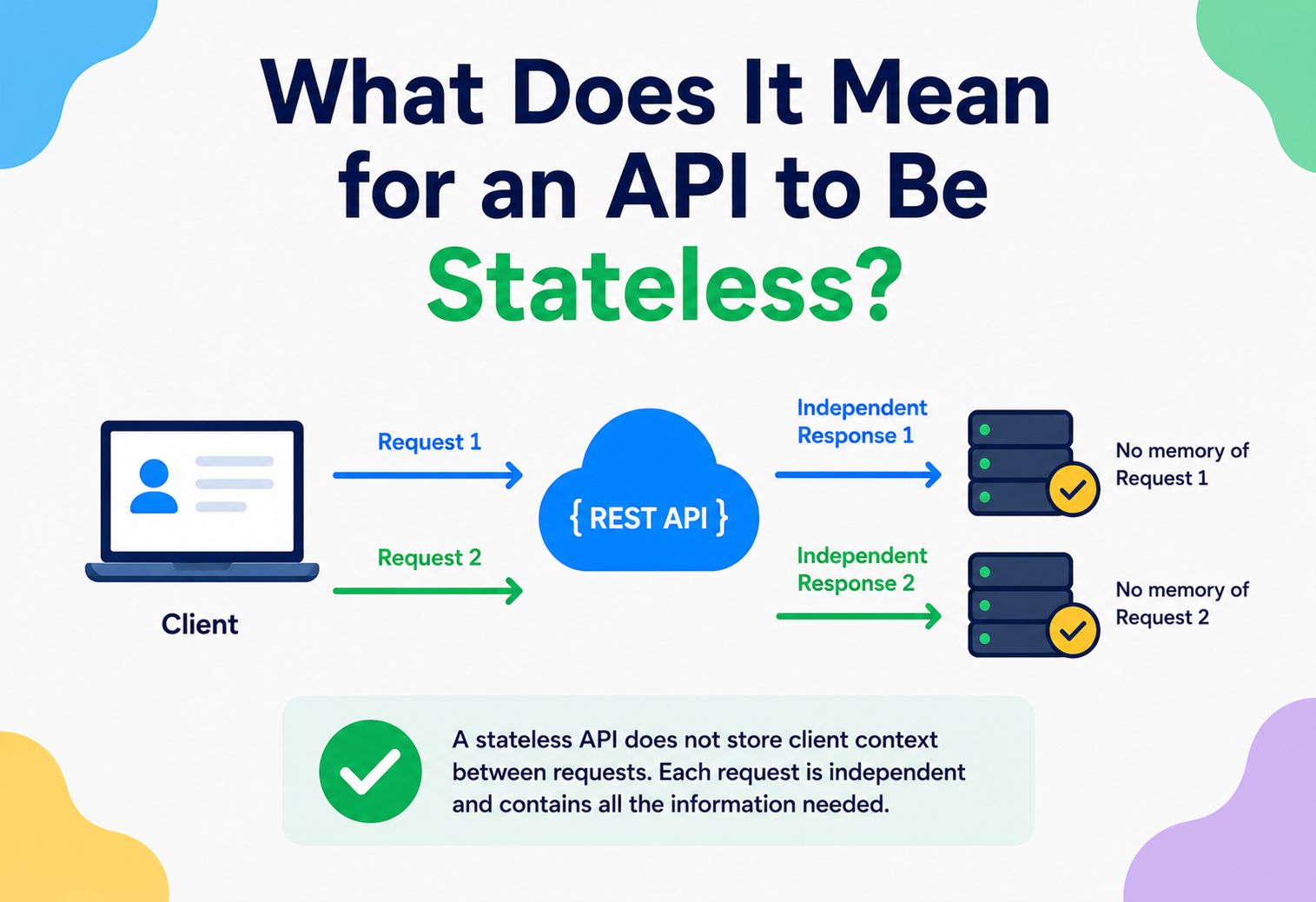
In plain English: a stateless API is one where the server does not remember anything about you between one request and the next. Every single request you send must carry everything the server needs to understand and fulfill it — who you are, what you want, and any context required. The server processes it, sends back a response, and then forgets you ever existed. The next request starts from zero, as if it came from a stranger.
A stateless API is like ordering at a fast-food counter where every single time you walk up, you have to say your entire order from scratch — “Hi, I’m Priya, I’d like a veg burger, no onions, extra cheese, and I already paid with card ending 4321.” The cashier behind the counter has no memory of you from your last visit. They don’t keep a running tab in their head. Every order is self-contained. Compare that to your regular neighborhood chai stall, where the vendor remembers you take less sugar and starts making it the moment they see you walking up — that’s a stateful relationship, because the vendor is holding context about you in their own memory.
Where Did This Idea Come From?
The term “stateless” in the context of web APIs was formally defined in the year 2000, when a computer scientist named Roy Fielding wrote his PhD dissertation titled “Architectural Styles and the Design of Network-based Software Architectures.” In it, he described an architectural style he called REST (Representational State Transfer), and one of its six guiding constraints was, quite simply, statelessness.
Fielding wasn’t inventing something totally new — he was describing the pattern that already made the World Wide Web itself work so well. Think about how a browser fetches a web page: your browser asks a server for a page, the server sends back the HTML, and then the server has no ongoing “session” open with your browser. Each request for a new page is a completely fresh transaction. Fielding looked at this design and said: this is exactly why the web scales to billions of users, and any API we build on top of HTTP should follow the same rule.
Before REST became popular, a lot of enterprise systems used protocols like SOAP combined with stateful session objects, where a server would hold open a conversation with a specific client, remembering exactly where that client was in a multi-step process. This worked fine for small numbers of users, but as the internet grew from thousands to billions of users, stateful designs started cracking under the load — servers ran out of memory holding millions of open “conversations,” and scaling meant buying bigger and bigger machines rather than simply adding more of them.
Why Does This Matter Today?
Statelessness isn’t just a REST trivia fact — it is the foundational assumption behind almost every modern piece of internet infrastructure you rely on: load balancers, container orchestrators like Kubernetes, auto-scaling groups on AWS, and content delivery networks. All of them assume that any server can handle any request, which is only true if servers don’t hold private per-user memory.
A Short History of How Systems Evolved Toward Statelessness
It’s worth walking through the broader evolution, because it shows statelessness wasn’t an arbitrary rule — it was a hard-won lesson repeated across several eras of computing:
- Mainframe era (1960s-70s): Terminals connected to a single central mainframe that held all session context in its own memory. This worked because there was only ever one “server” to begin with — there was no need to make servers interchangeable.
- Client-server era (1980s-90s): Applications began splitting logic between client machines and dedicated servers, often maintaining long-lived, stateful connections (like a direct database connection held open per user) — fine at hundreds of users, painful at thousands.
- Early web and CGI scripts (1990s): The web’s HTTP protocol was stateless by accident more than design — each page request was genuinely a fresh connection. Developers later bolted on cookies and server-side sessions to simulate statefulness for things like shopping carts, which reintroduced many of the old scaling problems.
- SOAP and enterprise web services (early 2000s): Many enterprise systems used stateful, session-oriented SOAP services, which struggled to scale horizontally across data centers.
- REST and the modern cloud era (2000s-present): Fielding’s REST constraints, combined with the rise of cloud computing and container orchestration, pushed the industry decisively back toward statelessness — this time deliberately, as an architectural discipline rather than an accident.
This history matters because it shows the industry didn’t arrive at statelessness through theory alone — it arrived there after repeatedly hitting the same wall with stateful designs at scale, across multiple completely different technology generations.
The Stateful Nightmare, and What Fixes It
To understand why statelessness exists, it helps to understand the pain it was designed to remove — and why every fix to that pain, without statelessness, ends up just moving the pain somewhere less obvious.
To understand why statelessness exists, it helps to understand the pain it was designed to remove. Let’s walk through what happens when an API is stateful — that is, when it does remember things about you between requests.
The Stateful Nightmare
Imagine an e-commerce API where, when you log in, the server creates a little object in its own memory (RAM) that says “this session belongs to Priya, she is currently logged in, and her shopping cart has 3 items.” This is called a server-side session. The server gives your browser a small token (often a cookie) that acts like a claim ticket, and every future request you make includes that ticket so the server can look up “oh right, this is Priya’s session” in its memory.
Picture a single school teacher (the server) who is personally remembering which of her 40 students has finished their homework, by keeping it all in her head. This works fine for 40 students. Now imagine 40 million students. She physically cannot hold that much in her head — and if she goes on lunch break (the server restarts), she forgets everything instantly.
This creates several concrete problems as the system grows:
- Server affinity (a.k.a. “sticky sessions”): Since Priya’s session data lives only in the memory of Server A, every future request from Priya must be routed back to Server A specifically. If a load balancer accidentally sends her next request to Server B, Server B has no idea who she is, and she appears to be logged out.
- Scaling becomes painful: You can’t simply add Server C, D, and E and spread the load evenly, because new servers don’t have any of the existing sessions. Load balancing turns into a puzzle instead of a simple round-robin.
- A server crash means real data loss: If Server A crashes, every session it was holding in memory — potentially thousands of logged-in users and their shopping carts — vanishes instantly. Those users are unceremoniously logged out.
- Deployments become risky: Every time you push new code and restart your servers (which might happen several times a day in a modern company), you wipe out every active session unless you build complex session-migration machinery.
- Memory grows unbounded: The more concurrent users you have, the more RAM your servers need just to hold session data, completely separate from the actual work of processing requests.
The Statelessness Solution
REST’s answer to all of this is simple, but powerful: stop storing session data on the server entirely. Instead, push all the necessary context into the request itself — usually as a token (like a JWT, discussed later) that the client stores and sends with every call. The server does the minimum work of validating that token and then immediately forgets it. No server holds any special, exclusive knowledge about any particular client.
Once that’s true, any server in your fleet can handle any request from any user at any time. This single property — often called server interchangeability — is what makes horizontal scaling, auto-healing, and rolling deployments possible without heroics.
When you call a modern REST API like GET /api/orders/482 with an Authorization: Bearer <token> header, the server reads the token, verifies your identity right there in that single request, fetches order 482, and responds. It never “remembers” you called five seconds ago. Your very next call, even to a completely different server, repeats this exact same self-contained process.
Production example — Amazon
Amazon.com processes an enormous volume of API calls across thousands of backend servers spread across multiple data centers. Because those APIs are stateless, Amazon’s load balancers can send your “add to cart” request to any healthy server in any availability zone, without caring which server handled your last request. Your cart state itself lives in a shared, durable database — not inside any individual web server’s memory — so no server is a single point of failure for your session.
A Concrete Before/After Comparison
To make the contrast vivid, here’s how the same “view my recent orders” feature might behave under each approach:
| Aspect | Stateful design | Stateless design |
|---|---|---|
| Where session lives | In the memory of the specific server the user first logged into | Encoded in a signed token carried by the client on every request |
| Load balancer routing | Must be “sticky” — always route to the same server | Free to route anywhere; simple round robin works fine |
| Server restart impact | All active sessions on that server are lost immediately | Zero impact — no in-memory session existed to lose |
| Adding a new server | New server can’t serve existing logged-in users until they log in again | New server can serve any user immediately, including existing ones |
| Debugging a request | Requires knowing which specific server instance handled it | Any server’s logs are equally self-sufficient for that request |
This comparison is exactly why nearly every public API you’ve ever called — from payment gateways to weather services to social media platforms — is built the stateless way, even though almost none of their engineering teams talk about “REST constraints” day to day. It has simply become the default, sensible way to build.
Statelessness, Formally — Term by Term
Let’s now build a precise, technical understanding of statelessness, term by term — because the word is used so casually that beginners often walk away with a fuzzy picture instead of an actionable one.
3.1 What Exactly Is “State”?
State simply means any information that needs to persist and be remembered across multiple interactions. If I tell you my name in message one, and you need to recall it in message five without me repeating it, that recollection is “state.” In software, common examples of state include: who is logged in, what’s in a shopping cart, which step of a checkout wizard someone is on, or how many login attempts a user has made.
3.2 Statelessness, Formally Defined
An API (or more precisely, the communication between a client and server) is stateless when each request from a client to a server must contain all the information necessary for the server to understand and complete that request. The server is not permitted to rely on any stored context left over from a previous request in the same interaction.
What
No server-side memory of “who called before, and what they were doing.”
Why
So any server can serve any request, enabling scaling, resilience, and simplicity.
Where
This applies to the HTTP request/response layer itself — it does not mean your application has no data at all (your database is very much stateful; more on this distinction below).
3.3 The Crucial Distinction: Stateless Communication vs. Stateless Application
This is where most beginners get confused, so let’s be very precise. Statelessness applies to the protocol / API layer — the conversation between client and server — not to the system as a whole. Your application absolutely still has state: a user’s order history, their saved addresses, their password hash. All of that lives happily in a database, which is a stateful, persistent store. What statelessness forbids is the web server process itself holding that context in its own private RAM between requests, tied to one specific client.
| Layer | Is it allowed to hold state? | Example |
|---|---|---|
| Web/API server (Spring Boot instance) | NO | Should not keep “user X is mid-checkout” in a local Java object |
| Database | YES | Stores the user’s cart, orders, profile permanently |
| Distributed cache (e.g., Redis) | YES | Stores session tokens accessible by every server, not just one |
| Client (browser / mobile app) | YES | Stores the auth token and sends it on every request |
3.4 Idempotency and Statelessness Are Cousins, Not Twins
Statelessness is often mentioned alongside idempotency (an operation that produces the same result no matter how many times you repeat it, e.g., PUT). They are related because both aim for predictable, repeatable behavior, but they solve different problems. Statelessness is about the server not remembering context between calls; idempotency is about a single operation being safely repeatable. You can have a stateless API where POST /orders is not idempotent (calling it twice creates two orders) — statelessness doesn’t automatically guarantee idempotency.
3.5 Self-descriptive Messages
A closely related REST principle is that every message must be self-descriptive — it should carry enough metadata (like Content-Type: application/json) that the receiver can process it correctly without any prior, out-of-band agreement. This supports statelessness: a self-descriptive message doesn’t rely on the server “remembering” what format was agreed upon earlier.
3.6 Client-side State vs Server-side State
A stateless architecture doesn’t mean state disappears — it means the responsibility for carrying context shifts to the client. The client (a mobile app, a browser, another backend service) is responsible for holding onto whatever it needs — usually an authentication token and any identifiers — and re-sending that with every request.
Think of a library where, instead of the librarian keeping a mental note of which books you’ve checked out, you carry a little card listing every book currently under your name. Every time you interact with any librarian (any of them — they’re interchangeable), you show your card. The librarian reads it, does what’s needed, and hands it back. No individual librarian needs to remember you.
3.7 Statelessness at the Transport Layer vs the Application Layer
It helps to be precise about which layer we’re discussing, since the word “stateless” gets used loosely in networking too. TCP, the transport protocol underneath HTTP, is actually a stateful protocol at the connection level — it tracks sequence numbers, acknowledgments, and connection status for the lifetime of a single connection. What REST’s statelessness constraint is really about is the application layer: regardless of what TCP connection carried it, the HTTP request itself must be interpretable on its own, without relying on some earlier request having “set up” context that this one silently depends on.
3.8 A Simple Mental Checklist
When you’re evaluating whether an endpoint you’ve designed is genuinely stateless, ask:
- If I sent this exact request from a brand-new server that just booted up thirty seconds ago, with no memory of anything, would it still work correctly?
- If I sent two identical requests back to back, but they landed on two completely different physical servers, would both behave identically?
- Does this request depend on any previous request having “primed” server memory first?
If the answer to the first two is “yes” and the third is “no,” your endpoint is stateless.
The Pieces That Make Statelessness Actually Work
Let’s look at the actual pieces involved in building a stateless system, and how they fit together — because the label “stateless” only earns its keep when a specific set of components cooperate in a specific shape.
4.1 The Client
The client is responsible for holding on to whatever context is needed — most commonly an authentication token. This might be stored in browser local storage, a mobile app’s secure keychain, or passed along by another backend service calling this API.
4.2 The Load Balancer
Because every server instance is now interchangeable (none of them hold exclusive session data), the load balancer is free to distribute requests using the simplest possible strategy — round robin, least-connections, or random — without needing “sticky sessions” that pin a client to one server.
4.3 Stateless Server Instances
Each server instance (e.g., a Spring Boot application running inside a container) does not keep any per-user data in its own JVM heap between requests. It reads whatever it needs from the incoming request (headers, body, query params), does its work, talks to shared stores if needed, and responds.
4.4 Shared, Durable Stores
All genuine state — user accounts, orders, cart contents — lives in a shared database or distributed cache that every server instance can equally access. This is the key architectural trick: state hasn’t disappeared, it has simply moved from “private server memory” to “shared, externally accessible storage.”
4.5 Authentication Tokens (JWT)
A JSON Web Token (JWT) is the most common mechanism for carrying identity statelessly. It’s a compact, digitally signed piece of text that encodes claims like “user ID 482, expires at 5pm, issued by our auth server.” Because it’s cryptographically signed, any server can verify it’s genuine without needing to “phone home” to a central session store — it can validate the signature locally and trust the contents.
{
  "sub": "482",
  "name": "Priya Sharma",
  "role": "CUSTOMER",
  "iat": 1721380000,
  "exp": 1721383600
}When your Spring Boot server receives a request with Authorization: Bearer eyJhbGciOi…, a filter validates the token’s signature and expiry, extracts the user ID and role from the payload, and attaches that information to the current request’s context — not to any long-lived server memory. Once the response is sent, that context evaporates.
What Actually Happens Inside a Stateless Server
Let’s trace exactly what happens inside a stateless server when a request arrives, using a Java/Spring Boot example — and by starting from a common anti-pattern most beginners write once before learning better.
5.1 A Stateful Anti-pattern (What NOT to Do)
// ANTI-PATTERN: storing session state as an instance field
@RestController
public class CartController {

    // DANGER: this field is shared across ALL users hitting this
    // controller instance, and disappears if the server restarts
    private Map<String, List<Item>> userCarts = new HashMap<>();

    @PostMapping("/cart/add")
    public void addToCart(@RequestParam String userId, @RequestBody Item item) {
        userCarts.computeIfAbsent(userId, k -> new ArrayList<>()).add(item);
        // This works on ONE server, with ONE instance, until it restarts.
        // Add a second server behind a load balancer and this breaks instantly.
    }
}
5.2 The Stateless Version
// STATELESS: no server-side memory; everything comes from
// the request (token) or a shared, durable store (database)
@RestController
@RequestMapping("/api/cart")
public class CartController {

    private final CartRepository cartRepository; // talks to shared DB

    public CartController(CartRepository cartRepository) {
        this.cartRepository = cartRepository;
    }

    @PostMapping("/add")
    public ResponseEntity<CartDto> addToCart(
            @AuthenticationPrincipal UserPrincipal user, // derived fresh from JWT
            @RequestBody ItemRequest item) {

        // userId comes from the validated token on THIS request only
        Cart cart = cartRepository.findByUserId(user.getId())
                .orElseGet(() -> new Cart(user.getId()));

        cart.addItem(item.toEntity());
        cartRepository.save(cart); // persisted to shared DB, not server RAM

        return ResponseEntity.ok(CartDto.from(cart));
    }
}
5.3 The JWT Validation Filter
@Component
public class JwtAuthFilter extends OncePerRequestFilter {

    private final JwtService jwtService;

    @Override
    protected void doFilterInternal(HttpServletRequest request,
                                     HttpServletResponse response,
                                     FilterChain chain) throws IOException, ServletException {

        String header = request.getHeader("Authorization");
        if (header != null && header.startsWith("Bearer ")) {
            String token = header.substring(7);

            // Signature + expiry check happens fresh, every single request.
            // No lookup into any server-held session map.
            if (jwtService.isValid(token)) {
                UserPrincipal user = jwtService.extractUser(token);
                var auth = new UsernamePasswordAuthenticationToken(
                        user, null, user.getAuthorities());
                SecurityContextHolder.getContext().setAuthentication(auth);
            }
        }
        chain.doFilter(request, response);
        // SecurityContextHolder is cleared automatically at the end
        // of the request thread — nothing about this user lingers.
    }
}- Request arrives at any server instance with a Bearer token in the header.
- The filter decodes and cryptographically verifies the token — no database or memory lookup needed for identity itself.
- The user’s identity and roles are attached to this specific request’s thread-local context.
- The controller uses that identity to fetch/modify data from the shared database.
- A response is returned.
- The thread is returned to the pool; all per-request context is discarded.
5.4 Why “No Server-side Session” Also Means No HttpSession
Spring’s built-in HttpSession mechanism is a classic stateful tool — it stores an object in server memory (or occasionally replicates it) tied to a session cookie. Truly stateless Spring Boot APIs configure Spring Security to disable this entirely:
@Bean
public SecurityFilterChain filterChain(HttpSecurity http) throws Exception {
    http
        .sessionManagement(session ->
            session.sessionCreationPolicy(SessionCreationPolicy.STATELESS))
        .authorizeHttpRequests(auth -> auth
            .requestMatchers("/api/public/**").permitAll()
            .anyRequest().authenticated())
        .addFilterBefore(jwtAuthFilter, UsernamePasswordAuthenticationFilter.class);
    return http.build();
}
The SessionCreationPolicy.STATELESS line explicitly tells Spring Security: never create an HttpSession, never rely on a session cookie, and treat every request as if it’s from a brand-new, unknown client until proven otherwise by its token.
One Request, Traced End to End
Let’s trace the full lifecycle of a single stateless API call, end to end — and then a follow-up call that quite happily lands on a completely different server.
Step-by-Step Breakdown
- Client builds a self-contained request: it attaches the auth token, any relevant identifiers, and the full payload needed. No assumption is made that the server remembers anything.
- Load balancer picks any available instance: since no server is “special” to this client, load balancing is trivial.
- Server validates and processes in isolation: the server reconstructs all necessary context purely from this one request plus shared stores.
- Server responds and forgets: after the HTTP response is sent, nothing about this client persists in that server’s memory.
- Next request repeats the whole cycle independently, potentially landing on a completely different physical machine.
Production example — Uber
When you request a ride, that single API call carries your location, your auth token, and your ride preferences. Uber’s backend can route this call to any available service instance across their fleet. The “state” of your trip — driver assigned, ETA, current location — lives in shared, durable stores (and gets pushed to you via separate real-time channels), not inside the memory of whichever server happened to answer your original request.
What You Buy, What You Pay, and Where It Fits Badly
Statelessness is not free. It buys enormous operational leverage, but every architectural choice has a bill attached — and there are a few situations where the bill is bigger than the benefit.
Pros
- Horizontal scalability: add more servers freely; any of them can handle any request.
- Simpler load balancing: no sticky sessions, no session affinity logic.
- Resilience: a crashed server loses no in-flight session data because none was stored there.
- Easier deployments: you can restart, replace, or redeploy servers anytime without logging users out.
- Simplified caching: responses can be cached more predictably since they don’t depend on hidden server state.
- Testability: stateless endpoints are easier to test in isolation — no need to simulate prior server memory.
Cons / Trade-offs
- Larger request payloads: every request must repeat context (like tokens), slightly increasing bandwidth.
- Token size and validation cost: JWTs carry data and require cryptographic verification on every call, adding minor CPU overhead per request.
- Revocation is harder: since tokens are self-contained and not looked up centrally, immediately revoking a compromised token requires extra machinery (blocklists, short expiries).
- State has to live somewhere: you still need a well-designed shared database/cache layer — statelessness moves complexity, it doesn’t remove it.
- Some workflows feel awkward: genuinely multi-step, long-lived interactive processes (like a multiplayer game session) don’t map naturally onto pure request/response statelessness.
When Statelessness Is the Wrong Tool
Not every system should be stateless. Real-time systems like multiplayer games, live chat, or collaborative editors (think Google Docs) often need persistent, stateful connections (like WebSockets) where the server actively tracks an open session, because the interaction pattern is fundamentally continuous, not request/response.
If your interaction is naturally a series of discrete asks (“fetch this,” “submit that,” “update the other”), a stateless REST/HTTP API is almost always the right choice. If it is naturally a continuous stream of events flowing both ways (live cursors, live scores, live audio), a persistent stateful channel — often alongside a stateless REST API for the non-real-time parts — is the right choice.
The Single Biggest Enabler of Horizontal Scaling
Statelessness is arguably the single biggest enabler of horizontal scaling in modern web systems. Let’s unpack why.
8.1 Horizontal vs Vertical Scaling
Vertical scaling means making one server more powerful (more CPU, more RAM). Horizontal scaling means adding more servers of the same size. Stateful architectures often get stuck relying heavily on vertical scaling, because adding new servers doesn’t help if those new servers can’t access existing sessions. Stateless architectures thrive on horizontal scaling — because any server can serve any request, adding a hundred new small servers is just as effective (often more cost-efficient) as adding one giant one.
8.2 Auto-scaling
Cloud platforms like AWS, GCP, and Azure offer auto-scaling groups that automatically spin up new server instances when traffic spikes, and shut them down when traffic drops. This only works cleanly with stateless servers — a freshly created instance can start handling real production traffic within seconds, because it doesn’t need to be “warmed up” with copied-over session data from other servers.
8.3 Cost Implications
Stateless design also enables more efficient use of ephemeral, cheaper compute options like AWS Spot Instances or serverless platforms (AWS Lambda), since any instance can be killed and replaced without data loss — there’s nothing irreplaceable stored on it.
Production example — Netflix
Netflix’s API layer handles billions of requests daily across a globally distributed fleet of servers. Because those APIs are stateless, Netflix can scale server capacity up in the evening (peak viewing hours) and down overnight, and can route any user’s request to whichever regional data center is closest and healthiest — critical for keeping video start times fast worldwide.
Why Stateless Fleets Heal Themselves
Statelessness directly strengthens fault tolerance. Let’s connect this to some classic distributed systems concepts — from CAP to consensus to graceful failover.
9.1 No Single Point of Session Failure
In a stateful design, if the one server holding your session crashes, your session is gone. In a stateless design, since no server holds exclusive session data, the failure of any single server only means that in-flight requests to that specific server fail — a load balancer detects the failure (via health checks) and routes future requests elsewhere immediately, with zero session loss.
9.2 Failover
Failover is the process of automatically switching to a backup or standby resource when the primary one fails. Stateless servers make failover close to instantaneous, because a “backup” server doesn’t need any special synchronization step to take over — it was already just as capable of handling the request as the one that failed.
9.3 CAP Theorem Connection
The CAP theorem states that a distributed data store can only guarantee two out of three properties at any given moment: Consistency (every read gets the latest write), Availability (every request gets a response), and Partition tolerance (the system keeps working despite network failures between nodes). Statelessness at the API layer doesn’t eliminate CAP tradeoffs — it just moves them to where they belong: the shared database or cache layer. Your stateless web servers can be maximally available and partition-tolerant, while your underlying data store (e.g., a distributed database) still has to make its own CAP tradeoff decisions.
9.4 Consensus and Replication
Since real state now lives in shared stores, those stores often need replication (keeping copies of data across multiple machines) and sometimes consensus algorithms (like Raft or Paxos) to agree on the “true” value of data when multiple replicas might disagree, especially after a network partition. This complexity doesn’t vanish with statelessness — it’s simply concentrated in one well-understood layer (the datastore) instead of scattered across every web server.
9.5 Disaster Recovery
Because stateless servers hold nothing irreplaceable, disaster recovery for the compute layer is straightforward: you can spin up a completely fresh fleet of servers in a different region within minutes. The real disaster recovery challenge shifts entirely to protecting and replicating your databases — which is exactly where DR effort should be concentrated.
9.6 Health Checks and Self-Healing
Orchestration platforms like Kubernetes continuously send lightweight health check requests (liveness and readiness probes) to each server instance. Because stateless instances are fully interchangeable, if a probe fails, the platform can kill that instance and start a fresh replacement automatically, without needing to migrate any session data — the new instance is instantly just as capable as the one it replaced. This “self-healing” behavior is one of the most valuable operational side effects of statelessness.
Production example — Google
Google’s globally distributed services rely on automated health checking and instance replacement at massive scale. A single failed machine among tens of thousands is a routine, unremarkable event handled entirely by automation — precisely because no individual machine holds anything that can’t be reconstructed or re-served elsewhere. This is only possible because the request-serving layer treats every instance as disposable and stateless.
9.7 Replication Strategies in the Data Layer
Since real state has moved to shared databases, those databases typically use one of a few replication strategies to stay both fast and durable:
| Strategy | Description | Tradeoff |
|---|---|---|
| Synchronous replication | A write is only confirmed once it’s copied to replica(s) | Stronger consistency, higher write latency |
| Asynchronous replication | A write is confirmed immediately; replicas catch up shortly after | Lower latency, small risk of losing very recent writes on failure |
| Multi-leader replication | Multiple nodes accept writes, later reconciled | High availability across regions, added complexity resolving conflicts |
None of these decisions have anything to do with your API servers being stateless — they’re entirely a property of the datastore. This is exactly the separation of concerns that makes stateless API design so valuable: it lets you reason about scaling your compute layer and your data layer as two genuinely independent problems.
Imagine a call center where any of 500 agents can pick up your call, because none of them personally “owns” your account — your entire history is available to whichever agent picks up, pulled fresh from a shared customer database. If one agent goes home sick, the business barely notices. Compare that to a call center where only one specific agent has ever spoken to you and keeps all your details in a personal notebook — if she’s out sick, you’re stuck.
How Statelessness Changes the Threat Model
Statelessness changes how you think about security, especially around authentication — it shifts a lot of trust onto the token that arrives with every request, which is a very different threat model from a traditional server-held session.
10.1 Token Theft and Replay
Since a bearer token alone proves identity for the lifetime of that token, if an attacker steals it, they can impersonate the user until it expires. This is why production systems combine several defenses:
- Short-lived access tokens (e.g., 15 minutes) paired with longer-lived refresh tokens stored more securely.
- HTTPS everywhere, so tokens can’t be intercepted in transit.
- Token binding techniques that tie a token to a specific device or client fingerprint.
10.2 Revocation Challenges
Because stateless servers don’t check a central session store on every request, instantly revoking a token (e.g., when a user logs out or their account is compromised) is trickier than in stateful systems. Common solutions include:
- Keeping token lifetimes very short, so stolen tokens expire quickly on their own.
- Maintaining a small, fast denylist in a shared cache (like Redis) for explicitly revoked tokens — a lightweight exception to full statelessness, checked on every request.
@Component
public class TokenRevocationChecker {

    private final RedisTemplate<String, String> redis;

    public boolean isRevoked(String jti) { // jti = JWT unique ID claim
        return redis.hasKey("revoked:" + jti);
    }

    public void revoke(String jti, Duration ttl) {
        redis.opsForValue().set("revoked:" + jti, "true", ttl);
    }
}
10.3 Statelessness Aids Security Auditing
Because every request is self-contained and self-descriptive, security logs are easier to reason about — each log entry contains everything relevant to that specific call, without needing to reconstruct a chain of prior server-side session mutations.
10.4 CSRF Is Less of a Concern
Cross-Site Request Forgery attacks typically exploit cookie-based sessions, where a browser automatically attaches cookies to requests. Token-based stateless authentication (where the client must explicitly attach an Authorization header, rather than relying on automatic cookie behavior) is inherently more resistant to classic CSRF attacks, though it introduces its own concerns around secure token storage (e.g., avoiding vulnerable local storage patterns for highly sensitive apps).
Observing a System Where No One Server Remembers Anything
Observability actually gets simpler with stateless APIs, because every request can be understood on its own — but that also means you have to carry your own thread of continuity through your logs, using correlation IDs.
11.1 Correlation IDs
Even though servers don’t remember clients, we still want to trace a single logical operation across multiple services. A correlation ID (a unique identifier generated at the start of a request, often passed as a header like X-Correlation-ID) is attached to every log line and passed along to downstream services, letting you stitch together the full journey of one request even though no server “remembers” it afterward.
@Component
public class CorrelationIdFilter extends OncePerRequestFilter {

    @Override
    protected void doFilterInternal(HttpServletRequest req,
                                     HttpServletResponse res,
                                     FilterChain chain) throws IOException, ServletException {
        String correlationId = req.getHeader("X-Correlation-ID");
        if (correlationId == null) {
            correlationId = UUID.randomUUID().toString();
        }
        MDC.put("correlationId", correlationId); // added to every log line
        res.setHeader("X-Correlation-ID", correlationId);
        try {
            chain.doFilter(req, res);
        } finally {
            MDC.clear(); // cleaned up — nothing lingers after the request
        }
    }
}
11.2 Key Metrics to Track
| Metric | What it tells you |
|---|---|
| Requests per second, per instance | Confirms load is spreading evenly across stateless servers |
| P50/P95/P99 latency | How fast most requests complete, including slow outliers |
| Token validation failure rate | Spikes may indicate expired tokens, clock skew, or attacks |
| Error rate (4xx / 5xx) | Client vs server-side failure trends |
| Instance count vs traffic | Validates auto-scaling is reacting correctly |
11.3 Distributed Tracing
Tools like OpenTelemetry, Jaeger, or Zipkin build on correlation IDs to visualize an entire request’s path across many stateless services as a single “trace,” complete with timing for each hop — invaluable for debugging latency issues in a microservices architecture.
Where Cloud Infrastructure Assumes Statelessness
Almost every modern deployment technique — rolling deploys, container orchestration, serverless — quietly assumes your servers are stateless. When they are, the rest of the toolbox works effortlessly.
12.1 Rolling Deployments
Because stateless servers hold nothing irreplaceable, you can deploy new code using a rolling deployment — replacing servers one (or a few) at a time — without any user-visible disruption. A load balancer simply stops sending traffic to a server about to be replaced, waits for its in-flight requests to finish, and swaps it out.
12.2 Containers and Kubernetes
Kubernetes’ entire scheduling model assumes stateless, disposable application containers (“pods”) that can be killed and recreated on any node at any time, for reasons ranging from node failure to simple rebalancing. Stateful workloads require special handling in Kubernetes (via StatefulSets with persistent volumes) precisely because they violate this assumption — this extra complexity is a strong incentive to keep your API layer stateless whenever possible.
12.3 Serverless (AWS Lambda, etc.)
Serverless platforms take statelessness to its logical extreme: your code might run on a brand-new, cold-started execution environment for every single invocation, with absolutely zero guarantee that two consecutive calls share any memory at all. Stateless API design is not optional here — it’s mandatory.
Where the Real State Lives, and How Servers Reach It
If the API servers hold no state, then something else must — and how well you design that “something else” largely determines how a stateless architecture actually behaves under production load.
13.1 Where Does the “Real” State Live?
All genuine, durable state moves to purpose-built, shared systems:
- Relational databases (PostgreSQL, MySQL) for structured, transactional data like orders and accounts.
- Distributed caches (Redis, Memcached) for fast-access, semi-durable data like session tokens or rate-limit counters.
- Object storage (Amazon S3) for large files like images or documents.
13.2 Connection Pooling
Since every stateless request may talk to the database, efficient database access matters enormously. A connection pool (e.g., HikariCP in Spring Boot) maintains a reusable set of open database connections rather than opening a fresh one per request, dramatically reducing latency.
spring:
  datasource:
    hikari:
      maximum-pool-size: 20
      minimum-idle: 5
      connection-timeout: 30000
13.3 Read Replicas
To handle heavy read traffic from many stateless servers hammering the database simultaneously, systems often use read replicas — copies of the database that handle read-only queries, while a single primary handles writes, keeping the write path consistent.
13.4 Load Balancing Without Stickiness
Because there’s no need for sticky sessions, load balancers can use simple, efficient algorithms:
| Algorithm | How it works |
|---|---|
| Round robin | Requests distributed sequentially across all healthy servers |
| Least connections | New request goes to the server currently handling the fewest active connections |
| Weighted random | Servers with more capacity receive proportionally more traffic |
13.5 Caching Responses
Stateless, self-descriptive responses (with proper Cache-Control headers) are much easier to cache safely at the CDN or reverse-proxy layer, since a cached response doesn’t depend on hidden per-session context — it’s valid for anyone who sends the same request.
Why Microservices Depend on Statelessness
Microservices, distributed transactions, service-to-service calls — all of these become dramatically more tractable when every service treats every request as an independent, self-contained ask.
14.1 Why Microservices Depend on Statelessness
In a microservices architecture, a single user action might trigger calls across five or six independent services (order service, payment service, inventory service, notification service, etc.). If each of those services held stateful, in-memory context about ongoing conversations, coordinating failures and retries across all of them would be extraordinarily fragile. Statelessness at each service boundary keeps each hop simple, independently scalable, and independently deployable.
14.2 Service-to-service Calls
When Service A calls Service B, it typically forwards the original caller’s identity token (or a service-specific token) along with the request — continuing the same “carry your own context” philosophy across internal service boundaries, not just at the public API edge.
@Service
public class OrderService {

    private final RestTemplate restTemplate;

    public InventoryCheckResult checkInventory(String productId, String authToken) {
        HttpHeaders headers = new HttpHeaders();
        headers.set("Authorization", "Bearer " + authToken); // pass context along
        headers.set("X-Correlation-ID", MDC.get("correlationId"));

        HttpEntity<Void> entity = new HttpEntity<>(headers);
        return restTemplate.exchange(
            "http://inventory-service/api/stock/" + productId,
            HttpMethod.GET, entity, InventoryCheckResult.class
        ).getBody();
    }
}
14.3 API Gateways
An API gateway sits in front of many microservices, often handling token validation once at the edge before forwarding requests inward. This is compatible with statelessness because the gateway itself doesn’t need to remember anything about the caller between requests either — it validates and forwards, request by request.
14.4 Eventual Consistency
Because state now lives in multiple independent, shared datastores (one per microservice, ideally), maintaining perfect real-time consistency across all of them is often impractical. Many microservices systems embrace eventual consistency — accepting that different services’ views of the world may be briefly out of sync, converging correctly over a short window, often coordinated using patterns like the Saga pattern or an outbox pattern for reliable event publishing.
14.5 The Saga Pattern in a Stateless World
A saga is a sequence of local transactions across multiple services, where each step publishes an event that triggers the next step, and each step has a corresponding “compensating action” to undo it if a later step fails. Crucially, the saga’s own progress — which step it’s on — is itself just more data, persisted in a shared store (often as rows in a database table or messages in a queue), not held in any single stateless server’s memory. Any worker instance can pick up the next step of any saga, because the saga’s state is externalized exactly like everything else.
14.6 Concurrency Considerations
Since many stateless server instances can process requests for the same underlying resource simultaneously, concurrency control becomes critical at the shared-data layer. Common techniques include:
- Optimistic locking: each record carries a version number; an update fails if the version has changed since it was read, forcing the client to retry with fresh data.
- Pessimistic locking: the database locks a row for the duration of a transaction, blocking other concurrent writers — useful for high-contention resources like inventory counts.
- Distributed locks: for operations spanning multiple services, a shared lock (often implemented via Redis) ensures only one instance performs a critical section at a time.
@Entity
public class InventoryItem {
    @Id
    private String sku;
    private int quantity;

    @Version // optimistic locking column
    private long version;
}
None of this concurrency machinery lives in any individual stateless server — it lives entirely in the shared database, which is exactly where it belongs, since that’s the one place all server instances actually meet.
Shapes That Reinforce Statelessness, and Shapes That Undermine It
Naming the recurring shapes makes a team dramatically faster at diagnosing problems. A quick tour of the patterns that actually preserve statelessness in practice, and the anti-patterns that quietly re-introduce hidden state.
Good Patterns
- Token-based authentication (JWT): carries identity in the request itself.
- Externalized session store: if you genuinely need session-like data, put it in a shared cache (Redis) accessible to all servers, rather than in-process memory — this is sometimes called a “stateless server, stateful store” pattern.
- Idempotency keys: for non-idempotent operations like payments, clients generate a unique key per logical operation so retries don’t cause duplicates — without needing the server to “remember” prior attempts beyond a quick shared-store lookup.
- HATEOAS (Hypermedia as the Engine of Application State): responses include links describing what actions are possible next, so the client doesn’t need to hardcode assumptions about server-side workflow state.
Anti-patterns to Avoid
In-memory session maps
Storing per-user data in a static or instance-level HashMap inside your controller or service class. Breaks the moment you run more than one server instance.
Sticky sessions as a “fix”
Configuring your load balancer to always route a client to the same server to work around stateful design, rather than fixing the underlying design. This masks the problem and reintroduces fragility.
Overloaded tokens
Cramming huge amounts of data into a JWT “just to avoid a database call” — bloats every request, and stale data in the token can drift out of sync with the real source of truth.
Assuming request order
Writing server logic that assumes request B will always follow request A from the same client in sequence, without independently verifying necessary preconditions each time.
Habits That Keep “Stateless” From Quietly Becoming a Lie
Statelessness is easy to claim and easy to lose. The gap between teams whose systems genuinely stay stateless in production and teams that accidentally drift back into hidden per-server memory is a small set of habits, practiced consistently.
- Keep all session-identifying data in the request (headers, tokens), never in server memory.
- Use short-lived access tokens with a refresh-token mechanism for long sessions.
- Put genuinely shared “runtime” state (like rate-limit counters) in Redis or similar, not local memory.
- Design database schemas so any server instance can safely read/write concurrently — use proper transactions and isolation levels.
- Make responses self-descriptive: correct
Content-Type, proper status codes, clear error bodies. - Version your token payload/claims carefully since old tokens might still be floating around after a deploy.
- Load test with multiple server instances early, not just one, to catch accidental statefulness before production.
- Document token claims and their meanings clearly, treating the token schema itself as a versioned contract between issuer and consumers.
- Prefer server-driven pagination cursors passed back and forth in requests over server-held “current page” state for large result sets.
- Use consistent naming and structure for error responses so clients can handle failures predictably without depending on any implicit server memory of prior attempts.
- Using default in-memory
HttpSessionin a multi-instance Spring Boot deployment without realizing it silently breaks under load balancing. - Forgetting to clear thread-local or MDC context at the end of a request, causing subtle “leaked” state between unrelated requests handled by the same thread pool.
- Treating a distributed cache as a dumping ground for state that really belongs in a proper database with transactional guarantees.
- Not handling clock skew between servers when validating token expiry times.
How the Giants Keep Their API Layer Deliberately Forgetful
The pattern is remarkably consistent across every large public API you can name: the request-serving layer is deliberately “dumb” and forgetful, while all the interesting durable state is pushed into purpose-built shared systems.
Netflix
Stateless microservices behind Zuul/gateway layers let Netflix scale server fleets up and down by the hour to match viewing demand across time zones.
Amazon
Cart and checkout APIs are stateless; cart data itself lives in DynamoDB, accessible to any server handling any request.
Google Cloud APIs use OAuth2 bearer tokens validated per-request, allowing any regional endpoint to serve any authenticated client.
Uber
Ride-request APIs are stateless at the edge; trip state is tracked in shared, durable stores and pushed via separate real-time messaging.
Across all of these companies, the pattern repeats: the public-facing API layer is kept deliberately “dumb” and forgetful, while all the interesting, durable state is pushed down into well-engineered, purpose-built storage systems designed to handle exactly that responsibility.
Common Questions, and What to Carry Away
A quick round of the questions people ask most often about stateless APIs — followed by a short, portable summary you can bring into any design review.
No. Statelessness applies to the server/protocol layer, not the system as a whole. Databases, caches, and object storage remain fully stateful and are exactly where real data should live.
Statelessness is one of REST’s defining architectural constraints. An API that violates it (e.g., relying on server-side sessions) isn’t fully RESTful, even if it uses HTTP verbs and JSON.
WebSockets maintain a persistent, stateful connection by design, because the interaction model is fundamentally continuous rather than request/response. Many real-time systems use a hybrid: a stateless REST API for most operations, and a separate stateful channel for live updates.
Slightly, yes — but the overhead of a few hundred bytes per request is a very small price for the scalability, resilience, and operational simplicity gained. This tradeoff is almost always worth it at any meaningful scale.
Each step is its own stateless request, and the “current step” is tracked either by the client (which page it’s on) or persisted explicitly in the shared database/cache as part of the order record — never in server memory.
Yes, in the vast majority of implementations. A GraphQL server, like a REST server, typically processes each incoming query independently, authenticating via a token attached to that specific request rather than a remembered session.
This is a nuanced case. Strictly speaking, if the server needs a prior request to have “set up” state that a later request depends on, some statefulness has crept back in — but by moving that state into a shared, externally accessible store like Redis rather than a single server’s private memory, you preserve the most important practical benefit: server interchangeability. Many teams call this “stateless servers with externalized state,” which is a reasonable, pragmatic middle ground.
Key Takeaways
- Statelessness means the server holds no memory of a client between requests — every request must be fully self-contained.
- It’s a core REST constraint, defined by Roy Fielding in 2000, modeled after how the web itself already worked.
- Statelessness applies to the API/protocol layer, not to your application’s data — databases and caches remain stateful.
- It enables horizontal scaling, simple load balancing, fast failover, and painless rolling deployments.
- JWTs are the most common mechanism for carrying identity statelessly, validated fresh on every request.
- Tradeoffs include slightly larger requests, harder token revocation, and awkward fit for genuinely continuous, real-time interactions.
- Companies like Netflix, Amazon, Google, and Uber all build their massive-scale API layers on this exact principle.
A stateless API pushes every scrap of context into the request itself so that any server can serve any request — and that single property is what quietly makes modern cloud-scale infrastructure possible.