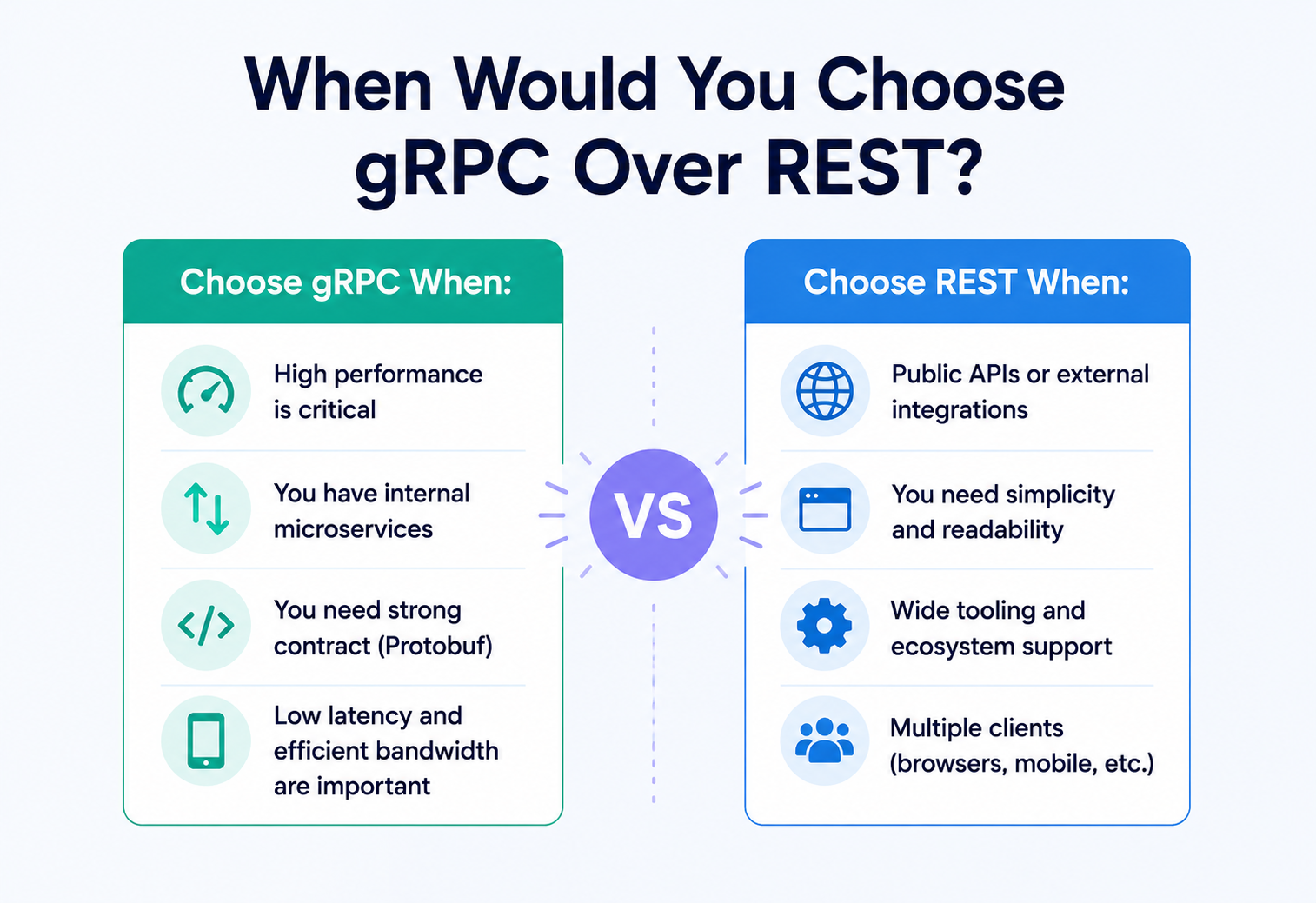
When Would You Choose gRPC Over REST?
A deep, beginner‑friendly tour through both technologies — how they work under the hood, where each one wins, and how to decide with confidence for your next service.
Introduction & History
Imagine two friends passing notes in class. One friend writes long, plain‑English sentences on a piece of paper — anyone who picks up the note can read it, even a stranger. That’s a bit like REST: it uses plain text (usually JSON) that’s easy for humans to read. The other friend has invented a secret shorthand where every word is replaced by a tiny symbol, and both friends have a “codebook” that tells them what each symbol means. Strangers can’t read it without the codebook, but the notes are much smaller and faster to write. That’s a bit like gRPC: it uses a compact binary format called Protocol Buffers, and both sides need a shared “codebook” (a .proto file) to understand each other.
REST (Representational State Transfer) was described by Roy Fielding in his year‑2000 doctoral dissertation. It wasn’t a piece of software — it was a set of architectural principles for building web services on top of HTTP, using standard verbs like GET, POST, PUT, and DELETE, and standard status codes like 200 or 404. Because it rides on plain HTTP/1.1 and human‑readable JSON, REST became the default way that web and mobile apps talk to backend servers for the better part of two decades.
gRPC was released by Google in 2015 as an open‑source evolution of an internal system Google had used for years called “Stubby,” which Google used to connect thousands of internal microservices efficiently. gRPC stands for “gRPC Remote Procedure Call” (yes, it’s a recursive acronym). It was built from the ground up for a world of microservices, mobile clients with limited bandwidth, and services that need to stream data continuously rather than one request at a time. It uses HTTP/2 as its transport and Protocol Buffers (protobuf) as its default data format.
REST is a style of building APIs using ordinary web requests and human‑readable text. gRPC is a framework for making one program call a function on another program over the network, as if it were a local function call, using a compact binary format and a persistent connection.
A brief timeline
REST is defined
Roy Fielding’s dissertation formalizes the REST architectural style for the web.
REST + JSON dominate
REST becomes the default for public web APIs, mobile backends, and SaaS integrations.
Google’s internal Stubby
Google runs a high‑performance internal RPC system across its massive service fleet, informing gRPC’s design.
gRPC open‑sourced
Google releases gRPC, built on HTTP/2 and Protocol Buffers, donated to the Cloud Native Computing Foundation (CNCF).
Microservices adoption
gRPC becomes a standard choice for internal service‑to‑service communication at Netflix, Square, Uber, Docker, Kubernetes, and many more.
The Problem & Motivation
Think about a big company’s kitchen with 50 different chefs (services), each responsible for one dish, who all need to pass ingredients and instructions to each other constantly, thousands of times a second. If every chef had to shout a full paragraph across the room every time they needed a pinch of salt, the kitchen would be loud, slow, and chaotic. That’s roughly the situation many companies found themselves in as they broke monolithic applications into dozens or hundreds of microservices.
REST with JSON over HTTP/1.1 works beautifully for public‑facing APIs where a human developer needs to read responses in a browser, and where each request is relatively infrequent (a mobile app fetching a user’s profile, for example). But it starts to strain under different conditions:
- Chattiness — Microservices often need to call each other many times per user request. Each REST call over HTTP/1.1 typically opens a new TCP connection or waits its turn on a limited number of reused connections.
- Payload size — JSON is text, so numbers like
12345are stored as multiple ASCII characters instead of compact binary, and every field name ("user_id","created_at") is repeated in every single message. - No streaming — Classic REST is one request, one response. If a service needs to continuously push updates (like live stock prices or a chat feed), REST needs workarounds like polling, long‑polling, or Server‑Sent Events.
- Loose contracts — REST APIs are usually documented with tools like OpenAPI/Swagger, but nothing forces the client and server to agree at compile time. A typo in a field name is often only caught at runtime.
gRPC was designed directly against these pain points: it multiplexes many calls over a single persistent HTTP/2 connection, it serializes data into a small binary format, it supports first‑class streaming in all four directions (more on that soon), and it generates strongly‑typed client and server code from a shared contract, so a mismatch is caught when you compile your code — not when a customer hits an error in production.
None of this makes REST “wrong.” For public APIs consumed by browsers, third‑party developers, or systems that value human readability and universal tooling, REST’s simplicity and ubiquity are real strengths — not weaknesses to be engineered away.
Core Concepts
Before comparing the two head‑to‑head, let’s build a shared vocabulary. Each term below is explained the way you’d explain it to someone hearing it for the first time.
HTTP/1.1
The version of the web’s transport protocol most REST APIs use. Think of it like a one‑lane road: one request has to finish before the next one on that lane can go (though browsers open several lanes/connections to work around this).
HTTP/2
A newer, smarter version of HTTP. It’s like a multi‑lane highway with an on‑ramp control system: many requests and responses can travel over a single connection at the same time, interleaved, without blocking each other. gRPC is built on top of this.
JSON
“JavaScript Object Notation” — a text format for data that looks like {"name": "Ana"}. Easy for humans to read, but wastes space repeating field names and storing numbers as text.
Protocol Buffers (protobuf)
Google’s binary data format. Instead of writing field names in every message, both sides agree ahead of time (via a .proto file) that “field number 1 is always the user’s name.” Only a small binary tag and the value are sent.
IDL (Interface Definition Language)
A shared “contract” file that describes what functions (services) exist and what data they accept and return. In gRPC, this is the .proto file. Both client and server generate code from it, so they can never disagree about the shape of the data.
RPC (Remote Procedure Call)
Calling a function that actually runs on another machine, but writing the code as if it were a normal local function call — the networking details are hidden from you.
Serialization
Turning a program’s in‑memory data (like a Java object) into bytes that can travel over the network, and turning those bytes back into an object on the other end (deserialization).
Multiplexing
Sending multiple independent streams of data over one shared connection at the same time, the way several radio stations can share the same tower using different frequencies.
A tiny .proto file looks like this — it’s the “codebook” both sides agree on:
syntax = "proto3";

package orders;

service OrderService {
  rpc GetOrder (OrderRequest) returns (OrderResponse);
  rpc StreamOrderUpdates (OrderRequest) returns (stream OrderResponse);
}

message OrderRequest {
  string order_id = 1;
}

message OrderResponse {
  string order_id = 1;
  string status = 2;
  double total_amount = 3;
}
The numbers after each field (= 1, = 2, = 3) are not defaults or example values — they’re permanent binary “tags” for that field. This is why protobuf messages can be so small: instead of sending the text "order_id" every time, it just sends a tag byte meaning “field 1.”
Architecture & Components
Both REST and gRPC follow a client‑server model, but the pieces involved look different.
A typical REST architecture
- Client — browser, mobile app, or another service, sending HTTP requests.
- API Gateway / Load Balancer — routes requests, often terminates TLS.
- Web server / Controller layer — parses the URL and HTTP verb, deserializes JSON.
- Business logic layer — the actual application code.
- Data layer — databases, caches, etc.
A typical gRPC architecture
- .proto contract — the shared source of truth for services and messages.
- Generated stub (client‑side) — auto‑generated code that looks like a normal local class with methods you call directly.
- Generated skeleton (server‑side) — auto‑generated base class you implement with your real logic.
- gRPC channel — a long‑lived HTTP/2 connection (or pool of connections) between client and server.
- Interceptors — gRPC’s equivalent of middleware, for things like authentication, logging, and retries.
.proto file, so the network call reads like a local method call while the framework handles serialisation, HTTP/2 framing and typed deserialisation on the other end.The key architectural shift: in REST, the client thinks in terms of “resources and URLs” (GET /orders/42). In gRPC, the client thinks in terms of “calling a method” (orderStub.getOrder(request)), and the framework hides the network plumbing almost entirely.
Internal Working & Data Flow
Let’s trace what actually happens, step by step, for each style, using a simple “get an order by ID” example.
REST request lifecycle
- Client builds an HTTP request:
GET /orders/42 HTTP/1.1with headers. - Request travels over TCP (and TLS, if HTTPS) to the server, often through a load balancer.
- Server’s router matches the URL pattern
/orders/:idto a controller function. - Controller fetches the order and serializes it into a JSON string.
- Server sends back
HTTP/1.1 200 OKwith a JSON body. - Client parses the JSON text back into an object in its own language.
gRPC request lifecycle
- Developer calls a normal‑looking method:
orderStub.getOrder(request). - The generated stub serializes the request object into protobuf binary.
- The stub sends it as an HTTP/2 frame over an already‑open, persistent connection (no new handshake needed for each call).
- The server’s generated skeleton deserializes the bytes back into a typed request object and calls your actual implementation method.
- Your method returns a response object, which is serialized to protobuf and sent back as HTTP/2 frames on the same stream.
- The client stub deserializes the bytes and hands your code back a fully‑typed response object — with compile‑time guarantees about its shape.
Java client example using generated gRPC stubs:
ManagedChannel channel = ManagedChannelBuilder
    .forAddress("orders.internal", 443)
    .useTransportSecurity()
    .build();

OrderServiceGrpc.OrderServiceBlockingStub stub =
    OrderServiceGrpc.newBlockingStub(channel);

OrderRequest request = OrderRequest.newBuilder()
    .setOrderId("42")
    .build();

OrderResponse response = stub.getOrder(request);
System.out.println("Status: " + response.getStatus());
Compare that to the equivalent REST call in Java using a plain HTTP client:
HttpClient client = HttpClient.newHttpClient();
HttpRequest request = HttpRequest.newBuilder()
    .uri(URI.create("https://orders.internal/orders/42"))
    .GET()
    .build();

HttpResponse<String> response =
    client.send(request, HttpResponse.BodyHandlers.ofString());

// Manual step: parse the JSON text yourself
OrderResponse order = objectMapper.readValue(response.body(), OrderResponse.class);
Notice the gRPC version never manually builds a URL string or parses text — the “network call” reads just like calling a local Java method. That’s the core promise of RPC frameworks.
gRPC Streaming Types
This is one of gRPC’s biggest structural advantages over classic REST. Because it’s built on HTTP/2, a single call can involve more than just “one request, one response.” There are four modes:
Unary
One request, one response — just like a normal REST call. Example: getOrder(request).
Server streaming
One request, many responses over time. Example: subscribing to live price updates for a stock after asking once.
Client streaming
Many requests, one final response. Example: a device uploading thousands of sensor readings, then getting a single summary back.
Bidirectional streaming
Both sides send messages back and forth independently over the same connection, like a live phone call. Example: real‑time chat or collaborative editing.
Server‑streaming example in the .proto file and Java:
// proto
rpc StreamOrderUpdates (OrderRequest) returns (stream OrderResponse);

// Java client
stub.streamOrderUpdates(request, new StreamObserver<OrderResponse>() {
    public void onNext(OrderResponse update) {
        System.out.println("Update: " + update.getStatus());
    }
    public void onError(Throwable t) { t.printStackTrace(); }
    public void onCompleted() { System.out.println("Stream finished"); }
});Achieving the same “server streaming” behavior in REST usually requires workarounds — polling every few seconds (wasteful), long‑polling (fragile), or Server‑Sent Events / WebSockets (extra infrastructure). gRPC gives you this for free as part of the core protocol.
Advantages, Disadvantages & Trade‑offs
Two candid side‑by‑side comparisons: gRPC’s strengths and weaknesses, then REST’s. Both technologies are optimising for different goals.
gRPC · Strengths
- Small, fast binary payloads (protobuf)
- Multiplexed connections via HTTP/2 — less connection overhead
- Native streaming in four modes
- Strongly typed contracts, generated code in 10+ languages
- Built‑in deadlines, cancellation, and flow control
- Pluggable interceptors for auth, logging, retries
gRPC · Weaknesses
- Not human‑readable on the wire — harder to debug with curl
- Limited native browser support (needs gRPC‑Web + a proxy)
- Steeper learning curve, extra build tooling (protoc)
- Less convenient for simple public, third‑party‑facing APIs
- Caching via standard HTTP caches (like CDNs) doesn’t work the usual way
REST · Strengths
- Human‑readable, debuggable with a browser or curl
- Universally supported — every language, every browser
- Simple mental model: URLs and HTTP verbs
- Works naturally with HTTP caching, CDNs, proxies
- Huge ecosystem of tools (Postman, Swagger UI, API gateways)
REST · Weaknesses
- Larger payloads (repeated field names, text‑encoded numbers)
- No native streaming — needs polling/SSE/WebSockets as add‑ons
- Contract is often informal or documented separately (drift risk)
- More connection overhead under HTTP/1.1 at high request rates
Neither list makes one technology universally “better.” They optimize for different things: REST optimizes for reach, simplicity, and human accessibility; gRPC optimizes for speed, type‑safety, and efficient service‑to‑service communication.
Performance & Scalability
Picture two moving trucks. The REST/JSON truck carries furniture wrapped loosely in bubble wrap with big empty gaps — easy to identify each item at a glance, but a lot of wasted space per trip. The gRPC/protobuf truck carries the same furniture disassembled and packed tightly with no gaps — smaller, faster to load, but you need the assembly instructions (the .proto file) to put it back together.
In practice, protobuf‑encoded messages are commonly 3 to 10 times smaller than the equivalent JSON, and serialization/deserialization is measurably faster because it’s working with binary offsets instead of parsing text character by character. Combined with HTTP/2 multiplexing (many calls sharing one TCP connection instead of opening new ones or queueing on limited connections), gRPC tends to achieve meaningfully higher throughput and lower latency under heavy internal service‑to‑service traffic.
Where this matters most: high‑fan‑out internal calls (a single user request triggering dozens of downstream service calls), high request‑per‑second internal APIs, mobile clients on constrained networks, and IoT devices sending frequent small updates. Where it matters less: a public API called a handful of times per user session, where the network round‑trip and business logic dominate over serialization overhead anyway.
Switching to gRPC doesn’t automatically make a poorly designed service fast. If your bottleneck is a slow database query or an inefficient algorithm, changing the wire protocol won’t fix that. Profile first.
High Availability & Reliability
Both REST and gRPC systems rely on the same broad HA techniques — redundant instances behind a load balancer, health checks, retries, and circuit breakers — but gRPC bakes a few of these directly into the protocol layer instead of leaving them entirely to application code.
- Deadlines / timeouts — gRPC requires (or strongly encourages) every call to carry a deadline, so a slow downstream service can’t silently hold resources forever. REST relies on the client remembering to set an HTTP timeout.
- Built‑in retries — gRPC has a standardized retry policy that can be configured declaratively (with backoff and retryable status codes), including “hedging” — sending the same request to multiple backends and using whichever answers first.
- Cancellation propagation — if a client gives up on a gRPC call, that cancellation can propagate down the call chain, stopping wasted work. REST has no standard equivalent.
- Health checking protocol — gRPC defines a standard health‑check service that load balancers and orchestrators (like Kubernetes) can query in a consistent way.
Both styles benefit from classic resilience patterns: the circuit breaker pattern (stop calling a failing service for a cooldown period instead of hammering it), bulkheading (isolating resource pools so one failing dependency can’t starve everything else), and graceful degradation (returning partial or cached data instead of a hard failure).
Security
Security concerns overlap heavily between the two, since both typically run over TLS, but there are some differences worth knowing.
Transport Encryption
Both support TLS. gRPC treats TLS (or mutual TLS) as a first‑class citizen and makes it easy to enforce mTLS between internal services — a common pattern in zero‑trust microservice meshes.
Authentication
REST commonly uses API keys, OAuth 2.0 bearer tokens, or session cookies in headers. gRPC supports the same token‑based approaches via metadata, plus native support for mutual TLS certificates and Google’s token‑based credentials.
Authorization
Both are typically handled in application code or a service mesh (like Istio or Linkerd), checking a token’s claims or scopes before allowing an action.
Input Validation
Protobuf’s strict typing rejects many malformed messages automatically (wrong types simply fail to decode). JSON is more permissive, so REST APIs must validate more defensively in application code.
Attack Surface
REST’s human‑readable, URL‑based surface is easier for automated scanners and pen‑testers to probe. gRPC’s binary surface is less “guessable,” though this is not a substitute for genuine authorization checks — obscurity is not security.
Assuming an internal gRPC service doesn’t need authentication because “it’s only called by other internal services.” Internal networks get breached too — always require identity verification (mTLS or tokens) between services, a principle often called zero trust.
Monitoring, Logging & Metrics
You can’t fix what you can’t see. Both REST and gRPC systems need visibility into latency, error rates, and traffic volume — but the way you get it differs slightly.
- Structured status codes — REST uses HTTP status codes (200, 404, 500…). gRPC uses its own richer set of status codes (OK, NOT_FOUND, DEADLINE_EXCEEDED, UNAVAILABLE, PERMISSION_DENIED, etc.) that map more precisely to RPC‑style failures.
- Interceptors / middleware — gRPC interceptors and REST middleware both provide a clean place to record metrics (latency histograms, request counts) and inject distributed tracing headers without touching business logic.
- Distributed tracing — Tools like OpenTelemetry support both styles, propagating a trace ID across service boundaries so you can see a full request’s journey through many microservices as one connected graph, often visualized in tools like Jaeger or Zipkin.
- Metrics aggregation — Prometheus + Grafana is a common stack for both. gRPC’s ecosystem includes ready‑made interceptors (like
grpc-prometheus) for capturing per‑method latency and error rates with almost no boilerplate. - Logging — Because gRPC payloads are binary, you generally log structured metadata (method name, status, duration, trace ID) rather than dumping the raw request body, whereas REST’s JSON bodies are sometimes logged directly for debugging (with care taken to redact sensitive fields either way).
Because gRPC traffic isn’t readable with plain curl, tools like grpcurl and BloomRPC/grpcui exist specifically to let you inspect and manually call gRPC services during development, using the .proto file (or server reflection) to decode the binary traffic into something readable.
Deployment, Cloud & Load Balancing
Deploying either style today usually means containers (Docker) orchestrated by Kubernetes, sitting behind a load balancer or service mesh. But there’s one structural wrinkle worth understanding: load balancing gRPC is different from load balancing REST.
A classic HTTP/1.1 load balancer distributes traffic connection‑by‑connection or request‑by‑request, which works fine since each REST request is short‑lived. gRPC, however, opens one long‑lived HTTP/2 connection and multiplexes many calls over it. If a simple load balancer only balances at the connection level, all of a client’s traffic can pile onto a single backend instance for the lifetime of that connection — starving other instances.
The common fixes:
- Client‑side load balancing — the gRPC client itself is aware of multiple backend addresses (often via DNS or a service registry) and spreads calls across them.
- Layer‑7 (L7) proxies — proxies like Envoy, which understand HTTP/2 and gRPC at the request level (not just the connection level), can balance individual RPCs across backends even within one client connection.
- Service mesh — tools like Istio or Linkerd sit as sidecars next to each service, transparently handling gRPC‑aware load balancing, retries, mTLS, and observability.
On the cloud side, all major providers (AWS, GCP, Azure) support gRPC through their modern load balancers (e.g., AWS ALB with gRPC target groups, GCP’s HTTP/2‑native load balancer), and API gateways like Envoy, Kong, and Google’s Apigee support translating public REST calls into internal gRPC calls — letting you expose a friendly REST API to the outside world while running gRPC internally.
Decision Framework · When to Choose gRPC Over REST
Here’s the core question this article set out to answer, distilled into a practical checklist. Ask yourself these questions about the system you’re building:
| Situation | Lean toward |
|---|---|
| Internal microservice‑to‑microservice calls, high volume | gRPC |
| Public API consumed by many third‑party developers or browsers | REST |
| Need real‑time bidirectional streaming (chat, live dashboards) | gRPC |
| Mobile clients on constrained/unreliable networks, bandwidth matters | gRPC |
| Team wants strict, compile‑time‑checked contracts across services | gRPC |
| You need broad, effortless browser support without extra proxies | REST |
| You rely heavily on HTTP caching / CDNs for performance | REST |
| Debuggability with plain tools (curl, browser) is a priority | REST |
| Polyglot microservices needing generated, type‑safe SDKs | gRPC |
| Simple CRUD service with low traffic, small team, fast iteration | REST |
A very common and pragmatic architecture is exactly this hybrid: a public‑facing REST (or GraphQL) API gateway that translates incoming requests into internal gRPC calls between backend microservices. This gives external consumers the simplicity and universal compatibility of REST, while your own infrastructure enjoys gRPC’s speed, streaming, and strict typing where it matters most — behind the scenes, at high volume.
Design Patterns & Anti‑patterns
Four patterns worth borrowing, and four tempting shortcuts that consistently backfire in production.
Pattern · API Gateway Translation
Expose REST/JSON publicly, translate to gRPC internally. Gives you the best of both worlds at the cost of one extra hop.
Pattern · Contract‑First Development
Write the .proto file before any code, treat it like a shared API spec, and generate client/server stubs from it — keeps teams in sync automatically.
Pattern · Backend‑for‑Frontend (BFF)
A thin REST layer tailored to a specific frontend (web or mobile), which internally fans out to multiple gRPC microservices and combines the results.
Pattern · Streaming Aggregator
Use gRPC server‑streaming to push incremental results to a client as they become available, rather than making it wait for one giant response.
Anti‑pattern · Chatty gRPC Calls
Making dozens of tiny unary gRPC calls where one batched call (or a streaming call) would do — you lose gRPC’s efficiency advantage by fragmenting the work.
Anti‑pattern · Breaking Proto Compatibility
Reusing an old field number for a new field, or changing a field’s type, silently corrupts data for any client still running older generated code.
Anti‑pattern · REST‑ifying Everything by Habit
Defaulting to REST for high‑throughput internal services purely out of familiarity, without evaluating whether gRPC’s efficiency and streaming would meaningfully help.
Anti‑pattern · gRPC for Public Browser APIs
Forcing gRPC directly onto public browser clients without gRPC‑Web and a compatible proxy — browsers can’t speak raw HTTP/2 trailers the way gRPC needs.
Best Practices & Common Mistakes
A field‑guide checklist for teams shipping either style in production, distilled from what consistently works — and what consistently fails.
Best Practices
- Version your
.protofiles and never reuse a field number - Always set deadlines on every gRPC call
- Use interceptors for cross‑cutting concerns (auth, logging, tracing)
- Keep proto messages focused — avoid giant “god messages”
- Use mTLS for internal service‑to‑service gRPC traffic
- Document REST endpoints with OpenAPI/Swagger and keep it current
- Use pagination for large REST collections instead of one huge payload
Common Mistakes
- Forgetting that gRPC needs an L7‑aware load balancer, not just L4
- Ignoring backward compatibility when editing shared proto files
- Using synchronous blocking stubs everywhere, hurting throughput
- Skipping input validation because “protobuf already types it”
- Overusing verbs in REST URLs (
/getUser) instead of resources (/users/42) - Not setting timeouts on REST HTTP clients, causing thread pool exhaustion
Real‑World Industry Examples
Six well‑known examples of who uses what, and why — a snapshot of how the industry has settled on a hybrid pattern rather than a winner.
gRPC’s origin story: born from Google’s internal “Stubby” system, used across virtually all of Google’s internal service‑to‑service traffic at massive scale.
Netflix
Uses gRPC extensively for internal microservice communication, alongside REST‑facing APIs for external and device clients, reflecting the hybrid pattern discussed earlier.
Square
An early and vocal adopter of gRPC for internal service communication, citing type safety and performance gains across its payments infrastructure.
Uber
Runs a large microservices fleet and uses gRPC internally for many high‑throughput service‑to‑service calls, prioritizing low latency at scale.
Docker & Kubernetes
Kubernetes’ internal components and the container runtime interface (CRI) use gRPC for structured, efficient control‑plane communication.
Public Web APIs
Stripe, GitHub, Twitter/X continue to expose REST (or REST‑like) APIs publicly, because third‑party developers value human readability, broad tooling support, and easy debugging above raw efficiency.
The pattern across nearly all of these companies is consistent: REST (or GraphQL) at the public edge, gRPC in the internal machine room.
Frequently Asked Questions
The six questions we hear most often once a team seriously starts weighing gRPC against REST for real work.
Can browsers call gRPC services directly?
Not the raw gRPC protocol — browsers can’t produce the specific HTTP/2 trailers gRPC relies on. You need gRPC‑Web, a JavaScript‑friendly variant, paired with a proxy (like Envoy) that translates it into standard gRPC on the backend.
Is gRPC always faster than REST?
Usually faster for internal, high‑volume, small‑payload communication, thanks to binary encoding and HTTP/2 multiplexing. For occasional calls where network latency dominates over serialization cost, the difference may be negligible.
Can I use both REST and gRPC in the same system?
Yes, and many companies do — REST or GraphQL for public/browser‑facing APIs, gRPC for internal service‑to‑service traffic, often bridged by an API gateway.
Does gRPC replace GraphQL?
They solve different problems. GraphQL lets clients ask for exactly the fields they need from a flexible graph of data, and shines for frontend‑facing APIs with varied client needs. gRPC is about efficient, strongly‑typed, high‑performance calls between fixed, known services.
Is JSON always required for REST?
No — REST is a style, not a format requirement. XML, plain text, or even protobuf can technically ride on a RESTful HTTP API, but JSON is by far the overwhelming convention today.
What languages does gRPC support?
Official support includes Java, Go, Python, C++, C#, Node.js, Ruby, PHP, Dart, Kotlin, and more — the same .proto file generates idiomatic client/server code for each.
Summary & Key Takeaways
REST and gRPC aren’t rivals fighting for the same job — they’re specialized tools that happen to overlap in some places. REST’s plain‑text simplicity, universal browser support, and mature tooling ecosystem make it the natural choice for public APIs and situations where humans need to read and debug traffic directly. gRPC’s compact binary encoding, HTTP/2 multiplexing, native streaming, and strict generated contracts make it the natural choice for high‑volume internal microservice communication, real‑time streaming needs, and bandwidth‑constrained clients.
Key Takeaways
- Choose gRPC for internal, high‑throughput, low‑latency, or streaming‑heavy service‑to‑service communication.
- Choose REST for public APIs, browser clients, and anywhere human readability and universal tooling matter most.
- The most common real‑world architecture is a hybrid: REST at the public edge, gRPC internally, joined by an API gateway.
- gRPC needs HTTP/2‑aware, L7 load balancing — plain connection‑level balancing can starve backend instances.
- Treat your
.protofiles as a permanent contract: never reuse field numbers, and evolve them carefully for backward compatibility. - Neither technology fixes a slow database or bad algorithm — profile the real bottleneck before switching protocols.