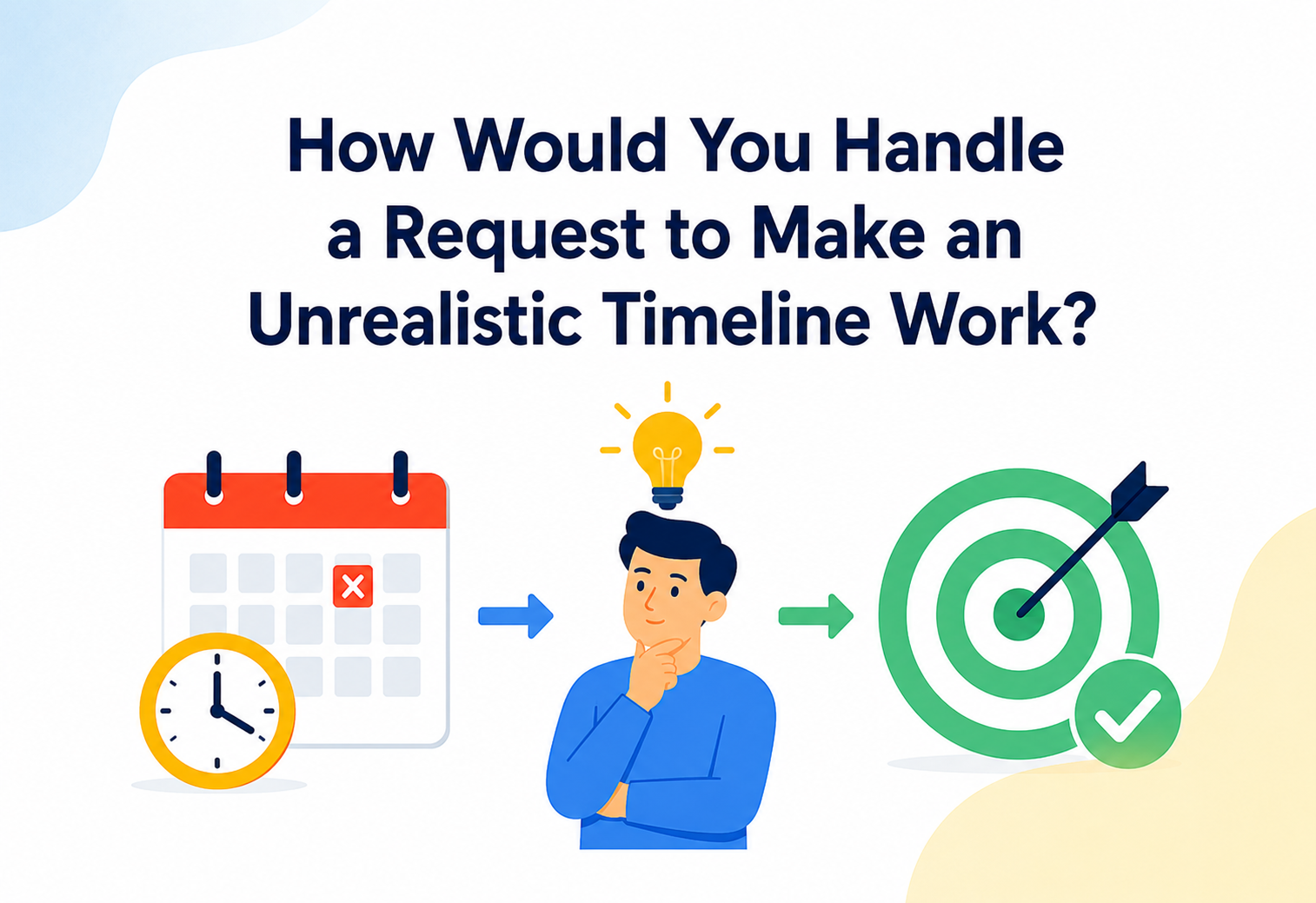
How Would You Handle a Request to Make an Unrealistic Timeline Work?
A calm, practical look at the moment someone asks for the impossible — and how to respond with honesty, options, and your credibility still intact.
The Sentence That Arrives With a Sinking Feeling
There is a particular sinking feeling that arrives with a specific sentence. Someone leans in — sometimes cheerfully, sometimes apologetically, sometimes with a tight smile that already knows the answer is not going to be easy — and says, “we need this by Friday. Can we make it work?” The date attached rarely leaves room for the honest answer, which is usually somewhere between “not really” and “only if something else gives.”
This moment shows up in every field, at every level, in some form. A marketing launch pulled forward by a leadership announcement. A construction deadline tied to a grand opening that has already been advertised. A software release promised to a customer before anyone checked with the engineers. The specifics change. The feeling in your chest when you are asked to make it work anyway does not.
This piece is about that moment — not how to say a flat no, and not how to quietly grit your teeth and promise something you already suspect will not happen. Something steadier, and more useful, than either extreme.
Why This Request Feels So Much Heavier Than It Sounds
On the surface, “can we make it work” sounds like a simple scheduling question. Underneath, it is rarely simple at all, because saying yes or no carries weight in several directions at once, and it is worth naming all of them honestly.
Say yes without really meaning it, and you are setting up a future version of yourself — and often your whole team — to either work an unsustainable pace, cut corners nobody is comfortable with, or eventually deliver late anyway, just later in the process when it is far more expensive to discover. Say no too bluntly, and you risk looking inflexible, unhelpful, or disconnected from the very real pressure the other person is under, which is often coming from somewhere just as real above them.
The discomfort in this moment is not a sign you are bad at your job. It is a sign you are holding two legitimate things at once — a genuine desire to help, and a genuine, hard-won sense of what is actually possible. The goal is not to make that tension disappear. It is to respond to it honestly, in a way that respects both the urgency and the reality.
Once you see it that way, the question changes shape. It stops being “how do I squeeze this in” and becomes “how do I respond to this request in a way that is honest now, and still trusted the next time a deadline like this comes around.”

What Is Usually Actually Being Asked
It helps enormously to understand what is really behind the request, because “can we make it work” rarely means what it literally says. People asking for an aggressive timeline are usually asking for one of a few different things, and figuring out which one you are dealing with changes how you should respond.
Sometimes they are asking for reassurance
A person under their own pressure — from a customer, from their boss, from a board meeting they have not survived yet — sometimes just needs to hear that someone is taking the deadline seriously, even before the actual plan is worked out. In these moments, “I hear you, this matters, let me look at what is really possible and get back to you by end of day” often does more good than any specific date could, because it answers the emotional need first.
Sometimes they are asking you to find hidden slack
Occasionally the request is a genuine, reasonable belief that there is more flexibility in the plan than you have accounted for — a step that could run in parallel instead of in sequence, a scope item that could be trimmed, a resource that could be temporarily reassigned. This version of the request deserves a real look, not an automatic no, because sometimes they are right.
Sometimes they are asking you to simply absorb the risk
And sometimes, less comfortably, the request is really asking you to quietly take on the risk of the date being wrong, so that someone else does not have to be the one to say so out loud, to their own boss or their own customer. This is the version most worth noticing and responding to carefully, because it is the one most likely to leave you holding a promise nobody else fully believed in either.
Before reaching for a plan, ask a genuine, curious question: “help me understand what is driving this date — is there flexibility if I find the real numbers do not work?” The answer tells you which of the three situations above you are actually in, and that changes everything about how the rest of the conversation should go.
The Real Cost of Saying Yes Without Really Meaning It
It is worth being honest about why the easy yes is so tempting, and equally honest about what it actually costs, because the cost is often invisible in the moment it is incurred.
Saying yes feels good immediately. It relieves the tension in the room, makes you look capable and cooperative, and delays the harder conversation to a later date — sometimes literally. But an unexamined yes rarely stays free. It tends to get paid for later, in one of a few predictable ways: a team working long hours that quietly erode both quality and goodwill, corners cut that show up as bugs, defects, or gaps discovered by a customer instead of by you, or a deadline that slips anyway, except now it slips in front of everyone, at the worst possible moment, instead of being renegotiated calmly in private weeks earlier.
There is a subtler cost too, one that compounds over time in a way that is easy to miss. Every time an aggressive date is agreed to without real scrutiny and then missed, the next date you commit to is trusted a little less, whether anyone says so directly or not. Ironically, the instinct to always say yes, meant to build trust, often erodes it faster than an honest, well-reasoned “here is what is actually possible” ever would.

Picture two lines drawn across a stretch of many small commitments. One line, made of easy yeses repeated over months, drifts steadily downward as each missed date quietly costs a little more credibility than the last. The other line, made of honest, well-reasoned commitments — some yeses, some “here is what is actually possible” — drifts steadily upward, because each kept promise reinforces the last. Neither line moves dramatically in any single conversation. Both move decisively over time.
A Gentler Way to Actually Diagnose the Timeline
Before you can respond well, it helps to actually understand what is driving the gap between the requested date and the realistic one. Most unrealistic timelines come from one of a few sources, and it is worth diagnosing which one you are facing before you say anything at all.
Is the scope actually fixed, or just assumed to be?
A surprising number of “impossible” timelines become possible the moment scope becomes a genuine variable instead of a silent assumption. Ask plainly: “if we cannot do all of this by Friday, is there a smaller version that would still meet the real need?” Sometimes the honest answer is that only part of what was asked for is actually urgent, and the rest was bundled in out of convenience rather than necessity.
Is the estimate actually wrong, or does it just feel wrong to the person hearing it?
Estimates given by people close to the work are sometimes dismissed simply because they are inconvenient, not because they are inaccurate. It is worth being confident, calm, and specific about how your estimate was built — what it accounts for, what assumptions it rests on — so the conversation is about the reasoning, not a gut-feeling standoff between two different levels of optimism.
Is there real slack hiding somewhere in the plan?
Sometimes there genuinely is room — a step that was planned sequentially out of habit rather than necessity, a review cycle that could be shortened without meaningfully increasing risk, a temporary reallocation of people from something lower priority. This is worth a real, honest look, precisely so that when you conclude there is not enough room, that conclusion carries weight.
Is the risk tolerance actually being discussed, or just assumed?
Almost every “impossible” timeline can technically be hit if enough risk is accepted — skipped testing, reduced review, deferred documentation, exhausted people making more mistakes than usual. The honest move is not refusing that trade-off outright. It is making sure it is a trade-off someone with the authority to accept it actually chooses consciously, rather than one that happens quietly by default because nobody named it out loud.
Before responding to the request, spend fifteen honest minutes answering these four questions on paper: what is truly fixed in scope, what is the estimate actually based on, where might real slack exist, and what risk would need to be accepted to hit the date as asked. That fifteen minutes tends to save hours of back-and-forth later.
How to Push Back Without Sounding Like You Are Saying No
Once you understand the real shape of the gap, the next challenge is communicating it in a way that lands as helpful rather than obstructive. A few small shifts in language make an outsized difference here.
Lead with the shared goal, not the obstacle
“I want this to actually work for you, which is why I want to be honest about what I am seeing” lands very differently than “that is not possible.” Both might lead to the same underlying message, but the first one signals you are on the same side of the problem, which makes the harder part of the conversation much easier to hear.

Bring the reasoning, not just the conclusion
“We cannot hit Friday” is a conclusion with nowhere to go. “Here is what the work actually involves, here is how long each part realistically takes, and here is where that adds up to a gap against Friday” is a conclusion someone can actually examine, question, and ultimately trust, because they can see how you got there rather than just being asked to take your word for it.
Name the trade-off explicitly, rather than making it silently
“We could hit Friday, but it would mean skipping this safeguard, and here is what that risks” respects the other person’s right to make an informed business decision. It also protects you, because if that risk is accepted and something later goes wrong, there is an honest record that it was a conscious choice, not an oversight.
Keep your tone steady, even if theirs is not
Pressure has a way of making its way into tone, especially from someone who is absorbing pressure of their own from further up the chain. It helps enormously to keep your own voice calm and even, regardless of the urgency in theirs — not to seem unbothered, but because a steady tone tends to draw the whole conversation toward problem-solving, while a matching, escalating tone tends to draw it toward conflict. You can take the request seriously without absorbing the anxiety that came attached to it.
Offering Real Options Instead of a Flat No
A flat no tends to end the conversation. A thoughtful set of options tends to move it forward, and it does something important psychologically too — it hands the decision back to the person who actually has the authority and context to make a trade-off call, rather than putting you in the position of unilaterally deciding what matters most.
Reduce the scope
Deliver a smaller, genuinely complete version by the date, with the rest following on a realistic second timeline.
Move the date
Keep the full scope, and shift the deadline to a date the work can actually, honestly support.
Accept the risk
Hit the original date and scope, with specific, named risks accepted consciously by someone with the authority to accept them.
Presenting these three side by side, with an honest description of what each one actually costs, turns an argument about whether the deadline is realistic into a shared decision about which trade-off is worth making. That is a much easier conversation to have, and it tends to produce a decision everyone can stand behind afterward, rather than one that quietly resents whoever said no first.
“I want to give you a real answer, not just a hopeful one. Here are three ways we could approach Friday, with an honest description of what each one actually costs — which one matches what matters most right now?”
When the Date Truly, Genuinely Cannot Move
Sometimes the deadline is real in a way that no amount of reframing changes — a regulatory filing date, a contractual obligation, a physical event that has already been scheduled and paid for, a partner whose own timeline depends entirely on yours. In these cases, “move the date” quietly leaves the table, and it is worth being honest about that rather than pretending the option still exists.
When the date is genuinely fixed, the remaining two levers — scope and risk — have to do all the work, and the conversation shifts from “can this move” to “given that this cannot move, what are we willing to trade to make it real.” This is a harder conversation, but it is still a far more honest and more manageable one than pretending everything can be done in full, on time, without cost.
It also helps, in these situations, to be the person who names the fixed constraint clearly rather than the person who quietly absorbs it. “I understand this date cannot move — given that, I want to be honest that hitting it in full likely means accepting these specific risks, or trimming this specific scope. Which would you rather we do?” This keeps the decision where it belongs, even when the calendar itself has already been decided by someone else entirely.

A fixed date changes what levers are available. It does not change your responsibility to be honest about what is actually achievable within it. Those are two separate things, and it is easy, under pressure, to let the first one quietly erase the second.
Protecting Your Team While You Are the One Absorbing the Pressure
If you lead others, this moment carries an extra responsibility that is easy to forget in the heat of the conversation — everything you agree to on their behalf eventually lands on them, whether or not they were in the room when the decision was made.
Do not pass the pressure downward unfiltered
It is tempting, especially when you are under real pressure yourself, to simply relay the deadline to your team exactly as it was given to you, with all its urgency and none of the context. A better instinct is to translate it the way you would want it translated to you — with the real reasoning, the real trade-offs already considered, and a clear sense of what is actually being asked of them and why.
Involve the people doing the work in the honest estimate
The people closest to the work usually have the clearest, most accurate sense of what is actually achievable, and involving them early does two things at once. It produces a more accurate answer, and it means the eventual plan — whatever it turns out to be — has been shaped with them rather than imposed on them, which tends to produce far more genuine commitment than a deadline handed down from above ever does.
Be the one who says the hard thing, so they do not have to
Part of the value you provide, in moments like this, is standing between your team and pressure that is not theirs to carry directly. If a deadline genuinely is not achievable without unacceptable cost, it is usually better for that message to come from you, clearly and calmly, than for your team to discover it themselves halfway through an unsustainable sprint that never should have been agreed to in the first place.
Learning to Tell Genuine Urgency From Habitual Urgency
Not every “we need this by Friday” carries the same weight, even when it is said with identical intensity, and learning to tell the difference changes how much energy the moment deserves.
Genuine urgency usually has a specific, external anchor attached to it — a contract clause, a regulatory date, an event that has already been booked and paid for, a dependency another team is genuinely blocked on. When you ask what is driving the date, the answer is concrete and checkable, and it tends to hold up under a second question. Habitual urgency, by contrast, often traces back to something softer — a general sense that things should move faster, a habit of front-loading pressure just in case, or simply the way requests have always been phrased in that particular team or company, regardless of whether the underlying need is actually that tight.
Neither version is dishonest, exactly. Genuine urgency deserves to be met with real seriousness and, often, real sacrifice on your part to help meet it. Habitual urgency deserves something different — a calm, consistent habit of asking the clarifying question anyway, so that over time, the people around you learn that dates come with real reasoning attached, and are taken more seriously themselves when they do carry it.
A useful, low-stakes way to test which kind you are facing is to offer a genuinely reasonable alternative and watch how it is received. If a small, well-reasoned shift in date or scope is met with real consideration, you are likely looking at habitual urgency with room to work. If the same offer is met with immediate, absolute refusal and no further explanation, that is often a sign the constraint really is as fixed as it was described, and it is worth treating it that way from that point onward.
If nearly every request from a particular person or team arrives with the same maximum urgency regardless of actual stakes, that is rarely a sign every single one of those requests is genuinely critical. It is more often a sign that urgency has become the default way of asking for things — and that is worth naming, gently, in a separate conversation from any one specific deadline.
A Small Story
A project lead I knew of was told, three weeks before a client’s promised launch date, that leadership had already announced the date publicly at an industry event nobody on the delivery team had attended. The full scope, as originally planned, was easily six weeks of work. There was no version of the math that made three weeks and six weeks the same number.
Instead of quietly promising to “find a way,” she spent an afternoon building an honest picture: what the full scope actually required, which pieces were genuinely essential to the client’s core need versus which had been added along the way for polish, and what risk would be involved in compressing the timeline as far as it could safely go. She brought three options to the next leadership conversation, each with its real cost spelled out plainly, rather than a single hopeful yes.
Leadership chose a version of the second option — a smaller, genuinely solid release at the original date, with two secondary features following two weeks later on a clearly communicated follow-up timeline. The client, told honestly and early rather than discovering a scramble later, was entirely fine with the plan; what they had actually needed by the announced date was narrower than what had been promised on their behalf. The team hit the date they committed to, delivered work they were proud of, and nobody worked a single weekend they had not agreed to.
What made the difference was not a clever trick or a heroic effort. It was a refusal to let an unexamined “yes” stand in for an honest answer, and the discipline to bring options instead of either a flat no or a hopeful, ungrounded promise. Months later, when a similarly tight timeline came up again, leadership came to her first, before the date was set, specifically because they had learned her honest answer was worth more than anyone else’s easy one.

Common Mistakes, Gently Corrected
Almost everyone has said yes too quickly at least once, under real pressure, with the best of intentions. These patterns are worth recognizing in yourself, not as failures, but as habits worth gently replacing.
Saying yes immediately
Committing before actually checking whether it is true. Instead: buy a short, honest pause — “let me look at this properly and get back to you by end of day” — before committing to anything.
Saying no flatly
Refusing without offering any alternative path forward. Instead: bring options with real trade-offs attached, so the conversation can keep moving instead of stalling.
Passing pressure downward
Handing an unrealistic deadline to your team, unfiltered and unexplained. Instead: translate it with context and reasoning, and involve the people doing the work in shaping the honest answer.
Silently absorbing risk
Quietly taking on risk on someone else’s behalf, without naming it out loud. Instead: make the trade-off explicit, so whoever has the authority to accept the risk does so consciously.
Letting resentment build
Outwardly agreeing to the date while quietly seething underneath. Instead: say the honest thing early and calmly — resentment is usually what happens when honesty gets delayed too long.
A Few Steady Habits Worth Keeping
The specific words of any single conversation matter less over time than the underlying habits that shape all of them. A short set, worth quietly cultivating.
- Ask what is driving the date before reacting to it. The real reason behind a deadline shapes how much flexibility genuinely exists.
- Build an honest estimate before responding, even under pressure. A rushed, unexamined answer rarely serves anyone well, including you.
- Bring reasoning, not just a conclusion. Show your work, so the other person can trust the answer rather than just accept or reject it on faith.
- Offer real options — reduce scope, move the date, or accept named risk. Let the person with the authority choose the trade-off consciously.
- Involve your team in the honest estimate, not just the resulting deadline. The people doing the work usually see the real picture most clearly.
- Name risk explicitly rather than absorbing it quietly. An unnamed risk accepted by default tends to become an unpleasant surprise later.
- Protect your credibility by only promising what you actually believe. One honest “no, but here is what we can do” is worth more than several hopeful yeses.
Frequently Asked, Honestly Answered
These are the questions that come up most often once the safer surface conversation is finished. Each one deserves a direct answer.
What if my honest answer is not what they want to hear, and they push back hard?
This happens, and it is worth staying calm and curious rather than defensive. Ask what specifically feels unrealistic about your reasoning — sometimes there is a genuine gap in your estimate worth examining, and sometimes the pushback is really just frustration with the situation itself, which no amount of debate will resolve. Either way, restating your reasoning calmly, rather than simply repeating your conclusion more firmly, tends to move the conversation forward.
How do I estimate honestly when I have been burned before by estimates that were too optimistic?
It is worth building in a deliberate buffer for the unknowns that always seem to appear — and being upfront that the buffer exists and why, rather than quietly inflating a number and hoping nobody asks. “This includes some margin for the kind of surprises that show up in work like this” is an honest sentence that protects both your estimate’s credibility and your team’s sustainability.
What if leadership just overrules my honest assessment and demands the original date anyway?
That is their right, and sometimes there are considerations above your view that justify it. What matters most in that moment is making sure the risk being accepted is documented and clearly understood, not just endured quietly. “I want to flag clearly that hitting this date means accepting these specific risks — I will do everything I can to manage them, and I want us to go in with eyes open” protects the team and keeps the decision honest, even when it is not the one you would have made.
Is it ever okay to just push through and hope it works out?
Occasionally, for a truly rare, one-time situation, a short sprint of extra effort is a reasonable, consciously chosen trade-off — people can usually sustain a hard push once in a while without lasting damage. The danger is when “just this once” quietly becomes the default response to every tight deadline, because that is precisely the pattern that leads to burnout, quiet corner-cutting, and a team that eventually stops trusting that their limits will ever be taken seriously.
Does this get easier with experience?
The specific numbers get easier to estimate accurately, but the underlying tension — wanting to help while staying honest — does not fully disappear, even for people who have done this for decades. What does improve with practice is the confidence to say the honest thing calmly, without treating it as a confrontation, and the trust you build by doing so consistently, which tends to make each future version of this conversation a little easier than the last.
What is the difference between healthy urgency and a culture of constant crisis?
Healthy urgency shows up occasionally, tied to a real and specific reason, and is usually followed by a calmer stretch afterward. A culture of constant crisis treats nearly every request as maximally urgent, all the time, until the word has almost lost its meaning. If you notice the second pattern in your own team or organization, it is worth raising as its own conversation — not tied to any single deadline — because no amount of individual honesty about one timeline will fix a pattern that is structural rather than situational.
A Closing Thought, and What to Carry Away
An unrealistic timeline is rarely solved by working harder, and it is almost never solved by simply saying yes and hoping the gap closes itself. It is solved, when it is solved well, by an honest look at what is actually true, a calm conversation about what that truth means, and a willingness to offer real options instead of either false comfort or a wall of resistance.
None of this makes the pressure disappear. Deadlines will keep arriving faster than the work behind them, because that is simply the nature of ambitious plans made by people who care about moving quickly. What changes, with practice, is your relationship to that pressure — from something that forces a hurried yes or a defensive no, into something you can meet with a clear head, an honest estimate, and a genuine offer to help find the version of the plan that actually works.
It is worth remembering, too, that the discomfort of this moment is doing something useful, even when it does not feel that way. It is a signal that you actually care about getting the answer right, rather than simply getting through the conversation. That discomfort is worth listening to rather than rushing past — it is usually the exact thing standing between a plan that looks fine on paper and one that actually survives contact with the real work ahead.
That, in the end, is what people remember and trust — not that you always found a way to say yes, but that when you said yes, it meant something, and when you said something else, it was said with just as much honesty and just as much care.
Key Takeaways
- An unrealistic timeline is a trust problem wearing a calendar’s clothing — not just a math problem to squeeze through.
- Diagnose what is really being asked before answering: reassurance, hidden slack, or someone quietly hoping you will absorb the risk.
- The unexamined yes is expensive. It gets paid for later in burnout, cut corners, or a slip that lands in front of everyone.
- Look at the four levers — scope, estimate, slack, and risk tolerance — before deciding what is actually possible.
- Push back with shared goals, reasoning, explicit trade-offs, and a steady tone. The conclusion is not the argument — the reasoning is.
- Offer three real options: reduce scope, move the date, or accept named risk. Hand the trade-off to the person with the authority to make it.
- When the date truly cannot move, name that clearly, then negotiate scope and risk out loud rather than absorbing them silently.
- Protect your team by translating pressure with context, involving them in the estimate, and being the one who says the hard thing.
- Tell genuine urgency from habitual urgency by asking what specifically anchors the date — and by watching how a reasonable alternative is received.
- Habits, not heroics, build the reputation that makes every future deadline easier to talk about.
You are not being asked to become the person who always says no, or the person who always finds a way. You are being asked, quietly, to become the person whose word is trustworthy in either direction — and that is built one honest conversation at a time, starting with the next deadline that arrives on your desk.