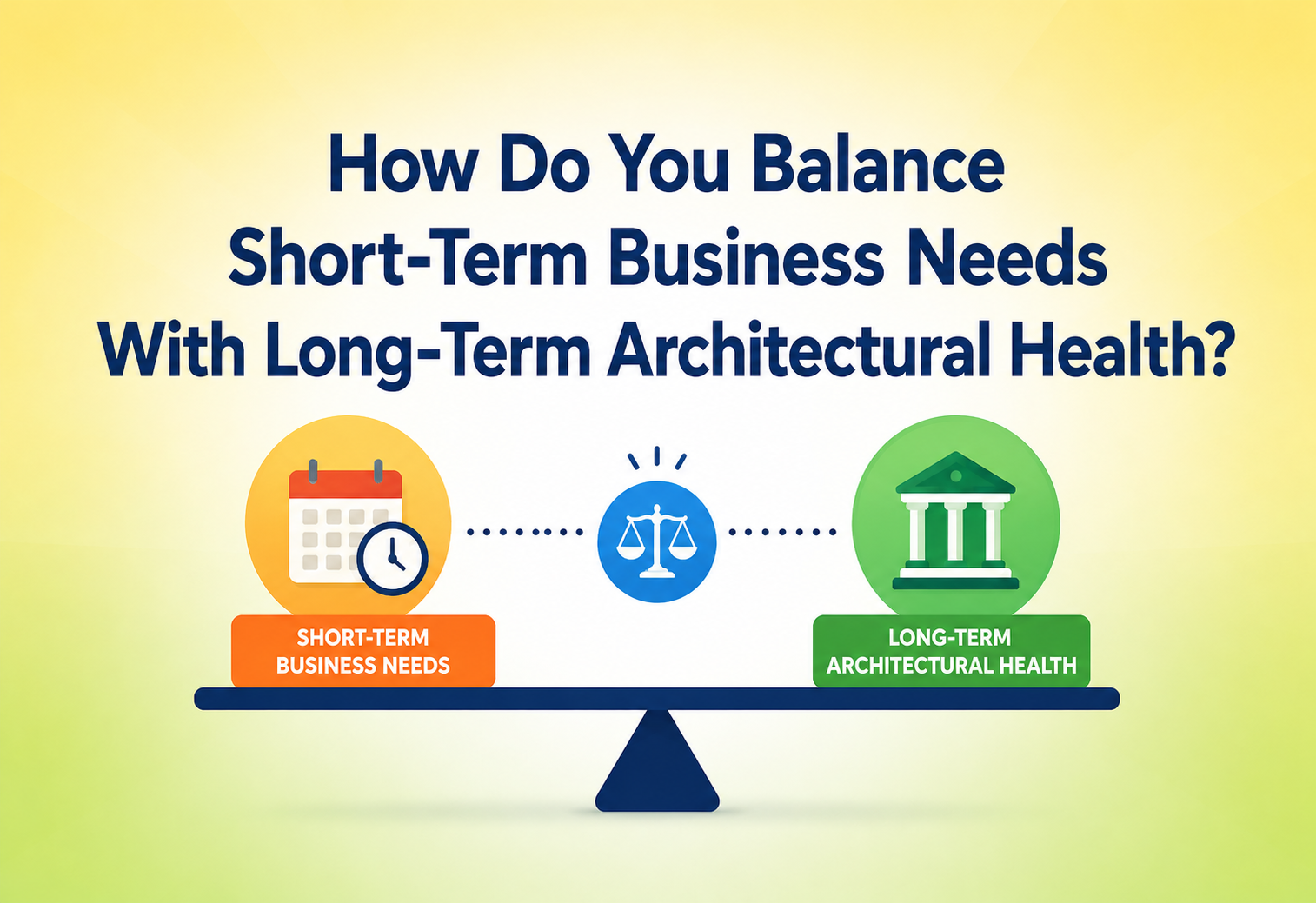
Balancing Short-Term Business Needs With Long-Term Architectural Health
A gentle, honest look at the tension every engineering leader lives with — and a few durable habits for holding both sides of it, sprint after sprint, without quietly breaking one of them.
A Quiet Dread You Already Know
Balancing short-term business needs with long-term architectural health is not a technical problem you solve once. It is a relationship you tend, sprint after sprint, quarter after quarter, for as long as the system is alive.
There is a particular kind of quiet dread that shows up in sprint planning. Someone asks for a feature “by Friday.” Someone else — usually the person who has spent the most nights thinking about the system’s bones — feels their stomach tighten. Not because the feature is hard. Because they already know what shortcut it will take to get there, and they already know who will pay for it, and when.
If you have felt that particular tightness, this guide is for you. Not because it has a clever formula that dissolves the tension — there isn’t one — but because naming the tension honestly, and building a few steady habits around it, makes it survivable. More than survivable, actually. Manageable. Even, on good days, a little bit graceful.
Like any relationship worth keeping, the balance between speed and structure asks for honesty, patience, and the willingness to have the same conversation more than once, in more than one way, until it actually lands.
Two True Things, Pulling Opposite Ways
It helps to start by admitting that this isn’t a failure of planning or a sign that someone on the team is doing their job badly. The tension exists because two things that are both true are pulling in different directions at once.
The business is true when it says the company needs revenue this quarter to keep paying salaries. The market is true when it says a competitor just shipped something that makes your product look old. The customer is true when they say a missing feature is the reason they’re about to cancel. None of that is wrong, and none of it is going away because an architecture diagram says otherwise.
The architecture is also true when it says that another shortcut, stacked on the last five shortcuts, will make the next feature take three times as long. The database is also true when it groans under a schema that was never meant to hold this much data. The on-call engineer is also true when they say they’re exhausted from being woken up by the same fragile integration every other week.
Both are real. Neither side is imaginary or dramatic. The discomfort you feel isn’t a sign that something has gone wrong in your thinking — it’s a sign that you’re holding two legitimate, competing truths at the same time, which is exactly what the job of building software for a living business actually asks of you.
Once you stop treating the tension as an error to be corrected and start treating it as a permanent condition to be managed, something shifts. You stop looking for the one meeting, the one framework, or the one heroic refactor that will make the tension disappear forever. You start looking, instead, for a way of working that lets both sides breathe.
Think of it less like solving a puzzle and more like riding a bicycle. Standing perfectly still on a bike is almost impossible; staying upright while moving is surprisingly easy, once you accept that the “balance” comes from many small, continuous corrections rather than one perfect posture.
Vital Signs, Not a Style
Before we can balance anything, it is worth slowing down on what we even mean by architectural health — because the phrase gets used loosely enough that it starts to sound like a vague virtue rather than something concrete you can point to.
A healthy architecture is not the same thing as a perfect one. Perfection is not the goal, and chasing it is its own kind of trap — plenty of teams have burned a year “doing it properly” while the market moved on without them. Health is a more modest, more useful word. A healthy system is one where a few concrete things are true at once:
Change is proportional to change
A small feature request takes a small amount of work. A large one takes a large amount. The size of the ask and the size of the effort roughly match, instead of every request — no matter how tiny — requiring someone to hold the entire system in their head.
New people can find their footing
Someone joining the team can read the code, follow the data, and build a rough mental map within a reasonable number of weeks — not months of oral tradition passed down from the two engineers who “just know how it works.”
Failure is contained
When something breaks — and something always eventually breaks — the blast radius is small enough that one bad deploy does not take down five unrelated things at once.
The team can still say yes
Health shows up less in the code itself and more in the team’s emotional relationship to the code. A healthy system is one engineers are still willing to touch. An unhealthy one is one everyone quietly avoids.
Notice that none of those points mention specific technologies, patterns, or the “right” way to structure services. Architectural health isn’t a style. It is closer to a set of vital signs — a resting heart rate for your codebase. You can run a monolith in good health and a beautifully decomposed set of microservices in terrible health, and the reverse is just as true.
Architectural health is the ongoing capacity of a system — and the team behind it — to keep absorbing change at a reasonable cost, without one bad week burning down years of accumulated leverage.
The Legitimacy on the Other Side of the Table
On the other side of the table, it is worth giving the same generosity to “short-term business needs” that we just gave to architecture — because they are just as often misunderstood by engineers as architecture is misunderstood by the business.
When a product manager pushes for a date, they are rarely being careless. Somewhere behind that date is a sales conversation, an investor update, a renewal that’s at risk, or a promise already made to a customer who has been patient for a long time. The date isn’t arbitrary even when it feels that way from the engineering side. It is a proxy for trust — trust with a customer, trust with leadership, trust in the market that the company can still move.
Businesses run on cash and on confidence, and both have a shorter half-life than most engineers are trained to appreciate. A company can survive an imperfect codebase for years. It cannot survive missing payroll, or losing its three biggest customers in the same quarter, or watching a well-funded competitor eat its market while the team polishes an internal framework nobody outside the building will ever see.
So when someone asks you to hold the line on quality against a deadline, it helps to remember that they are, in their own way, protecting something real too — usually the very company that pays for the architecture you’re trying to protect. You’re not adversaries. You’re both trying to keep the same thing alive, from different vantage points.
Instead of “the business versus the architecture,” try thinking of it as “today’s business versus next year’s business.” Both are the business. You’re simply the person in the room whose job is to make sure next year’s business still has a place to stand.
What’s Actually Underneath a Deadline
It is worth being explicit about the shapes a deadline can take, because they are not all equivalent. Some are truly external and non-negotiable: a regulatory filing date, a contractually-committed launch, a marketing campaign that has already bought media placement. Others are internal proxies: a target that leadership picked to force focus, or a date offered to a customer as a gesture rather than a commitment. The first kind deserves the caution of a physics constant. The second kind is a conversation waiting to happen, if you approach it with respect.
Learning to gently distinguish between them — without treating any of them as unimportant — is one of the more underrated skills of a senior architect. It is not about pushing back. It is about understanding, with the same care you’d apply to a system diagram, what the deadline is actually made of.
Both Extremes Lose — Just Differently
It is tempting to imagine that the safest move is to consistently favour one side over the other — always ship fast, or always insist on doing it properly. In practice, both extremes eventually produce the same outcome: a slow, quiet loss of the ability to move at all. They just get there by different roads.
What Happens When Speed Always Wins
Every shortcut, taken alone, looks harmless. A hardcoded value here. A skipped test there. A service that reaches directly into another service’s database because building a proper interface would take “another two days” nobody has. Each decision, in isolation, is defensible. It is the accumulation that becomes the problem, not any single choice.
Teams that always choose speed tend to notice the cost the same way you notice a slow leak in a tire — not in one dramatic moment, but in a gradual, background sense that everything is a little harder than it used to be. Estimates that used to be confident become guesses padded with fear. Features that should take days start quietly taking weeks, and nobody can point to a single cause, because the cause is everywhere and nowhere — a thousand small compromises, none large enough to justify on its own.
Eventually, this shows up as a very specific, very demoralising kind of meeting: the one where leadership asks why a “simple” change is taking so long, and the honest answer — “because six years of simple changes are still living in this codebase” — is too diffuse to say out loud, so someone says something vaguer instead, and the real cause never gets addressed.
What Happens When Caution Always Wins
The opposite failure is quieter but no less real. Teams that treat every decision as permanent, that insist on the fully generalised, perfectly abstracted, endlessly future-proofed version of everything, often build systems that are beautiful and almost entirely disconnected from what the business actually needed. Effort gets spent bracing for futures that never arrive, while the present slips by unattended.
These teams tend to lose in a way that’s harder to see coming, because the loss doesn’t show up as an outage or an incident. It shows up as irrelevance. The market moves on. A leaner competitor, with a scrappier and less “correct” codebase, gets to the customer first, learns faster, and by the time the well-architected version ships, the opportunity it was built for has already closed.
» Always Fast
- Ships quickly at first, then slows to a crawl as small compromises compound.
- Estimates start carrying more hedging words: “probably,” “if nothing else breaks.”
- Certain files quietly become no-go zones that everyone routes around.
- Ends up in a system nobody fully trusts or fully understands.
» Always Careful
- Builds something sound, but often arrives late to a market that has already decided.
- Small features get gold-plated with options nobody asked for.
- Design discussions grow longer than the delivery cycles they precede.
- The team feels proud of the elegance while the roadmap quietly stalls.
Neither failure is about intelligence or effort. Both are usually staffed by capable, well-meaning people. What is missing, in both cases, is a habit of deliberately choosing — sprint by sprint — rather than defaulting, quietly and by inertia, to whichever side feels most comfortable to whoever is in the room that day.

Neither “always ship” nor “always polish” is really a decision. Both are the absence of one — a default that quietly hardens into a habit until nobody remembers there was ever a choice to be made.
Five Habits That Give the Discomfort Somewhere Useful to Go
Here is a framework that has held up, in one form or another, across very different teams and very different systems. It will not remove the discomfort of the decision — nothing does — but it gives the discomfort somewhere useful to go.
1. Name the Debt Out Loud
The single most useful habit an architect can build is simply saying the quiet part out loud, at the moment the shortcut is taken, not months later when someone stumbles into it by accident. “We’re going to hardcode this for now, and it will need to be generalised once we have a second customer using it” is a sentence that costs nothing to say and saves enormous pain later, because it turns an invisible debt into a visible, tracked one.
Debt that is written down, dated, and attached to a reason is manageable. Debt that lives only in one engineer’s memory is a landmine with someone else’s name quietly written on it.
2. Separate Reversible From Irreversible
Not every shortcut carries the same weight. Some decisions are easy to undo later — a slightly messy internal function, a naming convention you’re not thrilled about, a manual step that could eventually be automated. Others are much harder to walk back — a data model that every other table depends on, a public API contract that customers have started to rely on, a security boundary drawn in the wrong place.
When time is short, spend your caution on the irreversible decisions and let yourself be more relaxed about the reversible ones. This single distinction, applied consistently, resolves a surprising number of arguments before they even start, because it turns “should we do this properly” into a much more answerable question: “how expensive would it be to change our minds later?”
Before agreeing to a shortcut, ask: if this turns out to be the wrong call, what does undoing it cost — an afternoon, a sprint, or a migration that touches every customer? The size of that answer should roughly match the size of the caution you bring to the decision.
3. Give Architectural Work a Permanent Seat, Not a Special Favour
One of the quiet reasons technical health keeps losing to feature work is structural, not personal: feature work has a permanent seat at the table — it is what the roadmap is made of — while architectural work has to ask for a favour every single time, competing fresh against a new business need each quarter.
Teams that manage this well tend to give architectural investment its own standing allocation, rather than re-litigating it every planning cycle. Some protect a fixed share of every sprint for health work. Some run dedicated “stabilisation” sprints on a regular cadence. The exact mechanism matters less than the principle: health work should not have to win an argument every single time it wants to exist. It should already have a chair.
4. Make the Invisible Cost Visible
Business stakeholders are not against architecture. They are against invisible, unquantified requests for time. “We need to refactor this” is a sentence with no shape a business person can hold onto. “This module is why the last three releases in this area took twice as long as estimated, and it will keep costing us roughly that tax on every future change here until we address it” is a sentence anyone can act on, because it is denominated in the currency the business already understands: time and money.
Wherever you can, translate architectural cost into terms that show up on a roadmap — slower delivery, higher incident rates, harder onboarding, more expensive hiring because good engineers don’t want to work in the mess. You’re not exaggerating to win an argument. You’re simply making visible a cost that was already being paid, quietly, by everyone.

5. Ask “What Will This Cost in Six Months” Before “What Does This Cost Today”
A simple question, asked consistently, quietly reshapes a lot of decisions: not “can we do this by Friday,” but “if we do this by Friday, what does it cost us in six months, and are we okay with that price?” Sometimes the answer is genuinely yes — the deadline matters more than the six-month cost, and that is a legitimate, adult decision to make with eyes open. What matters is that it is made with eyes open, by the people who will actually pay the six-month price, rather than decided by default because nobody asked the question at all.
The Quiet Signals of Drift
Balance is easier to keep when you catch the drift early, and much harder once a team has been leaning the same direction for a year without anyone quite noticing. A few quiet signals tend to show up before the bigger, more painful ones do.
When Speed Has Been Winning Too Long
The first sign usually isn’t an outage. It is a change in language. Estimates start coming with more hedging in them — “probably,” “if nothing goes wrong,” “assuming that part still works the way we think it does.” Engineers begin avoiding certain files, routing around them rather than through them, the way you might avoid a pothole you have hit once too often. New hires take noticeably longer to become productive, not because they’re less capable, but because there is more undocumented, unwritten context they have to absorb by trial and error before they can move confidently. None of these, alone, is a crisis. Together, they are a pattern worth naming out loud before it hardens further.
When Caution Has Been Winning Too Long
The signals look different, but they are just as visible once you know to look. Simple requests start requiring surprisingly long design discussions. Small features get quietly gold-plated with configuration options and abstractions nobody asked for and nobody will use for years, if ever. The team starts to feel proud of the elegance of the system in meetings, while the business, in a different room, quietly wonders why nothing seems to ship. Pride in craft is a wonderful thing right up until it stops noticing the calendar.
Why Catching It Early Matters
The value of learning these signals isn’t to become anxious about them — it is the opposite. A team that knows what drift looks like early can make a small correction — a slightly larger investment sprint here, a slightly firmer deadline there — long before the correction has to become dramatic. Course corrections made early feel like steering. Course corrections made late feel like crisis. The signals are simply how you tell, ahead of time, which one you are about to be doing.
Once a quarter, ask the team two plain questions in a retro: “What part of the system are we quietly avoiding right now?” and “What did we recently build that felt more careful than the situation actually called for?” The honest answers to those two questions, said out loud in the same room, are usually a more accurate compass than any dashboard.
Translation, Not Confrontation
Even the best framework falls flat if it never leaves the engineering team’s own conversations. A large part of this job is translation — carrying the same underlying truth across a language barrier, over and over, patiently, without resentment.
Speak in Outcomes, Not Internals
Nobody outside engineering is moved by the phrase “tightly coupled” or “lacking test coverage.” They are moved by “our last four releases in this area shipped later than promised” and “we had three customer-facing outages from this component this quarter.” Translate the internal diagnosis into the external symptom the business already feels, and you will find people listening far more closely than you expected.
Bring Options, Not Ultimatums
“We can’t ship this without a rewrite” tends to end conversations rather than open them, and it is rarely even true. A more useful version usually sounds like: “Here are three ways we could hit this date — this one ships fastest but adds real cost to the next two features in this area, this one takes an extra week but avoids most of that cost, and this one is somewhere in between. Which trade-off matches what matters most to us right now?”
Giving business stakeholders real choices, with honest trade-offs attached to each one, does two things at once. It respects their right to make business decisions, and it makes sure the cost of speed is a decision someone actually made, rather than a surprise someone discovers later and quietly resents you for.
Keep a Visible Ledger
Whatever tool your team already uses — a backlog, a wiki page, a simple spreadsheet — keep a short, living list of the shortcuts that have been taken on purpose, why, and what it would take to address them. This does two quiet but important things. It turns architecture from a vague, ambient worry into a concrete, prioritisable set of items the business can actually see and weigh against everything else competing for time. And it protects the team’s credibility, because when someone asks “why didn’t we know this would be slow,” there is an honest paper trail showing that yes, this was known, and it was a conscious trade, not an oversight.

“I can get you there by Friday, and I want to be honest that it will make the next thing in this area harder. I’m fine making that trade if you are — I just don’t want it to be a surprise later.” Said calmly, without drama, this single sentence has saved more relationships between engineering and the business than almost anything else in this guide.
Show, Do Not Only Tell
Whenever it is safe to do so, back up the translation with something the business can see for itself — a graph of how estimates in a specific module have drifted over the last four quarters, a screenshot of the on-call pager frequency for a fragile integration, a paragraph from an exit interview mentioning why an engineer left. None of these need to be elaborate. Their job is simply to make the invisible cost feel touchable, so that the same conversation you have been having in words for months finally lands in a way that a stakeholder cannot easily forget.
The Kind of Story That Happens Everywhere
Most architectural health is not won or lost in a single decisive moment. It is the sum of many small, honestly-made trades — tracked well enough that they can be revisited on purpose, rather than discovered by accident three years later.
A team I knew of — not famous, not remarkable, just an ordinary product team at an ordinary growing company — was six months into building a platform for a fast-moving market. Early on, a big customer asked for a feature that didn’t fit cleanly into the system’s data model. The honest estimate for doing it properly was three weeks. The customer needed it in five days, and the deal attached to that feature was large enough to matter to the whole company’s year.
The team made a deliberate choice. They built a special-case path just for that customer, wrote it down clearly as a known shortcut, and shipped in five days. The deal closed. Nobody pretended the shortcut was a good long-term design — everyone agreed, on the record, that it would need revisiting once a second customer needed something similar.
Eight months later, a second customer did need something similar, and the team had a choice: extend the special case again, or finally build the general version. Because the first shortcut had been named, dated, and tracked instead of quietly forgotten, the conversation about which path to take was quick and unemotional. They chose to invest the two weeks to generalise it, folding both customers into a proper solution, and the codebase came out healthier for having carried the debt consciously instead of accidentally.
Nothing about that story is dramatic. There is no heroic all-nighter, no dramatic rewrite, no villain. That is rather the point. Most architectural health is not won or lost in a single decisive moment — it is the sum of many small, honestly-made trades like this one, tracked well enough that they can be revisited on purpose, rather than discovered by accident three years later by someone with no idea why the code looks the way it does.
Day 1 — The Ask Arrives
A large customer needs a feature that does not fit the current data model. Proper estimate: three weeks. Requested window: five days.
Day 5 — Ship the Shortcut, on the Record
Team ships a special-case path. The shortcut is written down in the same commit — what it is, why it exists, what would trigger a revisit.
Month 8 — The Trigger Arrives
A second customer asks for something structurally similar. Because the debt was tracked, the team can decide calmly, not react in panic.
Month 8 + Two Weeks — The Generalisation
Both customers move onto a proper shared model. The codebase ends up healthier for having carried the debt consciously instead of accidentally.
The Habits Worth Slowly Retiring
Most of these mistakes are not made by careless people. They are made by tired, well-intentioned teams under real pressure, reaching for the habit that feels safest in the moment rather than the one that serves them best over a year.
None of the entries below deserve shame. They deserve a small, steady correction, applied gently and repeated until it becomes the new default instead of the exception.
| The Mistake | A Softer, Steadier Alternative |
|---|---|
| Treating every deadline as equally sacred, so there is never a “right moment” to invest in health. | Ask which deadlines are truly tied to something external — a contract, a launch, a regulation — and which are more flexible than they first appear. |
| Letting architectural decisions live only in one senior engineer’s head. | Write decisions down, briefly, close to where the code lives — a short note explaining the “why,” not just the “what.” |
| Presenting technical debt as a moral failing rather than a normal cost of moving fast. | Talk about debt the way finance talks about debt — sometimes useful, always worth tracking, never something to be ashamed of on its own. |
| Waiting until a system is in real pain before asking for time to address it. | Build in small, regular investment before pain arrives, the way routine maintenance is cheaper than emergency repair. |
| Arguing about architecture in a vocabulary only engineers understand. | Translate every technical concern into its business consequence before bringing it to a room with non-engineers in it. |
| Assuming the person asking for speed does not care about quality. | Assume, until proven otherwise, that they are protecting something real from a different vantage point — and ask what that is. |
The most dangerous version of any of these mistakes is the one that has been happening for so long that nobody remembers making the choice. Habits harden into culture quickly — and a culture is much harder to correct than a single decision.
Small Practices, Compounded Over a Year
None of the habits below require permission from anyone above you. They are things you can start quietly, on your own team, this week — and they compound.
Name the Shortcut the Moment You Take It
A single sentence in the pull request or the ticket is enough — “this is a deliberate shortcut, here is why, here is what it will need later.” Invisible debt becomes tracked, referenceable debt.
Keep a Short, Living List of Known Debt
Not an exhaustive audit — just enough to remember what you already know, so it does not have to be painfully rediscovered by whoever wanders in next.
Protect a Small, Regular Slice of Time for Health Work
Even ten percent of a sprint, kept consistently, compounds meaningfully over a year. Consistency beats size, every time.
Translate Technical Risk Into Business Language Before the Meeting
Arrive with the sentence already built, rather than improvising it under pressure across a table of people you are simultaneously trying to persuade.
Offer Options With Honest Trade-offs Instead of a Single Yes or No
Let the business choose the price it is willing to pay, with the full picture in front of it. That respect tends to be returned in kind.
Revisit Old Shortcuts on Purpose, Before They Demand Your Attention
A quarterly look back through the debt list catches problems while they are still small and cheap — before they show up in a post-mortem.
Celebrate the Boring Wins
A migration that goes smoothly, a service nobody had to think about this quarter — these deserve recognition too, not just the flashy launches. What gets celebrated gets repeated.
The Questions Behind the Questions
A short round of the questions most commonly asked about balancing speed and structure — answered plainly, without the reflex to sound clever.

Is it ever okay to just say no to a deadline for architectural reasons?
Rarely as a flat no, and almost always as a “yes, and here is what that costs us later.” An outright refusal tends to close the conversation rather than move it forward. A clearly explained trade-off, on the other hand, respects both the urgency of the ask and the legitimacy of the concern behind it — and it is usually far more persuasive than a refusal ever could be.
How much time should a team spend on architectural health versus new features?
There is no universal number, and anyone who gives you one with total confidence probably has not run a real team through a real year. What matters more than the exact percentage is consistency — a small, protected, recurring allocation tends to outperform a larger amount given sporadically, in bursts, only after something has already broken.
What if the business genuinely does not care about architecture at all?
In most cases, what looks like indifference is actually a language gap rather than genuine disinterest. Almost no leadership team is indifferent to slower delivery, more outages, or harder hiring — they simply may not connect those visible symptoms to the invisible architectural cause. Bridging that gap, patiently and repeatedly, is usually more effective than assuming the disinterest is permanent.
How do you know when a shortcut has finally become too expensive to keep?
A useful signal is when the same piece of code keeps showing up as the explanation for slow estimates, in conversation after conversation, without anyone having to search for it. When a shortcut becomes the answer to “why is this taking so long” often enough that the team can say it from memory, that is usually the moment it has earned its place at the top of the list.
Does this get easier with experience?
The discomfort rarely disappears completely, even for very senior architects — if anything, more experience often means seeing the long-term cost more clearly, which can make the short-term trade-offs feel heavier, not lighter. What does get easier is the process around the discomfort: naming trade-offs quickly, having the business conversation without dread, and trusting that a well-tracked, honestly-made compromise today is not a failure but simply how real systems get built by real teams working within real constraints.
Should juniors on the team be involved in these conversations?
Yes, more than most teams realise. Watching a senior engineer patiently make a trade-off visible to a stakeholder — without theatrics, without shaming anyone — is one of the most portable skills a junior can absorb, and it is almost impossible to learn from a book. If the room allows for it, bring them in; the muscle they build there will outlast every specific technology decision on the whiteboard behind them.
Balance Is Not a Destination
If there is one idea worth carrying away from all of this, it is that balance is not a fixed point you arrive at and then get to rest in. It is closer to riding a bicycle than standing on solid ground — a continuous, small, ongoing series of adjustments, made sprint after sprint, that only look like stillness from a distance.
Some quarters, the business will need more speed than the architecture would prefer to give, and that is a legitimate choice as long as it is made with open eyes and a clear record of what it costs. Other quarters, the system will need more care than the roadmap would prefer to spare, and that is just as legitimate, for the same reason. The goal was never to eliminate the tension. The goal is to keep making the trade-off consciously, together, out loud — instead of letting it get made for you, quietly, by default, until one day the bill comes due all at once.
That, in the end, is what architectural leadership actually is. Not the person who always insists on doing things properly, and not the person who always says yes to the deadline. The person who can hold both truths at the same time, translate between the two rooms that do not naturally speak the same language, and keep the whole thing standing — a little wobbly sometimes, but still standing — for as long as the business needs it to.
Key Takeaways
- The tension is permanent, not a bug. Two legitimate truths are pulling in opposite directions — the goal is to manage the pull, not eliminate it.
- Health is a set of vital signs, not a style. Change proportional to change, low onboarding cost, contained failure, and a team still willing to touch the code.
- Both extremes lose. Always fast slowly grinds to a halt; always careful arrives after the market has already moved.
- Name the debt out loud, the moment you take it. Written, dated, and attributed debt is manageable; invisible debt is a landmine with someone else’s name on it.
- Reversible and irreversible are not the same. Spend most of your caution on the decisions that would be expensive to walk back.
- Give architectural work a permanent seat. Health work should not have to win a fresh argument every planning cycle.
- Translate before you enter the room. Speak in outcomes, bring options rather than ultimatums, and keep a visible ledger of what you have deferred.
- Steer early rather than react late. Small, boring corrections beat dramatic ones, and the signals of drift are readable long before drift becomes crisis.
Balancing short-term business needs with long-term architectural health is not a formula — it is a habit of choosing, deliberately and out loud, sprint after sprint, so that the trade-off is always made by the people who will pay for it, rather than made for them by default.
#SOFTWAREARCHITECTURE#TECHNICALDEBT#ENGINEERINGLEADERSHIP#SYSTEMDESIGN#TEAMCULTURE