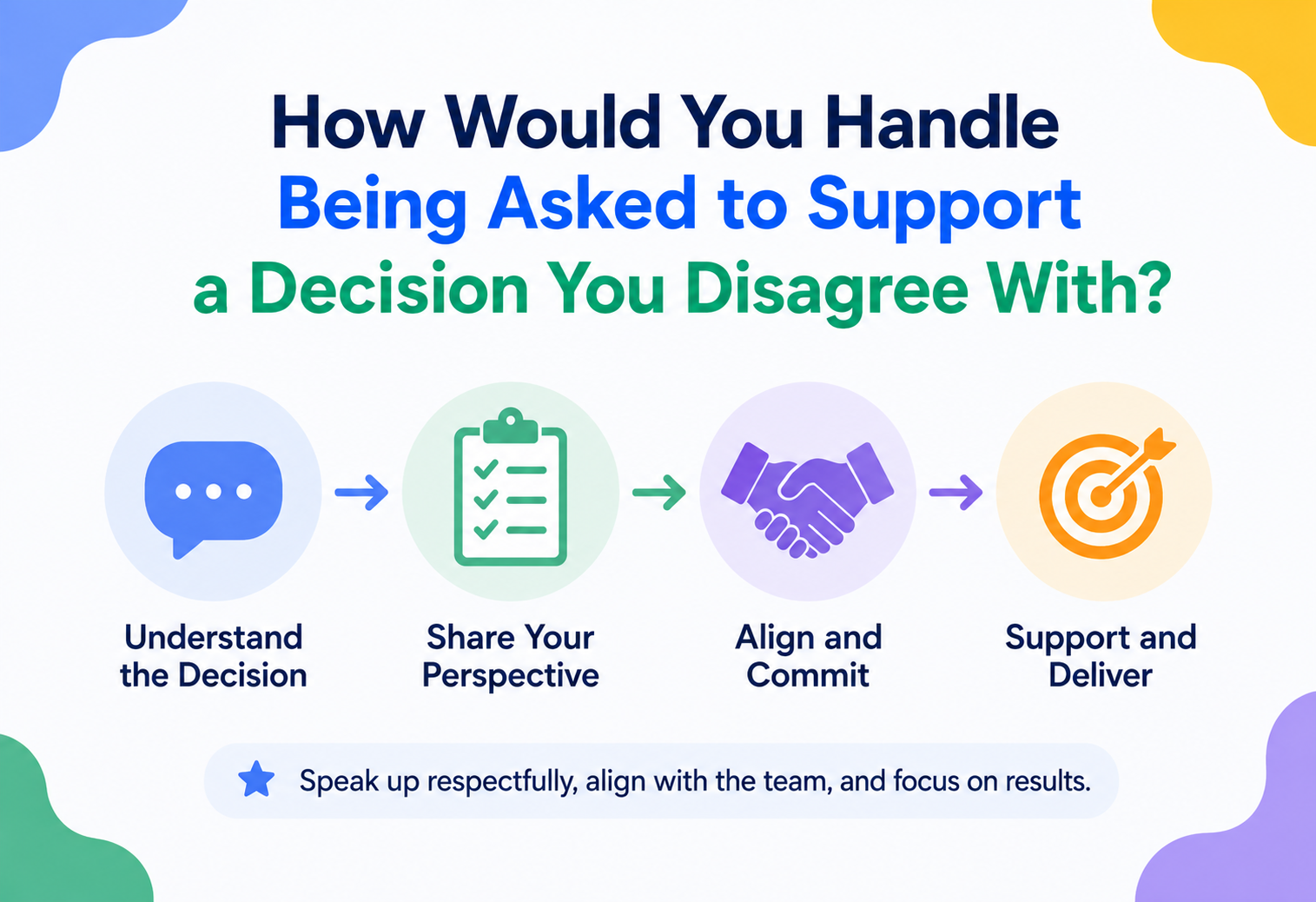
How Would You Handle Being Asked to Support a Decision You Disagree With?
A calm, honest look at one of the quieter tests of professional maturity — and how to stay both truthful and trustworthy when a call doesn’t go your way.
The Moment That Comes After the Meeting
There’s a specific moment many of us know too well. A decision gets made in a meeting you were part of. You raised your concerns, clearly, more than once. And the room went the other way anyway. Now you’re standing at your desk, or in front of your own team, expected to carry that decision forward as if it were entirely your idea — while some private part of you is still convinced it’s the wrong call.
That moment is small on the surface and surprisingly large underneath. It touches your sense of integrity, your relationship with the people you lead, and your standing with the people above you, all at once. Handle it well, and you build a particular kind of trust that’s hard to earn any other way. Handle it badly — either by quietly sabotaging the decision or by pretending you agreed all along — and something in the team’s fabric frays a little, even if nobody says so out loud.
This piece is about that moment. Not the meeting where the disagreement happened, but the harder, quieter part that comes after — when the decision is made, and the question shifts from “am I right” to “how do I carry this well.”
The way you carry a decision you disagreed with does more to build (or quietly erode) your professional trust than most of the decisions you actually get to make. It is the invisible part of leadership — the part nobody applauds in the moment, but everyone notices over time.
Why This Moment Is Harder Than It Looks
It’s tempting to treat this as a simple question of obedience — either you fall in line or you don’t. But that framing misses almost everything that actually makes the moment difficult. What makes it hard isn’t authority. It’s the collision of several things you genuinely care about, all at the same time.
You care about being right, or at least about being honest — you said what you believed, and some part of you doesn’t want to pretend otherwise now. You care about the team you lead or work alongside, who will look to you for a read on whether this decision is worth their full effort. You care about your relationship with whoever made the call, who you may need to trust and be trusted by again next month, on a different decision entirely. And underneath all of that, you care about the outcome itself — you want the thing to actually work, even if you would have built it differently.
None of these things are in conflict because you’re confused. They’re in conflict because they’re all real, all at once, and the moment asks you to hold them together without letting any one of them quietly win by default.
Disagreeing well is a skill. Supporting a decision you disagreed with, without losing yourself in the process, is a different skill — and it’s the one nobody teaches.
Once you see it this way, the goal stops being “get over it” or “just do what you’re told.” The goal becomes something more precise: stay honest about what you believed, while genuinely giving the decision the effort it deserves — because it’s no longer a hypothetical, it’s the plan, and half-hearted execution rarely proves anyone right. It usually just makes the outcome worse for everyone, including you.

Your own honesty
You said what you believed. Pretending you didn’t is corrosive to your own sense of self, even if nobody else notices.
Your team’s read
The people around you will take their cue from you, whether you intend that or not. Your posture becomes their permission.
The relationship
You will disagree with this same person again, on a different decision, and you both need to trust each other next time too.
The outcome itself
You want the thing to work. A half-hearted execution of a decision you doubt doesn’t prove your point — it just makes everyone lose.
Two Very Different Things That Look Similar From the Outside
It helps enormously to separate two things that get flattened together in most conversations about this topic, because they are not the same, and confusing them is where most of the pain comes from.
3.1 Disagree and commit
This is the healthy version. You said your piece clearly, ideally before the decision was final, and once it was made, you genuinely put your energy behind it — not performing enthusiasm you don’t feel, but giving the work the same real effort you’d give an idea of your own. Your private opinion about whether it was the right call doesn’t disappear, but it stops running the show. The decision does.
3.2 Silent compliance
This is the version that quietly costs everyone later. You go along with the decision on the surface, but underneath, you’re still fighting it — through half-effort, through comments to your team that undercut it, through an “I told you so” you’re already saving up for the postmortem. Nothing about this is dramatic or obviously disloyal in the moment. That’s exactly what makes it corrosive. It looks like cooperation and behaves like sabotage.
Disagree and commit looks like
Full effort toward the decision’s success, an honest record that you raised concerns, and a genuine willingness to be wrong about your own objection.
Silent compliance looks like
Surface agreement, private resentment, subtly reduced effort, and a quiet hope — even if unspoken — that the decision fails so your original view is proven right.
Most people don’t choose silent compliance on purpose. It creeps in, especially when the disagreement felt dismissed rather than heard. Which is exactly why the earlier part of the process — how you raised the concern in the first place — matters so much to how well you’re able to let it go afterward.
What Happens Before the Decision Matters More Than People Think
The ability to genuinely support a decision you disagree with is built earlier than most people realize — in how the disagreement was voiced in the first place, not in how it’s managed afterward. A concern that was raised clearly, respectfully, and with real evidence is far easier to let go of than one that was swallowed, hinted at sideways, or brought up too late to matter.

4.1 Say it once, say it clearly, say it early
The version of dissent that leaves the least residue afterward is the one said plainly, with reasoning attached, while the decision is still open. “I think this is a mistake, and here’s specifically why” — delivered calmly, before the room has moved on — gives the decision-maker a real chance to weigh your view, and gives you a clean conscience afterward, because you know the concern was actually heard, not just felt.
4.2 Separate the objection from the person
It’s much easier for a leader to genuinely hear “I’m worried this approach will slow us down in six months, for these three reasons” than to hear something that sounds, even slightly, like a challenge to their judgment as a person. The content of your disagreement deserves to be sharp and specific. The delivery deserves to stay generous, because the goal isn’t to win the room — it’s to make sure the best information is on the table before the door closes.
4.3 Ask, honestly, what would change the decision
A quietly powerful question, and one too rarely asked out loud, is simply: “what would need to be true for you to decide differently?” Sometimes the answer reveals that the decision-maker has information you don’t. Sometimes it reveals that they haven’t fully considered something you have. Either way, the question turns a debate into a shared search for the right answer, rather than two people defending fixed positions.
There’s a real difference between “I disagree and I want you to know why” and “I disagree and I want to be proven right later.” The first is a gift to the decision. The second is a grudge wearing the costume of honesty — and it tends to show, eventually, no matter how carefully it’s hidden.
When dissent is voiced this way — clearly, early, generously — something useful happens afterward, whether the decision goes your way or not. You’ve already said what needed to be said. There’s nothing left held back, nothing quietly festering. What’s left is simply the work of carrying the decision forward, which turns out to be a much lighter task than people expect once the earlier part has been done honestly.
After the Decision Is Made — What Genuine Support Actually Looks Like
Once the decision is final, the question changes shape entirely. It’s no longer “was I right.” It’s “what does this decision need from me now, and am I willing to give it.” Here is what that tends to look like in practice, in the small, unglamorous moments that actually make up most of work.
5.1 Give the decision your real effort, not your minimum effort
This is the heart of it, and it’s simpler to say than it is to do. Genuine support means bringing the same care, creativity, and attention to detail you’d bring to a plan of your own — not performing that care for an audience, but actually doing the work of trying to make the decision succeed, because a half-hearted execution of a good decision and a half-hearted execution of a bad one look almost identical from the outside, and both waste the same amount of everyone’s time.
5.2 Retire the objection from your public language
You’re allowed to privately still believe the decision was wrong. What you’re not entitled to do, once you’ve made the choice to support it, is keep relitigating it in front of the people counting on you to execute it. Every “well, I did say this would happen” chips away at the team’s confidence, and — more quietly — at your own credibility the next time you raise a concern that actually matters.
5.3 Represent the decision honestly to your own team
Your team will take their emotional cue from you, whether you intend that or not. If you present the decision with genuine (even if measured) commitment, they will generally follow that lead. If you present it with a raised eyebrow, a sigh, or a pointed “this isn’t what I would have done,” you’ve quietly handed them permission to under-invest too — and you’ll likely be the one left explaining the resulting shortfall later.

Your team doesn’t need to believe you agreed. They need to believe you’re trying, fully, regardless.
5.4 Keep the door open to being wrong
One of the more freeing parts of this whole practice is remembering that your objection might simply be incorrect. You have a partial view, shaped by your role, your history, your instincts — and so does everyone else in that room. Genuinely supporting the decision means giving it a real chance to prove itself, rather than quietly waiting to say “I told you so” the moment something goes even slightly wrong.
5.5 Ask what the decision actually needs from you
A practical way to turn commitment from a feeling into an action is to ask, plainly, “what does this decision need from me specifically to succeed.” Sometimes the honest answer is your technical skill, applied fully. Sometimes it’s your influence with a stakeholder who trusts you more than they trust the decision-maker. Sometimes it’s simply your public tone in the next few team meetings, since that tone will do more to shape morale than almost anything else you could contribute. Naming the specific thing turns a vague obligation to “be supportive” into a concrete list of things you can actually go and do, which is usually a relief, because vague obligations are exactly the kind that quietly go unmet.
When It’s More Than a Preference — Handling the Harder Cases
Everything above assumes something important: that the disagreement is a matter of judgment, strategy, or approach — a genuine difference of professional opinion about the best way forward. Most workplace disagreements are exactly that kind, and “disagree and commit” is the right posture for almost all of them.
But it’s worth naming, honestly, that not every disagreement belongs in that category. Sometimes what’s being asked isn’t “please support a strategy you wouldn’t have chosen.” It’s something that crosses into dishonesty, unsafety, or a violation of something you’re not willing to compromise — misleading a customer, cutting a corner that puts people at real risk, or asking you to represent something as true that you know isn’t. That is a different situation entirely, and it deserves a different response.
Ask yourself plainly: is this a decision I think is unwise, or a decision I think is wrong in a way I couldn’t defend to someone I respect? The first calls for support despite disagreement. The second calls for a much more direct conversation — and, if it comes to it, a willingness to say no, escalate, or in rare cases walk away, rather than quietly going along.
The vast majority of the disagreements that come up at work — about architecture, about priorities, about which feature ships first, about how a team is structured — sit comfortably in the first category. Reserving the harder response for the rare cases where it’s genuinely warranted keeps it meaningful. If everything gets treated as a line in the sand, nothing does, and the people around you lose the ability to tell the difference between “I’d have done this differently” and “I actually cannot in good conscience be part of this.”
It’s also worth being honest with yourself about which category you’re actually in, because it’s tempting, in the heat of a disagreement, to inflate an ordinary strategic objection into something that feels more serious than it is — partly because “this crosses a line” feels more justified than “I simply preferred a different approach.” A useful check is to imagine explaining your objection to a neutral third party, someone with no stake in either outcome. If their likely response is “that sounds like a reasonable difference of opinion,” you’re almost certainly in disagree-and-commit territory. If their likely response is “that does sound like a real problem,” the harder conversation is probably the right one, and it’s worth having it directly rather than letting it curdle into quiet resistance.
Noticing the Quiet Slide Toward Silent Compliance
Silent compliance rarely arrives as a decision. It arrives as a drift — a handful of small, forgivable-seeming moments that, stacked together, add up to something you didn’t consciously choose. It’s worth learning to notice the early signs, because they’re much easier to correct while they’re still small.
One early sign is a change in your language around the decision, even in casual conversation. “We’re doing this” quietly becomes “they’ve decided to do this” — a small shift in pronoun that reveals a larger shift in ownership. Another sign is a certain selectiveness in your effort: you show up fully for the parts of the plan you’d have chosen yourself, and just slightly less fully for the parts you wouldn’t have. Nobody would call that sabotage. It rarely even feels like a choice. But the outcome is the same as if it had been one.
A third, quieter sign is what happens in the small side conversations — the hallway comment, the private message to a trusted colleague, the aside before a meeting starts. If those conversations are full of a running commentary on everything the decision is getting wrong, while your public face stays neutral, that gap between the two is usually a sign that the disagreement hasn’t actually been let go — it’s just been moved somewhere less visible, where it can quietly do just as much damage to the team’s morale.
None of these signs are moral failings. They’re simply what happens when a disagreement hasn’t been fully processed, and the honest move, once you notice one of them in yourself, is a small private check-in: “have I actually committed to this, or am I just not fighting it out loud anymore.” Those are two very different postures, and only one of them is sustainable for very long.

If this decision succeeds completely, will I be glad — or will some part of me be quietly disappointed that I wasn’t right? If the honest answer is the second one, that’s worth sitting with, not as a source of guilt, but as useful information about where your commitment actually stands.
The pronoun shift
“We’re doing this” becomes “they’ve decided to do this.” A tiny linguistic tell of a much larger shift in ownership.
Selective effort
Full presence for the parts you’d have chosen; just slightly less for the parts you wouldn’t. Never dramatic, but corrosive.
Side-conversation drift
A neutral public face paired with a private running commentary on everything the decision is getting wrong.
Talking to Your Own Team About a Decision You Disagreed With
One of the trickiest versions of this moment happens when you’re not just personally supporting a decision, but responsible for explaining it to people who report to you — people who may sense, correctly, that you weren’t fully on board, and who are watching closely to see how you handle that.
8.1 You don’t have to pretend you agreed
Pretending can backfire badly, especially with a team that knows you well. A more durable approach is a version of honesty that stays professional: “I raised some concerns about this before it was decided, and they were heard. The decision is made, and I think it deserves our full effort — here’s how I’m thinking about it now.” This tells the truth without undermining the plan, and it models exactly the behavior you’d want from your own team the next time they disagree with something you decide.
8.2 Explain the reasoning, not just the outcome
Even when you weren’t the one who made the call, you can usually still explain why it was made — what problem it’s solving, what trade-off it reflects, what the decision-maker was weighing. People rarely need to agree with a decision to respect it. What they need is to understand it wasn’t arbitrary, and that someone thought it through.
8.3 Protect your team from your own residual frustration
This is the quiet discipline underneath everything else in this section. Your team shouldn’t have to manage your feelings about a decision on top of executing it. If you need to vent, find the right room for that — a peer, a mentor, someone outside the reporting line — rather than letting that frustration leak into the space where your team is trying to do good work.
A Small Story, the Kind That Happens Everywhere
A senior engineer I knew of — capable, well-respected, not prone to drama — disagreed strongly with a decision to migrate a core piece of the system to a new platform, ahead of what they believed was the right time. They said so clearly in the planning meeting, laid out the risks in detail, and were overruled. The business had reasons — a partnership, a timeline, a bet worth making even with the risk attached — and the call was made to move forward.
What happened next is the part worth noticing. The engineer didn’t pretend to have changed their mind. In the team update that followed, they said plainly: “I raised concerns about the timing of this, and they’ve been heard. We’re moving forward, and I want us to do it as carefully and well as we possibly can.” Then they did exactly that — leading the migration with the same rigor they’d have brought to a plan they’d designed themselves, catching two real issues along the way precisely because they were paying close attention, not coasting.
The migration wasn’t flawless. Nothing ever is. But it succeeded, and it succeeded partly because the person who disagreed with it chose to give it everything anyway. Months later, when that same engineer raised a concern about a different decision, they were listened to with unusual seriousness — not because they’d been right about everything before, but because everyone in the room remembered they’d supported a decision fully, even one they’d disagreed with, and hadn’t needed to be right to do it well.
It’s worth holding that story next to a quieter, less flattering one, because both are common and both are instructive. On a different team, a manager who’d been overruled on a reorganization handled it very differently. In meetings, they said all the right words — “we’re moving forward, I support it” — but in one-on-ones with their own reports, a different tone crept in: a sigh here, a “well, we’ll see how this goes” there, never quite a direct complaint, but enough that the team could feel the gap between the words and the weather underneath them. The reorganization struggled, and it’s genuinely hard to say how much of that was the plan itself and how much was a team quietly given permission, in a hundred small unspoken ways, not to fully believe in it. That’s the version worth watching for in yourself, precisely because it never announces itself as disloyalty.
That’s the quiet payoff of the first approach, and the quiet cost of the second. It isn’t that your disagreement disappears or stops mattering. It’s that your credibility compounds, decision after decision, in a way that makes people trust both your concerns and your commitment — which turns out to be a rarer, more valuable combination than being right.

Common Mistakes, Gently Corrected
Nobody handles this perfectly every time — the emotional pull toward being right is real, and it doesn’t switch off just because a decision has been made. These are less a list of failures and more a set of familiar patterns worth recognizing in yourself, so you can catch them a little earlier next time.
| The mistake | A softer, steadier alternative |
|---|---|
| Waiting until after the decision to raise concerns you’d actually been holding for weeks. | Say the hard thing early, while it can still change the outcome — silence beforehand rarely earns credibility afterward. |
| Agreeing out loud in the room, then quietly under-delivering once you’re back at your desk. | If you can’t genuinely commit, say so honestly rather than letting your effort say it for you later. |
| Reminding people you disagreed every time something goes even slightly wrong. | Let the record you already made speak for itself — repeating it out loud usually reads as point-scoring, not honesty. |
| Treating every disagreement as a hill worth dying on, until nobody can tell which ones actually are. | Reserve firm, immovable resistance for the rare cases that genuinely cross a line — it stays meaningful only if it’s rare. |
| Letting your visible frustration set the emotional tone for your entire team. | Process the frustration somewhere else, and bring your team the steadier, more useful version of yourself. |
A Few Steady Habits Worth Keeping
The practice of supporting a decision you disagree with is less a single skill and more a small collection of habits, each of them small on its own, but genuinely durable when carried together over years of professional life.
Say it once, early
Say your disagreement once, clearly, and early enough to matter. A concern raised in time is a gift to the decision. One raised after the fact is just a grievance.
Ask what would change the call
Ask what would change the decision-maker’s mind. It often reveals information you didn’t have, or a gap in their thinking you can now speak to directly.
Name the category honestly
Decide whether this is a “disagree and commit” moment or a real line. The two call for very different responses, and confusing them helps no one.
Give it your real effort
Give the decision your full, real effort once it’s made. Half-hearted execution doesn’t prove your point — it just makes the outcome worse for everyone, including you.
Retire the objection publicly
Retire the objection from your public language. You’re allowed to hold a private opinion. You’re not entitled to keep relitigating it in front of the people relying on you.
Be honest with your team
Be honest with your own team, without undermining the plan. “I raised concerns, they were heard, now let’s do this well” respects both the truth and the work.
Hold your view loosely
Let being wrong be a real possibility. Hold your objection loosely enough that you’d genuinely be glad, not just quietly disappointed, if the decision turns out well.
Frequently Asked, Honestly Answered — and a Closing Thought
A short set of the questions that reliably come up in real conversations about this practice, answered directly — and then a closing thought about why any of this matters in the first place.
12.1 What if I raise my concerns and nobody actually listens?
It happens, and it’s genuinely frustrating. Even so, it’s worth separating “I wasn’t listened to well” from “I wasn’t heard at all” — the first is worth raising directly with the decision-maker afterward, calmly, as feedback about the process rather than a rehash of the decision itself. If it becomes a consistent pattern rather than a one-time frustration, that’s useful information about the environment you’re in, and worth taking seriously as such.
12.2 Is it dishonest to act supportive of something I privately still doubt?
Not if you’ve been honest about the doubt already, at the right time, to the right person. There’s a real difference between hiding a disagreement and choosing, deliberately, not to let a disagreement you’ve already voiced keep undermining the work going forward. The first is dishonesty. The second is simply professional maturity.

12.3 How do I know if this is a “disagree and commit” situation or something more serious?
A fair question to sit with is whether you disagree with the approach or with the integrity of what’s being asked. Disagreeing with an approach — a technology choice, a timeline, a strategy — almost always belongs in the “commit” category. Disagreeing with the honesty or safety of what’s being asked belongs somewhere else entirely, and deserves a much more direct and immediate conversation.
12.4 What if the decision turns out badly, exactly as I predicted?
Resist the urge to make that moment about being right. A quiet, factual account of what happened — “here’s what we’re seeing, here’s what I think we should consider now” — carries far more weight than “I told you so” ever will, and it keeps the focus on fixing the problem rather than settling a score. Your credibility grows from how you handle this moment, not from how loudly you claim it.
12.5 Does supporting a decision I disagree with ever get easier?
The instinct to want to be right rarely goes away completely — that’s a very human thing, and there’s no shame in feeling it. What does get easier, with practice, is the gap between feeling that instinct and acting on it. Over time, most people find they can hold a private disagreement and a genuine public commitment at the same time, without either one canceling the other out.
12.6 What if I’m the one making the decision, and someone on my team disagrees with it?
The same practice runs in both directions, and it’s worth remembering that from the other seat. Hear the disagreement fully and take it seriously before deciding, rather than treating the conversation as a formality on the way to a conclusion you’d already reached. Once you’ve decided, be honest about the fact that a concern was raised, rather than acting as if the decision were unanimous. And afterward, watch for the same quiet signs of silent compliance in the person who disagreed with you — the goal isn’t to demand enthusiasm they don’t feel, it’s to make sure their honest effort is still there underneath their honest doubt.
12.7 Closing thought
There is a kind of professional trust that can only be earned in exactly this moment — not by always agreeing, and not by always being right, but by showing, again and again, that you can hold a real opinion and a real commitment at the same time, without either one quietly poisoning the other. That combination is rarer than it should be, which is precisely why it stands out so clearly when someone has it.
You will disagree with decisions again. Some of those disagreements will turn out to be right, and some will turn out to be wrong, and in most cases you’ll never get a perfectly clean answer either way. What stays entirely within your control, every single time, is how you carry the gap between your opinion and the outcome — whether you let it curdle into quiet resistance, or whether you turn it into the steadier, more valuable thing: honest input, followed by genuine effort, followed by the humility to let the work speak for itself.
It’s worth saying, too, that this practice isn’t really about the workplace at all, not underneath. It’s about a much older, more general skill — the ability to be part of something larger than your own opinion, without losing yourself in the process. Families do it. Communities do it. Any group of people trying to build something together eventually runs into a moment where not everyone gets their way, and what happens next says more about the group’s health than the decision itself ever could. Work simply happens to be where most of us practice it most often, in public, with consequences attached.
The one line worth keeping
- What makes someone worth having in the room the next time a hard decision needs to be made isn’t that they always agree — it’s that everyone already knows exactly what they’ll do if they don’t.