What Is a Common Example of a Serverless Service?
A complete, beginner-to-production guide to serverless computing — explained from first principles, with real analogies, Java code, architecture diagrams, and lessons from how Netflix, Coca-Cola, iRobot, Capital One, Uber, and Amazon actually use AWS Lambda, DynamoDB, Fargate, and Cloudflare Workers in production.
From Bare Metal to Vanished Servers
If you have spent any time around cloud engineers, you have probably heard someone say “just put it on Lambda” or “make it serverless.” It sounds almost magical — no servers to manage, code that runs itself, and a bill that only shows up when someone actually uses your app. But what does that really mean, and what is a common example of a serverless service?
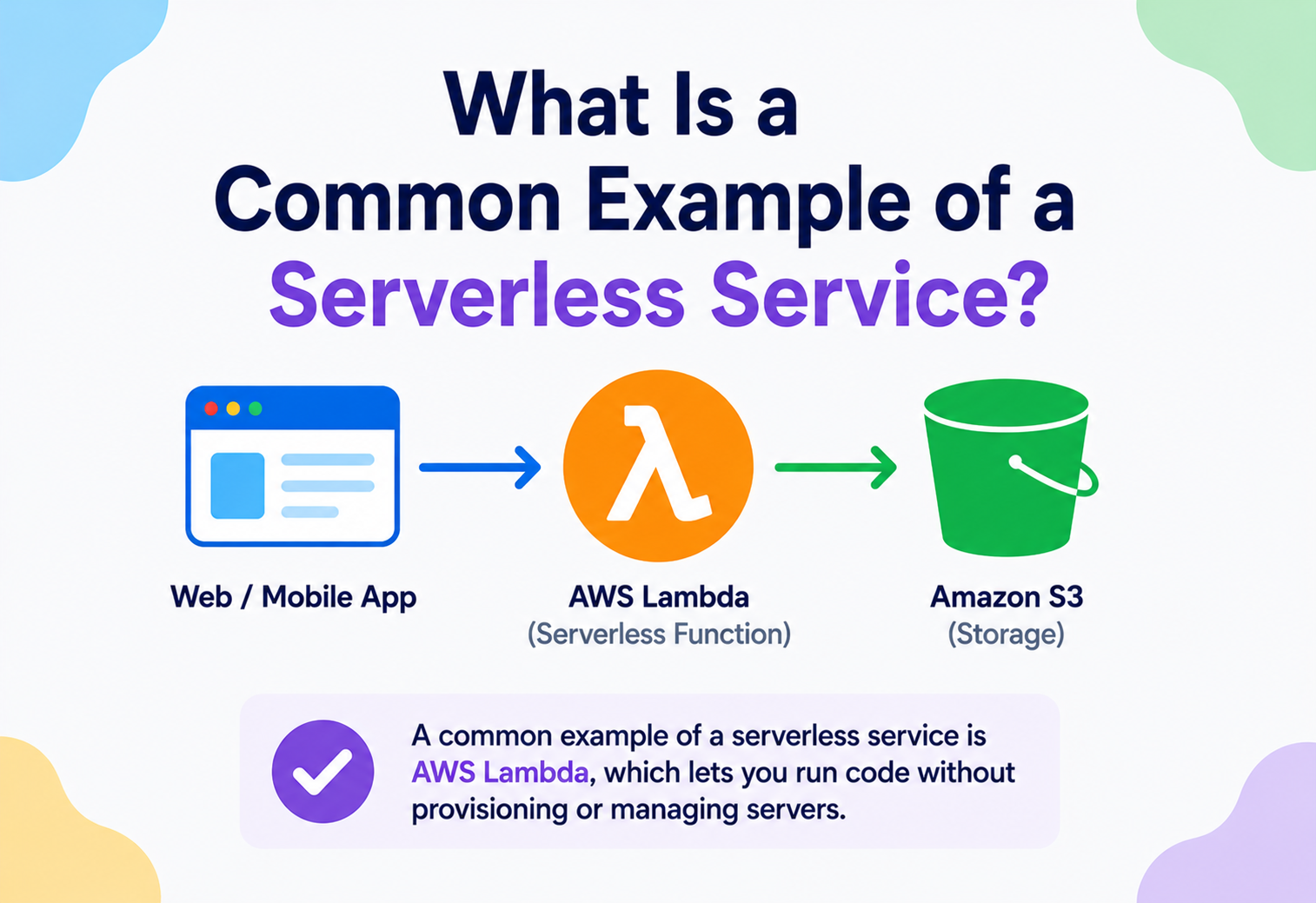
The short answer: AWS Lambda is the most common and widely recognised example of a serverless service, alongside siblings like Google Cloud Functions, Azure Functions, and platforms like AWS Fargate, Amazon DynamoDB, and Cloudflare Workers. But to really understand why these are called “serverless” — and why that word does not mean “no servers” — we need to walk through the whole story, from the days of racking physical machines in a data centre, to today’s world where your code can run within 50 milliseconds of being triggered, on infrastructure you will never see, own, or patch.
1.1 A brief history of “where code runs”
To appreciate serverless, it helps to see it as the latest stop on a fifty-year journey of abstraction. Each era removed one more layer of responsibility from the developer:
1960s–1990s — Physical / on-premise servers
Companies bought, racked, cabled, and cooled their own physical machines. Every capacity decision was a multi-month procurement cycle.
2000s — Virtual machines
Hypervisors like VMware and Xen let one physical machine pretend to be many. You still managed the OS, patches, and scaling, but hardware became a shared pool.
2006 — Amazon EC2 launches
Cloud computing made VMs rentable by the hour. You still had to configure the OS, install runtimes, and manage scaling groups yourself.
2013 — Docker popularises containers
Containers packaged an app with its dependencies, making it portable across machines — but you still ran and orchestrated the containers, often with Kubernetes from 2014 onward.
2014 — AWS Lambda launches
The watershed moment. For the first time, a mainstream cloud let you upload a function, define a trigger, and never think about a server, an OS, a scaling group, or a container runtime again.
2016 onward — The ecosystem matures
Azure Functions (2016), Google Cloud Functions (2017), and a wave of “serverless databases” (DynamoDB, Aurora Serverless), “serverless containers” (AWS Fargate), and “serverless edge compute” (Cloudflare Workers, 2017) all followed the same philosophy into new corners of the stack.
Think about how people get electricity at home. A hundred years ago, if you wanted power, you needed your own generator — you bought the fuel, maintained the engine, and hoped it did not break down at 2 a.m. Today, you just plug into the wall. You do not own a power plant; you do not know which turbine served your toaster this morning; you just pay for what you use. Serverless computing does the same thing for code execution: you stop owning “the generator” (the server) and simply plug your logic into the cloud’s socket.
1.2 Why the name is a little misleading
“Serverless” does not mean there are no servers. There absolutely are servers — thousands of them, humming away in AWS, Google, or Microsoft data centres. What is “serverless” is your relationship to those servers. You never provision one, never SSH into one, never patch its kernel, and never decide how many you need. The cloud provider does all of that behind an API, and you just supply code and configuration.
1.3 How the term spread beyond compute
Once developers experienced what it felt like to stop thinking about servers for their compute layer, the same “you manage nothing, we scale everything” philosophy started spreading into every other layer of the stack. Database vendors asked: why should a customer size a database instance in advance, when the provider could just watch actual read/write load and scale storage and throughput automatically? This is exactly how Amazon DynamoDB, and later Aurora Serverless, came to be described as serverless databases, even though the underlying compute model driving a database is quite different from a short-lived FaaS function. The same logic later extended to containers (AWS Fargate lets you run a container without ever choosing or managing the underlying EC2 instance) and even to messaging and streaming (Amazon SQS and Kinesis on-demand modes scale throughput automatically without capacity planning).
1.4 A quick timeline for reference
| Year | Milestone |
|---|---|
| 2006 | Amazon EC2 launches, kicking off the era of rentable, self-managed virtual servers |
| 2012 | Amazon DynamoDB launches as a fully managed, auto-scaling NoSQL database |
| 2014 | AWS Lambda launches at re:Invent, defining the modern Function-as-a-Service category |
| 2015 | Amazon API Gateway launches, giving Lambda functions a proper HTTP front door |
| 2016 | Azure Functions launches; the “serverless” label becomes an industry-wide category, not an AWS-only idea |
| 2017 | Google Cloud Functions and Cloudflare Workers launch, bringing FaaS to Google Cloud and to the network edge respectively |
| 2018 | AWS Fargate becomes generally available, extending the serverless model to containers |
| 2020s | SnapStart, Aurora Serverless v2, and edge-native runtimes push cold-start latency and cost efficiency further, making serverless viable for an ever-wider range of production workloads |
Why Waiting Servers Were Costing Fortunes
Serverless did not appear out of nowhere — it was a direct response to a set of very real, very expensive problems that every team running servers eventually hits.
2.1 Problem 1: idle capacity is wasted money
Imagine you run a food-delivery app. Traffic spikes hard at lunch and dinner, and is almost flat at 3 a.m. If you provision enough EC2 instances to handle your dinner rush, those same servers sit mostly idle for eighteen hours a day — and you are paying for all twenty-four.
It is like renting a 50-seat banquet hall every single day of the year, just because you host one big party a month. Most days, you are paying full rent for an empty room.
2.2 Problem 2: operational overhead steals engineering time
Running your own servers — even in the cloud — means someone has to patch operating systems, rotate SSH keys, configure auto-scaling groups, set up load balancers, and respond to 3 a.m. pages when a disk fills up. None of this delivers business value directly; it is the “tax” you pay just to keep the lights on.
2.3 Problem 3: scaling is hard to get right
Manually-configured auto-scaling groups react on a delay — they watch CPU metrics, then spin up new VMs, which themselves take 30–90 seconds to boot. If your traffic spike is sudden (a viral tweet, a flash sale), users hit errors before your fleet catches up.
2.4 Problem 4: undifferentiated heavy lifting
Amazon’s engineers use this exact phrase internally: “undifferentiated heavy lifting” describes all the plumbing work — server patching, capacity planning, network configuration — that every company has to do, but that provides zero competitive advantage. Serverless was built explicitly to let companies stop doing this work and instead focus 100% of their engineering time on the business logic that actually differentiates their product.
Startup resizes profile photos
Imagine a startup wants to resize user-uploaded profile photos. Before serverless, this meant: provision a server, install an image library, write a queue consumer, configure auto-scaling, monitor uptime — for a task that runs for 200 milliseconds per image. With AWS Lambda, the same startup writes a single function triggered by an S3 upload event. No server ever exists in their AWS console.
Netflix encoding pipelines
Netflix famously uses AWS Lambda extensively for encoding pipeline orchestration, backend automation, and event-driven media processing tasks. Instead of running a fleet of always-on servers to react to encoding-completion events, Netflix triggers Lambda functions only when an event (like a new video file landing in S3) actually occurs — paying for compute only during those bursts of activity.
The Vocabulary Behind Every Lambda Function
Before diving into architecture, let’s build a shared vocabulary. These terms show up constantly in serverless discussions, and each one deserves a plain-English explanation.
3.1 Serverless computing
What: A cloud execution model where the provider dynamically manages the allocation and provisioning of servers, and the customer is billed based on actual resource consumption, not pre-purchased capacity.
Why: It eliminates capacity planning and server management, letting teams ship code faster.
Where: Event-driven backends, APIs, data processing pipelines, chatbots, IoT backends, scheduled jobs.
3.2 FaaS — Function as a Service
FaaS is the most common flavour of serverless. You write a small, stateless function — a single-purpose piece of code — and the platform handles everything around running it: provisioning, scaling to zero or to thousands of instances, and tearing it down when idle.
A FaaS function is like a vending machine attendant who only appears the instant someone presses a button, does exactly one job (dispense the snack), and vanishes the moment they are done. You do not pay their salary while they are standing around idle — because they are never standing around idle.
Common examples: AWS Lambda, Google Cloud Functions, Azure Functions, Cloudflare Workers.
3.3 BaaS — Backend as a Service
BaaS provides fully managed backend building blocks — authentication, databases, file storage — that you consume via an SDK or API, without ever running server code yourself for that functionality. Firebase Authentication and Amazon Cognito are classic BaaS examples.
3.4 Cold start
What: The latency incurred the first time a serverless function is invoked after being idle, because the platform must allocate a new execution environment, load your code, and initialise the runtime before your handler can run.
Why it matters: A cold start can add anywhere from tens of milliseconds (lightweight runtimes) to several seconds (a large Java application with a heavy Spring context) to the first request’s latency.
People often think “serverless” means “always instantly fast.” In reality, cold starts are one of the central engineering challenges of serverless design, and much of production serverless architecture (see Chapter 8) exists specifically to manage them.
3.5 Event-driven execution
Serverless functions do not run continuously; they run in response to a trigger — an HTTP request, a new file in storage, a message on a queue, a database change, or a scheduled timer. This is fundamentally different from a traditional server that sits listening on a port 24/7.
3.6 Statelessness
Each invocation of a serverless function should be treated as independent — you cannot assume any data stored in memory from a previous invocation will still be there. State must live externally, in a database, cache, or object store.
3.7 Scale-to-zero
When nobody is calling your function, the platform runs precisely zero instances of it, and you are billed precisely nothing for compute. This is the single biggest financial difference between serverless and an always-on server or container.
3.8 Ephemeral compute
Serverless execution environments are short-lived and disposable. AWS Lambda, for instance, may reuse a “warm” environment for a few subsequent invocations, but it can be destroyed at any time, and you should never rely on local disk writes surviving beyond a single invocation’s lifecycle (with narrow exceptions like Lambda’s /tmp directory, which persists only within a warm container).
3.9 Warm start
What: The opposite of a cold start — an invocation that reuses an already-initialised execution environment, skipping the download-and-boot phase entirely.
Why it matters: Warm starts are typically one to two orders of magnitude faster than cold starts, which is why production systems often deliberately keep functions warm using scheduled “ping” invocations or Provisioned Concurrency.
A cold start is like arriving at a restaurant that has to first hire a chef, stock the kitchen, and preheat every oven before it can cook your order. A warm start is walking into that same restaurant an hour later, when the chef, ingredients, and hot ovens are all already in place — your order just gets cooked immediately.
3.10 Billing granularity
What: Serverless platforms typically bill in very fine-grained units — AWS Lambda bills per millisecond of execution time, multiplied by the amount of memory configured for the function.
Why: This is what makes the “pay only for what you use” promise concrete and measurable, rather than just a marketing phrase.
A function configured with 512 MB of memory that runs for exactly 120 milliseconds, 3 million times a month, can be costed precisely down to the fraction of a cent — a level of billing granularity that simply does not exist when you are paying a flat hourly rate for an EC2 instance regardless of how busy it is.
3.11 Vendor lock-in
What: The degree to which your application becomes dependent on a specific cloud provider’s proprietary APIs, event formats, and deployment tooling, making it costly to migrate elsewhere later.
Why it matters: Serverless platforms are convenient precisely because they integrate so deeply with a provider’s other managed services (S3, DynamoDB, SNS), but that same deep integration is what makes serverless architectures harder to port between clouds than, say, a portable Docker container.
3.12 Managed runtime vs. custom runtime
Most FaaS platforms ship official, managed runtimes for popular languages (Node.js, Python, Java, Go, .NET, Ruby). When a language is not natively supported, platforms like AWS Lambda also allow a custom runtime via a well-defined Runtime API, letting teams bring virtually any language or framework — including Rust or PHP — into the serverless model.
Anatomy of a Function-as-a-Service Platform
Let’s ground this in the most common example: AWS Lambda. Its architecture is representative of virtually every FaaS platform on the market.
4.1 Event sources
These are the triggers that cause a function to run: API Gateway (HTTP requests), S3 (file uploads), DynamoDB Streams (data changes), SQS (queue messages), EventBridge (scheduled cron jobs or custom events), and many more.
4.2 The control plane
This is the invisible orchestration layer that receives the trigger, decides which execution environment should handle it, and manages the function’s lifecycle. You never interact with this directly — it is entirely managed by the cloud provider.
4.3 Execution environment (micro-VMs)
AWS Lambda runs each function inside a lightweight virtual machine technology called Firecracker, purpose-built by AWS for fast-starting, secure, minimal-overhead virtualisation. Each Firecracker micro-VM boots in milliseconds and provides strong isolation between customers’ functions, even though thousands of functions from different companies may run on the same physical host.
4.4 The function package
Your code, dependencies, and a handler entry point, packaged as a ZIP file or container image. For Java, this often means a “fat JAR” containing your compiled classes and all dependencies.
4.5 Runtime
The language-specific execution engine (Node.js, Python, Java, Go, .NET, custom runtimes via the Lambda Runtime API) that loads your code and invokes your handler with the incoming event.
4.6 Concurrency model
Each simultaneous invocation of your function gets its own isolated execution environment. If 500 requests arrive at once, the platform can spin up (subject to account concurrency limits) up to 500 parallel environments — no code you wrote had to configure that scaling behaviour.
4.7 Why Firecracker matters
Before Firecracker, AWS ran Lambda functions inside full EC2 virtual machines dedicated per customer for isolation, which was secure but slow to start and wasteful of hardware, since a whole VM’s worth of resources was reserved even for a function that runs for 50 milliseconds. Firecracker was purpose-built to solve this: it strips a virtual machine down to only the minimal set of virtualised devices a function actually needs, allowing a micro-VM to boot in around 125 milliseconds while still providing the same hardware-level isolation boundary as a full VM — much stronger isolation than a plain Linux container alone would offer. This is a big part of why AWS can safely run functions from thousands of different, mutually-untrusting customers on the same physical servers.
Think of a shared commercial kitchen. A full dedicated VM is like each chef getting an entire separate building with their own utilities — extremely safe, but slow and expensive to set up per order. A Firecracker micro-VM is like each chef getting their own fully separate, lockable stall within one shared building — still completely walled off from every other chef, but ready to start cooking in seconds instead of hours.
4.8 Layers and extensions
Two additional architectural building blocks are common in real Lambda deployments. Layers let you package shared code or dependencies (like a common logging library or the AWS SDK) separately from your function code, so multiple functions can reference the same layer without duplicating it in every deployment package. Extensions let you attach third-party tooling — most commonly observability agents from vendors like Datadog or New Relic — that runs alongside your function’s execution environment, collecting telemetry without you having to instrument every line of business logic by hand.
| Component | Role | Analogy |
|---|---|---|
| Event Source | Triggers invocation | Doorbell being pressed |
| Control Plane | Routes and schedules execution | Building receptionist |
| Execution Environment | Isolated sandbox running your code | A single hotel room prepared for a guest |
| Function Package | Your code + dependencies | The guest’s luggage |
| Runtime | Language engine executing your handler | The hotel staff who show the guest around |
Step by Step, From HTTP Request to Handler
Let’s trace exactly what happens, step by step, when an HTTP request hits a Lambda function behind API Gateway.
- Request arrives at API Gateway, which validates the request against your defined route and authoriser.
- API Gateway invokes Lambda synchronously via the Lambda Invoke API, passing the HTTP request as a JSON event payload.
- The Lambda control plane checks whether a “warm” execution environment already exists for this function (and this specific code version) with capacity to handle another invocation.
- If warm: the request is routed directly to that environment, and your handler runs in single-digit milliseconds.
- If cold: AWS provisions a new Firecracker micro-VM, downloads your deployment package, initialises the runtime (starts the JVM for Java, for example), runs any static initialiser code outside your handler, and only then invokes your handler. This entire sequence is the “cold start.”
- Your handler executes, typically reading from or writing to a database, calling another API, or performing a computation.
- The response is returned to API Gateway, which forwards it to the client.
- The environment is frozen, not destroyed — AWS keeps it “warm” for a period (commonly 5–15+ minutes of inactivity, though this is an implementation detail that can change) so the next invocation can skip step 5’s expensive setup.
5.1 A minimal Java Lambda handler
// A simple AWS Lambda handler written in Java
public class ImageResizeHandler implements RequestHandler<S3Event, String> {

    // Anything here runs ONCE per cold start, not per invocation
    private final S3Client s3Client = S3Client.builder().build();

    @Override
    public String handleRequest(S3Event event, Context context) {
        String bucket = event.getRecords().get(0).getS3().getBucket().getName();
        String key = event.getRecords().get(0).getS3().getObject().getKey();

        context.getLogger().log("Processing upload: " + bucket + "/" + key);

        // Business logic: resize the image, then write it back to S3
        byte[] resized = ImageResizer.resizeTo(bucket, key, 300, 300);
        s3Client.putObject(
            PutObjectRequest.builder()
                .bucket(bucket)
                .key("thumbnails/" + key)
                .build(),
            RequestBody.fromBytes(resized)
        );

        return "Resized " + key;
    }
}
Notice the client (S3Client) is created as a field, outside the handler method. This is a critical serverless pattern: expensive objects like SDK clients or database connections should be initialised during the “cold” phase and reused across “warm” invocations, not recreated every single call.
5.2 Spring Boot on Lambda
Many teams want to reuse existing Spring Boot applications inside Lambda rather than rewriting them as bare handlers. AWS provides the aws-serverless-java-container library for exactly this:
@SpringBootApplication
public class OrderServiceApplication {
    public static void main(String[] args) {
        SpringApplication.run(OrderServiceApplication.class, args);
    }
}

// The Lambda entry point that adapts API Gateway events to Spring MVC
public class StreamLambdaHandler implements RequestStreamHandler {

    private static final SpringBootLambdaContainerHandler<AwsProxyRequest, AwsProxyResponse> handler;

    static {
        try {
            handler = SpringBootLambdaContainerHandler.getAwsProxyHandler(OrderServiceApplication.class);
        } catch (ContainerInitializationException e) {
            throw new RuntimeException("Could not initialise Spring Boot application", e);
        }
    }

    @Override
    public void handleRequest(InputStream inputStream, OutputStream outputStream, Context context)
            throws IOException {
        handler.proxyStream(inputStream, outputStream, context);
    }
}Spring Boot’s dependency-injection container is heavy to initialise — this is one of the most common causes of multi-second cold starts in Java Lambdas. Teams running latency-sensitive Spring Boot functions frequently adopt Provisioned Concurrency (Chapter 8) or migrate to lighter frameworks like Micronaut or Quarkus, which are designed for fast serverless startup.
How Events Cascade Across a Serverless System
Let’s walk through a realistic end-to-end lifecycle: a user uploads a receipt photo to an expense-tracking app, and the app should extract the total amount using OCR and save it to the database.
6.1 Step-by-step breakdown
- Ingress: The client uploads via a REST call; API Gateway performs request validation and authentication before Lambda ever runs.
- Synchronous handoff: The first Lambda function stores the raw file in S3 and returns a
202 Acceptedimmediately — it does not wait for OCR to finish, keeping the user-facing latency low. - Asynchronous trigger: S3’s event notification system invokes a second, independent Lambda function purely because a new object appeared — no polling, no queue consumer process running 24/7.
- Processing: The second function performs the actual OCR work, which might take 2–3 seconds — an acceptable duration for background work, but too slow for a synchronous HTTP response.
- Persistence: Results are written to DynamoDB, a serverless NoSQL database (Chapter 13) that scales automatically alongside the Lambda functions calling it.
- Fan-out notification: An event is published to SNS, which can fan out to multiple downstream subscribers (push notifications, analytics, audit logging) without the OCR function needing to know who is listening.
Every step in this flow is independently scalable, independently billed, and — crucially — nothing is running when there is no receipt to process. This is the essence of an event-driven, serverless data flow.
6.2 Synchronous vs. asynchronous invocation semantics
It is worth being explicit about a distinction that trips up many newcomers. A synchronous invocation (like the first Lambda in the flow above, called through API Gateway) means the caller waits for the function to finish and return a response — errors must be handled by the caller directly, and there is no automatic built-in retry. An asynchronous invocation (like the S3-triggered OCR function) means the event source hands off the event and moves on immediately; the platform itself takes responsibility for retrying failed invocations behind the scenes, and any response the function returns has nowhere to go, since the original caller already left. Choosing the right invocation model for each step in a workflow — and understanding who is responsible for retries in each case — is one of the more subtle but important design decisions in serverless architecture.
Where Serverless Shines, and Where It Bites
Serverless is neither a silver bullet nor a fad. Its advantages are real; its trade-offs are equally real. Knowing both is how you avoid the two most common failure modes: dismissing it out of hand, or over-adopting it for a workload it was never designed for.
7.1 Advantages & disadvantages
Advantages
- No server management — patching, scaling, and provisioning are entirely handled by the provider.
- Pay-per-use billing — you are billed in sub-second increments only for actual execution time, not idle capacity.
- Automatic, near-instant scaling — from zero to thousands of concurrent executions without any manual configuration.
- Faster time to market — developers focus purely on business logic instead of infrastructure.
- Built-in high availability — the platform spreads execution across multiple availability zones by default.
Disadvantages & challenges
- Cold starts — unpredictable latency spikes for infrequently-invoked functions.
- Vendor lock-in — event formats, IAM models, and deployment tooling are provider-specific, making migration costly.
- Execution time limits — AWS Lambda caps a single invocation at 15 minutes; long-running batch jobs need a different tool.
- Harder local debugging — the event-driven, distributed nature makes end-to-end local testing more complex than a monolith.
- Cost unpredictability at extreme scale — at very high, sustained request volumes, always-on containers or VMs can actually become cheaper than per-invocation billing.
7.2 When to choose serverless vs. alternatives
| Scenario | Good fit? | Why |
|---|---|---|
| Spiky, unpredictable traffic (e.g., webhook processing) | Excellent | Scale-to-zero avoids paying for idle capacity between spikes |
| Steady, high, predictable throughput (e.g., core payment API at massive scale) | Often poor | Reserved / always-on compute is usually cheaper per-request at sustained high volume |
| Short-lived event reactions (image resize, file validation) | Excellent | Textbook FaaS use case |
| Long-running batch jobs (> 15 minutes) | Poor | Exceeds Lambda’s execution time limit; use AWS Batch or Step Functions instead |
| Latency-critical, sub-10ms response requirements | Requires care | Cold starts and network hops can violate tight SLAs unless mitigated (Chapter 8) |
7.3 Understanding the cost model in depth
AWS Lambda pricing has two components: a charge per number of requests, and a charge based on GB-seconds — the amount of memory configured, multiplied by execution duration. This creates a non-obvious trade-off: allocating more memory to a function also proportionally increases its CPU allocation, which can make the function run faster. Up to a point, paying for more memory can actually make a function cheaper overall, because the reduced duration more than offsets the higher per-millisecond rate.
Teams running latency- or cost-sensitive functions in production commonly use AWS Lambda Power Tuning, an open-source tool that benchmarks a function across multiple memory settings and recommends the configuration with the best cost-to-performance ratio, rather than guessing.
7.4 The crossover point: serverless vs. always-on
A useful mental model: at low and moderate, spiky request volumes, serverless is almost always cheaper because you pay nothing during idle periods. As sustained request volume climbs into the range of a constantly busy always-on server, the per-invocation premium of serverless compute can exceed the flat cost of a reserved EC2 instance or container doing the same aggregate work. Mature organisations often run a hybrid: serverless for bursty, event-driven paths, and containers or VMs for steady-state, high-throughput core services.
Scaling Per-Request, and Managing Cold Starts
Serverless platforms do not scale the way traditional auto-scaling groups scale. Understanding how they actually scale — and how cold starts fit into that picture — is what separates production-ready serverless designs from “why is my p99 latency terrible?”
8.1 How scaling actually works
Unlike a Kubernetes Horizontal Pod Autoscaler, which reacts to metrics over a polling interval, Lambda scales per-request. Each concurrent invocation is dispatched to its own execution environment, up to your account’s concurrency limit (a soft limit, raisable via support request, commonly starting around 1,000 concurrent executions per region).
8.2 Mitigating cold starts
- Provisioned Concurrency: You pre-pay to keep a fixed number of execution environments permanently warm, eliminating cold starts for that baseline capacity entirely.
- Smaller deployment packages: Trimming unused dependencies reduces the time needed to download and initialise your code.
- Lighter runtimes: Choosing Node.js, Python, or Go over Java / .NET for latency-sensitive paths, since JVM / CLR startup is inherently heavier.
- SnapStart (Java-specific): AWS Lambda SnapStart takes a snapshot of an initialised JVM’s memory and disk state, then resumes from that snapshot on future cold starts instead of re-running full JVM and Spring initialisation — often cutting Java cold starts from seconds to under 200 ms.
8.3 Concurrency vs. throughput
Think of concurrency as the number of toll booths open on a highway at once. If traffic (requests) arrives faster than booths can open, cars queue (requests throttle). Serverless platforms open new booths almost instantly compared to traditional auto-scaling, but they are not infinite — there is a maximum number of booths your account is allowed to open at once.
8.4 Throttling
When concurrent invocations exceed your configured or account limit, additional requests receive a throttling error (HTTP 429-equivalent). Production systems typically pair this with retry logic, dead-letter queues, and reserved concurrency settings on critical functions to prevent one noisy function from starving others.
Multi-AZ, Retries, and Idempotency by Default
The platform hands you a lot of reliability for free — but only if your code plays by the rules it expects, especially around at-least-once delivery and idempotency.
9.1 Multi-AZ by default
Serverless platforms distribute function execution environments across multiple Availability Zones within a region automatically — you get multi-AZ resilience without configuring a single load balancer or subnet.
9.2 Retries and idempotency
Asynchronous invocations (like S3 or SNS triggers) are automatically retried by the platform on failure — commonly twice more after the initial attempt. This means your function must be idempotent: processing the same event twice should not corrupt data or create duplicate side effects.
// Idempotent handler pattern using a request ID check
public String handleRequest(OrderEvent event, Context context) {
    String requestId = event.getRequestId();

    // Skip if we've already processed this exact event
    if (processedRequestsTable.exists(requestId)) {
        context.getLogger().log("Duplicate event ignored: " + requestId);
        return "SKIPPED";
    }

    processOrder(event);
    processedRequestsTable.markProcessed(requestId);
    return "OK";
}
9.3 Dead-letter queues (DLQs)
When a function fails repeatedly, configuring a DLQ (an SQS queue or SNS topic) ensures the failed event is not silently dropped — it is captured for later inspection or replay, which is essential for production reliability.
9.4 Consensus and failure recovery in serverless data stores
Serverless databases like DynamoDB achieve durability and availability using replication across multiple storage nodes and a consensus protocol under the hood, so that a single node failure never loses committed writes. As an application developer using DynamoDB, you never configure this replication yourself — it is part of what makes the data store “serverless”: the CAP-theorem trade-offs and replication topology are managed entirely by the provider.
Least-Privilege IAM Is the Whole Ballgame
Serverless changes what you have to secure — not whether you have to secure it. The attack surface shrinks (no OS to patch, no long-lived server for an attacker to camp on), but IAM roles, dependencies, and configuration become the place breaches originate.
10.1 The principle of least privilege via IAM roles
Every Lambda function runs with an attached IAM execution role that defines exactly which AWS resources it may touch. A well-designed serverless system gives each function the absolute minimum permissions it needs — for example, a function that only reads from one specific S3 bucket should not have blanket s3:* access.
{
  "Version": "2012-10-17",
  "Statement": [
    {
      "Effect": "Allow",
      "Action": ["s3:GetObject"],
      "Resource": "arn:aws:s3:::receipts-bucket/uploads/*"
    },
    {
      "Effect": "Allow",
      "Action": ["dynamodb:PutItem"],
      "Resource": "arn:aws:dynamodb:us-east-1:123456789012:table/Receipts"
    }
  ]
}
10.2 Securing the perimeter
- API Gateway authorisers: validate JWTs or call a custom Lambda authoriser before a request ever reaches your business-logic function.
- Environment variable encryption: secrets like database passwords should be stored in AWS Secrets Manager or Parameter Store, not as plaintext environment variables.
- VPC integration: functions that must reach private resources (like an RDS database in a private subnet) can be attached to a VPC, trading a small cold-start penalty for network isolation.
10.3 Shared responsibility model
The cloud provider secures the underlying host, hypervisor / micro-VM isolation, and physical infrastructure. You remain responsible for your code’s logic, your IAM policies, your dependencies (a vulnerable npm or Maven package is still your problem), and your data.
Giving a Lambda function’s execution role the AWS-managed AdministratorAccess policy “just to get it working” during development, then forgetting to scope it down before production. This single misconfiguration is one of the most common root causes of serverless security incidents.
10.4 Dependency and supply-chain security
Because a Lambda deployment package bundles all of a function’s dependencies directly into it, a vulnerable third-party library becomes part of your function’s attack surface the moment you deploy. Production teams typically integrate dependency scanning (like AWS Inspector for Lambda, or Snyk / Dependabot in CI) directly into their deployment pipeline, so a newly disclosed vulnerability in a Maven or npm package is caught before it ships, not after.
10.5 Compliance considerations
Serverless does not remove compliance obligations — it shifts where the work happens. Regulated industries (finance, healthcare) still need to demonstrate encryption at rest and in transit, audit logging of who changed what configuration, and data residency guarantees. The advantage is that much of this — encryption, patching, physical security — is inherited “for free” from the provider’s own compliance certifications (SOC 2, PCI DSS, HIPAA-eligible services), rather than something your team has to independently prove for every server it runs.
Observability Without a Server to SSH Into
The classic debugging move — SSH in and tail a log file — simply does not exist in serverless. What replaces it is a set of platform-native observability primitives you must learn to read fluently.
11.1 Built-in observability
Every Lambda invocation automatically emits logs to Amazon CloudWatch Logs and metrics (invocation count, duration, error count, throttle count) to CloudWatch Metrics — with zero setup required, unlike a self-managed server where you would install and configure a logging agent yourself.
11.2 Distributed tracing
Because a single user request might traverse API Gateway → Lambda → DynamoDB → SNS → another Lambda, tracing a request across all those hops is essential. AWS X-Ray attaches a trace ID that follows the request through every serverless component, letting engineers visualise exactly where latency accumulated.
// Adding a custom X-Ray subsegment around an expensive operation
Subsegment subsegment = AWSXRay.beginSubsegment("OCR-Processing");
try {
    String extractedText = ocrEngine.extract(imageBytes);
    subsegment.putAnnotation("charactersExtracted", extractedText.length());
} catch (Exception e) {
    subsegment.addException(e);
    throw e;
} finally {
    AWSXRay.endSubsegment();
}
11.3 Key metrics to watch in production
| Metric | Why it matters |
|---|---|
| Invocation duration (p50 / p95 / p99) | Reveals cold-start impact and slow downstream dependencies |
| Error rate | Direct signal of code or dependency failures |
| Throttle count | Indicates concurrency limits are being hit |
| Concurrent executions | Tracks real-time load and headroom against account limits |
| Cold start count / init duration | Specifically isolates cold-start-driven latency from warm-path latency |
11.4 Alerting and on-call practices
Even though there is no server to page an engineer about, serverless systems still need proactive alerting. Common production alarms include: error rate exceeding a threshold over a rolling window, p99 duration approaching the configured timeout (a leading indicator of imminent timeouts under slightly higher load), and sustained throttling, which signals a concurrency limit needs to be raised or a downstream dependency is the real bottleneck. Because a single business transaction can span many small functions, teams increasingly build service-level dashboards around a business outcome (like “checkout success rate”) rather than per-function metrics alone, since a healthy-looking individual function can still sit inside a broken end-to-end flow.
Infrastructure as Code Is the Only Way
A serverless application is a small pile of code and a much larger pile of configuration — triggers, permissions, routes, aliases. Manually clicking through a console does not survive contact with a real team; every mature serverless deployment is defined as versioned code.
12.1 Infrastructure as code
Production serverless systems are almost never deployed by clicking through a console. Tools like AWS SAM, the Serverless Framework, Terraform, and AWS CDK let teams define functions, triggers, and permissions as versioned code.
# AWS SAM template.yaml -- defines a Lambda function and its API trigger
Resources:
  ReceiptUploadFunction:
    Type: AWS::Serverless::Function
    Properties:
      Handler: com.utivra.UploadHandler::handleRequest
      Runtime: java17
      MemorySize: 512
      Timeout: 10
      Events:
        UploadApi:
          Type: Api
          Properties:
            Path: /upload
            Method: post
12.2 CI/CD for serverless
A typical pipeline builds the deployment package, runs unit and integration tests against local emulators (like LocalStack or SAM Local), then deploys via canary or linear traffic-shifting — Lambda supports weighted aliases so a new version can receive, say, 10% of traffic before a full rollout, with automatic rollback on elevated error rates.
12.3 Observability of the deployment itself
Beyond runtime monitoring (Chapter 11), production teams also track deployment-level health: rollback rate, time-to-deploy, and the percentage of deployments using automated canary analysis versus a full immediate rollout. A mature serverless pipeline treats a bad deploy the same way it treats a bad code change at runtime — something to be detected automatically, via error-rate and latency alarms tied directly to the new version’s traffic-shifted alias, and rolled back within minutes without a human needing to notice first.
12.4 Multi-cloud landscape
| Provider | Common serverless example |
|---|---|
| Amazon Web Services | AWS Lambda |
| Google Cloud | Cloud Functions / Cloud Run |
| Microsoft Azure | Azure Functions |
| Cloudflare | Cloudflare Workers (edge-based) |
Serverless Databases, Connection Pools, and Caches
Compute is only half the picture. The data layer a serverless function talks to can either amplify the benefits of scale-to-zero or actively fight against them — the connection-pooling story is the most infamous example.
13.1 Serverless databases
Amazon DynamoDB is itself one of the most common examples of a serverless service outside of FaaS — you never provision a “database server”; you define a table, and DynamoDB automatically scales storage and throughput. Aurora Serverless extends this idea to relational databases, automatically starting, stopping, and scaling capacity based on actual load.
13.2 The connection pooling problem
Traditional relational databases (like PostgreSQL) maintain a limited number of connections. A Lambda function scaling to a thousand concurrent invocations could open a thousand simultaneous database connections, exhausting the database instantly.
This is one of the most notorious serverless-database pitfalls. The standard fix is Amazon RDS Proxy, which pools and multiplexes connections between many Lambda invocations and a smaller number of actual backend database connections.
13.3 Caching in serverless architectures
Because execution environments are ephemeral, an in-process cache (like a simple Java HashMap) only helps on “warm” invocations reusing the same environment — it disappears entirely on cold starts. Production systems typically use an external cache like Amazon ElastiCache (Redis) shared across all function instances.
13.4 Load balancing
You do not configure a traditional load balancer for Lambda itself — the platform inherently load-balances by creating parallel execution environments. However, API Gateway or an Application Load Balancer often sits in front as the entry point, handling routing, TLS termination, and request validation before Lambda is invoked.
13.5 Choosing between DynamoDB and a serverless relational database
A common architectural decision point in serverless projects is DynamoDB versus Aurora Serverless. DynamoDB favours applications with simple, well-known access patterns and a need for near-limitless horizontal scale with single-digit-millisecond latency — think session storage, IoT telemetry, or shopping-cart data. Aurora Serverless favours applications that genuinely need relational features — multi-table joins, complex transactions spanning several entities, or an existing schema migrated from a traditional relational system — while still wanting the database itself to scale automatically rather than being manually sized in advance.
DynamoDB is like a wall of labelled lockers — extremely fast if you know exactly which locker (key) you want, but it does not naturally answer questions like “show me every locker whose contents were placed there by Sarah last Tuesday.” A relational database is built precisely for those cross-cutting questions, at the cost of being harder to scale infinitely across many machines.
Small Functions, Talking Through Small Contracts
Serverless is not just a compute model — it is one of the cleanest realisations of microservices ever built. Each function is independently deployable, independently scalable, and communicates with its neighbours through well-defined asynchronous contracts rather than tight function calls.
14.1 Serverless as a microservices enabler
Serverless functions map naturally onto the microservices philosophy: each function ideally does one thing, is independently deployable, and is independently scalable. A single Lambda function is often the smallest possible unit of a microservice.
14.2 API Gateway patterns
Amazon API Gateway (or Azure API Management, Google API Gateway) is almost always the front door to a serverless API layer, handling request validation, throttling, API key management, and routing individual paths to individual functions.
// A REST controller-style Lambda handling multiple routes via API Gateway proxy integration
public APIGatewayProxyResponseEvent handleRequest(APIGatewayProxyRequestEvent request, Context context) {
    String path = request.getPath();
    String method = request.getHttpMethod();

    if (path.equals("/orders") && method.equals("GET")) {
        return respond(200, orderService.listOrders());
    } else if (path.equals("/orders") && method.equals("POST")) {
        Order created = orderService.create(request.getBody());
        return respond(201, created);
    }
    return respond(404, "Not Found");
}
14.3 Inter-function communication
Functions communicate asynchronously through SNS (fan-out), SQS (buffered queues), EventBridge (event routing), or Step Functions (explicit orchestration of multi-step workflows) — rarely by calling one another synchronously, which would reintroduce tight coupling and cascading failure risk.
14.4 Orchestration with Step Functions
For workflows spanning multiple functions with branching, retries, and long waits (e.g., an order fulfilment process spanning payment, inventory, and shipping), AWS Step Functions provides a state-machine layer that coordinates individual Lambda functions without any one function needing to know about the others.
Patterns Worth Copying and Anti-Patterns Worth Fearing
Every serverless failure story is basically the same handful of anti-patterns repeated across different companies. Learning the patterns that hold up — and the ones that reliably blow up — is the shortest path to production-worthy serverless design.
15.1 Good patterns
- Single Responsibility Function: each function does exactly one job, making it easier to test, deploy, and scale independently.
- Fan-Out / Fan-In: one event triggers many parallel functions (fan-out), whose results are later aggregated (fan-in) — commonly implemented with SNS plus Step Functions.
- Strangler Fig Migration: incrementally route specific routes from a legacy monolith to new serverless functions, gradually “strangling” the old system without a risky big-bang rewrite.
- Saga Pattern for Distributed Transactions: chain a sequence of functions with compensating actions to undo prior steps if a later step fails, since serverless workflows cannot rely on a traditional ACID database transaction spanning multiple services.
15.2 Anti-patterns to avoid
- The Monolithic Lambda: cramming an entire application’s routing logic into one giant function defeats independent scaling and deployment — effectively rebuilding a monolith inside a single function.
- Synchronous Function Chains: Function A calling Function B calling Function C synchronously multiplies latency, cold-start risk, and cost with every hop, and creates tight coupling that async messaging was meant to avoid.
- Ignoring Idempotency: assuming a function will only ever be invoked once per event, when the platform’s at-least-once delivery guarantee means it can be invoked more than once.
- Storing State in Memory: relying on in-process variables to persist data between invocations, which silently breaks the moment a cold start or scale-out occurs.
- Recursive Invocation Loops: a function that writes to the same S3 bucket or SNS topic that triggers it can accidentally invoke itself infinitely, a mistake that has caused real, expensive production incidents.
Patterns worth adopting
- Single-responsibility functions with narrow, explicit contracts.
- Fan-out / fan-in via SNS + Step Functions for parallel work.
- Strangler-fig migration off a legacy monolith, one route at a time.
- Saga pattern with compensating actions for cross-service consistency.
Anti-patterns worth naming
- The monolithic Lambda handling every route in one function.
- Synchronous chains of A → B → C multiplying every failure mode.
- Ignoring idempotency and assuming exactly-once delivery.
- Storing session or business state in process memory.
- Recursive invocation loops (function writes to the thing that triggers it).
15.3 Testing serverless systems
Because a serverless application is inherently distributed across many small, independently deployed functions and managed services, testing strategy has to adapt:
- Unit tests should isolate the handler’s business logic from the AWS SDK calls entirely, using dependency injection and mocking, so tests run in milliseconds without needing real cloud resources.
- Local emulation tools like AWS SAM Local or LocalStack spin up a locally simulated version of Lambda, API Gateway, and DynamoDB, letting developers iterate without deploying to the cloud for every change.
- Integration tests deployed to an actual (isolated, non-production) AWS account remain essential, since local emulators can never perfectly replicate IAM permission edge cases, cold-start behaviour, or the exact semantics of managed-service event payloads.
- Contract tests between functions that communicate asynchronously (e.g., verifying the JSON shape a producer function publishes matches what a consumer function expects) catch a whole category of bugs that only manifest at runtime in a loosely-coupled, event-driven system.
The Habits That Keep Serverless Systems Healthy
A short, portable checklist for keeping your serverless functions fast, cheap, secure, and boring — and the recurring mistakes that quietly produce most of the horror stories.
16.1 Best practices
- Keep deployment packages small and dependencies minimal to reduce cold-start time.
- Initialise SDK clients and expensive objects outside the handler function, not inside it.
- Design every function to be idempotent, assuming at-least-once delivery.
- Set explicit, conservative timeout values rather than relying on defaults — a stuck function billed at the max timeout every time is a silent cost leak.
- Use structured JSON logging so CloudWatch Logs Insights queries can filter and aggregate efficiently.
- Apply least-privilege IAM roles per function rather than one shared broad role for an entire application.
- Use Infrastructure as Code for every deployment — no manual console changes in production.
16.2 Common mistakes
- Treating Lambda’s
/tmpdirectory as permanent storage — it is only guaranteed to persist within a single warm environment’s lifetime, not across cold starts. - Forgetting connection pooling for relational databases, leading to connection exhaustion under load.
- Over-provisioning memory “just in case,” which directly increases cost since Lambda bills based on memory allocated × duration.
- Under-provisioning memory, which indirectly slows down CPU-bound work, since Lambda allocates CPU proportionally to configured memory.
- Not setting up a Dead-Letter Queue, causing failed asynchronous events to vanish silently.
Every serverless best practice above collapses into one habit: assume nothing about the environment between invocations, and make every function stateless, idempotent, narrowly permissioned, and observable. If a change to your function would still be correct after a cold start, after a duplicate delivery, and after a scale-out event happening mid-request, you are on the right side of the model.
How Netflix, Coca-Cola, iRobot, and Capital One Actually Use It
Abstract principles are useful, but concrete production case studies are what make them stick. Every example below shares one signature: event-driven, variable-volume traffic where paying for constant capacity would be pure waste.
17.1 Netflix
Beyond media-processing pipelines, Netflix has spoken publicly about using AWS Lambda for backend automation tasks and operational tooling, valuing the ability to run small, event-triggered pieces of logic without maintaining dedicated always-on infrastructure for each one.
17.2 Coca-Cola
Coca-Cola’s vending machine and loyalty-program backend has used AWS Lambda together with API Gateway and DynamoDB to build a serverless architecture that handles the highly variable, event-driven traffic pattern of customers scanning QR codes on vending machines — a workload that is naturally spiky rather than constant.
17.3 iRobot
iRobot, maker of the Roomba, has used AWS serverless services (including Lambda, IoT Core, and DynamoDB) to process telemetry data streaming in from millions of connected vacuum robots, where the event-driven, auto-scaling nature of serverless matches the unpredictable, device-triggered nature of IoT traffic well.
17.4 Financial services: Capital One
Capital One has publicly discussed migrating significant portions of its infrastructure toward serverless and managed services, including using AWS Lambda for real-time transaction processing and fraud-alerting pipelines. The appeal in a regulated financial environment is twofold: automatic scaling during peak shopping periods like Black Friday, and a smaller operational surface area to secure and audit, since there are no long-lived servers accumulating configuration drift over time.
17.5 A common pattern across these examples
In every one of these cases, the underlying workload shares a signature: event-driven, variable-volume traffic where paying for constant capacity would be wasteful. This is precisely the shape of problem serverless computing — and AWS Lambda as its most common example — was designed to solve.
Netflix
Encoding pipeline orchestration and operational automation, triggered by S3 events rather than a fleet of polling servers.
Coca-Cola
Vending-machine loyalty backend absorbing spiky QR-scan traffic without pre-provisioning constant capacity.
iRobot
Telemetry ingestion from millions of connected robots, where traffic shape follows device activity rather than a business schedule.
Capital One
Real-time transaction and fraud pipelines — automatic scale, smaller operational surface, less drift to audit.
The Portable Answers, In One Place
Fast, opinionated answers to the questions that come up first when teams are just starting to internalise what “serverless” means — followed by a compact summary and the ideas worth carrying away into every design conversation.
AWS Lambda is overwhelmingly the most cited and most widely adopted example, having effectively defined the FaaS category since 2014. Its direct equivalents — Google Cloud Functions and Azure Functions — are the next most common examples.
Yes. Serverless is not limited to compute — DynamoDB is a widely cited example of a serverless database, since you never provision or patch a database server; you simply define a table and it scales automatically.
No. Servers absolutely exist — you simply never provision, patch, or manage them directly. The term describes your operational relationship to the infrastructure, not its physical absence.
For workloads with steady, high, predictable throughput, for jobs exceeding 15 minutes of runtime, or for extremely latency-sensitive paths where even a mitigated cold start is unacceptable, container- or VM-based architectures are often a better fit.
Containers (via Docker / Kubernetes) still require you to manage scaling policies, cluster capacity, and often the underlying nodes, even if the app itself is portable. Serverless removes that management layer entirely, at the cost of less control over the execution environment.
Not reliably across invocations by default, since environments are ephemeral and can be recycled at any time. In practice, teams either use a connection-pooling proxy like RDS Proxy, or choose a database designed for high-concurrency serverless access patterns, like DynamoDB or Aurora Serverless with its Data API.
Standard Kubernetes is not serverless — you still provision and manage the underlying worker nodes. However, some managed offerings, like AWS Fargate for EKS or Google Cloud Run, apply serverless principles on top of container orchestration, removing node management while keeping the container packaging model.
AWS Lambda enforces a hard maximum of 15 minutes per invocation. Workloads that genuinely need to run longer should use a different compute model, such as AWS Fargate, AWS Batch, or Step Functions orchestrating multiple shorter Lambda invocations in sequence.
Summary
Serverless computing is a cloud execution model where the provider handles all server provisioning, scaling, and management, billing you only for actual usage. Its most common and defining example is AWS Lambda, a Function-as-a-Service platform that runs your code in response to events — HTTP requests, file uploads, queue messages, or scheduled timers — inside lightweight, isolated Firecracker micro-VMs that scale from zero to thousands of parallel executions automatically. Other common examples span the same philosophy into new domains: Google Cloud Functions and Azure Functions in compute, Amazon DynamoDB and Aurora Serverless in databases, AWS Fargate in containers, and Cloudflare Workers at the network edge.
The word “serverless” describes an operational model, not the literal absence of physical machines. Servers are still there — you just never own, size, patch, or scale them yourself. That single shift changes almost everything about how a system is designed: functions must be stateless and idempotent, cost is measured in milliseconds and megabytes rather than months and machines, and the entire architecture becomes explicitly event-driven from end to end.
Key takeaways
- AWS Lambda is the flagship, most common example of a serverless service, followed closely by Google Cloud Functions and Azure Functions.
- “Serverless” describes an operational model, not a literal absence of servers.
- The core problems serverless solves are idle capacity waste, operational overhead, and slow manual scaling.
- Cold starts, statelessness, and idempotency are the central engineering challenges unique to serverless design.
- Serverless databases (DynamoDB, Aurora Serverless) extend the same pay-per-use, zero-management philosophy beyond compute.
- It is best suited to event-driven, variable-traffic workloads — not necessarily to steady, high-throughput, latency-critical systems.
- Real organisations (Netflix, Coca-Cola, iRobot, Capital One) all reach for serverless for the same shape of problem: spiky, event-driven traffic where always-on capacity would be wasteful.
The most common example of a serverless service is AWS Lambda — a platform where you upload a function, define what should trigger it, and let the cloud handle every server, every scale event, and every bill line item that would otherwise have been yours.