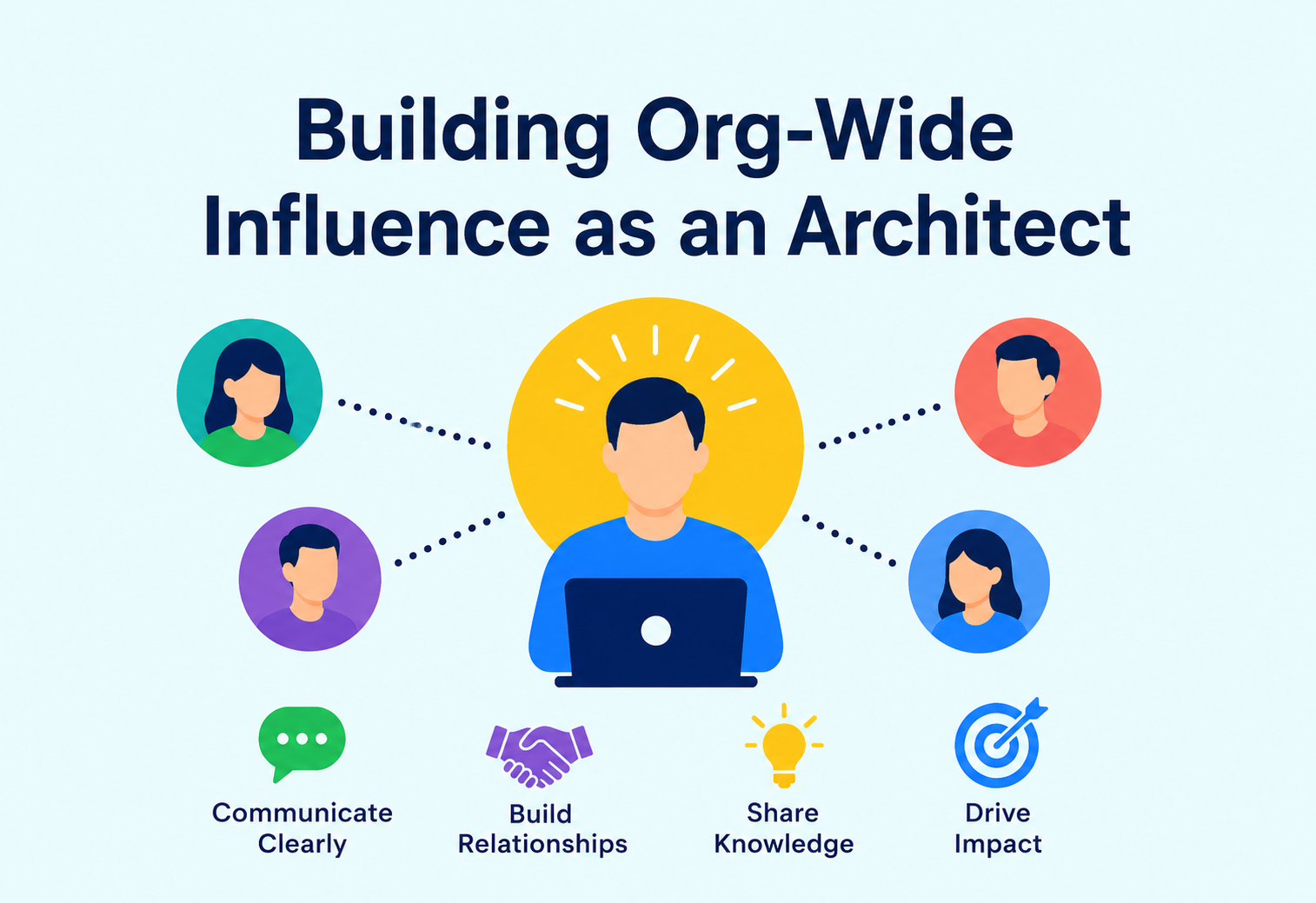
Building Org-Wide Influence as an Architect
The reach of your work was never meant to stop at the property line — and neither should you. Org-wide influence isn’t a title someone hands you. It’s what happens when good judgment, shown consistently in enough rooms over enough time, becomes something colleagues reach for on their own — long before they’re required to.
The Idea That Was Right, and Went Nowhere
Most architects are taught to make one project excellent. Almost none are taught what to do once colleagues outside that project start asking for your opinion, too — and even fewer are taught what to do when they should be asking, but aren’t.
You’ve likely had this exact experience. A pattern your team solved, cleanly and well, that would obviously help two other teams facing the same problem. You mention it in passing. Nothing happens. You write it up properly, share it in the right channel, even present it at a lunch-and-learn. Six months later, another team reinvents a worse version of the same solution from scratch, and nobody in the room even knows your team already solved it.
This isn’t a failure of the idea. Good ideas die in organizations constantly, not because they’re wrong, but because they arrive without a relationship attached to them. Influence, in most organizations, travels through trust between people far more reliably than it travels through documentation, however well written. A brilliant proposal from someone nobody across the org has ever had a real conversation with tends to sit in a queue. A modest suggestion from someone three teams already trust tends to get tried by Thursday.
This piece is about closing that gap — not through self-promotion, which tends to backfire in technical cultures, and not by waiting patiently for recognition to simply arrive, which mostly doesn’t happen either. There’s a slower, sturdier path in between, built from a specific, learnable set of habits, and it’s the one architects who end up shaping decisions well beyond their own team almost always turn out to have walked.
Picture a senior architect, two years into a mid-sized company, technically excellent, quietly frustrated. Their platform decisions were sound, their documentation was thorough, and almost nobody outside their immediate team had ever asked their opinion on anything. Meanwhile, a less technically deep colleague in another department had become the person leadership consulted on nearly every cross-team architecture question — not because their ideas were better, but because they’d spent two years showing up in rooms, remembering names, and following through on small promises long before anyone needed them to.
The frustrating part of watching this unfold, if you’ve lived any version of it, is how easy it is to misdiagnose. The natural conclusion is that the organization simply rewards the wrong things — charisma over competence, visibility over depth — and there’s a real risk of settling into quiet resentment about it, treating the gap as an injustice to be endured rather than a pattern with an actual mechanism behind it. But look closer at almost any version of this story and the mechanism turns out to be less mysterious and considerably more learnable than it first appears: one person had, without necessarily naming it as a strategy, built a track record other teams could feel, while the other had built a track record only their own team could see.
That distinction — a track record other people can feel versus one only your own team can see — turns out to be almost the entire subject of this piece. It’s rarely about talent, and it’s almost never about deliberate manipulation. It’s about where the good work actually shows up, and to whom.
What Org-Wide Influence Actually Is
It’s worth being precise here, because “influence” gets used loosely, and the loose version leads people toward exactly the wrong habits — self-promotion, meeting-hopping, collecting a reputation for talking rather than for being right.
Positional Authority
What your title lets you require of the people who report to you. Necessary inside your own team, and largely useless the moment you step outside it.
Visibility
Being known. A necessary ingredient, but on its own it produces recognition, not trust — plenty of people are visible and still not the one anyone actually listens to.
Expertise
Being right, technically, more often than not. Essential, but silent by itself — the org has to actually encounter your being right, repeatedly, before it becomes influence.
Real Influence
The specific, earned state where people outside your reporting line seek your view before a decision, rather than after one — because past experience taught them it was worth the extra step.
Real influence is the combination of the three ingredients above — authority, visibility, expertise — compounded over time by consistency. It shows up in a very specific, recognizable moment: someone from a team you don’t manage, facing a decision you have no formal say over, chooses to loop you in anyway, unprompted, because they’d rather have your view early than explain a mistake to you later.
It’s worth noticing, too, what real influence is not. It isn’t being the person who talks the most in cross-team meetings, or the one whose name appears on the most slides. Those are often signs of visibility without the trust to back it, and organizations are usually better at distinguishing the two than the person on the receiving end of either assumes. The quieter test — whether people seek you out before a decision rather than simply include you in the announcement afterward — is a far more honest measure, and it’s one you can genuinely track over time rather than guess at.
Why Architects Often Struggle With This Specifically
The gap isn’t caused by any one dramatic mistake. It’s usually a quiet accumulation of four very reasonable-sounding instincts, each of which serves you well inside a single project and quietly works against you the moment you step past its edges.
The work was designed to feel complete on its own
Architecture, done well, produces something clean and self-contained: a system that works, a decision that holds up, a document that answers its own questions. That completeness is a professional virtue, and it also creates a quiet trap — an assumption that good work will simply be noticed and travel on its own merits, without anyone needing to carry it anywhere. It rarely does. Good work has to be carried, by a person, into rooms where it isn’t already the subject.
Cross-team relationship-building doesn’t feel like “real” work
Many architects, trained to value depth and rigor, experience the unstructured, slower work of building trust across departments as a distraction from the actual job — something to feel slightly guilty about doing during working hours. This instinct is understandable and, over a career, expensive. The relationship work isn’t separate from the technical work’s impact; for anything beyond a single team, it’s the mechanism by which that impact travels at all.

Genuine expertise can make blunt honesty feel sufficient
Being reliably correct sometimes convinces skilled people that being right should be enough on its own — that persuasion, warmth, or patience with someone else’s slower path to the same conclusion are unnecessary extras. Across a single project, that can work. Across an organization, where you have no authority to simply be obeyed, being right without also being trusted usually just produces a correct opinion nobody outside your team ever hears.
Early bad experiences with self-promotion
Almost everyone has watched a colleague oversell a mediocre idea loudly enough to get traction anyway, and the reasonable reaction is often an overcorrection — deciding that visibility itself is somehow dishonest, and retreating entirely into quiet, heads-down excellence. The distinction worth holding onto is that self-promotion and being known for consistently good judgment are not the same behavior, even though from a distance they can look similar.
None of these instincts are wrong by themselves. Each of them is a reasonable adaptation to something real about the job. The trouble is only that they add up, silently, into a career shape that looks technically excellent from the inside and nearly invisible from anywhere else in the org — and it’s worth naming that pattern out loud before deciding how to move within it.
What It Costs to Stay Confined to Your Own Project
The costs of staying local are real, and they land in three different places — on the organization, on your career trajectory, and on the quiet daily experience of watching decisions get made without you. None of them announces itself dramatically. All of them compound.
The most immediate cost is the one from the opening story: good solutions stay local, get reinvented badly elsewhere, and the organization pays twice for a problem it only needed to solve once. That’s a real, measurable cost, and it’s usually the one leadership notices first, if anyone notices it at all.
The less visible cost lands on the architect directly. Careers in this field tend to broaden in scope over time — from a single project, to a program, to a function, to an organization — and each step depends on having already demonstrated sound judgment beyond the boundary just crossed. An architect who’s excellent inside their own team but invisible outside it isn’t building the track record that broader roles are actually evaluated against, no matter how strong the underlying work is. The promotion conversation, when it eventually happens, keeps needing evidence that was never given anywhere for anyone to see.
There’s a quieter cost too, harder to name directly: watching decisions get made elsewhere in the organization that you could have improved, had anyone thought to ask, and knowing that the reason nobody asked wasn’t a lack of respect for your ability — it was simply that you’d never given them a reason to think of you first.
And there’s a cost to the organization that’s easy to overlook because it never shows up as a single, attributable line item: the slow accumulation of duplicated effort, inconsistent decisions across teams solving nearly identical problems in incompatible ways, and a general thinning of the collective judgment available to any one decision, simply because the people best equipped to weigh in were never in the room. None of this is anyone’s fault in particular. It’s just what happens, by default, in any organization large enough that good judgment doesn’t automatically reach every room that needs it.
Nobody in another department is failing to notice your work out of malice. They’re managing their own set of relationships and defaults, the same way you are — and by default, people turn first to whoever they already trust, not to whoever is technically best qualified but unfamiliar.
Reading Where You Actually Stand
Before changing anything, it helps to get an honest read on your current standing, because the right next step differs quite a bit depending on whether you’re mostly unknown outside your team or already known but not yet trusted. The five diagnostics below tend to reveal more than any amount of quiet self-assessment.
Invited, or asking?
Being regularly pulled into other teams’ decisions unprompted is a strong sign of real influence. Having to request a seat, every time, suggests visibility without much pull yet.
Ideas paraphrased back?
When people repeat your ideas back to you as their own, unknowingly, it sounds like a slight and is often actually a compliment — it means your thinking has genuinely spread into how others reason, even if your name didn’t travel with it.
Name comes up in absentia?
Ask a trusted colleague, directly, whether your name surfaces in conversations you weren’t part of. The answer tends to be more revealing than any amount of self-assessment.
Consulted, or informed?
Are you consulted before a decision, or informed after? The gap between these two is, in practical terms, almost the entire definition of org-wide influence.
Do others know what you do?
It’s common to assume your role is obvious to people outside your immediate function. It rarely is, and that gap alone can explain a surprising amount of being overlooked.
Read your answers as a rough map, not a scoreboard. Two or three “not yet” answers are entirely normal and largely fixable through the habits in the next section. What’s worth taking seriously is the direction of drift over time — whether these signals are gradually strengthening as you invest in the habits below, or gradually thinning as the temptation to retreat into pure heads-down excellence quietly wins.
What Actually Builds It
Below are the specific, learnable habits that build genuine org-wide influence over time. None of them require charisma, extroversion, or gaming the system. Almost all of them are simply things technically strong people frequently under-invest in, because the return is slow, indirect, and easy to talk yourself out of on any single Tuesday.
Start with genuine curiosity about problems that aren’t yours
The single highest-leverage habit is also the simplest to describe and the easiest to skip: regularly spend time understanding what other teams are actually struggling with, with no immediate agenda of your own attached. Ask questions, listen more than you advise, and resist the pull to immediately offer your team’s solution as the answer. People remember who took a genuine interest in their problem long before they remember who had the best answer to it.
Make your team’s good thinking legible to people who weren’t there for it
A decision that’s excellent but explained only in the internal language and shorthand of your own team is functionally invisible outside it. Translating a technical choice into the terms another department already cares about — cost, risk, time, customer impact — isn’t dumbing it down. It’s the actual work of making it usable by people who didn’t sit through the six months of context that produced it.
Show up consistently in rooms with no personal stake in them
Volunteer for the cross-team working group nobody’s excited about, attend the guild or community of practice meeting even when your own project doesn’t need it that week, join the review for a project you’re not on when invited. Influence accumulates disproportionately in the unglamorous, recurring rooms where most technically strong people don’t bother showing up consistently, because there’s no immediate return for them individually.
Be the person who follows through on small things reliably
Offer to look at a document, and actually send comments within the week. Say you’ll make an introduction, and make it within the day. Trust across an organization is built overwhelmingly out of small, boring, kept promises rather than occasional impressive ones — largely because small promises are the ones most people quietly fail to keep, which makes reliably keeping them unusually memorable.
Give credit generously and specifically
When another team’s approach informs your own, say so, by name, in the room where it matters. This costs nothing and returns a great deal, because it’s rare enough to be remembered, and because people are far more willing to bring their next good idea to someone who’s previously made sure they got recognized for the last one.
Write things down in a way that outlives the meeting
A well-reasoned decision document, shared broadly and written so someone outside the immediate context can actually follow the logic, keeps working long after the conversation that produced it has ended. It becomes something colleagues can point back to, cite, and build on — extending your reach into rooms and decisions you were never physically present for.
Find a sponsor, not just a network of contacts
A wide network of friendly acquaintances is useful. It’s not the same as having one or two people, more senior or more broadly connected than you, who actively advocate for your view in rooms you’re not in. That kind of sponsorship is earned specifically, usually by consistently making a sponsor’s own job easier or their own judgment look good — and it’s worth being deliberate about cultivating rather than assuming it will simply accumulate on its own.
Teach, even when nobody’s asked you to
Running an occasional lunch-and-learn, writing an internal explainer on a pattern that keeps tripping people up, or simply taking the time to properly explain your reasoning to a junior colleague from another team costs an afternoon and compounds for years. Teaching does something particular that other forms of visibility don’t: it puts people in a room with your thinking at its clearest and most patient, which is usually the version of you least visible in the pressure of a live project deadline.
Make it easy for people to find you before there’s a crisis
Most cross-team consultation happens reactively, in the middle of a problem, when whoever’s easiest to reach gets asked first. Being genuinely easy to reach — responsive, approachable, undefended even when the question is a little naive — matters more than it should, precisely because the bar for being “the person people think to ask” is often just being noticeably less intimidating to approach than the alternative. Guarding your time fiercely has real value inside your own project. Applied indiscriminately toward colleagues from other teams trying to learn something, it quietly closes the exact door this whole chapter is about keeping open.
The Conversations That Build It, One at a Time
Habits are abstract until they show up in specific sentences you actually say to another human. Below are three of the most common cross-team moments architects find hard to navigate, with the exact kind of phrasing that tends to leave the room genuinely trusting you afterward — not because it’s clever, but because it’s honest about what you know and don’t.
Asking to join a room you weren’t invited to
"I noticed the platform migration discussion touches on a
caching pattern we worked through the hard way last year.
I’m not looking to take over any part of the decision —
I’d just like to sit in, mostly to listen, in case
there’s something from that experience worth saving you
the same detour."
This works because it leads with humility and a specific, concrete offer rather than a vague claim to relevance. Most teams welcome a quiet, genuinely useful observer far more readily than they’d welcome someone angling for a say in a decision that isn’t theirs to make.
Pitching an idea to a room that doesn’t know you
"Before I walk through the proposal, I want to be upfront
that this comes out of a problem my team hit directly, not
a general theory — here’s specifically what broke,
what we tried first that didn’t work, and what finally did.
I’d genuinely like to know where this doesn’t map to
your context, because I don’t have full visibility into
that."
Leading with the concrete failure, not just the eventual success, tends to build more credibility with an unfamiliar audience than a polished, failure-free pitch — because it signals the idea was actually tested against reality, not just theorized.
Handling being overruled without losing standing
"I hear the decision, and I understand the reasoning around
timeline that I probably wasn’t weighing heavily enough.
For what it’s worth, here’s the one risk I’d keep an
eye on given how this played out for us before — happy
to help if it comes up, otherwise this is fully your call
to make."
Being overruled gracefully, without quietly withdrawing or visibly sulking, is one of the most underrated influence-building moves available. It demonstrates that your earlier advocacy was really about the work, not about winning — and that distinction is exactly what earns you a genuine hearing the next time.
None of this is a case for constant networking at the expense of the actual work, or for treating every interaction as a strategic opportunity to be managed. The architects who build the strongest org-wide influence over a career are, almost without exception, the ones for whom the curiosity about other teams’ problems is genuine, not performed. If the relationship-building starts to feel like a campaign rather than an extension of real interest in solving good problems wherever they show up, that’s usually a sign to slow down and recheck the motive, not to push harder.
How This Looks Different Depending on Where You Sit
The underlying behaviors hold steady, but the shape of applying them changes quite a bit depending on your seniority and the size of the organization around you. The version of this that works for a mid-level engineer at a five-hundred-person company is not identical to the version that works for a principal engineer at a ten-thousand-person one — and it’s worth being honest about the differences.
Early career, individual contributor
Influence at this stage is mostly built through reliability on small, specific things — the code review someone can count on, the answer to a question that’s always accurate, the deadline that’s never missed. It’s tempting to feel that broader influence isn’t available yet without more seniority. In practice, being the quietly dependable person other teams already trust with small things is exactly the foundation more senior influence gets built on later; there’s no version of this that skips the small-and-dependable phase.
Senior architect, not yet in formal leadership
This is usually where the gap in the opening story shows up most sharply, because technical depth is already strong and the missing ingredient is almost entirely relational. The highest-leverage move here tends to be volunteering for the visible-but-unglamorous cross-team work — the working group, the shared standards document, the incident retrospective for a system you don’t own — precisely because peers at this level often avoid it, leaving an unusually open lane.
Principal or staff level, spanning multiple teams already
Here the risk shifts from being unknown to being overextended, spreading a now-real reputation too thin across too many rooms to actually follow through in any of them well. The discipline that matters most at this stage is saying no to some invitations deliberately, protecting the follow-through that built the reputation in the first place.
Small organization versus large one
In a smaller organization, reach across the whole company can happen almost by proximity alone — everyone already sees everyone’s work, and the main job is making sure that visibility reflects well on you. In a large organization, the same reach has to be built far more deliberately, team by team, because proximity alone will never cover the distance; the strategies in this piece matter proportionally more the larger the organization gets.
| Stage / Setting | Dominant Risk | Highest-Leverage Move |
|---|---|---|
| Early career IC | Feeling too junior to build reach | Be the quietly dependable one on small things |
| Senior architect | Great work stuck inside one team | Volunteer for unglamorous cross-team rooms |
| Principal / staff | Overextension, thin follow-through | Say no deliberately; protect delivery |
| Small org | Visibility misread as trust | Make the visible work reflect real judgment |
| Large org | Distance from most decisions | Build reach team-by-team, on purpose |
Knowing When Not to Reach for It
Influence, once it starts building, has its own gravitational pull, and it’s worth naming clearly when to resist extending it further. Not every problem in the organization needs your input, even where you could probably offer something useful.
Overextending into decisions well outside your genuine expertise, simply because you now have the standing to get a seat, tends to dilute exactly the credibility that took years to build — people start to notice when an opinion is being offered because it’s wanted, versus because it’s simply available.
A useful, honest test: would this team have sought out my view if I hadn’t proactively offered it? If the answer is consistently no, across several instances, that’s worth taking seriously as information, not overriding as false modesty.
Am I in this room because my judgment is genuinely wanted here, or because being in rooms has quietly become a habit I’ve stopped questioning? The first sustains influence. The second slowly spends it.
There’s also a simpler, more forgiving way to hold this whole chapter: influence built well tends to be self-correcting. If it’s genuinely earned, teams will keep pulling you back in even after you’ve deliberately stepped back from a few invitations, because the value was real and the room notices its absence. If a step back causes influence to quietly evaporate the moment you stop actively maintaining it everywhere, that’s useful information too — a sign the trust wasn’t as deep as it looked, and worth building further before assuming it can be spent freely.
Frequently Asked Questions
Short, honest answers to the questions that come up most often when architects start taking this idea of org-wide influence seriously for the first time.

How long does this actually take?
Meaningfully longer than most people expect going in — commonly a year or more of consistent, unglamorous behavior before it becomes visible as a pattern others can name. There’s no reliable shortcut, and treating it as a slow-compounding investment rather than a project with a deadline tends to produce far better results.
What if the organizational culture genuinely doesn’t reward this kind of behavior?
It’s worth being honest that some cultures reward political maneuvering over genuine trust-building, and the approach here works considerably less well in those environments. If that’s a consistent, structural pattern rather than an occasional exception, it’s a real signal about the organization, worth weighing seriously alongside everything else that makes a role worth staying in.
Is it possible to overdo the humility in these conversations?
Yes — there’s a version of this that reads as excessive self-effacement rather than genuine openness, and it can undercut a good idea just as much as overselling one would. The aim is honest confidence about what you actually know, paired with real curiosity about what you don’t, not a performance of modesty for its own sake.
Does this work the same way in a fully remote organization?
The underlying behaviors hold, but they need more deliberate scheduling, since the casual hallway moments that build a lot of this trust in person don’t happen by accident online. Regular, low-stakes one-on-ones with people outside your team, scheduled on purpose, tend to do the work that hallway conversations do in an office.
What’s the very first, smallest step, if all of this feels like a lot at once?
Pick one team you don’t work with directly, and schedule thirty minutes to genuinely learn what they’re currently struggling with, offering nothing in return except your attention. It’s a small, low-risk starting point, and it’s usually where every version of this actually begins.
How do you build this without it feeling transactional, like you’re networking for its own sake?
Keep the ratio honest: spend meaningfully more time helping with other people’s problems than asking for help with your own, and let a fair amount of that help happen with no expectation of anything in return, ever. If every interaction is quietly weighed against what it might yield later, people tend to sense it eventually, even when it’s never said aloud.
Does building this kind of influence ever backfire?
It can, mainly when it outpaces genuine expertise — when someone becomes known as broadly well-connected before their judgment has actually earned that reach, and a visible misstep in an unfamiliar area does more damage than a similar misstep would have inside their own team, where context and prior trust cushion it. Building influence a little slower than it could theoretically move, in step with genuine capability, tends to hold up far better over a whole career than moving as fast as the relationships alone would allow.
What’s Actually Worth Remembering
Org-wide influence isn’t granted by a title, and it isn’t built by being louder than the room. It’s built, slowly and specifically, out of genuine curiosity about problems that aren’t yours yet, and a long record of small promises kept.
Key takeaways
- Positional authority and real influence are different things, earned in different ways — a title lets you require, influence lets you be invited.
- Good work has to be carried into other rooms by a trusted person — documentation alone rarely travels far on its own.
- Show up consistently where there’s no immediate personal stake, especially in the unglamorous recurring rooms where technically strong people usually don’t.
- Keep small promises reliably; that builds more trust across an organization than any single impressive moment.
- Translate your team’s good thinking into terms other functions already care about — cost, risk, time, customer impact.
- Give credit generously and specifically, and write your reasoning down so it works in rooms you’re not in.
- Notice when influence is genuinely wanted versus simply available, and stay in the rooms where it’s the former.
- Build in step with real capability — influence that outpaces expertise tends to break in exactly the moments it’s tested.
The architects who quietly end up shaping decisions well beyond their own team almost always got there by taking a genuine interest in problems that weren’t theirs yet — and by keeping small promises long enough that colleagues started reaching for their judgment on their own.