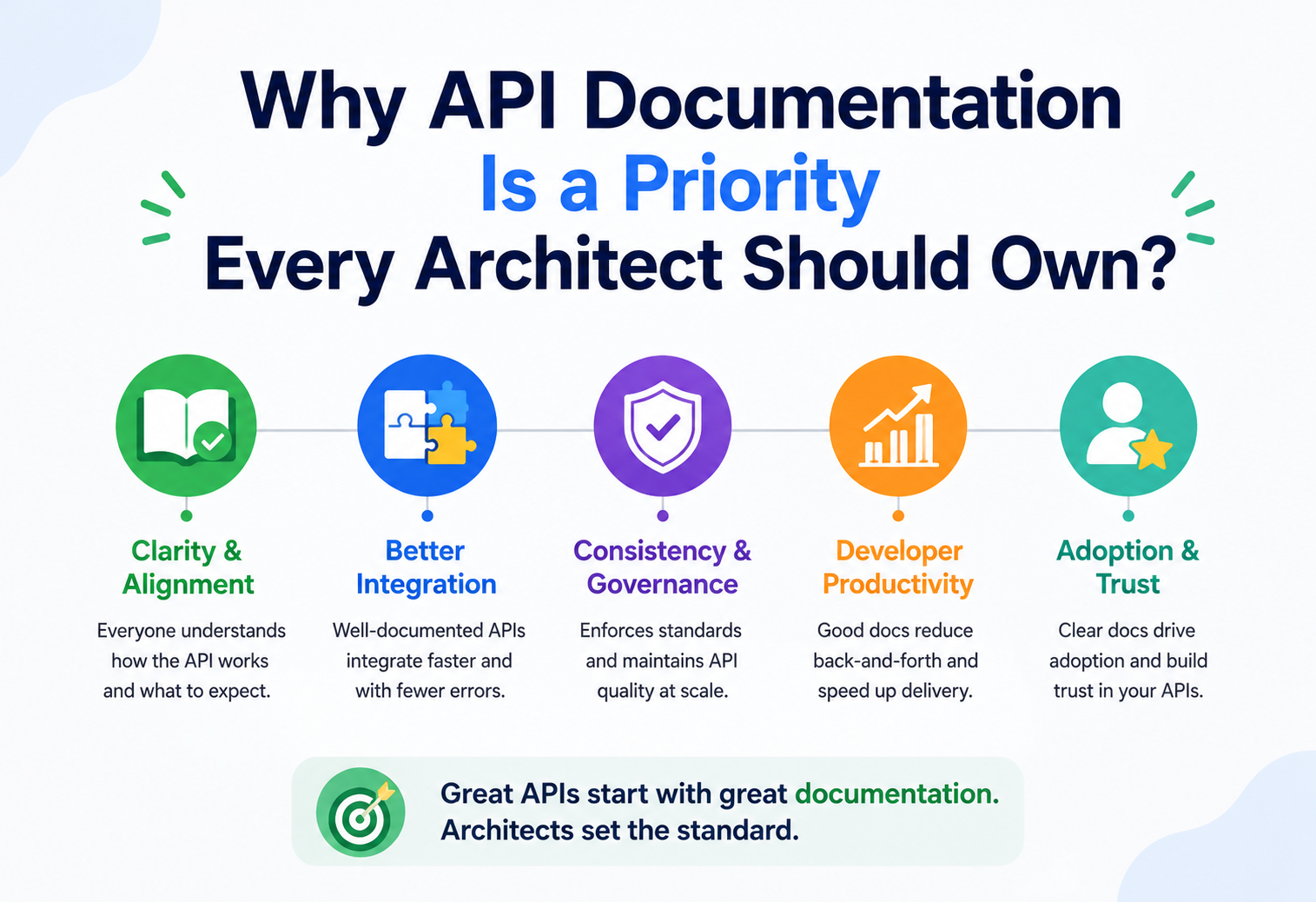
Why API Documentation Is a Priority Every Architect Should Own
A deep, ground-up tutorial on why documentation is not “extra paperwork” but load-bearing infrastructure — and how architects design, govern, and scale it across an organization.
Introduction & History
Imagine you moved into a huge new house, but nobody gave you the keys, the floor plan, or a note explaining which switch turns on which light. You would spend your first week just bumping into walls. That is exactly what it feels like for a developer — even a senior one — to integrate with an API that has no documentation. API documentation is the floor plan, the light-switch labels, and the “please don’t touch the stove when it’s on” warning sign, all rolled into one.
An API (Application Programming Interface) is a contract that lets one piece of software talk to another. Think of it like a restaurant menu: you do not need to know how the kitchen works, you just need to know what you can order, what it costs, and what will come back to your table. API documentation is that menu — plus the allergy list, the wait times, and the rules about substitutions.
Documentation as a discipline is almost as old as programming itself. Early mainframe systems in the 1960s shipped with thick paper manuals because there was no other way to explain how to use a system. As software moved to networks in the 1990s, documentation moved too — first as static HTML pages, then, with the rise of web services in the early 2000s (SOAP and WSDL), documentation became partly machine-readable. The real turning point came in 2011, when a specification called Swagger (later donated to the community and renamed the OpenAPI Specification, or OAS) let teams describe an API in a structured, machine-readable file — and then generate human-readable documentation, client code, and test stubs from that single file. This is the world architects operate in today: documentation is no longer an afterthought written after the code is “done” — it is often written first, and the code follows the contract.
1.1 A Short Timeline of API Documentation
Manual-driven era
Documentation shipped as printed technical manuals alongside mainframe and early networked systems.
Static web docs
HTML reference pages describing function calls and early RPC (remote procedure call) mechanisms.
SOAP & WSDL
XML-based contracts made APIs partially self-describing, but were verbose and hard for humans to read.
Swagger / OpenAPI
A machine-readable spec format that could generate docs, mock servers, and client SDKs automatically.
Docs-as-code & API-first
Documentation lives in version control next to code, reviewed like code, and often written before implementation begins.
The Problem & Motivation
Why should an architect — the person responsible for the big-picture shape of a system, not line-by-line code — spend precious time and political capital pushing for documentation? Because undocumented APIs create a very specific, very expensive kind of pain, and that pain almost always lands on the architect’s desk eventually.
Picture a mid-size company with 40 microservices. Each service exposes an API. If none of those APIs are documented, every new integration becomes an archaeology dig: someone reads the source code, pings the original author (who has since moved teams or left the company), or just guesses and tests in production. Multiply that by every new hire, every partner integration, and every internal team that needs to consume another team’s service, and you get an organization that is quietly bleeding time.
Undocumented APIs do not show up as a line item on any budget, but studies of developer time consistently show that engineers spend a large chunk of their week just trying to understand systems that already exist. That is an invisible tax the architect pays for, one Slack message at a time. Because it never appears on a P&L, it also never triggers the escalations that other forms of waste would — which is exactly what makes it so dangerous.
There is also a trust problem. When an external partner or a public developer wants to use your company’s API, documentation is the first — and sometimes only — thing they see before deciding whether to build on your platform. A confusing or missing doc page does not just slow a partner down; it can make them choose a competitor’s API instead. For an architect designing a platform strategy, documentation quality directly affects adoption, which directly affects the business case for the platform existing at all.
2.1 Why this lands specifically on the architect
- Architects design contracts, not just code. An API’s shape — its resources, verbs, and data model — is an architectural decision. Documentation is the visible expression of that decision.
- Architects own cross-team coupling. When Team A depends on Team B’s API, the architect is the one accountable for that dependency working smoothly, and documentation is the connective tissue.
- Architects answer for technical debt. Poor documentation is a form of technical debt — it does not break anything today, but it compounds interest every sprint until someone has to pay it down.
Undocumented APIs are the software equivalent of a company where every filing cabinet has a different, arbitrary labelling system that only its original owner understands. Everything technically works — until you need to find something in someone else’s cabinet. Then productivity collapses in the exact places where it matters most: cross-team collaboration.
Core Concepts
Before going further, let us build a shared vocabulary. Each of these terms will come back again and again in this guide, so it is worth pausing to make sure they are crystal clear.
3.1 API Contract
A contract is a formal agreement about what an API accepts as input and what it promises to return as output — including the shape of the data, the possible error codes, and any rules (like “email must be a valid address”). Think of it like the terms of a job offer letter: both sides know exactly what is expected.
3.2 Reference Documentation
This describes every endpoint, parameter, and response field — the equivalent of a dictionary. You look up a specific word (endpoint) when you need it; you do not read a dictionary front to back.
3.3 Guides & Tutorials
Unlike reference docs, guides walk a reader through a goal (“Send your first SMS message”) step by step. If reference docs are the dictionary, guides are the recipe book. Both are needed; neither substitutes for the other.
3.4 OpenAPI Specification (OAS)
A YAML or JSON file that describes an entire API in a structured, standardized way — every endpoint, every field, every data type. Tools can read this file and automatically generate documentation websites, mock servers, and even client-side code, saving huge amounts of manual work.

openapi: 3.0.3
info:
  title: Order Service API
  version: 1.2.0
paths:
  /orders/{orderId}:
    get:
      summary: Retrieve an order by ID
      parameters:
        - name: orderId
          in: path
          required: true
          schema:
            type: string
      responses:
        '200':
          description: Order found
        '404':
          description: Order not found
3.5 Docs-as-Code
A philosophy where documentation is written in plain text (like Markdown), stored in the same version-control repository as the code, and reviewed through the same pull-request process. This means docs can never drift too far from reality, because updating the API without updating the docs literally fails the same review gate.
3.6 SDK (Software Development Kit)
A pre-built package of code, in a specific programming language, that wraps an API so a developer does not have to construct raw HTTP requests by hand. Good documentation often includes SDK usage examples alongside raw request/response examples.
If an API is a vending machine, the documentation is the label next to each button explaining what snack it dispenses, how much it costs, and what happens if the machine is out of stock (the error case). Without those labels, even a working vending machine is nearly useless.
3.7 Vocabulary at a Glance
What the API promises
Inputs, outputs, error codes and validation rules, agreed between provider and consumer.
Endpoint dictionary
Exhaustive list of every route, parameter and response field — consulted on demand.
Task-oriented recipe
Step-by-step walkthrough of a specific real-world goal, from start to a working outcome.
Machine-readable spec
YAML/JSON description that tools can turn into docs, mocks and SDKs automatically.
Version-controlled prose
Documentation reviewed on the same pull requests as the code it describes.
Language wrapper
Idiomatic client library so developers do not craft raw HTTP by hand.
Architecture & Components of a Documentation System
Good documentation does not just appear — it is produced by a small system with its own moving parts, and an architect should understand each piece well enough to make design decisions about it, the same way they would for any other subsystem.
Spec File
The single source of truth (usually OpenAPI or a similar format) describing every endpoint of the API.
Doc Generator
Tooling that turns the spec into a browsable website — for example Redoc, Swagger UI or Docusaurus.
Mock Server
A fake version of the API, generated from the spec, so consumers can test integration before the real API is built.
Developer Portal
The public or internal website where all documentation, guides, and API keys are managed.
CI/CD Hook
An automated check that fails the build if the spec file and the actual API implementation disagree.
Analytics Layer
Tracks which doc pages are viewed, which searches return nothing, and where readers give up.
An architect’s job is to decide how these components fit into the broader system architecture: Does documentation get generated at build time or deploy time? Does every microservice publish its own doc site, or is there a unified portal that aggregates all of them? These are architectural decisions with real trade-offs, not just tooling choices left to individual teams.
Internal Working: How Documentation Actually Gets Built
There are three broad approaches to producing documentation, and understanding how each works internally helps an architect choose the right one for their organization.
5.1 Code-first (annotation-driven)
Developers write annotations directly above their code, and a tool scans the source code at build time to extract those annotations into a spec file. This is fast to start with, but risks the documentation only being as accurate as whatever the developer remembered to annotate.
@RestController
@RequestMapping("/orders")
public class OrderController {

    @Operation(summary = "Retrieve an order by ID",
               description = "Returns full order details, including line items.")
    @GetMapping("/{orderId}")
    public ResponseEntity<Order> getOrder(@PathVariable String orderId) {
        Order order = orderService.findById(orderId);
        if (order == null) {
            return ResponseEntity.notFound().build();
        }
        return ResponseEntity.ok(order);
    }
}
5.2 Spec-first (contract-first)
The team writes the OpenAPI spec before any code exists. Frontend and backend teams can then work in parallel against the agreed contract, and a mock server built from the spec lets frontend developers start integrating immediately, without waiting for the backend to be finished. Many architects consider this the gold standard for cross-team API design because it forces the contract conversation to happen up front, when it is cheap to change, rather than after the fact, when it is expensive.
5.3 Manually written
A technical writer or engineer writes prose documentation independently of any tooling. This produces the highest-quality guides and tutorials (machines are bad at writing “why,” only “what”), but is the most prone to drifting out of sync with the real API unless paired with a review process.
They combine all three: spec-first for the contract and reference docs, code annotations to keep the spec synced automatically, and hand-written guides for the “why” and the tutorials that a machine could never generate on its own. Each approach compensates for the weaknesses of the other two.
5.4 Comparing the Three Approaches
| Approach | Strength | Weakness | Best for |
|---|---|---|---|
| Code-first | Never far from the actual implementation | Only as good as developer discipline with annotations | Small teams shipping fast on a single service |
| Spec-first | Forces up-front contract agreement between teams | Slightly slower for early prototyping | Cross-team, cross-org, or public APIs |
| Hand-written prose | Best for the “why,” tutorials and conceptual guides | Drifts silently without review discipline | Guides, tutorials, onboarding material |
Data Flow & Lifecycle
Documentation is not a one-time artifact — it has a lifecycle that mirrors the lifecycle of the API itself. Understanding this flow helps an architect design the checkpoints where documentation must be validated.
Notice that the documentation lifecycle is tied to the pull request stage, not the deployment stage. This is deliberate: catching a mismatch between the spec and the implementation during code review is cheap. Catching it after a partner has already built against the wrong contract is expensive, sometimes involving a breaking change and an apology email.
6.1 Versioning across the lifecycle
As an API evolves, old documentation does not disappear — it needs to be versioned right alongside the API itself. A consumer still running against API v1 should never accidentally land on v2’s documentation and start sending fields that do not exist yet.
| Stage | What happens to docs | Architect’s concern |
|---|---|---|
| Design | Spec drafted, reviewed by stakeholders | Contract fits the broader system model |
| Build | Annotations / spec generate live docs | Automation exists, no manual steps forgotten |
| Release | Docs published, versioned, and tagged | Old versions remain accessible |
| Deprecation | Docs marked deprecated with a migration guide | Consumers have a clear off-ramp |
| Sunset | Docs archived, endpoint retired | No silent breakage for laggard consumers |
Advantages, Disadvantages & Trade-offs
Treating documentation as a first-class architectural concern is not free. It costs engineering time, tooling investment, and ongoing discipline. A good architect weighs these costs honestly rather than pretending documentation is purely upside.
Faster onboarding
New engineers and partners can integrate without pinging the original author of every service.
Fewer interruptions
Support tickets and “how does this work” questions drop sharply once the answers exist on a page.
Parallel dev
Frontend and backend teams can build in parallel against an agreed contract instead of waiting on each other.
Early-warning system
Trying to write a spec often reveals design flaws before any code exists to hide them.
External adoption
Higher trust and adoption from third-party developers evaluating your platform.
Automated testing
Generated mocks and contract tests turn documentation into an executable safety net.
Upfront time cost
Writing and maintaining specs is real work that must be scheduled, not wished into existence.
Tooling investment
Doc generators, spec validators and CI checks all have to be installed and owned by someone.
False confidence
Docs that silently drift can be more dangerous than no docs at all — readers trust them.
Prototyping friction
Spec-first workflows can feel heavyweight during very early exploratory work.
Requires discipline
Not just good intentions — enforced review gates, so the process survives contact with a deadline.
The trade-off that matters most to architects is this: documentation debt behaves like compound interest. A small gap between the docs and the real API is nearly free to fix today, but it becomes exponentially more expensive to fix once ten different consuming teams have built assumptions on top of the wrong information. The architect’s job is to insert automated checkpoints early enough that this debt never compounds unnoticed.
Performance & Scalability
It might sound strange to talk about “performance” for documentation — it is not a database query — but at organizational scale, documentation systems absolutely have performance and scalability characteristics that architects must plan for.
8.1 Human performance: time-to-first-successful-call
The most important performance metric for documentation is how quickly a new developer can go from “I have never seen this API” to “I made a successful call and got the response I expected.” Good documentation, with copy-pasteable examples and a working sandbox, can shrink this from days to minutes.
8.2 System performance: build and search scalability
As an organization grows from 5 APIs to 500, a documentation system built for a single service will not survive. Doc generation needs to run incrementally (not rebuild every page for every change), the search index needs to scale across thousands of endpoints, and doc sites need their own caching and CDN strategy just like any other high-traffic web property.
40% faster onboarding
Searchable, example-rich docs cut ramp-up time noticeably for new integrators.
3× fewer tickets
Support load drops sharply once integration questions have a public, canonical answer.
< 5 minutes
Target time-to-first-call for good docs: from landing page to a successful sandboxed request.
Incremental builds
Rebuild only the pages affected by a change, not the entire portal, on every merge.
Indexed search
A search index that scales to thousands of endpoints without stalling the reader.
CDN caching
Serve doc HTML from the edge so global readers never wait on a single origin.
Doc portals that regenerate everything from scratch on every commit become painfully slow at scale. Architects should design for incremental builds the same way they would for any large compilation pipeline — only rebuild what actually changed.
High Availability & Reliability
Documentation reliability has two very different meanings, and architects need to design for both.
9.1 Uptime reliability
If your developer portal goes down during a partner’s integration window, that partner is stuck — just as stuck as if the API itself were down. Public-facing documentation sites deserve the same availability planning (redundant hosting, CDN fallback, monitoring) as any customer-facing product.
9.2 Accuracy reliability (the more important one)
Far more damaging than a documentation outage is documentation that is up but wrong. A page that has been live and confidently answering questions incorrectly for six months is a silent liability. This is why “docs-as-code” and automated contract testing matter so much architecturally: they turn documentation accuracy from a hope into a guarantee enforced by the build pipeline.
If it is not possible for your CI pipeline to fail when the documentation and the implementation disagree, then your documentation is not reliable — it is just optimistic. Every reliable system converts a wish into a check; documentation is no exception.
9.3 Two Dimensions of Doc Reliability
| Dimension | Failure mode | Mitigation |
|---|---|---|
| Uptime | Portal down during integration window | Redundant hosting, CDN, uptime monitoring |
| Accuracy | Docs live but silently wrong | Contract tests, spec validation in CI, review gates |
| Freshness | Docs describe a version nobody runs anymore | Versioned doc sets tied to API versions |
| Discoverability | Right answer exists but reader cannot find it | Search analytics, cross-links, curated landing pages |
Security
Documentation sits at an interesting security crossroads: it needs to tell consumers everything they need to integrate safely, without accidentally telling attackers everything they need to break in.
10.1 What good API documentation must cover
- Authentication scheme — how to get and use an API key, OAuth token, or similar, without ever showing a real secret in an example.
- Rate limits — how many requests are allowed per time window, and what happens when a consumer exceeds it (usually an HTTP 429 response).
- Data sensitivity notes — which fields contain personal data and any relevant compliance obligations (e.g. GDPR) for handling them.
- Error responses — documented clearly enough that a client can handle failures gracefully instead of retrying blindly and accidentally causing a denial-of-service against your own system.
10.2 What documentation should never expose
Fake API keys
Placeholder credentials clearly marked as fake (e.g. sk_test_XXXX) so readers see the shape without seeing a real secret.
Generic error messages
Documented HTTP status codes and machine-readable error shapes so clients can handle failures gracefully.
Rate limit rules
Thresholds and retry guidance so consumers back off politely instead of hammering your service.
Real production tokens
Actual credentials copy-pasted from a real environment — even briefly — are effectively already leaked.
Internal-only endpoints
Routes meant to stay behind the firewall should not appear on a public developer portal.
Infrastructure details
Internal hostnames, IPs and topology hints that make an attacker’s job easier.
Architects should treat the documentation pipeline itself as part of the security boundary: a secrets-scanning check in CI, run against every doc update, catches accidental leaks (like a developer pasting a real token into an example) before they are published to the public internet.
Monitoring, Logging & Metrics
Just as you would monitor a production API for errors and latency, a well-run documentation system is monitored too — because it is telling you where your API design itself is confusing people.
Search analytics
Which searches return zero results? That is a gap in your docs — or a gap in your API’s discoverability.
Drop-off tracking
Where do readers abandon a tutorial? That is usually the exact step where your API is harder to use than it should be.
Feedback widgets
“Was this page helpful?” buttons turn documentation into a feedback loop instead of a one-way broadcast.
Support ticket correlation
Tagging support tickets by which API/endpoint they relate to reveals which docs need the most urgent rewrite.
This is one of the most underrated architectural insights: documentation analytics are a leading indicator of API design quality. If ten different developers all get confused at the same paragraph, the problem probably is not the writing — it is that the API itself has an awkward, unintuitive shape. Architects who watch these metrics get an early warning system for design flaws, often before a single bug report is ever filed.
A well-instrumented doc portal quietly hands the architect a heat-map of exactly where the API is hardest to understand — and that heat-map, once you learn to read it, is often more useful than a formal API review.
Deployment & Cloud Considerations
Documentation portals need a deployment strategy of their own, and architects typically choose between a few patterns.
12.1 Static site hosting
Doc generators like Redoc or Docusaurus output plain HTML/CSS/JS, which can be hosted extremely cheaply and reliably on a CDN (content delivery network) — the same technology that makes websites load fast worldwide by serving files from a server near the reader, rather than one far away.
12.2 API gateway integration
Many cloud API gateways (AWS API Gateway, Azure API Management, Kong, Apigee) can auto-publish documentation directly from the routes they manage, keeping the gateway configuration and the docs in perfect sync by construction.
12.3 Multi-service aggregation
In a microservices architecture, dozens of teams each own their own service and their own spec file. An architect typically designs a central aggregation pipeline that pulls every team’s spec into one unified developer portal, so a consumer never has to know that “the Orders API” and “the Payments API” are built and deployed by two entirely different teams.
12.4 Choosing Between Deployment Patterns
| Pattern | Best when… | Watch out for |
|---|---|---|
| Static site on CDN | Docs are largely reference material with occasional updates | Preview workflow for pending PR docs |
| Gateway-published docs | Docs need to match routing config exactly, by construction | Vendor lock-in to a specific gateway |
| Central aggregation portal | Many teams and services need one consistent front door | Spec-quality variance between teams |
APIs, Microservices & Documentation
In a monolithic application, there is really only one API surface, and it is usually well understood by everyone on the (probably small) team. Microservices change this completely: instead of one API, you might have hundreds, each owned by a different team, each evolving on its own schedule.
This is exactly the environment where documentation stops being a “nice to have” and becomes load-bearing infrastructure. Without it, every service becomes a black box to every other team, and the organization loses the ability to reason about how the whole system fits together — which is precisely the architect’s core responsibility.
13.1 Service contracts as the connective tissue
Each microservice’s API documentation acts as its public interface — the only thing other teams should need to know about it. Internally, a team is free to refactor, rewrite in a different language, or change their database, as long as the documented contract stays stable. This is what allows large organizations to move fast without constantly stepping on each other’s toes.
“In a microservices world, the API documentation IS the architecture diagram that actually stays up to date.” Every other diagram tends to rot; contract-tested documentation is enforced by CI and therefore cannot silently lie for long.
13.2 Contract testing
Beyond documentation, mature microservice architectures use contract tests — automated tests that verify a service still honors its documented contract, and that consumers still call it the way the contract expects. This catches breaking changes before they reach production, turning documentation from a passive description into an active safety net.
13.3 Why This Matters at Scale
| Organization size | Without documented contracts | With documented contracts |
|---|---|---|
| 5 services, one team | Fine — everyone knows everything | Slight overhead, minor benefit |
| 20 services, 3 teams | Constant “how does yours work?” interruptions | Teams unblock themselves via docs |
| 100+ services, many teams | Nobody has the full mental model any more | Documentation is the mental model |
Design Patterns & Anti-patterns
Documentation, like any other engineering artifact, has its own well-known good patterns and its own well-known ways of going wrong. Recognising both saves architects a lot of time.
14.1 Good patterns
Contract-first design
Agree on the API shape before writing implementation code — cheap to change now, expensive later.
Docs-as-code
Documentation lives in the same repo, reviewed the same way as code, versioned with the same tags.
Golden examples
Every endpoint has at least one full, copy-pasteable, working request/response example.
Versioned docs
Every API version has its own permanent, browsable doc set — no silent overwrites.
Interactive sandboxes
Readers can make real (sandboxed) API calls directly from the docs page, without leaving the browser.
14.2 Anti-patterns to watch for
The API works fine, but the only documentation is a senior engineer’s memory. This looks fine until that engineer goes on vacation, changes teams, or leaves the company — at which point the API becomes effectively undocumented overnight.
Docs get written weeks after the API ships, by someone who was not involved in building it, working entirely from guesswork. This nearly always produces documentation that is technically present but practically useless.
A code sample that was correct at launch but was never updated as the API evolved, silently teaching every new reader the wrong way to call the endpoint.
Best Practices & Common Mistakes
Some habits reliably produce documentation that ages well; others reliably produce documentation that quietly rots. The list below is the short version of every hard-won lesson in the previous fourteen sections.
Automate spec generation
Generate the OpenAPI spec from code annotations wherever possible so drift is nearly impossible.
Gate merges on validity
Fail the build on spec validation errors so nobody merges a change that would break the docs.
Write for the newcomer
Write for the reader who knows nothing about your system, not for the person sitting next to you.
Real, runnable examples
Include real, executable examples — not pseudocode — that a reader can copy, paste and run.
Version alongside the API
Version documentation alongside the API and never overwrite older versions while consumers still use them.
Treat confusion as signal
Track doc analytics and treat repeated reader confusion as a design signal, not a writing failure.
Write once, forget forever
Documentation that is written once and never revisited will be wrong within a quarter.
Assuming shared context
Writing as though the reader already knows the internal jargon of your team.
Only the happy path
Documenting only success cases and leaving every error condition to the reader’s imagination.
Docs outside version control
Letting documentation live in a wiki or Google Doc where it can drift with zero review discipline.
Delegated ownership
Treating documentation as a technical-writer-only responsibility, not an engineering responsibility.
Before approving any new API design, ask: is there a spec file? Is it validated in CI? Does it include error responses, not just success cases? Is there at least one working example? If any answer is “no,” the API is not done yet — no matter how well the code runs.
Real-World / Industry Examples
Theory is one thing; the way real, successful platform companies treat documentation makes the argument concrete.
Docs as the product
Widely regarded as the gold standard for API docs — every endpoint has live, editable code examples in multiple languages, and the docs themselves double as an interactive sandbox.
Docs-driven adoption
Built its entire developer-adoption strategy around documentation quality, treating docs as a core product feature, not a support artifact.
Docs at massive scale
Generates documentation directly from its internal service models at massive scale, keeping thousands of API operations consistently documented across dozens of services.
Internal contract testing
Uses internal API documentation and contract testing extensively to let hundreds of engineering teams build against each other’s microservices without constant coordination meetings.
Discovery Documents
Publishes machine-readable “Discovery Documents” for many APIs, letting tools auto-generate client libraries in numerous languages directly from the spec.
Service catalog
Maintains a large internal service catalog where every microservice’s documentation is a required, enforced part of shipping a new service.
The common thread across all of these companies is that documentation was never delegated to an afterthought team — it was treated as an architectural deliverable, owned and enforced at the same level as the API’s actual code.
Frequently Asked Questions
Is not documentation a technical writer’s job, not an architect’s?
Writing prose might be a technical writer’s job. But deciding that documentation must exist, be validated automatically, and be treated as part of the API’s definition of “done” — that is an architectural governance decision, and it rarely happens unless an architect insists on it.
We move fast — does not documentation slow us down?
Poor documentation slows you down later, just less visibly. Spec-first design, in particular, tends to speed up delivery because frontend and backend teams can work in parallel against an agreed contract instead of waiting on each other.
How do we keep documentation from going stale?
Automate as much as possible: generate the spec from code annotations, run contract tests in CI, and fail the build when the spec and the implementation disagree. Manual discipline alone rarely survives contact with a deadline.
What is the single highest-leverage first step?
Adopt an OpenAPI (or equivalent) spec for every new API, and make validating that spec part of the CI pipeline. This one change turns documentation from an optional courtesy into an enforced contract.
Summary & Key Takeaways
API documentation is not paperwork bolted onto “real” engineering work — it is the visible, readable form of the architectural decisions an architect is already responsible for: the contracts between services, the boundaries between teams, and the trust extended to every future developer who will build on top of the system. An architect who prioritizes documentation is not slowing the team down with process; they are preventing the much slower, much more expensive process of everyone individually reverse-engineering the same system, over and over, for years.
Key Takeaways
- Documentation is the visible surface of an API contract — and contracts are an architect’s core responsibility.
- Spec-first, docs-as-code approaches keep documentation accurate by making drift a build failure, not a surprise.
- In a microservices world, documentation is often the only architecture diagram that stays up to date.
- Documentation analytics are a leading indicator of API design quality — confusion in the docs usually means confusion in the design.
- Security and documentation intersect: good docs explain how to integrate safely without leaking what should not be public.
- Every major platform company (Stripe, AWS, Twilio, Netflix) treats documentation as a product, not an afterthought — and architects are usually the ones who make that cultural shift stick.