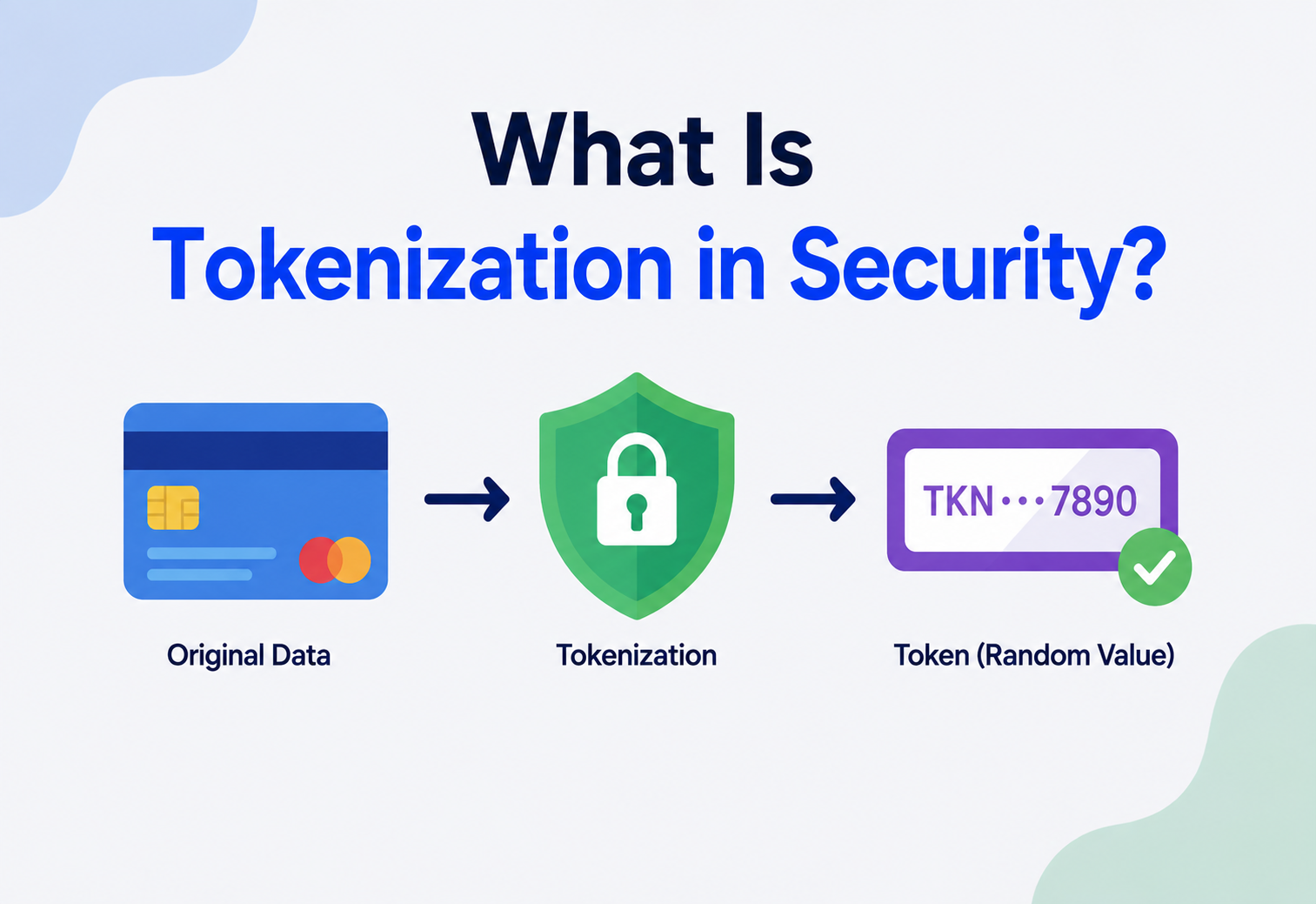
What Is Tokenization in Security?
A complete, beginner-friendly guide to tokenization — what it is, how it actually replaces sensitive data with safe substitutes, how companies like Visa, Stripe, and Apple Pay build and scale it, and how to implement it correctly in production systems.
Introduction & History
Before we go anywhere near credit-card vaults or Format-Preserving Encryption, let’s build the mental picture of what “tokenization” actually means — and where the idea came from.
Imagine a coat-check counter at a fancy restaurant. You hand over your expensive coat, and in exchange you receive a small numbered ticket — a plain, worthless piece of cardboard on its own. If a pickpocket steals that ticket from your pocket, they haven’t stolen your coat; they’ve stolen a meaningless number that only the coat-check attendant, holding the matching physical coat and the corresponding record, can actually redeem for anything of value. Even better, if the coat-check counter itself is ever robbed and the tickets are stolen, the thief still needs access to the attendant’s private records to know which ticket corresponds to which coat.
That is, in essence, exactly what tokenization does for sensitive data in security systems. Tokenization replaces a piece of sensitive information — most commonly a credit card number, a bank account number, or a Social Security number — with a randomly generated, non-sensitive substitute called a token. The token has no exploitable mathematical relationship to the original data; it’s simply a reference, mapped and stored securely in a separate system, that can later be exchanged back for the real value only by systems explicitly authorized to do so.
1.1 A Brief History
Tokenization as a formal security technique emerged prominently in the mid-2000s, driven largely by the payment card industry. As e-commerce exploded through the 1990s and early 2000s, merchants of every size were storing raw credit card numbers directly in their own databases to support recurring billing, refunds, and customer records. This created an enormous, distributed attack surface: any one of thousands of merchants with weak security practices represented a potential source of a massive card-data breach.
PCI DSS is established
Visa, Mastercard, American Express, Discover, and JCB jointly establish the Payment Card Industry Data Security Standard (PCI DSS), a rigorous set of requirements for any organization that stores, processes, or transmits cardholder data.
Tokenization emerges as the escape hatch
Complying with PCI DSS for a business that directly stores raw card numbers is expensive and operationally burdensome. Tokenization emerges as the elegant workaround: if a merchant never actually stores the real card number at all — only a token that’s useless outside the specific vault system that issued it — the compliance burden on that merchant shrinks dramatically, because the sensitive data itself never touches their systems.
Payment processors popularize the pattern
Shoplogix, TrustCommerce, and later a wave of payment processors including Braintree, Stripe, and Adyen build out large-scale tokenization platforms, popularizing the “tokenize on the client side, never let raw card data touch your servers” pattern that underlies nearly every modern payment integration today.
Tokenization broadens beyond payments
Healthcare systems begin tokenizing patient identifiers to comply with regulations like HIPAA, and cloud providers begin offering general-purpose tokenization services for any sensitive field — names, national ID numbers, phone numbers.
Apple Pay launches device-based tokenization
Apple Pay popularizes device-based tokenization at massive consumer scale: rather than a phone storing your actual card number at all, it stores a device-specific token, generated through a partnership between Apple and the card networks, that can only be used from that specific device for that specific transaction — a meaningful evolution of the same coat-check principle applied directly at the point of sale.
National regulators mandate tokenization
India’s central bank mandates card-on-file tokenization for online merchants, prohibiting merchants and payment aggregators from storing raw card numbers directly and requiring card network-issued tokens instead — a notable example of a national regulator enforcing tokenization as a baseline security requirement across an entire country’s digital payment ecosystem.
Beyond the coat-check counter, think of tokenization like a hotel giving you a keycard instead of the master key to the building. The keycard (token) opens exactly your room and nothing else, can be deactivated instantly without changing the building’s real locks, and even if someone finds a lost keycard on the street, it reveals nothing about which room it belongs to or where the hotel even is. The actual master key system (the sensitive real data) never leaves the hotel’s secure back office.
The Problem Tokenization Solves
To understand why tokenization matters, it helps to look at what happens without it — and why the alternatives, like simple encryption alone, don’t fully solve the problem.
2.1 Problem 1: Sprawl of Sensitive Data Across Systems
In a typical e-commerce business without tokenization, a raw credit card number might get copied into the checkout database, the order management system, the customer support tool, the analytics warehouse, and various backup archives — each one an independent attack surface an intruder could target. Every additional system that touches the raw sensitive value increases the total risk, and increases the cost and complexity of securing and auditing all of them to the same high standard.
2.2 Problem 2: Compliance Burden
Standards like PCI DSS impose strict, expensive requirements — network segmentation, encryption key management, quarterly vulnerability scans, restricted access controls — on any system that stores raw cardholder data. A small business processing payments would otherwise need to build and maintain this entire compliance apparatus just to run an online store.
2.3 Problem 3: Breach Blast Radius
Even with strong encryption, if an attacker breaches a system that stores encrypted sensitive data and the encryption keys needed to decrypt it (a common outcome in a sophisticated breach that compromises the whole application server), the encrypted data becomes exposed regardless. If that same system only ever held meaningless tokens — with the actual sensitive data and its mapping stored in a completely separate, more tightly secured vault — a breach of the token-holding system yields the attacker nothing of value.
2.4 Problem 4: Enabling Business Functionality Without Repeated Sensitive Data Exposure
Businesses still need to do useful things with sensitive data — charge a saved card for a recurring subscription, look up a customer’s order history, run fraud analytics — without every single one of those systems needing direct access to the raw sensitive value each time.
An online subscription service needs to charge your card every month. Without tokenization, it would need to store your actual 16-digit card number somewhere to do this. With tokenization, when you first enter your card, a token like tok_9f3ac21b is generated and stored instead — your real card number lives only inside the payment processor’s secure vault. Every month, the subscription service simply tells the processor “charge token tok_9f3ac21b,” and the processor looks up the real card internally to complete the charge, without the subscription service ever seeing or storing your actual card number even once after that initial entry.
Stripe’s tokenization model is a textbook production implementation: Stripe.js, a JavaScript library running in the customer’s browser, sends card details directly to Stripe’s servers and receives back a token, meaning the merchant’s own backend server never receives, transmits, or stores the raw card number at any point — dramatically simplifying the merchant’s own PCI DSS compliance scope.
Core Concepts
Let’s build a solid vocabulary before going deeper into architecture, since these terms recur throughout the rest of this guide.
3.1 Token
What: A surrogate value that stands in for a piece of sensitive data, with no mathematically derivable relationship to the original — meaning it cannot be reverse-computed back into the original value through any algorithm, unlike encrypted data, which theoretically can be decrypted given the right key.
Why this distinction matters: Because a token isn’t mathematically derived from the original data, even a complete compromise of the cryptographic algorithm used elsewhere in the system (a real, if rare, risk with encryption) cannot expose the original value through the token alone.
3.2 Token Vault
What: The secure, tightly access-controlled database that stores the actual mapping between each token and its corresponding original sensitive value. This is the single most security-critical component in any tokenization system — compromise the vault, and the entire scheme’s protection collapses.
3.3 Detokenization
What: The reverse operation — exchanging a token back for its original sensitive value. This should be a tightly restricted, heavily audited operation, available only to specific authorized systems for specific legitimate purposes (like a payment processor actually needing the real card number to submit a transaction to a card network).
3.4 Vaultless (Algorithmic) Tokenization
Not all tokenization systems maintain a literal lookup-table vault. Vaultless tokenization instead uses a reversible cryptographic transformation (often a specialized construction like Format-Preserving Encryption combined with a securely managed key) to deterministically generate and later reverse tokens, without needing to store every individual mapping in a database. This trades the operational burden of an ever-growing vault for a different kind of risk profile centered entirely on key management.
| Aspect | Vaulted Tokenization | Vaultless Tokenization |
|---|---|---|
| Storage | Requires a growing database of token-to-value mappings | No lookup table; tokens are algorithmically derived |
| Scalability | Vault can become a bottleneck at very high volume | Scales more easily since there’s no central lookup |
| Key/data compromise impact | Compromising the vault directly exposes mappings | Compromising the cryptographic key can expose all data at once |
| Format preservation | Achievable by design choice | Achievable via Format-Preserving Encryption |
3.5 Format-Preserving Tokenization
What: Generating tokens that mimic the format of the original data — a tokenized 16-digit card number is itself a 16-digit number, just not a valid one. This lets tokens pass through existing systems, database schemas, and validation logic designed for the original data format, without requiring costly changes to every downstream system that happens to touch the field.
3.6 Tokenization vs. Encryption vs. Hashing: A Crucial Distinction
Beginners frequently conflate these three, but they behave very differently:
Reversible with a key
The ciphertext is mathematically derived from the original data and can theoretically be decrypted by anyone possessing the correct key.
One-way by design
Intended to never be reversed, useful for verifying data (like a password) without ever needing to recover the original value.
Unrelated substitute
The token has no mathematical relationship to the original value at all (in the vaulted model); recovering the original requires looking it up in a specific, separately secured vault — not computing it from the token itself.
Encryption is like writing a message in a cipher that anyone with the right decoder ring can read directly from the ciphertext itself. Tokenization is like replacing the message with a random library call-number that means absolutely nothing without physically walking to a specific, guarded library shelf (the vault) and looking up what that call-number actually corresponds to.
Architecture & Components
Let’s assemble a complete, production-shaped tokenization architecture diagram.
4.1 Tokenization Service / API
The entry point that receives sensitive data, generates (or looks up) a corresponding token, and returns it to the calling system. This is typically the only component in the entire architecture ever allowed to receive raw sensitive data directly from a client.
4.2 Token Generator
The internal logic that produces the actual token value — whether via a cryptographically secure random number generator (vaulted model) or a reversible algorithmic transformation (vaultless model).
4.3 Token Vault
A tightly access-controlled, heavily encrypted data store holding the mapping between tokens and their original values. Access to this component is typically restricted to an extremely small, carefully audited set of internal services — never directly exposed to general application code.
4.4 Detokenization Authorization Layer
A policy-enforcement component (conceptually similar to the PEP/PDP pattern in access control systems) that decides whether a given request to reverse a token back into its original value should be permitted, based on the requester’s identity, the specific token, and the business context of the request.
4.5 Merchant / Application Backend
Everyday application systems only ever handle tokens — never the raw sensitive value — for the vast majority of operations like displaying a masked card number, running analytics, or storing customer records.
A small internal HR tool that needs to store employee national ID numbers might implement a minimal version of this architecture: a single internal microservice exposing a tokenize() and detokenize() function, backed by one encrypted database table — no separate authorization layer, no distributed vault cluster. This is the “toy” version of the diagram above, useful for understanding the concept before adding enterprise-scale complexity.
Internal Working: How Tokenization Actually Works
Let’s trace through exactly what happens, step by step, when a customer enters their credit card during checkout.
5.1 Step 1: Sensitive Data Capture
The customer types their card number into a checkout form. In a well-designed system, this form field is served directly by the tokenization provider (via an embedded iframe or JavaScript library, as in Stripe.js), meaning the raw card number is transmitted straight from the customer’s browser to the tokenization provider’s servers — bypassing the merchant’s own backend entirely.
5.2 Step 2: Token Generation
The tokenization service receives the raw value, validates its format, and generates a new token — a random value with no derivable relationship to the original, in the vaulted model. This token is designed to look plausible (often format-preserving) but is cryptographically meaningless as a stand-in.
5.3 Step 3: Vault Storage
The service stores the token-to-original-value mapping in the token vault, itself protected with strong encryption at rest, strict network isolation, and tightly scoped access controls, often within a dedicated, hardened environment separate from the rest of the application infrastructure.
5.4 Step 4: Token Returned to the Application
The tokenization service returns the newly generated token to the calling application (the merchant’s checkout page), which stores this token in its own database in place of the raw card number, and uses it for all future references to this payment method — recurring charges, refunds, display in the customer’s order history (typically shown masked, like **** **** **** 4242).
5.5 Step 5: Using the Token for a Transaction
When the merchant needs to actually charge the card — say, for a monthly subscription renewal — it sends a request to the payment processor containing the token, not the real card number. The processor, which controls the vault, performs the detokenization internally, retrieves the real card number, and submits the actual charge to the card network on the merchant’s behalf, all without ever exposing the raw value back to the merchant.
5.6 A Minimal Conceptual Example in Java
While production tokenization services use hardened vault infrastructure and hardware security modules, the core mechanic — generating a random token and storing a mapping — can be illustrated simply:
import java.security.SecureRandom;
import java.util.HashMap;
import java.util.Map;

public class SimpleTokenVault {

    // In production this map would be an encrypted, access-controlled
    // database table, never an in-memory HashMap.
    private final Map<String, String> vault = new HashMap<>();
    private final SecureRandom random = new SecureRandom();

    // Generates a token that preserves the 16-digit format of a card number
    public String tokenize(String sensitiveValue) {
        String token = generateFormatPreservingToken(sensitiveValue.length());
        vault.put(token, sensitiveValue);
        return token;
    }

    // Detokenization should always be gated by an authorization check
    // in a real system -- omitted here for brevity.
    public String detokenize(String token, boolean isAuthorizedCaller) {
        if (!isAuthorizedCaller) {
            throw new SecurityException("Detokenization denied: caller not authorized");
        }
        String value = vault.get(token);
        if (value == null) {
            throw new IllegalArgumentException("Unknown token");
        }
        return value;
    }

    private String generateFormatPreservingToken(int digitCount) {
        StringBuilder sb = new StringBuilder();
        for (int i = 0; i < digitCount; i++) {
            sb.append(random.nextInt(10));
        }
        return sb.toString();
    }

    public static void main(String[] args) {
        SimpleTokenVault vaultService = new SimpleTokenVault();

        String realCardNumber = "4242424242424242";
        String token = vaultService.tokenize(realCardNumber);

        System.out.println("Token stored by merchant: " + token);
        // The merchant's own systems only ever see and store this token.

        // Later, an authorized payment service detokenizes to process a charge
        String recovered = vaultService.detokenize(token, true);
        System.out.println("Recovered value (only inside authorized service): " + recovered);
    }
}
This snippet is deliberately simplified — real vaults use hardware security modules, strict per-caller authorization policies, comprehensive audit logging, and geographically redundant encrypted storage — but it captures the essential mechanic: a random, unrelated token stands in for the real value, and reversing it is a separate, gated operation.
5.7 How Format-Preserving Tokenization Actually Preserves Format
It’s worth understanding, at least conceptually, how a token can look exactly like a valid 16-digit card number without being a mathematically simple substitution. In the vaulted model, the token generator typically produces a random number within the same valid range and digit-length constraints as the original data type, then checks the generated candidate against the vault to ensure no collision with an already-issued token before storing the new mapping. In the vaultless model, Format-Preserving Encryption algorithms (standardized approaches like NIST’s FF1 and FF3-1) achieve this more elegantly by encrypting within a constrained mathematical domain — rather than producing arbitrary-length encrypted bytes like standard AES, the algorithm is specifically constructed so its output always falls within the same numeric range and digit count as its input, making the encrypted result directly usable anywhere the original format was expected.
5.8 Luhn Check Digit Preservation
A detail that trips up many first-time implementers: real credit card numbers include a checksum digit computed via the Luhn algorithm, and many downstream systems validate this checksum before accepting a card number as well-formed. A carefully designed tokenization scheme for card numbers generates tokens that also pass the Luhn check, ensuring existing validation logic throughout an organization’s systems continues working correctly against tokens without requiring any code changes.
Data Flow & Lifecycle
Let’s zoom into the full lifecycle of sensitive data as it moves through a tokenized system, since this is where beginners often lose track of exactly which systems see the raw value and when.
6.1 Token Lifecycle States
Tokens themselves have a lifecycle worth tracking explicitly: active (currently valid and mapped to a real value), expired (no longer valid, perhaps because the underlying card expired), and revoked (explicitly invalidated, for example when a customer requests deletion of their payment method). A mature tokenization system models these states explicitly rather than treating every token as permanently valid.
6.2 Single-Use vs. Multi-Use Tokens
Some tokenization schemes issue single-use tokens, valid for exactly one transaction and immediately invalidated afterward — minimizing the value of a stolen token to an attacker, since it can’t be replayed. Others issue multi-use tokens, valid indefinitely (or until revoked) to support ongoing use cases like recurring billing. Choosing between them is a deliberate security-versus-convenience tradeoff made per use case, not a one-size-fits-all decision.
6.3 Propagation Without Exposure
A key design discipline throughout the data flow is ensuring the token, once generated, is the only form of the data that ever propagates to logs, analytics pipelines, customer support tools, or backup systems — a single misconfigured logging statement that accidentally captures the raw value before tokenization occurs can silently undermine the entire architecture’s security guarantees.
Pros, Cons & Tradeoffs
No architecture is free. Let’s be honest about what you gain and what you give up by introducing tokenization.
7.1 Advantages
Dramatically reduced breach impact
Systems holding only tokens gain nothing of value to an attacker even if fully compromised.
Reduced compliance scope
Merchants and applications that never touch raw sensitive data face significantly lighter regulatory audit requirements (e.g., a smaller PCI DSS scope).
Format compatibility
Format-preserving tokens often slot directly into existing database schemas and validation logic without costly system-wide changes.
Centralized security investment
Security hardening effort concentrates on one well-defended vault, rather than being duplicated imperfectly across every system that would otherwise store raw sensitive data.
Supports data minimization
Aligns naturally with privacy regulations (like GDPR) that favor limiting the spread of personally identifiable information across systems.
7.2 Disadvantages & Tradeoffs
Vault becomes a high-value target
All the sensitive data’s protection now concentrates on one system; a breach of the vault itself is catastrophic, making it essential that the vault be exceptionally well-secured.
Operational complexity
Building or integrating a tokenization service, handling detokenization authorization, and managing token lifecycle states adds real engineering overhead compared to simply storing raw data.
Latency overhead
Every tokenize or detokenize operation is an additional network call, adding latency compared to reading a locally stored raw value directly.
Vendor lock-in risk
Relying on a third-party tokenization provider (like a specific payment processor’s token format) can make migrating to a different provider later operationally painful, since tokens generally aren’t portable between different vaults.
Doesn’t eliminate all risk
Systems that legitimately need the real value (the vault itself, and any authorized detokenizing service) remain sensitive targets requiring their own robust security program.
7.3 Tokenization vs. Encryption: When to Use Which
| Scenario | Better Fit | Why |
|---|---|---|
| Storing card numbers you must reference repeatedly but rarely need in raw form | Tokenization | Minimizes systems that ever handle the raw value |
| Protecting a large file or database column that must be fully recoverable by the storing system itself | Encryption | Reversibility is handled locally without needing a separate vault call |
| Verifying a password without ever needing to recover it | Hashing | One-way by design; recovery isn’t a legitimate requirement |
| Reducing PCI DSS compliance scope for a merchant | Tokenization | Directly removes raw cardholder data from merchant systems |
Performance & Scalability
For a tokenization service handling millions of transactions per day — think a major payment processor or a large retailer’s checkout flow — performance engineering is a serious discipline.
8.1 Latency of the Tokenize/Detokenize Round Trip
Every checkout flow that calls out to an external or internal tokenization service adds network latency to a customer-facing, conversion-sensitive path. Payment providers invest heavily in minimizing this — Stripe’s tokenization typically completes in well under a second, and many systems tokenize asynchronously in the background wherever the user flow allows it, rather than blocking the checkout experience entirely on the round trip.
8.2 Vaulted Tokenization at Scale: The Lookup Table Problem
A vaulted architecture’s token-to-value mapping table grows continuously as new sensitive values are tokenized, and at very large scale (billions of tokens) this lookup table itself becomes a significant infrastructure challenge — requiring careful database sharding, indexing strategy, and often geographic partitioning to keep lookups fast as the dataset grows into the terabytes.
8.3 Why Vaultless Tokenization Appeals at Extreme Scale
Because vaultless (algorithmic) tokenization doesn’t require a growing lookup table — tokens are computed on the fly using a securely managed cryptographic key — it sidesteps the lookup-table scaling problem entirely, trading it instead for the (different, but well-understood) challenge of key management and rotation, discussed further in the Security section.
8.4 Caching Tokenization Results
For scenarios where the same sensitive value is tokenized repeatedly in quick succession (less common for card numbers, more common for other identifier types), a short-lived cache in front of the tokenization service can reduce redundant vault writes — though this must be implemented carefully to avoid caching sensitive raw values anywhere outside the vault’s own tightly controlled boundary.
8.5 Capacity Planning: A Worked Example
Suppose a retailer processes 2,000 checkout transactions per second at peak, and each requires one tokenize call and, later, one detokenize call at fulfillment time. If a single well-provisioned tokenization service instance can sustain 500 such operations per second (bounded largely by the vault’s write/read latency and network round trips), the retailer needs at least four to five instances purely to keep up with tokenize traffic, plus additional headroom for detokenization load and redundancy — exactly the kind of calculation infrastructure teams run before sizing a production tokenization deployment.
8.6 Batch Tokenization for Bulk Data Migration
A distinct performance scenario arises when an organization needs to retroactively tokenize a large existing dataset — for example, migrating millions of historical customer records that currently store raw sensitive values. Rather than issuing millions of individual synchronous API calls, mature tokenization platforms typically offer a bulk or batch tokenization endpoint, accepting large chunks of records at once and processing them through optimized, parallelized vault-write paths, dramatically reducing the total migration time compared to a naive one-at-a-time approach, while still maintaining the same security guarantees around how the raw data is handled during the transition.
8.7 Connection Pooling to the Vault
Because every tokenize and detokenize operation involves a network call to the vault, applications integrating with a tokenization service should maintain a properly sized connection pool rather than establishing a new connection per request — a standard performance practice borrowed directly from general database client design, but especially important here given how frequently a busy checkout flow calls into the tokenization layer.
High Availability & Reliability
A tokenization service sitting directly in a checkout or payment path means its availability directly determines whether customers can complete purchases at all. An outage here isn’t a minor inconvenience — it’s lost revenue in real time.

9.1 Vault Replication and Geographic Redundancy
Production token vaults are typically replicated across multiple availability zones or regions, with strong consistency guarantees for writes (a token, once issued, must reliably map back to the correct value everywhere) balanced against the latency cost of synchronous cross-region replication.
9.2 Fail-Closed Behavior for Detokenization
Similar to access control systems, if the vault or authorization layer is unreachable, a detokenization request should fail closed — denying the operation — rather than falling back to some less-secure alternative path that might expose sensitive data without proper authorization checks.
Some early or poorly designed integrations cache the raw sensitive value locally “just in case the tokenization service is down,” defeating the entire purpose of tokenization the moment that fallback path is exercised. Reliability engineering for tokenization must never come at the cost of quietly reintroducing raw sensitive data storage as a workaround.
9.3 Disaster Recovery Planning
Because the vault is the single source of truth mapping tokens back to real values, a vault backup and restore strategy is not optional — losing the vault without a reliable, tested recovery process means every single token issued becomes permanently unusable, effectively destroying the underlying data (e.g., every stored payment method) across the entire platform at once.
Security
Because tokenization’s entire purpose is protecting sensitive data, the security of the tokenization system itself deserves the most careful treatment in this entire guide.
10.1 Vault Access Controls
Access to the vault’s raw mapping data should be restricted to the absolute minimum set of services and personnel necessary, enforced through strong authentication, network isolation (the vault typically lives in its own tightly firewalled network segment), and detailed audit logging of every single access — including read access by administrators, not just application-level detokenization calls.
10.2 Encryption of the Vault Itself
Even though tokenization is conceptually distinct from encryption, the vault’s own underlying storage should still be encrypted at rest, adding a defense-in-depth layer — an attacker who somehow gains raw filesystem or database access to the vault should still face an additional encryption barrier, not a plaintext mapping table.
10.3 Key Management for Vaultless Tokenization
In vaultless architectures, the cryptographic key used to generate and reverse tokens becomes the single most critical secret in the entire system — anyone possessing it can detokenize every value ever tokenized. Production systems store such keys in Hardware Security Modules (HSMs) or managed cloud Key Management Services, enforce strict key rotation schedules, and never allow the key to exist in plaintext outside these tightly controlled environments.
10.4 Token Guessability and Randomness
Tokens must be generated using a cryptographically secure random number generator, never a predictable sequence or a simple counter. If tokens were guessable or sequential, an attacker could potentially enumerate valid tokens and attempt unauthorized detokenization or replay attacks, undermining the entire security model.
10.5 Auditing Detokenization Requests
Every single detokenization event — who requested it, for which token, at what time, and for what stated business purpose — should be logged in enough detail to support both real-time anomaly detection (a sudden spike in detokenization requests from one service could indicate a compromise) and after-the-fact compliance audits.
A subtle but genuinely dangerous mistake is allowing overly broad detokenization permissions — for example, granting an entire application server blanket access to detokenize any token in the vault, rather than scoping permissions narrowly to the specific tokens and specific legitimate business operations each calling service actually needs. This turns a single compromised application into a full vault compromise.
10.6 Re-Identification Risk Through Correlation
Even without ever detokenizing anything, an attacker who gains broad read access to a system storing only tokens can sometimes still learn sensitive information indirectly, through correlation and pattern analysis — for example, noticing that the same token appears repeatedly across many transactions might reveal that those transactions all belong to the same underlying customer, even without knowing who that customer actually is. Mature tokenization deployments consider this class of statistical re-identification risk explicitly, sometimes using per-context or per-merchant token variants (so the same real card number produces different tokens in different contexts) specifically to prevent this kind of cross-system correlation.
10.7 Protecting the Tokenization Service’s Own Attack Surface
The tokenization service’s public-facing API — the very component that legitimately receives raw sensitive data from clients — is itself an attractive target, since it’s one of the few places in the entire architecture guaranteed to handle the real value. It requires the same rigorous application security practices applied to any other internet-facing service handling sensitive data: strict input validation, rate limiting to prevent abuse, TLS everywhere, and regular penetration testing, on top of everything already true of the vault behind it.
Monitoring, Logging & Metrics
Operating a production tokenization system means treating it, like any other security-critical piece of infrastructure, with rigorous observability.
11.1 Key Metrics to Track
| Metric | Why It Matters |
|---|---|
| Tokenization request rate and latency | Directly impacts checkout or onboarding conversion, since delays here are user-facing |
| Detokenization request volume per caller | Sudden spikes can indicate a compromised service or credential misuse |
| Vault write/read latency | A leading indicator of scaling issues before they cause visible outages |
| Failed detokenization (authorization denied) rate | Repeated denials from the same source may indicate an active attack attempt |
| Token vault storage growth rate | Feeds capacity planning for vaulted architectures |
| Key rotation compliance status (vaultless) | Ensures cryptographic hygiene policies are actually being followed |
11.2 Centralized, Tamper-Evident Logging
Given how security-sensitive every event in a tokenization system is, logs are typically shipped immediately to a centralized, write-once logging system, ideally with tamper-evident properties (such as cryptographic log chaining) so that even an attacker who compromises the vault cannot quietly erase evidence of their detokenization activity.
11.3 Alerting
Production teams set alert thresholds on the metrics above — for example, paging security on-call staff immediately if detokenization volume from any single caller exceeds its historical baseline by a significant margin, since this is one of the strongest available signals of an active data exfiltration attempt in progress.

If you build a small internal tokenization prototype, even a simple log line recording “token X was detokenized by service Y at timestamp Z” gives you the essential seed of the enterprise-scale, tamper-evident audit logging pipelines described above.
Deployment & Cloud
Where the tokenization service physically runs — and how sensitive data reaches it — has a direct bearing on both compliance scope and operational risk.
12.1 Self-Hosted vs. Managed Tokenization Services
Organizations can either build and operate their own token vault infrastructure, or rely on a managed provider such as a payment processor’s built-in tokenization (Stripe, Braintree, Adyen) or a general-purpose cloud tokenization/data protection service like AWS’s tokenization patterns built on KMS or dedicated third-party platforms like Protegrity and Thales CipherTrust. Managed services handle vault security, scaling, and compliance certification burden, at the cost of ongoing usage-based fees and less direct control.
12.2 Client-Side vs. Server-Side Tokenization
As illustrated by the Stripe.js example earlier, tokenizing sensitive data directly in the client (browser or mobile app), before it ever reaches the merchant’s own backend, minimizes the compliance scope of the merchant’s server infrastructure. Server-side tokenization, where the raw value briefly transits the merchant’s backend before being tokenized, is sometimes unavoidable (for legacy integrations) but carries a meaningfully larger compliance and risk footprint.
12.3 Infrastructure as Code for Vault Deployment
Vault infrastructure, including its network isolation rules, encryption configuration, and access policies, is typically defined and version-controlled through infrastructure-as-code tools, ensuring the extremely security-sensitive configuration is reproducible, reviewable, and auditable rather than manually configured.
resource "aws_kms_key" "token_vault_key" {
  description             = "Key for vaultless tokenization of PII fields"
  deletion_window_in_days = 30
  enable_key_rotation     = true
}

resource "aws_dynamodb_table" "token_vault" {
  name         = "token-vault"
  billing_mode = "PAY_PER_REQUEST"
  hash_key     = "token_id"

  attribute {
    name = "token_id"
    type = "S"
  }

  server_side_encryption {
    enabled     = true
    kms_key_arn = aws_kms_key.token_vault_key.arn
  }
}
This Terraform snippet defines a KMS key with automatic rotation enabled and an encrypted DynamoDB table to serve as a token vault backing store — infrastructure that, in earlier eras, would have required a much more manual, error-prone setup process.
Token Vaults, Caching & Scaling Infrastructure
Although tokenization isn’t a general-purpose database, the same distributed-systems thinking that governs load balancing, sharding, and caching in typical high-traffic architectures applies directly to vault infrastructure.
13.1 Sharding the Vault by Token Prefix
At very high scale, vaulted tokenization systems often shard their lookup table across many database partitions, commonly using a prefix or hash of the token itself as the shard key — allowing near-linear horizontal scaling of both storage capacity and lookup throughput as the total token count grows into the billions.
13.2 Read Replicas for Detokenization-Heavy Workloads
Since detokenization requests are reads against the vault, read replicas can offload lookup traffic from the primary write path, similar to how any read-heavy database workload is scaled — though with the important caveat that replica lag must be carefully bounded, since detokenizing a token whose mapping hasn’t yet propagated to a replica would incorrectly fail.
13.3 Caching — What Doesn’t (and Shouldn’t) Apply
Unlike typical web application caching, caching detokenized raw sensitive values anywhere outside the vault’s own tightly controlled boundary is a serious anti-pattern, even for performance reasons — it directly reintroduces the sprawl of sensitive data across systems that tokenization exists specifically to prevent. Caching in a tokenization context should be limited to non-sensitive metadata, like a token’s current lifecycle state, not the underlying sensitive value itself.
Sharding a token vault by prefix is like a massive coat-check operation splitting its physical racks alphabetically by ticket number range, so that any given attendant only ever needs to search a small fraction of the total coats to find the right one — rather than every attendant searching through every coat in the entire building for every single request.
APIs, Microservices & Tokenization-as-a-Service
Modern tokenization systems are rarely embedded directly inside a single application — they’re typically exposed as a well-defined internal or third-party API, consumed by many services across an organization.
14.1 The Tokenization API Contract
A well-designed tokenization service exposes a simple, consistent API: submit sensitive data, receive a token; submit an authorized detokenization request, receive the original value back. This uniform contract lets dozens of different internal services and applications integrate consistently without each one needing custom vault integration logic.
// Simplified example: calling an internal tokenization API
// from a Java microservice during customer onboarding.

public class TokenizationClient {

    public String tokenizeSensitiveField(String rawValue, String fieldType) throws Exception {
        String requestBody = String.format("""
            {"value": "%s", "type": "%s"}
            """, rawValue, fieldType);

        java.net.http.HttpClient client = java.net.http.HttpClient.newHttpClient();
        java.net.http.HttpRequest request = java.net.http.HttpRequest.newBuilder()
            .uri(java.net.URI.create("https://tokenize.internal.example/v1/tokens"))
            .header("Content-Type", "application/json")
            .header("Authorization", "Bearer " + getServiceCredential())
            .POST(java.net.http.HttpRequest.BodyPublishers.ofString(requestBody))
            .build();

        java.net.http.HttpResponse<String> response =
            client.send(request, java.net.http.HttpResponse.BodyHandlers.ofString());

        // In production, parse the JSON response body to extract the "token" field.
        return response.body();
    }

    private String getServiceCredential() {
        // Placeholder: real implementation fetches a short-lived service credential
        // from a secrets manager, never a hardcoded value.
        return "service-credential-placeholder";
    }
}
14.2 Tokenization as a Cross-Cutting Microservice
In a microservices architecture, tokenization is a natural cross-cutting concern — many independent services (checkout, subscriptions, customer support tools) all need to tokenize or reference sensitive data, but shouldn’t each independently implement their own vault. Centralizing it as its own well-defined internal service keeps sensitive data handling consistent, auditable, and independently securable, separate from any individual application’s own release cycle.
14.3 Third-Party Tokenization-as-a-Service Providers
Beyond payment-specific tokenization from processors like Stripe, general-purpose tokenization-as-a-service platforms let organizations tokenize arbitrary sensitive fields — names, national ID numbers, health record identifiers — through a straightforward API, without building and maintaining their own vault infrastructure from scratch, trading some control for significantly faster time-to-compliance.
Design Patterns & Anti-patterns
Certain patterns recur across mature tokenization systems — and certain mistakes recur just as reliably. Knowing both saves painful rewrites later.
15.1 Useful Design Patterns
Tokenize at the Earliest Possible Point
Capturing and tokenizing sensitive data as close as possible to its point of entry — ideally directly in the client before it ever reaches an organization’s own backend — minimizes the number of systems that ever handle the raw value, even briefly.
Scoped, Purpose-Bound Detokenization
Granting detokenization permissions narrowly, tied to specific services and specific legitimate business purposes, rather than broad blanket access — mirroring the least-privilege principle that governs access control systems generally.
Defense in Depth for the Vault
Layering multiple independent protections around the vault itself — network isolation, encryption at rest, strict access controls, comprehensive audit logging — rather than relying on tokenization alone as the sole security measure protecting the underlying sensitive data.
15.2 Anti-patterns to Avoid
A common and dangerous mistake is implementing something labeled a “token” that’s actually just a reversible encoding (like Base64) or weak obfuscation of the original value, rather than a genuinely unrelated, securely vaulted substitute — providing a false sense of security while offering essentially no real protection.
Application or infrastructure logging that captures request payloads before the tokenization step occurs silently reintroduces raw sensitive data into log storage systems, completely undermining the security benefit tokenization was meant to provide — a mistake that’s alarmingly easy to make accidentally with generic request-logging middleware.
Building a tokenization system without a clear, reliable way to revoke a token (for example, when a customer requests deletion of their data under privacy regulations) creates both a compliance gap and an unnecessary long-term security liability, since old, unused tokens continue to represent live, exploitable mappings indefinitely.
Best Practices & Common Mistakes
A condensed, practical checklist distilled from the patterns discussed throughout this guide.
Best Practices
- Tokenize as close to the data’s origin as possible — minimize the number of systems, even briefly, that ever see the raw sensitive value.
- Use cryptographically secure randomness for token generation — never rely on predictable or sequential token schemes.
- Scope detokenization permissions narrowly — grant access per service and per legitimate purpose, not broadly by default.
- Encrypt the vault itself — treat tokenization and encryption as complementary layers, not substitutes for one another.
- Rotate cryptographic keys on a defined schedule, especially critical for vaultless architectures where a single key protects the entire dataset.
- Audit every detokenization event in detail — capture who, what, when, and why for every reversal of a token, supporting both real-time anomaly detection and compliance reporting.
- Build an explicit token revocation and lifecycle process — support privacy-regulation-driven deletion requests and general data hygiene from day one, rather than as an afterthought.
Common Mistakes
- Conflating tokenization with simple obfuscation — implementing a reversible encoding scheme and mistakenly treating it as equivalent to genuine, securely vaulted tokenization.
- Accidentally logging raw values before the tokenization step — a frequent, easy-to-miss gap that quietly reintroduces the exact risk tokenization was meant to eliminate.
- Over-granting detokenization access — allowing broad, unscoped access to reverse tokens, turning any single compromised service into a full data exposure event.
- Underestimating vault scaling requirements — failing to plan for the lookup table’s long-term growth in a vaulted architecture, leading to painful re-architecture later.
- No disaster recovery plan for the vault — treating vault backups as optional, despite the vault being the single source of truth without which every issued token becomes permanently meaningless.
Real-World Industry Examples
Tokenization isn’t just a theoretical model — it powers production workloads at massive scale across many industries.
Modern payment tokenization
Stripe’s client-side tokenization model, described earlier, has become something close to an industry default pattern for online payment integrations, letting even very small merchants achieve a dramatically reduced PCI DSS compliance scope simply by never having their own servers touch raw card data at all.
Device-based tokenization
Apple Pay’s tokenization, built in partnership with the major card networks under a framework often referred to as EMV tokenization, issues a device-specific, transaction-specific token rather than transmitting the actual card number even at the point of sale — meaning a compromised point-of-sale terminal or a stolen phone reveals nothing usable to recreate the underlying card.
Network-level tokenization
Visa’s Token Service operates tokenization directly at the card network level, issuing tokens that merchants, digital wallets, and payment processors can all reference consistently, illustrating how tokenization has scaled from an individual merchant’s internal security control into shared, standardized infrastructure spanning an entire payment ecosystem.
HIPAA-driven patient identifier tokenization
Healthcare organizations frequently tokenize patient identifiers — medical record numbers, Social Security numbers — before that data flows into analytics platforms, research datasets, or third-party vendor systems, allowing valuable data analysis to proceed on de-identified, tokenized data without exposing the underlying protected health information to systems that don’t strictly need it.
General-purpose data-protection platforms
Enterprises with sensitive data spread across many internal systems — beyond just payment data — increasingly adopt general-purpose tokenization platforms to protect fields like national ID numbers, phone numbers, and email addresses uniformly across their entire technology stack, applying the same coat-check principle far beyond its original payment-industry origins.
Digital wallet ecosystem
Following Apple Pay’s lead, Google Pay and other major digital wallets adopted similar network-tokenization frameworks, meaning that across the vast majority of modern mobile contactless payments, the underlying real card number rarely, if ever, leaves the card network’s own secured infrastructure — a meaningful shift from the earlier era where physical card swipes and even many early online transactions routinely exposed raw card data to point-of-sale hardware and merchant servers alike.
National tokenization mandate
India’s central bank, the Reserve Bank of India, mandated card-on-file tokenization for online merchants starting in 2022, prohibiting merchants and payment aggregators from storing raw card numbers and CVVs directly, and requiring card network-issued tokens instead — a notable example of a national regulator directly enforcing tokenization as a baseline security requirement across an entire country’s digital payment ecosystem, rather than leaving it purely as an industry best practice.
FAQ, Summary & Key Takeaways
A handful of questions come up more often than others when engineers first start working with tokenization. This section collects the ones worth answering carefully — followed by a distilled key-takeaways summary.
Is tokenization the same as encryption?
No. Encryption transforms data using a reversible mathematical algorithm and a key; the ciphertext is mathematically derived from the original. Tokenization (in the classic vaulted model) replaces data with a randomly generated, mathematically unrelated substitute, with the real value recoverable only through a lookup in a separately secured vault — not through any computation on the token itself.
Does tokenization eliminate the need for PCI DSS compliance entirely?
Not entirely, but it substantially reduces the compliance burden for the merchant. Whichever entity actually operates the token vault and handles raw cardholder data still bears full PCI DSS responsibility for that portion of the system; the merchant’s own compliance scope shrinks dramatically because it never stores, processes, or transmits the raw card number itself.
Can tokens be reverse-engineered back into the original data?
In a properly implemented vaulted tokenization system, no — the token has no mathematical relationship to the original value, so there’s nothing to “reverse-engineer” through the token alone; the only path back is through the vault’s own lookup, which is exactly why the vault’s security is so critical. In vaultless (algorithmic) tokenization, reversal is technically possible with the correct cryptographic key, which is why key protection is equally critical there.
Should a small startup build its own tokenization system?
Usually not, especially for payment data. Relying on an established payment processor’s built-in tokenization (Stripe, Braintree, Adyen, and similar) is almost always faster, cheaper, and more secure than building custom vault infrastructure from scratch. Building an internal, general-purpose tokenization service becomes more worthwhile once an organization has broader sensitive-data protection needs spanning many internal systems beyond just payments.
How does tokenization relate to data masking?
They’re related but distinct. Data masking typically means displaying a partially obscured version of sensitive data (like showing only the last four digits of a card number) for legitimate display purposes, without necessarily removing the underlying raw value from storage. Tokenization goes further, actually replacing the stored raw value itself with a non-sensitive substitute. In practice, many systems use both together — a token is stored, and a masked version derived from it (or from limited unmasked metadata retained alongside the token) is what’s actually displayed to users.
What happens to a token if the underlying card expires or is replaced?
This depends on the specific tokenization scheme. Network-level tokenization (as used by Visa Token Service and similar frameworks) typically supports automatic token-to-card updates behind the scenes — when a card is reissued with a new number but the same underlying account, the network updates its internal mapping, and the merchant’s existing token continues working without any customer action needed. Simpler, merchant-specific tokenization schemes may instead require the customer to re-enter their new card details, generating a fresh token, since the old mapping simply becomes invalid.
Is tokenized data still considered personal or sensitive data under privacy laws like GDPR?
Generally, yes, from the perspective of the organization that also controls (or can request access to) the vault capable of reversing the token — regulators typically look at whether re-identification is realistically possible by the organization as a whole, not just by whichever specific system happens to be holding the token at a given moment. Tokenization is a strong risk-reduction and compliance-scope-reduction measure, but it isn’t automatically equivalent to full anonymization in the strict legal sense used by many privacy regulations.
Key Takeaways
- Tokenization replaces sensitive data with a randomly generated, mathematically unrelated substitute called a token, with the real value recoverable only through a separately secured vault.
- It emerged from the payment card industry’s response to PCI DSS compliance costs, and has since expanded into healthcare, general PII protection, and cloud-native data security platforms.
- Vaulted tokenization uses a lookup table to map tokens to real values; vaultless tokenization uses a reversible cryptographic function against a securely managed key, trading vault-scaling challenges for key-management ones.
- The real production flow moves sensitive data through capture, tokenization, secure vault storage, and gated, audited detokenization — with the goal of minimizing how many systems ever touch the raw value.
- Tokenization dramatically shrinks breach impact and compliance scope, at the cost of added architectural complexity, latency, and the vault itself becoming an extremely high-value security target.
- Security fundamentals — least-privilege detokenization access, strong random token generation, defense-in-depth around the vault, and comprehensive audit logging — are non-negotiable for any real production deployment.
- At scale, tokenization infrastructure requires the same distributed-systems rigor as any other production system: sharding, replication, caching discipline, and careful capacity planning around vault throughput.
Tokenization represents a genuine shift in how we think about protecting sensitive data: from “how do we lock this value down everywhere it goes?” to “how do we make sure this value only ever lives in one very well-defended place?” Like any architectural choice, it comes with real trade-offs — but for the large and growing class of applications that must handle payment cards, national identifiers, or other high-value personal data, it has become the default starting point for good reason.