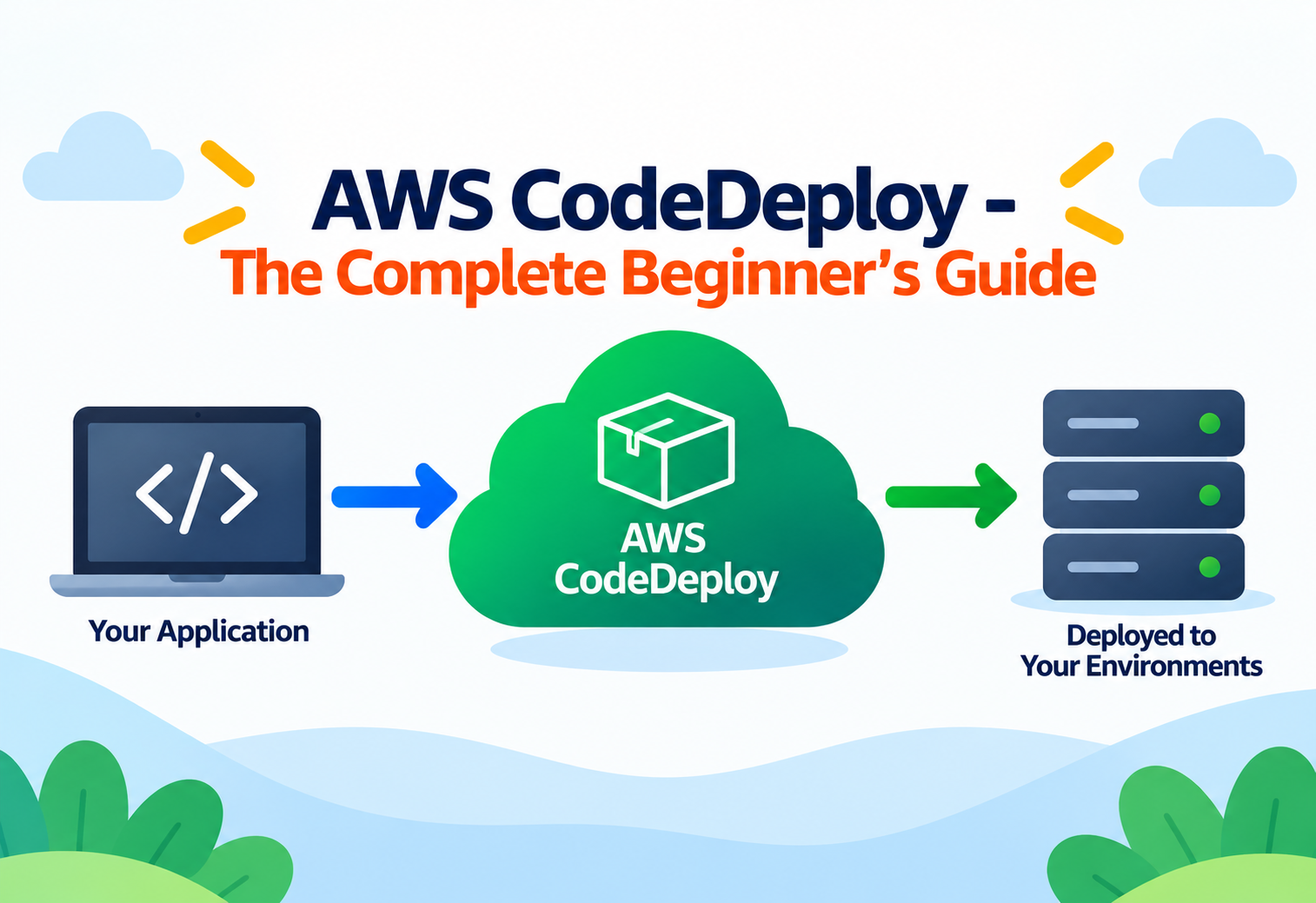
AWS CodeDeploy — The Complete Beginner's Guide
A fully managed deployment service that automatically pushes new code to EC2 instances, on-premises servers, Lambda functions, and ECS containers — with built-in rollback if anything goes wrong.
Picture a restaurant with fifty locations across the country. Head office just perfected a new recipe and wants every kitchen to switch to it tonight — but not all at once, in case the new recipe turns out to have a problem. They want a plan: update five kitchens first, watch customer feedback, then roll out to the rest, and if anything goes wrong, instantly switch every kitchen back to the old recipe. AWS CodeDeploy does exactly this, except the “kitchens” are servers, containers, or serverless functions, and the “recipe” is your application code. It automates the risky, repetitive, and easy-to-mess-up job of getting new code safely onto running infrastructure — one server, one function, or one container at a time, on your schedule, with automatic rollback if something breaks.
1Core Concepts
What is “deployment”?
Deployment is the act of taking a finished piece of code — already built and tested — and installing it onto the servers or platforms that real users interact with. This sounds simple until you have hundreds of servers, and doing it by hand (logging into each one, copying files, restarting the application) is slow, error-prone, and terrifying to do at 2 a.m. during an outage fix.
What is AWS CodeDeploy, specifically?
AWS CodeDeploy is a fully managed deployment service that automates pushing application code, configuration files, executables, and scripts to a set of “compute” destinations. It supports four compute platforms: Amazon EC2 instances, on-premises servers (physical machines in your own data center), AWS Lambda functions, and Amazon ECS (container services). Rather than writing custom scripts to SSH into every server, CodeDeploy handles the orchestration: which servers get the update first, how long to wait between batches, what to do if health checks fail, and how to roll everything back instantly if needed.
Think of CodeDeploy as an experienced stage manager for a live theater production with multiple touring casts performing simultaneously in different cities. Instead of every cast switching to a new script at the exact same random moment (risking that half the actors are on the old script and half on the new one mid-scene), the stage manager rolls the change out city by city, watches for problems after each city switches, and can instantly tell everyone to revert to the old script if the new one causes a disaster.
Why does this matter?
Manual deployments are one of the leading causes of production outages — a missed step, a typo in a config file, or forgetting to restart a service can bring down an application. CodeDeploy removes human inconsistency from the process by running the exact same, tested deployment steps every single time, on every single target, in a defined order.
2Architecture & Components
Application
A named container in CodeDeploy that groups everything related to deploying one piece of software — a logical folder for your deployment settings.
Deployment Group
The specific set of EC2 instances, Lambda function, or ECS service that a deployment should target, plus rules for how the rollout happens.
AppSpec File (appspec.yml)
A YAML or JSON file that tells CodeDeploy exactly what to do: which files go where, and which scripts to run at each stage of the deployment.
Revision
The actual bundle being deployed — your application files plus the appspec file, stored in Amazon S3 or a GitHub/CodeCommit repository.
CodeDeploy Agent
A small piece of software installed on each EC2 instance or on-premises server that talks to CodeDeploy, downloads the revision, and executes the appspec instructions locally.
Amazon CloudWatch Alarms
Health signals CodeDeploy can watch during a deployment — if an alarm trips, CodeDeploy can automatically stop and roll back.
flowchart TB
    S3["Revision Bundle
(app files + appspec.yml)
in Amazon S3 / CodeCommit"] --> CD["AWS CodeDeploy
Deployment Orchestrator"]
    CD --> DG["Deployment Group
(target selection + rollout rules)"]
    DG --> EC2A["EC2 Instance Batch 1
(CodeDeploy Agent)"]
    DG --> EC2B["EC2 Instance Batch 2
(CodeDeploy Agent)"]
    DG --> Lambda["AWS Lambda
(traffic-shifting alias)"]
    DG --> ECS["Amazon ECS Service
(new task set)"]
    EC2A --> Hooks1["Lifecycle Hooks:
BeforeInstall -> Install -> AfterInstall -> ApplicationStart -> ValidateService"]
    EC2B --> Hooks2["Lifecycle Hooks
(same sequence)"]
    CD --> Alarm["Amazon CloudWatch Alarms
Health Monitoring"]
    Alarm -->|"alarm triggers"| Rollback["Automatic Rollback
to last known-good revision"]
    CD --> CW["CloudWatch Logs & Events"]
Notice that EC2 and on-premises deployments rely on an installed agent doing the local work, while Lambda and ECS deployments work differently — CodeDeploy shifts traffic between old and new versions directly at the platform level, since there’s no “server” to install an agent on.
3Internal Working
For EC2 and on-premises deployments, the CodeDeploy Agent is the workhorse. It runs continuously on each target instance, periodically checking in with the CodeDeploy service to ask, “is there a deployment waiting for me?” When one is, the agent:
Downloads the revision
Fetches the application bundle and appspec.yml file from Amazon S3 or the source repository specified in the deployment.
Reads the appspec.yml
Parses the instructions: which files to copy where, and which lifecycle event hooks to run.
Runs lifecycle hooks in order
Executes scripts at each defined stage — for example, stopping the old application (ApplicationStop), copying new files (Install), running setup scripts (AfterInstall), starting the application (ApplicationStart), and confirming it’s healthy (ValidateService).
Reports status back
Tells CodeDeploy whether each step succeeded or failed, which CodeDeploy aggregates across every instance in the deployment group.
For Lambda deployments, there is no agent at all — CodeDeploy instead manipulates a Lambda alias (a named pointer to a specific function version), gradually shifting a percentage of invocation traffic from the old version to the new one according to the deployment configuration you choose. For ECS deployments, CodeDeploy works with an Application Load Balancer to spin up a new task set alongside the old one and shift traffic between them.
Lifecycle hook names differ slightly by compute platform. EC2/On-Premises deployments use hooks like BeforeInstall and AfterInstall; Lambda deployments use hooks like BeforeAllowTraffic and AfterAllowTraffic to run validation code before and after traffic shifts.
4Data Flow & Lifecycle
Step 1 — Package. The finished, tested application is bundled together with an appspec.yml file describing how to install it, then uploaded to Amazon S3 (or referenced from CodeCommit/GitHub).
Step 2 — Create a deployment. A deployment is started, referencing the application, the deployment group (which servers, functions, or containers to target), and the revision to deploy.
Step 3 — Select a deployment type. For EC2, you choose in-place (update servers where they stand) or blue/green (stand up entirely new, replacement servers and switch traffic once they’re verified healthy).
Step 4 — Rollout begins according to configuration. CodeDeploy applies your chosen deployment configuration — for example, updating one instance at a time, half at a time, or all at once — pausing between batches to check health.
Step 5 — Lifecycle hooks execute. On each target, the sequence of install-and-validate scripts defined in the appspec file runs in order.
Step 6 — Health is verified. CodeDeploy checks whether each instance, function version, or task set reports healthy — using its own validation hooks and, optionally, CloudWatch alarms.
Step 7 — Success or automatic rollback. If everything reports healthy, the deployment completes and moves to the next batch (or finishes). If a failure or alarm threshold is detected, CodeDeploy can automatically redeploy the last known-good revision, undoing the change without a human needing to react at 3 a.m.
Blue/Green in Practice
In a blue/green EC2 deployment, the “blue” fleet keeps serving all live traffic while the brand-new “green” fleet is provisioned and validated in the background. Only once green passes every health check does CodeDeploy shift the load balancer’s traffic over — meaning users never touch a partially-updated server.
5Advantages, Disadvantages & Trade-offs
Advantages
- Works across four compute platforms — EC2, on-premises, Lambda, and ECS — under one consistent model.
- Automatic rollback on failure removes a huge source of manual firefighting.
- Supports gradual traffic-shifting strategies (canary, linear) that limit the blast radius of a bad release.
- No extra charge for the CodeDeploy service itself when deploying to EC2/on-premises — you only pay for the underlying resources used.
- Integrates natively with CodePipeline, CloudWatch, and Auto Scaling.
Disadvantages
- Requires installing and maintaining the CodeDeploy Agent on every EC2/on-premises target.
- The appspec.yml and lifecycle-hook model has a learning curve for teams new to it.
- Less flexible than some third-party deployment tools for highly customized, multi-cloud rollout logic.
- Blue/green EC2 deployments temporarily double infrastructure cost while both fleets run.
6Performance & Scalability
CodeDeploy is built to handle deployments ranging from a single EC2 instance to fleets of thousands. Deployment configurations let you control the pace precisely: deploy to one instance at a time for maximum safety, half at a time for a balance of speed and safety, or all at once when speed matters more (such as deploying to a staging environment).
For Lambda and ECS, “scalability” takes a different shape: instead of batches of servers, CodeDeploy shifts a percentage of traffic — for example, a canary configuration might send 10% of traffic to the new version, wait ten minutes, then shift the remaining 90%, or a linear configuration might increase traffic by a fixed percentage every few minutes until it reaches 100%.
7High Availability & Reliability
CodeDeploy’s reliability story is really about protecting your application’s availability during the riskiest moment of its life — the moment code changes. By deploying in controlled batches rather than everywhere at once, a bad release only ever affects a fraction of your fleet before CodeDeploy notices and stops.
It’s the difference between a chef testing a new dish on one table of diners before adding it to the entire restaurant’s menu, versus serving it to every single guest simultaneously on opening night. One approach contains a mistake; the other broadcasts it.
Blue/green deployments push this further: because the old fleet (“blue”) keeps running and serving traffic throughout, a failed deployment of the new fleet (“green”) never touches production traffic at all — the switch to green only happens after it’s already proven healthy.
8Security
IAM Service Roles
CodeDeploy assumes an IAM service role granting it permission to interact with EC2, Lambda, ECS, Auto Scaling, and Elastic Load Balancing on your behalf — nothing more than what you grant.
Instance Profile
Each EC2 target needs an instance profile allowing the CodeDeploy Agent to communicate with the CodeDeploy service and download revisions from S3.
Encrypted Revisions
Revisions stored in S3 can be encrypted at rest using S3-managed or KMS keys, and all communication with the CodeDeploy service uses HTTPS.
AWS CloudTrail
Every deployment-related API call is logged, providing a full audit trail of who deployed what, when, and to which targets.
Anti-Pattern
Granting the CodeDeploy service role broad, account-wide permissions like full EC2 or Lambda access “to avoid permission errors.”
Why It’s A Problem
A compromised or misconfigured pipeline could then modify or terminate resources far outside its intended deployment scope.
Better Approach
Scope the service role to exactly the actions CodeDeploy needs (documented by AWS as managed policies like AWSCodeDeployRole), and further restrict resource access using tags and resource-level IAM conditions where possible.
9Monitoring, Logging & Metrics
| Tool | What It Tells You |
|---|---|
| CodeDeploy Console Deployment History | A step-by-step timeline of every deployment, including which instance or task set is on which lifecycle event right now. |
| Amazon CloudWatch Alarms | Health thresholds (like elevated error rates) that, when breached during a deployment, can trigger an automatic rollback. |
| Amazon CloudWatch Logs / Agent Logs | Detailed logs from the CodeDeploy Agent on each instance, useful for diagnosing why a specific lifecycle hook failed. |
| Amazon SNS Notifications | Alerts sent when a deployment starts, succeeds, fails, or rolls back. |
| AWS CloudTrail | An audit trail of every CodeDeploy API call for security and compliance review. |
Always attach at least one meaningful CloudWatch alarm — such as a spike in 5xx errors or latency — to production deployment groups. Without one, CodeDeploy can only detect failures it directly observes (like a script exiting with an error), not degraded application behavior after a “successful” deploy.
10Deployment & Cloud Integration
In a typical setup, code changes merged into a repository (such as AWS CodeCommit or GitHub) trigger AWS CodePipeline, which runs the build and test stage using AWS CodeBuild, and then hands the finished, tested package to CodeDeploy for the actual rollout. This means a developer’s merged pull request can result in production code being live minutes later, with zero manual steps, and a documented, auditable trail of exactly what happened at each stage.
Auto Scaling Integration
When deploying to an EC2 Auto Scaling group, CodeDeploy automatically ensures that any brand-new instance launched by Auto Scaling (say, during a traffic spike) receives the currently deployed application version immediately, without waiting for the next full deployment.
11Design Patterns & Anti-patterns
Canary Releases
Shift a small percentage of traffic (say 10%) to the new version first, observe for a defined period, then complete the rollout — catching problems before most users are affected.
Blue/Green with Automatic Rollback
Combine a fresh replacement fleet with CloudWatch alarms so any regression automatically reverts traffic to the still-running old fleet.
Skipping ValidateService
Omitting a real health check in the final lifecycle hook means CodeDeploy can report “success” even though the application never actually started correctly.
No Rollback Configuration
Leaving automatic rollback disabled on production deployment groups turns every failed deploy into an unplanned, manual incident-response exercise.
12Best Practices & Common Mistakes
Always enable automatic rollback
Configure it to trigger on deployment failure and, ideally, on CloudWatch alarm breaches too.
Write real validation scripts
Make ValidateService (or its Lambda/ECS equivalent) actually check that the application responds correctly, not just that a process is running.
Start with conservative deployment configurations
Prefer OneAtATime or a canary strategy for production, saving AllAtOnce for lower-risk environments like development.
Keep the CodeDeploy Agent updated
An outdated agent can lack bug fixes or new feature support — automate agent updates as part of your instance provisioning.
Version-control your appspec.yml
Treat deployment instructions with the same review rigor as application code, since a broken appspec file can break every deployment.
Assuming “deployment succeeded” always means “application is healthy.” CodeDeploy reports success based on the lifecycle hooks and health checks you define — if those checks are shallow, a genuinely broken release can still show a green checkmark.
13Real-World & Industry Examples
Netflix-Scale Streaming Platforms
Large media and streaming platforms use gradual, canary-style deployment strategies conceptually similar to CodeDeploy’s canary configurations to roll out changes to services handling millions of concurrent viewers without risking a full-scale outage from a single bad release.
E-Commerce Flash Sales
Retailers running Auto Scaling groups behind seasonal traffic spikes rely on CodeDeploy’s Auto Scaling integration to guarantee newly launched instances during a sale automatically receive the correct, current application version.
Serverless API Teams
Teams running APIs on AWS Lambda use CodeDeploy’s traffic-shifting for Lambda aliases to test new function versions on a small slice of real traffic before a full cutover, catching regressions with minimal customer impact.
Hybrid Data Centers
Enterprises migrating gradually to the cloud use CodeDeploy’s on-premises support to apply the exact same deployment pipeline and lifecycle hooks to their remaining physical servers as they use for their EC2 fleet.
14Frequently Asked Questions
15Summary and Key Takeaways
Key Takeaways
- AWS CodeDeploy automates the safe, consistent rollout of application code to EC2 instances, on-premises servers, Lambda functions, and ECS services.
- Deployments are driven by an appspec.yml file defining what to install and which lifecycle hooks to run, in order, on each target.
- Deployment configurations (OneAtATime, HalfAtATime, AllAtOnce, canary, linear) let you control exactly how fast and how carefully a rollout proceeds.
- Blue/green deployments stand up a fresh, verified fleet before switching traffic, keeping the old fleet as an instant fallback.
- Automatic rollback, especially when tied to CloudWatch alarms, turns a bad release into a self-healing non-event instead of a manual incident.
- CodeDeploy is typically the final, execution stage of a larger pipeline built with CodePipeline and CodeBuild, turning a merged code change into a live release automatically.
- Real health verification in your lifecycle hooks matters — a “successful” deployment is only as trustworthy as the checks you configure it to run.