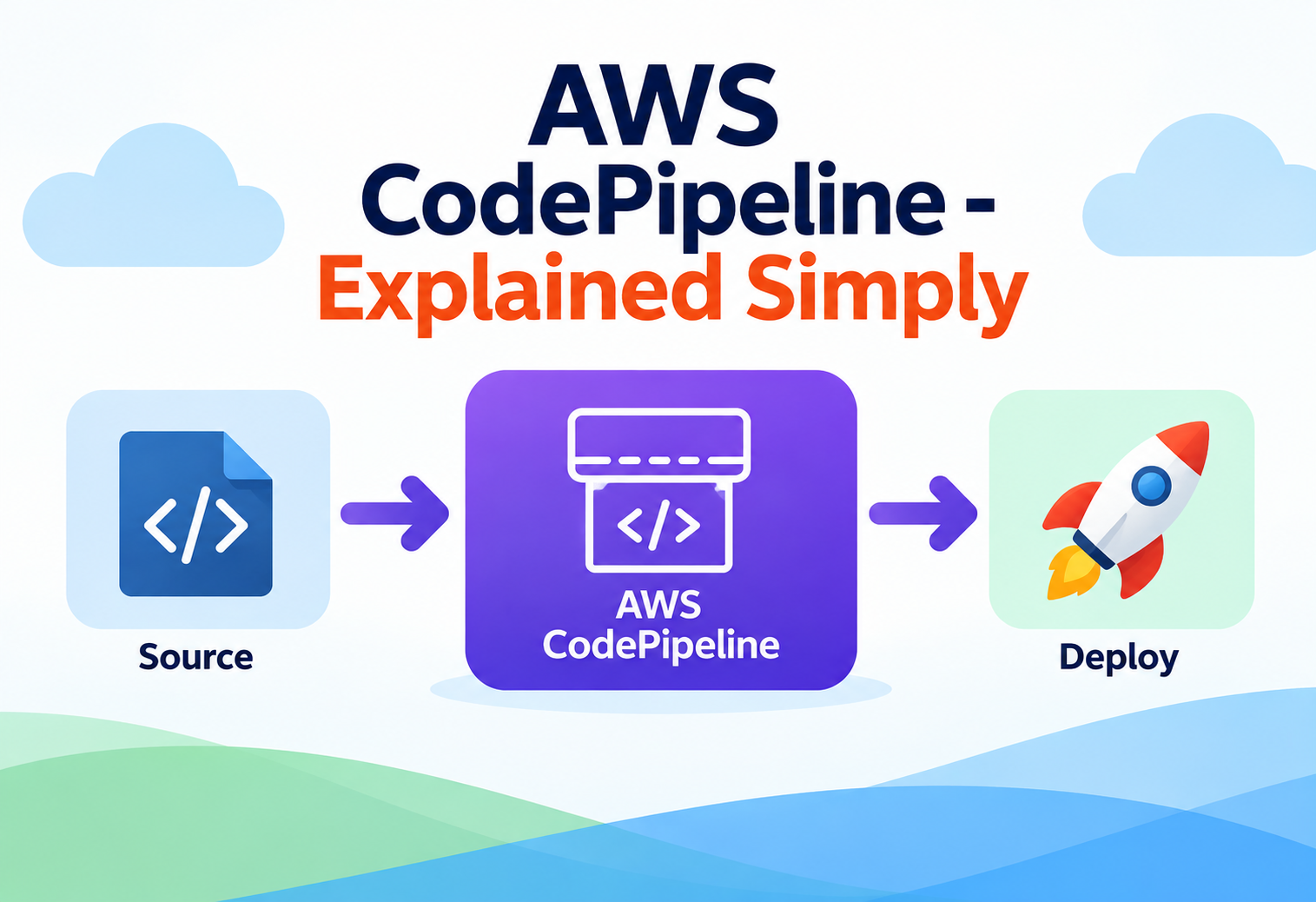
AWS CodePipeline – Explained Simply
A complete, zero-jargon walkthrough of how AWS CodePipeline moves your code from a commit to a running application — automatically, safely, and every single time.
Imagine you work in a bakery. Every time you bake a new batch of bread, someone has to check the oven temperature, taste-test a slice, package it, label it, and put it on the shelf for customers. If you did every one of these steps by hand, for every single loaf, you would be slow, tired, and prone to mistakes — forgetting a label here, under-baking a loaf there. Now imagine a conveyor belt that automatically moves each loaf through every one of those stations, in the same order, every time, without anyone forgetting a step. That conveyor belt, but for software instead of bread, is exactly what AWS CodePipeline is. It takes your code from “a developer just changed something” all the way to “customers are using the new version,” moving it automatically through testing, building, and deployment stations. This guide walks through what CodePipeline is, how it works under the hood, and how real companies use it — explained so that even a complete beginner can follow every step.
1Core Concepts
Before touching architecture, let’s build a rock-solid mental picture of what CodePipeline actually is and why it exists.
What Is AWS CodePipeline?
AWS CodePipeline is a fully managed continuous integration and continuous delivery (CI/CD) service offered by Amazon Web Services. In plain English: it is a service that automatically takes your application’s source code, runs it through a series of steps — like building it, testing it, and deploying it — and does this every time you make a change, without a human needing to click “deploy” manually. “Fully managed” means AWS runs and maintains the underlying servers and software for you; you never have to patch an operating system or worry about the pipeline engine crashing at 2 a.m.
Think of an airport baggage system. You drop your suitcase at check-in (this is like committing code to a repository). From there, conveyor belts, scanners, and sorting machines move your bag through security screening, sorting by flight, and loading onto the correct aircraft — all without you touching it again. CodePipeline is that conveyor-and-scanner system for your code: it moves your changes through building, testing, and deployment “checkpoints” automatically, and only lets the “bag” (your code) through to the next stage if it passes inspection.
Why Does It Exist?
Before tools like CodePipeline existed, teams shipped software by having an engineer manually copy files onto a server, restart services, and cross their fingers. This approach was slow, inconsistent, and terrifying at 2 a.m. when something broke. As companies like Amazon and Netflix started releasing new code dozens or hundreds of times a day, manual deployment became physically impossible. CodePipeline exists to solve three problems at once: speed (ship changes in minutes, not days), consistency (the exact same steps run every time, so human error is removed), and safety (nothing reaches production unless it passes every required check along the way).
Key Terms You’ll See Everywhere
Pipeline
The full end-to-end workflow definition — the entire conveyor belt from source code to a live application.
Stage
A major checkpoint in the pipeline, such as “Source,” “Build,” “Test,” or “Deploy.” Stages run one after another.
Action
A single task inside a stage, like “run unit tests” or “deploy to a server.” A stage can hold multiple actions.
Artifact
The output files passed from one stage to the next — for example, compiled code passed from the Build stage to the Deploy stage.
2Architecture & Components
CodePipeline is not a single tool — it is a coordinator that connects several AWS services together like stations on a factory line.
A typical CodePipeline setup connects a source provider (where your code lives), a build service (which compiles and tests your code), and a deployment target (where the finished application actually runs). CodePipeline itself does not build or deploy anything directly — it is the orchestrator that calls on other specialized AWS services to do each job, and moves the output from one to the next.
flowchart LR
    A["Developer
Commits Code"] --> B["Source Stage
(CodeCommit / GitHub / S3)"]
    B --> C["Build Stage
(AWS CodeBuild)"]
    C --> D["Test Stage
(CodeBuild / Device Farm)"]
    D --> E["Approval Stage
(Manual Approval - optional)"]
    E --> F["Deploy Stage
(CodeDeploy / ECS / CloudFormation / Elastic Beanstalk)"]
    F --> G["Live Application
(Production Environment)"]
    B -.->|"Artifact stored"| H[("Amazon S3
Artifact Bucket")]
    C -.->|"Artifact stored"| H
    H -.->|"Artifact retrieved"| D
    H -.->|"Artifact retrieved"| F
FIG 1 — A typical CodePipeline: source, build, test, optional approval, and deploy stages, coordinated through an S3 artifact bucket.
The Core Building Blocks
Source Provider
Where your code lives — commonly AWS CodeCommit, GitHub, Bitbucket, or an S3 bucket. CodePipeline watches this location for changes.
AWS CodeBuild
A managed build service that compiles code, runs unit tests, and produces deployable packages, following instructions in a file called buildspec.yml.
Amazon S3 Artifact Bucket
The “hand-off tray” between stages. Every stage’s output is zipped and dropped here so the next stage can pick it up.
Deployment Target
Where the application ends up running — AWS CodeDeploy (for EC2/on-premises), Amazon ECS (for containers), AWS Elastic Beanstalk, or AWS CloudFormation (for infrastructure).
IAM Roles & Permissions
The “security badges” that let each stage access only the resources it needs — nothing more.
CodePipeline does not run your tests or host your application itself. It is purely the traffic controller — deciding what happens next, in what order, and only if the previous step succeeded.
3Internal Working
What actually happens, moment by moment, when a pipeline runs?
Under the hood, CodePipeline is an event-driven state machine. It does not constantly poll and burn resources checking “is anything new yet?” every second. Instead, most modern setups use Amazon EventBridge, which listens for a specific event — such as “a new commit landed in this GitHub repository” — and instantly triggers the pipeline to start a new execution. This is similar to a doorbell: instead of someone standing at the door all day checking if a visitor has arrived, the doorbell rings the instant someone presses it.
Once triggered, CodePipeline creates a new pipeline execution, which is a single run through all the stages, and assigns it a unique execution ID. The pipeline then processes stages strictly in order — Stage 2 cannot begin until every action in Stage 1 has reported success. Within a stage, actions can run in parallel (side by side) or sequentially depending on how the pipeline is configured.
Picture a relay race. Each runner (stage) must finish their leg and physically hand the baton (the artifact) to the next runner before that runner can start. If a runner drops the baton (a stage fails), the race stops right there — the next runner never begins, and officials are alerted immediately rather than the race quietly continuing with no baton.
Artifact Hand-off Explained
Every time a stage finishes successfully, its output files are zipped into an artifact and uploaded to a dedicated Amazon S3 bucket. The next stage then downloads that exact artifact from S3 before it begins. This matters because it guarantees that the Test stage tests the exact same code the Build stage just built — not a slightly different copy pulled fresh from source control, which could introduce inconsistencies.
4Data Flow & Lifecycle
Following one commit from a developer’s laptop to a live production server.
sequenceDiagram
    participant Dev as Developer
    participant Repo as Source Repo (GitHub/CodeCommit)
    participant EB as Amazon EventBridge
    participant CP as AWS CodePipeline
    participant CB as AWS CodeBuild
    participant S3 as S3 Artifact Bucket
    participant CD as AWS CodeDeploy
    participant App as Production Servers

    Dev->>Repo: git push (new commit)
    Repo->>EB: Emits "push" event
    EB->>CP: Triggers pipeline execution
    CP->>Repo: Pulls latest source code
    CP->>S3: Stores source artifact
    CP->>CB: Starts Build stage
    CB->>S3: Fetches source artifact
    CB->>CB: Compiles code, runs unit tests
    CB->>S3: Uploads build artifact
    CP->>CD: Starts Deploy stage
    CD->>S3: Fetches build artifact
    CD->>App: Deploys new version (rolling/blue-green)
    App-->>CP: Reports deployment status
FIG 2 — Lifecycle of a single commit, from developer push to a live deployment on production servers.
Notice the pattern: at every arrow, data or control passes from one specialized service to the next, and CodePipeline itself simply watches, waits for a success or failure signal, and decides what happens next. If any step reports failure, CodePipeline halts immediately and marks the entire execution as failed — the “bad loaf of bread” never reaches the shelf.
Transitions Between Stages
Each stage-to-stage transition can optionally have a transition gate, which lets a team temporarily disable movement into a specific stage — for example, freezing all deployments to production during a holiday shopping event, while still allowing builds and tests to run normally.
5Advantages, Disadvantages & Trade-offs
Like every tool, CodePipeline is a great fit for some situations and an awkward fit for others.
Advantages
- Fully managed — no servers to patch or scale for the pipeline engine itself
- Deep native integration with other AWS services (CodeBuild, CodeDeploy, ECS, Lambda, CloudFormation)
- Visual pipeline editor makes stages and their status easy to understand at a glance
- Pay-per-active-pipeline pricing keeps costs predictable for small teams
- Built-in support for manual approval gates before risky deployments
Disadvantages
- Tightly coupled to the AWS ecosystem — less convenient if your infrastructure is multi-cloud
- Fewer built-in third-party plugin integrations compared to tools like Jenkins
- Debugging a failed stage often means jumping into CloudWatch Logs, which can be less friendly for beginners
- Complex, highly customized workflows can require stitching together multiple services and Lambda functions
CodePipeline trades some flexibility for a large amount of “it just works” reliability inside AWS. Teams already living inside AWS gain enormous convenience; teams needing to orchestrate deployments across AWS, on-premises, and another cloud provider often find more flexible tools a better fit.
6Performance, Scalability & High Availability
How CodePipeline behaves when a company runs thousands of pipelines a day.
Performance
CodePipeline itself introduces very little overhead — most of the time spent in a pipeline execution is actually spent inside CodeBuild (compiling and testing) or CodeDeploy (rolling out to servers), not in the orchestration layer. A simple pipeline can complete a full source-to-deploy cycle in a couple of minutes; complex pipelines with many test suites can take much longer, but that time is a property of the tests, not of CodePipeline.
Scalability
Because CodePipeline is serverless and fully managed by AWS, it automatically scales to support many pipelines running in parallel across an organization, without any capacity planning from the customer. A large company can have hundreds of teams, each running dozens of pipelines a day, and AWS handles the scaling transparently behind the scenes.
High Availability
CodePipeline’s control plane runs across multiple Availability Zones within a region, meaning the service that tracks and coordinates your pipeline executions is designed to keep working even if part of an AWS data center has an issue. For true disaster recovery of your application deployments, teams typically pair CodePipeline with multi-region deployment targets, so that even a region-wide event does not stop new releases from reaching customers.
7Security & Monitoring
A pipeline that can push code to production is also a pipeline that must be locked down carefully.
Security
Every action inside a CodePipeline stage runs using an IAM role — a defined set of permissions describing exactly what that action is allowed to touch. Following the principle of least privilege, a Build stage’s role should only be able to read source code and write build artifacts, never deploy directly to production. Secrets like database passwords are kept out of the pipeline definition entirely and instead pulled at runtime from AWS Secrets Manager or AWS Systems Manager Parameter Store.
Think of IAM roles like keycards in an office building. The intern’s keycard opens the front door and the break room, but not the server room. The senior engineer’s deploy-stage keycard opens the server room, but only during approved hours. Nobody carries a master key that opens everything — that would be a security disaster waiting to happen.
Monitoring, Logging & Metrics
Every pipeline execution’s history — which stage it is in, whether it succeeded or failed, and how long each step took — is visible directly in the CodePipeline console. Detailed logs from the Build and Deploy stages flow into Amazon CloudWatch Logs, while state changes (like “stage started” or “stage failed”) can trigger Amazon SNS notifications to alert a team instantly via email, Slack, or a paging tool. This turns a silent failure into an immediate, actionable alert rather than something discovered hours later by an angry customer.
Set up a CloudWatch Events rule (or EventBridge rule) that notifies your team’s chat channel the moment any pipeline enters a FAILED state. This single habit dramatically shortens the time between “something broke” and “someone is looking at it.”
8Design Patterns & Anti-patterns
What experienced teams do right — and what beginners often get wrong.
Good Pattern: Blue-Green Deployment
Instead of updating live servers directly, a completely separate “green” environment is stood up with the new version. Traffic is switched over only once the green environment passes health checks, and the old “blue” environment stays ready as an instant rollback target.
Good Pattern: Approval Gates Before Production
Adding a manual approval action between the Test stage and the Production Deploy stage means a human reviews results before the riskiest step happens — cheap insurance against automation moving too fast.
Pattern
Deploying directly to production with no separate Test stage, “because it’s just a small change.”
Why It Fails
Small changes cause a large share of real-world outages precisely because they feel too minor to test carefully. Skipping validation removes the safety net that catches an unexpected side effect.
Better Approach
Keep the Test stage mandatory for every change, no matter how small it appears, and rely on fast, well-targeted automated tests to keep this stage quick rather than removing it.
Pattern
Giving every pipeline’s IAM role broad “AdministratorAccess” permissions to “avoid permission errors.”
Why It Fails
A single compromised credential or a buggy script can now touch every resource in the AWS account, turning a small mistake into an account-wide incident.
Better Approach
Grant each stage only the specific permissions it needs, and review these permissions periodically as the pipeline evolves.
9Best Practices & Common Mistakes
Practical habits that separate a smooth pipeline from a constant source of team frustration.
| Best Practice | Why It Matters |
|---|---|
| Keep pipeline definitions in version control (Infrastructure as Code) | Changes to the pipeline itself get reviewed and tracked, just like application code |
| Fail fast — run cheapest, quickest tests first | Catches obvious problems in seconds instead of waiting minutes for a full test suite |
| Use separate pipelines per environment (dev, staging, prod) | Prevents an experimental change in development from accidentally reaching customers |
| Always add a rollback plan to the Deploy stage | Turns a bad deployment into a quick fix instead of a multi-hour outage |
| Tag and version every artifact | Makes it possible to trace exactly which commit is running in production at any moment |
Common Mistakes Beginners Make
- Forgetting to restrict who can approve the manual approval gate, making it a meaningless formality
- Not setting a timeout on stages, so a stuck build silently blocks the pipeline for hours
- Hard-coding environment-specific values (like server addresses) instead of using parameters
- Ignoring failed pipeline notifications until someone notices the app is broken in production
10Real-World Usage Patterns
How well-known companies apply these same ideas at massive scale.
Amazon Retail
Amazon’s own internal deployment culture — the philosophy that inspired CodePipeline itself — relies on small, frequent, automatically tested changes rather than large, risky, infrequent releases.
Netflix
Netflix uses automated pipelines with staged rollouts and automated health checks, so a new version reaches a small slice of users first before a full global release.
Lyft
Companies with many independent microservices rely on per-service pipelines so one team’s release never has to wait for another team’s code to finish testing.
BBC
Media organizations with strict editorial and compliance checks add manual approval gates in their pipelines before anything reaches a public-facing website.
11Frequently Asked Questions
12Summary and Key Takeaways
Key Takeaways
- AWS CodePipeline is an orchestrator, not a builder or deployer itself — it coordinates specialized services like CodeBuild and CodeDeploy in a fixed, repeatable order.
- Stages run in strict sequence, and a pipeline halts the instant any stage fails, preventing broken code from silently reaching customers.
- Artifacts hand off through Amazon S3 between stages, guaranteeing the exact same code is tested and deployed, with nothing lost or swapped in between.
- Security follows least-privilege IAM roles per stage, and secrets are pulled from Secrets Manager rather than stored in the pipeline itself.
- Manual approval gates and blue-green deployments add human judgment and instant rollback safety to the riskiest step: reaching production.
- Scalability is automatic — CodePipeline is serverless, so teams never provision capacity for the orchestration layer itself, only for their actual build and deploy targets.
- Companies like Amazon and Netflix rely on this exact philosophy — small, frequent, automatically verified changes — to ship reliably at enormous scale.