AWS Systems Manager, Explained Simply
A complete, zero-jargon walkthrough of the service that lets you see, control, and maintain thousands of servers from one single dashboard — without logging into any of them individually.
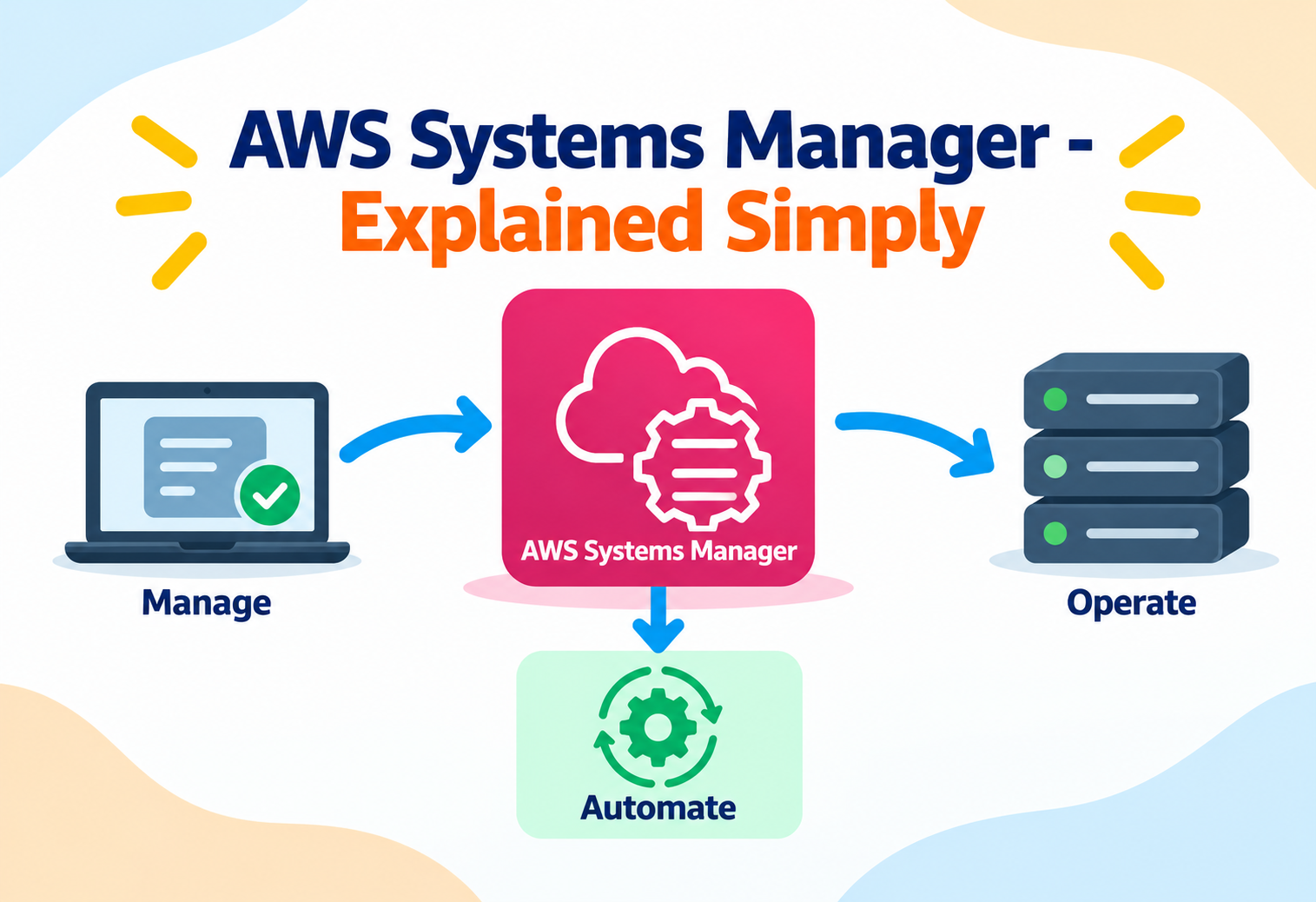
Imagine you are the head custodian for an entire school district with fifty school buildings. If you had to physically drive to each building every time a lightbulb needed replacing, a thermostat needed adjusting, or a door needed locking, your entire day would disappear into driving. Now imagine a single control room where you can see the status of every building at once, flip switches remotely, push a maintenance checklist out to all fifty buildings simultaneously, and get an alert the moment something goes wrong in any one of them. AWS Systems Manager is that control room, but for servers instead of school buildings. It gives you one central place to view, configure, patch, and troubleshoot potentially thousands of servers across your AWS account — and even servers running outside AWS — without needing to individually log into each one. This guide explains what Systems Manager is, how it works internally, and how real companies rely on it, assuming no prior cloud knowledge at all.
1Core Concepts
Before touching architecture, let’s build a clear picture of the problem Systems Manager solves.
What Is AWS Systems Manager?
AWS Systems Manager (often shortened to “SSM”) is a management service that gives you visibility and control over your servers — called managed nodes — from one central console, without needing direct network access or individual logins to each machine. It bundles together many operational capabilities, such as running commands remotely, patching software automatically, storing configuration values securely, and viewing an inventory of everything installed across your fleet.
Think of a TV remote that works on every television in a large electronics store simultaneously — press one button, and every screen changes channel at once, instead of a staff member walking to each television individually. Systems Manager is that universal remote for your servers: run one command, and it executes across hundreds of machines at once, each reporting back its own individual result.
Why Does It Exist?
As companies grow from a handful of servers to hundreds or thousands, logging into each one individually to check a setting, apply a security patch, or troubleshoot an issue becomes physically impossible. This manual approach also creates inconsistency — one server might get patched today, another accidentally forgotten for months, quietly becoming a security risk. Systems Manager exists to make an entire fleet of servers behave and stay updated consistently, as if it were one manageable unit rather than thousands of individually maintained machines.
Key Terms You’ll See Everywhere
Managed Node
Any server — an EC2 instance, an on-premises machine, or even one in another cloud — registered with Systems Manager.
SSM Agent
A small piece of software running on each managed node that receives instructions and reports status back.
SSM Document
A predefined or custom set of steps describing an action to perform, such as “install this update” or “restart this service.”
Parameter Store
A secure, centralized place to store configuration values and secrets that applications and automation can retrieve on demand.
2Architecture & Components
Systems Manager works through a lightweight agent installed on every machine it controls, communicating back to a central service.
Every managed node runs the SSM Agent, a small background process that regularly checks in with the central Systems Manager service to see if there is anything to do. This design means Systems Manager never needs to directly, proactively reach into your servers over an open network port — instead, each agent reaches out on its own, which is both simpler to secure and easier to operate across complex, firewalled networks.
flowchart LR
    A["AWS Systems Manager
(Central Service)"] -->|"Sends command/config"| B["SSM Agent
on EC2 Instance"]
    A -->|"Sends command/config"| C["SSM Agent
on On-Premises Server"]
    A -->|"Sends command/config"| D["SSM Agent
on Another Cloud VM"]
    B -->|"Reports status"| A
    C -->|"Reports status"| A
    D -->|"Reports status"| A
    A --> E["Parameter Store
(Config & Secrets)"]
    A --> F["Inventory Data
(Installed Software/Config)"]
FIG 1 — One central Systems Manager service coordinates many managed nodes across AWS, on-premises, and other clouds through a lightweight agent.
The Core Building Blocks
Session Manager
A secure, browser-based way to open a terminal session on a managed node without opening any inbound network ports.
Run Command
Executes a predefined action, like installing a package or restarting a service, across many managed nodes at once.
Patch Manager
Automates scanning for and applying operating system and software patches on a defined schedule.
Parameter Store
A secure repository for configuration values and secrets, retrievable by name from applications and automation.
Because the agent initiates contact outward rather than the service reaching in, Systems Manager can often manage servers even in tightly locked-down private networks with no direct inbound internet access at all.
3Internal Working
What actually happens, step by step, when you run a command across your entire fleet?
When you send a command through Systems Manager, it does not travel directly to your servers over a traditional network connection. Instead, the command is placed where the SSM Agent on each targeted managed node will find it the next time that agent checks in — a pattern called polling. Once an agent picks up the instruction, it executes it locally on that machine and reports the result — success, failure, or output — back to the central service, which aggregates results from every targeted node into one combined view.
Think of a company-wide memo pinned to a shared bulletin board rather than a manager personally walking to every employee’s desk. Each employee checks the board periodically, reads any new memo addressed to them, carries out the instruction, and reports back. The manager never had to physically visit anyone, yet the instruction still reached everyone reliably.
Why Polling Instead of Direct Push?
This check-in style, rather than a direct incoming connection, avoids the need to open inbound firewall ports on every managed server, which would otherwise be a significant, constantly-managed security exposure. It also naturally handles temporarily offline machines — a server that was briefly restarted simply picks up its pending instructions the next time its agent checks in, rather than the whole operation failing outright.
4Data Flow & Lifecycle
Following one “install security patch” command from an administrator’s click to confirmation on every server.
sequenceDiagram
    participant Admin as Administrator
    participant SSM as AWS Systems Manager
    participant Agent1 as SSM Agent (Server A)
    participant Agent2 as SSM Agent (Server B)

    Admin->>SSM: Sends "Run Patch" command, targets fleet
    SSM->>SSM: Queues instruction for each managed node
    Agent1->>SSM: Regular check-in (polling)
    SSM-->>Agent1: Delivers pending instruction
    Agent1->>Agent1: Applies patch locally
    Agent1->>SSM: Reports success
    Agent2->>SSM: Regular check-in (polling)
    SSM-->>Agent2: Delivers pending instruction
    Agent2->>Agent2: Applies patch locally
    Agent2->>SSM: Reports failure (disk full)
    SSM-->>Admin: Combined result: 1 success, 1 failure
FIG 2 — One command is delivered to many agents through polling, and results from every server are combined into a single report.
Notice that the administrator sees one unified outcome, even though the work actually happened independently on two entirely separate machines, at slightly different moments, without the administrator ever directly touching either server.
5Advantages, Disadvantages & Trade-offs
Centralized fleet management is powerful, but it comes with its own considerations.
Advantages
- Manage thousands of servers from one console without individually logging into each one
- Session Manager removes the need to open risky inbound SSH or RDP ports
- Patch Manager automates a task that is easy to forget and dangerous to skip
- Works across AWS, on-premises servers, and even other clouds through the same agent
- Parameter Store centralizes configuration, avoiding scattered, duplicated settings
Disadvantages
- Requires the SSM Agent to be installed and correctly configured on every managed node
- The breadth of capabilities can feel overwhelming to a complete beginner at first
- Polling-based check-ins mean there can be a short delay before a command actually reaches a node
- Misconfigured permissions can unintentionally grant broad command execution across many servers at once
Systems Manager trades the immediacy of directly logging into one server for the enormous efficiency of managing an entire fleet consistently. For a single personal server, the setup overhead may feel unnecessary; for a fleet of dozens or thousands, it quickly becomes indispensable.
6Performance, Scalability & High Availability
How Systems Manager behaves when a fleet grows from ten servers to ten thousand.
Performance
A command sent through Run Command typically reaches and executes on targeted agents within seconds to a couple of minutes, depending on each node’s check-in interval and current workload. Because execution happens locally on each machine, the actual speed of the task itself — like installing a specific patch — is determined by that task, not by Systems Manager’s own coordination overhead.
Scalability
Systems Manager is built to comfortably manage very large fleets, letting administrators target servers using flexible groupings — by tag, by resource group, or by explicit list — so a single command or patch schedule can apply uniformly whether it touches ten servers or ten thousand.
High Availability
The central Systems Manager service is built on AWS’s highly available infrastructure, and because each agent operates somewhat independently — checking in and executing locally — a brief central service interruption does not immediately halt every server’s normal operation; pending instructions simply wait until the service and agent reconnect.
7Security & Monitoring
A tool that can run commands on thousands of servers must be locked down with equal seriousness.
Security
Every action taken through Systems Manager is governed by IAM policies, controlling precisely who can run which type of command against which specific servers. Session Manager improves security further by removing the need for open inbound SSH or RDP ports altogether, and every session opened through it can be fully logged for later review, unlike a traditional direct terminal login that leaves far less trace.
Think of a hotel’s electronic keycard system replacing physical brass keys. Not only does it control exactly which rooms a card can open, it also records exactly when each door was opened and by which card — visibility that a traditional physical key could never provide. Session Manager brings this same accountable, logged access model to server terminals.
Monitoring, Logging & Metrics
Command execution history, patch compliance status, and inventory data are all visible directly within the Systems Manager console, and can also flow into Amazon CloudWatch and AWS CloudTrail for centralized logging and alerting. This makes it straightforward to answer questions like “which servers are missing this month’s security patch” in seconds rather than manually checking each machine.
Regularly review Patch Manager’s compliance dashboard. A server that silently falls out of compliance for months is one of the most common, quietly dangerous gaps in an otherwise well-managed fleet.
8Design Patterns & Anti-patterns
Habits that make fleet management smooth, and habits that quietly create risk.
Good Pattern: Use Session Manager Instead of Open SSH Ports
Replacing direct SSH access with Session Manager removes an entire category of exposed network attack surface while still giving administrators full terminal access when genuinely needed.
Good Pattern: Tag-Based Targeting for Commands and Patching
Organizing servers with consistent tags (like environment or application name) lets commands and patch schedules target precisely the right group without manually maintaining server lists.
Pattern
Storing plain-text secrets, like database passwords, directly in scripts or application code instead of using Parameter Store.
Why It Fails
Secrets scattered across many scripts and files are difficult to rotate, easy to accidentally expose, and nearly impossible to audit consistently.
Better Approach
Store secrets centrally in Parameter Store (or AWS Secrets Manager for especially sensitive values), and have applications retrieve them at runtime instead.
Pattern
Granting one broad IAM permission that allows running any command against any server in the account.
Why It Fails
A single overly broad permission turns a small mistake, or one compromised credential, into the ability to run arbitrary commands across the entire fleet at once.
Better Approach
Scope permissions narrowly to specific document types and specific tagged groups of servers, following the same least-privilege principle used everywhere else in AWS.
9Best Practices & Common Mistakes
Habits that keep a large, centrally managed fleet healthy and predictable.
| Best Practice | Why It Matters |
|---|---|
| Adopt consistent tagging across all servers | Enables precise, reliable targeting for commands and patch schedules |
| Prefer Session Manager over direct SSH/RDP | Removes exposed network ports and provides a full audit trail of access |
| Schedule regular, automated patch windows | Prevents servers from silently drifting out of compliance over time |
| Centralize secrets in Parameter Store or Secrets Manager | Avoids scattered, hard-to-rotate credentials across scripts and code |
| Review IAM permissions for Systems Manager regularly | Limits how much damage a single mistake or compromised credential could cause |
Common Mistakes Beginners Make
- Forgetting to install or update the SSM Agent, leaving a server unmanageable through the service
- Never checking patch compliance dashboards until an audit or security incident forces the question
- Granting a single administrator account command access to the entire fleet with no restriction
- Storing secrets directly inside a script instead of retrieving them securely from Parameter Store at runtime
10Real-World Usage Patterns
How organizations use centralized fleet management day to day.
Amazon Retail
Large fleets of servers supporting retail operations are patched and configured consistently across regions using centralized automation rather than manual, server-by-server effort.
Capital One
Strict compliance requirements are enforced by auditing patch status and configuration consistency across every server in a regulated environment.
Large Enterprises
Companies with a mix of AWS and on-premises data centers manage both from the same console using the same lightweight agent, avoiding two entirely separate toolsets.
Fast-Growing Startups
Small engineering teams rely on Session Manager and Run Command to manage a growing fleet without needing a dedicated, full-time operations team from day one.
11Frequently Asked Questions
12Summary and Key Takeaways
Key Takeaways
- AWS Systems Manager centralizes visibility and control over potentially thousands of servers, without needing to log into each one individually.
- The SSM Agent polls for instructions rather than being reached into directly, avoiding the need for risky open inbound network ports.
- Session Manager provides secure, logged terminal access without requiring traditional SSH or RDP ports to be opened at all.
- Patch Manager automates a task that is easy to forget manually and dangerous to skip, keeping a fleet consistently up to date.
- Parameter Store centralizes configuration and secrets, avoiding scattered, hard-to-rotate values spread across scripts and code.
- Flexible tag-based targeting lets one command or patch schedule apply precisely to the right group of servers, whether ten or ten thousand.
- Organizations ranging from large retailers to regulated financial institutions rely on this exact centralized approach to keep large, complex fleets consistent, secure, and auditable.