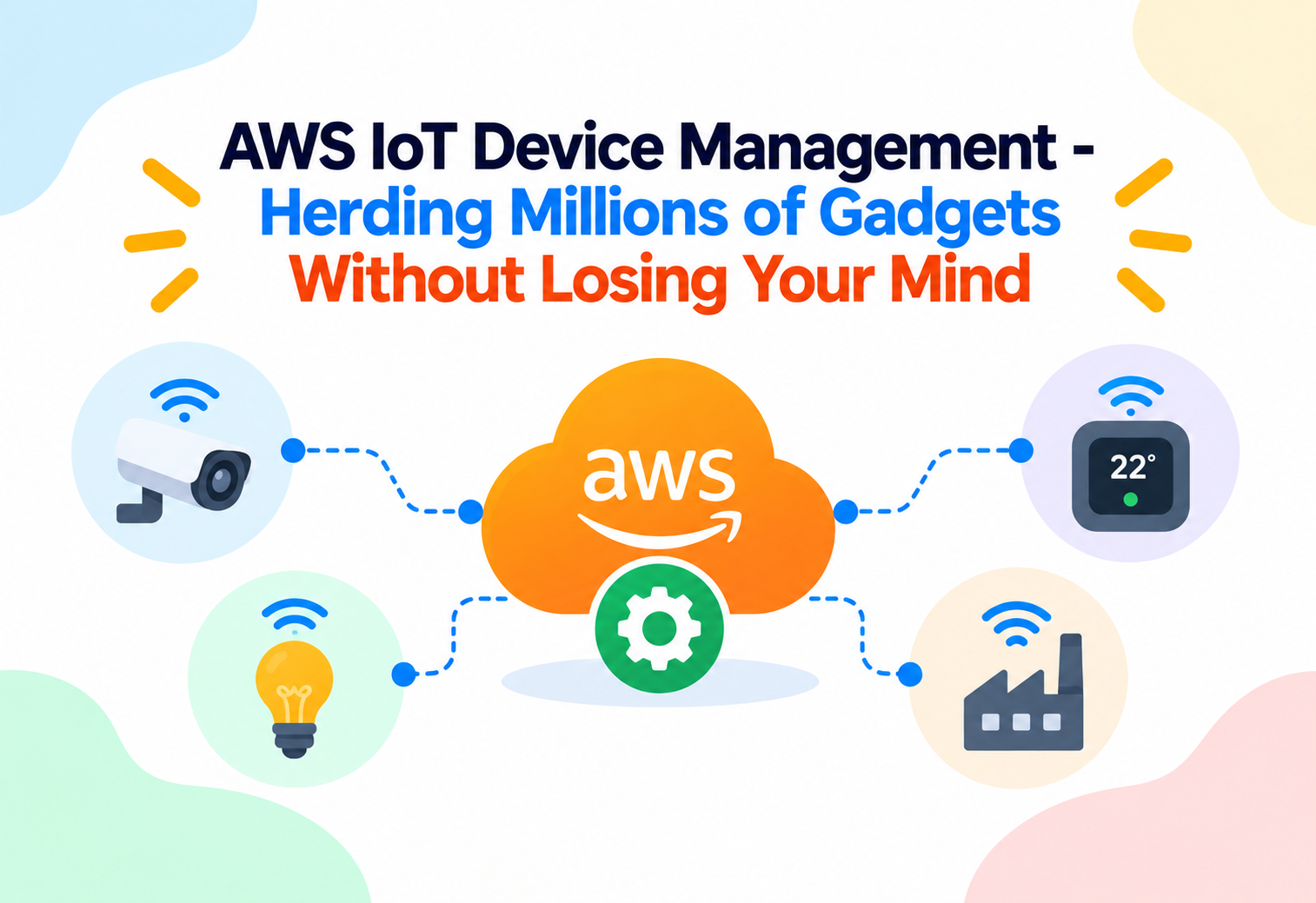
AWS IoT Device Management – Herding Millions of Gadgets Without Losing Your Mind
How companies keep track of, organize, update, and troubleshoot enormous fleets of connected devices scattered across the entire world.
Imagine you’re responsible for a fleet of ten thousand delivery bicycles spread across an entire country. Simply knowing each bicycle exists isn’t enough — you need to know which ones need new tires, which ones haven’t been serviced in months, which region has the most bicycles in use, and how to send a mechanic to fix a specific one hundreds of miles away, all without physically visiting every single bike yourself. Now replace “bicycles” with “internet-connected devices,” and you’ve got the exact challenge that AWS IoT Device Management was built to solve. While a service like AWS IoT Core focuses on letting devices connect and send messages, AWS IoT Device Management focuses on something equally important but very different: organizing, monitoring, updating, and troubleshooting potentially millions of those devices once they’re already out in the real world. This tutorial breaks down, step by step and in everyday language, exactly what AWS IoT Device Management does and why it matters.
1What Is AWS IoT Device Management?
The control center for an entire fleet of connected devices.
AWS IoT Device Management is a set of tools and features that help organizations onboard, organize, monitor, update, and troubleshoot large numbers of connected devices throughout their entire lifecycle — from the moment a device is first set up, all the way through years of daily use, and eventually retirement.
Where AWS IoT Core is mainly about letting devices talk and exchange messages, AWS IoT Device Management is about managing the devices themselves as physical assets: knowing exactly how many exist, where they are, what condition they’re in, and being able to act on large groups of them at once, rather than one at a time.
If AWS IoT Core is the phone network that lets your devices call home, AWS IoT Device Management is the fleet management office that tracks every single phone that was ever handed out, knows exactly who has which model, and can push a software update or shut off a lost phone remotely, all from one dashboard.
2Why Device Fleets Are Genuinely Hard to Manage
The unique headaches of managing hardware you can’t just walk over to.
Physical Distance
Devices might be scattered across an entire country or the whole world, making manual, in-person maintenance impractical.
Sheer Volume
Companies can have millions of individual devices, far too many to track or update using spreadsheets or manual checklists.
Software Needs Updating
Devices need their internal software (called firmware) updated periodically for new features, bug fixes, or security patches.
Troubleshooting From Afar
When something goes wrong with a specific device, someone needs to diagnose the problem remotely rather than physically inspecting it.
AWS IoT Device Management turns “manage every device individually by hand” into “define an action once, and apply it intelligently across thousands or millions of devices at once.”
3Core Concepts and Terminology
The essential vocabulary of fleet-scale device management.
Device Registry
A centralized catalog listing every registered device, along with details like its type, location, and current status.
Thing Group
A named collection of devices grouped together, often by location, model, or purpose, so actions can be applied to the whole group at once.
Fleet Indexing
A searchable index of device information and status, letting you quickly find devices matching specific criteria across an enormous fleet.
Job
A defined task, such as a firmware update or a configuration change, that gets pushed out and tracked across many devices.
Over-the-Air (OTA) Update
A software or firmware update delivered wirelessly to a device, without anyone needing to physically plug into it.
Remote Actions
Commands, like rebooting a device or resetting its settings, that can be triggered remotely without physical access.
A “Thing Group” is like sorting your bicycle fleet into separate racks by neighborhood, so instead of individually calling ten thousand riders, you can send one announcement to “everyone in the downtown rack” at once.
4Organizing Devices With Groups and the Registry
Turning a chaotic pile of devices into a structured, searchable fleet.
The device registry acts as a master list of every device a company has deployed. Beyond simply listing them, AWS IoT Device Management lets you organize devices into groups based on whatever logic makes sense for your business — geographic region, device model, customer account, or firmware version, for example.
Static Groups
Devices are manually or programmatically assigned to a group and stay there until explicitly changed, useful for stable categories like “Warehouse A” or “Model X sensors.”
Dynamic Groups
Group membership is automatically calculated based on defined criteria (like “all devices running an outdated firmware version”), updating in real time as device conditions change.
Dynamic groups are especially powerful for tasks like “find every device that needs a security patch” without manually rebuilding that list every time.
5How an Over-the-Air Update Actually Happens
Pushing new software to thousands of devices without touching any of them physically.
Prepare the Update
A new firmware or software version is prepared and uploaded, ready to be distributed to devices.
Select the Target Group
A specific device group is chosen to receive the update — perhaps a small test group first, before a wider rollout.
Create and Schedule a Job
A job is created describing the update task, and a rollout schedule is defined, such as updating devices gradually rather than all at once.
Devices Download and Apply the Update
Each targeted device downloads the new software and applies it, often reporting back its progress along the way.
Monitor Job Progress
Administrators track how many devices succeeded, failed, or are still in progress, all from a central view.
Handle Failures
Devices that failed to update can be retried, flagged for investigation, or rolled back to a previous known-good version.
flowchart LR
    A[New Firmware Uploaded] --> B[Select Target Device Group]
    B --> C[Create OTA Update Job]
    C --> D[Gradual Rollout to Devices]
    D --> E[Devices Apply Update]
    E --> F[Progress & Status Reporting]
    F --> G{Success?}
    G -->|Yes| H[Device Updated]
    G -->|No| I[Retry or Investigate]
6Fleet Indexing: Finding a Needle in a Haystack of Millions
Quickly answering questions about huge groups of devices.
Without fleet indexing, finding an answer like “how many devices in Texas are running firmware version 2.1 and reporting low battery” across a million devices would be an enormous, slow task. Fleet indexing keeps a constantly updated, searchable index of device details and status, so questions like this can be answered almost instantly.
It’s the difference between searching for a book by flipping through every shelf in a massive library one at a time, versus typing a few words into the library’s digital catalog and getting an instant, precise answer.
7Security in Device Management
Protecting devices even as they’re actively being updated and controlled.
Signed Firmware Updates
Updates are cryptographically signed, so devices can verify an update genuinely came from a trusted source before applying it.
Access Permissions
Fine-grained permissions control which administrators or systems can create jobs, update firmware, or manage specific device groups.
Audit Logging
Actions taken across the fleet are logged, providing a clear record of what changed, when, and by whom.
Secure Tunneling
Remote troubleshooting access to individual devices can be established through secure, temporary connections rather than leaving permanent open access.
Pushing an untested firmware update to an entire fleet all at once, rather than a small test group first, risks widespread device failures if the update contains an unexpected bug.
8Common Use Cases
Where fleet-scale device management proves essential.
Connected Consumer Products
Manufacturers of smart home devices roll out feature updates and security patches to millions of customer devices without requiring anyone to manually update anything.
Industrial Equipment Fleets
Companies operating large numbers of sensors or machines across multiple facilities organize and monitor them by location, model, and health status.
Connected Vehicle Fleets
Fleet operators track vehicle software versions and push updates or diagnostic checks to vehicles scattered across wide geographic areas.
Remote Troubleshooting Support
Support teams can securely and temporarily connect to a specific misbehaving device in the field to diagnose an issue without an on-site technician visit.
9Advantages, Disadvantages, and Trade-offs
An honest look at what fleet-scale management offers, and what it demands.
Advantages
- Manages millions of devices from a single, centralized view.
- Over-the-air updates eliminate the need for costly physical maintenance visits.
- Fleet indexing makes finding specific devices or conditions nearly instant.
- Dynamic groups automatically adjust as device conditions change.
- Secure tunneling enables safe remote troubleshooting without permanent open access.
Disadvantages / Trade-offs
- Requires thoughtful planning of groups, jobs, and rollout strategies to avoid mistakes at scale.
- A poorly tested update can affect an enormous number of devices very quickly if rolled out too broadly.
- Setting up meaningful indexing and search criteria takes some upfront design effort.
10Best Practices and Common Mistakes
Lessons from managing fleets safely and efficiently.
Problem
Rolling out a firmware update to 100% of a device fleet immediately, without a staged or gradual approach.
Why It’s Harmful
If the update has an unexpected problem, it can simultaneously affect the entire fleet before anyone notices the issue.
Correct Approach
Roll updates out gradually, starting with a small test group, and expand only after confirming success.
Problem
Leaving remote troubleshooting connections open indefinitely instead of closing them after the specific task is done.
Why It’s Harmful
An open remote access channel left running longer than necessary increases the risk of unauthorized access to a device.
Correct Approach
Use temporary, time-limited secure tunnels for troubleshooting, and close them immediately once the task is complete.
Use Dynamic Groups for Conditions
Rely on dynamic groups for anything based on changing device state, like outdated firmware or low battery levels.
Monitor Job Health Closely
Watch update job progress in real time so failures can be caught and addressed quickly rather than discovered much later.
Sign and Verify Every Update
Always distribute cryptographically signed firmware so devices can confirm updates are legitimate before installing them.
11Frequently Asked Questions
No. AWS IoT Core focuses on device connectivity and messaging, while AWS IoT Device Management focuses on organizing, updating, and troubleshooting the devices themselves once they’re deployed.
Yes, that’s actually a recommended best practice — target a small test group first, confirm success, then gradually expand the update to the rest of the fleet.
A static group’s membership is set manually and stays fixed until changed, while a dynamic group automatically updates its membership based on conditions you define, like firmware version or status.
It lets you instantly search across an entire fleet for devices matching specific criteria, such as a particular error state, instead of manually checking each device one by one.
Yes, using secure tunneling, support staff can establish a temporary, secure remote connection to a specific device without leaving permanent open access.
12Summary and Key Takeaways
AWS IoT Device Management tackles a problem that only becomes more urgent as the world fills with more and more connected devices: it’s simply not possible to manually track, update, and troubleshoot millions of individual gadgets scattered across the globe. By providing a centralized registry, flexible grouping, powerful fleet-wide search, and reliable over-the-air update tools, it turns an overwhelming logistical challenge into something a small team can genuinely manage from a single dashboard. Where AWS IoT Core gets devices talking, AWS IoT Device Management makes sure that enormous, ever-growing fleet of talkers stays healthy, current, and under control.
Key Takeaways
- AWS IoT Device Management — tools for organizing, monitoring, updating, and troubleshooting large fleets of connected devices.
- Core building blocks — the device registry, Thing Groups, fleet indexing, and jobs.
- Over-the-air updates — allow firmware and software changes to be pushed to devices remotely, without physical access.
- Fleet indexing — makes it possible to instantly search and filter across enormous numbers of devices.
- Security essentials — signed updates, fine-grained permissions, audit logs, and temporary secure tunnels.
- Common uses — smart consumer products, industrial equipment, connected vehicle fleets, and remote support.
- Best practice — roll out updates gradually, starting with a small test group, and always verify update authenticity before deployment.