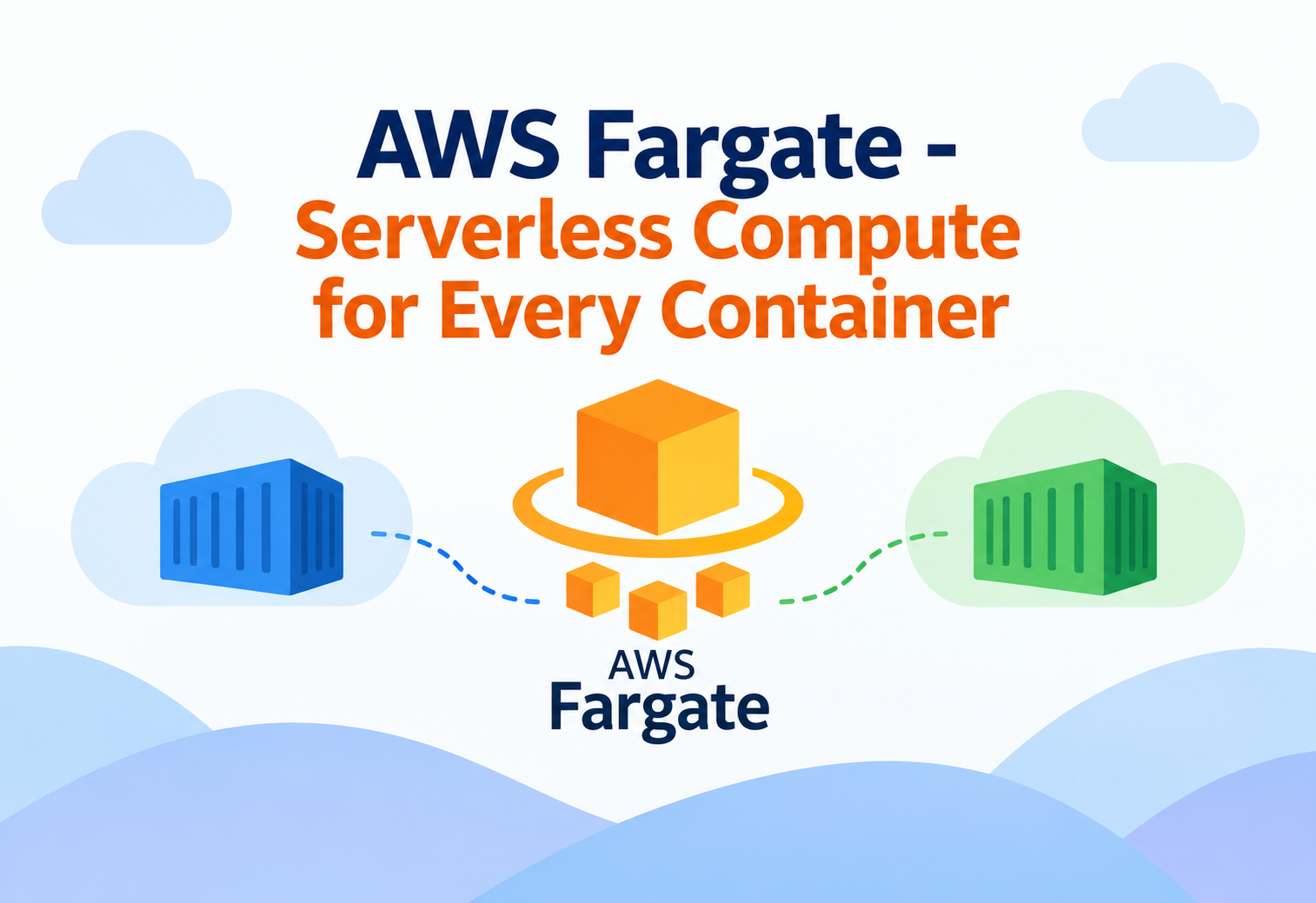
AWS Fargate – Serverless Compute for Every Container
How AWS Fargate actually isolates, provisions, and bills for containers without you ever touching an instance — the microVM boundary, per-task networking, and the trade-offs that decide when Fargate is the right call and when it isn't.
Picture renting a fully furnished, single-occupancy apartment that appears the instant you need it, disappears the instant you’re done, and where you never once think about who built the building, who maintains the boiler, or who’s living in the apartment next door — because there effectively isn’t one. That’s the promise AWS Fargate makes for containers. Most engineers describe it simply as “ECS or EKS without managing EC2 instances,” which is true but undersells what’s actually happening underneath. This tutorial goes past that summary and into how Fargate actually isolates each task, how its resource and pricing model really works, and the patterns that determine when reaching for Fargate is the right call instead of a well-managed EC2 fleet.
1Core Concepts Beyond the Basics
Once you know Fargate “runs containers without instances,” the real understanding starts with what “no instances” actually means at the isolation level.
Fargate is a compute engine for containers, usable through either Amazon ECS or Amazon EKS, that provisions right-sized compute per task rather than per shared instance. Critically, this isn’t containers sharing a hidden pool of EC2 instances behind the scenes in the way you’d expect from a typical multi-tenant service — each Fargate task runs inside its own isolated compute environment, sized precisely to the CPU and memory you specify, and torn down completely when the task stops.
Running containers on self-managed EC2 instances is like renting an entire apartment building and deciding for yourself how many tenants to pack into it. Fargate is like booking single hotel rooms one at a time — you specify exactly the room size you need, it’s cleaned and prepared just for you, and you’re never aware of, or affected by, whoever’s staying in a different room down the hall.
Fargate is a compute engine, not an orchestrator
It’s worth being precise here: Fargate doesn’t decide what to run or how many copies to keep alive — that’s still ECS’s or EKS’s job. Fargate answers a narrower question: given a task ECS or EKS wants to run, where does the actual CPU and memory to run it come from, and who is responsible for the underlying host. Understanding this separation clarifies why almost everything covered in an ECS or EKS tutorial about scheduling and services still applies unchanged when Fargate is the launch type or compute type underneath.
Choosing Fargate doesn’t change your task definitions, services, or Kubernetes manifests in any fundamental way — it changes where those same constructs actually execute, and who’s responsible for patching and securing the layer underneath them.
2Architecture and Core Components
Fargate’s architecture is defined by what it removes from view as much as by what it provides.
Per-Task Isolated Environment
Each task or pod gets its own dedicated kernel and compute boundary, sized to the exact CPU and memory requested — never shared with another customer’s workload.
Dedicated Elastic Network Interface
Every task receives its own ENI with its own private IP address, enabling per-task security groups regardless of orchestrator.
Ephemeral Storage
A configurable amount of temporary disk space attached to each task, wiped completely when the task stops.
Amazon EFS Integration
Tasks can mount Amazon EFS file systems directly, giving Fargate workloads a path to durable, shared storage despite the compute itself being ephemeral.
graph TD
  ECS[ECS Service / EKS Pod Spec] --> FG[Fargate]
  FG --> ISO1[Isolated Task 1 - own microVM]
  FG --> ISO2[Isolated Task 2 - own microVM]
  ISO1 --> ENI1[Dedicated ENI]
  ISO2 --> ENI2[Dedicated ENI]
  ISO1 --> EFS[(Amazon EFS - optional)]
  ISO2 --> EFS
Two front doors: ECS and EKS
Fargate isn’t tied to one orchestrator. Through ECS, a task definition simply specifies Fargate as its launch type. Through EKS, a Fargate profile matches specific Kubernetes namespaces or labels, and matching pods are automatically scheduled onto Fargate instead of onto EC2 worker nodes. The underlying isolation and provisioning model is the same either way; the front-end API differs.
3Internal Working: MicroVM Isolation
The specific mechanism behind Fargate’s “no shared instance” promise is a lightweight virtualization technology built for exactly this purpose.
Fargate tasks run inside Firecracker microVMs — a lightweight virtual machine technology built by AWS that provides the strong security isolation of a full virtual machine (its own kernel, its own virtualized hardware boundary) while starting up and consuming overhead closer to a container. This is what allows Fargate to make a genuinely strong multi-tenant isolation claim rather than relying on container-level namespace isolation alone.
People sometimes assume Fargate tasks are just containers running on a shared EC2 instance somewhere behind the scenes, isolated only by standard container namespaces. In reality, each task gets its own microVM-level boundary — a materially stronger isolation guarantee than container isolation alone provides.
Right-sized provisioning, not bin-packed onto pre-existing hosts
When a Fargate task is launched, AWS provisions compute matched to the specific CPU and memory combination requested — from a defined set of valid combinations — rather than placing it onto a pre-existing, fixed-size instance and hoping it fits. This is fundamentally different from EC2 launch type’s bin-packing problem covered in ECS-focused material; there’s no fragmentation of leftover, unusable instance capacity to manage, because there’s no persistent instance for the customer to reason about at all.
Platform versions
Fargate periodically releases new platform versions bundling underlying runtime updates and behavior changes. Task definitions can pin a specific platform version or float on LATEST; understanding which platform version a task runs affects available features like certain EFS mount options or ephemeral storage size limits, since not every capability is available on every version.
4Data Flow and Lifecycle
Tracing a Fargate task from request to running shows exactly what AWS is doing during the moments a task shows as PENDING.
Orchestrator requests a task
ECS’s scheduler or the EKS Fargate profile controller decides a new task or pod needs to run and requests Fargate capacity for it.
Fargate provisions an isolated environment
A right-sized microVM is provisioned specifically for this task’s requested CPU and memory combination.
Networking is attached
A dedicated elastic network interface is created and attached, giving the task its own private IP address in the specified subnet.
Container images are pulled and started
Using the task execution role’s permissions, container images are pulled and the containers inside the task start up.
Task reaches RUNNING and serves traffic
Once healthy, the task can be registered with a load balancer or otherwise begin doing its actual work.
Task stops and the environment is torn down
On completion or replacement, the task’s containers stop, the ENI is released, and the entire isolated compute environment is discarded completely.
Why this matters for statefulness
Because the entire compute environment is discarded on task stop, anything written only to a task’s ephemeral local storage disappears permanently with it. Workloads needing state to survive a task replacement must explicitly write to a durable store — Amazon EFS, S3, or a database — rather than assuming local disk persists the way it might on a long-lived EC2 instance.
5Advantages, Disadvantages and Trade-offs
Fargate’s removal of instance management is unambiguously convenient — and unambiguously priced accordingly.
Advantages
- Zero instance patching, capacity planning, or bin-packing to manage.
- Strong, microVM-level isolation per task, independent of container-level isolation alone.
- Per-task networking with dedicated security groups, regardless of orchestrator.
- Scales naturally with task count, since there’s no underlying fleet size to pre-provision.
- Works consistently across both ECS and EKS, unifying the operational model between them.
Disadvantages / Trade-offs
- Per-task pricing is typically higher than well-utilized, reserved EC2 capacity at steady, high-volume scale.
- Less control over the underlying host — no custom AMIs, no host-level daemons, no privileged host access.
- Ephemeral storage limits and certain networking configurations available on EC2 aren’t all available on Fargate.
- Cold-start latency for a new task, while fast, is still not instantaneous, which matters for extremely latency-sensitive scaling events.
The trade-off in one sentence
Fargate trades the cost efficiency of tightly bin-packed, self-managed instances for the operational simplicity of never thinking about instances at all — a trade that favors variable, unpredictable, or operationally lean workloads over large, steady-state, cost-optimized fleets.
6Performance and Scalability
Because Fargate removes instance capacity planning, scaling conversations shift almost entirely to task-level concerns.
Valid CPU and memory combinations
Fargate tasks are sized from a defined set of CPU-to-memory ratios rather than arbitrary values — for example, a given vCPU allocation supports a specific range of memory values. Understanding these fixed combinations matters when right-sizing a workload, since requesting a value outside the supported set for a given CPU allocation simply isn’t possible.
Scaling is purely a task-count problem
Because there’s no instance fleet to keep sized correctly, scaling a Fargate-backed service is entirely about adjusting desired task count — through Application Auto Scaling on ECS, or Horizontal Pod Autoscaler combined with a Fargate profile on EKS. There’s no second capacity layer to coordinate, which is precisely the operational complexity Fargate removes compared to EC2 launch type.
Fargate Spot for Scalable, Fault-Tolerant Workloads
Fargate Spot offers the same per-task isolation and provisioning model at a discount, for workloads that can tolerate occasional task interruption — commonly used for batch processing, CI/CD runners, and other workloads where a replaced task simply retries rather than causing user-facing impact.
Account-level and regional quotas
Like most AWS services, Fargate has account-level quotas on concurrent running tasks per region, which can be raised through a service quota increase request — a consideration for very large-scale, bursty workloads that might otherwise unexpectedly hit a default ceiling during a scaling event.
7High Availability and Reliability
Fargate’s reliability story is built on the same orchestrator-level self-healing covered elsewhere, combined with the fact that there’s no shared instance whose failure could take down multiple unrelated tasks at once.
No shared blast radius between tasks
Because each Fargate task runs in its own isolated microVM, a hardware or kernel-level problem affecting one task’s underlying environment has no direct mechanism to affect a different task, even one belonging to the same service — a meaningfully different reliability property than tasks sharing an EC2 instance, where an instance-level issue can simultaneously affect every task placed on it.
Multi-AZ placement remains the application’s responsibility
Fargate itself doesn’t automatically guarantee a service’s tasks spread across Availability Zones — that still depends on the orchestrator’s configuration, such as an ECS service being given subnets in multiple AZs, or an EKS Fargate profile matching pods that a Kubernetes scheduler spreads appropriately. Removing instance management doesn’t remove the need to deliberately design for zone-level redundancy.
Assuming Fargate’s “serverless” nature means high availability is automatic. Multi-AZ resilience still requires configuring the service or deployment with subnets and desired counts that actually achieve that spread — Fargate removes instance-level toil, not architectural responsibility.
Automatic task replacement still applies
The self-healing behavior described for ECS services and Kubernetes deployments works the same way on Fargate as on EC2 launch type — a stopped or failed task triggers the orchestrator to request a replacement, and Fargate provisions a fresh isolated environment for it just as quickly as the original.
8Security
Fargate’s security model layers strong infrastructure-level isolation underneath the same IAM and networking controls used elsewhere in AWS.
MicroVM Isolation
Each task’s compute environment is isolated at the virtual machine level, not just the container level, from every other task on Fargate.
Per-Task Security Groups
Each task’s dedicated ENI can carry its own security group rules, independent of any other task, service, or orchestrator.
Task Roles (ECS) / IRSA (EKS)
Fine-grained IAM permissions scoped per task or per Kubernetes service account, rather than a broad role shared across an entire instance fleet.
No host-level access changes the security conversation
Because there’s no underlying host for a customer to access directly, an entire class of host-level security concerns — patching an OS, hardening a shared kernel used by multiple tenants’ containers, securing SSH access to worker nodes — simply doesn’t apply the way it does with EC2 launch type. Security effort shifts toward container image hardening, IAM scoping, and network configuration instead.
Problem
Assuming Fargate’s strong infrastructure isolation makes container image security less important, and skipping image scanning or using unverified base images as a result.
Why It’s Harmful
MicroVM isolation protects against cross-tenant compute-level attacks, but it does nothing to protect against a vulnerable dependency, malicious package, or overly permissive application-level configuration inside the container itself.
Correct Approach
Continue scanning container images for known vulnerabilities and following least-privilege IAM scoping regardless of launch type — infrastructure isolation and application-level security are separate concerns that both still matter.
9Monitoring, Logging and Metrics
Because there’s no host to install a monitoring agent on, Fargate observability relies entirely on integrations built into the task and orchestrator layer.
awslogs / FireLens
Container stdout and stderr are streamed to CloudWatch Logs (or routed through FireLens to other destinations) since there’s no host filesystem to write log files to directly.
Container Insights
Provides CPU, memory, network, and storage metrics per task without needing an agent installed on any host, since Fargate itself reports these metrics.
CloudWatch Container Insights for EKS Fargate
A Fargate-compatible variant collects pod-level metrics for EKS workloads without requiring a DaemonSet, which wouldn’t work in a Fargate environment anyway.
Trying to install a traditional host-level monitoring agent expecting it to work on Fargate the same way it would on an EC2 instance. Because there’s no accessible host, monitoring tooling has to be container-native or use the Fargate-specific integrations designed for this model.
10Deployment and Cloud Configuration
Deploying to Fargate looks slightly different depending on which orchestrator sits in front of it, but the underlying decisions are similar.
Launch Type or Capacity Provider
A task definition specifies Fargate directly, or a capacity provider strategy mixes Fargate with Fargate Spot or EC2 within one service.
Fargate Profiles
A profile matches pods by namespace and label selectors; matching pods are automatically scheduled onto Fargate rather than EC2 worker nodes.
Platform Version Pinning
Choosing between a pinned platform version and LATEST trades predictability against automatically receiving new capabilities and fixes.
Not every Kubernetes workload fits an EKS Fargate profile
Certain Kubernetes constructs — DaemonSets, privileged containers, and some networking configurations relying on host-level access — aren’t compatible with the Fargate model on EKS, since there’s no accessible host to run them against. Workloads with these requirements need at least some EC2-backed node group alongside Fargate-backed ones.
11Design Patterns and Anti-patterns
A handful of workload shapes consistently play well with Fargate’s per-task, ephemeral compute model.
Pattern: Bursty or Unpredictable Web Services
Services with highly variable traffic benefit from Fargate’s ability to scale task count without any pre-provisioned instance capacity sitting idle during quiet periods.
Pattern: Short-Lived Batch and CI/CD Jobs
One-off or scheduled jobs that spin up, do work, and terminate map naturally onto Fargate’s per-task provisioning and teardown model, often combined with Fargate Spot for cost efficiency.
Pattern: Mixed EC2/Fargate Fleets for Cost Control
Running predictable, steady-state baseline load on EC2 capacity providers while bursting onto Fargate for unpredictable spikes balances cost efficiency against operational simplicity.
Problem
Running a very large, steady-state, high-utilization fleet entirely on standard Fargate without ever evaluating EC2 launch type or Savings Plans for cost comparison.
Why It’s Harmful
At consistently high, predictable scale, Fargate’s per-task convenience pricing can end up meaningfully more expensive than well-utilized, committed EC2 capacity, turning an operational convenience into an avoidable ongoing cost.
Correct Approach
Periodically evaluate steady-state workloads against EC2 launch type with committed-use discounts, reserving standard Fargate for genuinely variable or operationally lean use cases where its convenience clearly outweighs the cost premium.
12Best Practices and Common Mistakes
Most Fargate-specific issues in production come from applying EC2-era assumptions to a model that doesn’t share them.
Advantages
- Write any state that must survive a task restart to EFS, S3, or a database — never to local ephemeral storage alone.
- Use Fargate Spot deliberately for interruption-tolerant workloads to capture meaningful cost savings.
- Pin platform versions for production predictability, testing new versions deliberately before adopting LATEST broadly.
- Re-evaluate steady-state, high-volume workloads periodically against EC2 launch type for cost efficiency.
Disadvantages / Trade-offs
- Assuming Fargate automatically provides multi-AZ resilience without configuring the service or deployment accordingly.
- Trying to run DaemonSets or privileged workloads on EKS Fargate profiles, which they don’t support.
- Skipping container image scanning under the mistaken belief that microVM isolation covers application-level security too.
- Not accounting for ephemeral storage limits when a workload briefly needs more local scratch space than expected.
When a workload’s cost on standard Fargate feels high, checking whether Fargate Spot fits its interruption tolerance is often a faster win than re-architecting onto EC2 launch type entirely.
13Real-world and Industry Examples
Fargate tends to show up wherever a team has explicitly decided instance management isn’t work they want to keep doing.
Startups and Small Platform Teams
Teams without dedicated infrastructure engineers frequently standardize on Fargate specifically to avoid the ongoing operational load of patching and right-sizing an EC2 fleet.
Multi-Tenant SaaS Isolation Requirements
SaaS platforms with strict customer isolation requirements sometimes choose Fargate specifically for its microVM-level boundary between tenant workloads, beyond what container-level isolation alone would provide.
CI/CD and Batch Processing Pipelines
Build systems and data processing pipelines commonly run individual jobs as short-lived Fargate tasks, often on Fargate Spot, avoiding the cost of an idle, always-on build fleet.
14Frequently Asked Questions
Yes — each task runs in its own Firecracker microVM, a virtual-machine-level boundary, rather than relying solely on container namespace isolation shared on a common host.
Both — Fargate works with ECS through the Fargate launch type, and with EKS through Fargate profiles that match specific pods by namespace and label.
Not if it was only written to the task’s ephemeral local storage — that’s discarded entirely with the task. Anything that needs to survive should be written to Amazon EFS, S3, or a database instead.
Not always, but at high, steady-state utilization, well-managed EC2 capacity with committed-use discounts is often cheaper than standard Fargate’s per-task pricing. Fargate tends to win on variable or operationally lean workloads instead.
No — DaemonSets and certain other host-dependent Kubernetes constructs aren’t supported on Fargate profiles, since there’s no accessible host for them to run against; those workloads need EC2-backed node groups instead.
Both provide the same per-task isolation and provisioning model; Fargate Spot uses spare capacity at a discount but can interrupt a task with notice, making it suitable for fault-tolerant, interruption-tolerant workloads rather than latency-critical, always-on services.
15Summary and Key Takeaways
AWS Fargate’s real contribution is removing an entire layer of infrastructure reasoning — instance sizing, patching, bin-packing — by provisioning strongly isolated, right-sized compute per task instead of per shared host. That isolation comes from Firecracker microVMs, not container namespaces alone, and it applies consistently whether the front door is ECS or EKS. The trade-off is real: convenience and strong isolation come at a per-task price premium compared to well-managed EC2 capacity at steady, high-volume scale. Teams that understand ephemeral storage’s limits, design multi-AZ resilience deliberately rather than assuming it’s automatic, and periodically compare Fargate’s cost against EC2 launch type tend to get the most out of it without being surprised by its edges.
Key Takeaways
- Fargate is a compute engine, not an orchestrator — ECS and EKS still decide what runs; Fargate decides where the compute for it comes from.
- Isolation happens at the microVM level via Firecracker, a stronger boundary than container namespace isolation alone.
- Every task gets its own dedicated ENI, enabling per-task security groups regardless of orchestrator.
- Ephemeral storage is genuinely ephemeral — durable state needs EFS, S3, or a database, never local disk alone.
- Multi-AZ resilience is still a configuration responsibility, not something Fargate provides automatically just by being “serverless.”
- Fargate Spot extends the same model at a discount for workloads that can tolerate task interruption.
- Cost efficiency favors variable workloads — steady-state, high-utilization fleets are worth periodically comparing against EC2 launch type.