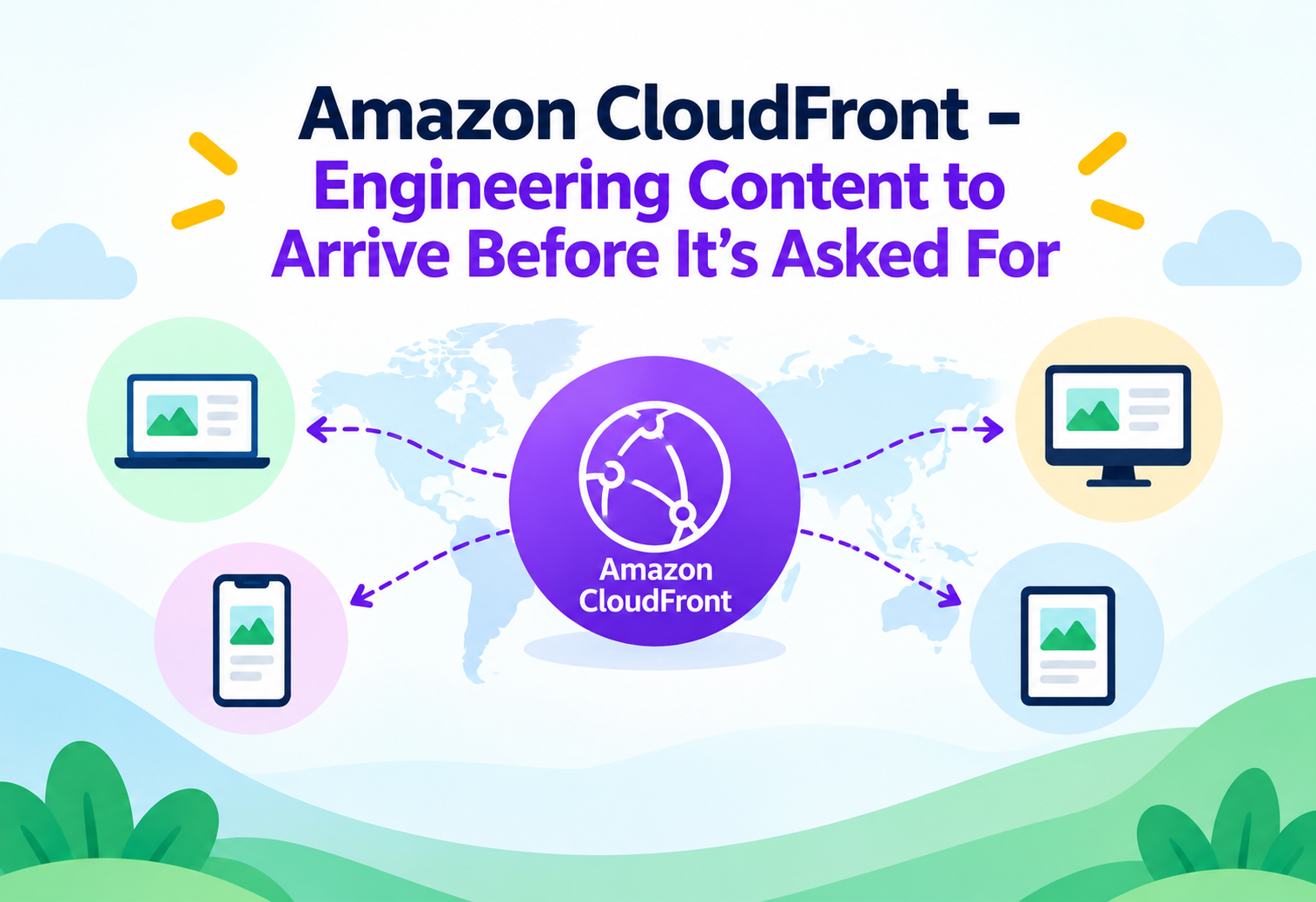
Amazon CloudFront – Engineering Content to Arrive Before It's Asked For
A deep dive into how Amazon CloudFront's global edge network, cache logic, and origin protection work together to shave hundreds of milliseconds off every request — and what happens internally when a cache actually "hits."
Picture a chain of neighborhood libraries scattered across every city in the world, each one quietly keeping a copy of the books people in that city read most. Nobody has to travel across an ocean to borrow a popular title — the local branch already has it. Amazon CloudFront works on exactly that principle for web content: instead of every request crossing the planet to a single origin server, hundreds of edge locations keep warm copies close to the people asking for them. This tutorial goes past “it’s a CDN” and into how that copy gets there, how it decides what to serve, and how it protects the origin behind it.
1Architecture and Core Components
CloudFront is not a single server — it is a coordinated set of components spanning global edge locations, regional caches, and configuration objects that decide exactly how a request is handled.
The core building blocks
A CloudFront deployment centers on a distribution, which is the configuration object tying together an origin, cache behaviors, and the domain name clients actually connect to. Requests land at edge locations — physical points of presence distributed worldwide — and, for content not already cached at the edge, may pass through a smaller set of regional edge caches before finally reaching the configured origin, which can be an S3 bucket, an Application Load Balancer, or any custom HTTP server.
Distribution
The top-level configuration object defining origins, behaviors, certificates, and the domain clients use.
Edge Location
A physical point of presence closest to end users where cached responses are actually served from.
Regional Edge Cache
A larger, less numerous caching tier between edge locations and the origin that absorbs less-popular content.
Origin
The authoritative source of content — S3, a load balancer, or a custom server — that CloudFront fetches from on a cache miss.
Think of regional edge caches as regional warehouses sitting between a small local shop (the edge location) and the factory (the origin). If the shop runs out of stock, it checks the regional warehouse first — which usually has it — rather than immediately calling the factory across the country.
Cache behaviors
Within a single distribution, cache behaviors let different URL path patterns be treated completely differently. A path like /images/* might cache aggressively for a day, while /api/* might forward every request straight to the origin with no caching at all. Each behavior independently controls caching duration, which headers and cookies get forwarded, and which origin serves that path.
graph LR
    User[End User] --> Edge[Edge Location]
    Edge -->|Cache Hit| User
    Edge -->|Cache Miss| REC[Regional Edge Cache]
    REC -->|Cache Hit| Edge
    REC -->|Cache Miss| Origin[(Origin: S3 / ALB / Custom)]
    Origin --> REC
2Internal Working: How a Request Is Resolved
Every request CloudFront receives goes through a consistent decision sequence, whether it ends up being served from cache in a few milliseconds or fetched fresh from the origin.
DNS routing to the nearest edge
When a client resolves a CloudFront domain, DNS-based routing directs it to a nearby edge location based on network conditions and geographic proximity, not a fixed, hardcoded server. This is why the same CloudFront distribution can respond from a different physical location depending on where in the world the request originates.
Cache key evaluation
Once a request lands at an edge location, CloudFront computes a cache key — essentially a fingerprint of the request built from the URL path plus whichever headers, query strings, and cookies the matching cache behavior is configured to include. Two requests with identical cache keys are treated as asking for the same object; requests differing only in a header that isn’t part of the cache key are still treated as identical, which is a frequent source of confusing cache behavior when misconfigured.
Request arrives at edge
DNS resolution has already routed the client to a nearby edge location.
Cache key computed
The matching cache behavior determines which parts of the request form the cache key.
Local cache lookup
The edge checks whether an unexpired object matching that cache key already exists locally.
Escalation on miss
On a miss, the request escalates to a regional edge cache, and if needed, onward to the origin.
Response cached and returned
The fetched response is stored at the layers it passed through, respecting its TTL, then returned to the client.
Adding a header to a request does not automatically make CloudFront treat it as unique. Unless that header is explicitly included in the cache behavior’s cache key configuration, CloudFront ignores it when deciding whether two requests match.
Origin request policies
Separately from what defines the cache key, an origin request policy controls what CloudFront actually forwards to the origin on a cache miss — which can include additional headers the origin needs for logging or personalization, even if those headers were deliberately excluded from the cache key to preserve a high cache hit rate.
3Data Flow and Content Lifecycle
Content cached at the edge does not stay there forever — its lifecycle is governed by TTLs, explicit invalidations, and origin-driven freshness signals.
Time-to-live and freshness
Every cached object carries a time-to-live, sourced either from origin-supplied cache-control headers or from default and maximum TTL settings on the cache behavior. Once a cached object’s TTL expires, the next request for it triggers a fresh fetch from the origin, even if the underlying content hasn’t actually changed — which is why choosing sensible TTLs, not just maximizing them, matters for balancing freshness against origin load.
Invalidation versus versioning
When content must be updated before its TTL naturally expires, teams have two options: issuing an invalidation request that forcibly purges specific paths from edge caches, or shifting to versioned file names so that new content simply lives at a new URL and old cached URLs are left to expire naturally. Versioning is generally cheaper and faster at scale, since invalidations across many paths can take longer to fully propagate worldwide.
Invalidation
- Works without changing URLs referenced elsewhere
- Useful for urgent corrections to already-published content
- Takes time to propagate across all edge locations globally
Versioned URLs
- New content is immediately correct with no propagation delay
- Old cached copies harmlessly expire on their own schedule
- Requires updating references to the new file name everywhere
sequenceDiagram
    participant Client
    participant Edge
    participant Origin

    Client->>Edge: GET /logo-v2.png
    Edge->>Edge: Check cache (miss - new key)
    Edge->>Origin: Fetch /logo-v2.png
    Origin-->>Edge: 200 OK + Cache-Control
    Edge-->>Client: 200 OK (cached going forward)
    Note over Edge: Old /logo-v1.png entry expires naturally via its own TTL
4Performance and Scalability
CloudFront’s performance advantage comes from reducing both network distance and origin load simultaneously — two separate problems solved by the same caching layer.

Origin shielding under load
A dedicated caching layer called an origin shield can be placed in front of the origin, consolidating requests from many regional edge caches into a single point before they reach the origin. Under a traffic spike, this collapses what could have been dozens of simultaneous origin requests for the same object into effectively one, protecting the origin from being overwhelmed the moment content suddenly goes popular.
Compression and protocol efficiency
CloudFront can automatically compress eligible content before delivering it, reducing payload size over the network, and it supports modern transport protocols that reduce connection setup overhead compared to older HTTP versions — both of which matter more as round-trip distance to the client shrinks, since fixed protocol overhead becomes a larger fraction of total request time.
A high cache hit ratio is usually a better scalability signal to watch than raw request count, because it directly reflects how much load is being absorbed at the edge instead of reaching the origin.
5High Availability and Reliability
Because CloudFront’s edge network spans many independent locations, availability considerations focus on origin resilience and graceful degradation rather than a single point of failure.
Multiple origins and failover
A distribution can be configured with a primary and a secondary origin, so that if the primary origin returns an error or becomes unreachable, CloudFront automatically retries the request against the secondary origin, without the end user ever seeing the underlying failure.
Serving stale content during origin outages
CloudFront can be configured to continue serving a previously cached, technically expired object if the origin is unreachable when a refresh is attempted, rather than surfacing an error to the end user. This trades strict freshness for continuity during an origin incident — a deliberate and often valuable trade-off for read-heavy, non-critical content.
Custom error responses
Distributions can map specific origin error codes to custom, friendlier responses — such as serving a cached maintenance page when the origin returns a server error — improving the experience during a partial outage instead of showing a raw error to visitors.
6Security
Sitting in front of every request to an origin, CloudFront is a natural place to enforce transport security, access restrictions, and application-layer protection before traffic ever reaches backend infrastructure.
TLS Everywhere
Managed or custom certificates encrypt traffic between clients and edge locations, and between edge locations and the origin.
Signed URLs & Cookies
Time-limited, cryptographically signed access lets private content be served through CloudFront without exposing it publicly.
Origin Access Control
Restricts an S3 origin so it only accepts requests coming through CloudFront, preventing direct bucket access that bypasses caching and controls.
Web Application Firewall Integration
A firewall can be attached to inspect and block malicious requests — such as SQL injection attempts — before they ever reach the origin.
Leaving an S3 origin bucket publicly accessible “just in case” defeats origin access control entirely, since attackers can then bypass CloudFront’s caching, rate protection, and firewall rules by hitting the bucket directly.
7Monitoring, Logging and Metrics
Understanding whether a distribution is actually helping performance requires looking past total request volume and into cache effectiveness and error behavior.
Standard and real-time metrics
Cache Hit Rate
The proportion of requests served directly from cache — the single clearest indicator of how well caching is tuned.
Origin Latency
How long the origin itself takes to respond on cache misses, isolating origin performance from edge performance.
4xx / 5xx Error Rate
Spikes often point to misconfigured cache behaviors, broken origin paths, or an origin under distress.
Total Bytes Transferred
Tracks data transfer volume, directly relevant to both cost and detecting unusual traffic patterns.
Access logs
Detailed access logs record individual requests, including which edge location served them and whether the result was a hit or a miss, making it possible to trace exactly why a particular request behaved unexpectedly rather than only seeing aggregate trends.
8Deployment and Cloud Integration
CloudFront distributions are typically defined as part of an application’s broader infrastructure rather than configured as a standalone afterthought.
Infrastructure as code
Distributions, cache behaviors, origin configurations, and security policies can all be declared through infrastructure-as-code tooling, keeping caching rules version-controlled and reviewable alongside application code changes rather than adjusted ad hoc through a console.
Integration with static hosting and serverless origins
A very common pattern pairs CloudFront with an S3 bucket for static assets and a serverless or load-balanced origin for dynamic API paths, using separate cache behaviors within the same distribution so static and dynamic content each get appropriate caching rules under one unified domain.
Edge compute at the CDN layer
Lightweight functions can run directly at edge locations to modify requests or responses in flight — for example, rewriting a URL path, adding a security header, or performing simple redirects — without needing a round trip to the origin at all.
9Design Patterns and Anti-Patterns
Most CloudFront problems in production trace back to cache key or TTL decisions made early and never revisited as traffic patterns evolved.
Problem
Forwarding all cookies and all query strings into the cache key by default across an entire distribution, “just to be safe.”
Why It’s Harmful
Every unique combination of forwarded values creates a separate cache entry. Forwarding unnecessary cookies or query strings fragments what should be one cacheable object into thousands of near-identical variants, collapsing the cache hit rate.
Correct Approach
Include only the specific headers, cookies, and query strings that genuinely change the response for a given cache behavior, and forward the rest to the origin only, outside the cache key, when the origin needs them but caching doesn’t.
Problem
Relying on frequent, broad invalidations as the normal way of publishing new content, rather than versioned file names.
Why It’s Harmful
Invalidations are meant for corrections, not routine publishing, and broad or frequent invalidations reduce the effective cache hit rate globally while content re-populates across every edge location.
Correct Approach
Adopt content-hashed or versioned file names for routine deployments, reserving invalidation for genuine emergencies where a live, incorrectly cached asset must be removed immediately.
Pattern: layered caching for mixed content types
Using separate cache behaviors for static assets, API responses, and personalized content within one distribution lets each type receive TTLs and cache-key rules suited to its own freshness requirements, instead of forcing one blanket policy onto fundamentally different content.
10Advantages, Disadvantages and Trade-offs
CloudFront’s value depends heavily on how cacheable a workload actually is — understanding where it shines and where it adds limited benefit avoids misplaced expectations.
Advantages
- Dramatically reduces latency for geographically distributed audiences
- Shields origins from traffic spikes through caching and origin shielding
- Centralizes TLS, access control, and firewall enforcement at the edge
- Flexible per-path cache behaviors support mixed static and dynamic content
Disadvantages / Trade-offs
- Limited benefit for highly personalized, rarely-cacheable responses
- Cache invalidation and propagation introduce operational complexity
- Debugging requires understanding cache-key and TTL interactions, which is non-trivial
- Misconfigured cache keys can silently serve one user’s response to another
11Real-World and Industry Examples
The same caching principles show up across very different industries, each stressing a different aspect of CloudFront’s design.
Media streaming: video segment delivery
Streaming platforms rely on caching short video segments at the edge so that popular content is served from nearby locations, keeping playback smooth even during simultaneous demand spikes for a major release.
E-commerce: product catalog and static assets
Product images, stylesheets, and scripts are cached aggressively at the edge, while checkout and cart APIs bypass caching entirely through a separate cache behavior on the same distribution.
Software distribution: large file downloads
Software installers and updates benefit from edge caching to avoid every download request hammering a single origin server simultaneously after a new release ships.
News and publishing: traffic spikes on breaking stories
A sudden surge of readers hitting one article is exactly the scenario origin shielding and edge caching are built for, collapsing a potential origin overload into a small number of backend requests.
12Best Practices and Common Mistakes
A handful of recurring configuration habits separate distributions that quietly perform well from ones that generate confusing support tickets.

Set explicit, deliberate TTLs
Relying entirely on origin-supplied cache-control headers without reviewing them means caching behavior is dictated by whatever the origin happens to send, which may not match actual content update frequency.
Separate cache behaviors by content volatility
Grouping highly dynamic and mostly-static content under one cache behavior forces a single compromise TTL that serves neither well; splitting them by path lets each get appropriate treatment.
Forgetting to restrict the origin to only accept traffic from CloudFront, which leaves a direct, uncached, unprotected path into the origin sitting right alongside the properly configured one.
Monitor cache hit rate as a first-class metric
Treating cache hit rate as a routine dashboard metric, not an afterthought, surfaces regressions quickly — such as a deployment accidentally adding a cache-busting header to every response.
Review cache behaviors whenever origin architecture changes, since a new API path or a restructured static asset layout often needs its own explicit caching rule rather than inheriting a default meant for something else.
13Frequently Asked Questions
It can, but usually shouldn’t by default — personalized responses vary per user, so caching them without a carefully scoped cache key risks serving one user’s private response to another. Most teams route personalized paths through a cache behavior with caching disabled or minimized.
Edge locations are numerous and closest to end users but individually hold less content; regional edge caches are fewer, larger, and sit between edge locations and the origin, absorbing content that isn’t popular enough to stay cached at every edge location.
Not instantly — invalidations propagate across the global edge network and typically complete within a short window, but they are not synchronous, so a brief period where some locations still serve the old version is possible.
Yes, if configured to serve stale cached content during origin failures, previously cached objects can continue being served past their normal expiration until the origin recovers.
No, it’s optional but commonly attached for public-facing distributions, since it adds request inspection and blocking rules at the edge before traffic reaches the origin.
14Summary and Key Takeaways
Amazon CloudFront’s real engineering value isn’t simply “content close to users” — it’s the layered decision-making around cache keys, TTLs, origin shielding, and failover that determines whether that proximity actually translates into fewer origin requests and faster responses. Getting it right means treating cache-key configuration as deliberately as any other API contract, choosing versioned URLs over routine invalidations, separating cache behaviors by how volatile each type of content actually is, and closing off any path that lets traffic reach the origin while bypassing CloudFront’s protections entirely.
Key Takeaways
- The cache key defines identity — only headers, cookies, and query strings explicitly included in it make two requests “different.”
- Origin shielding protects against spikes — consolidating many edge misses into one origin request prevents overload during sudden popularity.
- Versioned URLs beat routine invalidation — invalidation is for emergencies, not everyday publishing.
- Multiple origins enable failover — a secondary origin keeps a distribution serving traffic through primary origin outages.
- Security is enforced at the edge — TLS, signed URLs, origin access control, and firewall integration all sit in front of the origin.
- Cache hit rate is the health signal to watch — it reflects tuning quality better than raw traffic volume alone.
- Separate behaviors for separate volatility — static, dynamic, and personalized content each deserve their own caching rules.